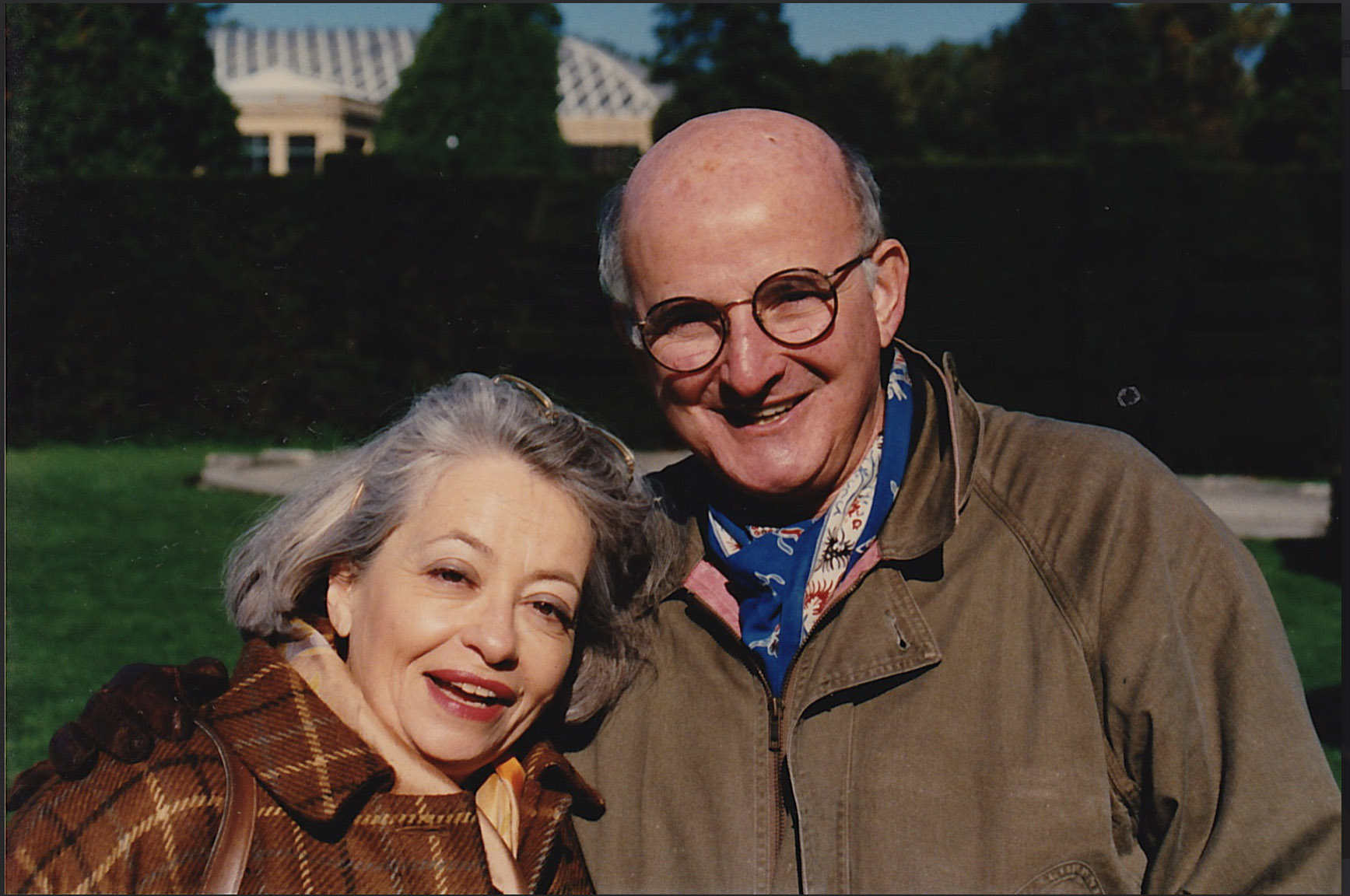
Judith (Judy) Noselson 14 April 1933 – 27 June 2003
Kalman (Kal) Noselson 30 July 1929 – 23 September 2014
Photographed in Bath in 1998.
Memories of Judy and Kal Noselson (z"l)
It is not often that one has the good fortune to meet people who are highly cultured, humanists in the best sense of the word, philanthropists and supporters of liberal causes, with a particular emphasis on schools and early education.
They travelled the world as interested and compassionate observers of local cultures. As art collectors their tastes ranged widely: a life-size New Guinean boar in the entrance hall, a Calder mobile on the coffee table, an Orozco mask over the fireplace, Kachina dolls in the library. One of their many endearing qualities was that they did not collect only “high art”. There were shelves of snow globes from many countries. Kal collected the miniature typewriters carried by 1920s typewriter salesmen and tiny cardboard hat boxes. He also assembled a large collection of 19th-century English bargeware pottery and of 19th- and early 20th-century theatre and travel posters, all beautifully framed and filling whatever wall space was left.
They were film lovers, theatre enthusiasts, politically engaged and supporters of many of New York’s museums. Judy, a voracious reader, served for many years as full-time head librarian at a local school for a salary of one dollar a year. She was also a wonderful cook, and together they were known for their hospitality and their involvement in worthy causes. Their intellectual curiosity is perhaps best shown by Kal’s decision, at the age of 60, to return to study and take a degree in the history of the decorative arts at the Cooper-Hewitt Museum. His interest in the decorative arts also showed in his collection of jewellery, ranging from the Bronze Age to Art Deco and always made up of unusually well-chosen examples.
The same discerning eye is evident in his major collection of Byzantine rings, seals and amulets. This interest began in the early 1980s, when very few collectors looked at ancient jewellery beyond Egyptian or Greek. He recognised that the field was understudied but fascinating, and began a serious programme of reading to understand his acquisitions in depth. He would choose an important image on a ‘plain’ bronze ring over a more common type in silver or gold, though there are plenty of those too. What fascinated him were the small intaglios, the seals and amulets in often humble materials, the syncretism, and the roots of Judaism and Christianity as expressed in these very personal objects and the beliefs behind them.
I like to think that this collection reflects both his connoisseurship and their shared humanity. May their memory be a blessing.
Derek Content