Home > Stories by TimeLine Auctions
Stories by TimeLine Auctions
20 Great Private Antiquities Collections, and What Became of Them
When Sir William Hamilton sold his Greek vases to the British Museum in 1772, for eight thousand guineas, he turned a library with a natural-history cabinet attached into a museum of classical art. The Townley marbles, the Egyptian sculpture and the Parthenon frieze all arrived later, through the door his pots had opened. For three centuries the natural end of a private collection of antiquities was to become a public one.
The collections below are proof that the pattern continues, and that it has more than one ending. A private collection is the most personal kind of museum and the least permanent. It can become a museum with the collector's name over the door, go on long-term loan while the family keeps title, survive only as a scholarly catalogue, or dissolve in a single afternoon at auction, the name surviving as a line of provenance. Every one of them raises the same two questions: what is in it, and what became of it.
What follows is twenty, assembled in living memory or just outside it, across Cypriot pottery, Greek gold, Roman marble, Egyptian faience, Near Eastern seals, ancient glass and ancient coins. Ranking collections this different against one another would be a parlour game; they run, loosely, from the largest holdings of sculpture down to cabinets that fit in a drawer.
1. The Torlonia Collection, Rome
The largest private holding of ancient sculpture in Europe spent most of a century behind a locked door. Across the late eighteenth and nineteenth centuries the Torlonia family, Roman bankers, bought older collections whole: the Cavaceppi studio, 269 Giustiniani statues, the marbles of the Villa Albani that Cardinal Albani and Winckelmann had gathered, and they dug their own estates besides, the Villa of the Quintilii, Portus, Vulci. The result was 620 catalogued marbles, among them roughly 180 Roman portrait busts. The set pieces are the Torlonia Vase, the marble krater that gives the family vessel its name; a relief of the harbour at Portus alive with ships and a lighthouse; the seated Giustiniani Hestia; a bronze Germanicus from Fara Sabina.
After the family's museum on the Via della Lungara closed following the Second World War, almost none of it was seen for decades. An accord with the Italian state in 2016 freed ninety-two restored works to tour as "The Torlonia Marbles," from Rome in 2020 onward to the Louvre and across North America. The collection itself stays private.
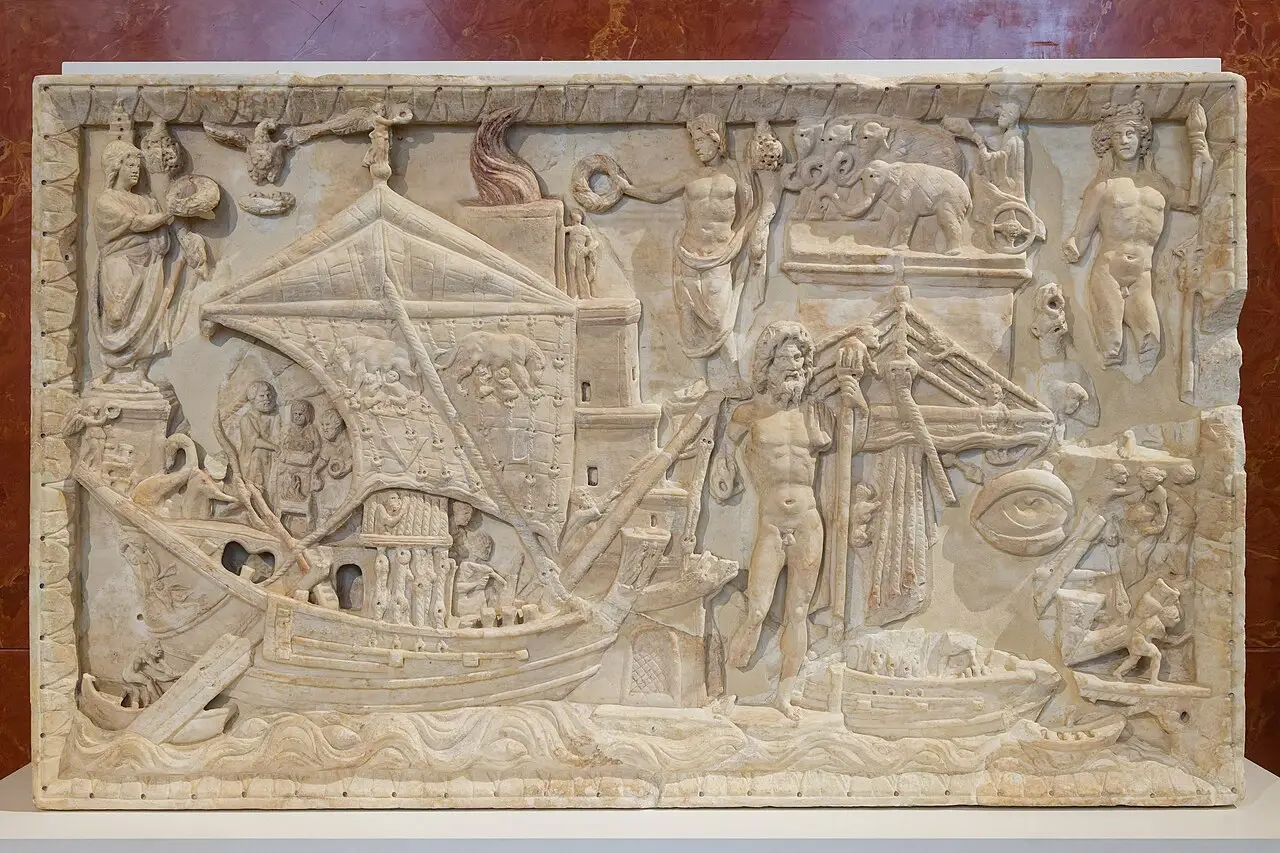 The Torlonia relief of the harbour at Portus, Roman, late second or early third century AD, with merchant ships, the Pharos and an elephant quadriga crowning the arch. Torlonia Collection, Rome, inv. MT 430. Public domain, via Wikimedia Commons.
2. The Goulandris Collection and the Museum of Cycladic Art, Athens
In the early 1960s the shipowner Nicholas Goulandris and his wife Dolly began buying Early Cycladic marble: the spare folded-arm figurines of the third millennium BC and the shallow "frying-pan" vessels whose use no one has settled. They built more than three thousand pieces. Dolly gave the whole collection to a foundation, and in 1986 it opened as the Museum of Cycladic Art, purpose-built in central Athens. Those figurines are now the picture most people carry of Cycladic art, which is the collection's own complication: as David Gill and Christopher Chippindale estimated, about eighty-five per cent of such figures come from no recorded excavation, a problem the museum's scholars discuss rather than hide.
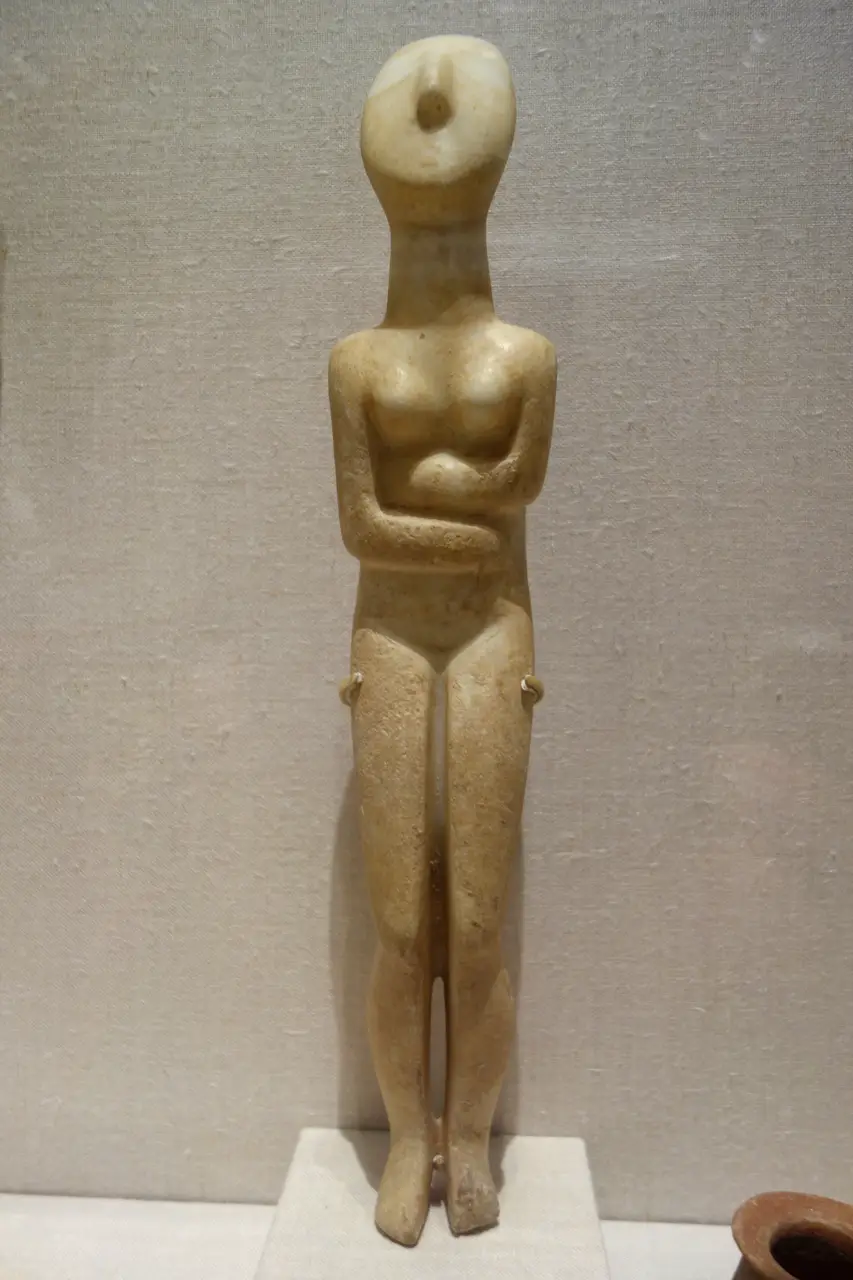 A marble figure of the folded-arm type, Early Cycladic, about 2700 BC. The Metropolitan Museum of Art. Photo: Zde, CC BY-SA 4.0, via Wikimedia Commons.
3. The Pierides Collection, Larnaca
The oldest private collection of Cypriot antiquities still kept whole began as an act of refusal. Demetrios Pierides, a Larnaca banker, started buying in the middle of the nineteenth century precisely to keep the island's antiquities on the island, while the American consul Luigi Palma di Cesnola and others shipped them out by the crate to New York. Five generations of his family held the collection together in their 1825 town house. It now runs to around 2,500 objects, the oldest from the fourth millennium BC: Red Polished ware, Roman and later glass, Byzantine ceramics, and a set of antique maps of Cyprus. It is open as the Pierides Museum, under the Bank of Cyprus Cultural Foundation.
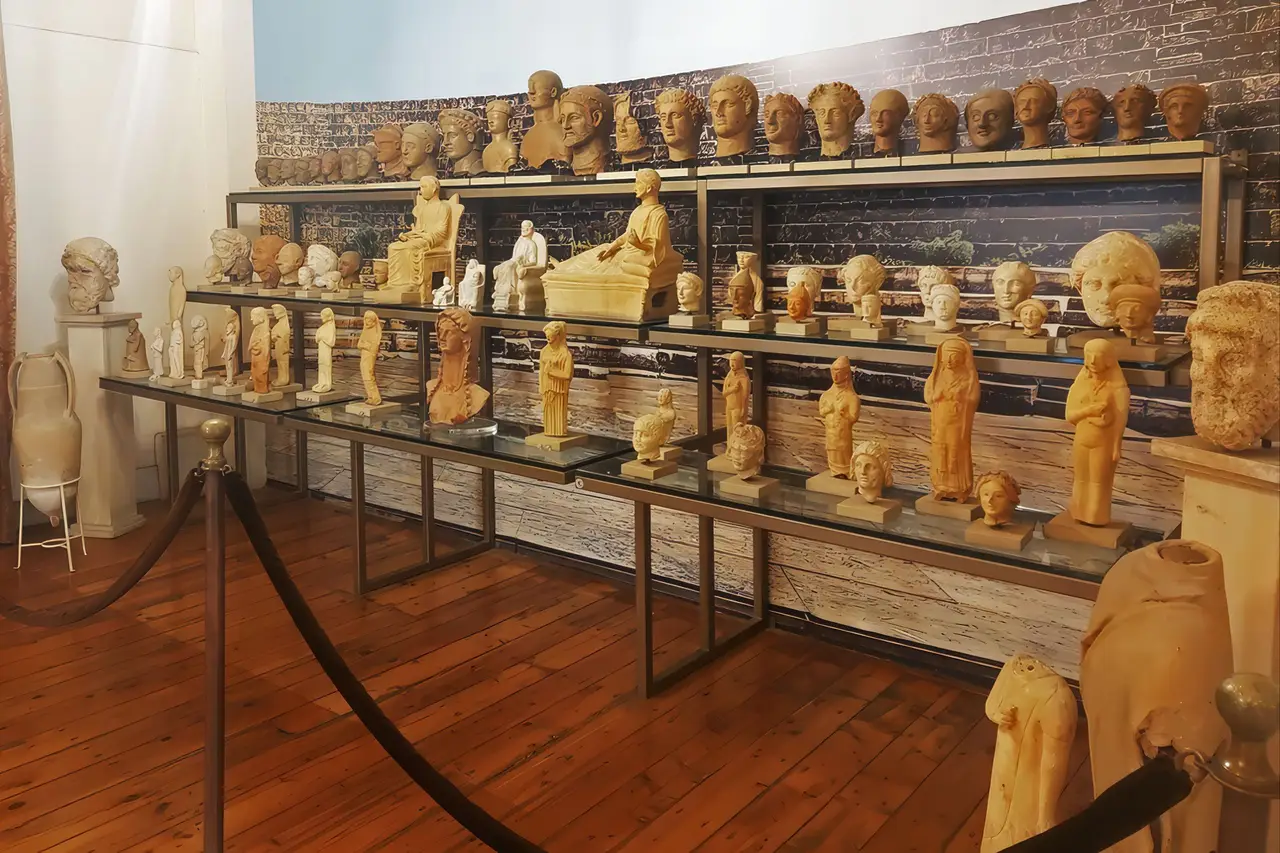 Cypriot terracotta heads and figurines on display in the Pierides Museum, Larnaca, the oldest private collection of Cypriot antiquities kept whole.
4. The Stathatos Collection, Athens
Eleni Stathatos, born into the Greek community of Alexandria, spent the first half of the twentieth century assembling ancient gold. The centrepiece is the Karpenisi treasure of Thessaly, late fourth to early second century BC, bought from an Athens dealer in 1929: three gold hairnets with repoussé medallion busts of Aphrodite and Artemis, a diadem with a glass-inlaid Heracles knot, an enamelled gold strap worked with flowers, insects and birds. She gave the archaeological collection to the National Archaeological Museum in Athens in 1957, where the Stathatos Room holds 971 pieces from the fifth millennium BC to late Byzantium; other parts went to the Benaki. The four-volume catalogue Pierre Amandry edited for her remains the reference.
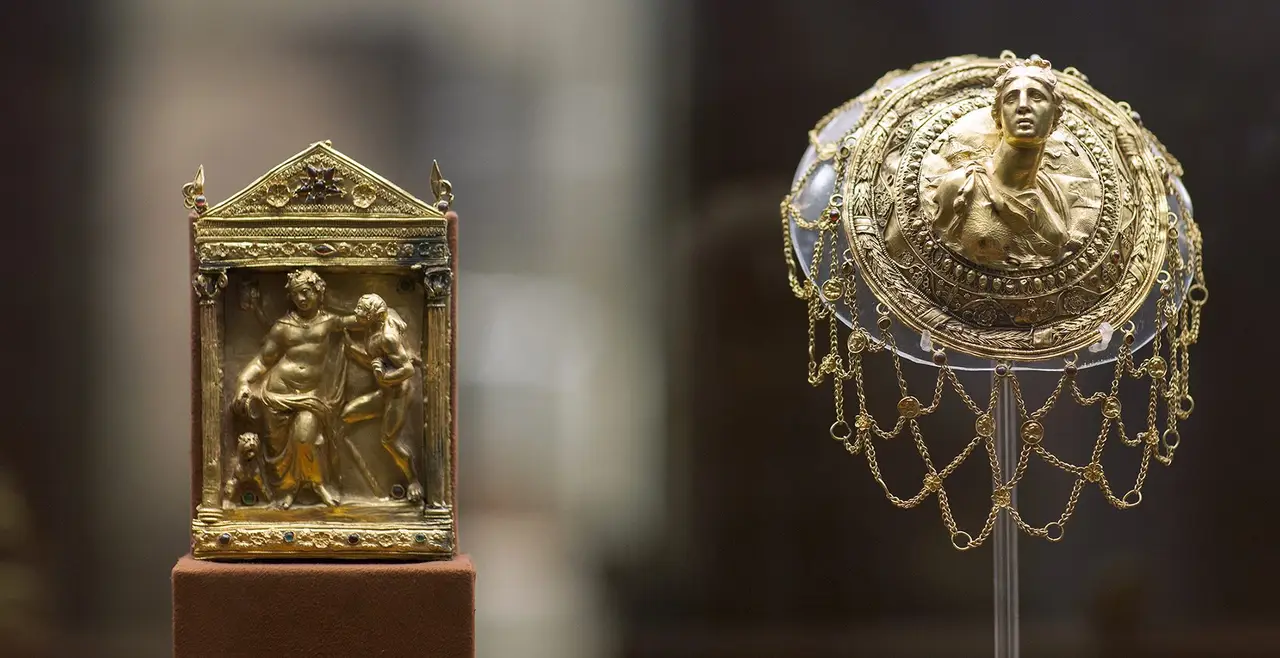 A gold hairnet, its mesh of chains hung from a repoussé medallion bust, beside a gold naiskos pendant, from the Karpenisi treasure assembled by Eleni Stathatos, Greek, late fourth to early second century BC. National Archaeological Museum, Athens.
5. The Desmond Morris Collection of Cypriot Antiquities
In the autumn of 1967 the zoologist Desmond Morris walked into the Cyprus Museum in Nicosia and came out a collector. He was already famous for the wrong subject; The Naked Ape, his book on human behaviour, had sold in the millions. Over the next decade he assembled more than eleven hundred pieces of ancient Cypriot pottery, most of it Bronze Age, which his 1985 Phaidon catalogue called the largest private collection of its kind outside Cyprus. The object on the jacket is a Red Polished bowl of about 2000 BC, its rim crowded with a standing bull, poles topped with ox skulls, a vulture and a ring of miniature bowls. He read the pots the way a zoologist reads a species, sorting dozens of incised Middle Bronze Age bottles into workshop groups.
Then he took the collection apart himself. Much of it sold at Christie's South Kensington on 6 November 2001; the A.G. Leventis Foundation bought pieces there and gave them to the Department of Antiquities of Cyprus, sending them home, while other pots passed into newer collections. One man's years of buying became, in a single afternoon, several other people's collections and one nation's restitution.
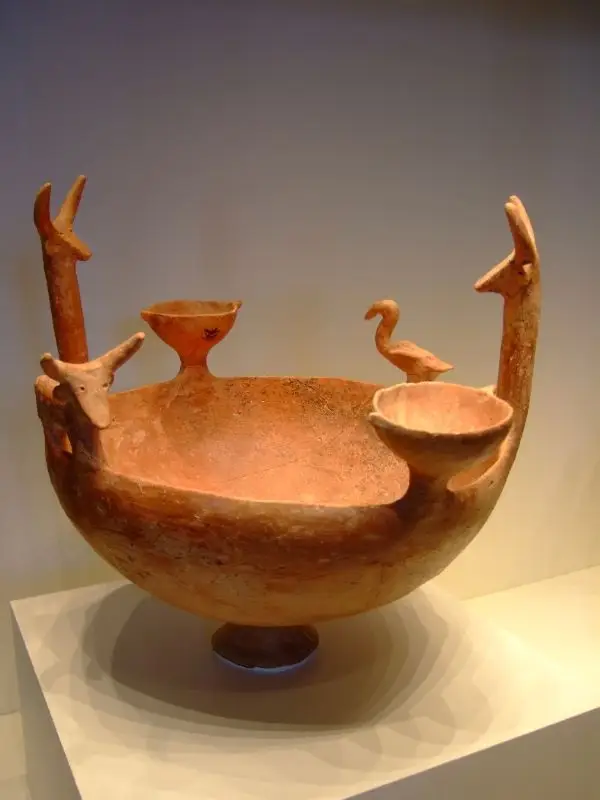 A Cypriot Red Polished ware bowl of the kind Morris collected, modelled with cattle, a bird and a ring of small vessels, Early Bronze Age, about 2000 BC. The J. Paul Getty Museum. Photo: Mary Harrsch, CC BY-SA 2.0, via Wikimedia Commons.
6. The Canellopoulos Collection, Athens
Paul Canellopoulos bought his first two pieces, a pair of early-sixteenth-century Byzantine icons, as a student in 1923, and did not stop for seventy years. With his wife Alexandra he assembled more than 6,500 objects across Greek prehistory, the Archaic and Classical periods and Byzantium: a Neolithic clay figurine, a terracotta "Melian relief" of Elektra and Orestes of about 470 BC, a bronze hydria, gold animal-head bracelets of the fourth century BC, hundreds of icons. They gave the collection to the Greek state in 1972, and it opened in a restored neoclassical house on the north slope of the Acropolis, where it remains, the Kanellopoulos Museum.
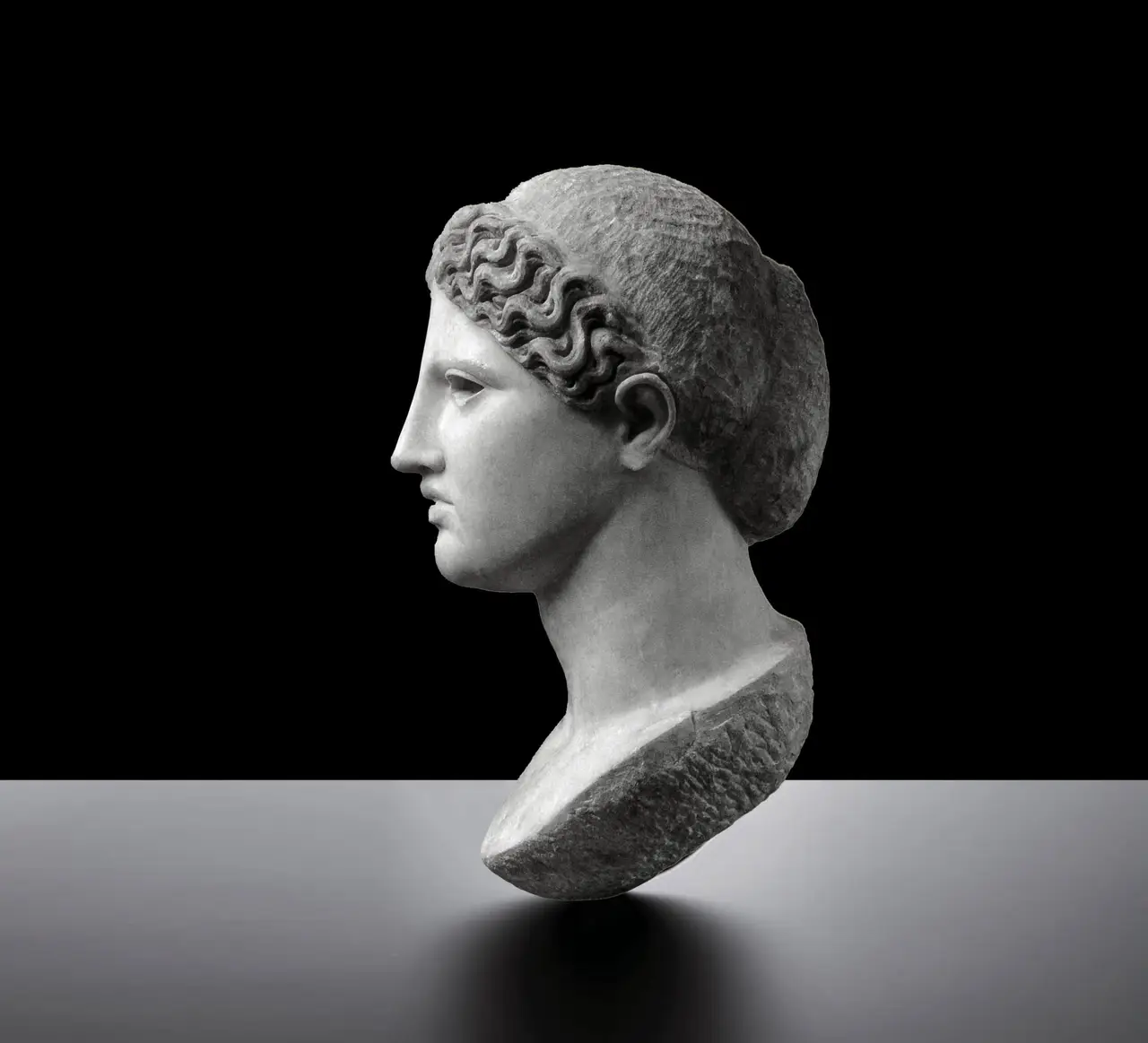 A Classical Greek marble head of a woman, the hair waved back into a knot at the nape, from the sculpture in the Kanellopoulos Museum, Athens.
7. The Severis Collection, Nicosia
Leto Severis began collecting in Nicosia in the early 1940s under the eye of her father-in-law, and with her husband Costakis built around 1,900 Cypriot pieces over thirty years: ceramics above all, with ring vases, female figurines, bronze weapons, glass and jewellery across every period. Rather than sell or donate, the family kept title and lent the collection out. Since 2009 it has hung in a gallery of its own at the Leventis Municipal Museum of Nicosia, catalogued by Vassos Karageorghis, whose name runs through the whole Cypriot subject like a watermark.
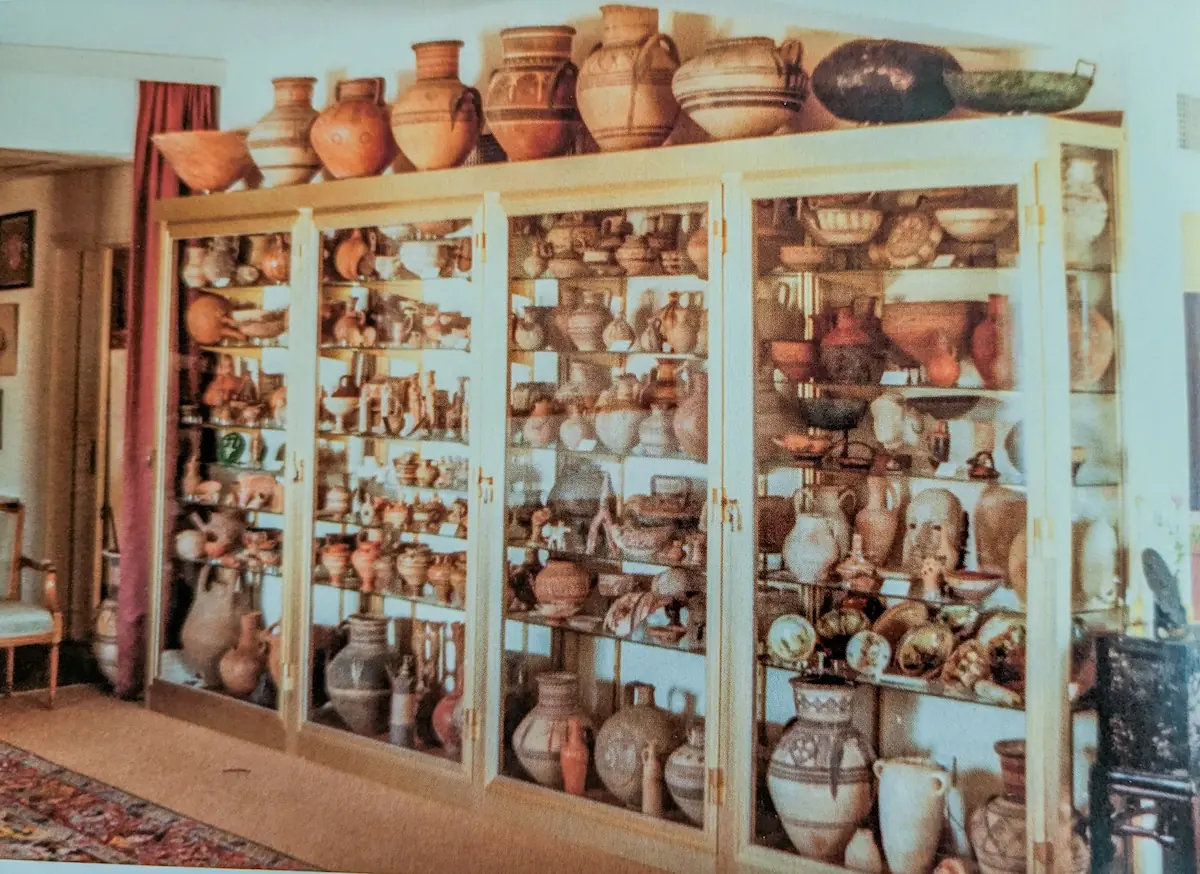 Part of the Severis collection of Cypriot antiquities, the pottery ranged in a glazed cabinet in the family house in Nicosia.
8. The Mougins Museum of Classical Art
The British hedge-fund manager Christian Levett opened the Mougins Museum of Classical Art in a medieval hill town above Cannes in 2011, and hung Roman marbles and Greek vases beside the Picassos, Dalís and Hirsts they had shaped. Into it he built what he called the world's largest private collection of ancient arms and armour, much of it bought from the dispersed holdings of the Berlin developer Axel Guttmann. The centrepiece was the "Mouse," a Roman cavalry helmet of the later second century AD.
In 2023 Levett closed the classical museum, reopened the building the next year as a museum of women artists, and sent the antiquities to Christie's, where they were sold across roughly six sales valued together near twenty-two million pounds. The first, in December 2023, made about £4.3 million; the Mouse alone made over $1.2 million in New York the following January. A private museum, it turns out, can be taken apart as deliberately as it was assembled.
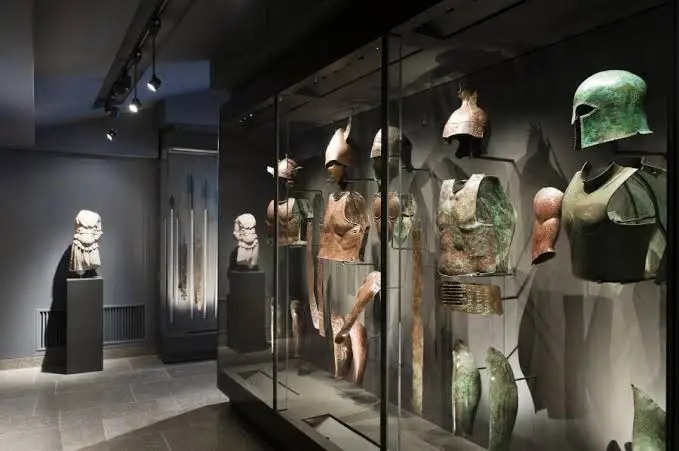 Ancient bronze helmets, cuirasses and anatomical breastplates in the arms and armour gallery of the Mougins Museum of Classical Art, before its closure in 2023.
9. The Axel Guttmann Collection of Arms and Armour
Guttmann, a Berlin property developer riding the post-reunification building boom, bought his first Roman helmet in 1982, and by his death in 2001 held over twelve hundred pieces of ancient arms and armour, the largest such holding in private hands. He kept it in a private museum outside the city and opened it to scholars, who used the Sammlung Axel Guttmann volumes he funded. The helmets ran from Greek and Near Eastern types through a pseudo-Corinthian Apulian bronze of the fifth or fourth century BC to Roman Weisenau infantry helmets and the cavalry "Mouse." After he died the collection scattered through Christie's and Hermann Historica between 2002 and 2004; the Mougins Museum took several pieces, which is how the Mouse helmet came to be sold twice in a single generation.
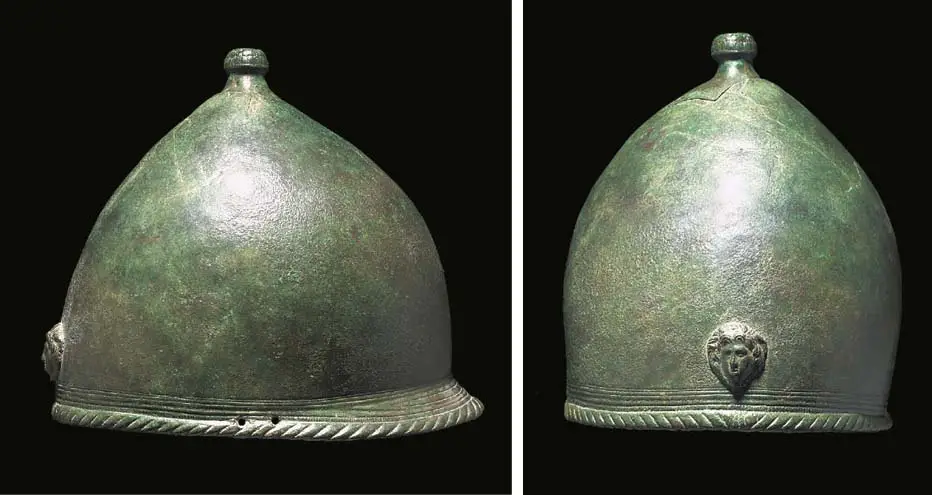 A bronze Montefortino-type helmet, front and back, the bowl crowned with a knob and finished with a cable-moulded rim and a small mask at the back, from the Axel Guttmann collection of ancient arms and armour.
10. The Zintilis Collection, on Loan in Athens
The businessman Thanos Zintilis assembled roughly 780 catalogued Cypriot objects in the 1950s and 1960s, one of the largest such collections to leave the island and survive intact. It hung for years at the Allard Pierson Museum in Amsterdam before moving in 2002 to the Museum of Cycladic Art in Athens, where about four hundred pieces are now shown in a gallery of their own. The collection runs from the Chalcolithic to the early Byzantine: stone and terracotta figurines, bronze weapons, glass, jewellery and faience. Stella Lubsen-Admiraal published the full catalogue in 2003.
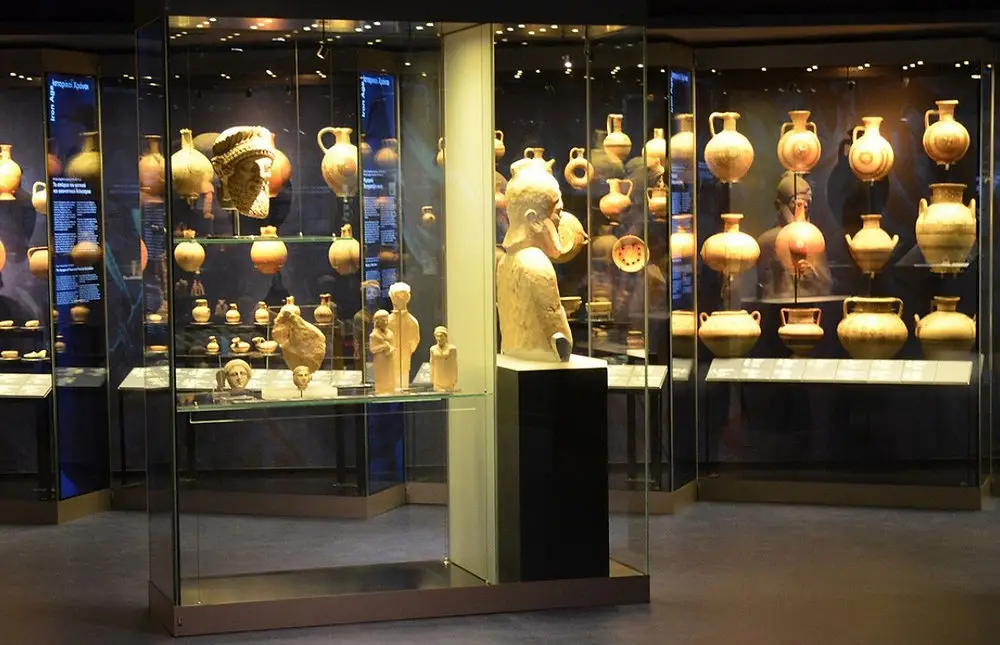 Cypriot pottery, limestone heads and figurines from the Zintilis collection, on long-term display at the Museum of Cycladic Art, Athens.
11. The Al Thani Collection, Paris
The model that built the great museums did not die with the twentieth century; it changed currency. Since about 2009 Sheikh Hamad bin Abdullah Al Thani of Qatar has built a private collection of more than five thousand works across cultures, the antiquities among them running from an Egyptian royal head in red jasper of the Eighteenth Dynasty to a Han-dynasty gilt-bronze weight shaped as a bear, a Maya mosaic mask and an Achaemenid inlaid gold plaque. Since November 2021 a suite of it has been on a twenty-year display at the Hôtel de la Marine, on the Place de la Concorde in Paris.
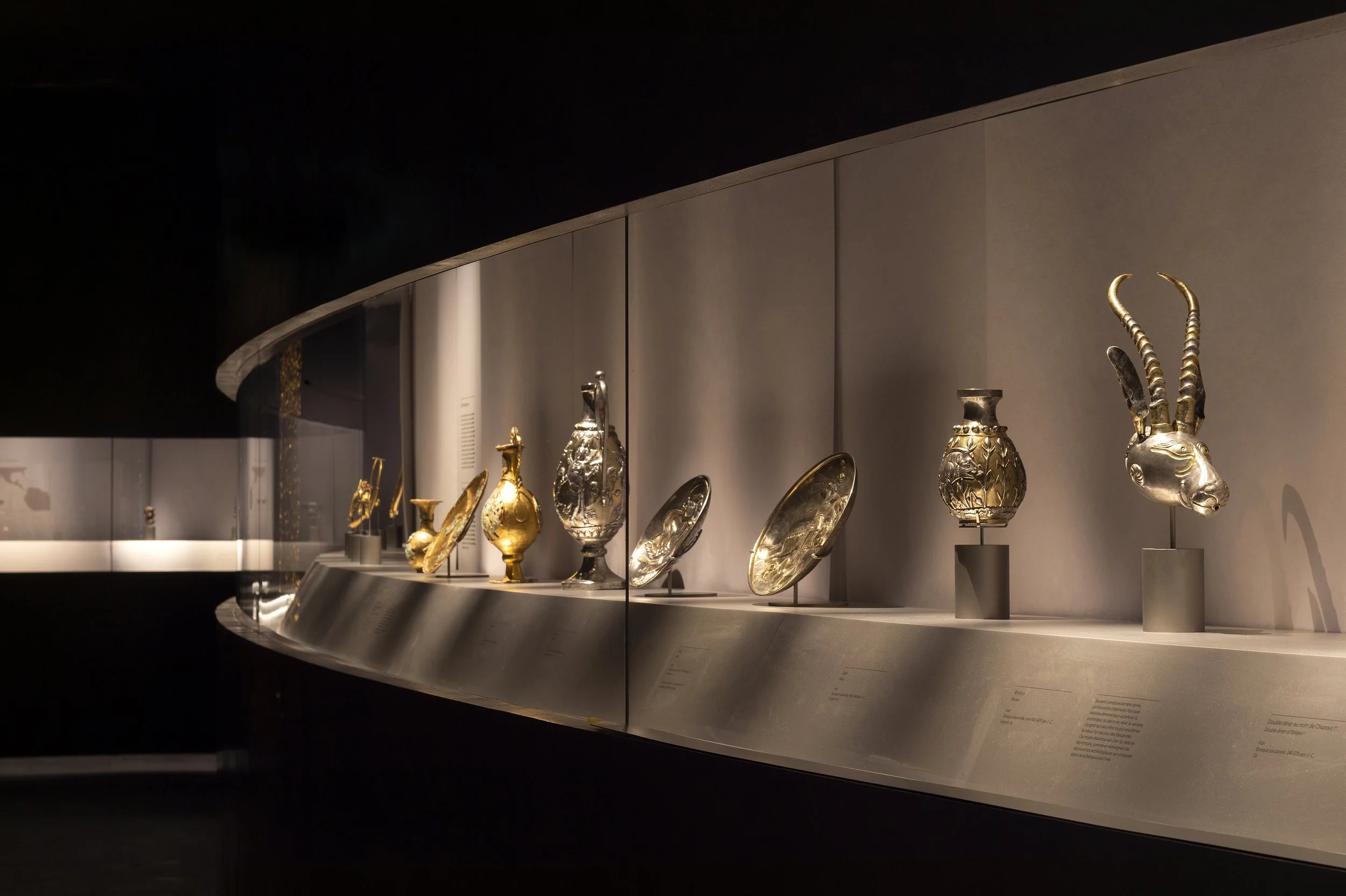 Gold and gilt-metal vessels, dishes and a horned-animal rhyton from the Al Thani Collection, on display at the Hôtel de la Marine, Paris.
12. The Fondation Gandur, Geneva
Jean Claude Gandur, a Swiss oil financier raised partly in Alexandria, holds an archaeology collection of nearly 1,250 objects, more than six hundred of them Egyptian. Among them are Egyptian and classical bronzes and one of the largest groups of Egyptian amulets in private hands. He keeps the collection through a Geneva foundation, lends from it, and in 2024 announced a permanent museum to open around 2030 in Caen.
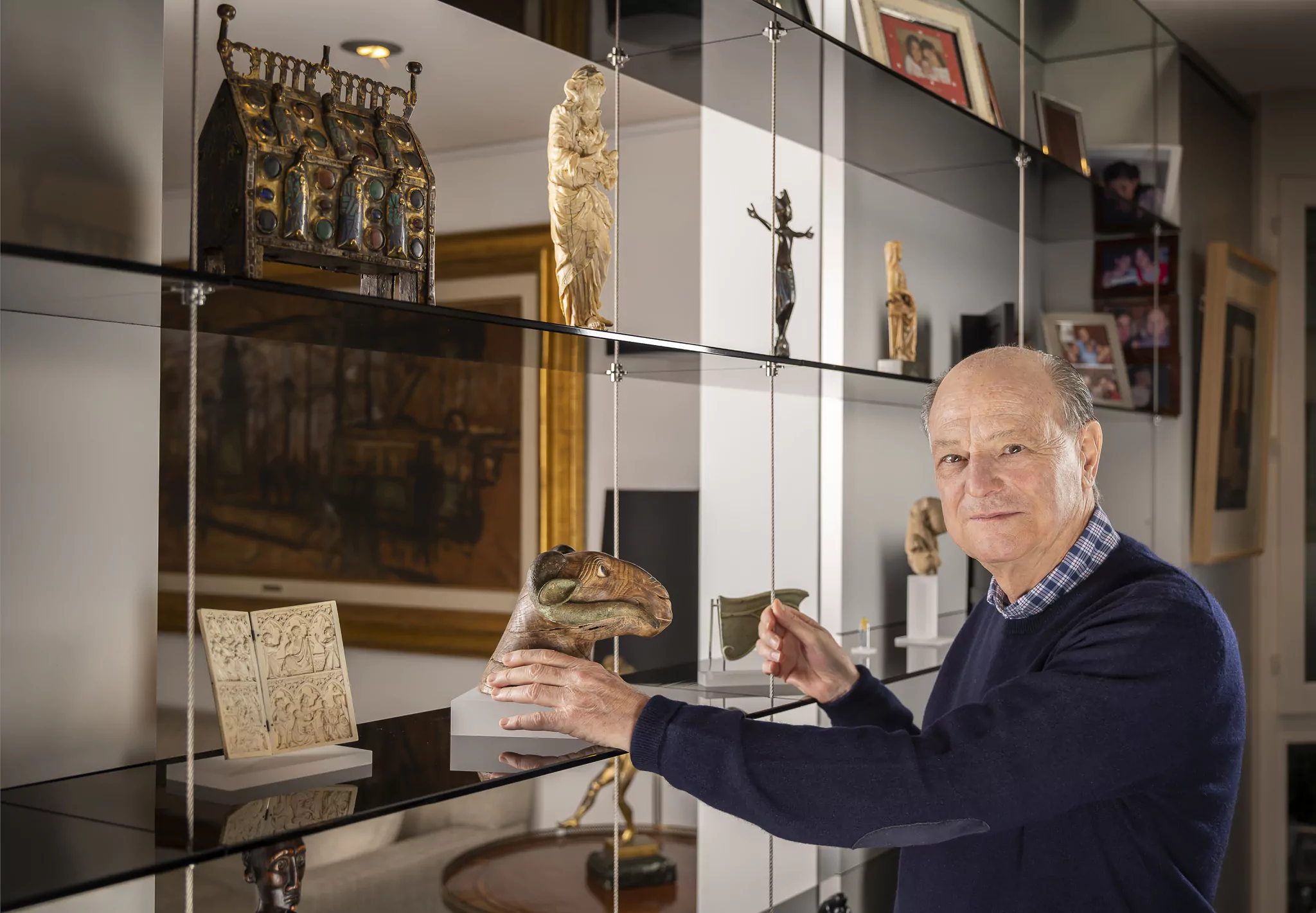 Jean Claude Gandur with works from the holdings of his Geneva foundation, the Fondation Gandur pour l'Art.
13. The Eton Myers Collection of Egyptian Art
Major William Joseph Myers first went to Egypt in 1882 as a young army officer and spent the rest of his short life buying its decorative art, faience above all, with glass, bronzes, stone and wood besides. By the time he was killed in the Boer War in 1899 he had assembled around 1,300 objects, which he left to his old school. Eton College has held the Myers collection ever since, a celebrated series of Egyptian faience, studied and shown in partnership with the University of Birmingham and exhibited at the Metropolitan Museum in 2000.
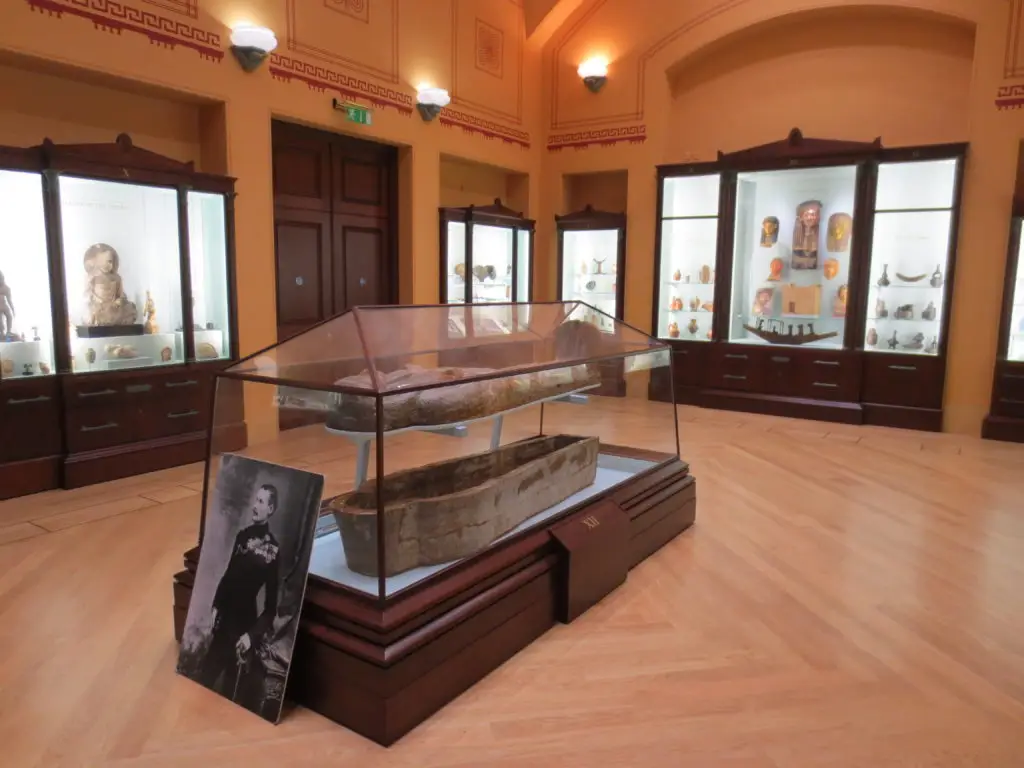 Egyptian antiquities of the Eton Myers Collection on display, with a photograph of Major William Joseph Myers, who left the collection to his old school.
14. The Barbier-Mueller Collection, Geneva
Josef Mueller began buying early in the twentieth century; his son-in-law Jean Paul Barbier-Mueller carried it on, and in 1977 they opened the Musée Barbier-Mueller in Geneva. Its more than seven thousand pieces are mostly the arts of Africa, Oceania and Asia, with classical and pre-Columbian antiquities among them. When the museum sold its pre-Columbian holdings at Sotheby's in Paris in 2013, 313 lots led by a two-million-euro Chupícuaro figure, Peru, Mexico and Guatemala objected and lodged repatriation claims, though the sale went ahead. The museum itself stays open.
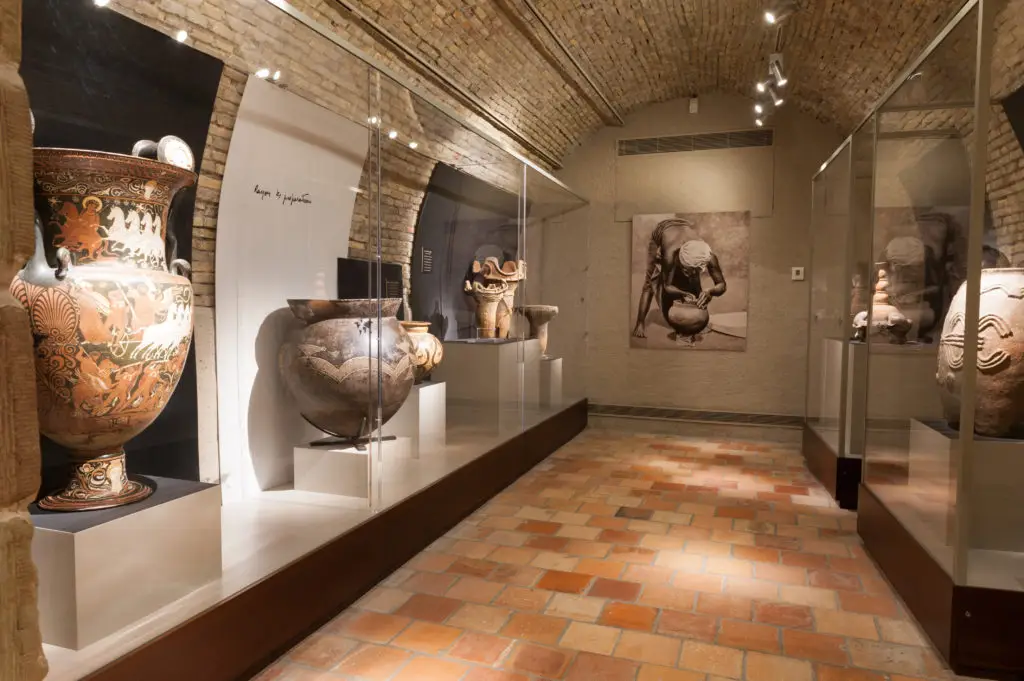 Classical antiquities, among them a Greek red-figure volute krater, displayed by the Musée Barbier-Mueller, Geneva.
15. The Phylactou Collection and the Online Cypriot Catalogues
A recurring modern fate among Cypriot collectors is the catalogue, the full scholarly publication that fixes a private holding in the record whatever later becomes of the objects. The collection began with Chris Phylactou's grandfather, Heracles Skyrianides, who bought old Cypriot pieces in 1930s Limassol, when they still sold in bulk across the island, and passed down through the family to Phylactou himself. Vassos Karageorghis published the whole of it in 2010: pottery of the Early, Middle and Late Bronze Age, with gold jewellery of the Classical and Hellenistic periods, from a Middle Cypriote bowl of about 1900 BC to a first-century AD glass flask. The objects have hung on long-term loan at the Leventis Municipal Museum of Nicosia since that year, and the book records every one of them.
The catalogue's newest form is the website. The British collector David Johnson put his 250-odd Cypriot pieces online object by object, a picrolite cruciform figure of about 3000 BC and a bichrome terracotta model chariot of the early first millennium among them, before agreeing to give the collection to Cyprus. On sites such as AncientCyprus.com a private holding of Cypro-Geometric and Cypro-Archaic pots can now be turned over on screen, several of them as rotatable three-dimensional models.
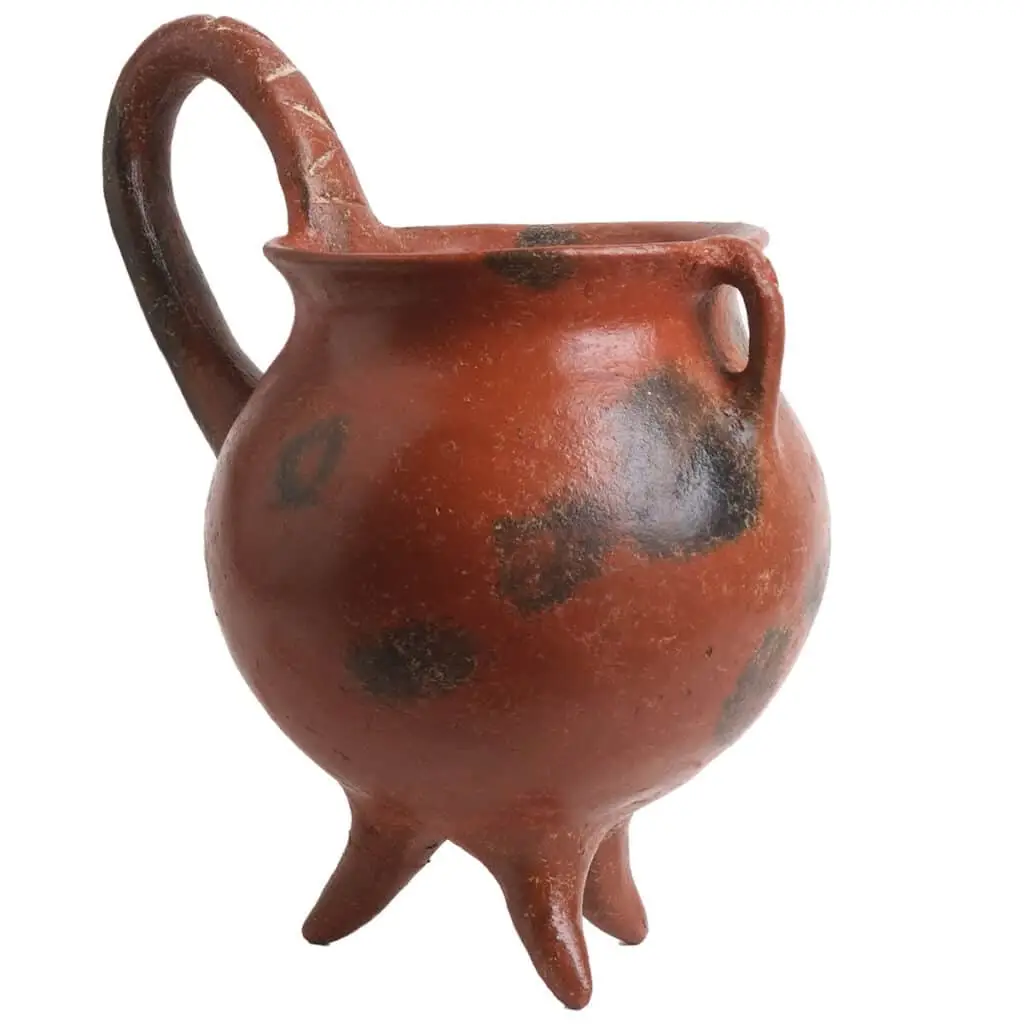 A Cypriot Red Polished ware tripod jug with a high arching handle, Early to Middle Bronze Age, from the Phylactou collection.
16. The Moussaieff Collection of Near Eastern Antiquities
The rarest fate is none of these: a collection that never becomes a museum, never goes on loan, never sells. Shlomo Moussaieff, the London jeweller, spent six decades buying Near Eastern and biblical antiquities, cylinder seals and cuneiform tablets, West Semitic inscriptions, the Aramaic incantation bowls that families once buried beneath their floors against demons, until he held what the press numbered at around sixty thousand pieces. Much of it has appeared only in scholarly volumes, never as a named sale. A collection bought that fast and that wide takes in forgeries, and his did; several of his inscriptions are still argued over. The bulk of it stays what it was, one man's idea of what mattered, kept together.
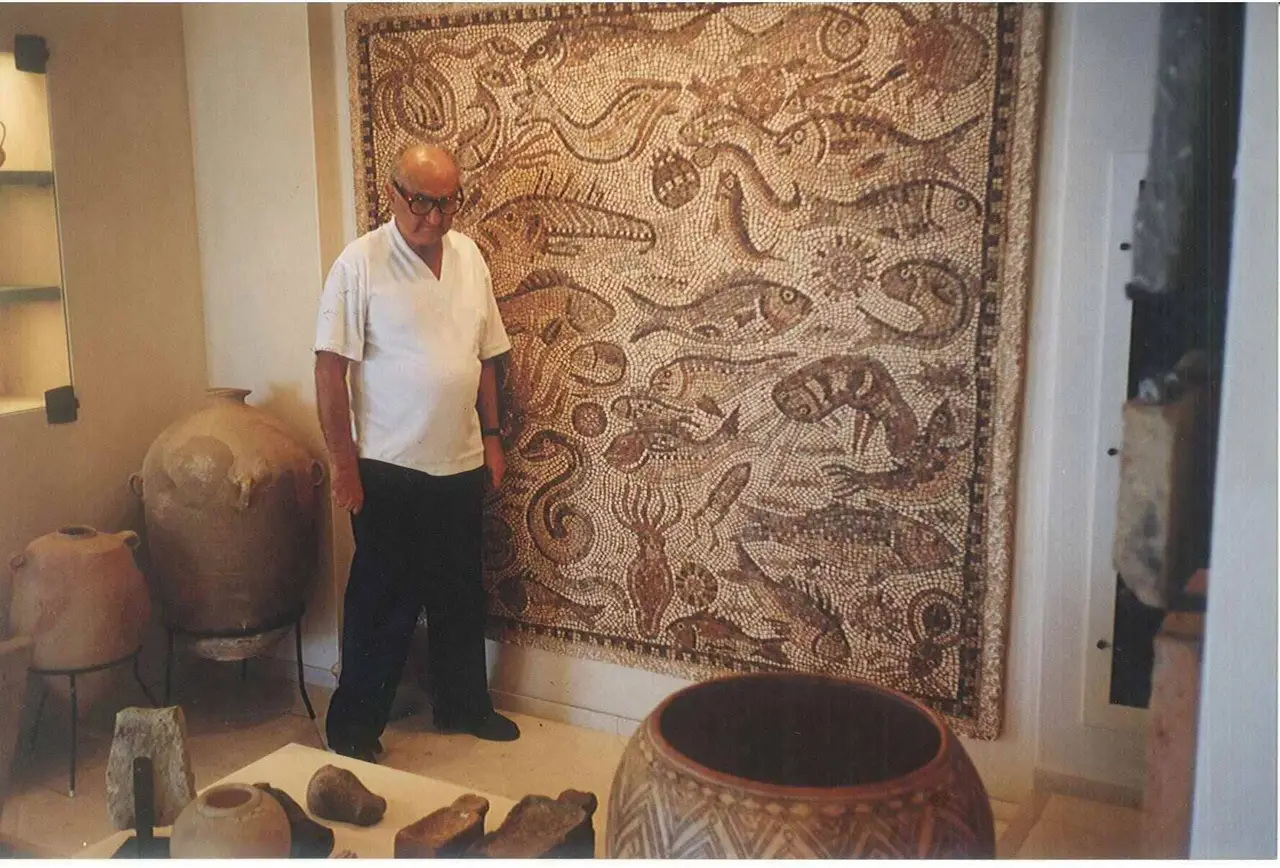 Shlomo Moussaieff among antiquities from his collection, before a Roman mosaic of marine life.
17. The Constable-Maxwell Collection of Ancient Glass
Ancient glass has produced some of the sharpest single-owner sales of all. The Constable-Maxwell family's glass, about 355 lots sold at Sotheby's in 1979 with a foreword by the glass scholar Donald Harden, included a late-Roman cage-cup of about AD 300, a diatretum whose openwork outer shell stands clear of the inner beaker on little glass struts, one of only a handful anywhere near complete. It made £520,000 in 1979, then a record for glass, and when it surfaced again at Bonhams in 2004 it made £2,646,650, still the auction record for any piece of ancient glass. Six years on from the first sale, the Lucerne glass of Ernst Kofler-Truniger, 348 lots dispersed in 1985, scattered to the Metropolitan, Boston and the Getty, and included a Roman flask shaped, with a glassblower's joke, like a mouse.
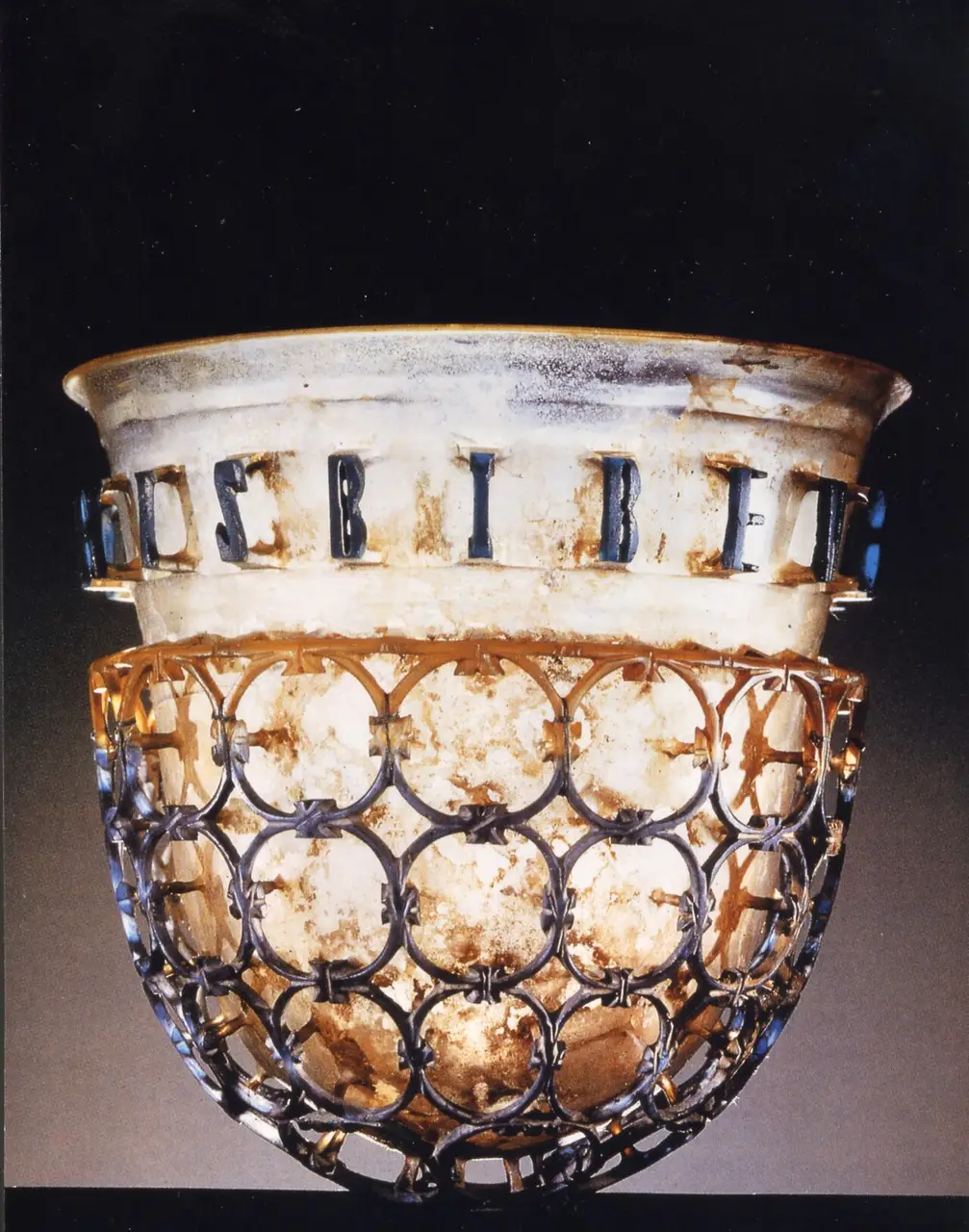 The Trivulzio cage cup, a late-Roman vas diatretum of about AD 300, the openwork outer cage standing clear of the beaker on small glass bridges. Museo Archeologico, Milan. Public domain, via Wikimedia Commons.
18. The Sangiorgi Collection of Glass and Engraved Gems
Giorgio Sangiorgi, a Rome dealer and connoisseur, built two collections at once: ancient glass, core-formed and cast and cameo, and ancient engraved gems, several with pedigrees reaching back to the Marlborough and Boncompagni cabinets. He moved both to Switzerland in the 1950s. The glass sold at Christie's in New York in 1999, the best of it going to the Corning and Toledo museums; the forty gems followed in 2019, where the J. Paul Getty Museum bought seventeen for $7.94 million, among them a Marlborough cameo of Antinous and an amethyst signed by Dioskourides, cut with the head of Demosthenes.
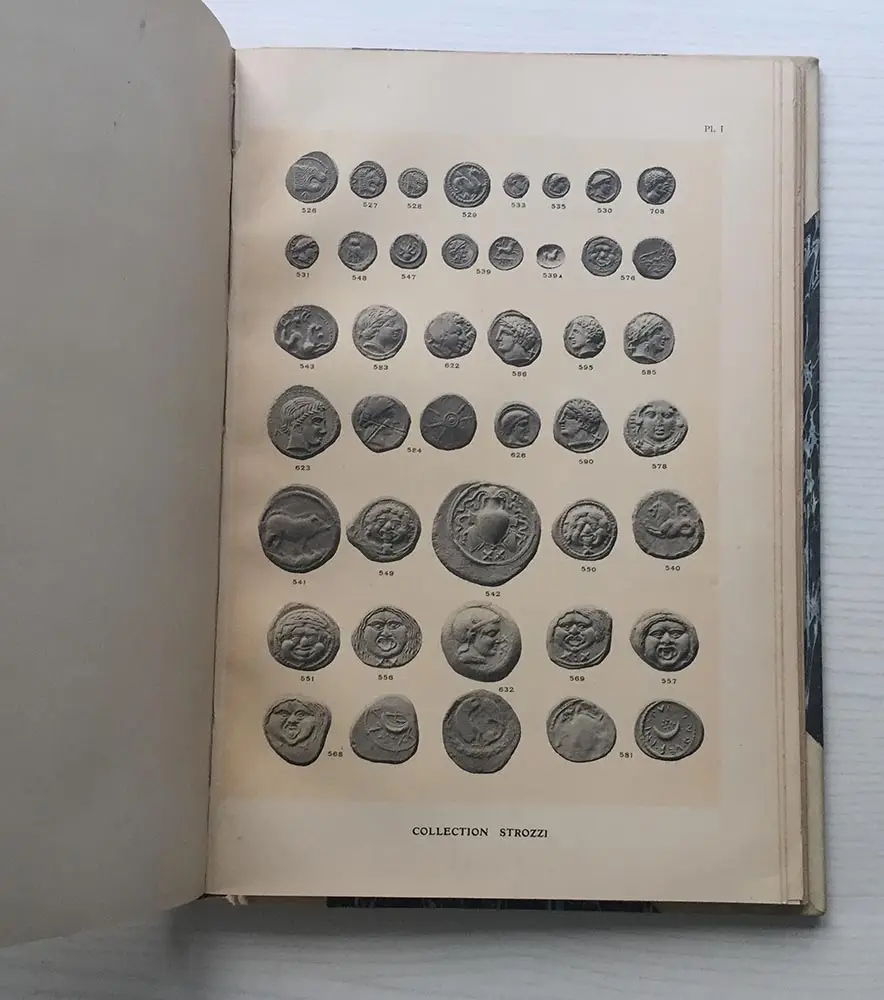 A plate of ancient engraved gems from the catalogue of the Strozzi cabinet, one of the old European gem collections whose stones carried the kind of pedigree found among Sangiorgi's gems.
19. The BCD Collection of Greek Coins
A coin cabinet is almost pure provenance once it is sold, and none has marked the literature more than the regional Greek coinages assembled by the collector who signed himself only "BCD," now known to be Basil Demetriadi. Over decades he gathered something past fifty thousand coins of the Greek mainland, region by region, kept with his own handwritten tags, and dispersed them through the 2000s in ten catalogues printed with his commentary: Corinth in 2001, Boiotia and the Peloponnesos in 2006, Thessaly in 2012. A coin is now cited as "BCD Boiotia" the way a plant carries a Latin name.
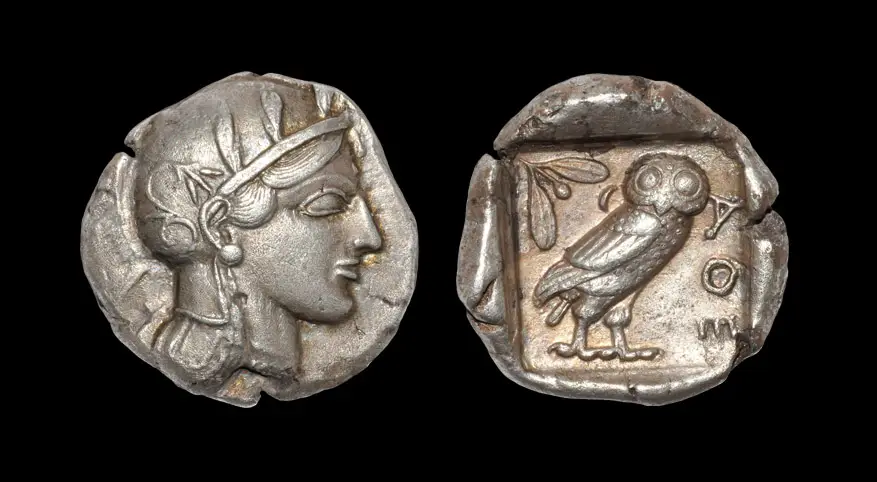
20. The Prospero Collection of Greek Coins
In January 2012 a cabinet of more than six hundred Greek coins, assembled anonymously between 1960 and 1991 and then left untouched for twenty years, sold at the Waldorf Astoria in New York as the Prospero collection for over twenty-five million dollars, one coin reaching $3.25 million, a record for an ancient Greek coin. The Roman Republican series has its equivalent in the 1,860 coins of Roberto Russo, published in 2013 as the RBW collection after his own sales: a private cabinet turned into the book the field opens first.
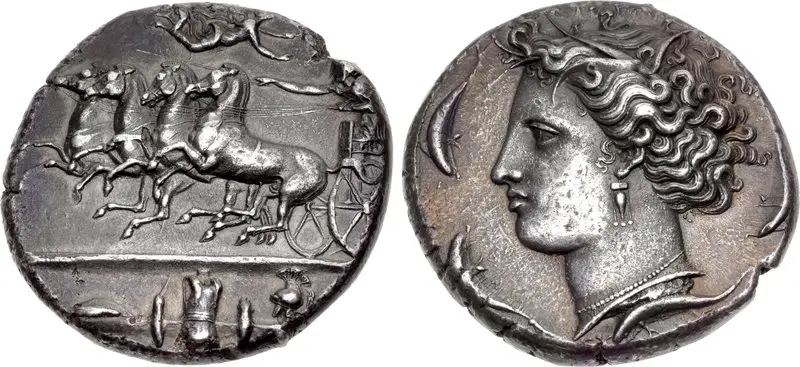 A Syracuse silver dekadrachm, the reverse die signed by the engraver Euainetos, about 400 BC. Photo: Classical Numismatic Group, CC BY-SA 2.5, via Wikimedia Commons.
The same salerooms still turn over the raw material of the next collection, a worn Republican denarius, a Cypriot Red Polished jug, a Roman glass flask, the loose components of some future BCD waiting for a collector with the patience to sort them.
TimeLine Auctions, 30th June 2026