Home > Stories by TimeLine Auctions
Stories by TimeLine Auctions
A 19-Year-Old Intern Found a Corroded Silver Lump. Nine Months Later, Experts Were Lost for Words
Nico Calman was sifting through soil at an archaeological dig in Haltern am See, a small town in Germany's North Rhine-Westphalia region. He was 19 years old, an intern with the Westphalie Department for the Preservation and Care of Field Monuments, and he had just uncovered what appeared to be a shapeless mass of corroded silver fused to a block of rusted iron.
Nobody on site realised what they were looking at. Not yet.
A Site Archaeologists Thought They Knew
The excavation was taking place at one of the most thoroughly studied Roman military sites in Germany. Archaeologists had known about Haltern's "Hauptlager" (main camp) since 1900. During the reign of Augustus, from 27 B.C. to A.D. 14, this base housed Roman legions pushing into Germanic territory. The soldiers stationed here met a grim fate: three entire legions (roughly 15,000 men) were annihilated when Germanic tribes crushed the forces of the Roman general Varus in A.D. 9.
Near the camp lies a cemetery where soldiers and their families were buried. After more than a century of excavation, experts assumed the site had given up most of its secrets. Calman's discovery proved them wrong.
What Nine Months of Restoration Revealed
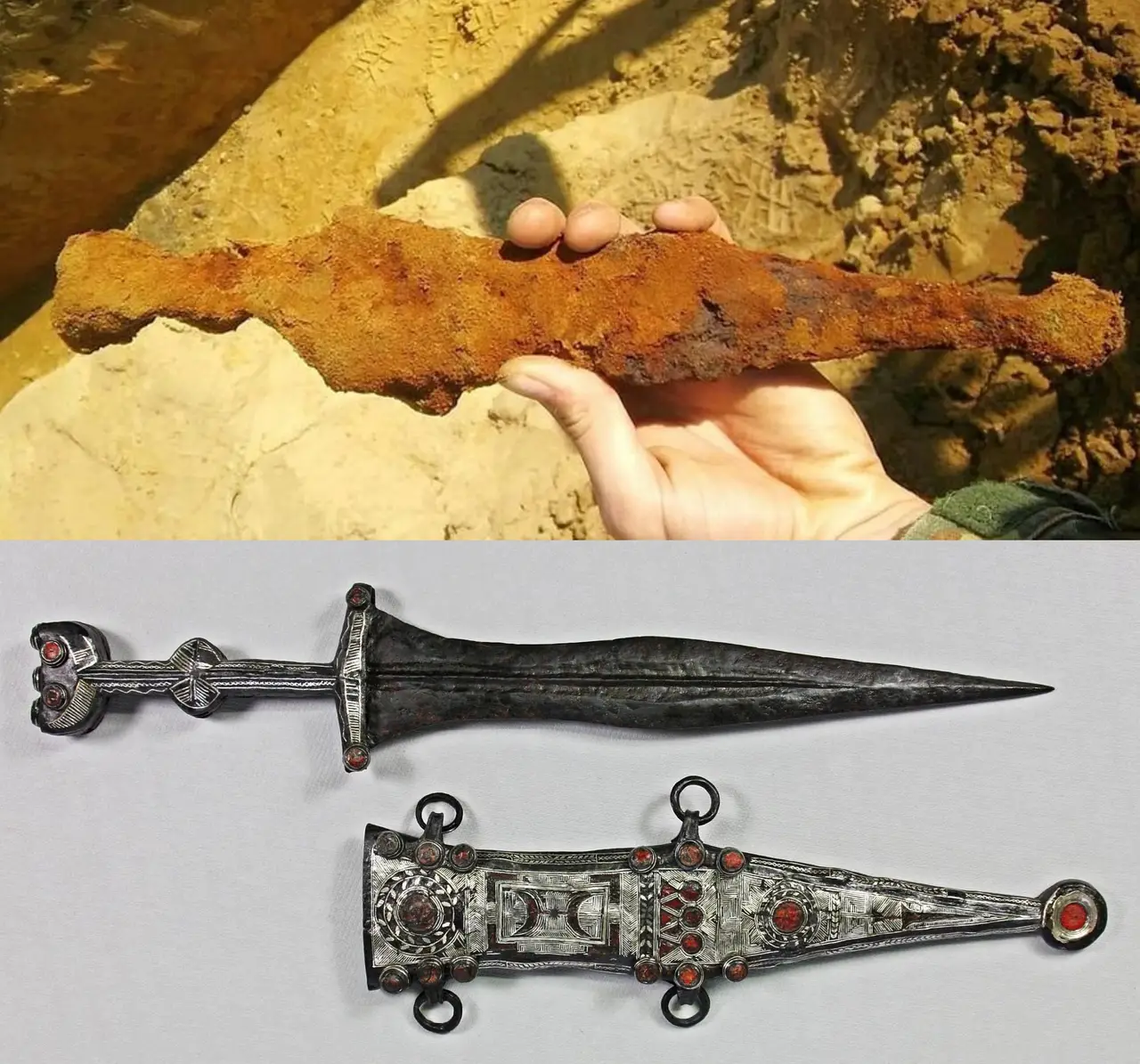
The corroded lump went to conservation specialists, who began the painstaking process of removing 2,000 years of corrosion. They sandblasted. They ground away oxidation layer by layer. They X-rayed and CT-scanned the object to understand what lay beneath the surface.
Nine months later, the team could finally see what Calman had pulled from the earth.
The "lump" was a Roman military dagger, or pugio, still seated in its original sheath. The iron blade measured 13 inches long, with deep grooves running along either side of a central ridge, a pronounced waist, and a long tapering point designed for close-quarters combat. The handle was inlaid with silver and studded with decorative rivets.
But the sheath was the real showpiece. Lined with linden wood, its iron exterior had been decorated with red glass, silver inlay, niello (a black metallic compound of sulphur, copper, silver, and lead), and brilliant red enamel. Rings attached to the sheath once connected it to a leather belt, fragments of which survived in the grave alongside the weapon.
Bettina Tremmel, the archaeologist leading the excavation, later told reporters that the team was "lost for words."
Why This Almost Never Happens
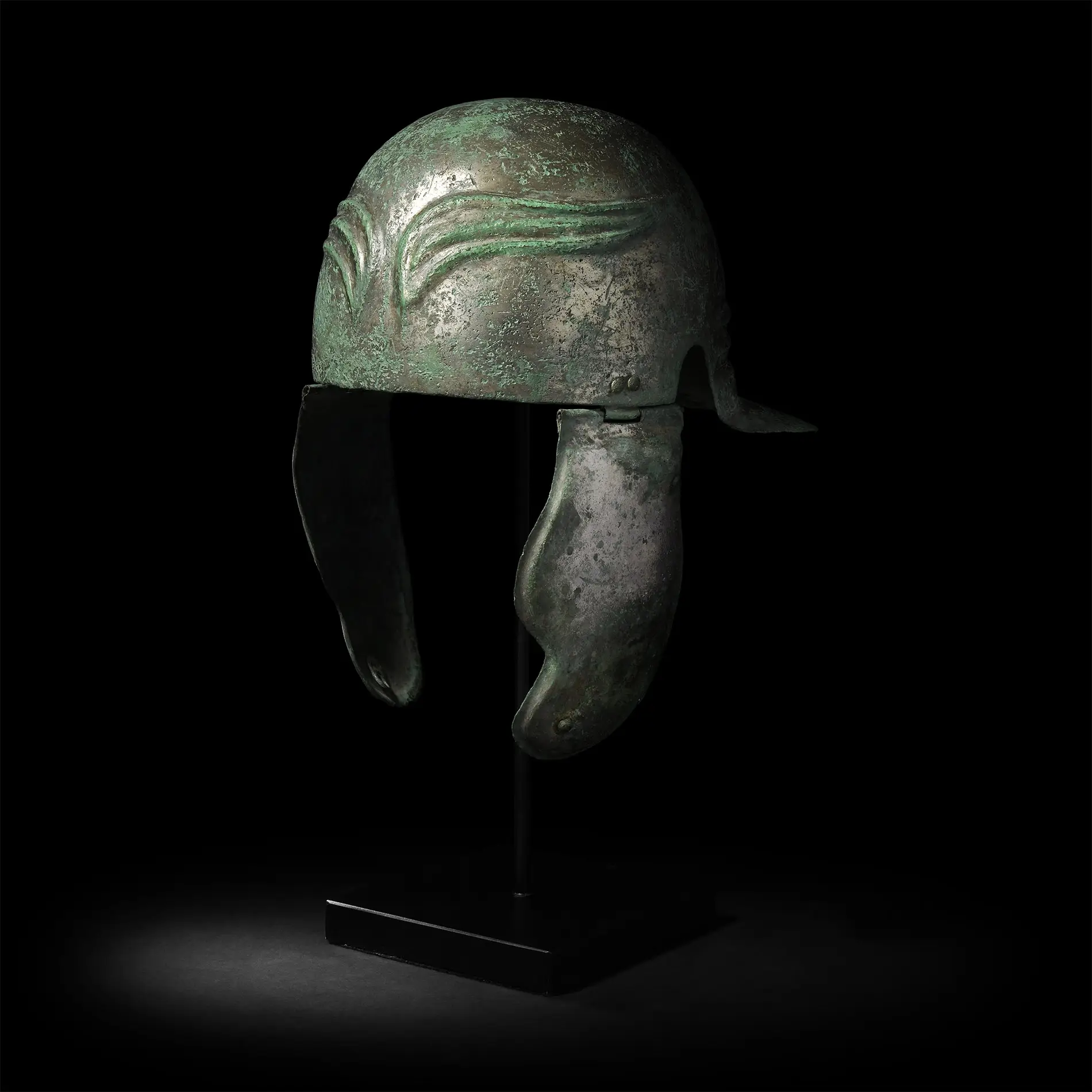
Roman soldiers weren't buried with their weapons. Military equipment belonged to the legion, and the penalties for losing your gear were brutal enough to ensure that soldiers kept a death grip on their helmets, swords, and daggers throughout their service. When a legionary died, his equipment went back into circulation.
So why was this soldier different?
Tremmel has theories. The deceased may have been a Celtic or Germanic recruit who followed his native burial customs rather than Roman military protocol. Or perhaps his family specifically requested that the dagger accompany him. We will probably never know for certain. What we do know is that this burial practice, whatever motivated it, preserved something extraordinarily rare.
Only one other complete Roman military belt, dagger, and sheath assemblage has ever been found. That example came from Velsen in the Netherlands, where a Roman soldier was thrown into a pit during a military conflict with Germanic tribes in 28 B.C. The Haltern dagger is, quite literally, one of two known examples on the planet.
The Soldier Who Carried It
Who owned this weapon? Tremmel believes it belonged to either a legionary infantryman, an auxiliary soldier, or possibly a centurion (a mid-ranking officer). The dagger wasn't a primary weapon; Roman soldiers relied on their swords for serious fighting. But as Tremmel explained, "The dagger was a formidable weapon to have as a backup should the sword be lost or damaged."
Picture the man who wore this on his belt. He marched into hostile territory, far from Rome, knowing that Germanic warriors had already wiped out thousands of his fellow soldiers. He kept his dagger polished, its enamel bright, its blade sharp. And then, for reasons we cannot reconstruct, he was buried with it, against all standard practice, in a cemetery that archaeologists would excavate two millennia later.
What This Means for Collectors
Stories like the Haltern dagger remind us why we find ancient objects so compelling. Every corroded bronze, every patinated silver piece in an auction catalogue has a history waiting to be understood. Some were treasured possessions buried with their owners. Others survived by accident, lost in fields or rivers and forgotten until modern excavation brought them back to light.
At TimeLine Auctions, we handle Roman military objects regularly. None of them will be as rare as the Haltern dagger (that's a once-in-a-generation find), but each one connects you to the same world, the same legions, the same moment when Rome's reach extended into the forests of Germania.
You don't need to excavate a cemetery to own a piece of that history. You just need to know where to look.
Browse our current catalogue to see what Roman military objects are available now. If you're new to collecting and want to learn before you bid, register for an upcoming auction and follow the prices. Watching what sells (and for how much) teaches you more than any article can.
We're here when you're ready.
TimeLine Auctions, 4th March 2026