Home > Stories by TimeLine Auctions
Stories by TimeLine Auctions
A Bowl for Manishtushu
Manishtushu, king of Akkad from roughly 2270 to 2255 B.C., is best remembered in stone. His obelisk, a four-sided diorite stele, records the royal purchase of more than three thousand hectares of land in northern Babylonia. His own inscriptions claim that he led an expedition across what the Akkadians called the Lower Sea, the Persian Gulf, to Magan in present-day Oman, to secure diorite and metals for his court. "These are no lies," one inscription insists. "It is absolutely true!"
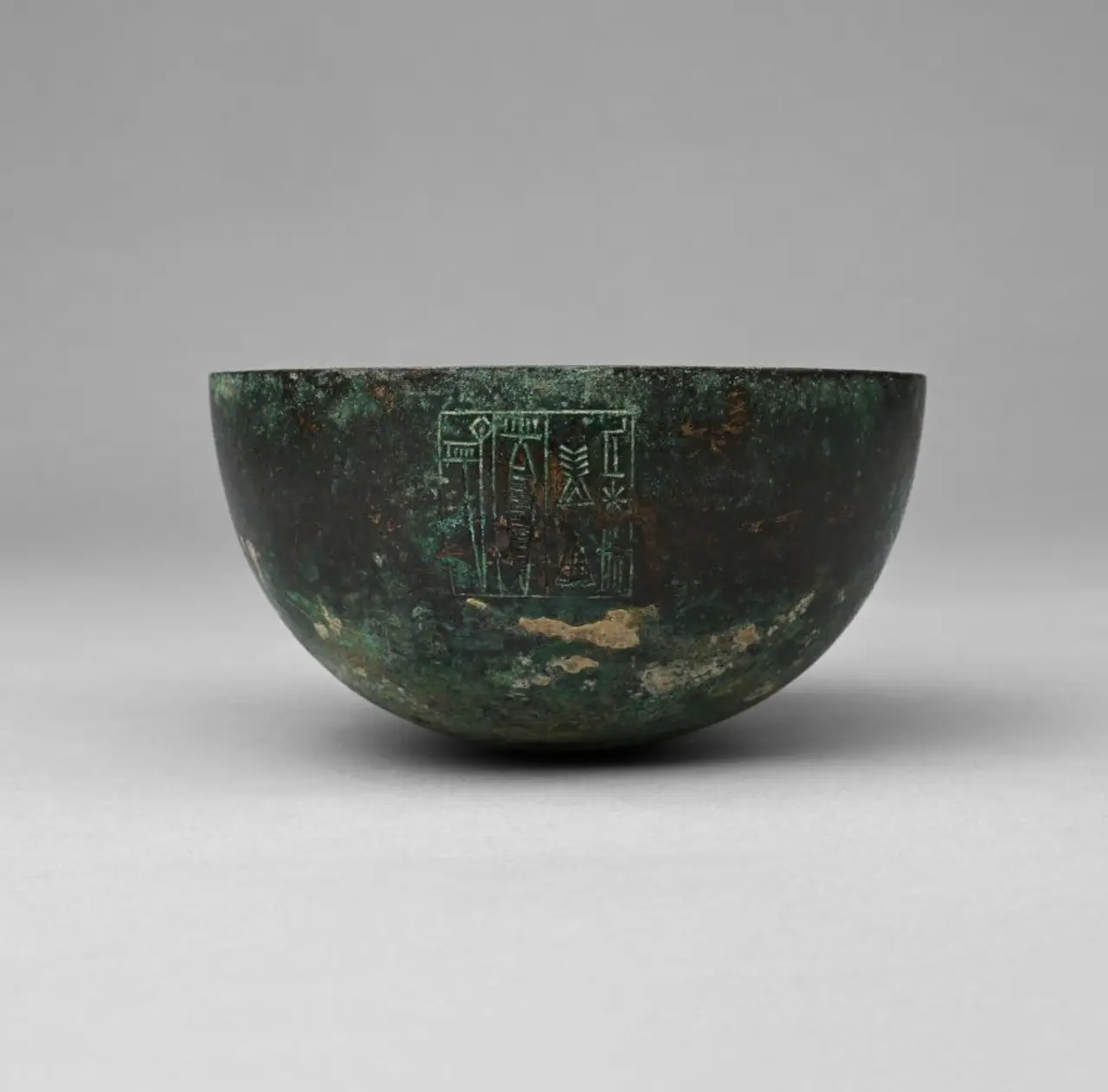
A bronze bowl carries his name. Hemispherical, thin-rimmed, 13.5 cm across and weighing 273 grams, it sits at the scale of the drinking cups held by seated banqueters on Akkadian cylinder seals. The surface is mottled brown and black, with patches of green encrustation where the copper alloy has corroded over four and a half thousand years. Toward the upper exterior, an incised rectangle has been laid out and divided into three vertical fields. The left and middle fields carry linear marks: a tall hatched element, a long oval with horizontal striations. The right field carries five cuneiform signs naming the king.
The copper very likely arrived in Mesopotamia by the same route Manishtushu claimed to have crossed. Akkadian administrative texts identify Magan as the main source of the copper that sustained the empire's metalwork, with ingots shipped across the Gulf into state workshops. By Manishtushu's reign, smiths were alloying that copper with tin to produce true bronze, and production was centralized: weighed-out metal was distributed to teams of state-subordinate smiths, who returned finished goods to royal administrators. A vessel of this weight, incised with the king's name, was a small piece of imperial accounting made permanent.
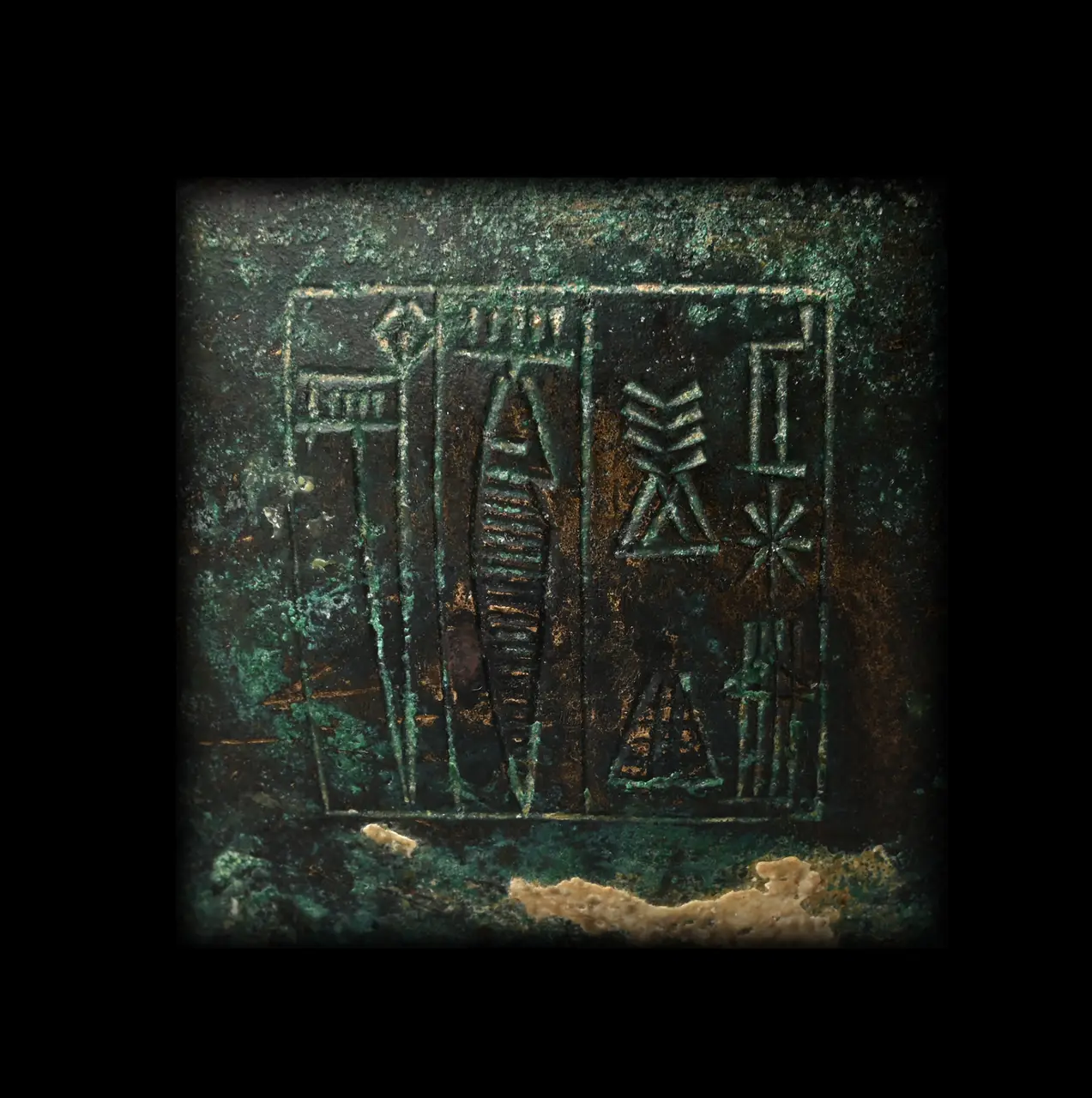
The inscription on the right-hand field is short: Man-iš-tu-šu, five signs. But it ties the bowl to a king who staked his reputation on bringing this metal back from across the sea, and to the apparatus of state production through which the metal was turned into things. The two figures in the adjacent fields remain unread on the present evidence; their relationship to the cuneiform name is not settled.
Inscribed Akkadian royal bronzes are rare. A 13 cm copper bowl in the Israel Museum carries an inscription naming Manishtushu's son Naram-Sin as the conqueror of Armanum and Ebla. Another Akkadian inscribed bronze bowl was retrieved from Tell Munbaqa in Syria in the early 1970s, well outside the Akkadian heartland, suggesting the kind of distribution that royal gifts and administrative grants imply. A near-identical bowl appeared at Christie's, London, in May 2002. The pattern is consistent: hemispherical bronze, hand-held, the king's name set into the metal his policies produced.
The bowl comes from a Swiss private family collection and a private London collection, and is believed to share ownership with a bronze bowl sold at Sotheby's, London, on 21 April 1975 (lot 238). It is offered for sale at TimeLine Auctions on 2 June 2026 as lot 249, with an estimate of £40,000–60,000.
TimeLine Auctions, 22nd May 2026