Home > Stories by TimeLine Auctions
Stories by TimeLine Auctions
A County Of Cabinet Quality Coins ... And One Of Them Is In Our Upcoming Auction!
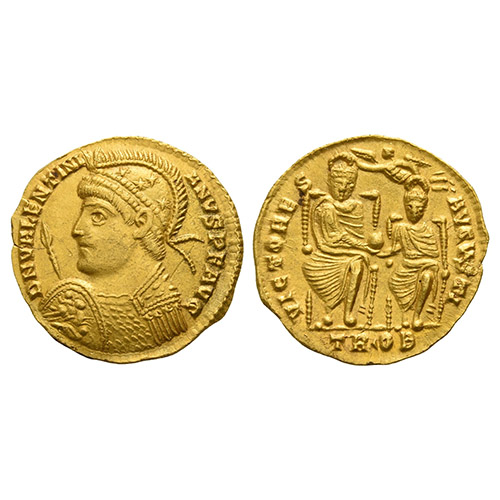
Despite its geographical size as England’s second largest inland county, Shropshire has a sparse and mostly rural population, with fewer than one person per hectare, compared to four per hectare throughout the rest of the country. It has, nevertheless, an impressive record when we look at metal detectorists’ finds reported under the Portable Antiquities Scheme. They include 123 silver discoveries, and 38 gold – one of which comes under the hammer in our September 2025 auction: a Valentinian I solidus, struck at Treveri mint in AD 367-375. Its obverse has Valentinian’s diademed and cuirassed bust to left, wearing a helmet decorated with stars; holding a spear and shield decorated with a horseman motif, The legend readsD N VALENTINIANVS P F AVG. On the reverse Valentinian and Gratian, seated facing, hold a globe between them, as Victory flies to left above and crowns them. The legend reads: VICTORE S AVGVSTI,;with TR◂OB (Treveris in Officina Secunda) in exergue. Thoroughly checked-out by TimeLine’s Vetting Team, the coin in described in our catalogue as one of the finest known examples; and estimated to reach a hammer price at £3,000-£4,000.
PAS records tell of other gold coin finds in Shropshire. They include:
- A gold half pound of Elizabeth I (1558-1603), 'Second Issue' (1561-82; North 1994; Spink 2520B), mint: Tower (London), initial mark: castle dating to AD1570-72. The flan is broken, “probably due to recent contact with farm machinery”.
- A gold quarter noble of Edward III (1327-1377) dated to the pre-treaty period AD 1351-61.
- A gold noble of Henry VI - annulet issue struck c. AD 1422 -27at the mint in Calais.
- Four gold and 15 silver Iron Age coins of the Dobunni tribe; 1st century BC.
- Seven gold Iron Age coins; North Eastern inscribed gold staters, usually associated with the 'Corieltavi' tribe, and Western inscribed gold staters, ascribed to the 'Dobunni'.
- A Gold Guinea of Queen Anne (1702-1714), struck in 1713.Obv: Draped bust of Queen Anne (third issue/ bust) facing left.A guinea of George I was later discovered in the immediate vicinity by another person. Insufficient evidence to suggest that these coins were deposited together in the ground at the same time; and that at the time of discovery neither coin was more than 300 years old. Returned to finders.
- One gold and one hundred and thirty silver coins including a James I gold crown; and 4 half-crowns and 20 shillings in silver.
- 5 coins gold doblas of Peter or Pedro I, King of Castile (Pedro the Cruel), who reigned 1350-69. All the coins were struck at the Seville mint, the main mint of Castile. They are of good weight and are in generally good condition.
Found during a detectorists rally in 2005. In 2007 a further four gold coins of the same monarch found at a second rally on the same site.
- A group of 913 coins reported found hidden within a Broadwood Piano from Bishop's Castle, Shropshire. All are gold; mostly sovereigns (634), but with a considerable number of half-sovereigns (280). The face value of the group was therefore £773. They were struck to the same standard, 91.7% gold; and most were struck at the London mint; but a significant proportion originated in Australia at the mints of Melbourne, Sydney and Perth, where branches of the Royal Mint were opened to coin gold from the Australian mines first discovered in 1851.They range in date from the early-Victorian period, specifically 1846, to the early years of George V (12 coins of 1914 and just two coins from 1915). The bulk of the hoard falls within the period 1890-1912. The unknown hoarder carefully packaged the coins in bundles of recycled cardboard cartons, one of which carried an advertisement for Shredder Wheat. An executive at the breakfast cereal factory identified and dated the advertisement, providing the BM with a vital clue that helped to pin down some of the hoard’s history. The hoarder had made quite sure that the gold-packed wrappings did not interfere with normal playing of the piano, which accounted for the coins remaining hidden after the owner’s presumed death.
Silver finds from Shropshire worthy of mention include:
- Denarius of Mark Anthony dating to the period c.32-31 BC; struck by Mark Antony for the use of his fleet and legions as he prepared for the struggle with Octavian, which culminated in the Battle of Actium on the 2nd of September, 31 BC .
- Cut halfpenny of John (1199-1216), moneyer: Henricvs, mint: Rhuddlan.
Coins of the Rhuddlan mint are rare. This is only the fourth found in Shropshire, and the first of its type.
- Worn milled halfcrown of William III (1694-1702); subsequently inscribed on both faces with a profanity (CUNT). Such re-engraved coins are known; often showing political dissent; but their survival is relatively rare. This is an early example of the practice potentially associated with Jacobite Rebellions.
- Half real of Ferdinand and Isabella of Spain, minted AD 1475-1497. Its presence reflects high levels of trade with Spain during the period of close allegiance following the marriage of Catalina (Catherine) of Aragon to Prince Arthur of England in 1501.
- Hoard of 139 coins: pennies, cut halfpennies, farthings and additional small broken fragments, from the reign of Henry III (AD 1216-1272).
- Roman Republican hoard of 69 silver coins, dating to 110-31 BC.
- Purse loss of twenty Tudor silver coins struck AD 1544 - 1561 during the reigns of Henry VIII, (1509-47) Edward VI (1547-1553), Mary I (1553-1554), Mary I and Philip of Spain (1554-1558) and Elizabeth I (1558-1603).
- Hoard of 21 groats, halfgroats and threepences of Edward I,II and III, with a single coin of Henry V.
- Hoard of 69 denarii, including 51 Republic, 12 Augustus and 6 Tiberius.
(Some of our detector-owning readers are probably booking Shropshire holidays as they read this text!)
Brett Hammond, TimeLine Auctions, 7th August 2025