Home > Stories by TimeLine Auctions
Stories by TimeLine Auctions
A Fayum Portrait, a Cup of Wine, and a Man No One Can Name
A middle-aged man looks out from a wooden panel, and he does not look happy about it. His dark hair is receding at the temples and going grey; a short beard, flecked with the same grey, frames a full mouth; two vertical creases are pressed between heavy brows, over large dark eyes that do not quite line up. In his right hand he holds a conical glass beaker with a blue rim, red at the bottom where the wine sits. His raised left hand carries a thick bundle of pink roses, and on its little finger is a gold ring. Down the middle of the board, just to the right of the nose and through the beard, a single crack runs from top to bottom.
He is a Fayum portrait, one of the painted wooden panels that Romano-Egyptian families set over the faces of their mummified dead, and he is lot 116 in our sale of 8 September. He was made to keep this man's face present on his mummy, and to keep him someone rather than no one, for as long as the burial lasted. It did not work out that way. We do not have his name, we do not have his body, and where exactly he was buried is a matter of informed guesswork. Almost everything that can be said about him has to be argued for, and the arguing is the interesting part.
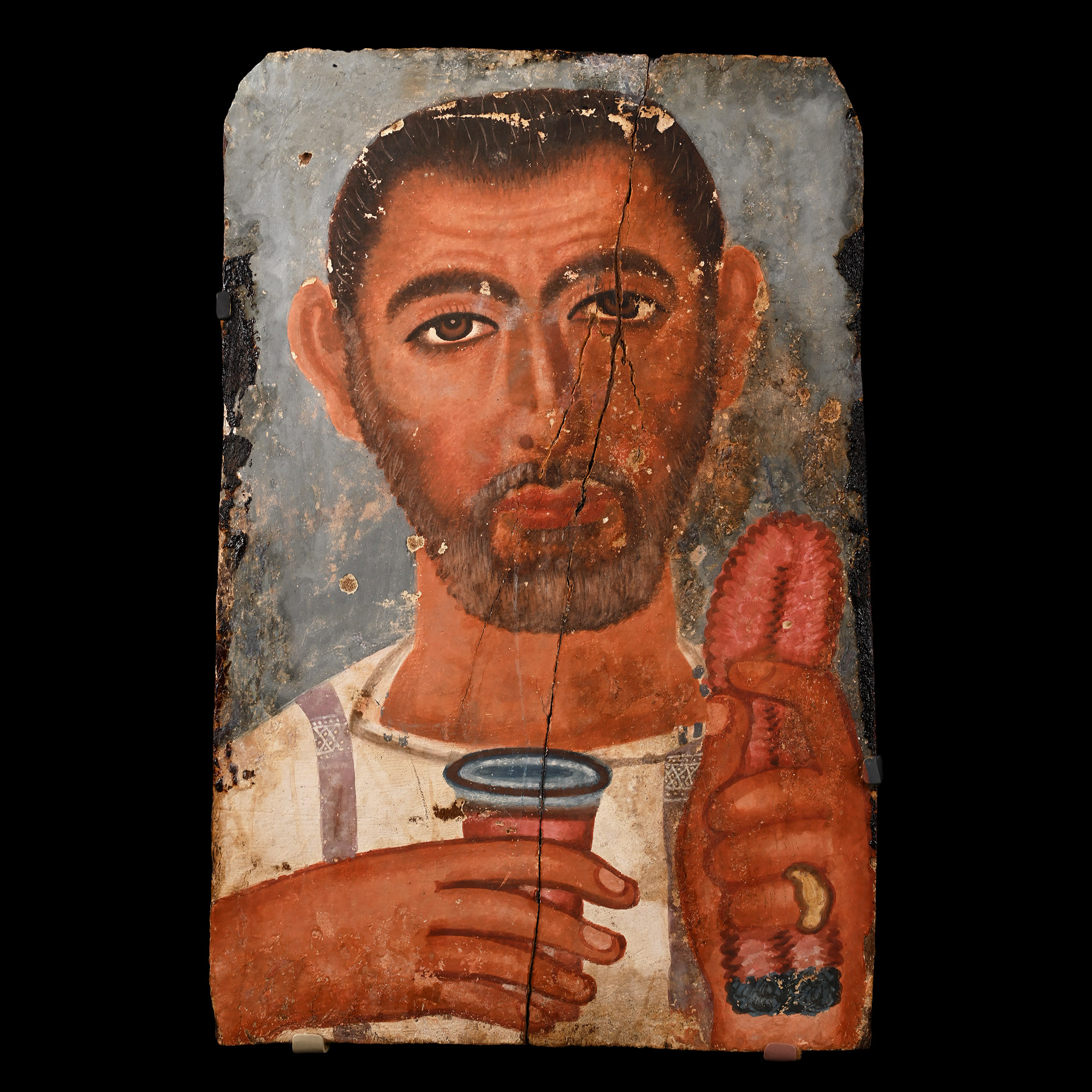
Set over the face of the dead
Panels like this one are the oldest, and very nearly the only, naturalistic panel paintings to survive from classical antiquity. Every comparable Greek and Roman painting on wood rotted long ago; these lasted because they were buried in Egypt, in sand dry enough to keep wood and paint for two thousand years. About nine hundred to a thousand are known, scattered now across the world's museums and across private collections. They take their name from the Fayum, the fertile basin south-west of Cairo where many turned up, though painted portraits of this kind were made the length of the Nile valley.
The purpose was funerary and specific. A finished panel was trimmed to fit and laid over the wrapped face of the mummy, held there by the outer bandages and a little warm resin. It did the work the older Egyptian cartonnage mask had done, keeping the face of the dead present and identifiable, now in the lifelike manner the Roman world expected of a portrait. Even among people who could afford mummification this was rare: at Hawara, where Flinders Petrie dug them in quantity, only one or two mummies in a hundred had a painted face at all. The families who commissioned them were the Fayum's Greek-descended landholding class, the people who could pay both for the embalming and for the very good painters the work required.
So the panel began its life pressed against a body, part of a burial meant to stay sealed. Through the nineteenth century, dealers and the diggers they hired prised the portraits off the mummies and discarded the bodies, which is why so few have any findspot worth the name. A handful of these people can still be named, where a painter or a relative wrote a label on the shroud: a young man called Artemidoros, an Ammonios on a shroud from Antinoopolis, an old man named Demetrios with his name and years set down in Greek beside him. This man is not among them.
The year the cemetery was sold
Where he is said to come from is a story about one dealer and one year. The catalogue assigns the panel to er-Rubayat, on the north-east edge of the Fayum, the burial ground of the Graeco-Roman town of Philadelphia. That name attaches to nearly every tempera portrait of his kind, and it attaches through Otto Theodor Graf, an Austrian merchant in carpets and then antiquities with shops in Vienna and Cairo. In 1887 local diggers opened a cemetery there, and Graf, through his Cairo agent, bought up almost the whole find: something like three hundred portraits by the lowest count, and perhaps well over that. The mummies were thrown aside on the spot. Some of the panels, contemporary accounts say, were burned as worthless before the survivors reached a dealer's hands.
Graf then toured the survivors as a sensation, through Munich and Berlin and on to Paris, London and the Chicago World's Fair of 1893, and oversold them badly, marketing some as portraits of the Ptolemaic royal house. They are nothing of the kind; nothing in them supports a date before the Roman period, and the label was dropped long ago. What Graf never did was record where anything had lain. He did not describe the site; an Austrian engineer mapped it two years later only as "the findspot of the Graf pictures," and the identification with Philadelphia's cemetery was settled afterward by the excavations of Grenfell and Hunt in 1900 and 1901. More than one cemetery was probably worked by his diggers. So "er-Rubayat" on a panel of this type is a trade attribution, a claim about where the group came from, not a record of where this board was found. Museums that own such pieces tend to write the careful formula "said to be from er-Rubayat,".
The attribution is a reasonable one all the same, because the er-Rubayat panels have habits. They are cut with the two upper corners clipped off at an angle, as here, so the board would seat neatly under the wrappings. Many of the sitters wear a decorated undertunic showing at the throat, as here. Susan Walker and Morris Bierbrier, whose 1997 catalogue Ancient Faces is still the standard English account of the subject, give both traits as characteristic of the group, while warning that neither is decisive: clipping the corners was a general funerary convenience, and a few panels filed under "er-Rubayat" on style may in fact come from elsewhere.
Graf's flood drew a darker suspicion at the time than any quibble over findspots. A thousand ancient Roman faces surfacing at once, through a single carpet dealer, looked to some like the output of a forger's workshop. The doubt was largely put to rest the following year, when Petrie's controlled dig at Hawara produced around ninety comparable portrait-mummies from a securely dated Roman cemetery, and the Graf panels stood vindicated as a class.
Water paint on a hard board
How the man was painted settles a second fact about the type. Fayum portraiture divides almost into two schools by technique. The famous Hawara faces are encaustic: pigment carried in hot beeswax, laid on thick and worked with a heated tool, so the surface stands up off the panel and holds the light like oil paint. This man is tempera, the other method: pigment bound in water-soluble glue or gum, brushed on thin and flat, the modelling built up in fine hatched strokes rather than blended. Encaustic reads waxy and luminous. Tempera reads matte and slightly chalky, and it is the signature of the er-Rubayat group.
For a long time tempera panels were dated late almost by reflex, their thin hatched surfaces taken for a decline from the rich Hawara wax-work. Walker's correction is worth keeping in mind: the apparent crudeness is the medium, not the century. Date a tempera panel by the fashions it shows, she argues, and many turn out to be roughly contemporary with the grander encaustics rather than later than them. The board itself is oak, or the kind of hard Mediterranean wood the er-Rubayat panels are usually cut from, a timber imported into a country that grew no oak of its own; the Hawara painters generally used a soft local lime. The closest published parallel to this panel, in the Getty, is painted on cedar of Lebanon whose timber radiocarbon-dates centuries older than the painting on its surface. Old wood was reused, and a board can be much younger than the tree it came from.
The colours are the ordinary ancient range, earths and minerals with a few Roman-era additions. The cool blue-grey ground behind the head is most likely a plain carbon-black-and-white grey, perhaps carrying a little Egyptian blue or indigo, both of which turn up in Graeco-Roman Egyptian greys even where the surface does not read as blue. The lilac stripe on his tunic, the clavus, is almost certainly a madder or rose lake cooled with white. That last pigment says something about the cloth it stands for. Real purple, the Tyrian murex dye that carried status at Rome, is essentially never found in Egyptian textiles; Egyptian "purple" was an imitation mixed from madder and woad, a plant-dye counterfeit that the surviving recipe papyri give working instructions for. The painter is depicting a garment, not analysing its chemistry, but the lilac he reached for is the colour of an affordable purple, which sits with everything else the panel says about the man's standing. None of this has been put to the instruments in this case. "Tempera" is a reading of the surface, a confident one, and the pigment names are the corpus norm rather than a report on this board; media were often mixed in any event, a little wax lingering in a film that is otherwise glue.
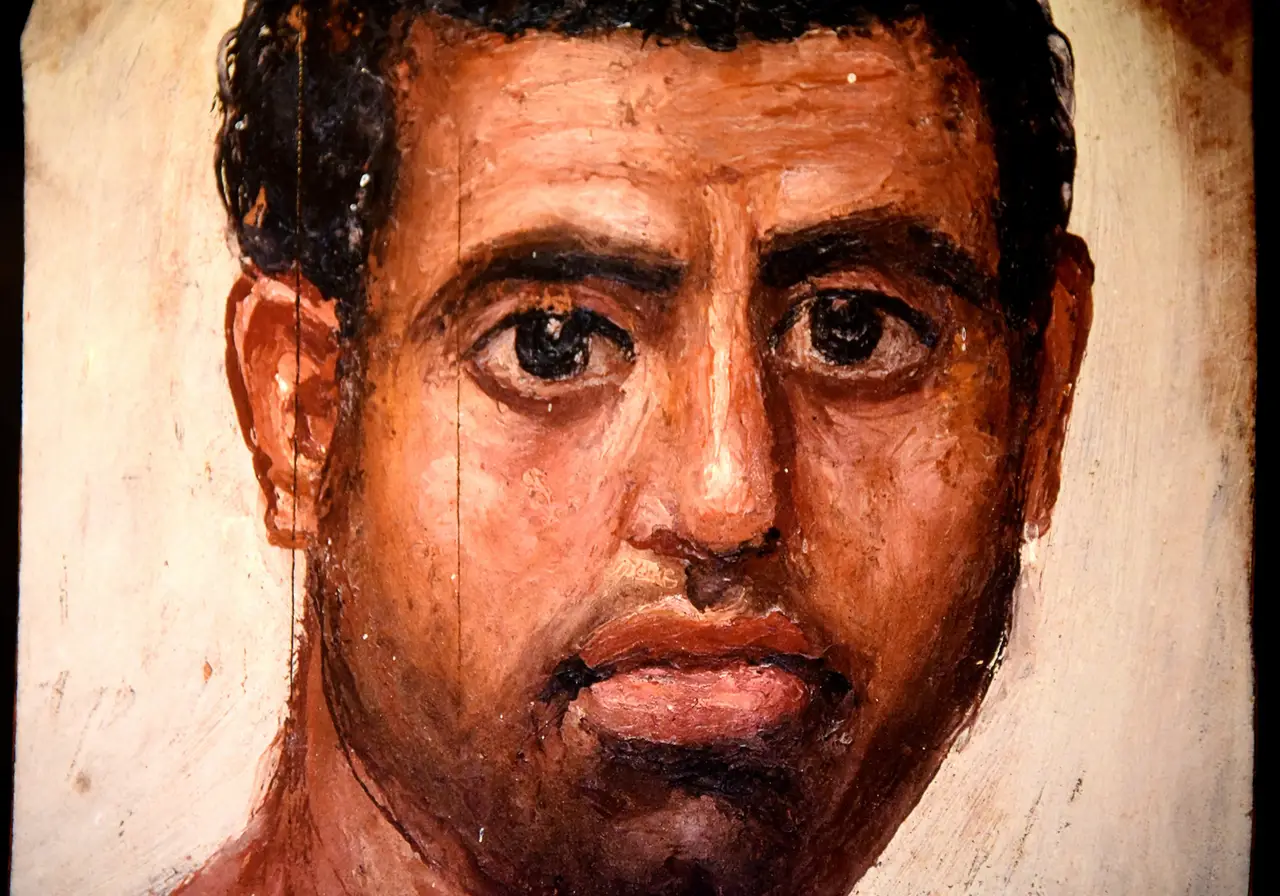 A mummy portrait of a man from Hawara, painted in encaustic, about AD 80 to 100. The thick, glossy beeswax and blended modelling are the Hawara manner, against which the flat, hatched tempera of lot 116 looks matte and dry. British Museum, London. Photo: Osama Shukir Muhammed Amin, CC BY-SA 4.0, via Wikimedia Commons.
The wine and the roses
The two things in his hands are where the panel stops being a generic bust and joins a small, recognisable family. Most Fayum portraits give a plain head and shoulders and nothing else. A minority hand the sitter something, and when they do, one pairing keeps recurring: a cup of red wine in one hand, a garland of roses in the other. It clusters exactly where this panel sits, among the tempera pieces of er-Rubayat and the later painted shrouds.
The reading nearly every scholar gives is funerary, and it should be held as a reading rather than a caption the painter left behind. The cup and the wreath look like attributes lifted out of the old funerary banquet, the Greek scene of the dead reclining at table with a cup in hand. Wine did double work in this culture, an offering to the dead in Egyptian practice and, to a Greek eye, unavoidably Dionysiac, a drink of immortality that folded the dead man into Dionysus-Osiris. The roses carry a charge of their own. Christina Riggs and others read the rose garland as the Egyptian "crown of justification," the wreath awarded to a person who had been weighed before Osiris and found true; the same flowers tie into the cult of Isis and into the Roman Rosalia, the spring festival when families carried roses to the graves. Petrie, digging at Hawara, turned up the real thing: preserved garlands of roses and narcissus laid on the mummies, the physical objects that these painted ones stand in for.
The glass is a real object too, not a symbol invented for the picture. Conical beakers with applied blobs of blue glass, exactly like the painted one, have come out of the ground in quantity at Karanis, elsewhere in the Fayum. And there is a near-exact match for the whole set. In the Louvre, on a linen shroud of the fourth century, a man holds a glass tinted pink with the wine inside it, wears two gold rings with one on the little finger, and carries, in Walker's words, "the garland of roses of the deceased favourably judged by Osiris." Change the support from linen to oak and you have this panel's programme, ring and all.
The red cup has a history of misleading its viewers. Early scholars saw a Christian chalice and read the imagery as Eucharistic; Édouard Naville did just this with a related group of mummy-masks. This is traditional Graeco-Egyptian funerary symbolism, made by and for people still practising the old religion, and the genre dies out precisely as Egypt turns Christian and gives up mummification. The man holds the wine of an eternal Egyptian banquet, not a sacrament.
How old is he
The catalogue answers the question with a range, "3rd to 4th century,". Fayum portraits are dated the way a costume historian dates an old photograph, by matching hair, beard, jewellery and dress against Roman coins and sculpture that can be fixed on other grounds. Beards on men come into fashion under Hadrian, in the first half of the second century, so a bearded sitter is unlikely to be earlier than that. This particular look, hair cropped short and receding, going grey, with a close-trimmed beard, is the soldierly grooming of the Severan period in the early-to-middle third century, made fashionable by the emperor Caracalla. Walker points to a near-twin in the Getty, a tempera panel of a man with "dark close-cropped hair receding at the temples in the manner of Severan portraits," dated to about AD 220 to 250. On the evidence of his own face, that is where this man belongs.
His wine and his roses pull the other way. The cup-and-garland package, Walker notes, became common only toward the end of the third century and through the fourth, and the glass on that Louvre shroud is a late-fourth-century shape. Fashion says early third; iconography says late third or fourth; and "3rd to 4th century" is what you write when you refuse to fake a precision the object cannot support. The wider scholarship splits the same way. Barbara Borg, whose 1996 study reset the field's chronology, allows no portrait panel later than the middle of the third century, a deliberate correction of Klaus Parlasca, who had defended dates running on into the fourth. Fashion-dating is loose in any case. Petrie already complained that provincial Egypt lagged Rome by as much as seventy years, and radiocarbon, thrown off by that reused old wood, resolves only to within about a century. The safe statement is the range. Pressed for a verdict, the beard votes for the earlier end.
The painter with no name
The last claim the catalogue makes is the boldest and the most fragile: that this panel may come from the hand of one identifiable ancient painter. No mummy portrait is signed. Not one, anywhere. To speak of a "hand" at all, scholars borrow a method built for another body of anonymous art, the sorting of unsigned Greek vases by John Beazley, who had taken it in turn from Giovanni Morelli's way of telling Renaissance painters apart by the small unconscious habits an artist repeats without thinking: the drawing of an ear, a lip, a hand. Apply that eye to these panels and clusters emerge, individual temperaments visible across several boards. David Thompson made the debt to Beazley explicit and, following Parlasca, gave the clusters names, among them the Malibu Painter, the St Louis Painter, and the Brooklyn Painter.
The Brooklyn Painter is Parlasca's own coinage, for a group of small tempera panels of children and young adults from er-Rubayat, now placed around AD 200 to 250. Two of them are the pieces the catalogue names as parallels to this man. One is a boy in the Brooklyn Museum with a bound garland of pink rose petals in one hand and a blue glass beaker of red liquid in the other, the same objects this man holds. The other is the Getty portrait already mentioned, a man with a pink garland and a small glass of wine. Parlasca, the catalogue reports, "some years ago suggested that the present portrait may be attributed to the same hand."
Notice how carefully that is phrased, and keep it careful. Parlasca himself admitted that his groupings were often "only suggestions," tentative by nature. Even this group's core is disputed: Walker thinks several painters were involved, and quietly removes one long-assumed member, a child's portrait in Brooklyn she judges to be by a different hand. Her verdict on the Getty man is the right model for how much weight the word "attribution" can carry here. The link to the Brooklyn Painter, she writes, "is very likely right, at least for this painting if not for the whole group," and the shared features are matters of style, not of a single repeated face. The wine and the garland do not strengthen the case; they are a workshop formula, and prove only that the painter knew the convention. What speaks for a single hand are the small involuntary things: the set of the eyes and lashes, the brows meeting over a long thin nose, the pursed lips with a pucker at each corner, the oddly elongated, ill-drawn hands. Those are the marks a copyist does not think to copy. The attribution is a good argument. It is not a document, and the field's most careful readers do not pretend that it is.
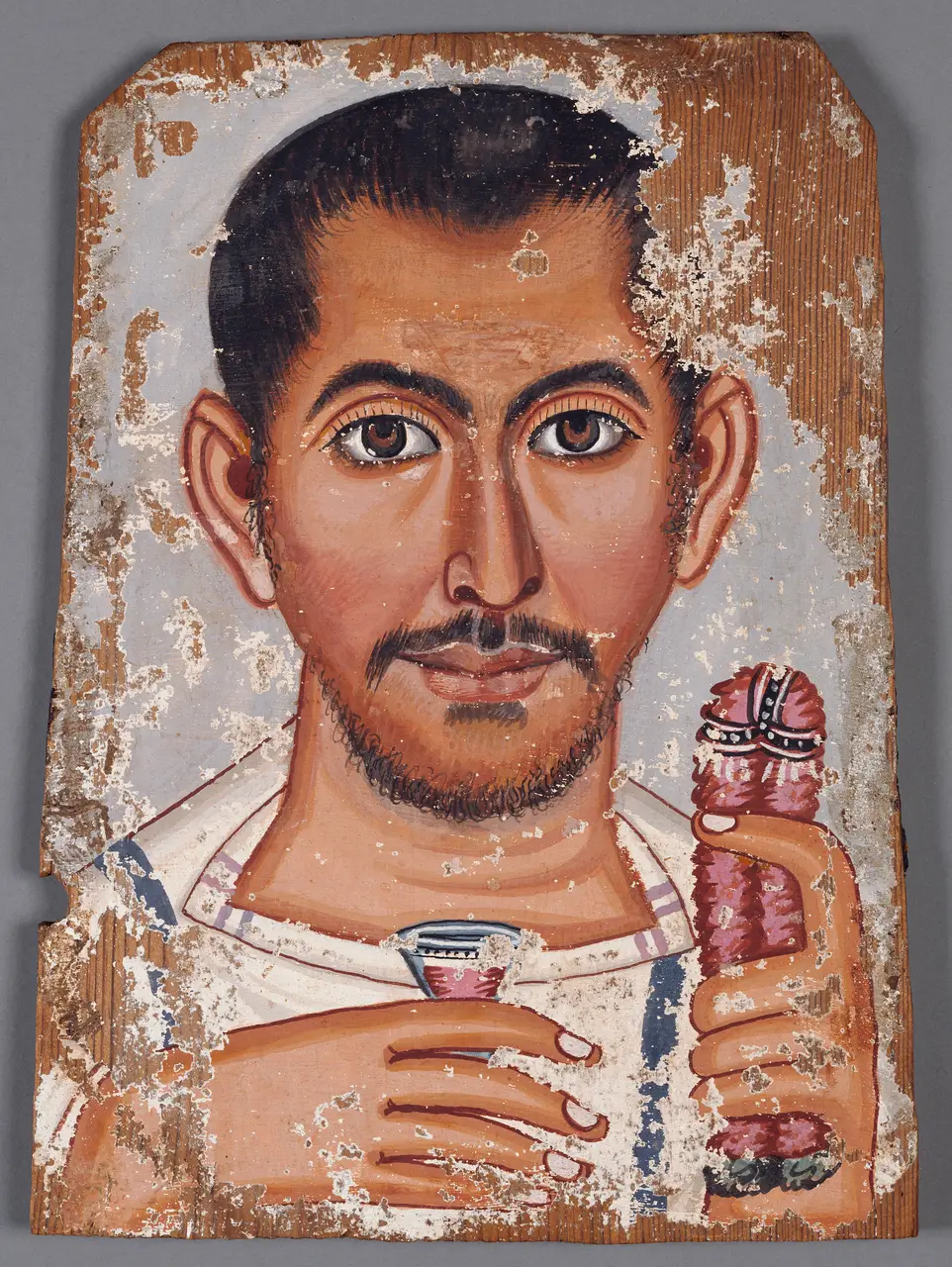 The Getty portrait of a man, tempera on a clipped-corner cedar panel, about AD 220 to 250, holding a small glass of wine and a bound garland of rose petals. It is the closest named parallel to lot 116, and one of the panels assigned to the hand Parlasca called the Brooklyn Painter. The J. Paul Getty Museum, Los Angeles, Open Content Program.
One fixed point holds under all this drift. A single member of the Brooklyn Painter's group was actually excavated, a boy's portrait dug up at er-Rubayat by Grenfell and Hunt in 1901, now in Dublin, found beside a woman's portrait, now in Edinburgh, that may be the same painter's work for one family. Everything else in the group, this panel included, hangs off that one securely buried board. Another member spent much of the twentieth century among Sigmund Freud's antiquities.
A firmer recent past
The panel's own recent history holds a last irony: we know more, and know it more securely, about where this board has been in the past thirty years than across the seventeen centuries before.
It surfaces in the record at Sotheby's in London on 12 June 1997, in a sale that folded a well-known private collection into a general antiquities auction. The collection was the Erlenmeyer, formed in Basel between the 1940s and the early 1960s by Hans Erlenmeyer, a professor of chemistry from the family that gave the laboratory its Erlenmeyer flask, and his wife Marie-Louise. It was known above all for ancient Near Eastern material, cylinder seals and cuneiform, and because the Erlenmeyers never published it in full, the auction catalogues from its dispersal became its main published record, which lends such a citation real evidentiary weight. The dispersal ran through the 1990s to fund an animal-welfare foundation Marie-Louise had established.
The 1997 sale was an "Antiquities" auction with the named Erlenmeyer Near Eastern group folded into it, and an Egyptian panel turning up as lot 338, near the tail, most likely rode along in the general portion rather than belonging to the Near Eastern collection proper. What is documented is a published market appearance in 1997, carrying an estimate then of forty to fifty thousand pounds, traceable to a named and reputable Swiss dispersal. It is uncommon for painted wood of this age to survive at all, and less common still for a panel to reach the market with a documented twentieth-century history behind it.
The panel also carries an Art Loss Register certificate and an Interpol database check, and it pays to be plain about what those do. The Art Loss Register is a commercial database of some seven hundred thousand reported stolen, looted or disputed objects; a clean certificate means the panel matched nothing on it. Interpol's smaller database of stolen art returns the same answer. Both are searches against what has been reported stolen.
His name went into the sand with the mummy the diggers threw away, and no amount of connoisseurship gets it back. The crack still runs down through the beard where the old board dried and split. The gold ring is still on his little finger, worn where Roman men wore it; the roses are still bundled in his raised hand; the wine is still red in the glass.
TimeLine Auctions, 19th August 2026