Home > Stories by TimeLine Auctions
Stories by TimeLine Auctions
A Million Years for £195: Ten Real Antiquities We Sold for Under £200
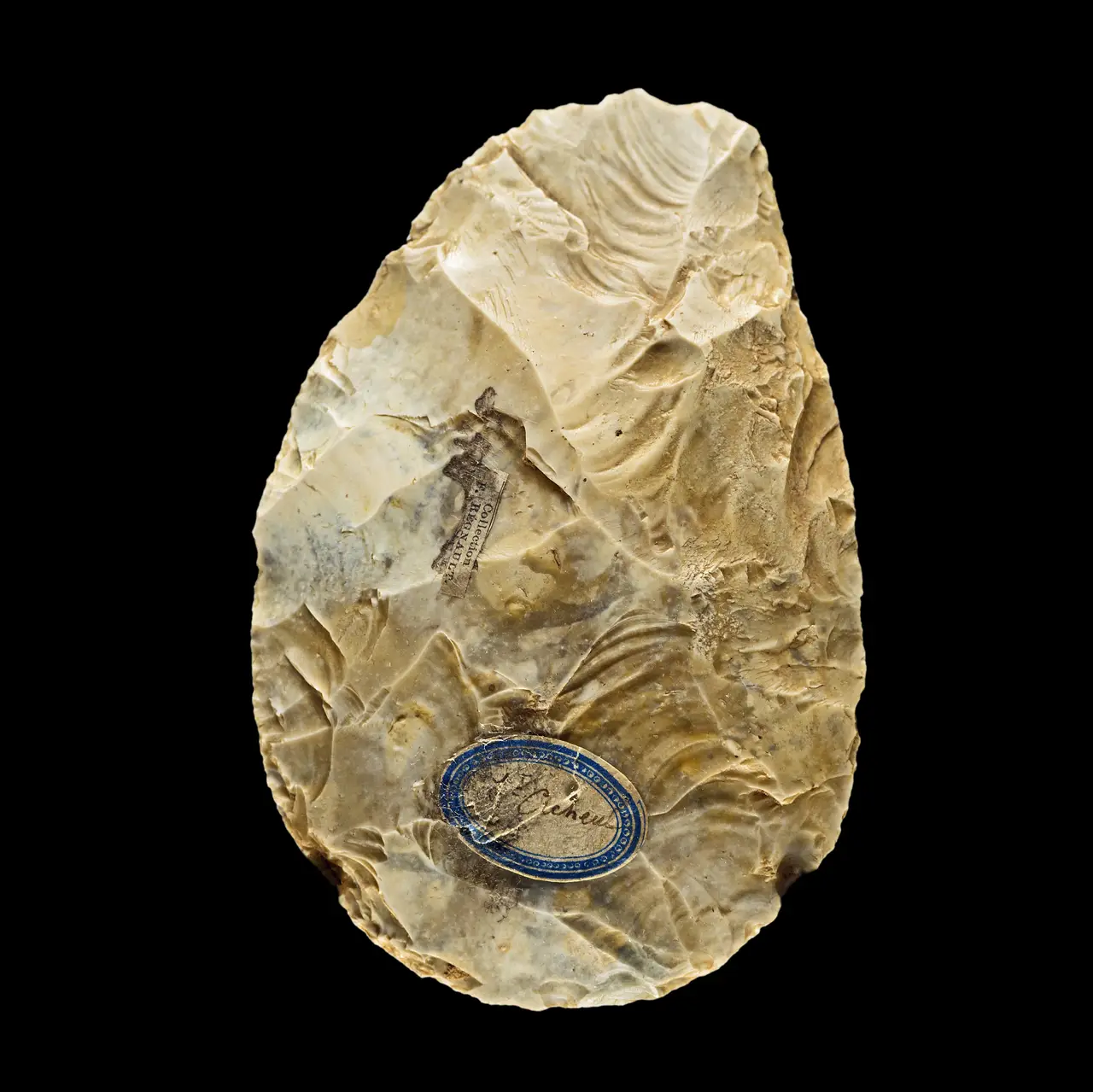 A flint handaxe from Saint-Acheul near Amiens, the site that gave the Acheulean its name. Tools of this kind were made to much the same pattern for over a million years and survive in enormous numbers. Muséum de Toulouse. Photo: Didier Descouens, CC BY-SA 4.0, via Wikimedia Commons.
A quartzite handaxe, worked from a river cobble somewhere in the northern Sahara around three-quarters of a million years ago, sold in our June rooms for £195. Whoever shaped it was not one of us. The maker belonged to an earlier human species, and the tool is older than Homo sapiens. £195 is roughly a dinner for two in central London.
Most writing about auctions fixes on the top of the room, the gold and the named Greek vases and the imperial portrait bronzes. Below all of that sits a deep shelf of objects that are genuinely ancient and cost very little, and the reason is supply. A million years of stone tools. Hundreds of thousands of clay tablets. The industrial coin output of empires. The everyday glass buried in Roman cemeteries. When a thing survives in quantity, a real example of it costs less than a concert ticket, and that abundance is no mark against it.
Here are ten we sold for under £200. They run from a North African riverbed a million years ago to a lump of asteroid that cratered Argentina before the pyramids were finished. The ten together cost £1,535, across two recent sales. Each comes with one thing worth knowing, because every one of these is more interesting once you understand what it actually is.
1. A handaxe older than our species, £195
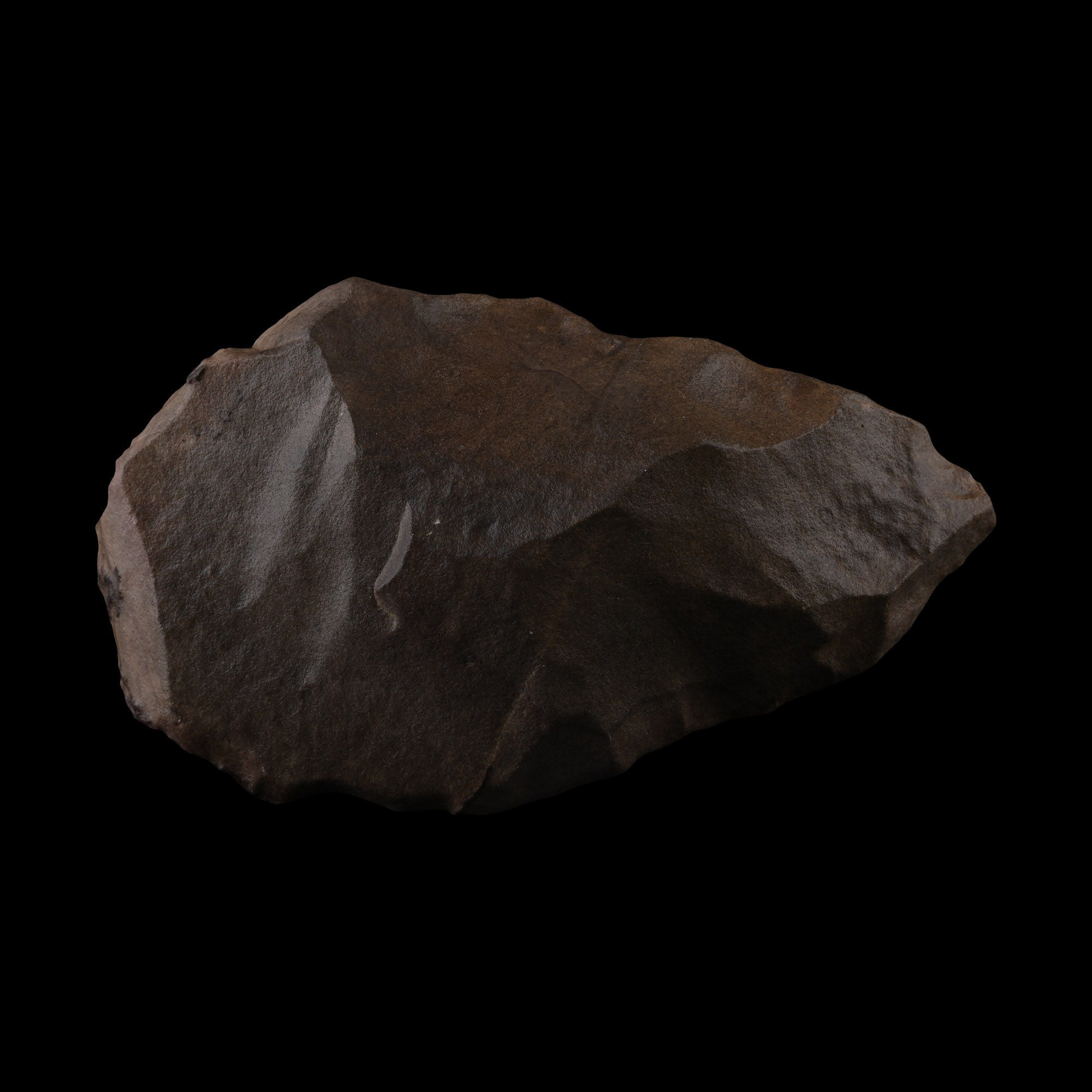
This one is a cordate, or heart-shaped, biface: 18.5 cm long, 1.17 kg, still wearing a cap of chocolate-brown cortex at the base. You can hold in one hand an object designed and made by a different human species, Homo erectus or ergaster, older than our own (sapiens is around 300,000 years old). It belongs to the longest-lived technology anyone has ever made. The Acheulean handaxe, named after Saint-Acheul near Amiens, where finds in the 1850s helped prove the antiquity of humankind, was produced to much the same template for well over a million years, something like fifty thousand generations. The earliest securely dated examples, from Kokiselei in West Turkana, reach back 1.76 million years, as Christopher Lepre and colleagues established in Nature in 2011. Nothing invented since has had a run anything like it.
Despite the name, there is no haft and no handle: it was held directly in the hand, which is why archaeologists call it a biface or a large cutting tool. "Around a million years" is the age of the type, a typological bracket rather than a measurement of this particular stone, since a loose surface find from the Sahara cannot be dated to the year. Microwear and butchery experiments point to a general-purpose cutting tool, used to joint carcasses and cut hide but also to work wood and process plants, with no single task clearly dominant. The well-known idea that the over-engineered symmetry was a fitness display to attract mates, put forward by Marek Kohn and Steven Mithen in 1999, is a real and much-argued hypothesis rather than a settled fact; the symmetry may simply have made the tool easier to grip and use. North Africa is, almost literally, paved with these. Saharan lake and spring sites have yielded them by the thousand, which is the whole reason a real one costs under £200.
2. A painted bowl from one of the first cities, £156
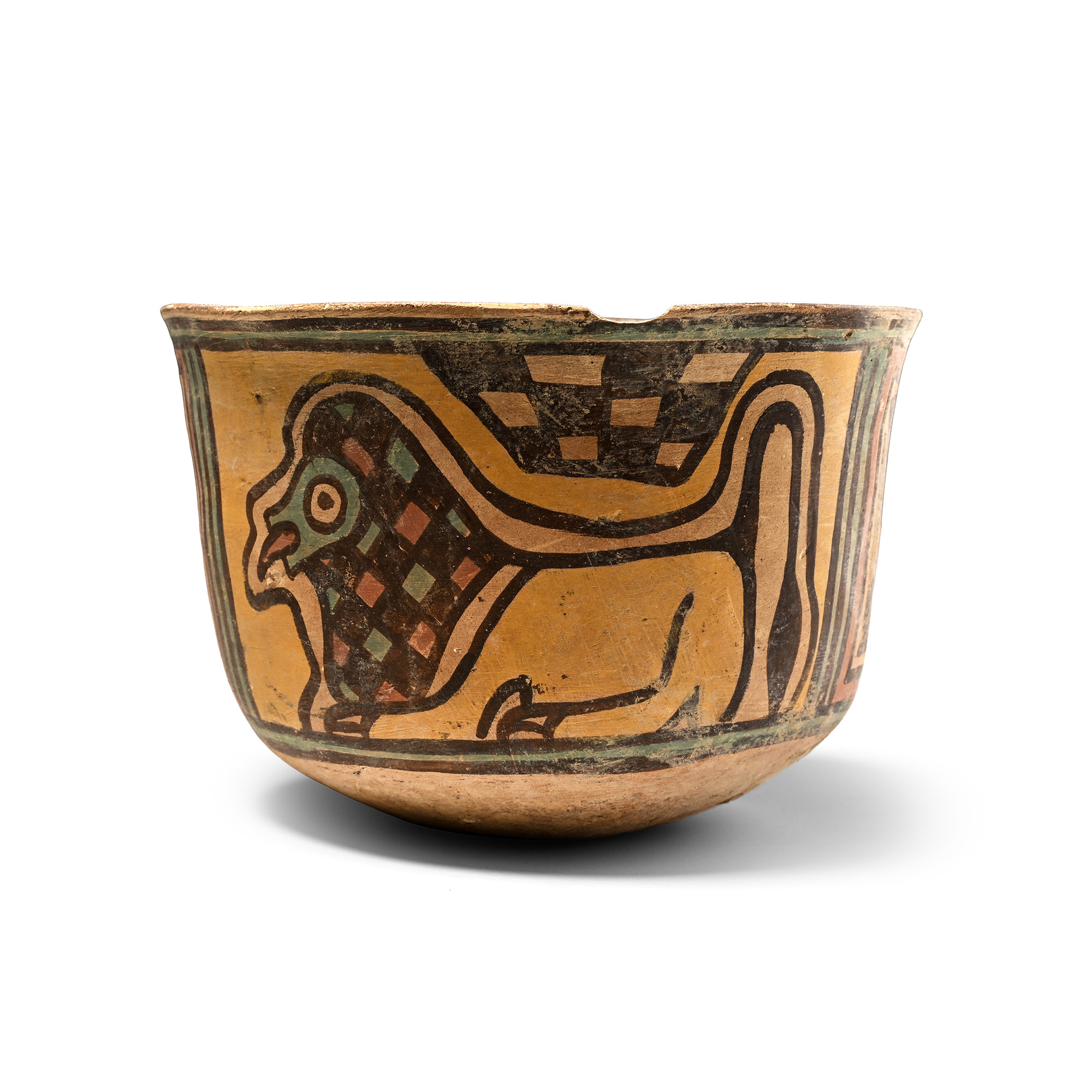
A bell-shaped bowl on a buff slip, painted in red, black and green with panels of geometry, a crouching big cat with a checkerboard body, and a pair of fish; 12.5 cm across, the rim chipped. It came from a London collection of Bronze Age pottery formed in the 1970s. The painter worked roughly 4,500 years ago, in the borderlands of the Indus civilisation, the third of the world's first urban societies alongside Egypt and Sumer, a world of planned brick cities. The vocabulary of the painting, schematic fish, caprids, foliage and geometric panels on buff, is textbook for the Bronze Age wares of Balochistan and the Indus borderland: Nal, Kulli, Quetta, Nausharo. John Marshall, who directed the excavations at Mohenjo-daro, illustrated the same painted vocabulary of fish and animals in his 1931 report.
Mehrgarh, the region's earliest known farming village, founded around 7000 BC in the Bolan Pass, has lent its name as a loose label for this whole painted-pottery world; bowls of this kind belong to the later, third-millennium traditions of the same borderland. For an unprovenanced pot the exact site cannot be recovered, so "Indus borderland, third millennium BC" is as far as the evidence reaches. The crouching cat is most likely a tiger or a leopard rather than a lion, since there are no convincing lions in Indus art, and the Indus script remains undeciphered, so whatever else the pot does, it says nothing anyone alive can read.
3. A piece of the first writing, and it is a receipt, £195
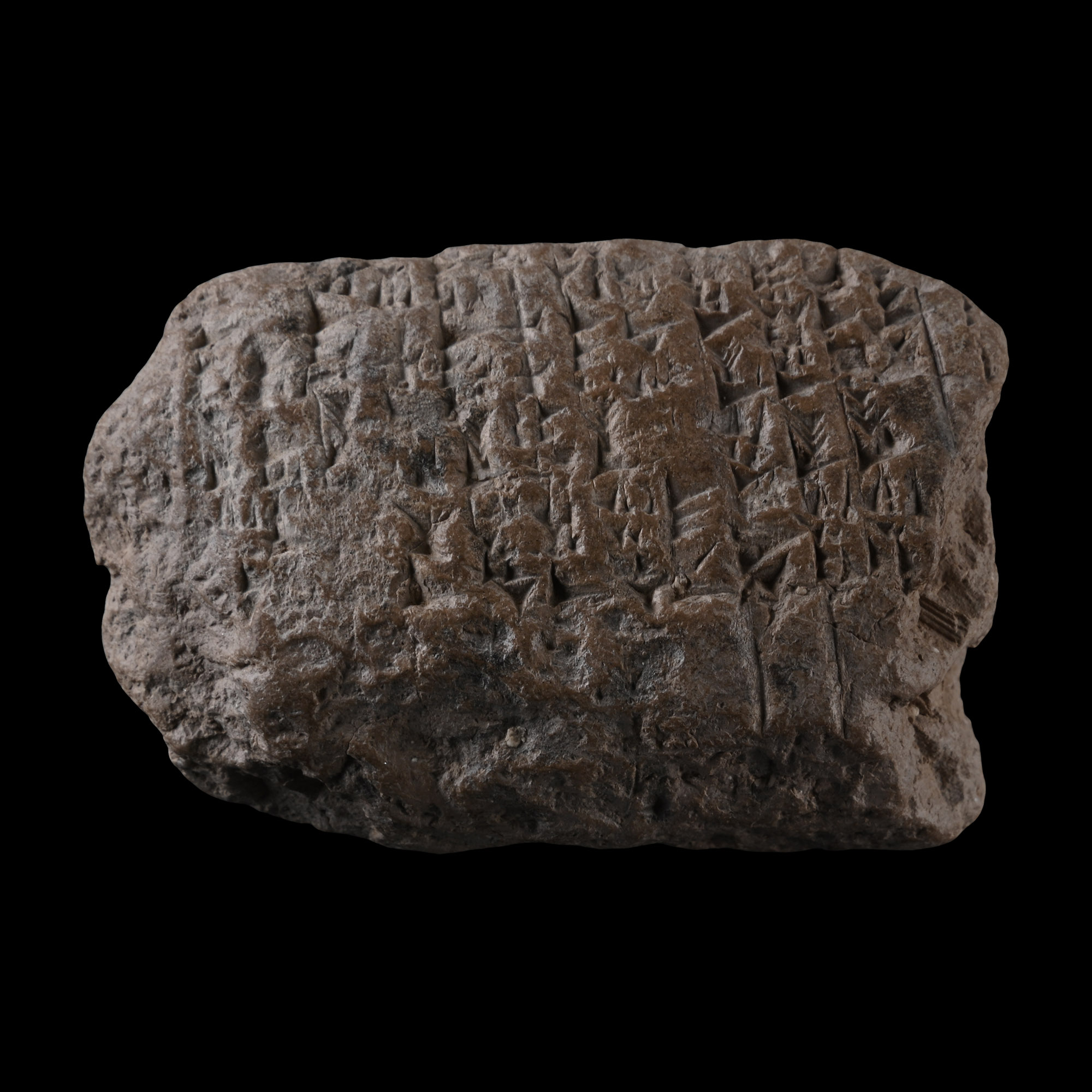
Cuneiform is the earliest writing we know of, and you can own a piece of it for under £200. The everyday truth is better than the legend. This pillow-shaped fragment, 71 mm across and dense with wedge-signs on both faces, is early second-millennium BC, Old Babylonian, the world of Hammurabi. It is almost certainly not a hymn or an epic. It is paperwork: a receipt, a ration list, a contract. The first thing humans did with writing, overwhelmingly, was keep accounts.
Cuneiform, from the Latin cuneus, a wedge, was made by pressing a cut reed into wet clay, each sign impressed rather than drawn, the tablet then usually left to dry in the sun rather than baked. The proportion of literature in any archive is tiny, dwarfed by the accounts, receipts and ration lists that clay was really for. Clay was cheap, so writing recorded the mundane, which is exactly why so much of it survives. Up to a million tablets already sit in the world's museums, with many millions more thought to be still in the ground; abundance, again, sets the price. On an inexpensive object the provenance is real reassurance, and this one has it: the fragment was examined by Professor Wilfred Lambert, author of Babylonian Wisdom Literature and one of the twentieth century's leading Assyriologists, who died in 2011. Two final cautions. Unbaked clay is fragile and draws in salts, and reading cuneiform takes a specialist, so a fragment's text may never be fully identified. Buy it as an object with four thousand years behind it, not as a document you will read.
4. The fly that stood for nerve, £130
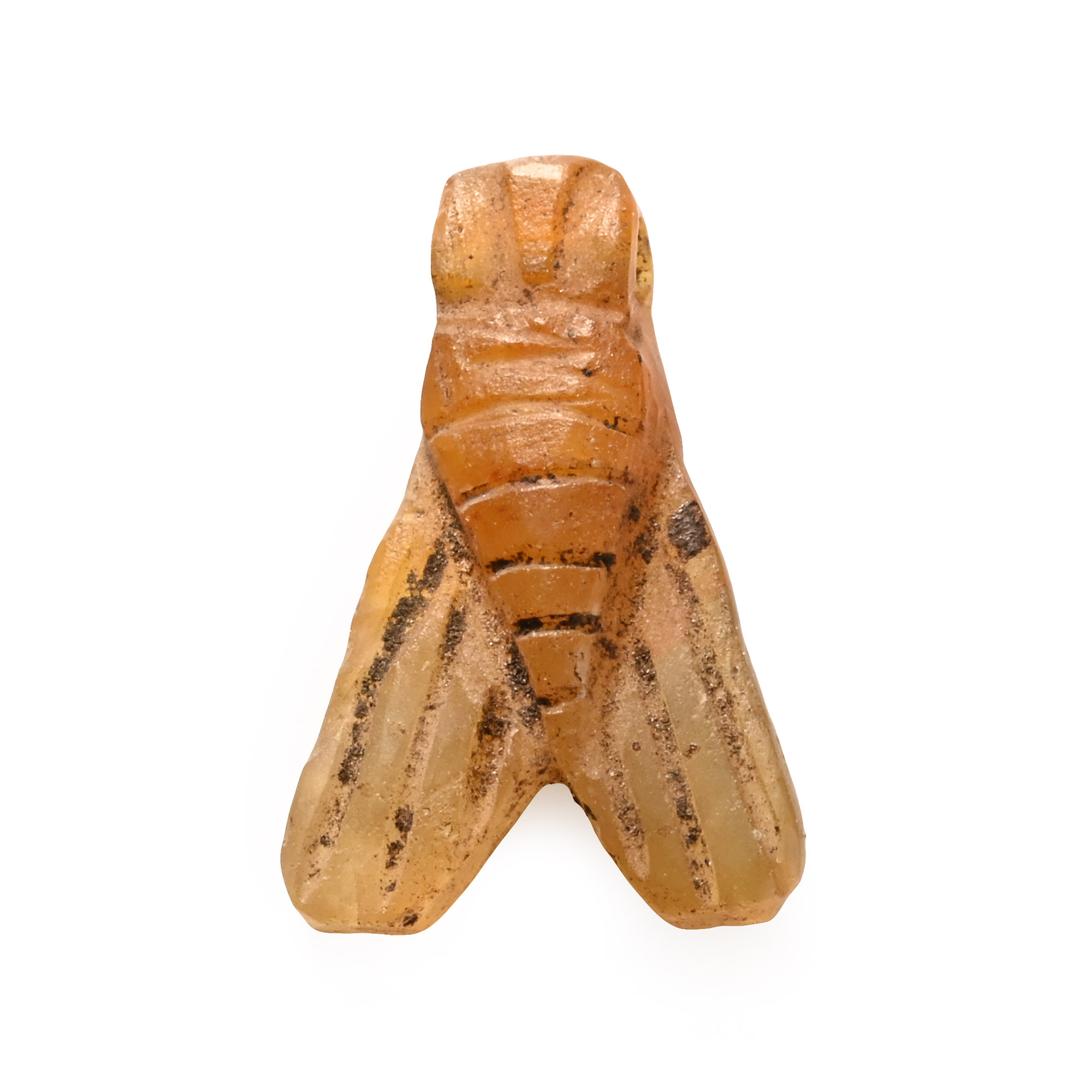
The Egyptians looked at the most maddening insect they knew and turned it into a badge of nerve. The logic is direct: be as hard to swat away as a fly, as impossible to drive off as one. This example is carved from honey-coloured carnelian, body and wings detailed, a suspension loop above the head, 12 mm long and a third of a gram in weight, of the Late Period (664 to 332 BC). Flies were worn as amulets in Egypt from the Predynastic period onward, in gold, silver, faience, lapis and bone, partly as sympathetic magic to ward off the very pest they show, partly for the fly's associations with speed and persistence. Carol Andrews, whose Amulets of Ancient Egypt remains the standard reference, sets out both readings.
The famous military award, the large gold pendant given for bravery and sometimes called the Order of the Golden Fly, sits at the grand end of this tradition. Queen Ahhotep, mother of the pharaoh who expelled the Hyksos, was buried with three big gold flies, now in the Luxor Museum. A small carnelian charm like this one belongs to the everyday end of the same idea, worn for the fly's qualities rather than awarded for a battle. Even the grand version is less settled than it sounds: Taneash Sidpura, reviewing the surviving golden flies in 2022, found them too varied in size, material and form to work as a single, recognisable decoration, and noted that most of the flies whose archaeological context is known come from the graves of women rather than soldiers. "Order of the Golden Fly" is a modern label rather than an attested ancient institution. The fly stood, by long tradition, for persistence and courage, with the precise meaning of any one example still argued.
5. Small change from Alexander's lifetime, £143
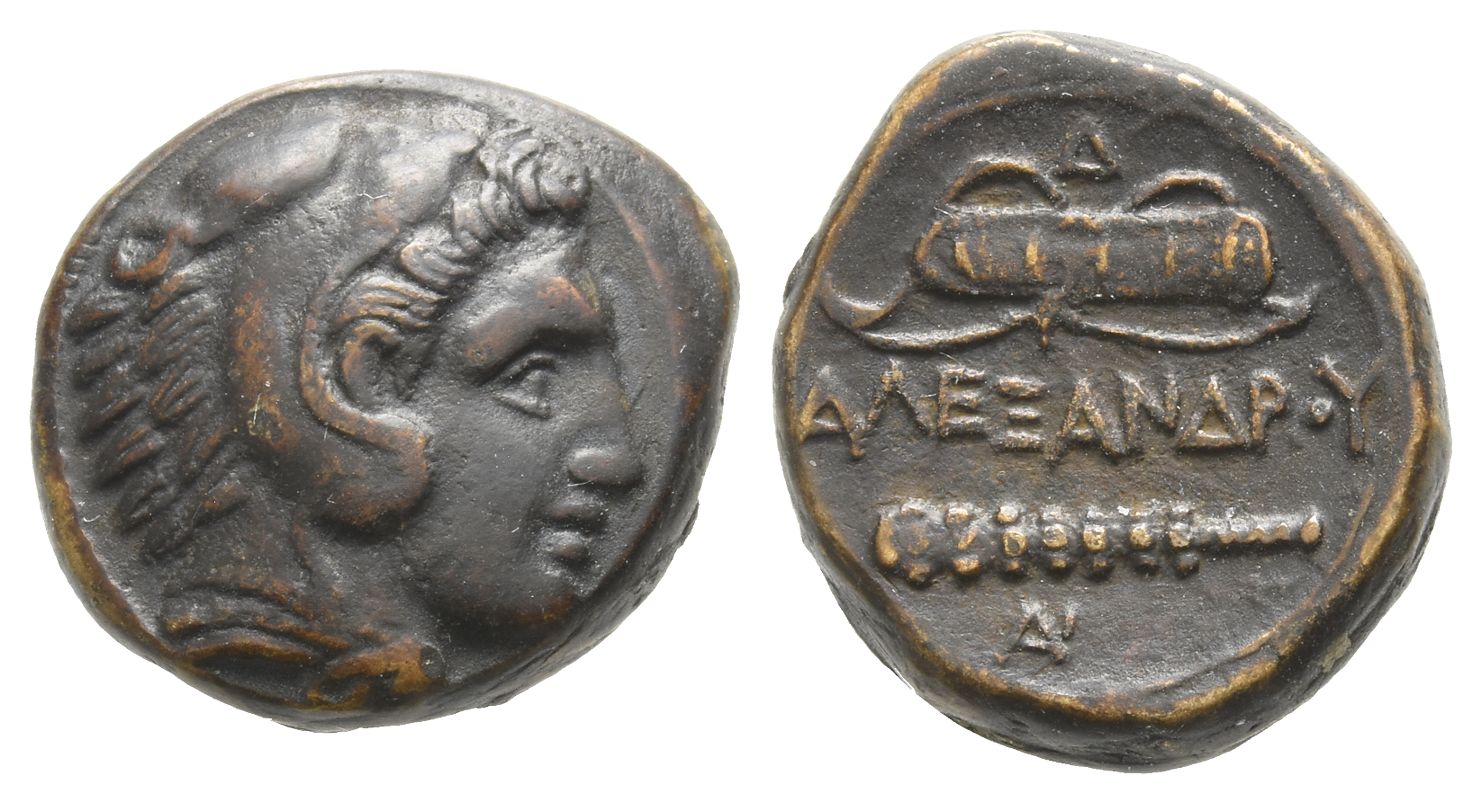
For £143 you hold bronze small change struck while Alexander was alive, the everyday cash of the empire he was cutting from Greece to the Indus. The coin weighs 6.78 g and is graded extremely fine. On the front is the head of Herakles in his lion-skin; on the back, ΑΛΕΞΑΝΔΡΟΥ with the hero's club and a bow in its case (Price 292, in the catalogue of Martin Price, whose 1991 study is still the standard reference for the series). Alexander's coinage was huge and standardised, silver tetradrachms and drachms alongside these little bronzes, struck across dozens of mints and continued for decades after his death by his Successors. That sheer output is why a coin tied to antiquity's most famous conqueror costs the price of a good dinner.
The head is Herakles, though the resemblance to Alexander was the point: the Macedonian royal house claimed descent from the hero, and Alexander was said to wear the lion-skin in his own image, so the echo was deliberate and grew stronger as the coinage developed. Whether to read the face as "Alexander in the guise of Herakles" is an old and reasonable argument rather than a settled fact, which is why it is catalogued as Herakles with the intended echo noted. Two plainer notes: "lifetime issue", meaning struck between 336 and 323 BC rather than drawn from the much larger posthumous flood, is contested for many coins, and the mint of this one is simply uncertain.
6. The coin of the man who tried Jesus, £111
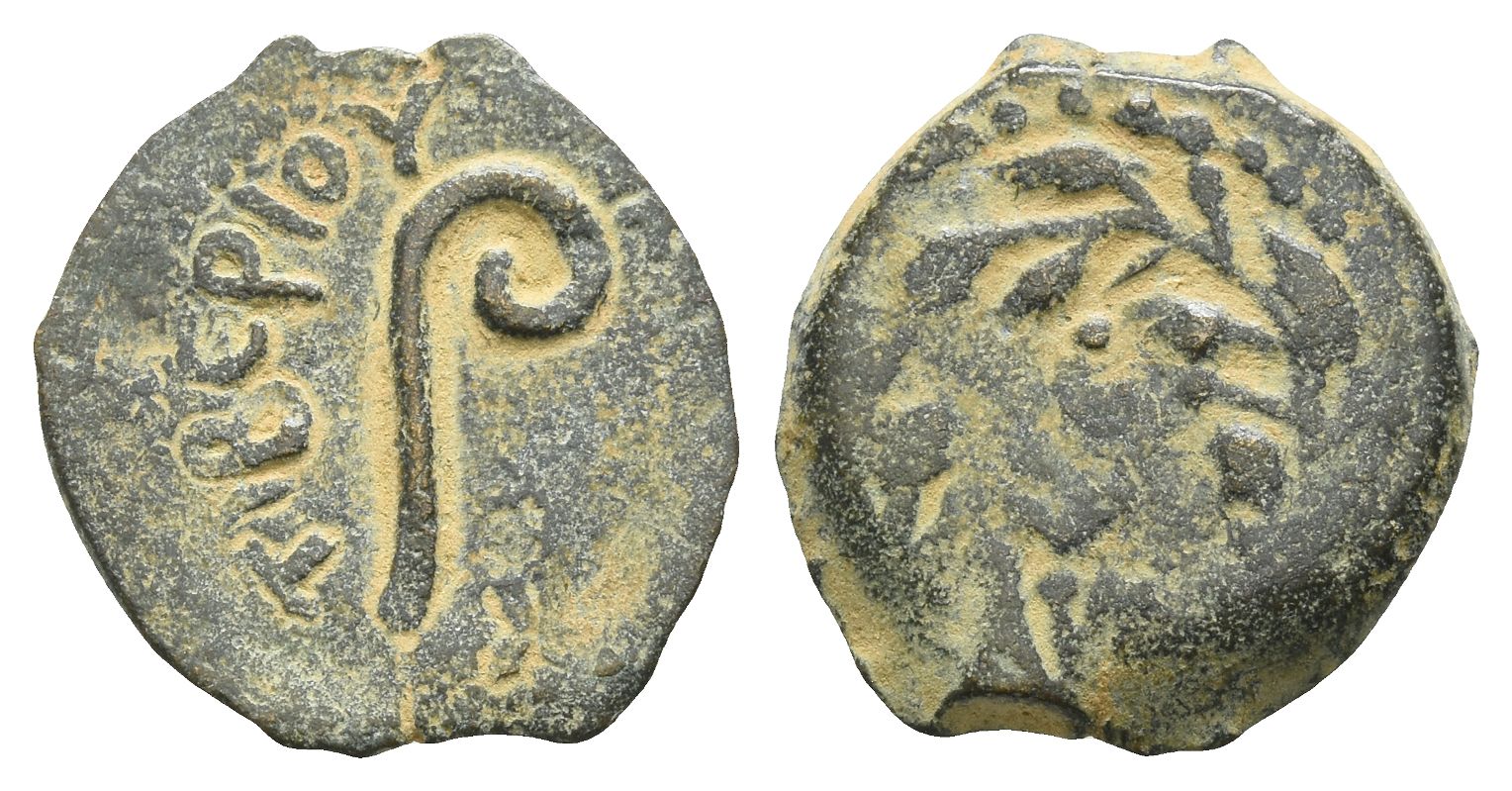
Two grams of copper, issued in Jerusalem by Pontius Pilate, the Roman governor who, the Gospels say, washed his hands of Jesus. Coins like this one were the small change of Judaea during the years of Jesus's ministry, and material traces of Pilate are otherwise close to nonexistent: essentially these coins, one inscribed stone, and a copper ring from the Herodium that may or may not be his. That is what makes the £111 surprising. Pilate was prefect of Judaea from about AD 26 to 36 and struck dated bronze prutot at Jerusalem in three years. He broke with his predecessors, who had kept to neutral farming imagery, by putting Roman priestly implements on coins circulating in a Jewish province: a simpulum, the libation ladle, on his first issue and, as here, the lituus, the augur's curved wand, with the year inside a wreath on the other face.
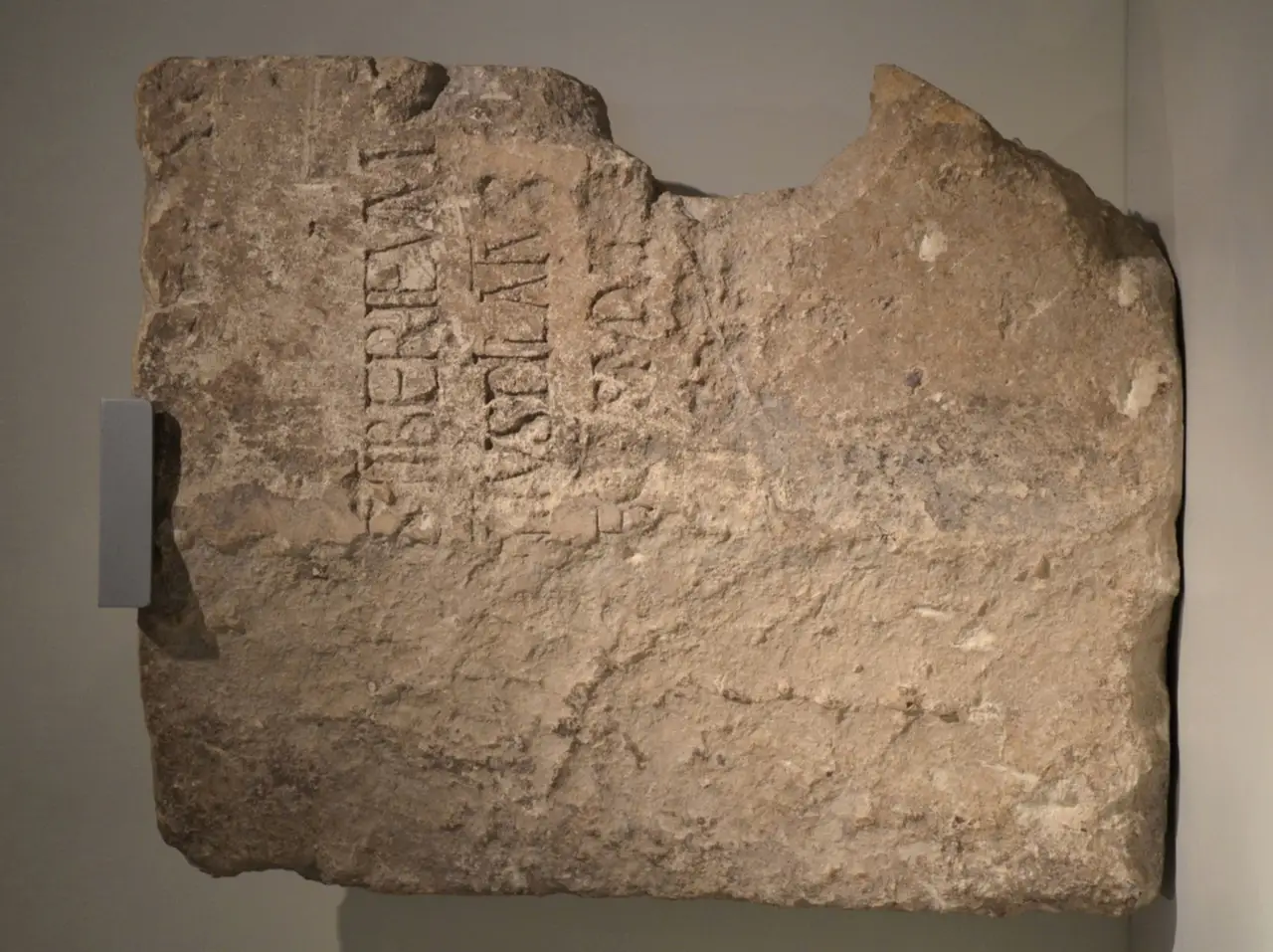 The Pilate Stone, found reused in the theatre at Caesarea Maritima, the one inscription that records Pontius Pilate by name and title. Israel Museum, Jerusalem. Photo: Carole Raddato, CC BY-SA 2.0, via Wikimedia Commons.
Whether that choice was deliberate provocation is genuinely argued. Helen Bond, in a 1996 study of the coins, rejects the provocation reading, since the single most offensive option, the emperor's portrait, was never used; Joan Taylor, in 2006, takes the imagery instead as promotion of the imperial cult. The provocation case leans on Josephus, who records Pilate marching military standards into Jerusalem and raiding the Temple treasury to fund an aqueduct. It is worth knowing that this prutah is not the "tribute penny" of "render unto Caesar", which is a silver denarius of Tiberius bearing the emperor's portrait, a different coin from a different mint, nor is it one of the "thirty pieces of silver", usually identified as Tyrian shekels. This one carries the date year 17, AD 30 to 31, the kind of figure that can be hard to read on worn copper.
7. The bottle whose rainbow is decay, £130
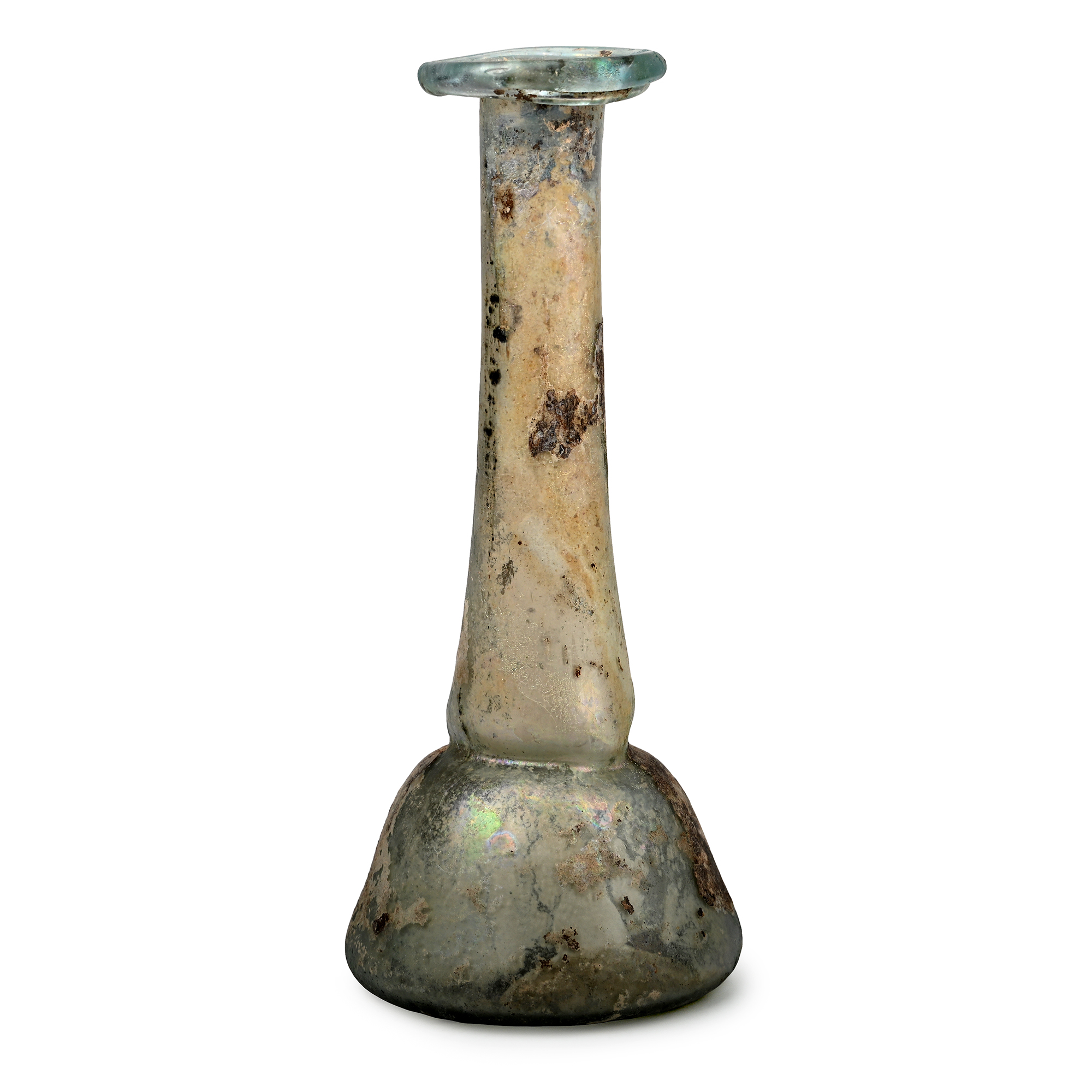
The shimmer that makes this bottle lovely is two thousand years of slow chemical decay. The Romans made it as plain, clear glass; the rainbow is what burial did to it. It is a free-blown unguentarium, a small flask for scented oil, balsam or cosmetics, 13.2 cm tall with a bell-shaped body, a pinched neck and a rolled rim, of the first century AD. Flasks like it are affordable today because of the glassblowing revolution: free-blowing, developed by Syro-Palestinian workers in the first century BC and perfected over the following century, made glass cheap and ubiquitous across the empire, and unguentaria turn up in their thousands, above all in graves.
The iridescence is weathering rather than decoration. Buried in damp soil, the glass slowly loses its alkali as water leaches it out, and the surface splits into microscopically thin flakes of hydrated silica that diffract light, the same physics as oil on a wet road or a soap bubble. The shimmer is the glass deteriorating, not anything the makers intended, and the chemistry was worked out as early as 1931, by A. W. Laubengayer, on Roman glass from tombs in Cyprus. Two old stories cling to flasks like this. They are often called "tear bottles" or lachrymatories, though they held oils and perfumes, not mourners' tears, a Victorian fancy spun partly out of Psalm 56. And the rainbow is not a mark of quality: glass that stayed dry, on a tomb shelf rather than in wet silt, often shows almost none of it, so the colour really tracks how wet the ground was.
8. Two dice you would recognise, £195
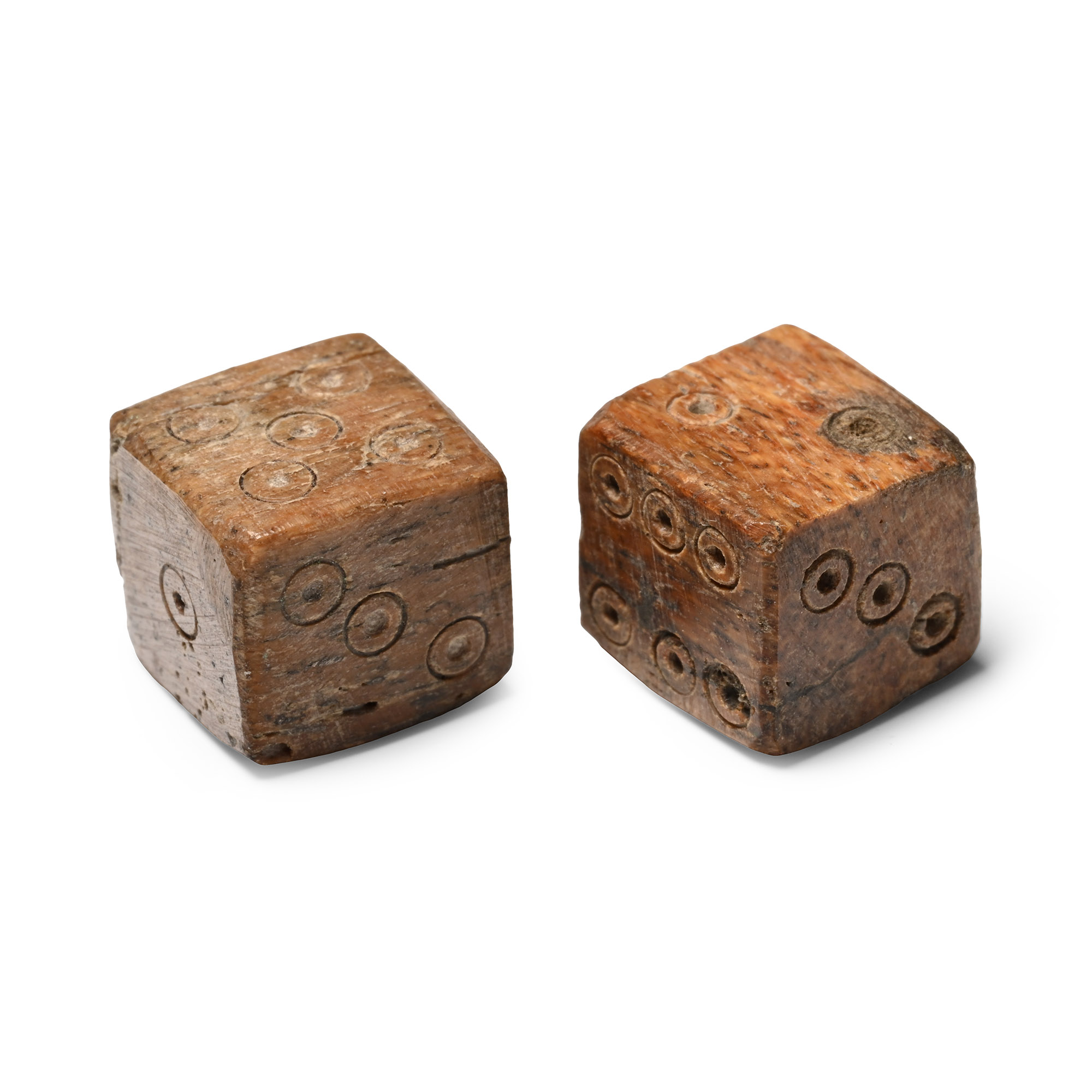
Two bone cubes, about a centimetre each, that nineteen centuries ago could decide who paid for the next jug of tavern wine. They are laid out exactly like the dice in a modern pocket: one opposite six, two opposite five, three opposite four, every facing pair adding to seven. The pips are cut as a dot inside a ring, drilled with a centre-bit that scribes both at once. Romans called cube dice tesserae; the rounded knucklebone kind were tali. Dicing crossed every class. Playing for money was technically illegal except during the December Saturnalia, the fine set at four times the stake, but the law was a dead letter and the emperors themselves played: Augustus, Suetonius tells us, cheerfully staked his own guests, and Claudius wrote a book on dicing and had his carriage fitted so he could play on the move. The best throw was "Venus", the worst "the dog", and Pompeian bar paintings even preserve the row that follows, one drinker insisting it was a two and not a three, until the landlord throws both players out into the street.
This pair adds to seven, but that layout was not yet the rule. Roman dice were not standardised: makers used the sum-to-seven scheme, the prime-pairs scheme and plainly irregular ones side by side. Jelmer Eerkens and Alex de Voogt, who measured hundreds of ancient dice, found that the sum-to-seven arrangement we now treat as obvious only became universal around the fifteenth century, and that the rigid layout with one opposite two is the mark of medieval dice rather than Roman. Loaded dice are attested, but small bone cubes are routinely a little lopsided through ordinary manufacture, so a pair like this is best not called "loaded" without a test.
9. A Viking's silver charm, £182
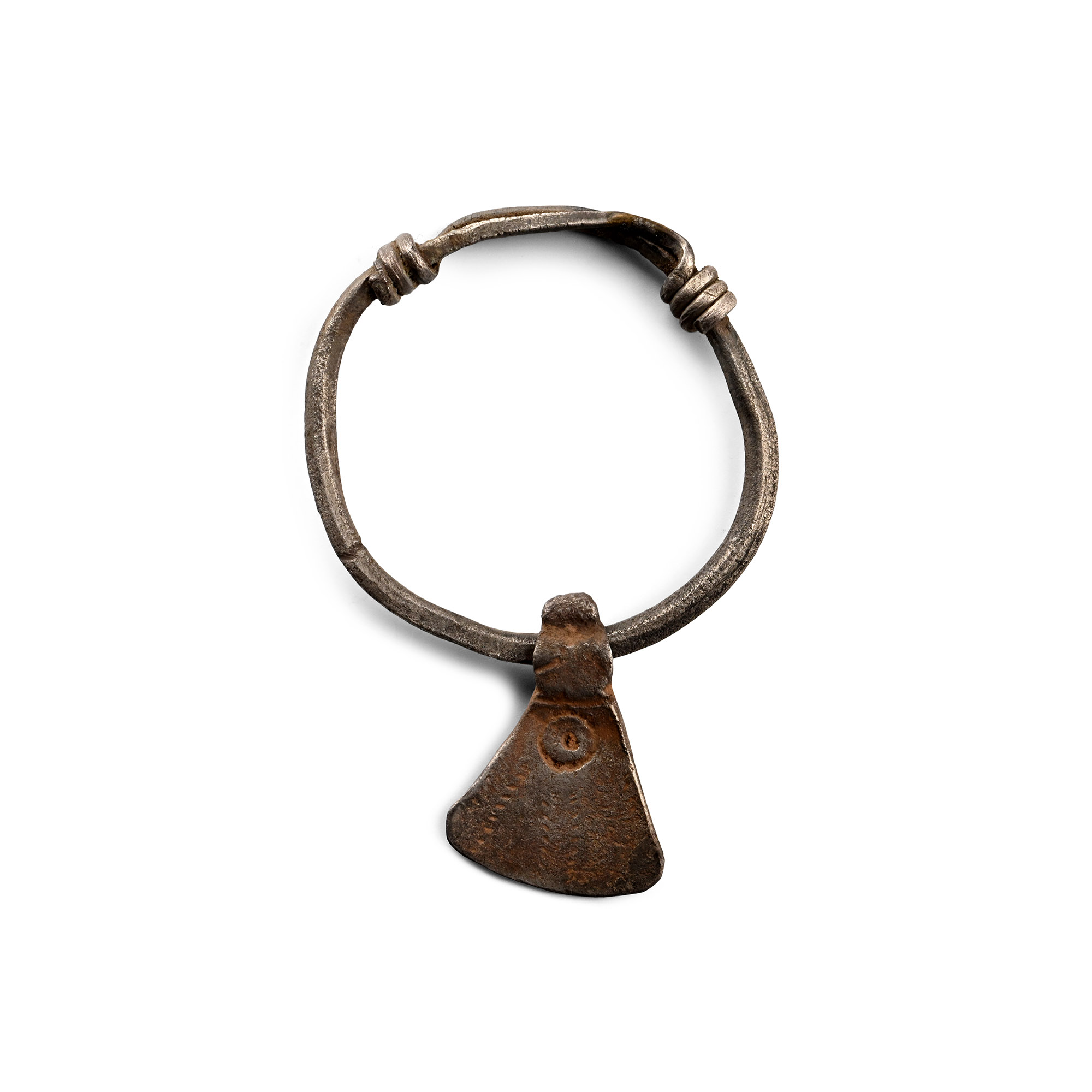
This was the most-watched lot under £200 in its sale, and the appeal is easy to see: a thousand-year-old silver charm, 53 mm and lighter than a pound coin, that you could wear today. A small axe-head runs free on a silver neck-hoop with coiled-wire sleeves and overlapping terminals, decorated with ring-and-dot and rows of pecked lines; ninth to eleventh century, from a Dorset collection. Norse amulets often took the shape of miniature weapons and tools, axes, spears, sickles, strike-a-lights, worn alongside the T-shaped Thor's hammer, Mjöllnir, the one such amulet tied to a named god (a 2014 find at Købelev in Denmark is actually inscribed "this is a hammer"). Silver mattered in an economy that weighed hack-silver and Arab dirhams on small balance scales, so a silver charm was a small statement of standing as well as of faith.
An axe pendant is not a Thor's hammer: no source links Thor himself to an axe, and the two types are distinct. Axe-shaped pendants have a markedly eastern distribution, around the Baltic, Poland and the lands of the Rus', and their blade shapes often match Slavic rather than Norse weapons. One reading ties them to Perun, the Slavic thunder-god associated with the axe, a counterpart to the Scandinavian hammer; that interpretation goes back to the Soviet archaeologist V. P. Darkevich in the 1960s and is still argued, with recent cataloguers warning against reading a single religious meaning into every example. The Thor-versus-Perun question is open, and not every miniature axe need have been an amulet at all; some may have been ornaments, pins or toys. One more plain word: the type is heavily faked, and silver examples sit at the finer, scarcer end of it, so the Dorset provenance is part of what you are paying for.
10. Wear a piece of an asteroid, £98
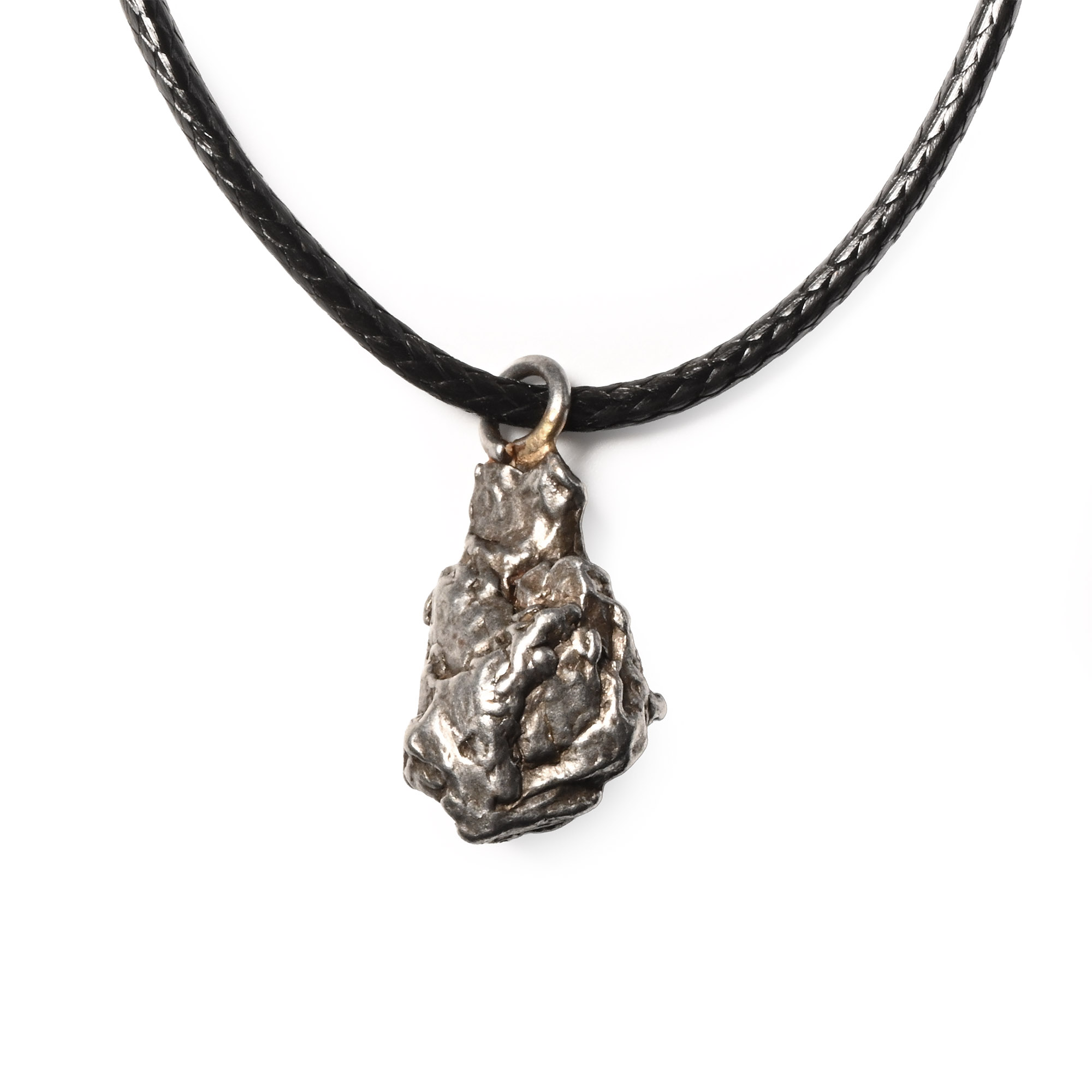
The cheapest thing on the list is also, by a margin that makes the handaxe look modern, the oldest. This is a fragment of the Campo del Cielo meteorite, a nickel-iron body, about 93% iron and 7% nickel, mounted with a loop on a cord, 22 mm of metal weighing under seven grams. The iron formed with the solar system roughly 4.5 billion years ago, in the core of an asteroid that later broke apart, which makes the metal older than the oldest rock on Earth. The fall is a separate, much younger date: charcoal under the craters puts the impact around 4,000 to 4,700 years ago, when an iron mass more than four metres across came in at a shallow angle and threw up a field of some two dozen craters on the plain of Chaco. Keep the two numbers apart, because they are constantly run together: 4.5 billion years for the metal, about 4,500 for the landing.
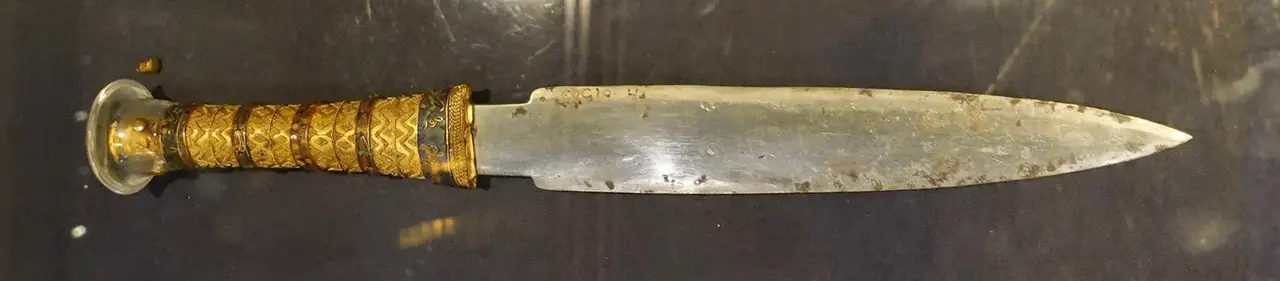 The iron dagger from the tomb of Tutankhamun, its blade forged from meteoritic iron, fourteenth century BC. Egyptian Museum, Cairo. Photo: Olaf Tausch, CC BY 3.0, via Wikimedia Commons.
The local people called the place Piguem Nonralta; the Spanish translated it Campo del Cielo, Field of the Sky, and from 1576 sent expedition after expedition after the great iron masses, the largest of which weigh close to thirty tons. More than a hundred tons have been recovered, which makes Campo del Cielo one of the most abundant meteorites on the market and is the only reason a real piece costs under £100; the price is supply, not doubt. There is a clean tie to the rest of this list. Before anyone could smelt iron, people cold-worked the kind that fell ready-made from the sky: the Gerzeh beads of Egypt, around 3200 BC, are hammered meteoritic iron, and the blade buried with Tutankhamun is meteoritic too, confirmed by analysis at about 11% nickel, by Daniela Comelli and colleagues in 2016. The pharaohs, who could not yet smelt iron, prized this sky-metal above gold. Pieces this old, and this affordable, come up in every sale we hold, across all ten categories on this list. For £98 you can put a fragment of this one on a cord and wear it.
TimeLine Auctions, 16th August 2026