Home > Stories by TimeLine Auctions
Stories by TimeLine Auctions
A Pyxis with a Chariot
The pyxis is 22.5 cm across and weighs just over a kilo, the lid raised on a small knop, the sidewall carrying a single continuous frieze. A four-horse chariot moves to the right. Attendants in chitons and himatia walk alongside, spears held upright. Among them is a woman in a long robe, the only figure whose dress is set apart from the rest.
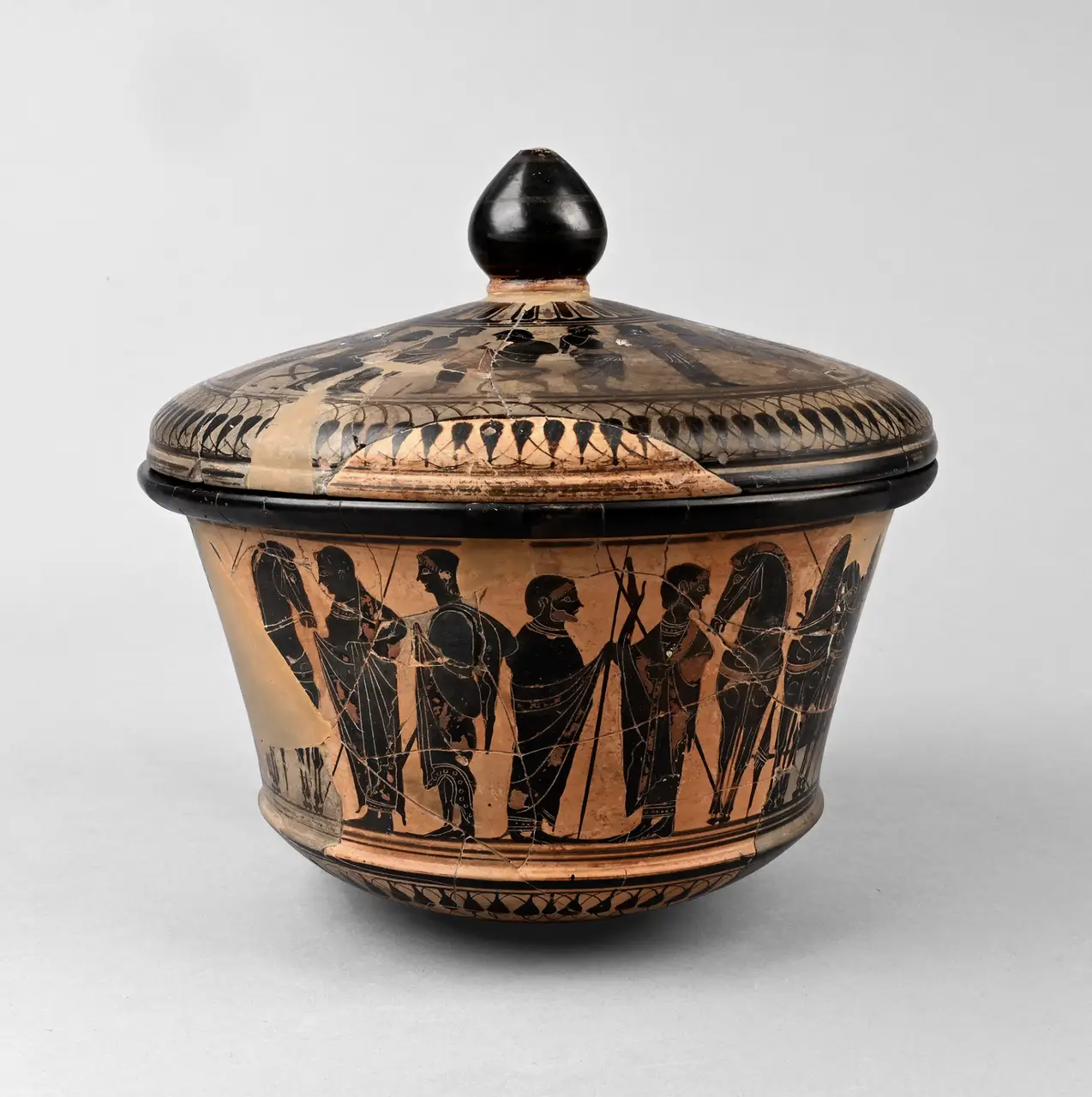
The shape is the squat Attic pyxis of the 6th century B.C.: a flared sidewall with carination at top and bottom, a rounded foot, a broad watchglass lid set with a central acorn-shaped knop. The decoration is black-figure, silhouettes painted in dark slip on the buff Attic clay, the internal detail incised through to the lighter ground below, with touches of added red on garments and trappings. A band of coiled tendrils runs around the foot, with another framing the figural scene on the lid.
The procession on the body, all forward movement and horses, is replaced on the lid by an interior gathering. Figures sit in profile on diphroi, the folding stools that signal a formal indoor setting. Attendants stand by, and other figures approach in conversation. Two women in long robes are visible among them. There is no chariot here, no spears; the scene is at rest.
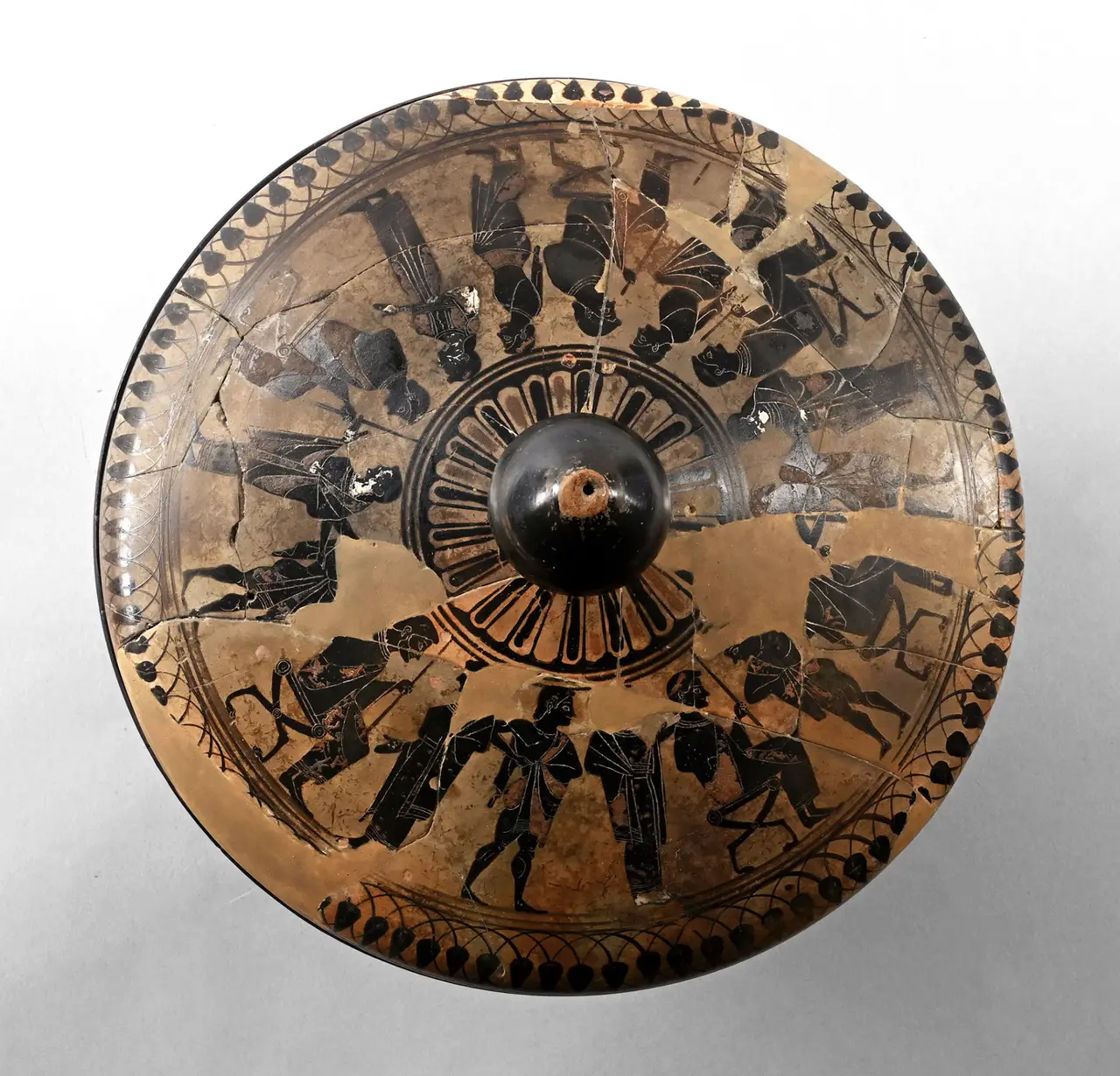
Read together, the two friezes give the two halves of a single Athenian event. The chariot frieze is an ekdosis, the formal procession by which the bride was conducted from her father's house to the groom's. A quadriga is the proper vehicle, and the same horses that race or carry warriors on other Attic vessels here carry the bride. The escort of male relatives with spears is consistent with the reading: the spears are processional rather than military, marking the status of the party and the formality of the transfer. The lid then shows the destination. The seated figures, the attendants, the women in robes belong to the wedding party gathered at the groom's house, the feast prepared, the guests in place, all of it waiting for the procession on the body to arrive.
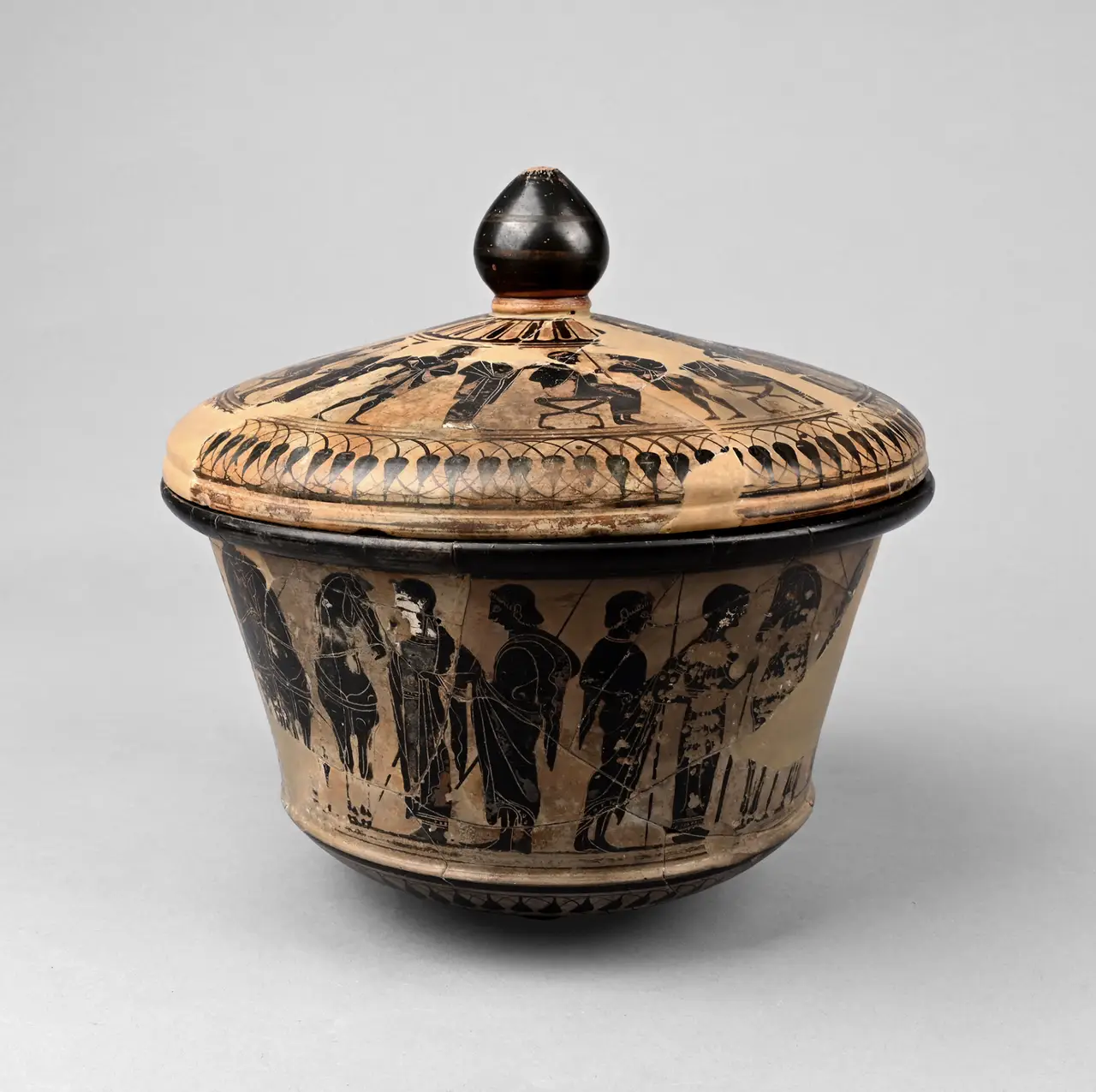
If the reading is right, the object would have been doubly appropriate. Pyxides were women's vessels, kept in the gynaikeion to hold cosmetics, small jewellery, and personal trinkets. They were given as wedding gifts and used afterwards by the woman who received them. A pyxis painted with the journey from her father's house and the reception at her new one would have sat in her quarters as a small visual record of the day it commemorated, opened most mornings.
Athenian painters in the 6th century were beginning to develop this kind of domestic narrative in black-figure, where everyday and ritual life took its place beside the mythological scenes that had dominated earlier work. A fragment of a related pyxis is preserved in the British Museum (1886.0401.1289), published by Beazley and Payne in their 1929 study of Attic black-figure pieces from Naukratis; Victoria Sabetai has used pyxides of this kind as her point of departure for the wider iconography of marriage in Attic vase-painting, and the literature on the wedding pyxis in New York (Metropolitan Museum 1972.118.148) is an entry into the same field.
The piece is repaired and restored, as is usual for vessels of this date and shape. Its recorded provenance begins with Mrs Lambelet of Neuchâtel, who acquired it before 1972; it passed by descent in her family before entering a private collection in 2012.
What stays in the eye, after the chariot and the diphroi, is the small thing the painter has done by dividing the work this way. The procession is on the body; the destination is on the lid. The vessel, lid in place, completes the meeting of the two. The pyxis will be offered at auction on the 2nd of June 2026 as lot 96, with an estimate of £40,000–60,000.
TimeLine Auctions, 15th May 2026