Home > Stories by TimeLine Auctions
Stories by TimeLine Auctions
A Seal's Tooth, Strung on a Cord: Britain's Rarest Ice Age Pendant Gets a New Identity
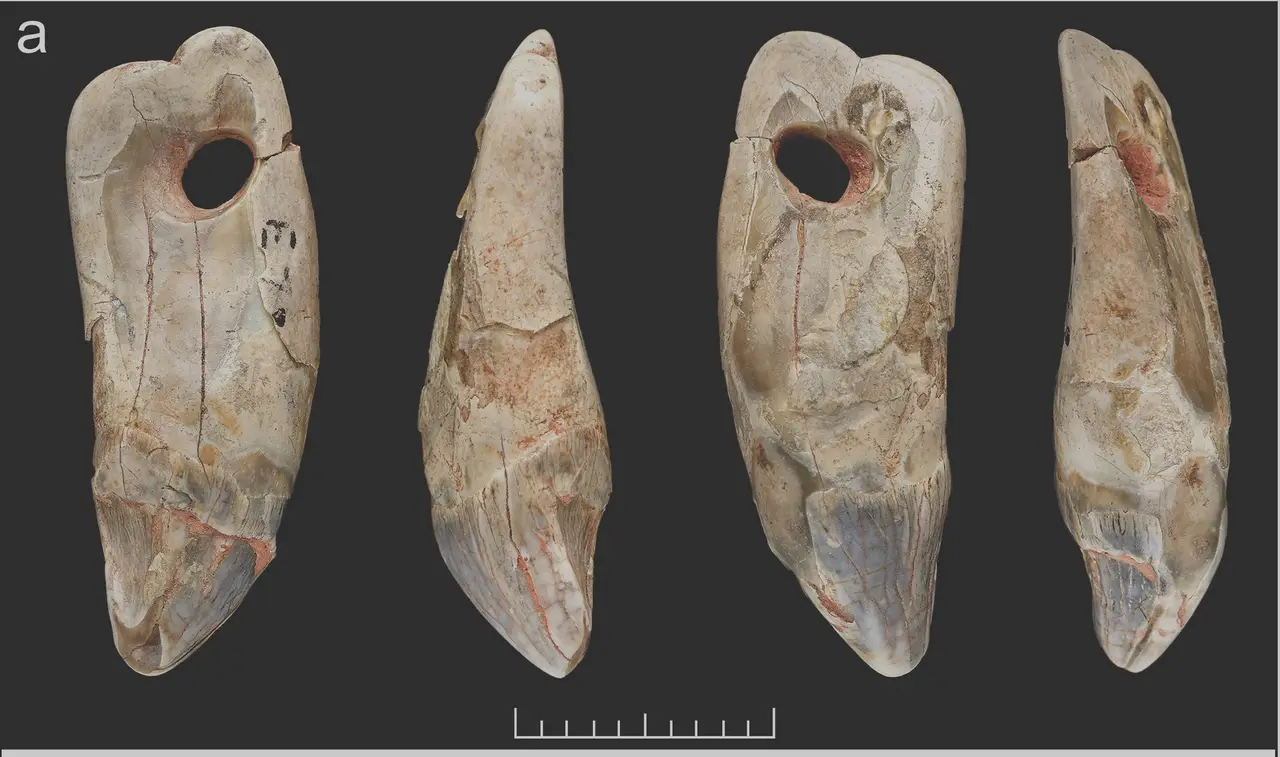
For more than 150 years, a small perforated tooth sat in the collections of London's Natural History Museum, labelled first as a badger canine, then as a wolf incisor. Neither identification was correct. A new study published this month in Quaternary Science Reviews reveals that the tooth belongs to a grey seal, making it Britain's only known Upper Palaeolithic seal tooth pendant, and one of just a handful found anywhere in Europe.
The pendant was unearthed on 4 February 1867 by William Pengelly, the Victorian naturalist whose meticulous cave excavations at Kents Cavern in Devon helped establish the deep antiquity of human presence in Britain. Pengelly found the tooth in the Vestibule of the cave, within deposits containing Magdalenian artefacts dating to roughly 15,000 to 14,000 years ago. According to Simon Parfitt of University College London and the Natural History Museum, who led the new analysis, the tooth had been intensively shaped, drilled, polished, and worn on a cord for what appears to have been a considerable stretch of time.
A Case of Mistaken Identity
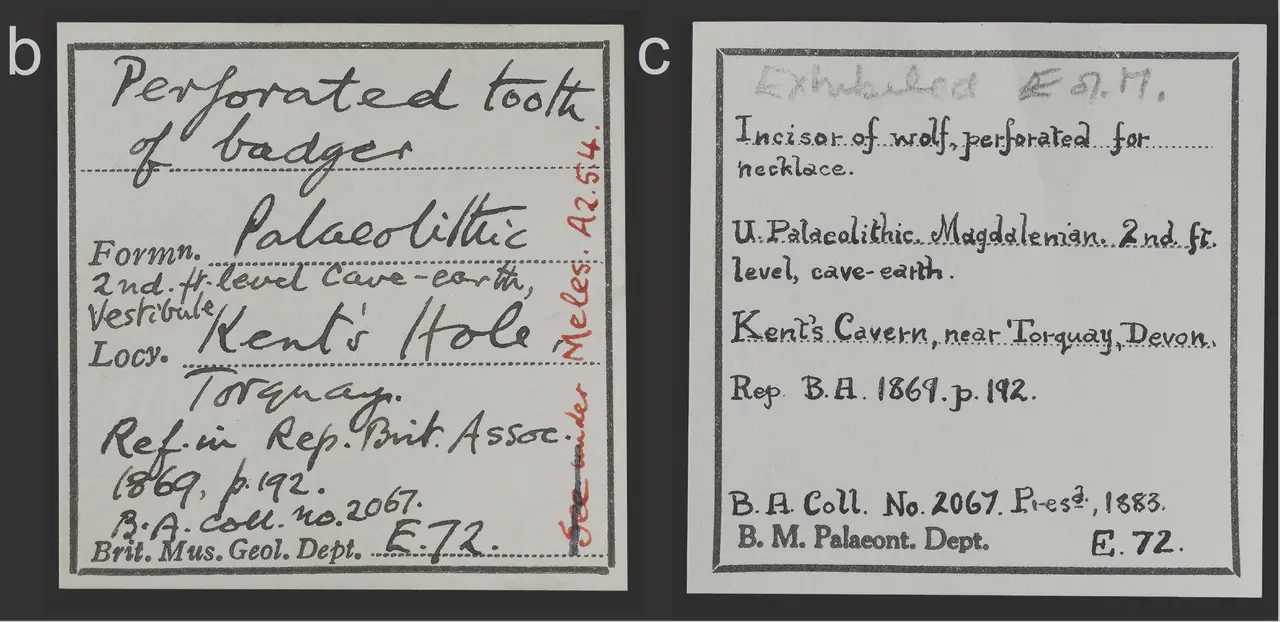
The pendant's long obscurity owes something to its confused taxonomy. Pengelly himself recorded it as a badger tooth. A later museum label reassigned it to a wolf. Neither identification ever prompted much scholarly attention, and the object drifted to the margins of the published record. Dorothy Garrod's 1926 survey of the British Upper Palaeolithic included it in a list of objects that could not be attributed to any particular period, a cautious assessment that nonetheless implied she thought a Palaeolithic date plausible.
In 2024, Parfitt set out to resolve the question by comparing the pendant against the Natural History Museum's extensive collection of modern carnivore skulls. No terrestrial carnivore matched. When he extended the search to marine mammals, the tooth found a clear counterpart in the grey seal (Halichoerus grypus), specifically as a left upper third premolar from a male animal that was likely around twelve years old when it died. The team determined the animal's sex from the pronounced size dimorphism in grey seal teeth, and estimated age at death by counting annual growth rings (cementum banding) visible in the polished surfaces of the root.
How the Pendant Was Made
The research team, which included Lucile Crété and Silvia Bello of the Natural History Museum, Rob Dinnis of the University of Aberdeen, Claire Lucas of the British Museum, and Barry Chandler of Torquay Museum, combined traditional microscopy with 3D surface imaging and micro-CT scanning to reconstruct the pendant's manufacturing sequence.
The maker first thinned the root extensively on both sides, scraping and grinding away cementum and dentine to produce a flattened, blade-like profile. This bifacial thinning is a technique that appears almost exclusively in Magdalenian contexts, according to the study, and is exceedingly rare in earlier periods. The perforation was then drilled from both faces of the thinned root using a hand-held flint point, rotated back and forth through semi-circular turns until the two depressions met. Micro-CT imaging, which digitally stripped away centuries of cave sediment clogging the hole, revealed fan-shaped striations on the inner wall of the perforation, traces left by the irregularities on the edge of the flint drilling tool.
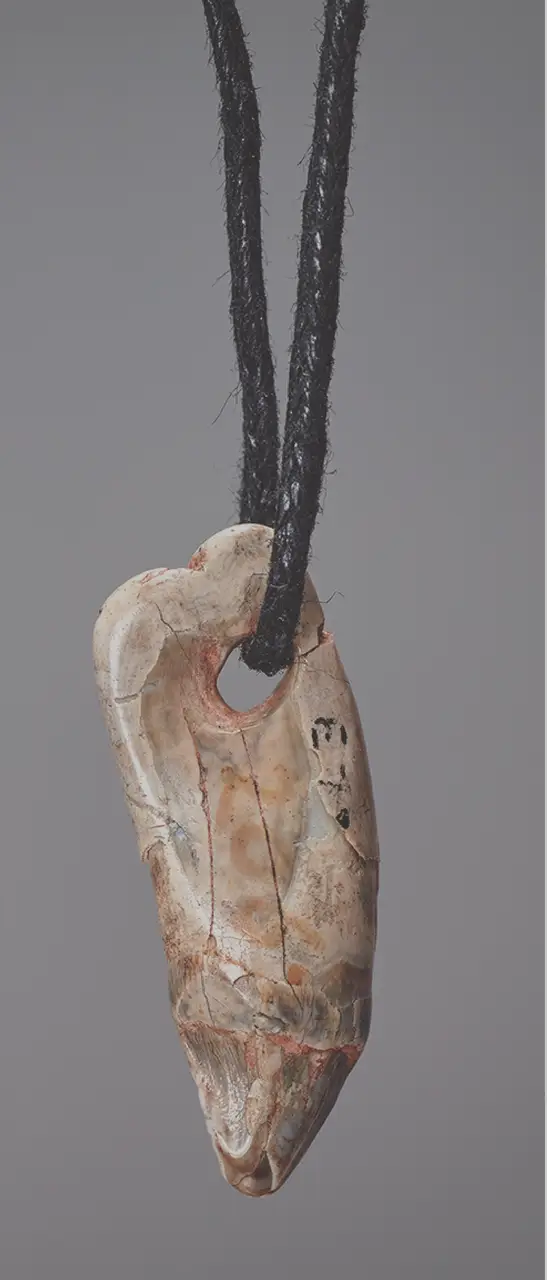
The resulting hole, originally circular and measuring roughly 2 by 3 millimetres, was gradually elongated into an oval by the friction of a cord. Two shallow furrows on either side of the perforation align precisely with the point where a cord would rest if the pendant hung freely. According to the study's authors, this pattern of wear is consistent with a tooth swinging loosely on a string (as opposed to being sewn tightly onto a garment), suggesting it was worn as a true pendant or perhaps as part of a bracelet.
The entire surface of the root carries a high-gloss polish that, combined with the extensive cord wear, points to prolonged handling and use over a long period.
125 Kilometres from the Sea
Today, Kents Cavern overlooks Torbay on the Devon coast. During the Late Upper Palaeolithic, however, sea levels were far lower, and the nearest shoreline lay at least 125 kilometres to the southwest, according to recent palaeotidal modelling cited in the study. The seal tooth therefore had to travel a significant distance to reach the cave, whether carried by the person who killed the animal, passed hand to hand through exchange networks, or some combination of the two.
The question of how marine objects ended up at inland Magdalenian sites has occupied researchers for decades. Parfitt and his colleagues outline three competing hypotheses. The first proposes that highly mobile groups made long seasonal journeys between the coast and the interior. Evidence from other British Magdalenian sites supports this idea: at Gough's Cave in Somerset, for example, seashells, Baltic amber, and flint sourced from Salisbury Plain (some 70 kilometres away) all appear together in a single occupation horizon, hinting at movements spanning 300 kilometres or more. The second hypothesis favours exchange networks linking less mobile groups, with objects being passed from community to community over great distances. The third, older suggestion, that seals might have swum far upriver following migrating salmon, has largely fallen out of favour, though the study notes it cannot be entirely excluded.
Only four other Upper Palaeolithic perforated seal teeth are known from the whole of Europe: two from the cave of Isturitz in the French Pyrenees, one from Las Caldas in northern Spain, and a possible example from La Marche in western France. All date to the Middle Magdalenian, roughly 18,000 to 16,000 years ago. The Kents Cavern pendant may be slightly younger, placing it in the later Magdalenian, though the absence of a direct radiocarbon date (the tooth is too rare and fragile to sample destructively) means its age rests on stratigraphic context and the typology of the manufacturing technique.
What a Tooth Can Tell Us
The study represents the first detailed technical analysis of any Upper Palaeolithic seal tooth pendant. By combining archival detective work (tracing the object through Pengelly's numbered excavation diaries, Victorian committee reports, and successive museum labels) with high-resolution imaging, Parfitt and his co-authors have recovered the biography of an artefact that was, as they put it, on the verge of disappearing from the scholarly record altogether.
Future scientific advances may push the story further. The authors note that isotopic analysis and ancient DNA extraction from minuscule samples could one day determine whether the seal lived in Atlantic waters, the North Sea Basin, or even a now-vanished freshwater lake on the drowned landscape of Doggerland. For now, the pendant stands as a vivid reminder that Ice Age people in Britain were connected, whether by their own journeys or by the reach of their social networks, to a world far beyond the cave mouth.
We regularly handle Palaeolithic worked artefacts in our cataloguing room at TimeLine, though seal tooth pendants of this age are, predictably, museum-bound rarities. Upper Palaeolithic and Mesolithic worked items, perforated teeth, and stone tools from the same broad tradition do appear in specialist sales. Browse our current catalogue for prehistoric personal ornaments and worked artefacts.
TimeLine Auctions, 10th May 2026