Home > Stories by TimeLine Auctions
Stories by TimeLine Auctions
A Second Medieval Sword Surfaces Off Israel's Coast, and the Same Diver Found Both
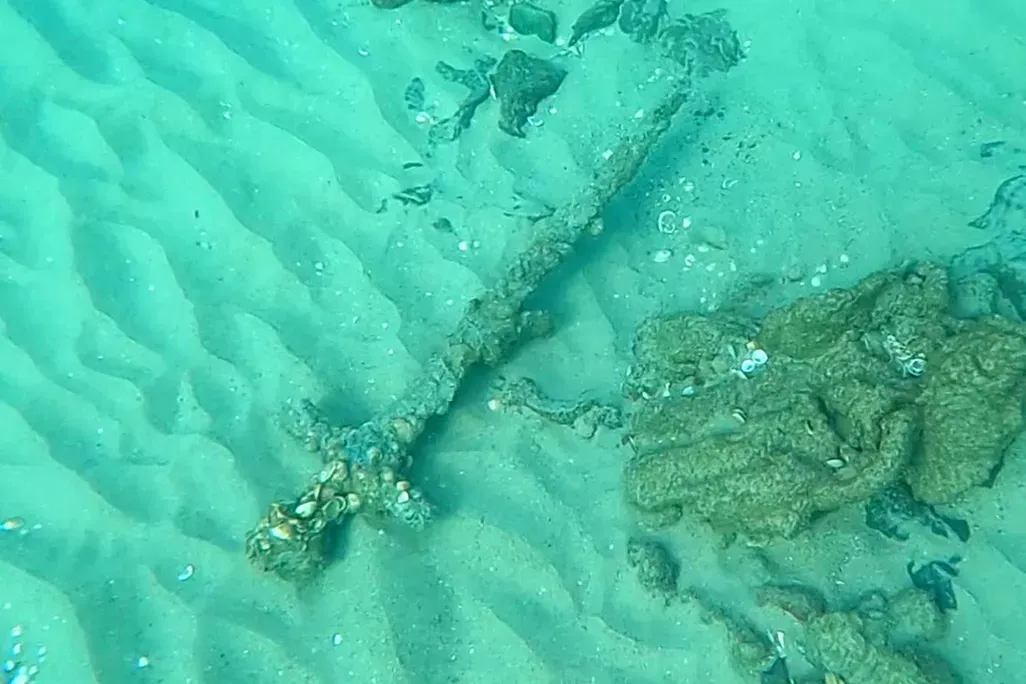 Image Credit: Yoav Bornstein / University of Haifa
The three-foot blade, encrusted in centuries of marine growth, was spotted jutting from the seabed near Dor Beach, not far from where Shlomi Katzin recovered a similar weapon in 2021.
A one-metre sword has been pulled from the Mediterranean seabed off the coast of Israel, the second such find in the same stretch of water in just four years. Shlomi Katzin, an underwater archaeologist and student at the University of Haifa's Department of Maritime Civilizations, spotted the weapon protruding from the sand while swimming near Dor Beach on Israel's northern coastline. The sword is believed to date to the 12th century C.E., placing it squarely within the period of the Crusades.
Katzin's first discovery, a four-foot iron sword in similar condition, made international headlines in 2021. This latest find, slightly shorter at around three feet, was recovered under rather dramatic circumstances: Katzin had noticed a group of divers carrying metal detectors in the area, suspected they were antiquities looters, and chased them off before noticing the blade on the seafloor himself. He immediately contacted Prof. Deborah Cvikel, also of the University of Haifa's Department of Maritime Civilizations, who in turn alerted the Israel Antiquities Authority. The agency granted special permission for the sword's removal and study.
Inside the Barnacles: What the CT Scan Revealed
After centuries underwater, the sword arrived at the university's conservation laboratory at the Leon Recanati Institute for Maritime Studies coated in a thick shell of marine concretion, the calcium-rich crust that sea organisms deposit on submerged objects over time. Studying it directly was essentially impossible without risking damage. The research team turned instead to the imaging department at Medica Elisha Hospital in Haifa, where the sword was put through a medical CT scanner, the same technology used to examine human patients.
The non-invasive scan allowed researchers to see through the layers of marine buildup without touching the original metal. What they found was sobering: the blade showed a clear fracture, and only a tiny fraction of the original iron had survived the corrosive effects of saltwater over roughly nine centuries.
Dr. Eyal Berkowitz, the medical director of Medica Diagnostics and a faculty member at the University of Haifa's School of Medicine, described the process in a university statement: the CT enabled the team to examine the sword's internal structure and precise physical condition while preserving the artefact's integrity for future study.
According to the research team, the sword was designed for single-handed use and was almost certainly not manufactured in the region. The metalwork points to a European origin, consistent with the weapons carried by Frankish knights who travelled to the eastern Mediterranean during the Crusader campaigns of the 12th and 13th centuries.
A Knight's Weapon, or Something More Complicated?
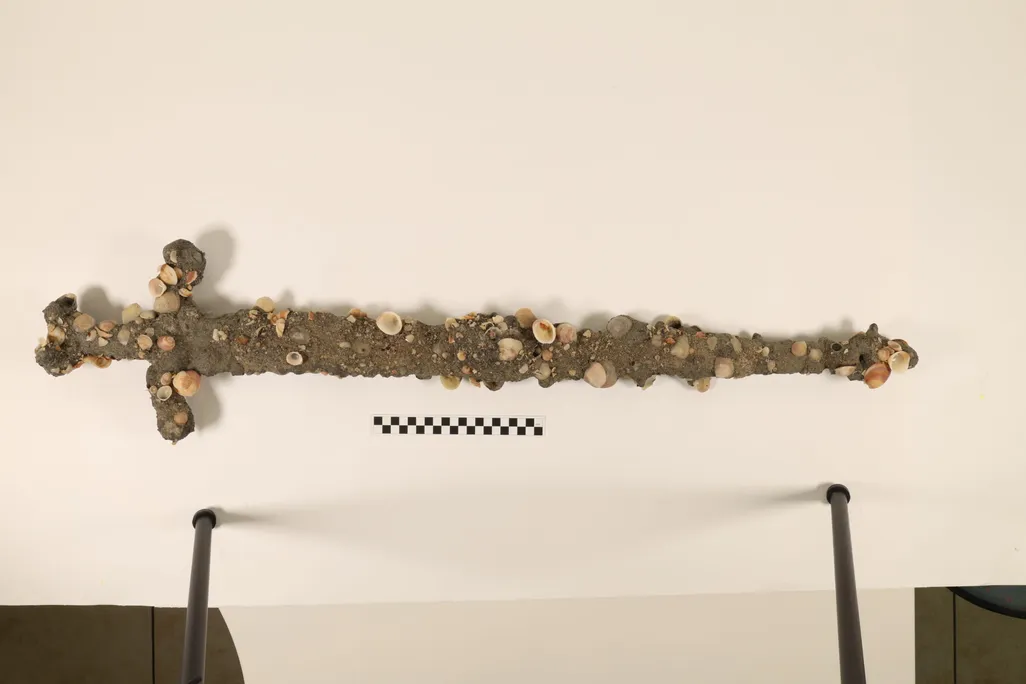 Image Credit: Yoav Bornstein / University of Haifa
It is tempting to label both of Katzin's finds as "Crusader swords" and leave it there. The University of Haifa's own press materials use the term freely. But as historians have pointed out, the label deserves scrutiny.
When the first sword was recovered in 2021, Jonathan Phillips, a historian of the Crusades at Royal Holloway, University of London, told the New York Times that the weapon could have belonged to a knight who fell overboard or lost it during a naval engagement. That remains one plausible scenario for the second sword as well.
Yet writing for Smithsonian magazine at the time of the 2021 discovery, historians David M. Perry and Matthew Gabriele urged caution with the "Crusader" label. They noted that the eastern Mediterranean of the 12th century was a busy crossroads: not every traveller was a Christian, not every Christian was a Crusader, and the Crusades were far from the only events unfolding across the region during those two centuries. Objects, they argued, have lives of their own, and a sword's journey to the ocean floor may not have been its first voyage.
Prof. Cvikel, for her part, frames the significance in broader terms. "This is an extremely rare find that illuminates the Crusader presence along the country's coasts," she said in the university's announcement. "Only a handful of similar swords from the Crusader period are known from Israel, and this discovery greatly contributes to our understanding of the use of maritime anchorages and the lives of warriors during this era."
Dr. Sarah Lantos, also of the University of Haifa's Department of Maritime Civilizations, emphasised the cultural weight of such objects. Medieval swords, she noted, were expensive, carefully maintained possessions that served as symbols of knighthood, chivalry, and Christian faith. The recovery of so personal an artefact offers a rare window into the material culture of the Crusader period and the daily lives of Frankish knights in the Holy Land.
From the Seabed to the Collection
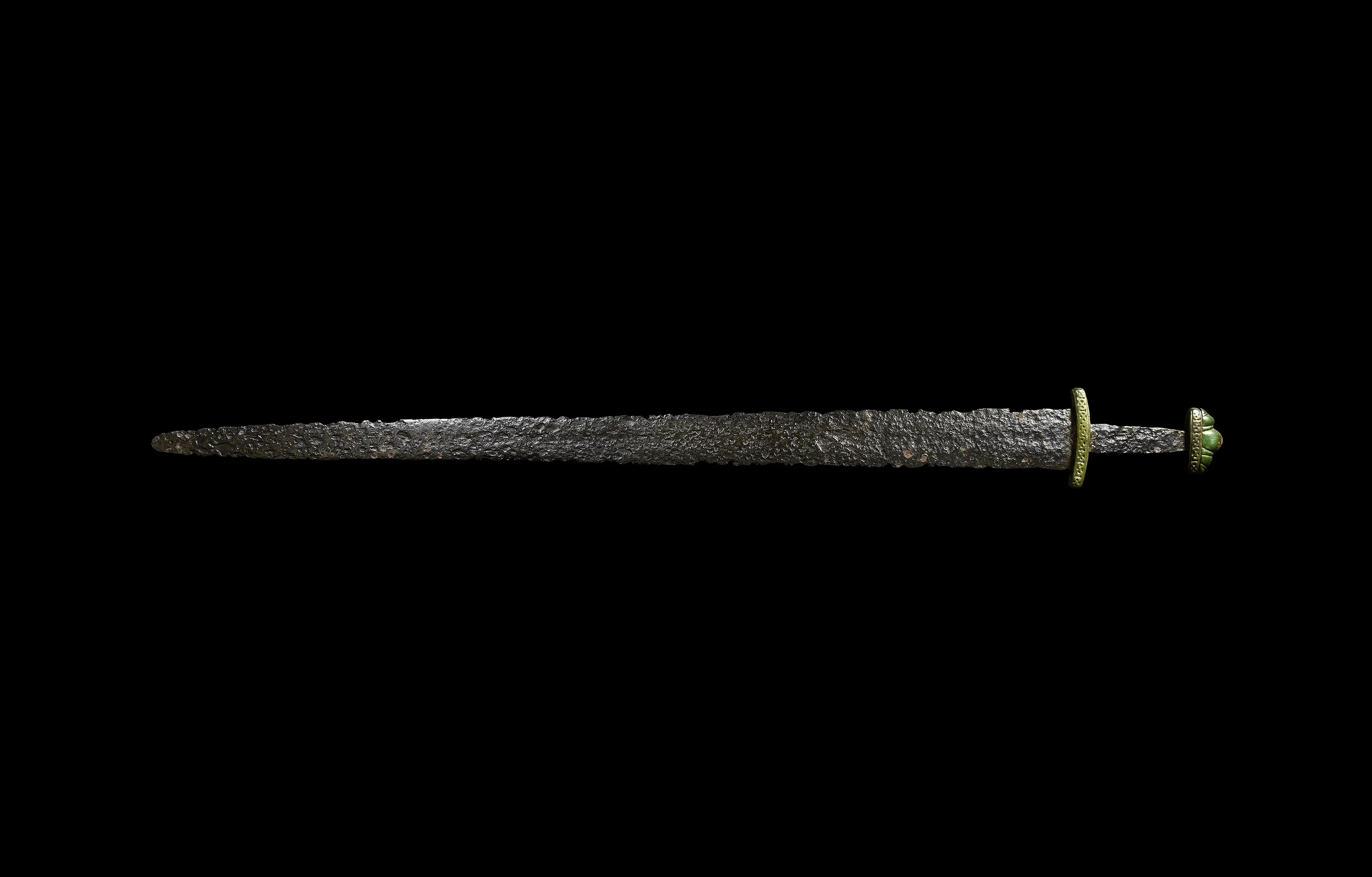
Medieval swords of any provenance are exceptionally scarce on the open market, and documented underwater finds rarer still. Both of Katzin's swords will remain in institutional hands for conservation and research. For collectors, however, the broader material world of the Crusades is not entirely out of reach. Smaller artefacts from the period (pilgrim badges, iron arrowheads, coins struck by Crusader states) do surface in specialist sales, including our own at TimeLine Auctions. We handle medieval weapons and military metalwork regularly, and objects from the Crusader kingdoms remain among the most sought-after categories in the field.
Browse our current catalogue for medieval arms and Holy Land antiquities.
TimeLine Auctions, 4th May 2026