Home > Stories by TimeLine Auctions
Stories by TimeLine Auctions
A Symposium Isn't What You Think It Is
Book a symposium today and you get a conference room, a lanyard, and a panel of specialists taking turns at a microphone. The word has been promoted. It began as the name for a drinking party, and specifically for the drinking that came after dinner, once the food had been cleared and the tables carried out. One standard reference, The Classical Tradition, puts it flatly: the modern academic event "has none of the characteristics that marked the Greek practice." Somewhere between an Athenian couch and a hotel ballroom, the wine drained out of the word.
Put it back, and something stranger comes into view. The Greek symposion (from syn and posis, "drinking together") was a dozen or so men reclining on couches around a large mixing-bowl, ladling watered wine in turns while they sang, argued, played, flirted and competed. It was the engine-room of aristocratic life, the place where much of early Greek poetry was first performed and where political factions met to plot. It was also imported, comparatively late, and far rowdier than the version the philosophers left us. And it was only one of the ways Greeks drank together.
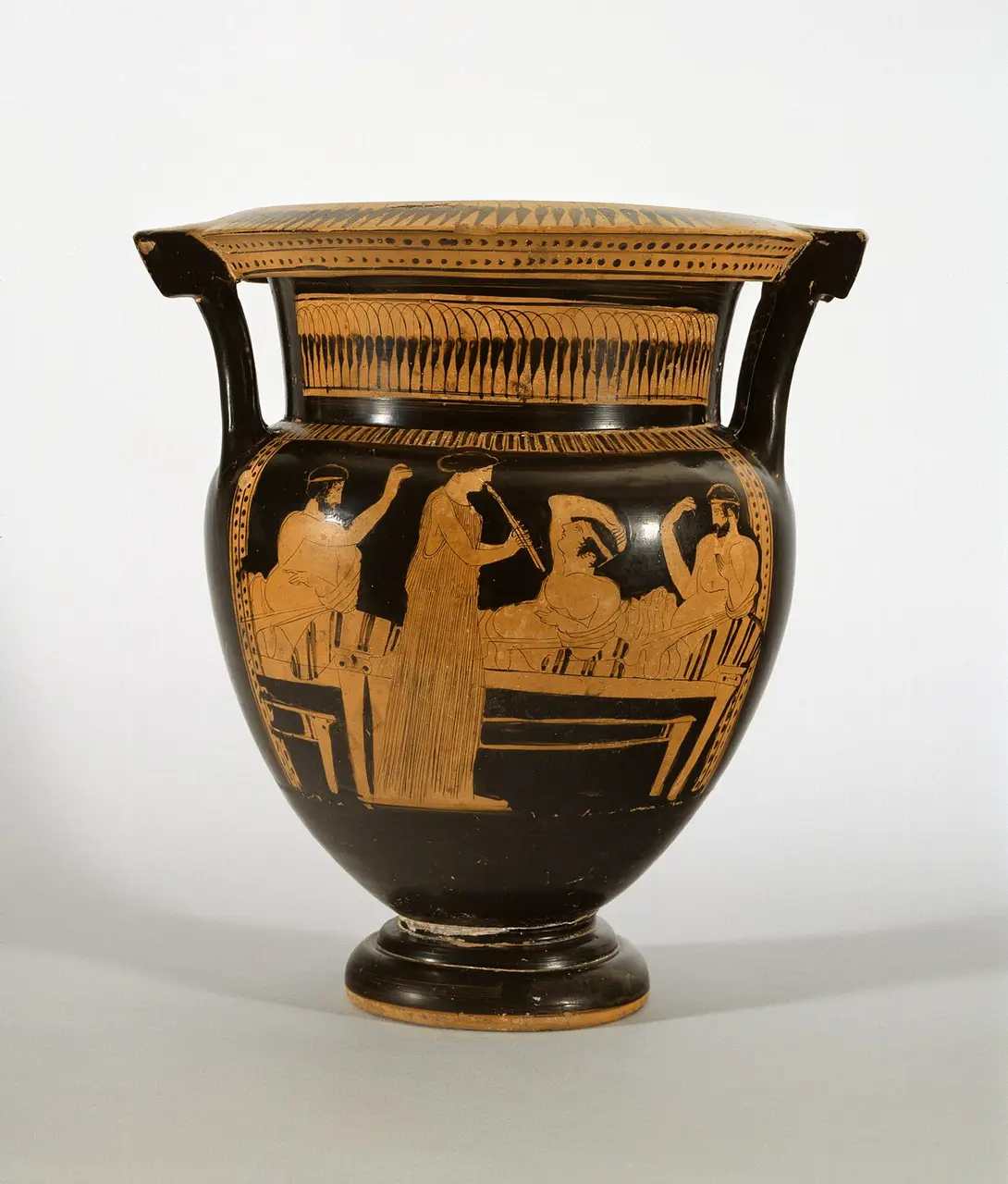 A symposion on the side of an Attic red-figure column-krater, around 440 BC, attributed to the Naples Painter. Two men and a youth recline on couches above low tables while a woman plays the double pipes. Walters Art Museum, Baltimore. Public domain, via Wikimedia Commons.
First the food, then the drinking
A symposion came in two parts, and the order mattered. First the meal, the deipnon, eaten by convention without the serious wine; food, as one survey of the custom puts it, "did not mix with conversation or with cultural pursuits." Only when the eating was finished, the tables lifted away and the diners' hands washed did the drinking begin. Athenaeus, whose enormous Deipnosophistae is our richest quarry for all of this, defines a symposion exactly as "the drinking which follows a grand dinner." The party people remember was the second half of the evening.
It happened in a room built for it. The andron, the "men's room," is the one space in a Greek house an archaeologist can identify with confidence, because it was designed around its couches: a raised border runs along the walls to take five, seven or eleven of them, and the doorway sits deliberately off-centre so one more couch could fit against the wall. It was the show-room of the house. If any room was plastered, it was the andron; sometimes it was painted too, and it often stood near the street with wide windows, so that passers-by "could hear snatches of music and conversation, or drunken boisterousness, from inside." One honest qualification: a purpose-built andron was a minority feature, found in fewer than a third of the excavated houses at Olynthos, and many Athenian houses had nothing of the kind. The dozen reclining aristocrats are a real picture, and an elite one.
Inside, the furniture imposed a posture. Diners lay on couches, klinai, one or two to a couch, propped on the left elbow with the right hand free, which is an awkward way to manage food and a cup at once. Reclining elegantly was a skill you had to learn: in Aristophanes' Wasps the boorish old Philocleon has to be taught by his son how to lie on a couch like a gentleman. Low tables held salty, thirst-provoking nibbles. And at the centre stood the krater, the great mixing-bowl, "the starting point for the distribution of wine," the object around which everything else was arranged.
The drinking opened with ritual. A small taste of unmixed wine went to the Agathos Daimon, the "Good Spirit"; then came libations and a sung hymn, the paean, before the mixed wine was ladled out. The libations followed a rough scheme, three of them, the last "to the Saviour," Zeus Soter, though the formula shifted from city to city and cup to cup. Sometimes a "ruler of the drinking," a symposiarchos, was appointed to fix the strength of the wine, the number of bowls, the order of play. Here a caution is due. The tidy image of a master of ceremonies enforcing the rules is partly a modern reconstruction from scattered sources; in Plato's own Symposium there is no symposiarch at all, the hung-over guests simply agreeing to drink as much as each pleased. The opposite pressure was just as real: the blunt imperative pithi, "drink!", and the mockery that fell on anyone who held back.
The fullest picture of how the evening was meant to look comes from the poet Xenophanes, around 500 BC: the floor swept clean, the cups and hands washed, garlands handed round, perfume offered in a dish, the mixing-bowl "filled with good cheer," incense and a hymn, and the sensible rule that a man should drink only as much as would let him "come home without an attendant, unless he is very old." It is a lovely scene, and the Loeb editor adds the necessary warning: Xenophanes "seems to be describing an ideal symposium, not one actually in progress." Almost everything written about the symposion sits somewhere on that line between the evening as it should go and the evening as it went.
Homer's heroes ate sitting up
Reclining to drink feels like the most Greek thing in the world, which is one reason it helps to know the posture was neither very old nor originally Greek. Athenaeus noticed it himself: in Homer, he observes, "the heroes sit instead of reclining" at their feasts, and he sighs that "we have so far degenerated as to recline when we feast." Homeric furniture is the chair and the footstool; the feasting records from Mycenaean Pylos list seats, thrones and stools. The shared feast of the epics is an upright, seated affair.
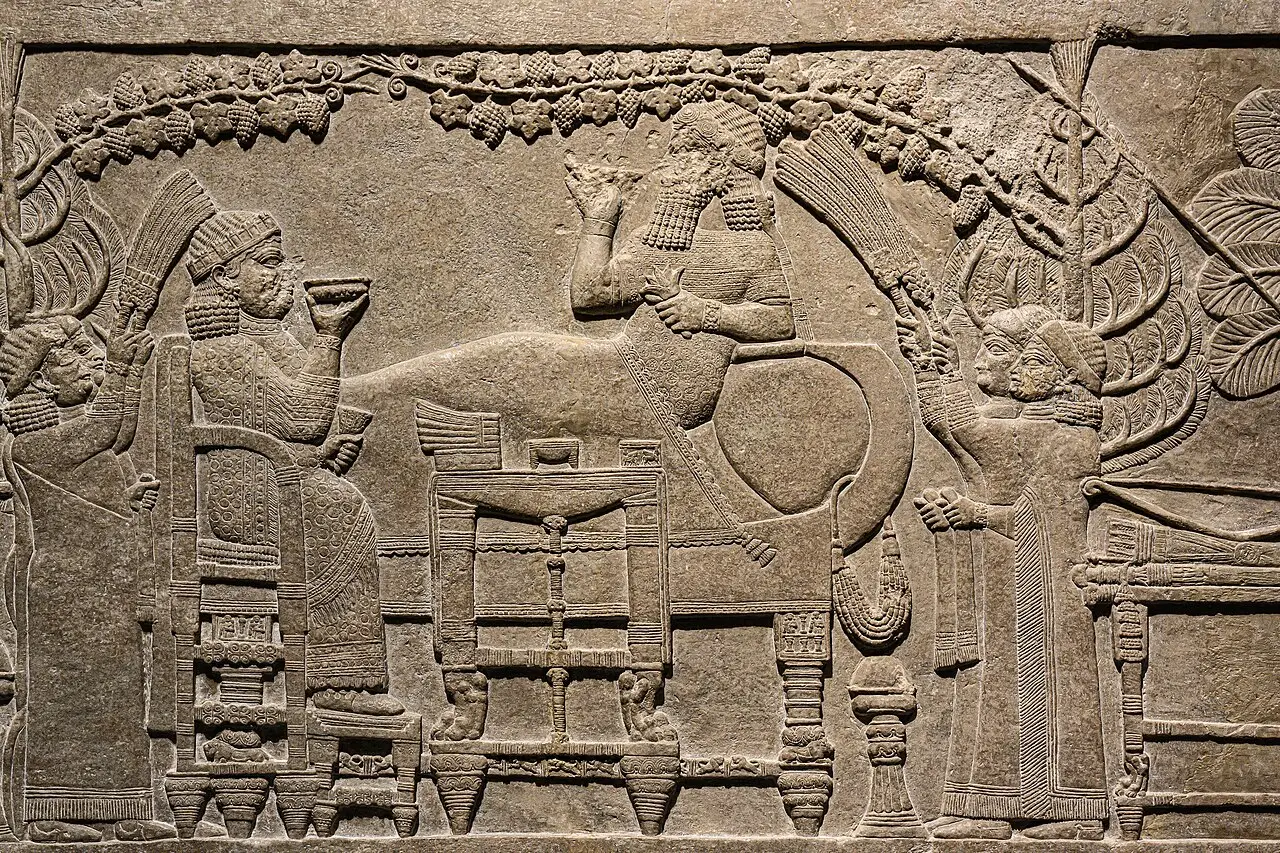 The Garden Party relief of Ashurbanipal from the North Palace at Nineveh, around 645 BC, now in the British Museum. The king reclines on a couch with a bowl in his hand while his queen sits upright on a throne. Photo: Allan Gluck, CC BY 4.0, via Wikimedia Commons.
The couch came later, and from the east. The case worked out by the French scholar Jean-Marie Dentzer and others traces reclining banquets to a Syro-Phoenician source, a habit that spread in two directions, east into Assyria and west, perhaps by way of Cyprus, to Greece. The best-known eastern image is the so-called Garden Party relief of Ashurbanipal from Nineveh, around 645 BC, now in the British Museum: the Assyrian king reclines on a high couch with a bowl in his hand, a female orchestra plays, attendants wave fans, and in a tree nearby hangs the severed head of the defeated Elamite king. Look closely, though, and the relief undercuts the easy story that it is the model for the Greek symposion. The king reclines, but his queen sits upright on a throne beside him, because sitting was the normal Assyrian posture; the reclining is Ashurbanipal's own innovation, and it never caught on even among his successors. The relief is a cousin of the Greek scene rather than its parent. Both descend from a shared Levantine habit, and it is on Cypriot metal bowls of the eighth century, some showing a man and a woman reclining together, that the social practice seems to have travelled west.
In Greece itself the institution comes into focus around 600 BC, and the pottery shows it happening. The krater was a rarity in eighth-century Athens; only at the very end of the seventh century do Corinthian potters start making mixing-bowls in quantity, and, as the archaeologist James Whitley notes, "when they do one theme dominates the decoration: the symposium itself." The earliest depicted symposion we have is the Eurytios Krater, a Corinthian piece of about 600 BC found in Italy and now in the Louvre, showing Herakles and King Eurytios reclining at the drink, side-tables before them, hunting dogs tethered to the couch-legs. The Greeks themselves felt the eastern pedigree of all this luxury and named it: the reclining, the soft fabrics, the perfume were habrosyne, an elegance they associated with Lydia. Xenophanes again, sourly, on his fellow citizens of Colophon who "learned useless luxuries from the Lydians" and paraded in purple robes with gold in their hair.
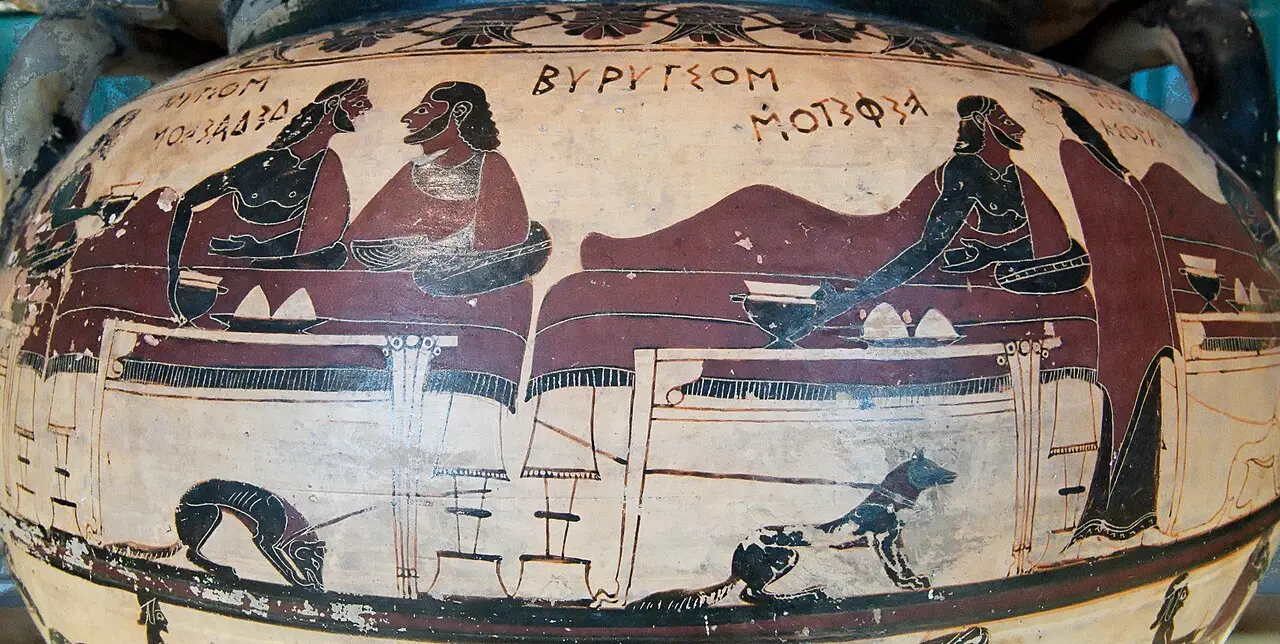 The Eurytios Krater, a Corinthian krater of about 600 BC, now in the Louvre. Herakles and King Eurytios recline at the drink, with side-tables before them and hunting dogs tethered to the couch-legs. Photo: Ismoon, CC BY-SA 4.0, via Wikimedia Commons.
Not everyone dates the thing so late. Oswyn Murray, whose work in the 1980s did more than anyone's to put the symposion at the centre of archaic history, argued that "something like" it existed already in the ninth century, and pointed to evidence such as Nestor's Cup. The usual reconciliation, again Whitley's, is that male drinking together is genuinely old but "need not entail an institution as elaborated as that of the symposium": what happened around 620 BC was a synthesis, old Greek conviviality fused with the imported habit of couched dining and a new set of eastern furniture. A few scholars, R. A. Tomlinson among them, resist even that, suspecting the whole eastern-import case leans too hard on a single Assyrian relief.
Watered wine and the ten bowls of Dionysus
Greeks drank their wine mixed with water, and the mixing was the civilised part. Concentrated wine came from the storage amphora, water from the hydria; the two were combined in the krater and ladled out, and the bowl itself was read as a token of civilisation, set against the wineskin of neat liquor that belonged to herdsmen and barbarians. There was no single correct ratio, and the question was argued over for centuries. Athenaeus collects the options: Hesiod wants three parts water to one of wine, Anacreon prefers it stronger, the comic poets quote everything down to one-to-one, which they treat as the mark of serious drinkers. "Drink five, or three, but not four," ran the proverb. The direction is easy to get wrong, since Greek normally names the water first: a "two to one" in a Greek poem may be two of water, or, in a hard-drinking verse of Alcaeus, two of wine.
Wine drunk neat, akratos, marked you as no Greek at all. The peoples to the north, Scythians and Thracians, drank it undiluted, and to drink that way was to court madness. Herodotus tells the story of the Spartan king Kleomenes, who kept company with some Scythians, took up unmixed wine in their style, and was driven mad by it; the Spartans, he says, coined a verb for strong drinking, episkythisai, "to do a Scythian." (Herodotus is careful to report this as the Spartan explanation; his own guess for the king's madness runs to divine punishment.) Anacreon makes the same point as a toast: let us not practise Scythian drinking, with uproar and shouting, but drink moderately amid lovely songs.
Moderation was the ideal, and the Greeks knew how rarely they reached it. The comic poet Eubulus put the whole arc of an evening into the mouth of Dionysus, counting out his mixing-bowls. Three bowls are for the sensible: one to health, one to love and pleasure, a third to sleep, after which "wise guests go home." The rest belong to the god in his other mood: the fourth "to violence," the fifth "to uproar," the sixth to the drunken street-revel, the seventh to black eyes, the eighth to the policeman, the ninth to nausea, and the tenth "to madness and hurling the furniture." Theognis had stated the sober principle two centuries earlier: drink "neither sober nor too drunk," for wine past a man's limit leaves him "no longer in command of his tongue or his mind." Plato's Laws treats wine as a cheap test of character, to be allowed in measure. The reality, as the same encyclopaedias that lay out the rules concede, was that drunkenness "almost inevitably" arrived, "since not to drink was a cause for mockery and the proceedings might well last all night."
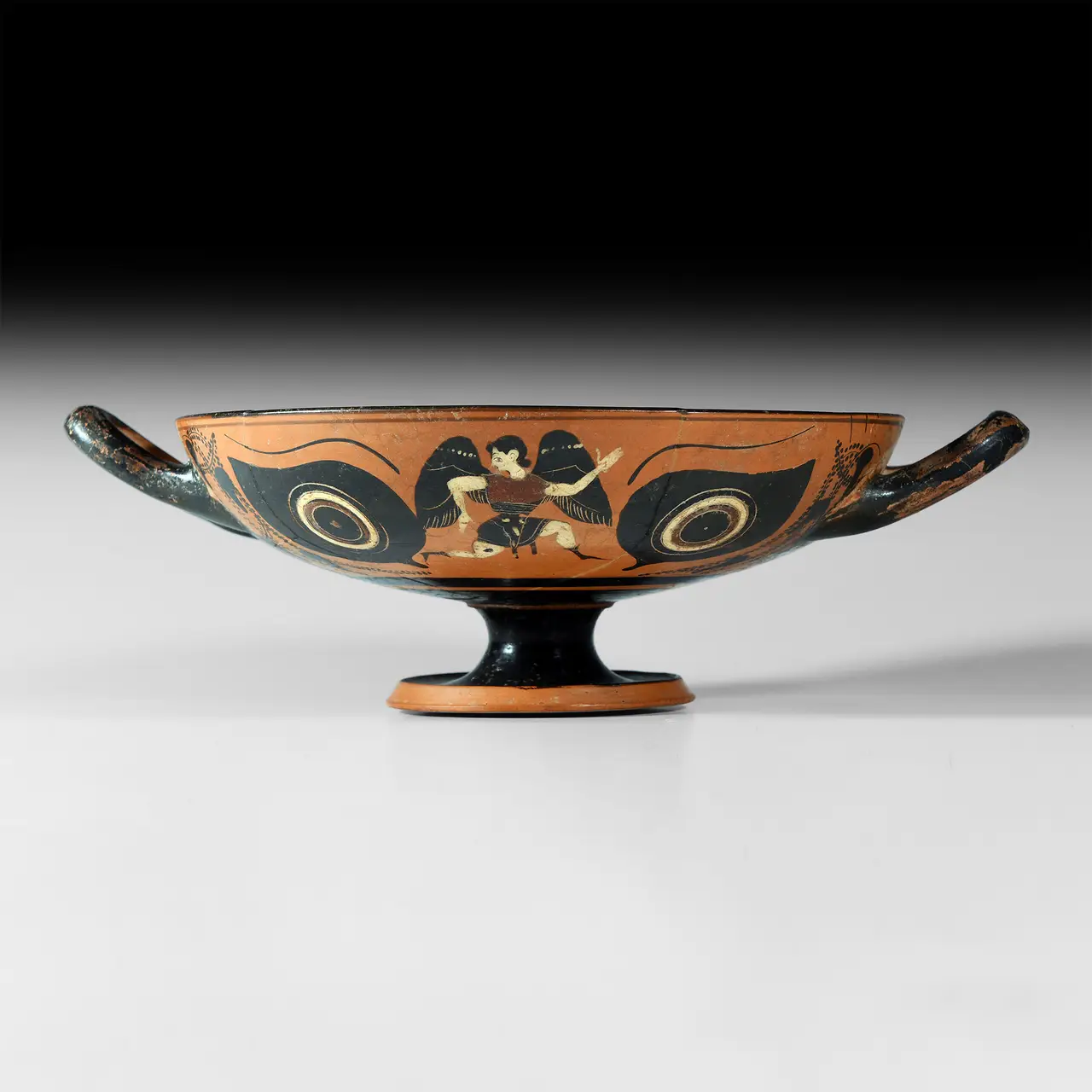
Watered though it was, this was still wine, and the comfortable notion that dilution made it nearly harmless, something like a weak beer, is itself disputed; a good deal of the mixing was about making strong, resin-flavoured wine, sometimes cut with seawater, palatable and safe to drink at all. The result, by the later bowls, was a room of competitive aristocratic men a long way from sober. The pottery knew it. Cups were made to play on the drinker: eye-cups painted with a great pair of eyes turned the vessel into a mask as it was raised, and many cups hid an image in the tondo at the bottom that surfaced only as the wine drained. On one cup by Exekias the god Dionysus sails across a wine-dark interior among dolphins, rising into view as the drinker finishes. At the bottom of another, in the Louvre, a man is shown vomiting while a dog laps it up, a coarse joke waiting for whoever drank that far down.
Kottabos, the lyre, and the crooked song
A symposion was a competition as much as a party, and its signature game was kottabos. A drinker hooked an empty cup over one finger and, with a flick of the wrist, flung the last drops of his wine, the dregs, at a target across the room: usually a small bronze disk balanced on a tall stand, to be knocked off with a satisfying clang, or little dishes floating in a basin, to be sunk. The throw was often dedicated aloud to a beloved, the player naming the boy or woman he hoped for as the wine flew, so that a clean hit read as a good omen for the suit. On the painted wall of a tomb at Paestum a reclining guest is caught in the act, his cup tipped to send the dregs flying. One thing the game was not: the target, despite the look of the stand, was never a lamp. The frequent claim that kottabos meant knocking down an oil-lamp confuses its tall bronze pole with the lamp-stand it merely resembled.
The music was misnamed too. The standard instrument was the aulos, a double-pipe sounded with a reed, closer to an oboe than to anything in the flute family, and the long habit of translating it "flute" has misled readers for generations. It was played by a hired girl, an auletris; Athenian law fixed her maximum fee at two drachmas and instructed the city officers to draw lots if several men wanted the same one. The guests themselves were expected to perform, but as amateurs, singing in turn to a lyre passed around the couches, the long-armed barbitos that was the instrument of the party. These turn-songs were skolia, "crooked songs," and the name is a small lesson in how the evening worked: it refers to the zig-zag order in which the singing jumped around the room, each guest taking up a sprig of myrtle and either singing a fresh piece or capping the one before. The most famous of them celebrates the men Athens remembered as its tyrant-slayers, hiding their blades in festival myrtle: "I shall carry my sword in a branch of myrtle, as Harmodius and Aristogeiton did when they killed the tyrant and made Athens a city of equal laws." The myrtle, song-branch and hidden sword at once, is the whole point.
This singing was not idle. The symposion was the place where a great deal of early Greek poetry was first performed, and in Ewen Bowie's judgement it is "the only performance context securely attested for our extant shorter poems." The roll of poets who wrote for the couches is most of archaic lyric and elegy: Alcaeus, Anacreon, Theognis, Solon, Xenophanes, Critias. Alcaeus supplies the genre's drinking-cry, "Let us drink! Why wait for the lamps? Day is down to an inch," and turns even politics into a drink-order, calling for wine to mark the death of a local tyrant. The oldest of these jokes is scratched onto a cup. Nestor's Cup, found in a child's grave on the island of Ischia and dated about 730 BC, carries three lines among the earliest alphabetic Greek writing yet found: "Of Nestor I am the cup, good to drink from. Whoever drinks this cup dry, straightway the desire of fair-garlanded Aphrodite will seize him." It parodies the great cup of old Nestor in the Iliad and bends the heroic reference toward sex and wine, a sympotic in-joke set in writing before there was any fixed text of Homer to be in on.
The men, the boys, and the women who didn't count
The guests on the couches were free citizen men. Respectable women, the wives and daughters of those men, did not attend; the women in the room were there to work or to be enjoyed. "The only women who participated," as one historian puts it flatly, "were those with no reputation to lose": the pipe-girls and dancers, the courtesans, the enslaved. This was an exclusion from the male party, and from little else. Greek women drank at festivals, in religious ritual, as medicine; what they were shut out of was this particular performance of male leisure.
The party ran on slavery. Boys, the oinochooi, did the mixing and pouring, and the cups show them naked, at the drinkers' beck and sometimes at their mercy: on one eye-cup a reclining man swings a slipper at a serving boy. The auletris hired for music was, by common assumption, available for more than music; "aulos-girl" slid into ordinary Greek as a word for a cheap prostitute, and pipe-girls were the usual prize in the drunken mock-auctions that ended many parties. The most argued-over figure is the hetaira, the "companion," and the argument is live scholarship rather than settled fact. The textbook account separates three kinds of women, set out in a speech once attributed to Demosthenes: "we have courtesans for pleasure, concubines for the daily care of our bodies, and wives to bear us legitimate children." For a long time that neat division, the cultured hetaira against the cash prostitute against the wife, was read as plain social description. It is now under heavy fire. James Davidson argued that the hetaira was defined precisely by vagueness, paid in gifts rather than coin to keep the relationship from looking like a transaction. Leslie Kurke went further, reading the elegant hetaira as an invention of the aristocratic symposion itself, a figure conjured "to shield itself from the public sphere" and the cash economy it disdained. Allison Glazebrook and others put it more bluntly: the refined courtesan is "a fabrication of the male mind." Kenneth Dover, surveying the words in use, concluded that the line "could not be sharp," and that which term a Greek reached for often depended on the feeling he wanted to convey.
The room's erotics ran between males as well. The symposion was a recognised setting for courtship between an older man and a youth, the conventional pairing of archaic Athens, played out in the kalos-acclamations painted on cups (so-and-so "is beautiful") and in kottabos throws dedicated to a named boy. The convention carried its own rules and its own stigma, much of it attached to the passive role; and, as Thomas Hubbard notes, the vase-painters did not in fact confine it to men and boys, showing plenty of couples close in age. Around all of this lay an idea about the house. The andron was set apart, often by the street door, as a male preserve into which guests came without crossing the women's quarters, the architectural articulation, in the phrase of one study, of a gender divide. As an idea it was sharp. As a wall it was porous: archaeologists cannot locate a separate women's wing in most Greek houses, the segregation seems to have been about keeping respectable women from unrelated men rather than from all society, and once the guests were settled with their wine "normal domestic activities could have resumed" elsewhere in the house.
Drinking-clubs and the night the statues were smashed
Inside the room the code was equality. The couches were equal, the krater was shared out in fair measure, every man had his turn at the song and his right to speak; the vocabulary of the symposion is full of the same words, the equal share, the fair portion, that the democracy used of itself. Oswyn Murray's influential reading took this seriously and turned it outward: the symposion was the social form of the old aristocratic warrior-band, a closed society with its own code of honour and trust, willing to set up conventions, in his careful phrase, "fundamentally opposed to those within the polis as a whole." Its ancestor was the Homeric feast at which a chief fed his followers and bound them to him. Its descendant, in the classical city, was an institution that could sit uneasily beside the democracy, because the loyalty it manufactured was loyalty to the group.
The vehicle for that loyalty was the hetaireia, the aristocratic club: twenty or thirty men of the same age and rank, meeting privately, often in secret, in one another's houses, their natural occasion the symposion. They backed each other in court and at elections, and they sealed their bonds with oaths, which is where the language turns sinister. The word for a group bound by a sworn oath, synomosia, is also the ordinary Greek for a conspiracy. In 415 BC the city decided it had one on its hands. On a single night, on the eve of the great expedition to Sicily, the Herms, the stone pillars that stood at Athenian doorways, were found mutilated across the city; at the same moment informers came forward to say the secret rites of the Eleusinian Mysteries had been performed for laughs in private houses, at drinking-parties, with Alcibiades among the performers. Thucydides records that the Athenians took it "exceedingly to heart, as ominous to the expedition, and as part of a conspiracy for revolution and the overthrow of the democracy." The two scandals were almost certainly unconnected, and the link between them lived mainly in the public mind. Thucydides himself doubted that Alcibiades had touched the Herms. The judgement of Alan Sommerstein and Andrew Bayliss is harsher still: the conspiracies of 415 "exist largely, if not entirely, in the imagination of the Athenian public."
The sting is in what came next. The city that convulsed over imaginary plots in 415 was, four years later, undone by a genuine one. In 411 the politician Peisander brought the rival drinking-clubs together and persuaded them to act as one for the overthrow of the democracy, which they briefly achieved; in 404, after the city's defeat, the same networks of sworn men served the junta of the Thirty, whose leader Critias had himself once written sympotic verse. The danger the Athenians imagined in their drinking-clubs turned out to be real, only on a delay. The historian Mogens Hansen adds the fair caution that this is evidence from years of crisis and cannot simply be read back onto the clubbable, litigious symposia of calmer decades. And the whole "society against the city" picture has its answer in the work of Pauline Schmitt-Pantel, who insists the city had a convivial life of its own, public feasting through which citizenship itself was defined. Whether the symposion is best seen as a world set against the polis or as the polis in miniature is still, genuinely, an open question.
Black broth, the street, and the couches of Etruria
For all its prominence in the written record, the reclining symposion was one Greek way of eating and drinking together, not the only one. It even had a built-in shadow: the komos, the drunken procession that spilled out of the andron and into the street, the same men now upright and garlanded, carrying their cups and torches, singing at a locked door or forcing their way into someone else's party. Where the symposion was closed, indoor and ruled, the komos was its public release, and Aristotle thought the word "comedy" was born from it.
Sparta built the deliberate opposite. The Spartan common mess sat its men on hard benches, with no couches and no luxury; each contributed a fixed monthly ration, and what they ate was the notorious black broth, pork boiled in blood and vinegar. Membership was decided by secret ballot, and a man who could not keep up his contribution lost his standing as a citizen. Plutarch makes the contrast with the Athenian party explicit: the Spartan lawgiver, he says, kept his men from "reclining on costly couches at costly tables" and from being "fattened in the dark, like voracious animals." The broth became a standing joke at Sparta's expense; the tyrant Dionysius of Syracuse, the story goes, bought a Spartan cook to make him some, spat it out, and was told the missing ingredient was a lifetime of Spartan exercise and a bath in the river Eurotas.
The sharpest contrast of all lay across the sea in Etruria, and it scandalised Greek observers, because Etruscan men and women reclined together on the same couch, and the wife was an honoured guest. The historian Theopompus turned this into lurid copy: Etruscan women, he wrote, "dine not with their own husbands but with any men who happen to be present." Aristotle reported the same custom more plainly, that Etruscans "eat with their wives, reclining under the same cloak." Modern scholars reading the tomb-paintings see what Theopompus chose not to, that the Greeks "may have mistaken the liberty and equality enjoyed by married Etruscan ladies for licentiousness." The sculpted couples on Etruscan sarcophagi, a husband and wife reclining side by side as if mid-conversation, around 530 to 510 BC, make the slander look as mean as it was. Set the two images together and the difference is the point: on the Assyrian relief the king reclines while his queen sits below him; on the Etruscan couch the wife shares the cushion.
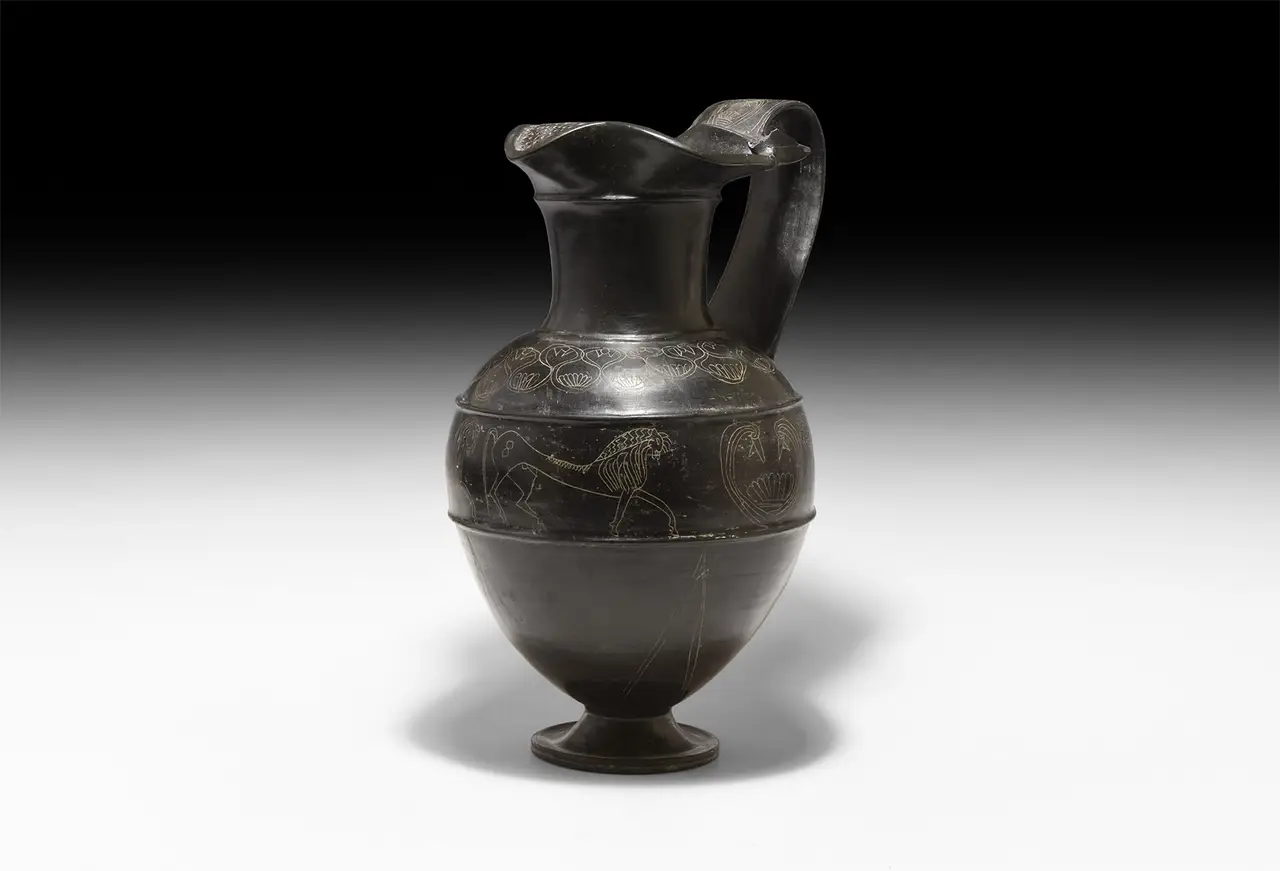
It is the Etruscan appetite for Greek pottery, in fact, that explains why so much of it survives. The finest Attic sympotic vases were exported west in bulk and buried in Etruscan tombs, in such quantity that until 1837 these Greek cups and kraters were catalogued as "Etruscan" ware. That funerary afterlife is why the kit of the symposion, the cups, jugs and mixing-bowls, is among the most collectable of all classical antiquities, and why it still passes regularly through the saleroom.
A party painted for no one
The single complete painting of a Greek symposion to come down to us was never meant to be seen. It sits inside the Tomb of the Diver at Paestum, in southern Italy, around 480 BC: a small box of five painted limestone slabs, sealed over a body. Four of the inner walls carry the party. Men recline two to a couch, a pair of them leaning close, one tipping his cup to fling the dregs, another holding out a lyre, a boy at the krater. The fifth slab, the lid, shows the scene that gave the tomb its name: a single naked figure in mid-air, arms out, diving into a band of water. The whole ensemble was painted to be shut in the dark above a dead man, a last symposion laid on for the one guest who could not attend it.
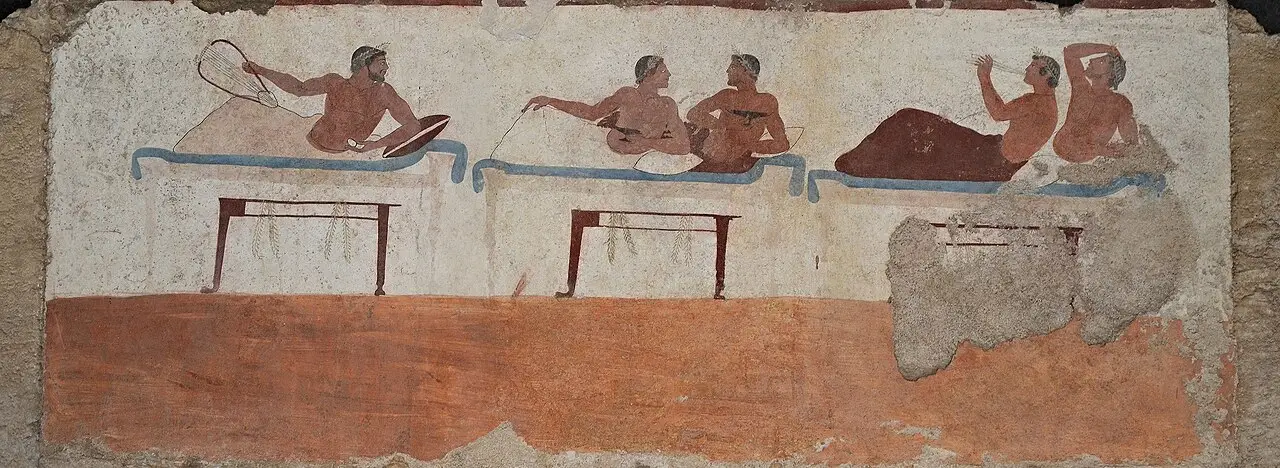 A wall of the Tomb of the Diver at Paestum, around 480 BC, now in the Paestum Archaeological Museum. Men recline two to a couch above low tables, one tipping his cup to fling the dregs at kottabos. Photo: Carole Raddato, CC BY-SA 2.0, via Wikimedia Commons.
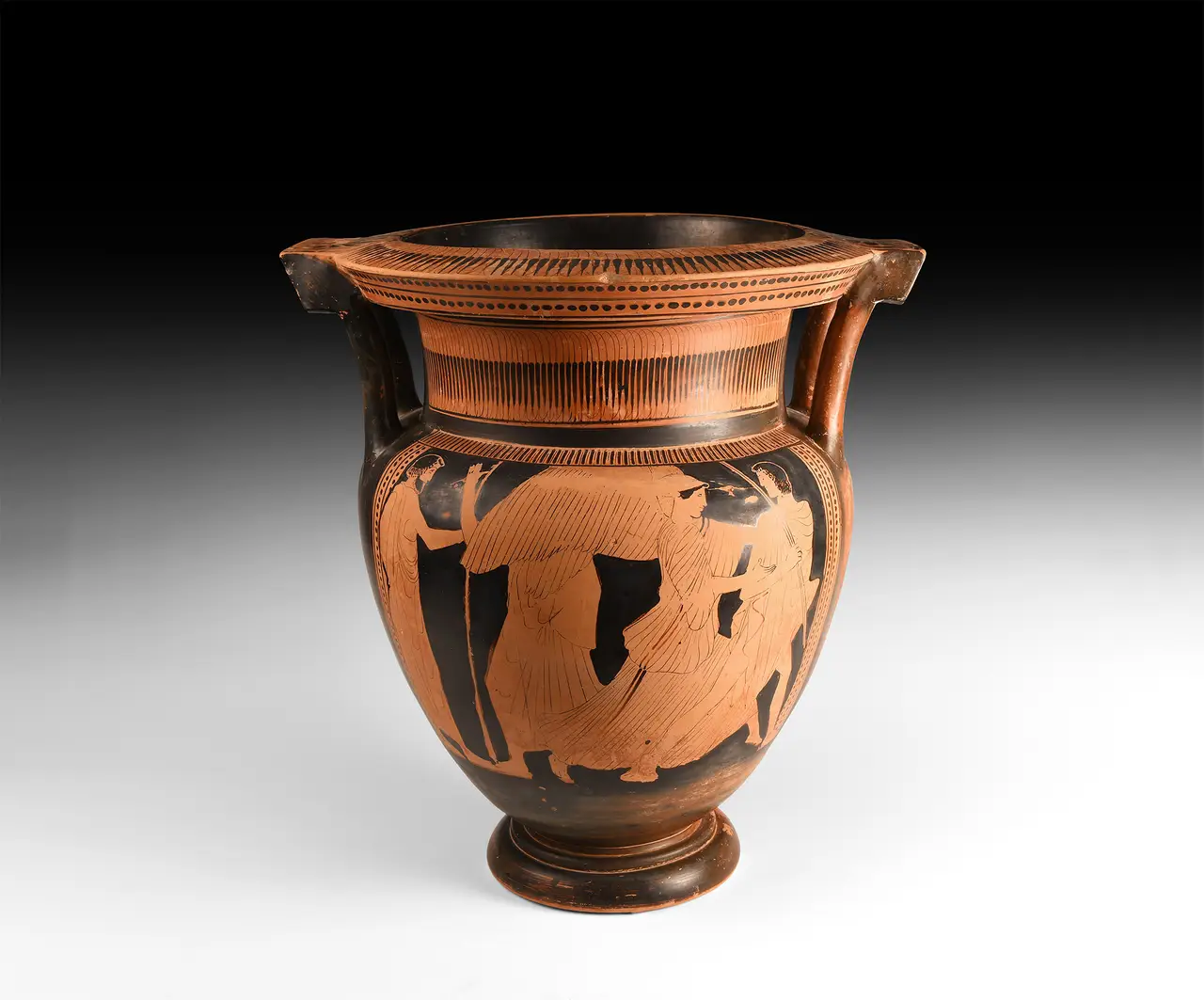
And there, on one of the panels, set apart, the painter put the krater by itself: the mixing-bowl that stood at the centre of the room and the centre of the institution, the thing that measured the wine out and, when the measure failed, presided over everything that followed.
TimeLine Auctions, 28th June 2026