Home > Stories by TimeLine Auctions
Stories by TimeLine Auctions
An 81-centimetre stick from a Greek coal mine is the oldest known handheld wooden tool
Two worked wooden objects from Marathousa 1 in Greece, dated to around 430,000 years ago, push the record for portable wooden tools back by some 40,000 years. One looks like a digging stick; the other, barely larger than a finger, has no known parallel.
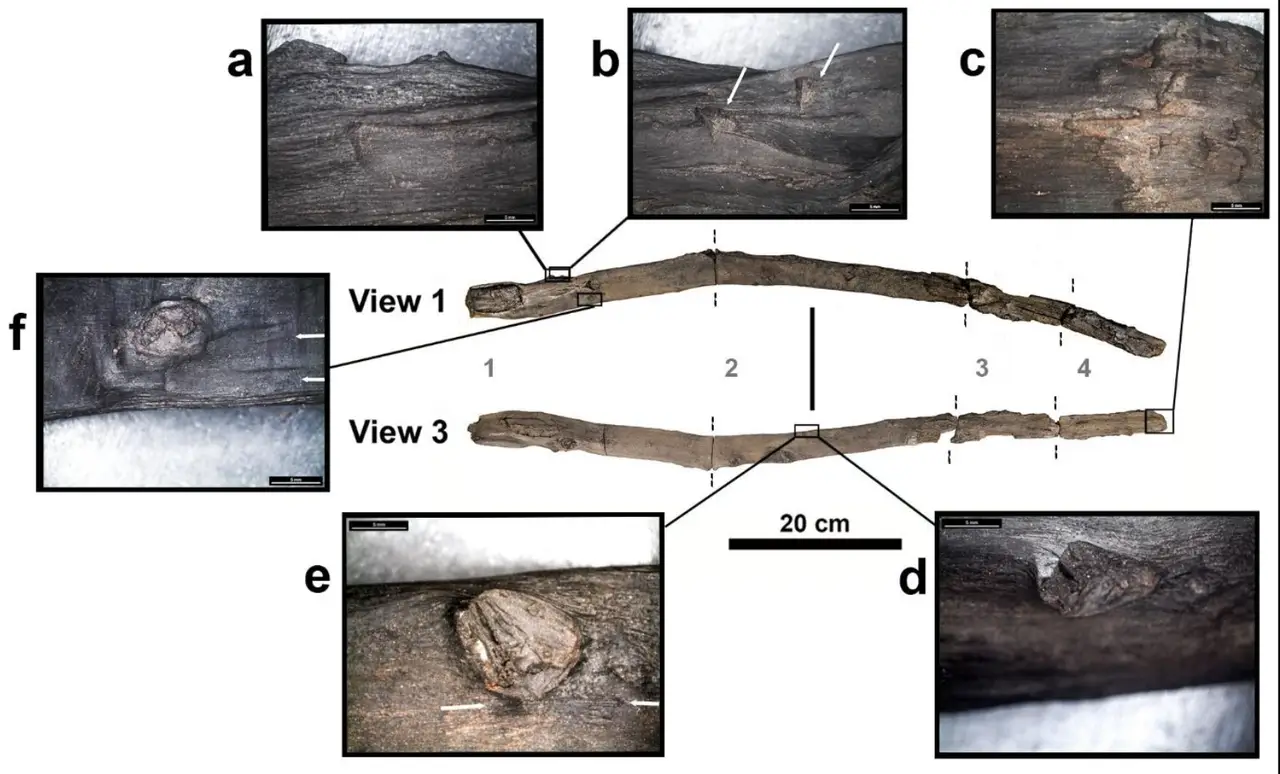 Catalog number: 940/673-39
Two pieces of worked wood from a lakebed in southern Greece have been identified as the oldest known handheld wooden tools, made around 430,000 years ago. The larger is an alder stick about 81 centimetres long, shaped by chopping and carving and worn smooth at one end. The smaller is a willow or poplar object just 5.7 centimetres long, debarked and trimmed to a point, small enough to be held between finger and thumb.
Both came from Marathousa 1, a Lower Palaeolithic site in the Megalopolis Basin exposed by lignite mining. They are described this year in the Proceedings of the National Academy of Sciences by a team led by Annemieke Milks of the University of Reading and Katerina Harvati of the University of Tübingen, working with the Ephorate of Paleoanthropology and Speleology of the Hellenic Ministry of Culture.
The age matters because portable wooden tools almost never survive. According to the paper, the two objects are about 40,000 years older than the previously oldest securely identified handheld wooden tools, from Kalambo Falls in Zambia, and they are the only such finds from south-east Europe. They did not turn up in isolation. They lay among the butchered bones of a straight-tusked elephant, more than 2,000 stone artefacts and worked bone, in sediments deposited during one of the coldest phases of the Pleistocene.
Why wood rarely survives
The scarcity is the point. Wood rots and stone does not, which is part of why the deep past is read mostly through stone and why the period carries the name Stone Age at all. Harvati told New Scientist that wood "might be the oldest type of tool that anybody used." Plant-based artefacts, she said, "are a lot more fragile and harder to find than those made from stone." Sites like Marathousa 1, where waterlogging preserved organic material, are the exceptions that let researchers test the idea.
Reading 144 pieces of wood
The wood came out of the ground between 2015 and 2019 and was kept waterlogged in distilled water in refrigerated containers, to stop it drying and cracking. In all, the team logged 144 plotted wood pieces from the site, most of them showing no sign of human work. The analysis, carried out at the M.H. Wiener Laboratory for Archaeological Science at the American School of Classical Studies at Athens, sorted candidate tools into four categories, from certain tools at one end to pieces with suggestive shapes but no diagnostic marks at the other.
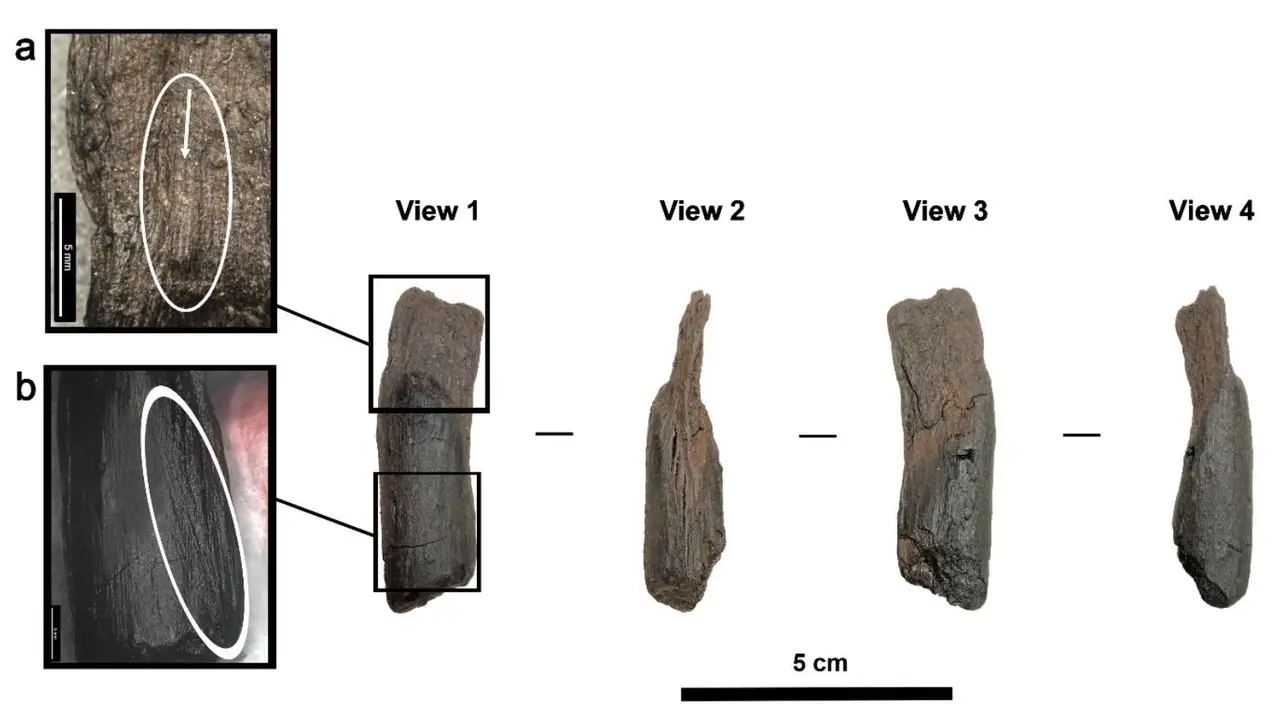 Catalog number: 935/671-13
To separate worked wood from wood altered by water, sediment, insects or animals, the researchers combined hand-lens inspection, stereo microscopy and, where the material allowed, microCT scanning, which images internal structure such as annual growth rings. Only the smaller of the two tools survived intact enough for a usable scan; the rest of the assemblage had been flattened by the weight of roughly 30 metres of sediment that once lay above the archaeological layer. The team also built high-resolution 3D models of the main specimens and released them as an open dataset.
The digging stick
The certain tool, catalogued as 940/673-39 (seen above as the first figure), is a length of alder that broke into four refitting fragments and measures 81 centimetres reassembled. It carries carving marks with associated stop marks, where a cutting stroke halted, along with chopping marks, including two that run together along the trunk and one that sheared off a knot. The working clusters around knots and toward what the team reads as the upper part of the stick, and the marks point consistently in one direction, toward the base of the original tree.
The woodworking was minimal. There is no careful surface finishing; the maker seems to have stripped most of the bark and taken off branches and protruding knots, and little more. One end is slightly thicker and rounded, which the authors suggest may have worked as a simple handle. The opposite, thinner end shows frayed fibres and micro-splintering over the last two to three centimetres, with rounding and adhering sediment, a pattern the team reads as use-wear.
The authors write that the tool has "a morphology and size comparable to digging sticks," and its dimensions fall within the range of digging and multipurpose sticks known from later Pleistocene and early Holocene sites. The function is not pinned down. The paper notes the stick could have been used to dig up tubers, to peel bark for the edible inner layer, or to process the elephant carcass it lay among. Harvati was candid about the last possibility in an interview with the New York Times.
"I don't really know what they were doing with it. I've never tried to cut up an elephant carcass, so I don't know. I assume it's not so easy, but I mean, I guess it's possible."
A tool with no parallel
The second object, 935/671-13 (seen above as the second figure), is the more puzzling of the two. It is a small piece of willow or poplar, woods that are hard to tell apart in archaeological material, measuring 5.7 centimetres long and a little over a centimetre across, and it was found away from the main cluster of elephant bones. Microscopy picked out two probable tool facets: one with a stop mark showing the direction of working, and one made of parallel striations running across the grain, read as a scrape from removing bark.
The microCT scan added the detail that, to the team, rules out a natural origin. At the narrow end, the wood's annual growth rings have been cut away from both sides, shaping it to a point in a way that would not happen on its own. The researchers also checked the piece against the gnawing traces left by beavers, whose remains are present at the site, and found no match. The opposite end shows rounding and pitting that may be wear from use.
At that size, the object has no obvious counterpart in the Pleistocene record, and Harvati called it "a completely new type of wooden tool." What it was for is unresolved. One suggestion in the paper is that it served to retouch the small stone flakes common at Marathousa 1, an activity already inferred from the lithics, but the authors present this as a hypothesis rather than a conclusion. As Harvati put it, "We don't really know what it was for."
Claw marks from a carnivore
A third large piece of wood from the site turned out not to be a tool. Specimen 942/677-59 is a segment of a big alder trunk, about 35 centimetres across at its widest, recovered in pieces from the northern edge of the elephant skeleton. It carries three roughly parallel grooves running at an angle across the grain, between about 15 and 20 centimetres long.
The grooves are too wide to have been cut by stone tools, the team argues, and their shape does not match the feeding traces of wood-boring insects. The fine, silty sediments and the absence of trampling damage on the nearby bones and stones make a heavy animal treading on the trunk an unlikely cause. The authors instead read the marks as fossilised claw marks from a large carnivore, with a bear the leading candidate; some grooves cross weathering cracks, which fits an animal clawing at a standing dead tree, perhaps after insects. No carnivore bones were found at Marathousa 1 itself, but bears, lions and possibly leopards are recorded at other localities in the Megalopolis Basin.
The placement carries a point for Harvati. Cut marks show hominins reached the elephant carcass early, the paper notes, while gnawing marks on the same remains show carnivores were not far behind. Large carnivores leaving their mark beside a butchered carcass, Harvati said, "indicates fierce competition between the two."
Where it sits in the record
Until now, securely dated handheld wooden tools have come from a short list of waterlogged or otherwise favourable sites. The paper lists the Clacton-on-Sea spear tip from England, at around 400,000 years old but from a less secure context; the handheld tools from Kalambo Falls in Zambia, at 390,000 to 324,000 years old; the spears and throwing sticks from Schöningen in Germany, at about 300,000 years old; wooden tools from Gantangqing in China, at about 300,000 years old; and the boxwood sticks from Poggetti Vecchi in Italy, at about 171,000 years old. At roughly 430,000 years, the Marathousa 1 objects are the oldest handheld wooden artefacts yet identified, according to the authors.
Older wood survives, but not as portable tools. The same Kalambo Falls excavation produced interlocking logs, interpreted as part of a structure, dated to at least 476,000 years ago. A possible polished willow plank from Gesher Benot Ya'aqov in Israel may be older still, at around 780,000 years, though the paper notes it has not been reassessed with current methods. The line the authors draw is between using wood to build something fixed and shaping a wooden object to carry and use by hand.
The Marathousa 1 tools also fit a pattern the team flags: several better-known wooden finds, including Schöningen and Poggetti Vecchi, turn up alongside assemblages of small stone tools, as here. The wider case for organic technology has been made recently from other sites as well. A separate study reported a hammer made from elephant bone at Boxgrove in England, dated to around 500,000 years ago; Silvia Bello of the Natural History Museum in London told the New York Times that flint fragments embedded in the bone confirmed it had been struck repeatedly against stone for a specific task.
Who made them
No hominin fossils have been found at Marathousa 1, so the identity of the toolmakers is not known directly. The date places the site well before Homo sapiens reached Europe. Harvati's working hypothesis, as she described it, is a pre-Neanderthal population often labelled Homo heidelbergensis, though she stressed that Greece sat at a crossroads for human groups and that it would be premature to settle the question. Milks put the range similarly, saying the makers could have been Homo heidelbergensis or possibly very early Neanderthals.
Whoever they were, the picture from the site is of people drawing on whatever the lakeshore offered during a hard glacial period: stone, bone and wood, used to butcher large animals and, the wood now suggests, to dig, scrape or process other materials. Harvati framed this as evidence of the behavioural flexibility of the Marathousa hominins.
Why these tools are easy to miss
Both objects are easy to overlook, and the authors think that may be the wider lesson. The larger stick was barely shaped, its tool marks are microscopic, and the smaller piece is little bigger than a finger; tools like these could sit unrecognised in collections from other sites with good organic preservation. Identifying them takes the kind of systematic, microscope-led examination of wood assemblages that has become standard only in the past decade. Dirk Leder of the Lower Saxony State Office for Cultural Heritage, who works on the Schöningen wooden tools and was not involved in the study, said prehistoric wooden artefacts remain very scarce. "Every single find is welcome," he said.
*The study, "Evidence for the earliest hominin use of wooden handheld tools found at Marathousa 1 (Greece)," is published in the* Proceedings of the National Academy of Sciences. The authors' 3D models of the specimens are available as an open dataset on Zenodo.
TimeLine Auctions, 8th July 2026