Home > Stories by TimeLine Auctions
Stories by TimeLine Auctions
Ancient Egyptian Pottery: A History in Two Clays
Every pot ancient Egypt made, from a Badarian bowl shaped around 4400 BC to a wine jar stoppered on the eve of the Arab conquest, began as one of two muds. The first is Nile silt, the iron-bearing alluvium the river laid down the whole length of the country: fired in a clean, well-aired flame it comes out red to brown, and anyone with a digging stick could win it from the riverbank. The second is marl, a family of pale, lime-rich clays from the desert edge between Esna and Cairo, harder to get (at Ballas, near Qena, it was mined from underground galleries), fussier to fire, and pale where the silts are red: cream, pink, sometimes a soft olive green. Five thousand years of Egyptian ceramics rest on that division, and the pottery chapter of the standard handbook, Nicholson and Shaw's Ancient Egyptian Materials and Technology, written by the ceramicists Janine Bourriau, Paul Nicholson and Pamela Rose, calls it so well established that trying to change it would be counterproductive.
Hold the split in mind and the rest of the story arranges itself. The painted and black-topped jars of the Predynastic cemeteries made pottery an archaeological subject in the first place. The Old and Middle Kingdoms turned potting into an industry and, for the archaeologist, into a clock. The New Kingdom produced the one flamboyant pharaonic ware, painted in real cobalt. Roman and Christian Egypt shipped its ceramics further than any pharaoh's ever travelled. And along the way sit the named shapes every museum visitor meets, canopic jars, hes-vases, ostraca, together with one great impostor: the bright blue-green material of shabtis and the Metropolitan Museum's hippopotamus "William", which is not pottery at all.
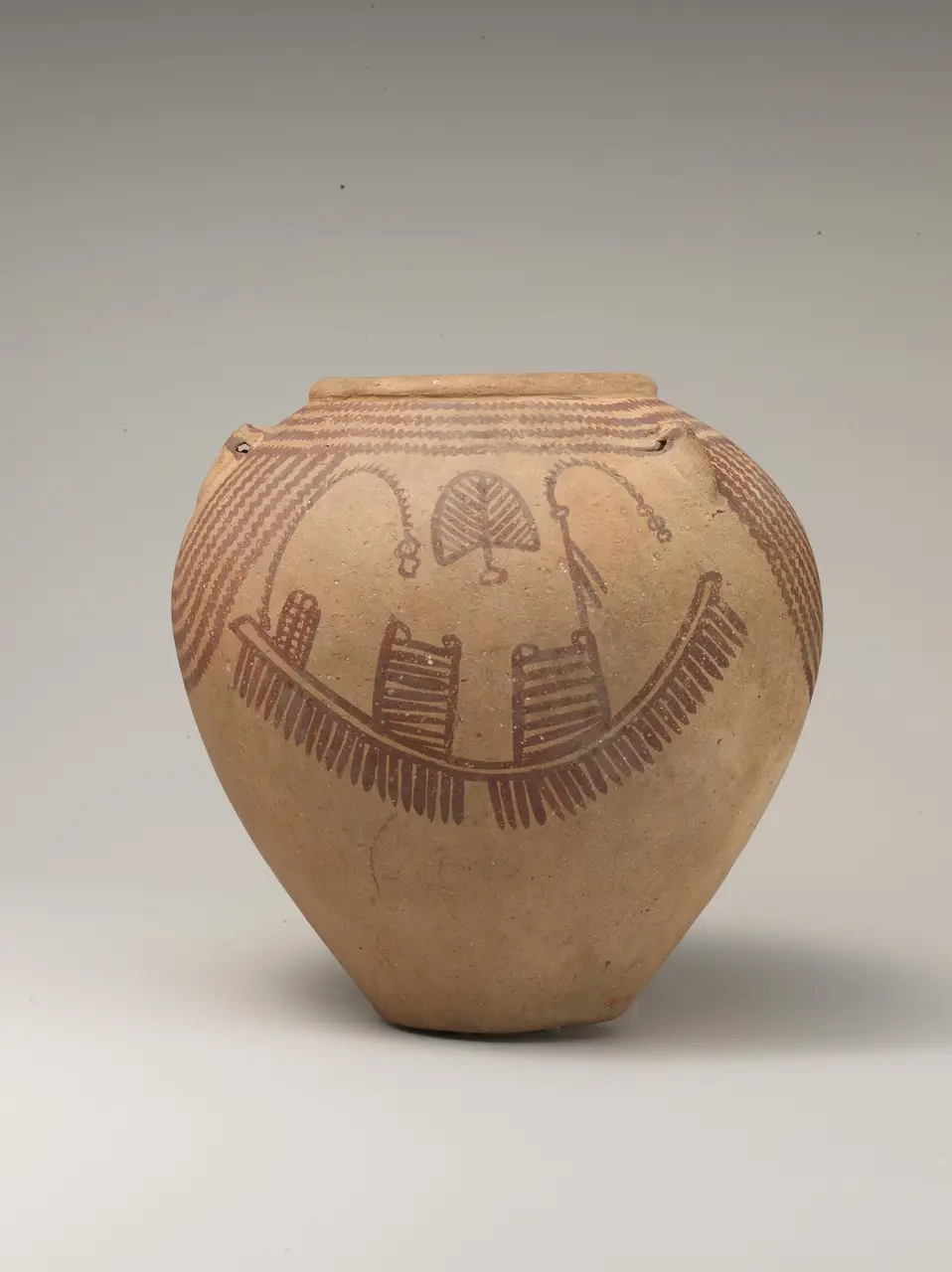 A Decorated ware jar of Naqada II, red-brown paint on pale marl clay: a many-oared boat carries two cabins and a standard. Metropolitan Museum of Art, New York. CC0, via Wikimedia Commons.
Two clays and the language on the label
A fresh break tells you which family you are holding. Nile silt fires brown to red, often around a black core where oxygen never reached the middle of the wall, and its commonest fabric is full of chopped straw, added to open the clay so steam could escape in the fire. Marl breaks pale and very hard, and it plays one consistent trick: its mineral salts effloresce as the pot dries and fire to a thin white skin that passes for a deliberate cream slip. Bourriau and her co-authors warn that this scum deceives the unwary; fired hot enough, it can even vitrify to a glassy olive film that has been mistaken for glaze. The rule of thumb pairs marl with fine wares and silt with coarse ones, and it is only a rule of thumb: Marl C, the standard fabric of Middle Kingdom storage jars, is coarse and speckled, and fine Nile fabrics exist. (A third clay, a pink kaolin at Aswan, stays offstage until Roman times.)
The vocabulary on museum labels was settled in 1980, when six archaeologists, Dorothea Arnold, Manfred Bietak, Janine Bourriau, Helen and Jean Jacquet and Hans-Åke Nordström, met in Vienna and agreed a common way of describing fabrics from a sherd break under a hand lens. Their methods had been forged in the UNESCO campaign to salvage Nubia's archaeology ahead of the Aswan High Dam, which filled the valley in the 1960s with surveyors who needed a shared ceramic shorthand and did not have one. The result, the Vienna System, published in full by Nordström and Bourriau in 1993, sorts Egyptian fabrics into Nile A to E and Marl A to E, with mixed clays alongside. Nile B2, straw-tempered and endlessly variable, is the workhorse of every period; porous, thick-walled Nile C went into beer-brewing vats; Marl D, shot through with angular limestone, carried the Eighteenth Dynasty's amphorae. A label reading "Marl F" speaks a later dialect, added by David Aston after 1993 for Late Period Delta fabrics the Vienna workshop never covered. The system's authors were modest about it: it was built for field recording between the Old Kingdom and the end of the New, its groups shade into one another, and it does not claim to say where a pot was made. Chemistry often cannot say either, because Nile sediment is so uniform along the valley that no laboratory analysis has yet sourced a silt pot within Egypt on composition alone.
How the pots were formed changed more slowly than most visitors assume. The earliest Egyptian pottery is entirely hand-built, coiled or beaten out over an anvil, and some of the finest vessels in the whole tradition were made that way before the wheel existed. A potter's wheel appears in Old Kingdom tomb art, securely in the Fifth Dynasty tomb of Ty at Saqqara and perhaps a dynasty earlier in a tomb at Giza, and an actual wheel-head has been excavated at Abusir. Whether those early pivots could throw a pot, raising the wall under centrifugal force, or merely steady it while the hands did the work, is a live question: Colin Hope argued in 1981 that they were turntables and no more, and Powell answered in 1995 by throwing true pottery on a reconstructed two-stone pivot, one-handed, the other hand keeping the wheel moving. The fast kick-wheel, driven by the potter's foot on a flywheel, is far later; the first Egyptian evidence for it is a scene in the temple of Hibis in Kharga Oasis, painted under the Persian king Darius, around the time of the battle of Marathon. The pyramids are two thousand years older than the fast wheel.
Firing began as a bonfire and for most wares stayed one. Open firings have been measured to an average peak of about 860 degrees Celsius, hotter than the word suggests, but a bonfire cannot hold its heat, and the updraught kiln, a chimney with a gridded floor over a firebox, became the professional's tool because it can. What every firing shares is the chemistry of iron: give the fire air and iron-bearing clay oxidises red; choke it with smoke and the iron reduces to black. Decoration, when it came at all, came before the fire. Slips of fine clay evened out the surface colour; burnishing with a pebble compacted the wall to a sheen that has been called a glaze often enough for the handbooks to warn against the error; paint went on before firing with only rare exceptions. Egyptian potters learned early to steer the iron chemistry deliberately.
The pots that invented archaeological dating
In the mid-1890s W. M. Flinders Petrie dug more than three thousand prehistoric graves at Naqada and Ballas, with more to follow at Abadiyeh and Hu, and none of them contained a written word. His answer to the dating problem became a founding method of archaeology. For each of some nine hundred graves holding five or more pots he made out a slip of paper listing the types present, then rearranged the slips until each type's floruit clustered along a diagonal, every form rising, peaking and fading in order. He cut the arrangement into fifty steps, numbered them Sequence Date 30 to 80, and left 1 to 29 deliberately empty in case older cultures were still in the ground. They were: when Guy Brunton and Gertrude Caton-Thompson found the Badarian culture in the 1920s, it slotted in below his starting line, exactly as he had allowed. Stan Hendrickx, the chronology's modern keeper, calls this the first seriation ever attempted in archaeology, and when the statistician David Kendall re-ran the arithmetic on computers around 1970, the ordering held.
The engine of the seriation was a single vessel family. Wavy-handled jars enter in Naqada II as globular storage vessels with a functional ledge handle, a form borrowed from Palestine; over the centuries the handle climbs the shoulder, shrinks, and ends as a painted wavy line on the tall cylindrical jars of the First Dynasty. Petrie read that decay as a one-way clock, and he was broadly right, though wrong in detail after detail. Elise Baumgartel later showed that his earliest wavy-handled type specimen had been bought rather than excavated; Werner Kaiser, reworking the horizontal spread of graves across the Armant cemetery in 1957, rebuilt the sequence into the phases now called Naqada I, II and III, retiring Petrie's old culture names of Amratian and Gerzean; Hendrickx has revised the phases again since. Sequence Dates themselves carry no calendar value. SD 45 is a position in a relative queue, the fifty steps are of unequal length, and absolute time arrived only with radiocarbon: the Bayesian model published by Michael Dee and colleagues in 2013 puts the accession of King Aha, at the threshold of the First Dynasty, close to 3100 BC.
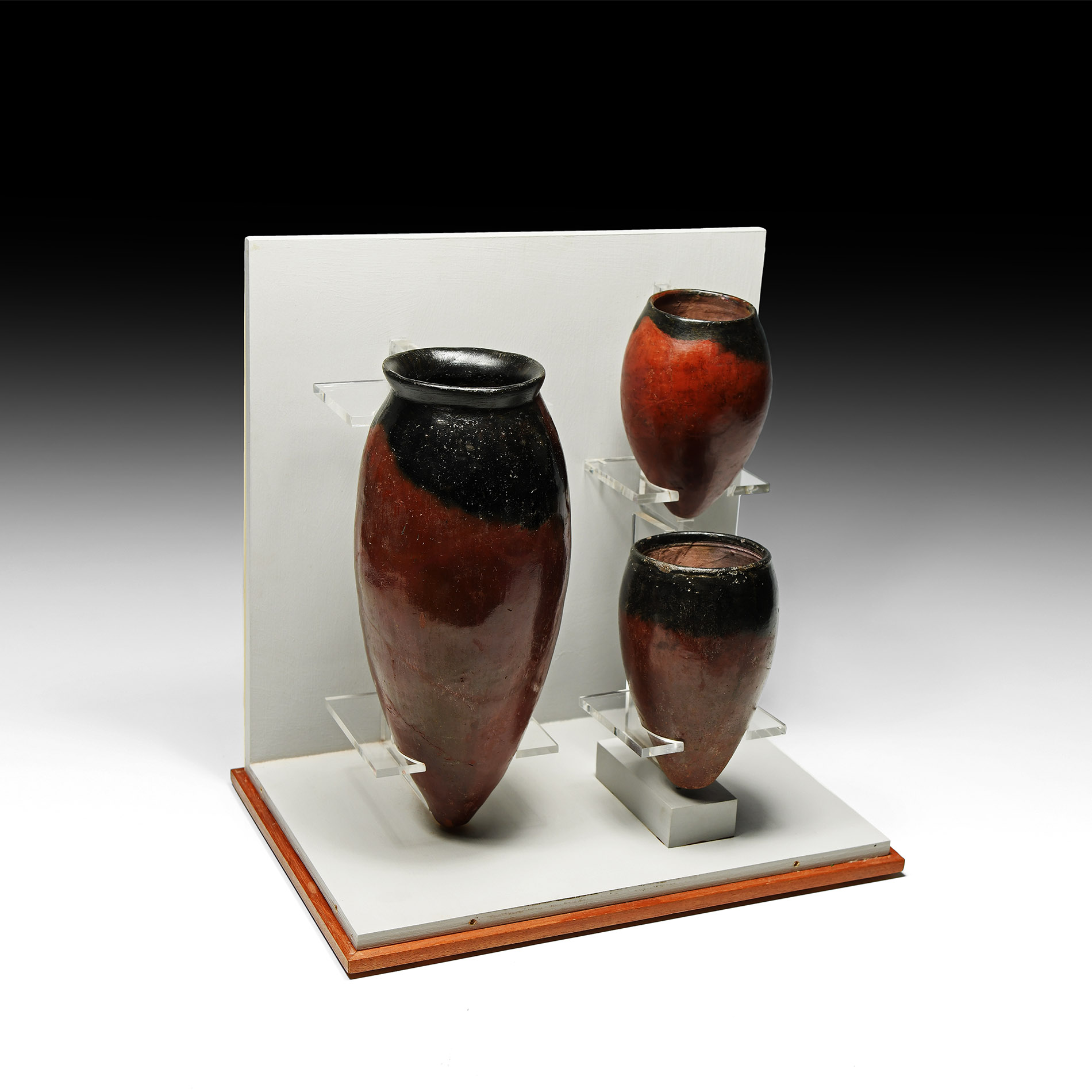
The wares Petrie lettered remain the crown of any Egyptian pottery collection. Black-topped red ware, his class B, is the signature: a Nile-silt vessel coated in red ochre and burnished to a gloss, with a clean black band running around the rim and down the interior. There is no black paint on it anywhere. In the standard reconstruction the potter fired the pot in a smoky, oxygen-starved blaze and then, while it still glowed, upended it mouth-down into sawdust or chaff; the smothered rim reduced to black while the exposed body kept its red. The band was long explained as a coating of magnetite, until a Mössbauer spectroscopy study by Makundi and colleagues in 1989 ruled that out, finding carbon and chemically reduced iron instead; the analysed sherds were Cypriot and Nubian cousins of the ware, so the result carries to Egypt by analogy, though the mechanism is the same. Bourriau's handbook counts the best black-topped vessels among the finest pottery known from ancient Egypt: coil-built, fired without a kiln, and controlled to a hair. Beside them stand the still thinner bowls of the Badarian, combed while leather-hard and then burnished so that the combing survives as a fine, regular ripple under the gloss. In Badarian graves a black-topped pot is often the principal offering, laid in beside siltstone palettes and ivory combs.
White cross-lined ware, class C, belongs to Naqada I: the same red-polished ground now carries designs in white and cream paint, crossed lines and chevrons, hippopotamus hunts, human figures. Decorated ware, class D, displaces it in Naqada II and changes everything at once. The body is now pale marl, the first large-scale use of the desert clay; the paint is red-brown; and the repertoire settles into many-oared boats with twin cabins and standards, files of long-legged birds catalogued since Petrie's day as flamingos, spirals, and wavy lines read as water and desert. What the boats meant is unknown. Funerary procession is the conventional reading, inferred from the graves the jars were buried in, and it remains inference. The two painted classes never occur together in a grave, which is the property Petrie leaned on to order the early cemeteries. The rest of his alphabet is quieter: P for polished red without the black top, R for the rough straw-tempered kitchen ware of every period, F for fancy zoomorphic shapes, N for black incised bowls with white-filled patterns, and L for the late wares that run up to the First Dynasty.
Bread moulds, beer jars and the bowls that date whole sites
With the unified state, pottery becomes an industry, and most of the industry's output was built to be thrown away. Nothing shows it better than the bread mould, a thick cylinder of coarse, barely fired silt into which dough was pressed and baked, the mould then broken to free the loaf; Helen Jacquet-Gordon's typology follows the form's decline from massive Old Kingdom cylinders to the small, crude cones of the New Kingdom, and the fragments turn up in huge numbers around excavated ovens. Beside the moulds, in similar bulk, sit beer jars, tall rough tapering vessels named by Rostislav Holthoer from their constant funerary pairing with bread moulds; bread and beer head the offering formula, and the pair reproduced it in ceramic. David Aston notes that there is no evidence they actually held beer, so the name is a convention and may stay one. The people behind this output are nearly invisible: tomb scenes at Beni Hasan set the potters beside the bakers and brewers, in workshops of one or two, and the inscriptional record barely acknowledges that they existed.
The fine ware of the age is the Meidum bowl, first isolated by Petrie at the Meidum pyramid in 1892: a thin, hard, sharp-shouldered bowl with a recurved rim, red-slipped and polished in the manner of the metal and stone vessels the shape copies, found in Old Kingdom settlements, cemeteries and temples alike. Its value to archaeology lies in its profile, which drifts. Early bowls have high sides, a restricted mouth and a knife-sharp carination; by the Fifth and Sixth Dynasties the shoulder rounds off and the rim widens until it equals or passes the body's widest point, and excavators use that drift to split earlier from later Old Kingdom deposits. A datable bowl dates the deposit around it, which is what archaeologists mean when they borrow the geologists' term and call a pot a type fossil.
When central control failed at the end of the Old Kingdom, the pottery fragmented with it; regional styles appear along political boundaries and only re-homogenise under the Twelfth Dynasty. Out of those same decades comes the offering tray: a coarse pottery platter modelled with loaves, a trussed duck and a foreleg of beef, cut with drainage channels, made as a cheap stand-in for a stone offering table and left where the living could pour water over it. By the Middle Kingdom the tray had grown walls, stairs, columns and an upper storey, the modelled food still set out in the courtyard. Petrie, excavating at Rifeh, named these models soul houses on the surmise that they sheltered the spirit of the dead. The name stuck; the surmise is still a surmise, and the tidy evolution from plain tray to elaborate house has since been questioned too, with trays and houses argued to be contemporary alternatives rather than stages.
The Middle Kingdom's dating instrument is humbler again: a plain, round-bottomed drinking cup that fits in a palm. Dorothea Arnold, publishing the pottery of the pyramid cemeteries at Lisht and Dahshur, showed that the cups deepen and narrow generation by generation, and that the drift can be measured: divide the maximum diameter by the height and multiply by a hundred. First Intermediate Period cups are wide and shallow, with indices around 230; by the late Thirteenth Dynasty the figure has sunk to about 120. The index is now standard equipment for dating Middle Kingdom deposits, used with the field's own cautions attached: a group is dated by its lowest value, a single cup proves nothing, and Stephan Seidlmayer has shown the fashion moved at different speeds in different provinces. Late cups add a small flourish, a hairline of red at the lip, made by dipping the finished cup mouth-down into paint.
Storage ran on the other clay: Marl C jars, pale, speckled and extremely hard, were the standard commodity containers of Lower Egypt through the Middle Kingdom and the Hyksos period, and Bettina Bader's study of the material from Tell el-Dabʿa treats them as the packaging of internal trade. Household water storage worked an opposite trick. The big zir was deliberately under-fired and left porous, so that water seeping through the wall evaporated and cooled what stayed inside.
At the era's edges run two black burnished traditions. Tell el-Yahudiyeh juglets, small piriform vessels punctured in geometric bands packed with white chalk, tie the eastern Delta of the Hyksos period to Palestine and Cyprus; they were made in several fabrics at several centres, and the ware travelled as far south as Kerma. Kerma itself, the Nubian kingdom above the Third Cataract, produced in the same centuries what George Reisner, who excavated it, judged the finest pottery of the whole Nile valley: the Classic Kerma tulip beaker, black-topped, bell-shaped, its walls under three millimetres and its surface burnished to a metallic sheen. Reisner concluded that transplanted Egyptian potters must have made anything so good. Modern scholarship reads the beakers as wholly Nubian, and his conclusion as a compliment the evidence never required.
The blue-painted jars of Malqata and Amarna
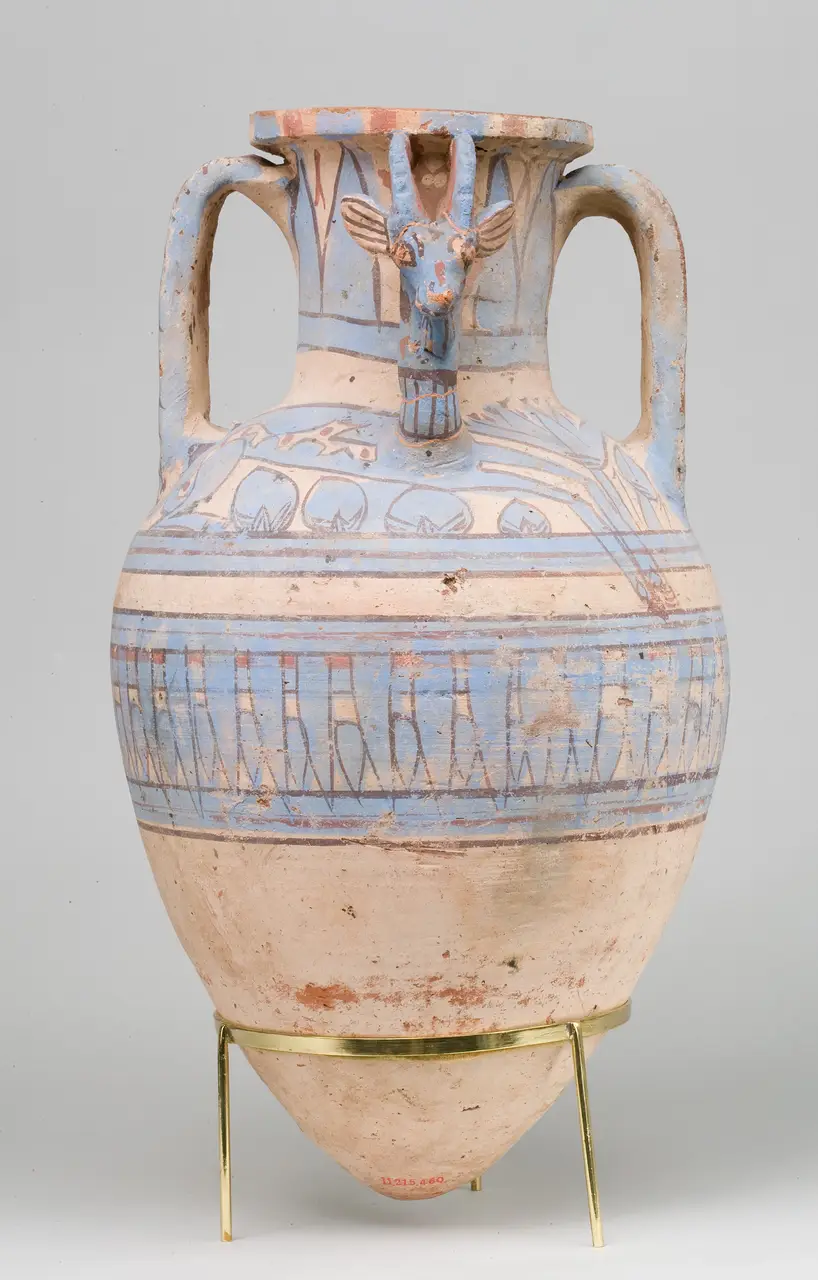 A blue-painted amphora from the palace-city of Malqata, about 1390-1353 BC, its neck carrying a modelled ibex head between the handles. Metropolitan Museum of Art, New York. CC0, via Wikimedia Commons.
For most of pharaonic history Egyptian pottery is plain, and then, for nearly three centuries, one class breaks the rule: blue-painted ware, the festival ceramic of the late Eighteenth and earlier Nineteenth Dynasties, its amphorae, jars and bowls wrapped in painted collars of lotus petals, buds and festoons in blue, black and red over a cream or pink ground. The blue itself is a genuine cobalt pigment, cobalt aluminate, chemically unrelated either to the copper-based "Egyptian blue" of wall painting or to the copper glaze of faience. Kaczmarczyk's analyses traced its most plausible source to cobalt-bearing alum from the Kharga and Dakhla Oases, some 150 miles out in the Western Desert; the raw alum is pink, and turning it blue meant precipitating it with natron or plant ash and roasting the product at 800 to 1,000 degrees. Cobalt enters Egyptian glass, faience and pottery in the sixteenth century BC and disappears in the eleventh, returning only centuries later from a different, probably Iranian, source. Blue-painted pottery lives and dies inside that window, and because glass, faience and the pottery pigment all drew on one scarce mineral, its workshops appear to have sat close to the palaces that could command the supply.
Older books file the whole class as "Amarna ware", and Colin Hope, its principal modern student, would retire the label altogether: blue appears as sparse accent bands under Amenhotep II and Thutmose IV, the ware is in full production at Amenhotep III's palace-city of Malqata a generation before Akhenaten, and it runs on to about Ramesses IV. Nor was it a royal monopoly. At Amarna, where every grade of housing has been excavated, blue-painted sherds turn up in the poorest quarters, and what wealth changed was the quality of the painting; the bowls modelled with the face of the goddess Hathor, once read as cult equipment, were in Hope's judgement common household utensils. The motifs stay overwhelmingly floral, lotus and cornflower and poppy, with rarer friezes of pintail ducks in flight, gazelles and ibexes, and on the showiest pieces the decoration concentrates on one face, as if the jar were meant to be seen from the front.
Decoration did not lift these vessels out of service: the polychrome amphorae from the tomb Horemheb built at Saqqara while he was still a general carry hieratic wine dockets in ink, one reading "Year 1. Wine of the irrigated land of the Prince and King's Scribe Horemheb". The showiest ceramic of the New Kingdom was also working packaging, labelled by year, estate and owner like a vintage. Most such jars are Marl D, the very hard limestone-flecked fabric mass-produced to standard shapes and capacities in a few centres, probably in Lower Egypt, and shipped everywhere; the mnt-jars of the Deir el-Medina texts, which brought the workmen their wine and oils, belong to the same family. And painted ware of any kind is a sliver of the whole. The bulk of the New Kingdom corpus is plain: storage jars, drop-shaped and biconical forms, funnel-necked stands, flower pots with thumb-pierced bases, and the lentoid pilgrim flask, which arrives under Thutmose III as a Levantine import and is copied for the next eight hundred years. A survey of 980 pilgrim flasks from Egyptian sites by the ceramic specialist Loretta Kilroe watches the handles migrate slowly down the neck from the Eighteenth Dynasty to the Late Period; the painted concentric circles of the textbook example are more Levantine than Egyptian, and the Egyptian flasks are most often plain.
Canopic jars, Bes faces and the pot as paper
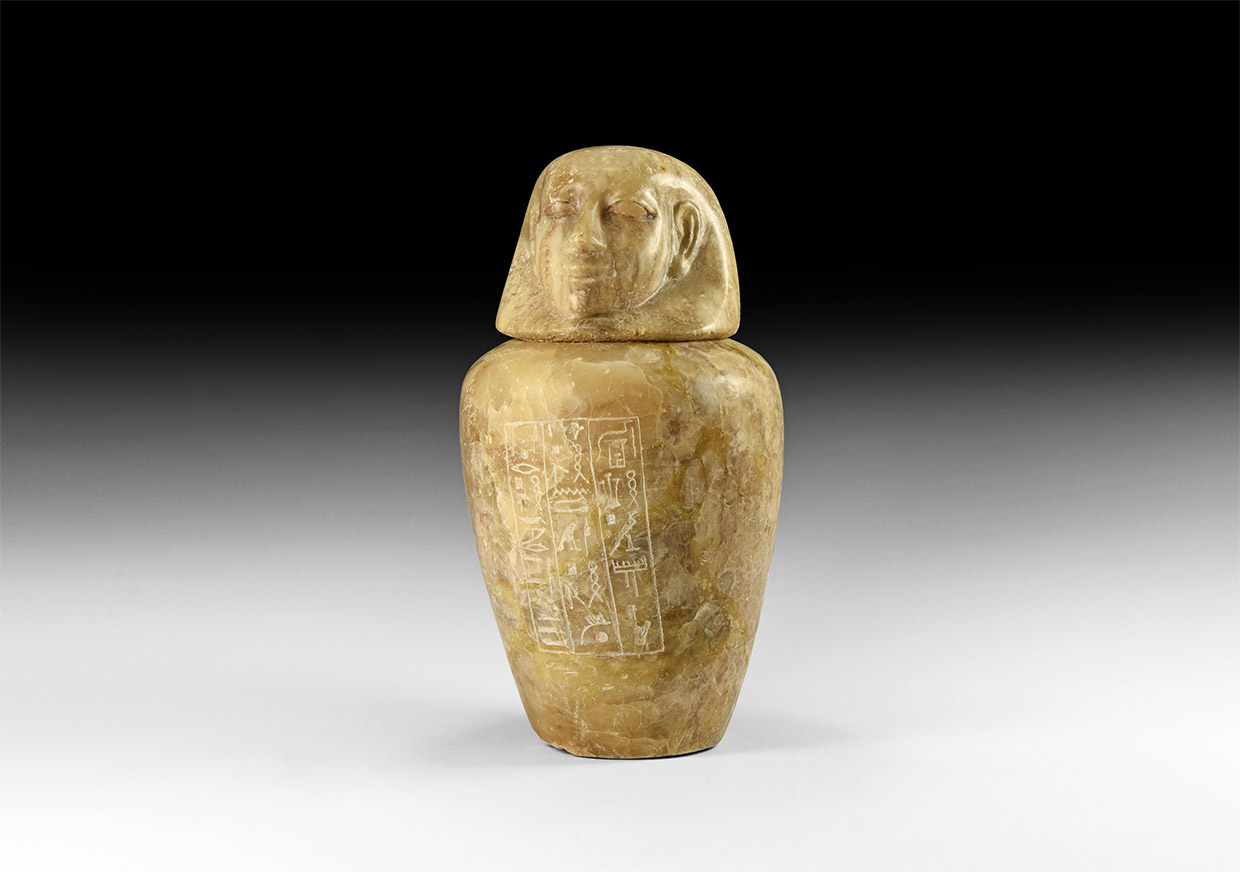
Canopic jars, the sets of four containers for the embalmed liver, lungs, stomach and intestines under the guard of the Four Sons of Horus, are at their finest calcite or limestone, with wood, cartonnage and faience alongside; pottery held the economy end. The economy end was busy, the British Museum alone holds many painted pottery canopics, and materials mixed freely: a Twenty-second Dynasty set in the Luxor Museum pairs pottery jars, painted white, with lids of carved limestone. By the Third Intermediate Period embalmers had gone back to leaving the viscera inside the body, and wealthy burials went on including canopic jars anyway, empty, or solid dummies with no cavity at all. The form had outlived its function and kept its place in the tomb inventory for centuries regardless.
The hes-vase, a tall slim pourer with a flaring rim and spreading foot, has the most literate silhouette in Egyptian ceramics: its outline writes the hieroglyph hes, "to praise", so that pouring a libation from it performed the word. The Delta temple site of Tell Ibrahim Awad has yielded one of the largest groups of them known, in plain pottery, with faience and metal versions further up the social scale. Bes jars, necked vessels wearing the modelled face of the bug-eyed, tongue-out dwarf god who guarded households and childbirth, run from the New Kingdom into Ptolemaic times, and the best recent evidence for their purpose comes from Mut al-Kharab in Dakhleh Oasis, where the corpus published by Gill in 2016 records an intact example set complete against a house wall, apparently a protective foundation deposit. The older idea that they were beer vessels for Hathor's drunken festivals stays in circulation, and stays unproven. So does almost everything about the small Eighteenth and Nineteenth Dynasty vessels modelled as women, sometimes nursing a child; a dozen or so are known, and "perhaps for milk" is as far as the careful literature will go. Beside the ritual shapes sits one purely industrial one: the spinning bowl, an open bowl with loop handles on its interior floor for plying wet flax, a machine component in fired clay.
The commonest way pottery carries words, though, is by accident. An ostracon is a broken sherd, or a flake of limestone, reused as a writing surface, and Egypt ran its daily paperwork on ostraca because papyrus cost money: letters, accounts, contracts, scribal exercises, sketches, and fair copies of literature. The workmen's village of Deir el-Medina has produced thousands, more than fifteen hundred of them bearing literary excerpts, and the largest ostracon known, in the Ashmolean Museum, carries the Tale of Sinuhe. At Deir el-Medina itself most of the flakes are limestone from the surrounding cliffs; the pottery ostracon rules in the towns and the Delta, where ink dockets on wine jars survive in their thousands and record estate, vintage and year. A pot that broke stopped being a container and became stationery, and a good share of what is known about ordinary Egyptian life survives on that stationery.
Faience is not pottery
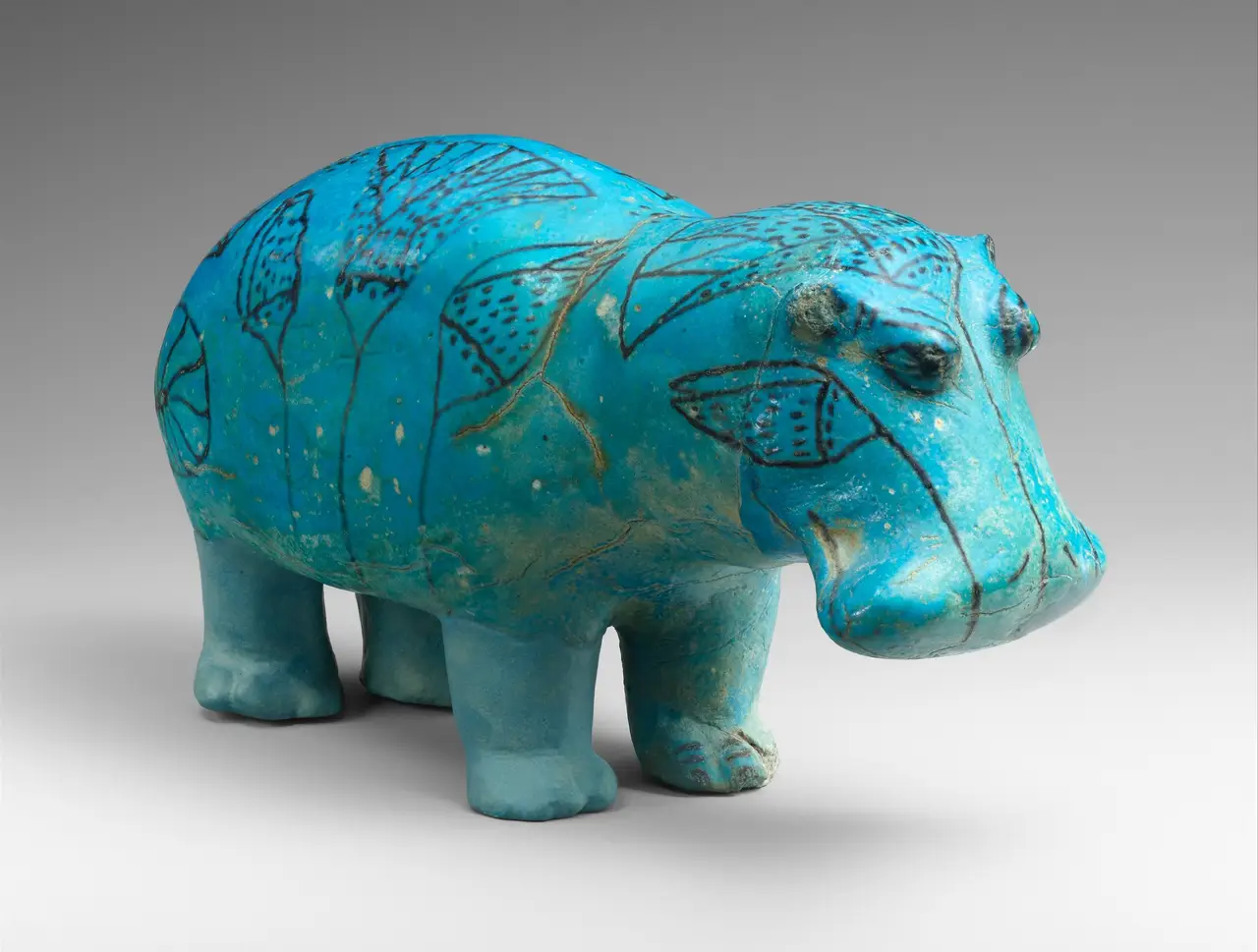 "William", the Metropolitan Museum's faience hippopotamus, Twelfth Dynasty, about 1961-1878 BC, painted with the river lotuses of his marsh. Metropolitan Museum of Art, New York. CC0, via Wikimedia Commons.
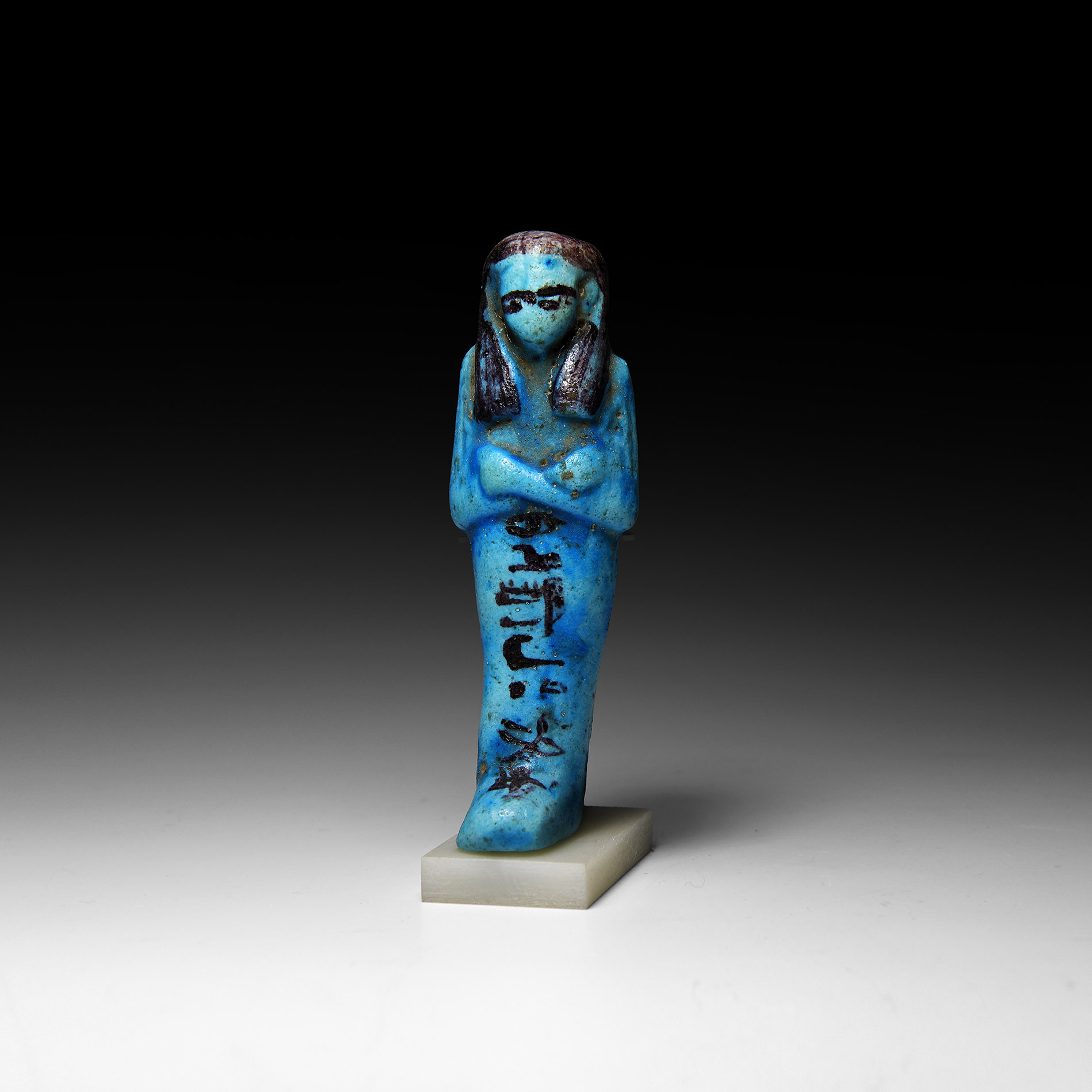
The bright blue-green material of shabtis, amulets, temple tiles and the Met's "William" is faience, and faience contains no clay. The body is crushed quartz or quartz sand with small additions of lime and natron or plant ash, shaped damp, dried and fired at 800 to 1,000 degrees; the glaze, coloured its unmistakable blue-green by copper, largely makes itself. In the oldest and commonest method the glazing salts are mixed into the body, and as the object dries they effloresce to the surface (within about half an hour of shaping, Pamela Vandiver found) and melt in the fire into a thin glassy skin. A second method packed the object in glazing powder inside a container, a technique researchers found still in use in the Iranian town of Qom in the 1960s; a third brushed or dipped the glaze on. Vandiver and Kingery called faience the first high-tech ceramic, and it is best understood as an artificial gemstone: the Egyptian name, tjehenet, is rooted in the idea of shining, and a second name it shared with lapis lazuli.
The modern name is borrowed, and borrowed badly. European collectors took it from Faenza, the Italian town whose tin-glazed clay earthenware is now called majolica; the Egyptian material shares nothing with Faenza's except the loan of the word. The chemist Alfred Lucas judged the term unsuitable and too ingrained to displace, and there matters remain; the British Museum's cataloguers sidestep it with "glazed composition".
What faience made, it made in bulk. Djoser's Step Pyramid complex at Saqqara was fitted in the Third Dynasty with around 36,000 blue tiles. Middle Kingdom workshops turned out bowls painted with marsh scenes of lotus and tilapia fish, and the hippopotamus figures of which William is the famous survivor; New Kingdom palaces carried polychrome tiles, bound foreign captives among the favourite subjects; and shabtis, the mummiform tomb servants, were never more abundant than in the Third Intermediate and Late Periods. A broken edge settles most identifications. Faience shows a pale granular quartz core under a thin skin of glaze; Egyptian blue, the ground copper-silicate pigment of the wall painters, is the same colour all the way through, with no core and no glaze; a glazed scarab is usually steatite, dense carved stone under the coating, and glazed steatite is probably the first material Egyptians glazed at all. True glazed clay pottery, the thing the word faience suggests to anyone raised on European ceramics, Egypt essentially did not make: a few Roman-period vessels with part-clay bodies edge toward it, and a genuine lead-glazed earthenware industry arrives only in the eighth century AD, after the Arab conquest. Across the entire pharaonic span the rule holds: if it is glazed, it is not clay.
Two faience types matter here because they impersonate pottery shapes. The New Year flask borrows the pilgrim flask's lentoid body, adds a neck moulded as a papyrus umbel with two small baboons for handles, and was filled, the inscriptions suggest, with Nile water given as a present at the inundation festival. And the shabti, among the Egyptian antiquities a collector meets most often, is glazed composition, not fired clay.
Pottery after the pharaohs
From the late seventh century BC the Saite kings settled Greek traders at Naukratis on the Canopic branch of the Nile, the port of their capital at Sais, and East Greek painted pottery arrived by the shipload, the bulk of it datable between about 650 and 525 BC; Alexandra Villing and Udo Schlotzhauer, editors of the British Museum's study of the site, open it with an older historian's verdict that Archaic Naukratis was the Shanghai of ancient Egypt. Silver, wine and oil came in; grain, linen, papyrus and natron went out. The pots the Greeks dedicated in its sanctuaries were scattered across some seventy museums, and a British Museum project is still reuniting them digitally.
What Egypt itself shipped, above all, was wine, and the wine travelled in Nile clay. Amphora-making in Egypt runs unbroken from pharaonic times to the Arab period and beyond, in fabrics so consistent that jars centuries apart share the same drab chocolate-brown break, flecked with golden mica and streaked with the voids of burnt-out straw. Ptolemaic types carried the vintages of the Mareotis, the prized lake-country wine district behind Alexandria; under Rome the potters copied the Italian Dressel 2-4 shape at about twenty-five litres for the same trade; and the small ribbed Late Roman Amphora 7, spike-based and narrow-necked, carried valley wine out to the oases and down to the ports into the seventh century. The trade ran both ways, and Alexandria's dumps mix the local jars with Rhodian, Cilician and Gazan imports.
At the table Egypt joined the red-slip world of the late Roman Mediterranean. In the fifth to eighth centuries especially, potteries at Aswan turned the local pink kaolin, the third clay at last, into Egyptian Red Slip ware: open bowls, dishes and cups under a burnished slip with a feel the specialists call soapy, many of the shapes copied from the African Red Slip ware arriving out of Tunisia. Nile-silt versions were made across the country; Donald Bailey, who sorted the British Museum's material from el-Ashmunein, judged that the production sites "must have been legion". On these pale grounds the Coptic centuries painted what their monasteries painted on walls, birds, Nile fish, ducks over a wavy waterline, braided borders and boxed crosses, in black outline with red fill; the idiom is so long-lived that near-identical jars are dated anywhere from the fourth century to the seventh, and honest labels say so.
The best-travelled Egyptian pot of all is one of the smallest. The ampulla of St Menas is a flat, palm-sized flask, mould-made in two halves at Abu Mina, the pilgrimage city south-west of Alexandria that grew over the martyr's tomb; its standard face shows the saint at prayer between the two kneeling camels of his legend, ringed by a border of beads. Pilgrims had them filled with oil or water sanctified at the shrine and carried them home as eulogiai, blessings, and home proved to be a long way off: find-spots run from central Europe to Britain, and the type has a fair claim to be the most widespread pilgrim souvenir of Late Antiquity. Recent work has tightened the production window to the sixth and earlier seventh centuries, shorter than the old handbook range, and added a second workshop, since a cache of some 150 flasks from Kom el-Dikka points to production in Alexandria itself.
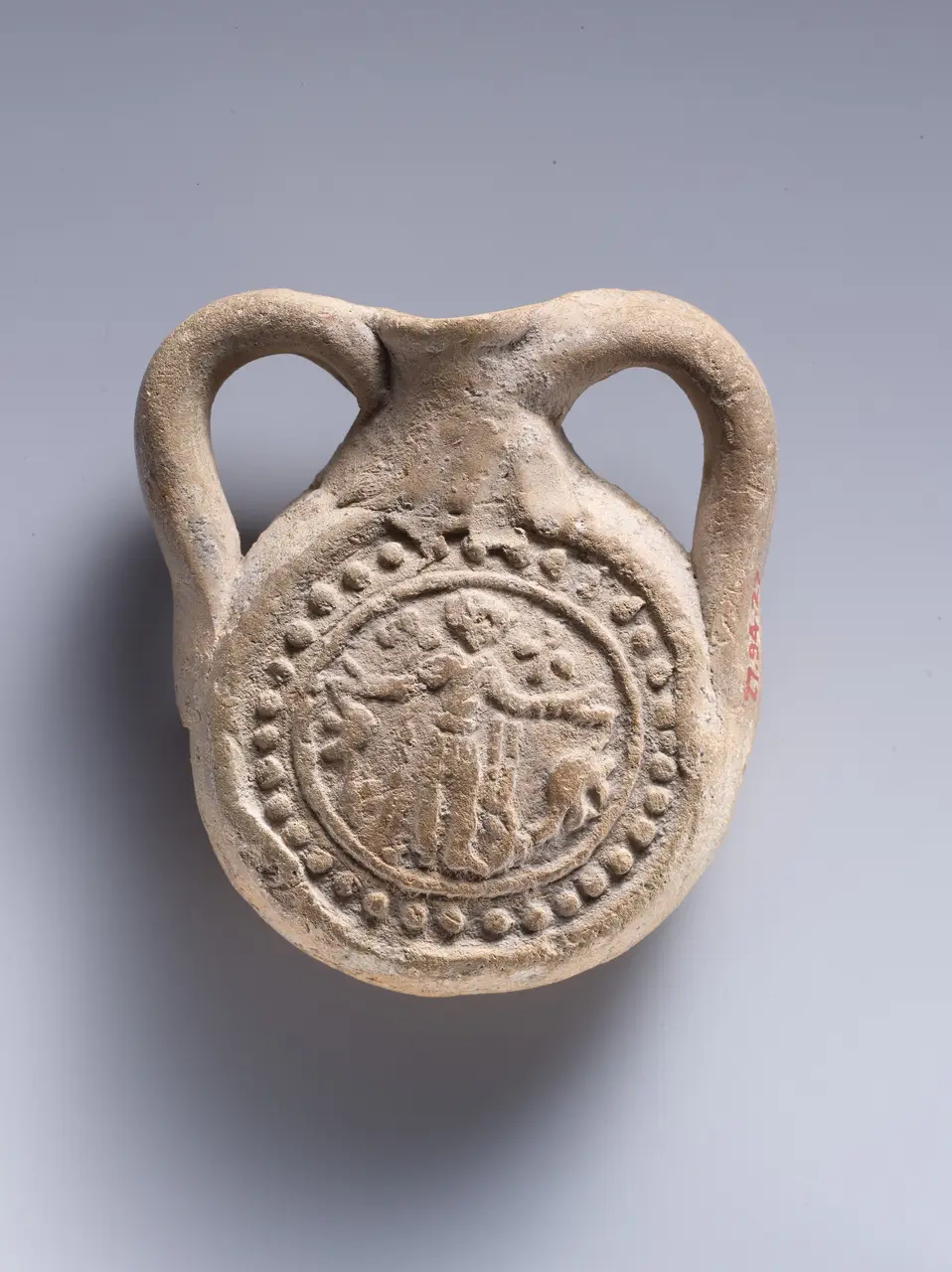 An ampulla of St Menas, mould-made at Abu Mina in the sixth or early seventh century: the saint prays between his two kneeling camels inside a border of beads. Metropolitan Museum of Art, New York. CC0, via Wikimedia Commons.
The Arab conquest closes the ancient sequence and, within a century, opens the door the pharaohs never used: lead-glazed earthenware, true glazed clay pottery, spreads to Egypt in the eighth century. The village tradition carried on underneath it. At Ballas and Qena, on the same marl beds pharaonic potters mined, workshops were still throwing pale water jars into the twentieth century, and the Ballas Pottery Project of Nicholson and Patterson traced their clay to a source that appears to have been known since antiquity, with Pharaonic and Roman vessels of similar forms almost certainly made from it.
How the pots left Egypt
A provincial museum in England or the American Midwest owns its case of Naqada jars because of partage, the division of finds that governed excavation in Egypt into the twentieth century. A foreign expedition kept a negotiated share of what it dug, commonly around half, with the Egyptian Museum in Cairo retaining the rest, and pottery, plentiful and endlessly "duplicated", was distributed with particular freedom. The Metropolitan Museum's excavations at Lisht and Malqata ran, in its own account, on an equal division between Cairo and New York; Petrie's finds went to University College London, where his teaching collection grew into a museum of some 80,000 objects, and onwards through the subscription lists of the Egypt Exploration Fund and the British School of Archaeology in Egypt to institutions across the world. Whole reference series travelled with the pots, keyed to the published type numbers, and Janine Bourriau's 1981 Fitzwilliam exhibition, Umm el-Gaʿab: Pottery from the Nile Valley before the Arab Conquest, put the accumulated result in front of the public as one continuous craft.
Labels need reading with one eye on geography, because Egyptian findspots fill museum cases with pottery Egypt never made. Cypriot Base Ring "bilbil" juglets went into New Kingdom graves by the hundred; Petrie picked 1,341 Mycenaean sherds out of Amarna in 1890-91, stirrup jars among them, probably arrived full of Aegean oil; Canaanite amphorae came in with wine and resin, and Theban tomb paintings show them being unloaded. A pot found in Egypt is a fact about trade, and only sometimes a fact about Egyptian potting. The bilbil carries the whole problem in miniature: Robert Merrillees proposed in the 1960s that its shape mimics an inverted poppy head and advertised opium, residue studies have since landed on both sides, and after sixty years the question is still open.
For the collector, the practical consequence is that Egyptian pottery circulates steadily at auction, most of it out of nineteenth-century and partage-era collections: black-topped and Decorated jars from the Predynastic cemeteries, Middle and New Kingdom storage vessels, pilgrim flasks, Coptic painted jars and amphorae. It is also one of the few ancient fields where a beginner can check a catalogue entry at a glance, because the fabric shows at the base and the break: silt fires red-brown, marl pale, and with the ware names the period follows. Examples of most of the wares in this article pass through our own quarterly sales, catalogued in these terms.
Petrie built his corpus for that use. The plates of the Corpus of Prehistoric Pottery and Palettes were arranged, he wrote, so that as soon as a grave was cleared the pottery could be laid out in order, each type searched for in the corpus and noted by its letter and number. A century on, the method still runs: when a black-topped jar surfaces in a sale, a cataloguer somewhere lays it against the same plates, and files it under the letter Petrie gave it at Naqada in 1895.
TimeLine Auctions, 15th August 2026