Home > Stories by TimeLine Auctions
Stories by TimeLine Auctions
Antiquities Dealers in Egypt & How Antiquities Left the Country, from the First Dealers to the 1983 Export Ban
Into the 1950s, a tourist could finish a circuit of the Egyptian Museum in Cairo, step into a room beside the exit, and buy a genuine antiquity to take home. Baedeker's guide for 1895 described the arrangement in a sentence, without alarm: in Room XCI "the visitor may purchase antiques, the authenticity of which is vouched for by the museum-authorities. A permit to export is given with each purchase." The state that guarded ancient Egypt also sold it, over a counter, with the export licence handed across in the same transaction.
For most of the nineteenth and twentieth centuries, carrying a piece of ancient Egypt back to Europe was an ordinary part of a Nile holiday, no stranger than buying a carpet. A visitor in 1833 could already reach for the standard joke: a traveller from Egypt "cannot decently show his face in Europe without a mummy in one hand and a crocodile in the other." By 1898 Thomas Cook and Son were carrying some fifty thousand travellers up the river in a single year, and a good number went home with antiquities in their luggage.
The trade that supplied them was large, organised, and for long stretches perfectly legal. It ran on three channels at once: the dealers, from the great Cairo houses down to a farmer with a stela in his courtyard; the excavators, who carried home a lawful share of what they dug; and the Egyptian state itself, which signed the permits and, in that room by the museum exit, kept the shop. Egypt first banned the export of antiquities in 1835 and did not ban the trade outright until 1983. In the century and a half between, the law chased the market and never quite caught it. Each prohibition was decreed, evaded, half-enforced, then rewritten more strictly a decade or two on, by which time a legal channel was already running alongside it.
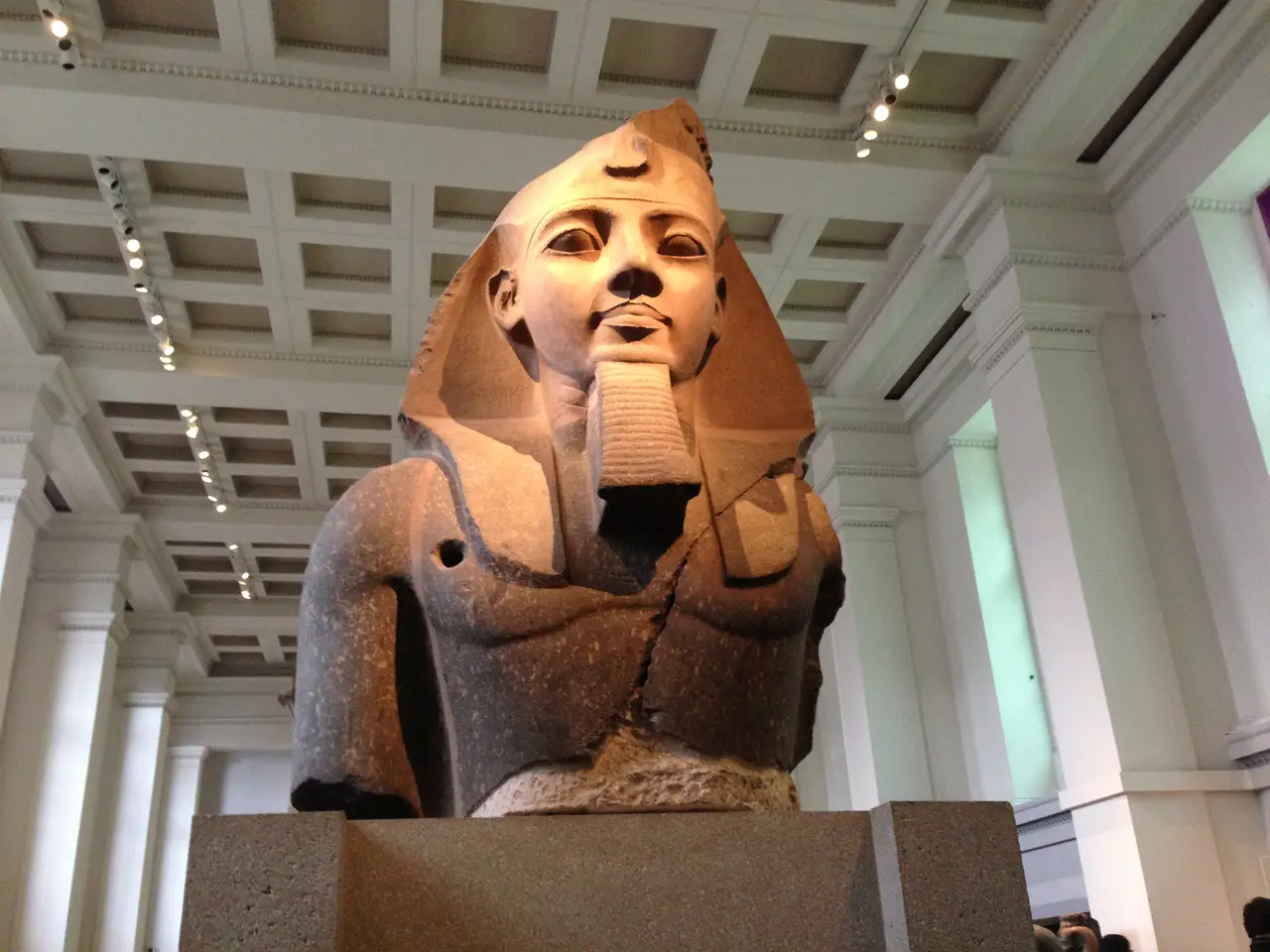 The Younger Memnon, the upper half of a granite statue of Ramesses II from his mortuary temple at Thebes, now in the British Museum. Photo: Nate Loper, CC BY 2.0, via Wikimedia Commons.
Two armies on the Nile
The first generation worked in a vacuum where there was no law to break. Napoleon's expedition of 1798 to 1801 failed as a military venture, but its scientific commission of some 160 savants produced the Description de l'Égypte, whose plates turned a European curiosity into a fashion. Museums and monarchs now wanted Egyptian objects, and Egypt's ruler, Muhammad Ali, treated them as a cheap currency for foreign goodwill. Anyone who wished to dig applied for a firman, a permit from the ruler, and the men best placed to obtain one were the European consuls-general, whose standing gave them his ear.
Two of them divided the country between them. Bernardino Drovetti, the French consul-general, and Henry Salt, his British counterpart, ran rival teams of agents who emptied tombs the length of the Nile. Sir Richard Burton later called the field "a battle-plain for two armies of Dragomans and Fellah-navvies," one under Salt and the other under Drovetti, and to keep the peace the two agreed a rough line: the west bank at Thebes to Salt, the east to Drovetti, though both worked the great sites regardless. The rivalry was not always genteel. On Boxing Day 1818, at Karnak, Drovetti's armed agents set upon Salt's man in a quarrel over an obelisk.
Salt's man was Giovanni Belzoni, a Paduan of enormous size who had performed in London as a circus strongman, "the Patagonian Samson," before coming to Egypt to sell Muhammad Ali a water-wheel. The wheel scheme failed; the engineering found other use. In the summer of 1816 Belzoni levered the seven-ton granite head of Ramesses II, the so-called Younger Memnon, onto a wooden sledge and hauled it from the Ramesseum to the Nile on palm-fibre rope and local muscle, where the French had tried, failed, and blown off part of the back with gunpowder. The head reached the British Museum in 1818, officially a gift from Muhammad Ali to the Prince Regent. The next year Belzoni cleared the sand from the front of the great temple at Abu Simbel and found the tomb of Seti I, whose translucent alabaster sarcophagus the British Museum declined to buy; the architect Sir John Soane took it instead, for £2,000, and it stands in his house in Lincoln's Inn Fields still.
The collections these men assembled were sold whole, and they became the founding cores of Europe's Egyptian museums. Drovetti's first went to Turin in 1824 for 400,000 lire and created the Museo Egizio; his second to the Louvre in 1827; his third to Berlin around 1836. Salt's first went to the British Museum in 1823 for £2,000, a price that did not cover his costs and left him sour, writing of Belzoni, "I have but one wish, never to have my name coupled with his." His second collection went to the Louvre, his third to a nine-day Sotheby's sale in 1835. Giovanni Anastasi, consul-general for Sweden and Norway, sold 5,675 objects to Leiden in 1828 and more to the British Museum in 1839. A single generation of diplomats and their agents had stocked the founding galleries of Turin, the Louvre, the British Museum, Leiden, and Berlin.
The price of all this was the information. The objects were dug for sale, not for study, and their findspots were treated as trade secrets; Salt's resident agent at Thebes, Giovanni d'Athanasi, welcomed visitors to view his finds but refused to say where any of them had been found. The era's single greatest written record, the Turin king-list papyrus, the only ancient Egyptian document to give the lengths of the kings' reigns, reached Drovetti nearly complete and crumbled to scraps before anyone could study it, handled as a commodity rather than a record.
The first attempt to stop any of this came on 15 August 1835, when Muhammad Ali banned the export of valuable antiquities and ordered finds to a museum to be built in Cairo. Historians count it among the earliest heritage laws of any country, and it was unenforceable. The museum went unbuilt; the ruler himself kept giving monuments away as diplomatic gifts; and the text covered only antiquities "of a particularly high value," which it did not define. In October 1835 Muhammad Ali personally ruled that an Englishman could ship a coffin and mummy to India, because the decree "is silent on the subject of mummies of the unbelievers." Eight years later the French traveller Émile Prisse d'Avennes cut a king-list from a wall at Karnak, packed it into eighteen crates, bribed a governor, and sent it to the Louvre, by his own account simply ignoring the requirement for a firman because asking would have brought a refusal.
Up from the villages
Every object that left Egypt had to be found first, and most were found by people who never saw a museum. The supply came up from the villages, above all from the cluster of hamlets on the Theban west bank known together as Qurna, whose houses were built into and over the rock-cut tombs of the New Kingdom nobility. Belzoni recorded in 1820 that the villagers dug in organised companies, each under a chief, splitting the proceeds of a sale, and that some had grown rich enough to be choosy about taking day-labour. A. Henry Rhind, excavating there in the 1850s, left the most candid account of the trade's manners: "Secrecy and mystification are the great points. In the innermost recesses of their tomb-dwellings they usually hide the larger or more important of such relics; and a likely purchaser is conveyed secretly to look at them there."
The finders rarely sold to the tourist directly. As Emma Andrews noticed on the west bank in 1890, the men who dug by night "dare not offer what they find for sale openly"; they either sold cheaply to "two or three dealers in Luxor, who in their turn secrete them until a safe and advantageous opening offers itself," or made the occasional quiet sale to a passing visitor. The digging end and the selling end were separate worlds. The west bank found; Luxor sold.
The most famous Qurna find fixed the village's reputation for a century. Around 1871 the brothers Mohammed and Ahmed Abd el-Rassul came upon a shaft southeast of Deir el-Bahari that had been packed, in antiquity, with some forty coffins of New Kingdom kings: Seqenenre Tao, Ahmose, Amenhotep I, the Thutmoses, Seti I, several of the Ramesses. The priests of Amun had hidden them there three thousand years before, to save them from robbers. The family did not report it. For a decade they treated the tomb as a bank account, drawing down a Book of the Dead here, a shabti or a canopic jar there, selling onto the market when funds ran short. The royal names began surfacing in European collections, and by 1878 Gaston Maspero, soon to head Egypt's Antiquities Service, was certain that a royal tomb had been found.
The reckoning came in 1881. One brother, interrogated and imprisoned at Qena, was by later accounts beaten; Budge's lurid claim that one of them died under torture is unreliable, written long afterward by a man who saw none of it, and a brother said to have been tortured was photographed alive at the tomb in 1909. When the family fell out over the division of the spoils, Mohammed forestalled an informer in his own ranks by going to Qena on 25 June 1881 and confessing. On 6 July he led Emil Brugsch of the museum to the shaft; its contents were cleared in two days and shipped to Cairo on the steamer Menshieh. Mohammed was rewarded with about £500 and a post as a foreman in the Service that had just caught him. Ten years later it was again he who pointed Brugsch to a second cache nearby, the tomb of the priests of Amun.
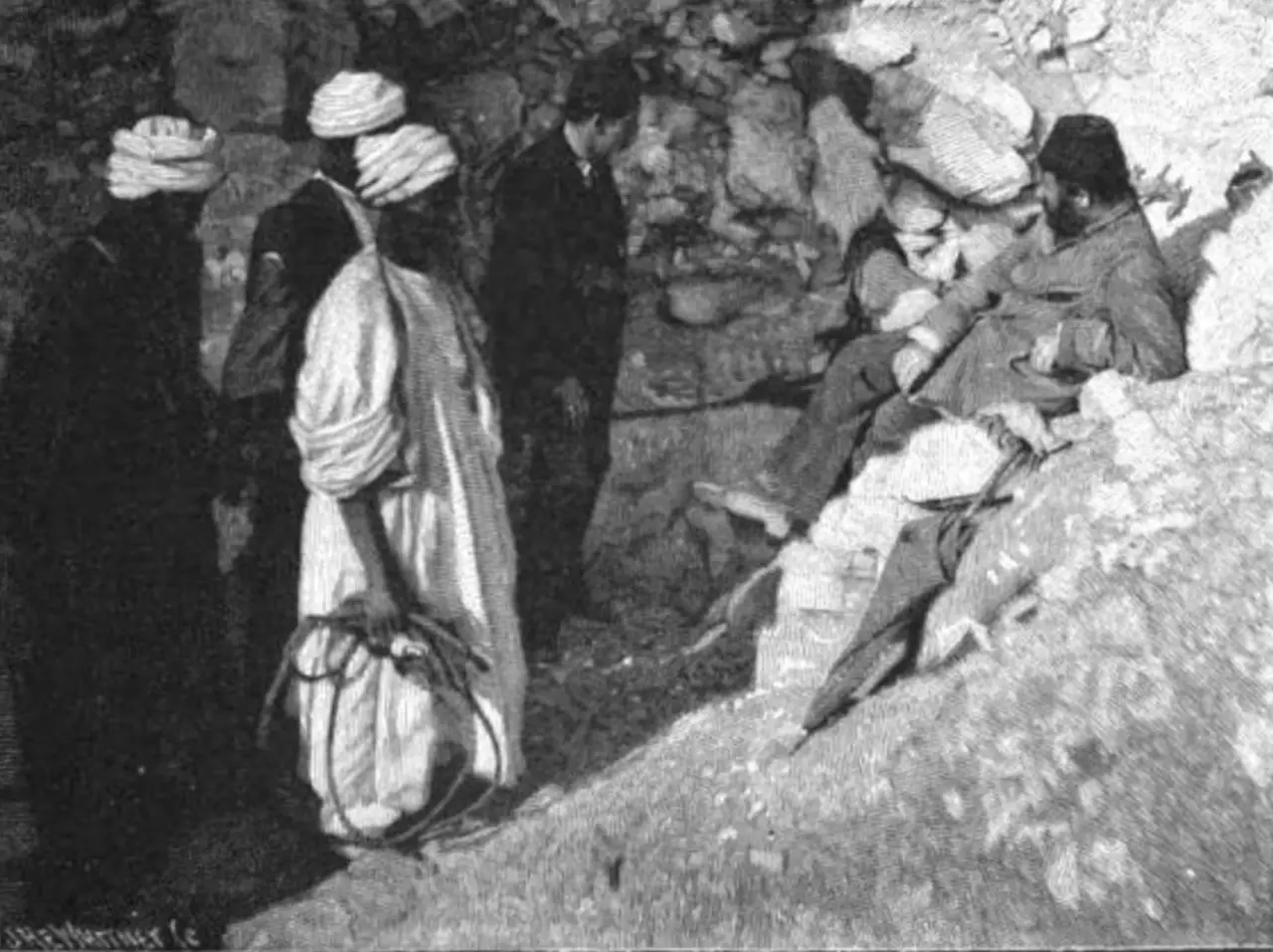 Gaston Maspero (seated), Émile Brugsch (centre) and Mohammed Abd el-Rassul (holding the rope) at the mouth of the royal cache shaft at Deir el-Bahari. Photo: Edward Livingston Wilson. Public domain, via Wikimedia Commons.
The men the finders sold to ran their businesses from grand houses on the Luxor waterfront, several built inside the Luxor temple itself, and most were consular agents for the European powers. The status mattered for one reason: diplomatic immunity. When the Service director Eugène Grébaut raided the Luxor dealers in 1888, the houses of the consuls were not entered. Mustafa Aga Ayat, agent for Britain and Russia, kept the most comfortable private residence in Upper Egypt between the columns of Amenhotep III's colonnade inside the temple; he sheltered the Abd el-Rassul brothers when the Service came for them, and held off the demolition of his house until after his death, when it finally came down in 1889.
The most respected of the Luxor dealers had little to hide. Mohammed Mohasseb, who took the title Bey, opened his shop opposite the Luxor temple in the late 1880s and traded until his death in 1928. He sold more than a thousand objects to the British Museum alone; his customers included Charles Wilbour, J. P. Morgan, and, through Howard Carter, Lord Carnarvon, to whom he sold most of the gold jewellery from the looted tomb of the three foreign wives of Thutmose III, now in the Metropolitan Museum. Percy Newberry wrote that through Mohasseb's hands "have passed many of the most important Egyptian monuments that now enrich the museums of Europe and America." His stock came from everywhere: gold from the Fayum, statuettes from Meir, mummies from Gebelein. Where a thing was sold told you nothing about where it was found, which matters when an object's only recorded provenance is the name of the dealer who handled it.
How antiquities actually left Egypt
The buyer did not have to seek out the seller; the dealers came to the boat. Amelia Edwards, whose 1873 voyage became the best-seller A Thousand Miles up the Nile, described how the Luxor dealers "waylaid and followed us wherever we went," some installing themselves on the lower deck for a fortnight, "ready to rise up, and salaam, and produce from some hidden pocket a pocketful of scarabs or a bundle of funerary statuettes." Edwards is also the best witness to how quickly an ordinary tourist turned relic-hunter. Shocked at first by the rifled graves at Saqqara, she found that "we soon became quite hardened to such sights, and learnt to rummage among dusty sepulchres with no more compunction than would have befitted a gang of professional body-snatchers." She went home with more than three thousand antiquities and is said to have kept two ancient heads in her bedroom closet. The destruction she had seen turned her, a few years later, into the founder of the Egypt Exploration Fund.
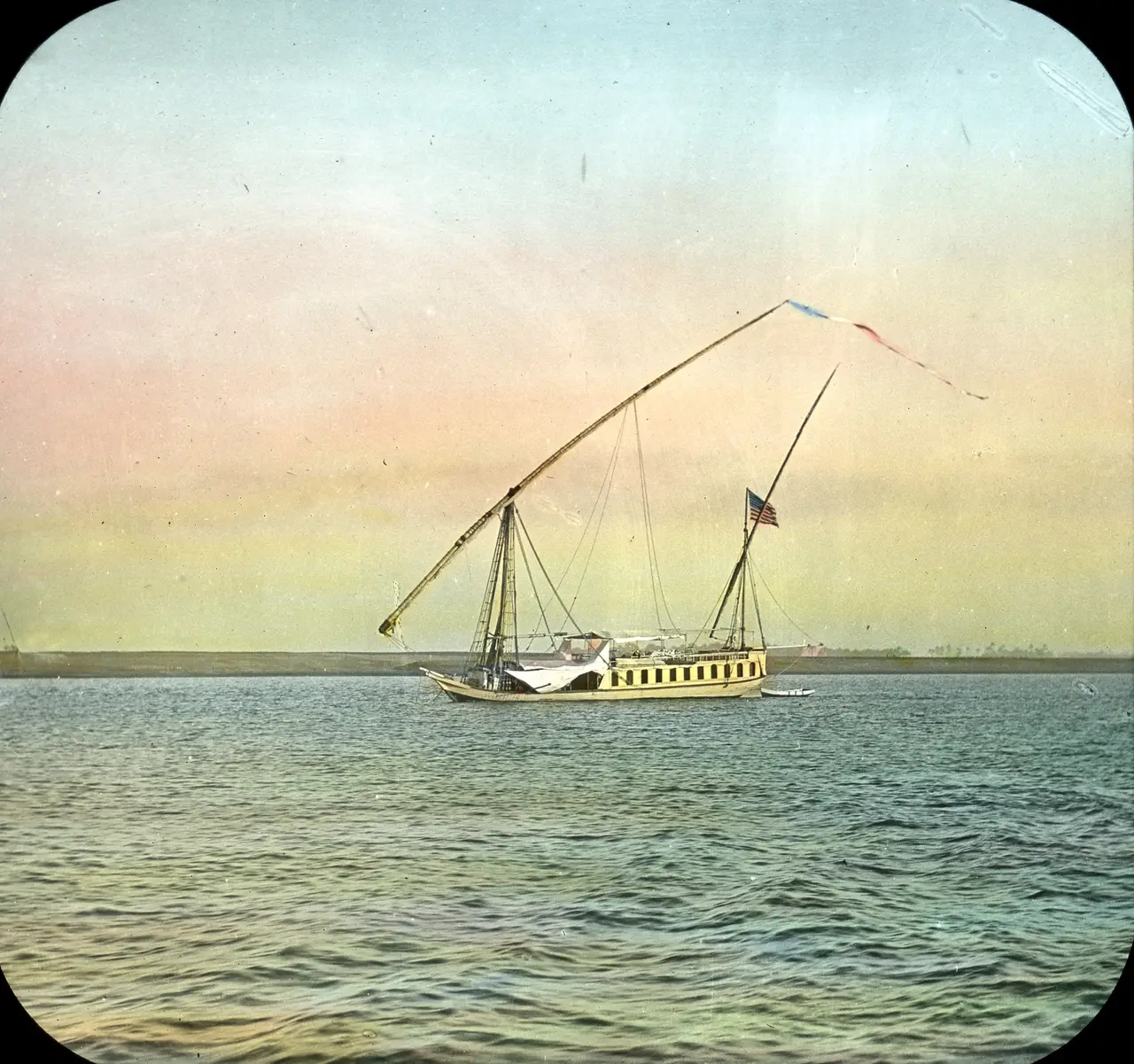 A traveller's dahabeah on the Nile at Luxor in the late nineteenth century. Dealers rowed out to boats like this one with scarabs and statuettes to sell. Photo: William Henry Goodyear, Brooklyn Museum. Public domain, via Wikimedia Commons.
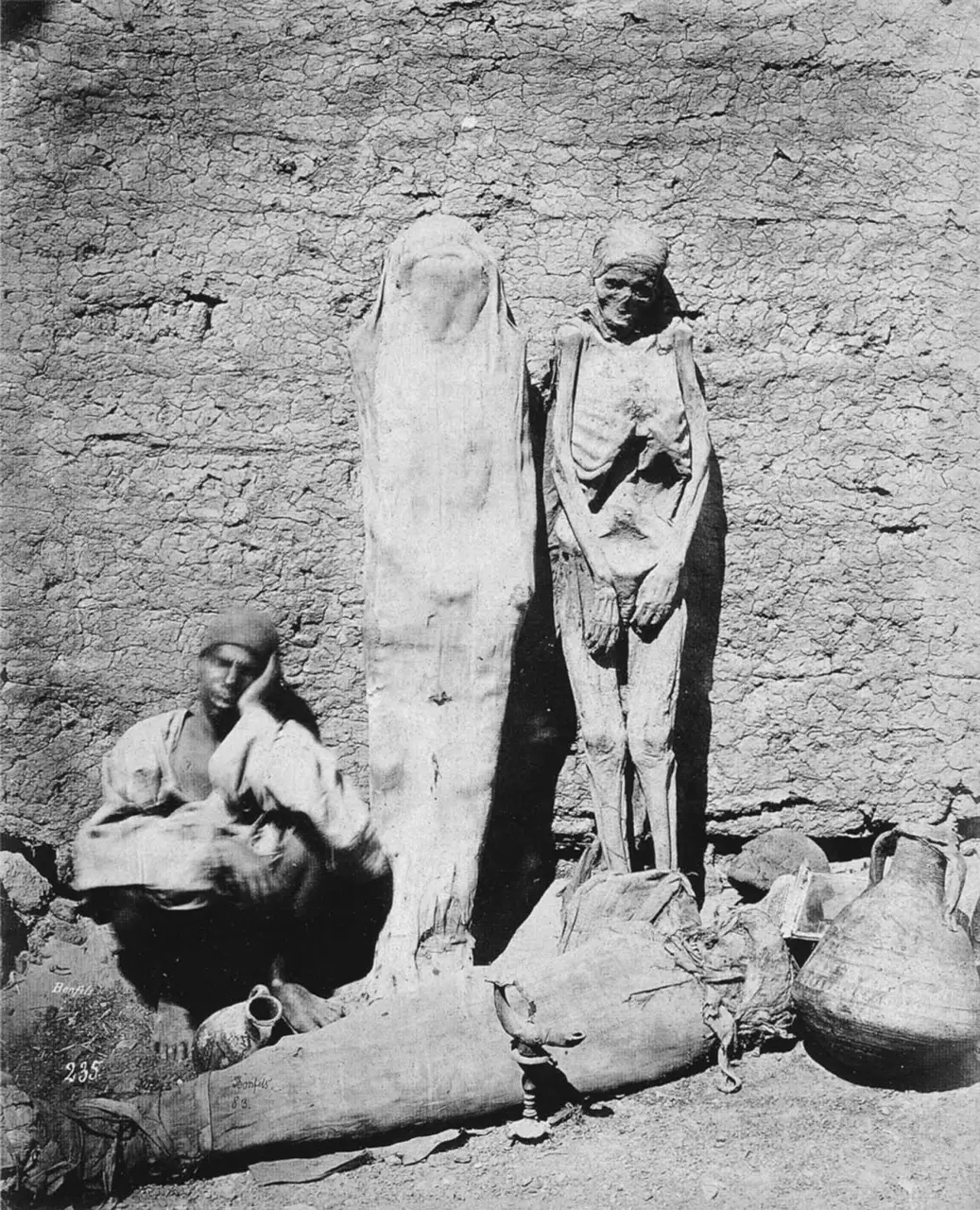
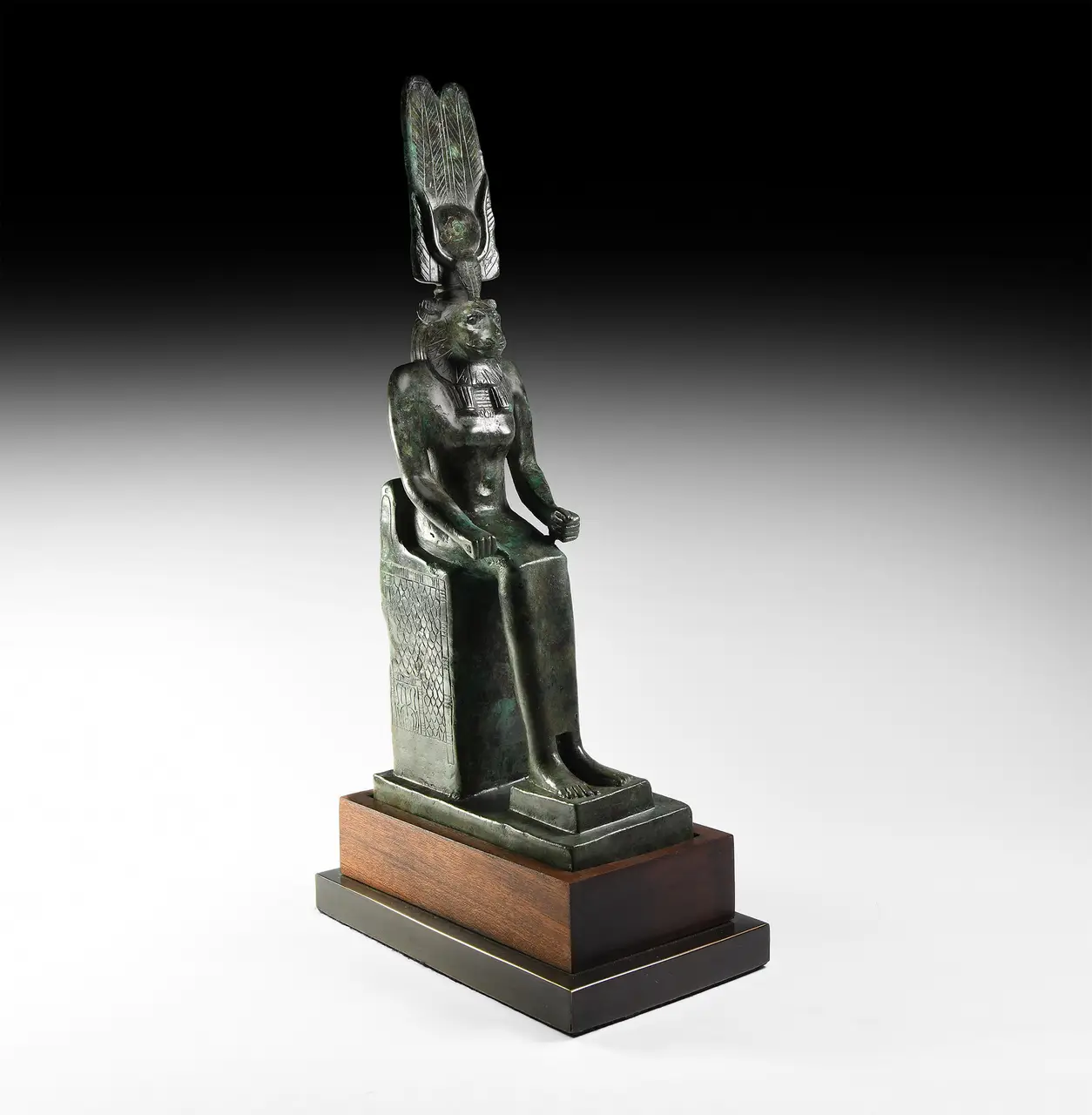
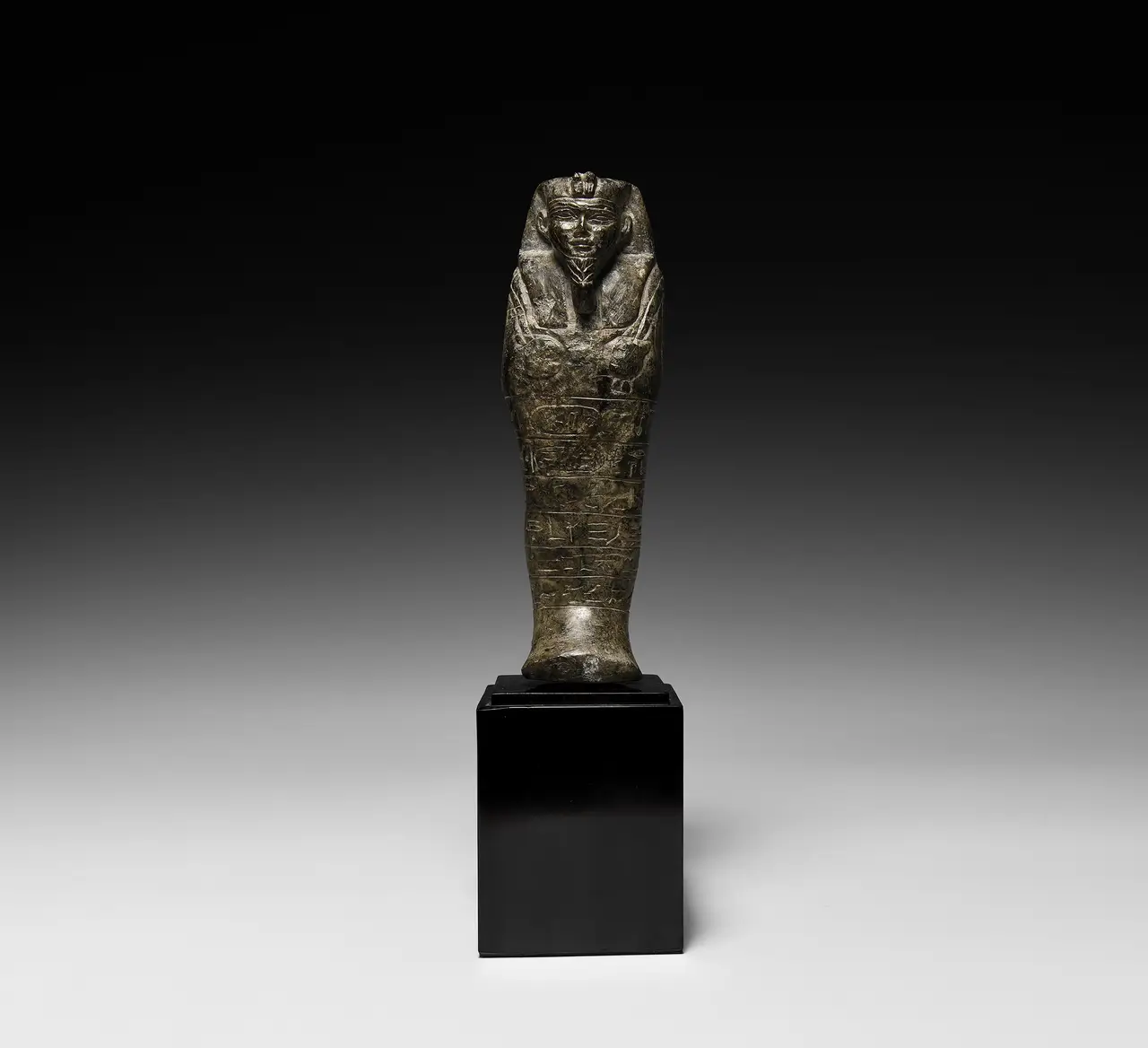
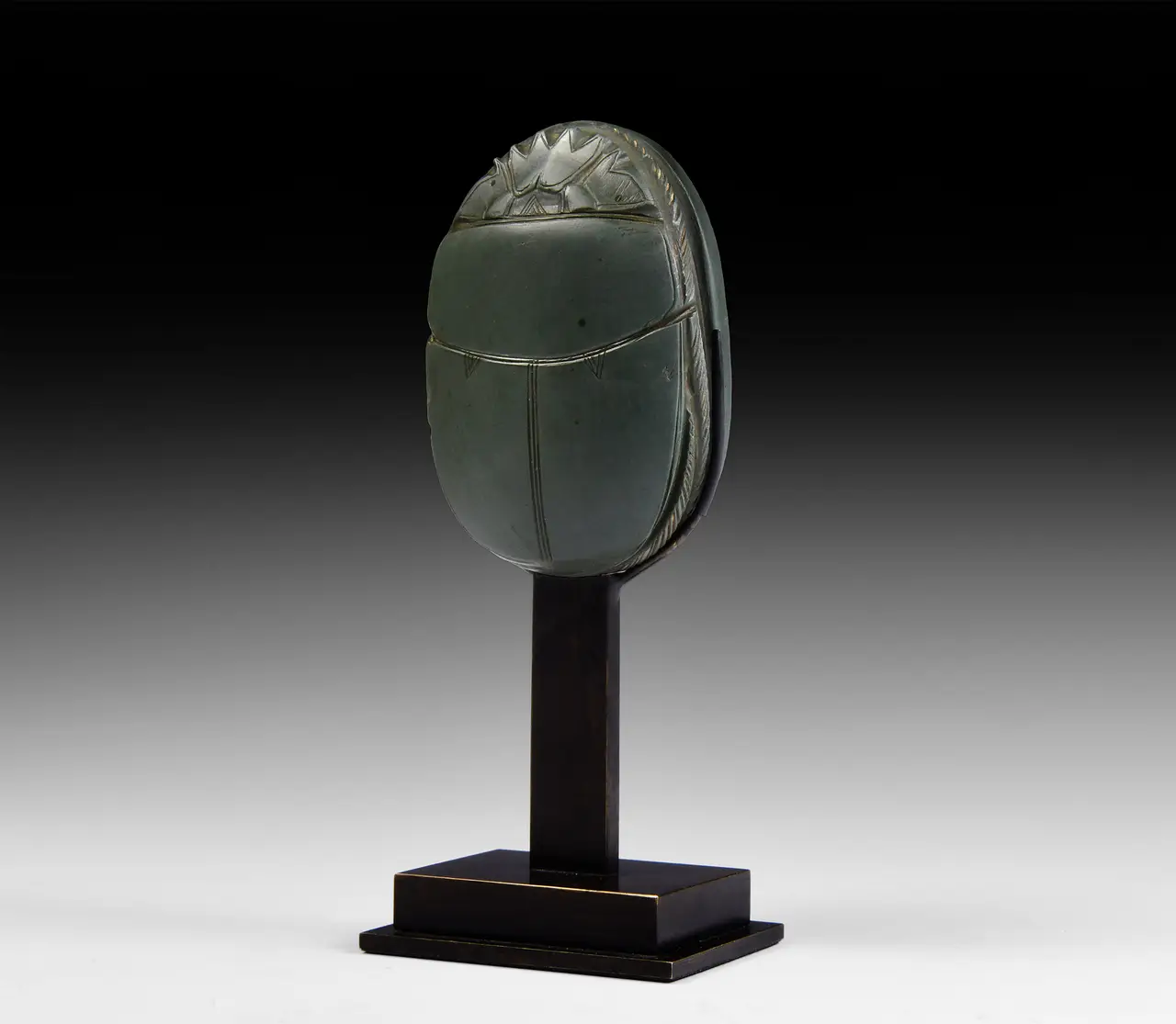
What the tourists carried off were the small, portable classes the trade was built on: scarabs, shabtis (the small servant-figures buried with the dead), amulets, bronze figures of the gods, faience, small stelae, papyri, mummified cats and birds, fragments of painted coffin. These were the objects light enough to pack or post, and they are still the categories a collector is most likely to meet today. Demand on that scale pulled in the middlemen. The dragoman and the donkey-boy took their cut; Baedeker warned that "dragomans and commissionnaires usually have a private understanding with the dealer, so that to make purchases in their company is to add 10 to 20 per cent to the price."
The strangest seller of all was the state. The Antiquities Service had long acted as a dealer; Maspero, its director, admitted to his wife in 1886 that he did not know how he would have managed his budget "without the sales of objects and mummies." In 1888 the museum formalised the practice with a sales room, the Salle de Vente, which sold off duplicate and surplus material with an export permit folded into the price. It dug to keep the shelves stocked: inspectors were sent out specifically to find saleable objects, and the report for 1910 noted that the Sale Room had been filled with several thousand pieces taken from supervised sebakh digging, the mining of ancient mudbrick mounds for fertiliser. Prices were low and aimed at tourists. Between 1899 and 1910 the room took in £15,866, an average year more than ten times the salary of a second-class inspector.
The man who ran it for years was Emil Brugsch, brother of the Egyptologist Heinrich Brugsch, a former tavern manager who, as one account dryly puts it, "had learnt to make photographs." A recent study titles its chapter on him the museum's "Provider of mummies." He scattered mummies and coffins to museums from Chicago to Christchurch, assembled private collections on the side, and on at least one occasion helped Crown Prince Rudolf of Austria buy antiquities at Abydos that he knew to have been illegally dug. The museum's sales carried a guarantee of authenticity; a few fakes went out under it anyway, some traced back to Brugsch himself.
For anyone who wanted to take an object out properly, the procedure was clerical. A 1906 guidebook, written by Wallis Budge, set it down: antiquities "should be submitted to the authorities of the Egyptian Museum, who will assess their value for export duty, and have them duly sealed with the official seal," and the owner would be given a signed permit addressed to the head of customs. By the 1929 Baedeker the fees were fixed at sixty millièmes a box and a 2.5 per cent duty on the declared value. Whether an inspector actually opened the boxes depended on the man: the strict Grébaut unpacked and examined each item; on a laxer day, one could persuade or bribe an official to seal a box without looking inside. The same service outlived the Sale Room. Until 1971 the Cairo Museum kept a Thursday "clinic day," when dealers and collectors brought antiquities to be checked, packed, sealed, and cleared for export.
Demand on this scale outran the genuine supply, and the gap filled with forgeries. "Half of Luxor makes a living from manufacturing fake antiquities," Lange wrote, "and the other half from selling them," echoing a line already in the first English Baedeker. Forging was seasonal work, taken up during the flood when the fields lay idle. Scarabs were the staple: a workman learned to cut a convincing cartouche and to melt ancient glaze onto a modern steatite scarab with a blowpipe, and the finished pieces were aged by feeding them to turkeys, from which they emerged with "a degree of venerableness that is really charming." Papyri were faked on a stick, wrapped in genuine fragments and sealed with clay, so that good papyri were broken up to supply the wrappings. Forgers copied hieroglyphs straight out of Newberry's published book of scarabs. The market caught even the experts: Lange, who prided himself on spotting fakes, was twice deceived in a single 1930 visit, once paying £61 for a modern Amarna head, probably from the workshop of the forger Oxan Aslanian, the so-called Berlin Master.
When the museum refused to release an object it judged too important, the answer was often to remove it regardless. Statues were taken apart and exported in pieces, the head and an arm in one consignment, the body and seat in another. Papyri were the easiest of all: Budge described cutting up rolls he knew would be refused, hiding the fragments among the pages of books of tourist photographs, and posting the parcels to the British Museum. On one celebrated night he had gardeners tunnel under the wall of the Luxor Hotel to carry off the Papyrus of Ani while the manager kept the Service's guards at dinner. He once declared eight hundred ancient skulls to customs as "bone manure."
The lawful half: splitting the finds
The largest legal channel of all was the dig itself. From 1884 the Antiquities Service offered foreign excavators a share of what they found, to offset the cost of working in Egypt. The arrangement, called division, or by its French name partage, hardened into a rule of thumb: after each season the Service took what it wanted for Cairo and split the remainder, the excavator receiving about half, often more, since the museum had neither room nor appetite for the smaller objects. The 1912 antiquities law set it down precisely, requiring that the finds be divided "into two shares of equal value," the excavator choosing between the two lots. From the start the division excluded two things: unique or especially important objects, and everything from an intact tomb. That second exclusion was written, unremarked, into the Valley of the Kings permit that Lord Carnarvon signed in 1915. No one yet knew what it would cost him.
This was what Amelia Edwards's outrage had built. The Egypt Exploration Fund she helped found in 1882 dug in Egypt and parcelled out the foreign share among the museums that subscribed to it; in 1891, her health already failing, she went down to the London docks herself to watch the antiquities arrive and be dispersed. Flinders Petrie, the most systematic of the excavators, turned the model into a machine. Each summer he shipped his share to London and laid it out in a public exhibition at University College, where his sponsors viewed the finds and the material was allotted by the size of each one's donation, the display stirring a useful competition among them. His finds reached museums from Manchester to Sydney to Tokyo.
Whole museum departments were founded on the expectation of a share. When the Metropolitan Museum created its Department of Egyptian Art in 1906, the trustees sent an expedition to Egypt precisely because, as the museum's own history puts it, "the natural way to acquire a significant collection of Egyptian antiquities was by archaeological fieldwork." George Reisner's divisions at Giza gave Boston its finest Old Kingdom sculpture, the alabaster Menkaure groups and the bust of Ankhhaf. Berlin's excavations at Amarna under Ludwig Borchardt produced the most argued-over division of all, the painted bust of Nefertiti, which Borchardt always maintained had been allotted fairly and which Egypt has sought to recover ever since. Hagen and Ryholt, whose study of the market is the fullest there is, make a point that cuts against the romance of the spade: most of the Egyptian objects in the great collections were bought on the market, not dug by the institutions that hold them. The dealer and the dig ran side by side, and fed the same museums.
Tutankhamun and the clause that closed the door
For most of the trade's life the rules grew stricter on paper while the market carried on beneath them. Auguste Mariette had given Egypt its first real enforcement: appointed in 1858, he created the Antiquities Service with a monopoly on excavation and built the first national museum, at Bulaq, in 1863. Further bans followed in 1869 and 1880. The 1912 law declared every buried antiquity the property of the state and required dealers to be licensed, which produced the first countable register of the trade, just under a hundred licensed dealers by the end of that year. Petrie saw the flaw at once: the penalties applied only to Egyptian and Turkish nationals, so the riskier dealing shifted to Greeks, Italians, and Armenians, and Egyptian dealers took foreign partners for cover.
What finally changed the trade was a single tomb. Less than three weeks before Howard Carter found the steps down to Tutankhamun in November 1922, the head of the Antiquities Service, Pierre Lacau, had already announced that he meant to end the customary even division: the Service would claim everything, and any share to a foreign expedition would be a gift at its discretion, granted only to institutions, never again to private individuals like Carnarvon. Then Carter opened a tomb that was, by the standards of the Valley, almost intact. Carnarvon argued that it had been robbed in antiquity and so fell outside the exclusion; Lacau answered that "rifled" was the better word, since the king's mummy had never been disturbed. The clause in the 1915 permit held. A revised law, ratified in 1929 (some date the decisive shift to an administrative decision of 1923, others to a statute of 1926), settled the matter: neither Carter nor Carnarvon's widow could take a single object from the tomb out of Egypt. The estate received a £36,000 settlement in 1930, framed as the value of duplicates but matching the cost of seventeen years of excavation.
The timing was sharp. The same decade the Tutankhamun finds were locked in Cairo, Carnarvon's earlier collection, assembled over years of legal division and dealer purchase, was sold to the Metropolitan Museum for $145,000. One regime was closing while the other was still paying out.
1983: the trade made illegal
After Tutankhamun the legal trade lived on, but on a shortening lease. The 1951 law still allowed a licensed market and still permitted division with foreign expeditions. Then the politics did what the statutes had not. The system of consular agents that had sheltered the dealers behind diplomatic immunity was abolished in 1949. In 1952 anti-British rioters burned Shepheard's Hotel in Cairo and the antiquities shops it housed. The foreign-run firms were nationalised one by one, Kelekian's in 1952, Albert Eid's in 1956. The museum closed its Sale Room sometime in the 1950s or 1960s. The Thursday clinic day ended in 1971; the issuing of export licences to dealers ended in 1974. The house of Khawam, founded in 1862, gave up Cairo and moved to Paris in 1977.
The end came with Law No. 117 of 6 August 1983, which forbade any trade in antiquities in Egypt, gave existing dealers a single year to dispose of their stock, abolished the excavator's share, and declared all archaeological material the property of the state. The permits, the Sale Room, and the partage that had run alongside every earlier ban were gone at a stroke. For nearly a century and a half the law had chased the trade; in 1983 it caught it by abolishing it.
The objects that left in all those decades sit now in Turin and London, New York and Boston, argued over in terms their first buyers would not have recognised. Mohasseb's customers asked whether a scarab was genuine, not whether it could lawfully leave Egypt, because for most of their lifetimes it could. The great collections abroad were assembled, in the main, under the rules in force when the objects moved, and they are contested now because those rules were later repealed.
The classes the trade once moved by the boatload, the scarabs and shabtis, the bronze figures of the gods, still come up at auction, and TimeLine's Egyptian antiquities are where a collector meets them now. What such a piece can rarely show is the ground it came out of; its history reaches back only as far as a dealer's name and a date. That name is a relic of this trade as surely as the object beside it.
TimeLine Auctions, 26th June 2026