Home > Stories by TimeLine Auctions
Stories by TimeLine Auctions
At a Sardinian Bronze Age tower, a sealed well and a votive sword point to ritual reuse
A sealed stone well packed with deliberately broken pottery, and a nearby cache holding a 94-centimetre bronze sword, three razor-like blades and a lump of copper, have been re-examined at Nuraghe Barru, a Bronze Age tower in south-central Sardinia. A paper published in May in the open-access journal Open Archaeology pairs analysis of the pottery with chemical testing of the metalwork and concludes that the objects were placed there as part of a structured ritual episode, generations after the tower was first built.
The work was led by Silvia Amicone of the University of Tübingen and University College London, with Italy's regional heritage authority, the Soprintendenza in Cagliari. It adds to a body of evidence that some of Sardinia's thousands of prehistoric towers were reused for ceremony even as the island's religious life moved toward new kinds of sacred site. Thin-section analysis indicates that most of the pottery was made elsewhere on the island, in some cases more than 40 kilometres away, which the authors read as a sign that the site sat within a wider network of movement and exchange during the Final Bronze Age and Early Iron Age.
The site and what came out of it
Nuraghe Barru stands on a ridge in the Trexenta region of south-central Sardinia, on the boundary between the modern municipalities of Guamaggiore and Guasila. It is a complex nuraghe, built up over time from several towers and connecting walls, with a village of circular huts spread around it. The tower complex was excavated between 2015 and 2016 by the Soprintendenza, in work directed by Chiara Pilo, while the surrounding village has yet to be dug.
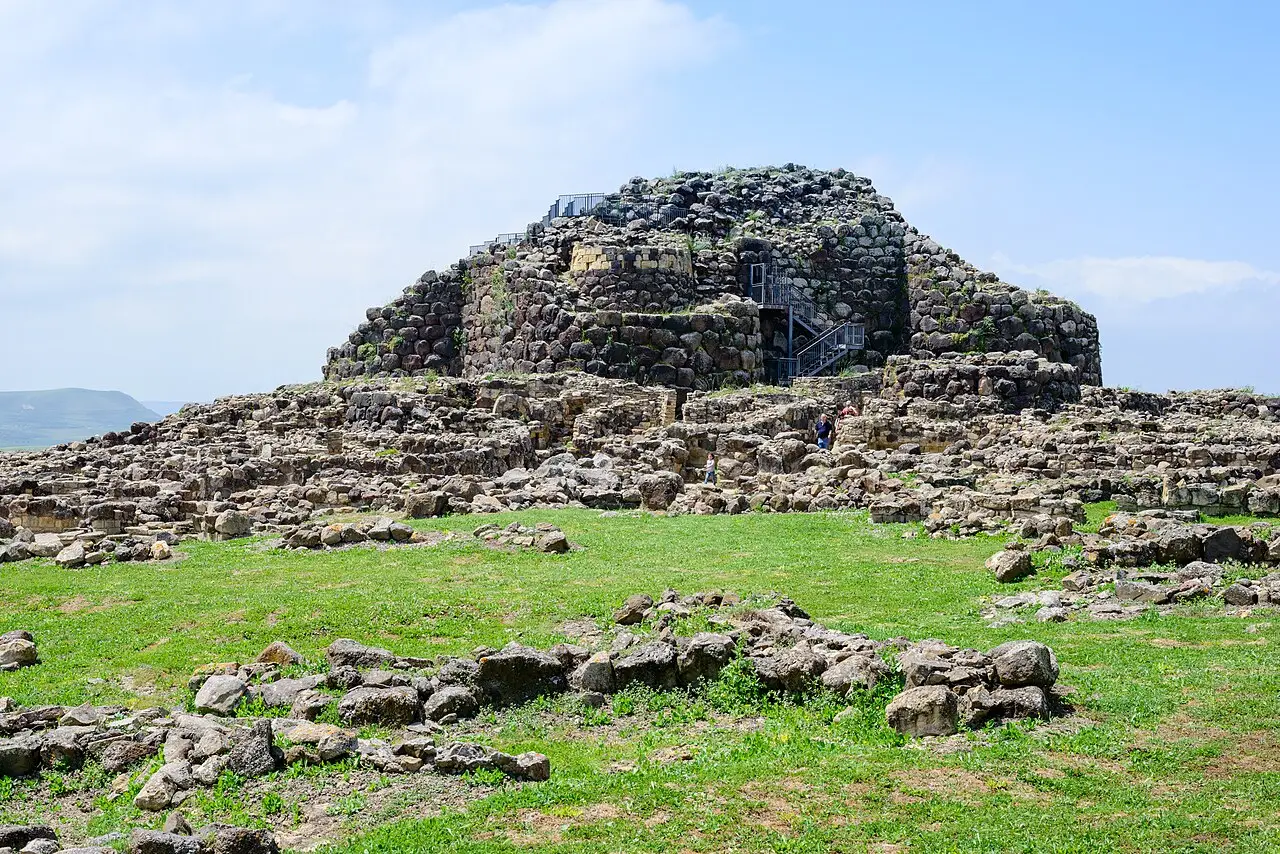 The complex nuraghe of Su Nuraxi at Barumini, south-central Sardinia, built around a multi-storey central tower with a village of huts at its foot. Nuraghe Barru, in the neighbouring Trexenta district, is a complex of the same type. Photo: Norbert Nagel, CC BY-SA 3.0, via Wikimedia Commons.
Inside the western wall, the excavation found a cistern-well reached by a lintelled doorway and a staircase. The well had been closed off with limestone slabs, and at the bottom lay animal and human bones together with the broken remains of at least 23 ceramic vessels, plus a four-handled vessel of a kind associated with ceremony.
"At the bottom of it were various deliberately smashed ceramic vessels, including what were clearly jugs, a miniature amphora, and a rare ceremonial vessel with four handles," Pilo said in a statement issued by the University of Tübingen. "We also found animal and human remains."
The metalwork came from a separate spot. On the staircase leading to the tower's upper floor, the excavators recovered a votive deposit containing the bronze sword, the three razor-like objects and the copper lump. Once these had been laid down, the entrance to the staircase was walled up with stone blocks, closing off the upper level. According to Pilo, it is the pattern of the finds, rather than their mere presence, that marks them out.
"Overall, the finds suggest an episode of ritual activity rather than randomly discarded objects," Pilo said. "The building itself was also changed by this."
What the pottery showed
Sardinia holds about 7,000 nuraghi, drystone towers raised across the second millennium BCE, and their original purpose is still argued over. "Whether they were used as defensive structures, elite residences, or ritual monuments is still a matter of debate," Amicone said. By the end of the Bronze Age and into the Early Iron Age, which Amicone places roughly between 1200 and 800 BCE, the island's religious practice was shifting toward purpose-built sacred wells and sanctuaries, and the long phase of tower-building had ceased. Where older nuraghi show ritual activity in this period, the authors note, it usually takes one of two forms: a tower restructured around a water cult, as at Nurdole near Orani, or worship centred on the tower itself as a symbol, as at Su Mulinu-Villanovafranca. Barru fits a third, looser pattern, in which a building that was never fully converted into a sanctuary nonetheless became the setting for an isolated rite.
To trace where the Barru pottery came from, the researchers used thin-section petrography, which identifies the minerals in a fired clay body under a microscope and matches them against the geology of possible source areas. Valeria Tiezzi of the University of Pisa carried out the petrographic work on 23 samples from the well. The four-handled ceremonial vessel was left out because it was almost intact and could not be sampled.
The samples fell into eight distinct fabric groups, and seven of the eight did not match the marls and clays around Barru. Only one fabric, made from a marine clay rich in microfossils and shell fragments, was consistent with local material, and it was represented by a single vessel; to test the match, the team fired a briquette of clay collected near the site and compared it under the microscope. The non-local fabrics pointed to sources at varying distances, from around 10 kilometres away to more than 40, in regions including the Marmilla, the Sarcidano and the area around Orroli, home to the large nuraghe of Arrubiu, where comparable clays occur. Some carried crushed basalt, others gabbro or diorite, rocks whose nearest outcrops lie tens of kilometres from the site.
"They came from different geological regions of Sardinia, some from more than 40 kilometres away," Amicone said.
The authors read that spread of sources as a sign that people, goods and ideas moved across the island during these centuries, with Barru perhaps an important point in that exchange.
Dating rests on the shapes themselves, analysed by co-author Lionello Morandi, who matched the jugs and bowls against finds from sites including the village of Lipari, Nuraghe Adoni and Sant'Anastasia di Sardara. The comparisons place the group in the last phase of the Final Bronze Age and the start of the Early Iron Age. Most of the vessels were jugs and amphorae built for holding and pouring liquids. The authors note that some of these forms, including the askoid jugs and certain bowls, have been linked in earlier research to wine and other fermented drinks. At Barru, though, they put more weight on the setting: because the vessels were deposited in a water structure, they suggest the rite was tied to water itself, as either the focus or the medium of worship, rather than to feasting.
What the metal analysis showed
The metal objects were tested with portable X-ray fluorescence (pXRF), a non-destructive method that reads the elements present at an object's surface. Kyle Freund, the co-author who carried out the analysis, measured five items: the sword, the three razor-like blades and the copper lump.
All proved high in copper and low in tin. The sword was about 99 per cent copper with under half a per cent tin; the blades ran around 98 per cent copper and a little over one per cent tin; the lump was almost pure copper. Amicone said the sword's makeup fits a known class of object.
"Such alloys are common for Nuragic votive swords, which were not made for combat but for symbolic or ritual purposes," she said.
Long, thin Sardinian swords of this type are generally read as votive rather than functional, and the Barru example is unusual on a further count. The authors describe it as only the second intact votive sword recovered from inside a nuraghe, the first having come from the site of Ruinas, near Arzana. The two cases share a detail: at both, a staircase was sealed off after metal objects were placed nearby. Such swords are more often found at sanctuaries dedicated to water cults, where they were set into walls or altars with the blade pointing upward, which makes the staircase deposit at Barru a departure from the usual setting.
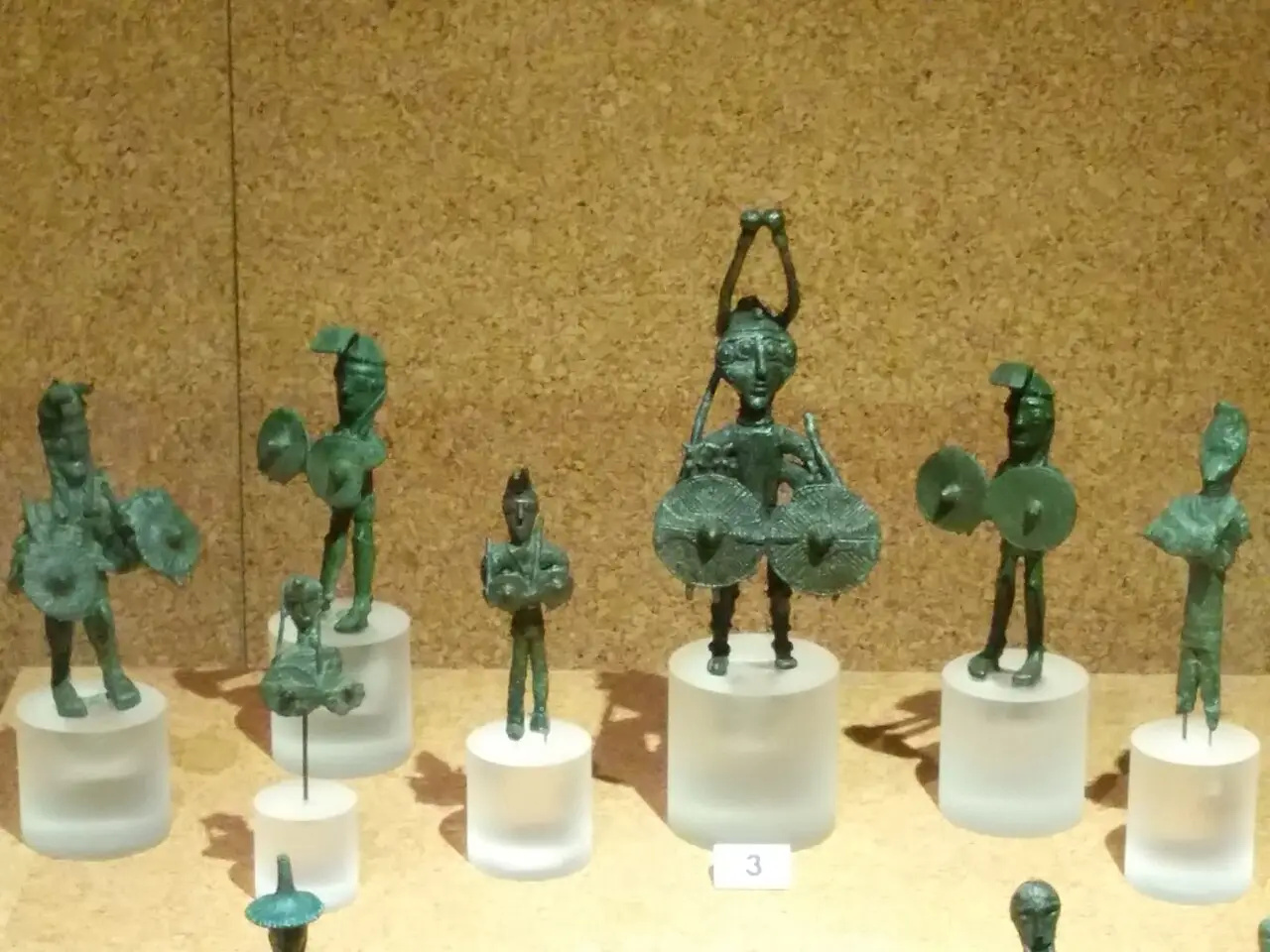 Nuragic bronze figurines of armed warriors, with crested helmets and round shields, in the Museo Archeologico Nazionale in Cagliari. Cast votive bronzes like these are among the metalwork associated with Nuragic ritual. Photo: Prc90, CC BY-SA 3.0, via Wikimedia Commons.
The razor-like blades raise a question about contacts beyond Sardinia. Their form recalls objects from mainland Italy, where razors turn up in Early Iron Age graves, but their metal does not match, since continental examples tend to carry more tin. Amicone said that difference points away from straightforward importation.
"The composition of the material might suggest that the blades were not imported but produced locally," she said.
The authors are explicit about one limit of the metal data. Because pXRF reads only the surface, the low tin figures could in part reflect corrosion or surface change rather than the original alloy. They note, though, that comparably low tin has been recorded in other Sardinian swords: an earlier study by Begemann and colleagues found tin averaging about one per cent in votive sword fragments from a Nuragic hoard, against closer to ten per cent in other bronze implements. The copper lump, which on its own would be hard to read, is interpreted in this context as a possible offering, with copper standing in as a symbolic material.
How the deposit is being read
Taken together, the sealed well, the smashed and carefully placed vessels, the bones, the votive metalwork and the walling-up of the staircase are read by the team as the traces of a deliberate ceremony that took an everyday part of the building out of ordinary use. The same reading has been applied to cistern-wells holding distinctive vessels at other Sardinian sites, among them Lugherras, La Prisgiona and Santu Antine. In the authors' account, Barru shows an old tower given a renewed role rather than allowed to fall into disuse.
"Nuraghe Barru is a well-documented case," said Gianfranca Salis, a co-author and the Soprintendenza's scientific director for the ongoing work at the site. "It was an active center during the Iron Age, where ritual practices and social identities were expressed in a period of transformation. When new places of worship emerged, not all of the old buildings were abandoned. Certain Nuragic culture towers were reused for ceremonial purposes."
As for what the ceremony marked, the authors offer possibilities rather than a single answer. The sword and the razor-like blades, they suggest, might tie the rite to warfare or hunting; alternatively, given the well, it could relate to securing water, perhaps in time of drought. They also set the razors in a wider frame, noting that such objects are linked in Early Iron Age Etruria to male identity, and that other finds, including Nuragic bronzes in Etruscan graves, point to contact between Sardinia and the mainland in this period.
Limits and what comes next
The authors are restrained about how far the case can be pushed. The sampled assemblage is small, they write, and the results cannot stand in for Nuragic ritual practice as a whole; they present Barru instead as a well-recorded reference point for future work on similar deposits. The pXRF results are described as a first characterisation rather than a full account of the metalwork.
Several questions are left open by design. Lead isotope analysis, which could identify the source of the copper in the sword and blades, has not been carried out, because the team has chosen to keep to non-destructive methods for now, given the importance of the objects. Whether the metal was made at Barru, nearby, or further afield therefore remains unsettled, the more so because no trace of metalworking has been found at the tower itself. The surrounding village may yet help: a 2021 geophysical survey by co-author Manuela Broisch-Höhner, using magnetic gradiometry and ground-penetrating radar, picked up round buried features that may be Nuragic, and that ground has not been excavated.
TimeLine Auctions, 29th June 2026