Home > Stories by TimeLine Auctions
Stories by TimeLine Auctions
Between Luxor and Abydos: A Painted Stele and Its Three Divine Patrons
His name placed him under the protection of Amun at Luxor; his offering formula asked Osiris at Abydos for bread. Pa-di-Amun-(em)-ipat, "the one whom Amun-in-Opet has given," owned a stele that bound two distant cult centres into a single painted surface, and that surface is what survives.
The stele is wooden, arch-topped, 45 centimetres high and just under two kilograms. It is built from two vertical boards, coated with gesso (a smooth white plaster ground) for painting. In the arched top, a winged sun-disc flanked by two pendant uraei spans the full width. Below, the deceased stands in adoration before the falcon-headed Ra-Horakhty, whose solar disc identifies him at once. Behind the god stand the Four Sons of Horus (Imsety, Hapy, Duamutef, and Qebehsenuef), each with his name inscribed above. Six horizontal lines of hieroglyphic text fill the bottom of the panel.
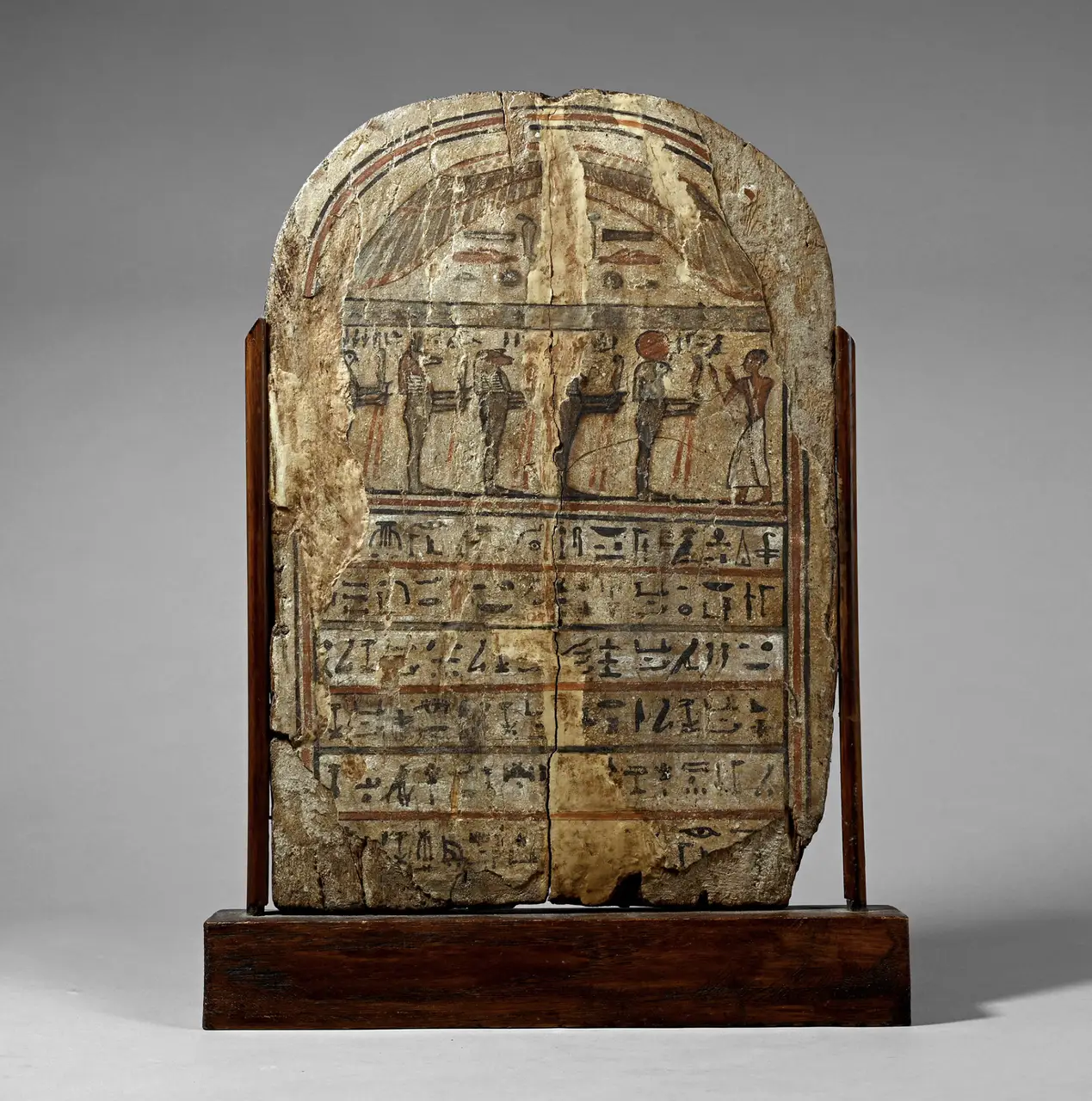
The text is a ḥtp-dı͗-nsw, the standard offering formula used across Egyptian funerary monuments, and it is here that the stele's theological geography becomes legible. The formula invokes both Ra-Horakhty, "Great God, Lord of Heaven," and Osiris, probably as "Foremost of the West" (the reading is partially restored) and as "Lord of Abydos," requesting a voice-offering of bread, beer, oxen, fowl, wine, incense: the familiar litany of "thousands." It closes with a request for "a good burial in the beautiful West."
Abydos and Luxor lie some 150 kilometres apart along the Nile. Abydos was the sacred city of Osiris, where the god's tomb was believed to stand and where generations sought a stele or cenotaph to benefit from his proximity. The Southern Opet at Luxor was the sanctuary of Amun, renewed annually by the Opet Festival. Pa-di-Amun-em-ipat's name ties him to the Luxor precinct: he was "given" by the Amun who dwelt there. Yet his afterlife provisions reach to Abydos. Late Period theology freely merged solar and Osirian guarantees, but this stele makes the double address visible. The painted scene presents Ra-Horakhty, deity of morning and rebirth. The text beneath calls on Osiris, lord of the dead. The name identifies the owner with Amun, a third god entirely. Three divine patrons, three sacred geographies, carried on two boards of wood.
The Four Sons of Horus, standing behind the god in the scene above, participate in both halves of this theology. Originally guardians of the mummified organs, by the Late Period they also served as protectors in the solar journey. Named and upright, they are central to the stele's work as a complete programme of divine protection, packaged as a portable panel. In burials of this period, where tomb walls were often left undecorated, the painted wooden stele could serve as a substitute for the carved wall scenes of earlier centuries, placed inside the burial chamber near the coffin and carrying everything the deceased required: divine encounter, protection and perpetual sustenance.
The name Pa-di-Amun-em-ipat was common among Theban priestly and administrative families of the seventh and sixth centuries B.C. The owner of this stele was born to a woman whose name begins Kha- and is now incomplete. The six lines of text contain several gaps, and no titles are legible in what survives; he appears simply as "the Osiris Pa-di-Amun-(em)-ipat," the standard way of identifying any justified dead person with the god of the underworld. The stele's format is compared in the accompanying literature to a piece illustrated in Peter Munro's Die spätägyptischen Totenstelen (1973, vol. 2, pl. 3, fig. 12), the foundational typological study for Late Period funerary stelae, with further parallels cited in the British Museum (EA 22919, for its three-line border) and the Cairo Museum (A 9444, for its plain single-coloured band).
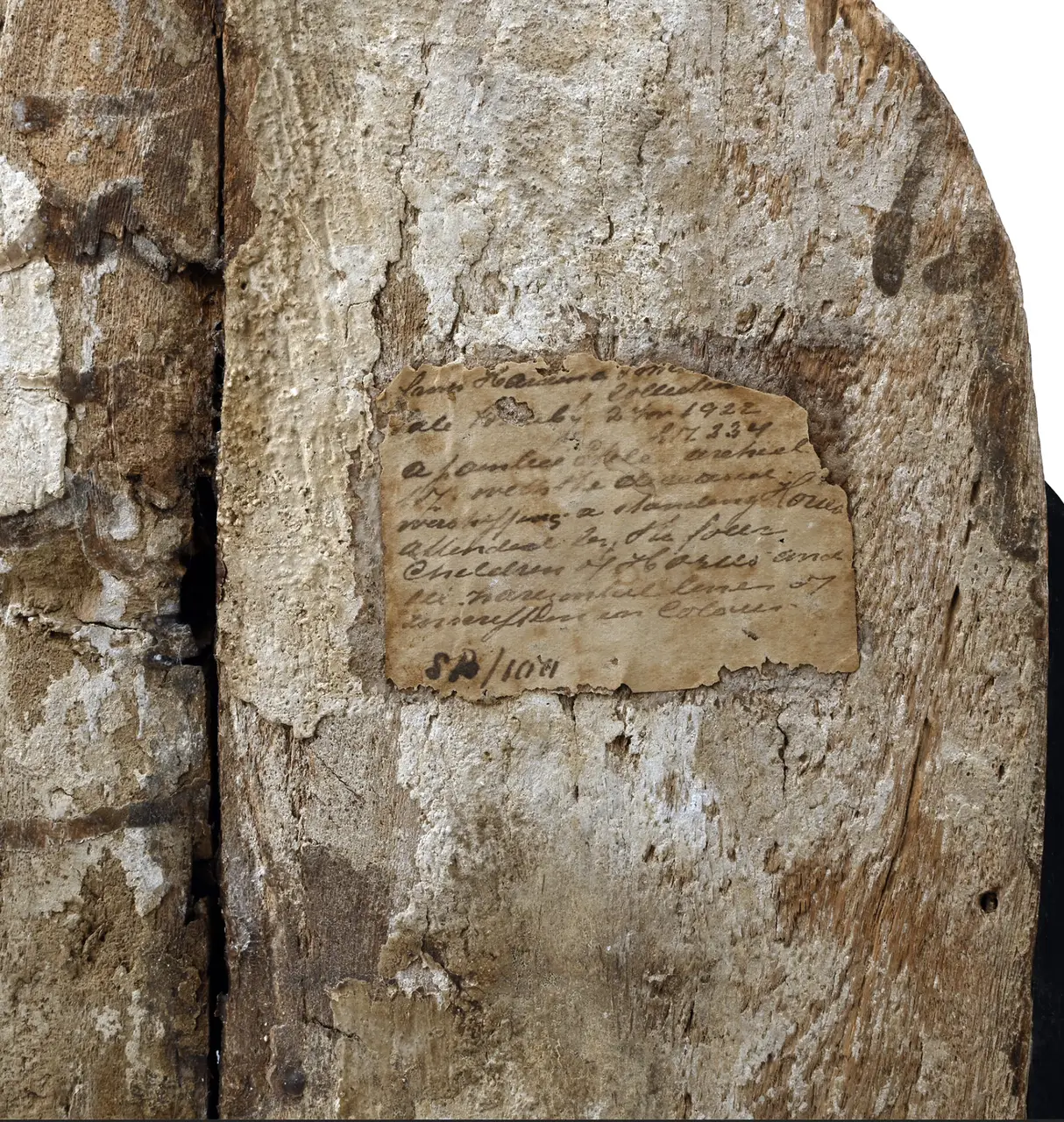
The stele was in the collection of W. Harding Smith (1848–1922), a British collector whose holdings ranged across Semitic inscriptions and Egyptian antiquities. After his death, the collection was sold by Sotheby, Wilkinson & Hodge on 2 November 1922; this piece appeared as lot 234. A handwritten label on the verso records the sale and describes the object as "A families [sic] stele, arched top, with the deceased worshipping a standing Horus attended by the four Children of Horus and six horizontal lines of inscription in colour." A second notation, "SP/10a," remains unexplained. The stele is accompanied by an academic report by the Egyptologist Paul Whelan and a copy of the 1922 catalogue pages.
The offering formula asks for thousands of loaves and thousands of jars of beer, but it ends with a name: the mother's name, beginning Kha- and then breaking off. It is the one point in the text where the formula gives way to biography, and it is precisely there that the stele falls quiet. This stele will be offered at TimeLine Auctions on 2 June 2026 as lot 65, with an estimate of £15,000–20,000.
TimeLine Auctions, 24th May 2026