Home > Stories by TimeLine Auctions
Stories by TimeLine Auctions
Bezoar Stones, Toadstones and Other Medicine You Could Wear
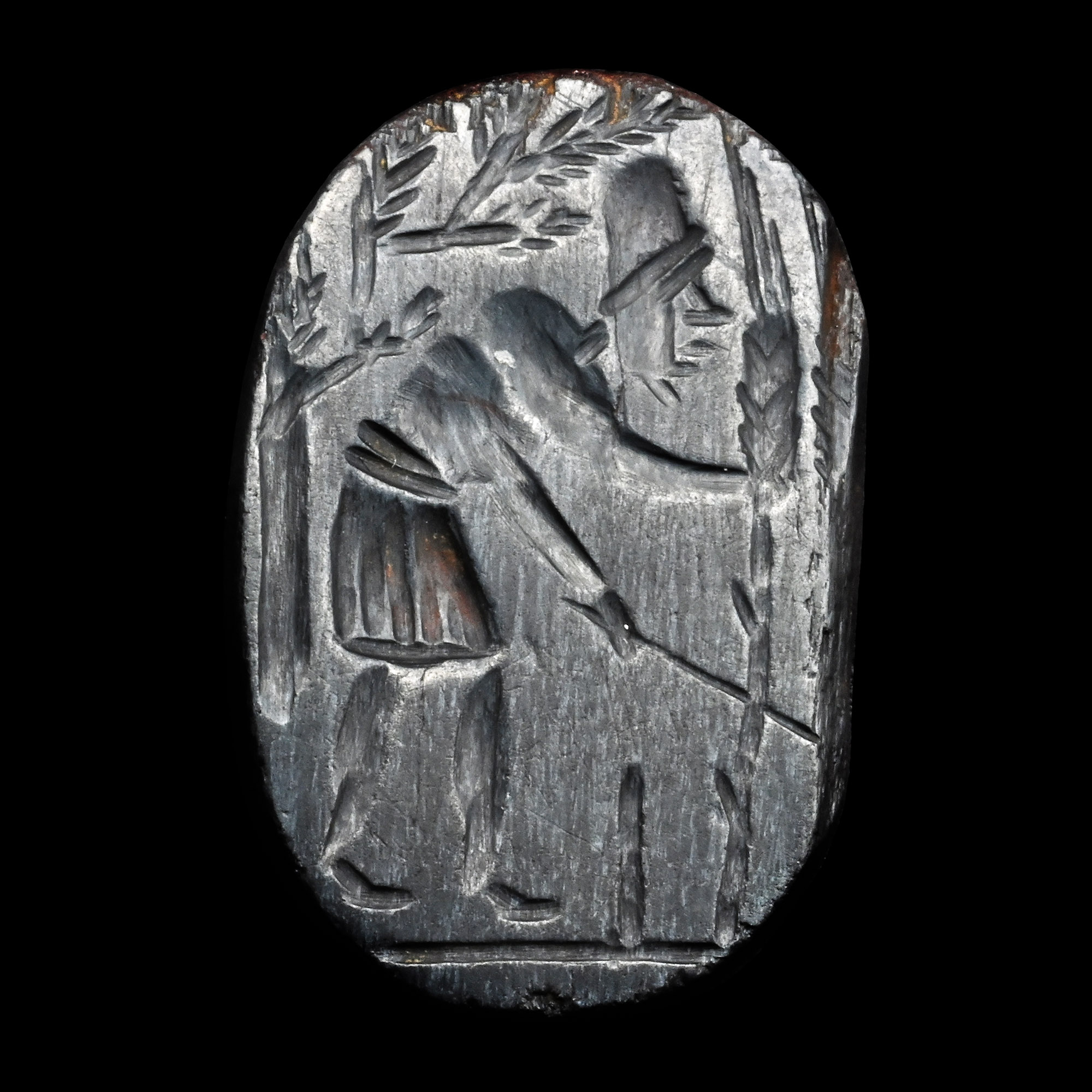
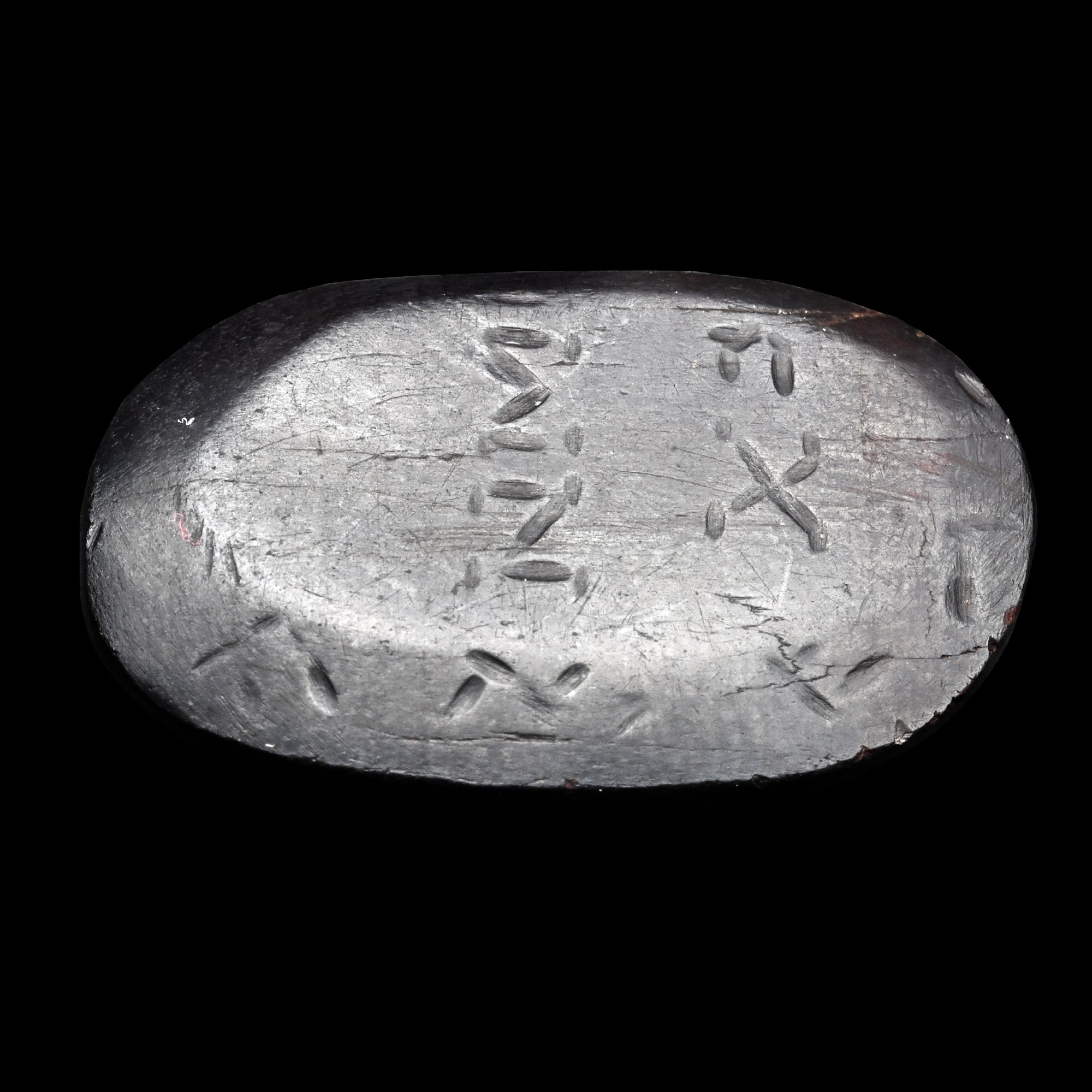
On the flat face of lot 128, a Roman oval of dark haematite 27.3 millimetres long, a reaper bends from the waist to cut stalks of wheat. On the curved back are the Greek letters "CX/WN", which on stones of this type stand for ischiōn, "for the hips", from the word that also gave English "sciatica". The gem was cut in the third or fourth century AD as a remedy for a bad back, and the picture is thought to have worked by likeness, since the reaper bends again and again without effort, as its owner hoped to.
Most of the amulets in this story were made, like the reaper, against one named trouble, whether the stomach, a demon who came for women in childbirth or the falling sickness. The last two in TimeLine's December sale, a toadstone ring and a bezoar stone, were worn against poison, the bezoar being a concretion from an animal's gut that Europe bought as an antidote. For fifteen centuries the people who made, prescribed and wore such things disagreed about where the cure lived, in the stone, in the picture cut into it or in its words.
Reaper stones were too large for a ring and too soft to pierce for a cord, so they were probably carried in a pouch, and lot 128 is the right size for one. Collectors call such stones "Gnostic" gems and scholars call them magical gems, and many were made for a particular complaint, colic and sciatica among them. Lot 1129, a Roman bronze dagger guard with a fist making the fica gesture at one end and an erect phallus at the other, is the general-purpose kind, the phallus charm being what Pliny called the "physician against envy".
Stone, picture or word
Galen, the Greek physician who practised in Rome in the late second century, wrote that green jasper worn as an amulet helps the stomach. Some people, he added, set it in a ring engraved with a serpent crowned with rays, the god many gems name as Chnoubis, as the legendary Egyptian king Nechepsos had prescribed. Galen tried the stone without the picture, hanging it at the mouth of his stomach: "I made a necklace of small stones of that variety and hung it from my neck at just such a length that the stones touched the position of the cardiac orifice. They seemed just as beneficial even though they had not the design that Nechepsos prescribed."
The gem-cutters went on cutting the serpent all the same, and they matched stone to subject, keeping the Chnoubis for translucent green and milky stones and the reaper and the rider Solomon for black ones, which is where lot 128's dark haematite belongs.
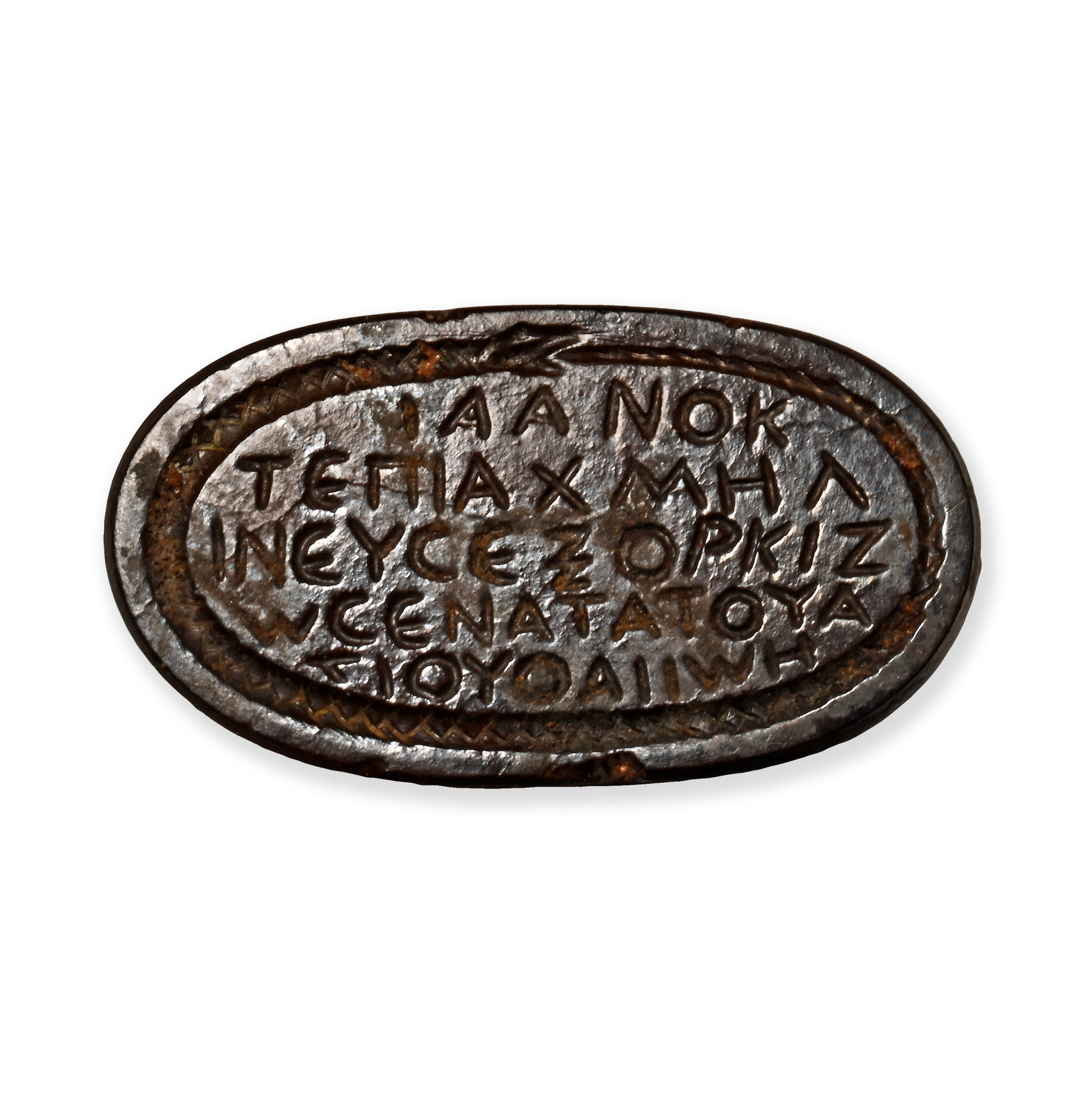
Galen had also tried a stone for haemorrhoids that was worn with letters cut into it, and lot 124, a haematite oval of 21 millimetres, carries letters and nothing else. Five lines of well-cut Greek capitals fill the face inside a linear border. Among them runs "EΞOPKIZ / WCE", exorkizō se, "I adjure you", the verb that opens an exorcism.
Solomon's seal and the dwarf god Bes
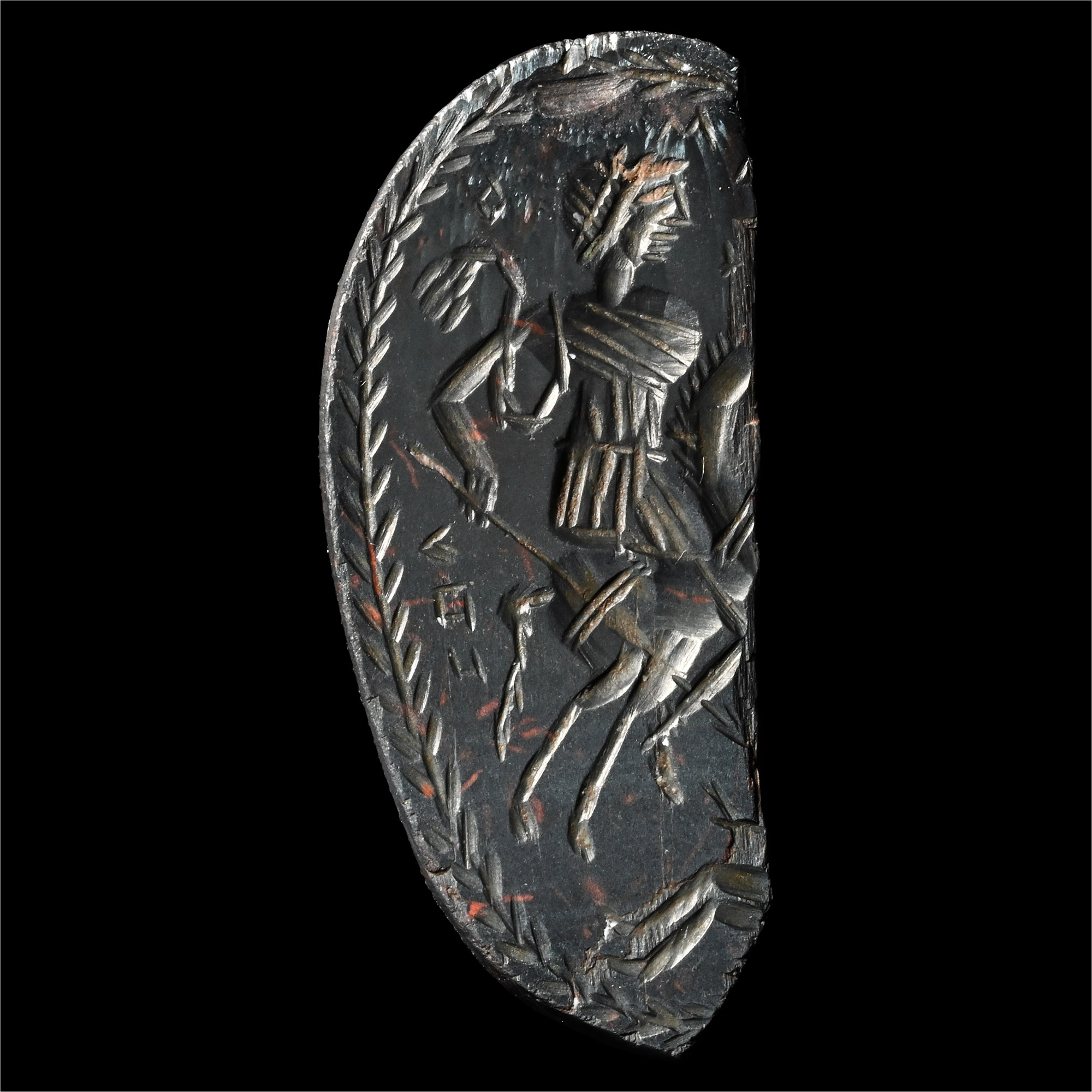
In the legends written down as the Testament of Solomon, God gives the king a seal that commands demons. On a complete example in the American Numismatic Society a rider labelled Solomon thrusts his spear down at a woman lying under his horse's raised forelegs, and the back reads "seal of God". The woman has been read as Lilith, or as Abyzou, a demon who caused the death of infants during childbirth, and the stones as protection against her.
Lot 1015 is a fragment of an oval haematite plaque 31 millimetres long, with a rider of this kind inside a wreath border: a horseman with a spear tramples a fallen enemy who lies face up with legs flexed. It comes from a European collection formed since the 1970s, and with it comes a museum-quality impression of the scene.
Long before Solomon's seal, Mesopotamia had set the demon Pazuzu against Lamashtu, who preyed on mothers and babies, and in Egypt the dwarf god Bes watched over births. A spell in a papyrus now in Leiden calls for his figure, "a dwarf of clay to be placed on the brow of a woman, who is giving birth while suffering".
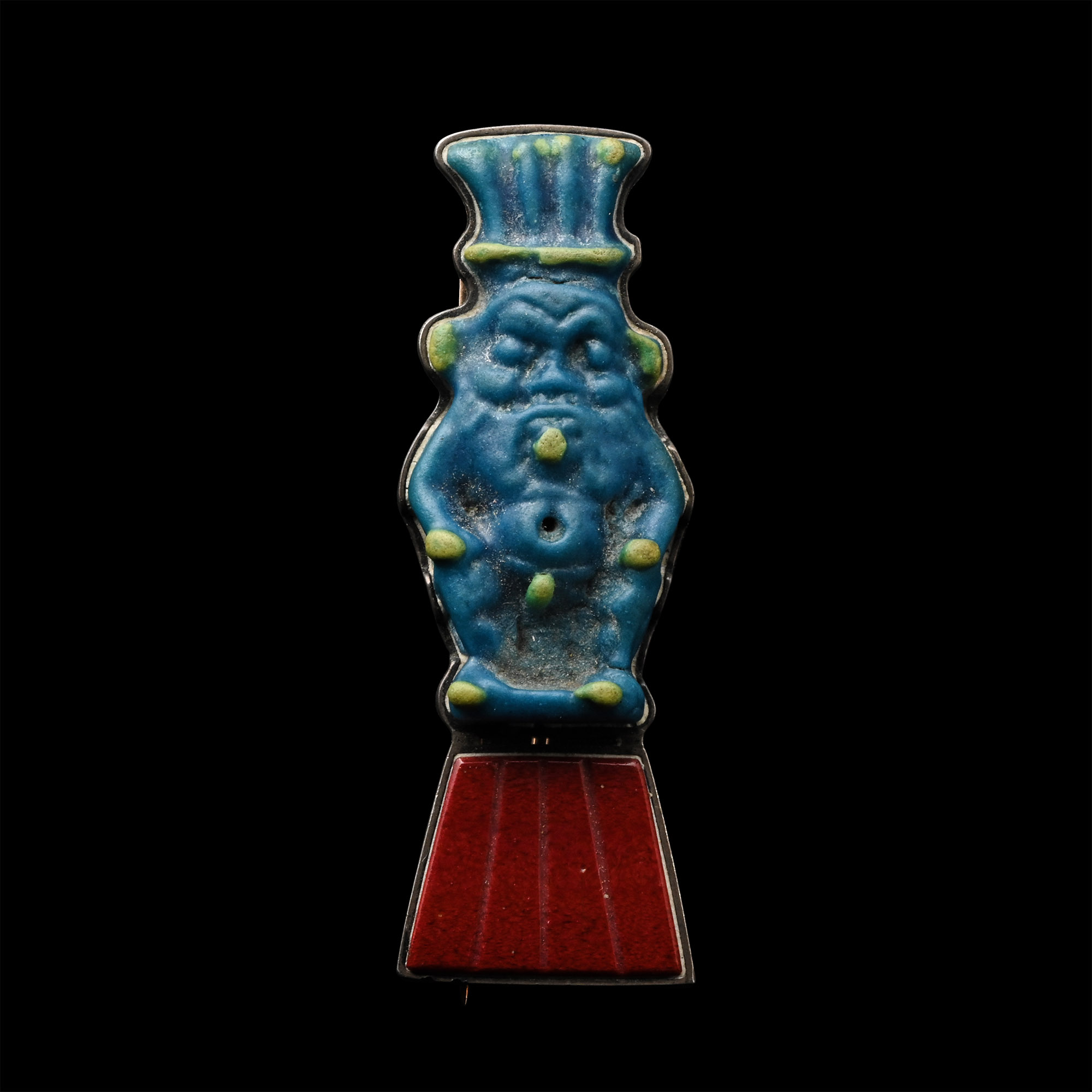
Lot 740 is a faience Bes of the Late or Ptolemaic period, between about 664 and 30 BC. The god stands bandy-legged with his hands on his hips, fearsome under a plumed headdress, in a deep blue glaze picked out in yellow. He is fashioned as a dress pin, set in a metal casing with hinged pins on the back and a red jasper insert of four plumes beneath his feet. Bes was the patron and protector of pregnant women and children, and he kept that role until at least the third or fourth century AD.
Three names against the falling sickness
Around 1305 Bernard Gordon, a physician of Montpellier, advised the use of three names against epilepsy, the falling sickness: Caspar, Melchior and Balthasar, the Magi. Their relics had come from Milan to Cologne in 1164, and a brass once in St Peter Mancroft in Norwich promised in Latin verse that whoever carried the three names of the kings would be "freed from the falling sickness by the mercy of Christ".
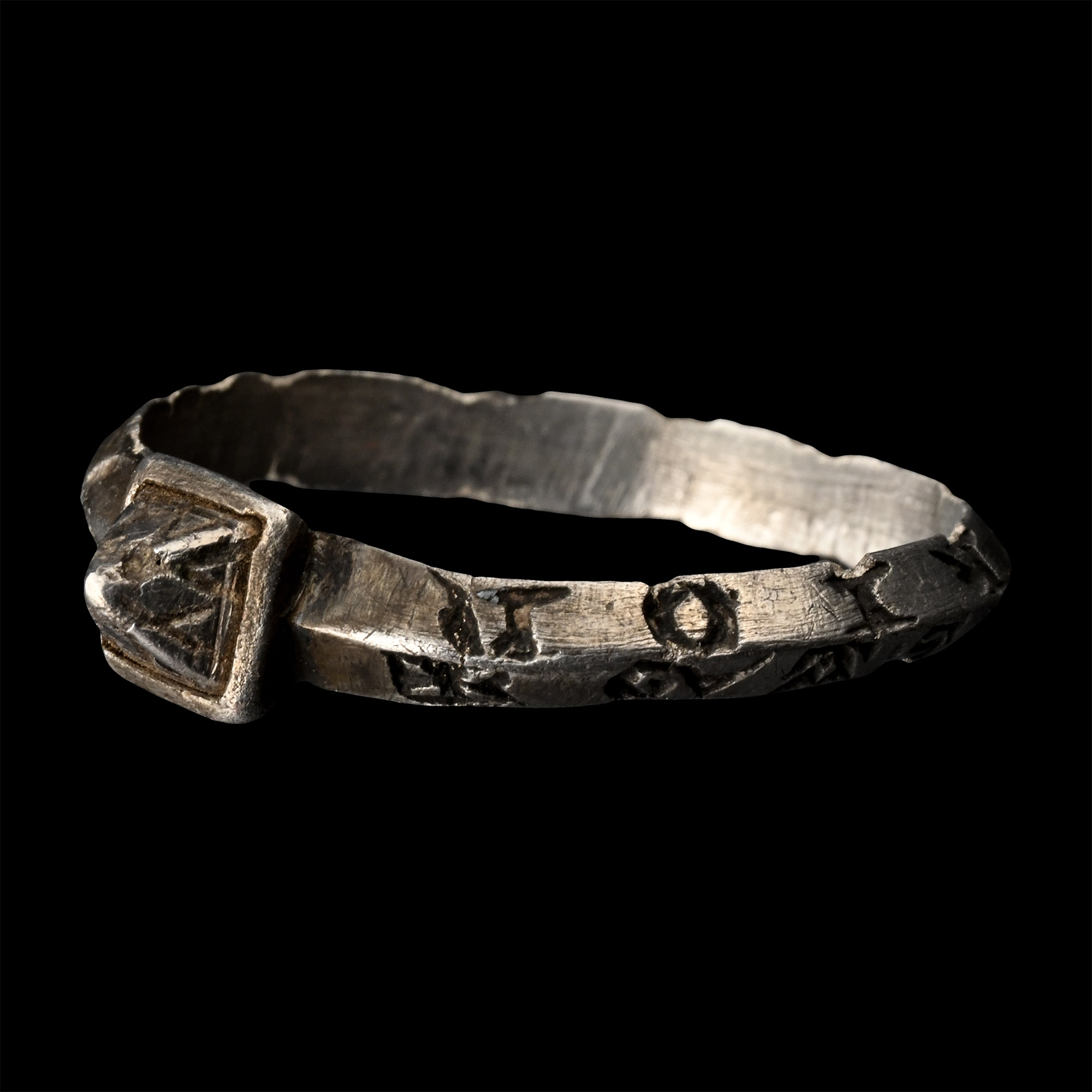
Lot 336 is a silver ring of about the thirteenth century, engraved round the outside of the hoop with the names Melchior, Balthasar and Caspar. In place of a stone, its bezel holds a separate piece of silver shaped like the pyramid of a natural diamond crystal and set in a collet as if it were a gem. The diamond had virtues of its own in the lapidaries, the books of stones and their powers, and an English one of 1582 credits it with the power "to resist poyson and witchecrafte".
What is a toadstone?
The toadstone was credited with the same power against poison, and was believed to grow in the head of a toad. Toadstones are fossil fish teeth, long thought able to detect or counteract poison, and a prince might own several: the 1416 inventory of Jean, Duke of Berry, lists seven toadstone rings.
A seventeenth-century English jeweller wrote in his treatise on gems that the toad must be "very greate and old and hath Lived Long in hedges or diches", and that the stone is of most virtue if it is taken from the toad alive. He then recorded a sale of his own: "myself had one wch was black and spoted with redd spotes wch I did sett in a ring off gold off 20/- vallew and I sould it ffor £6. Butt I never since could meete with such another."
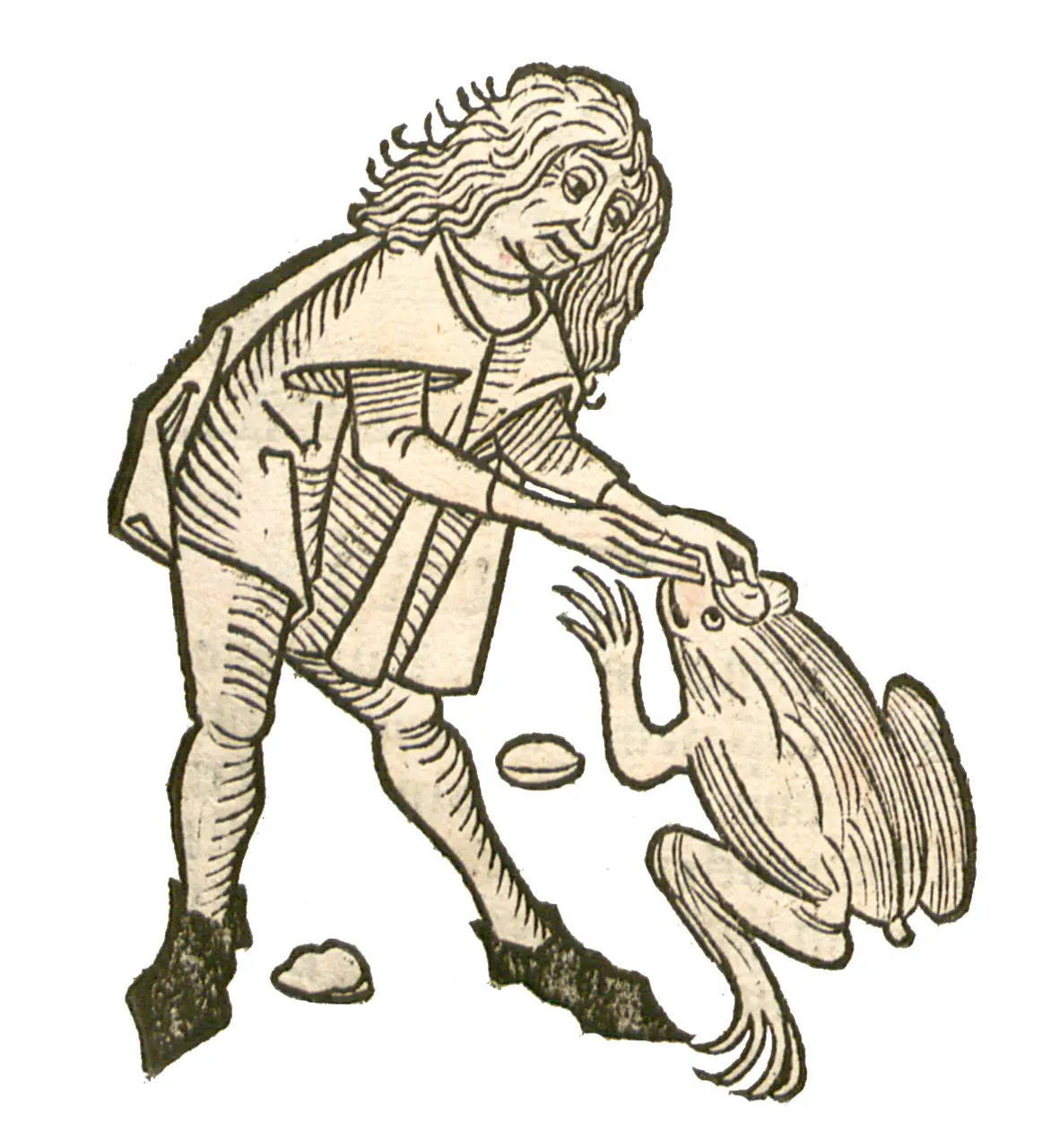 A man takes the stone from a toad's head in the woodcut for the toadstone in the Hortus Sanitatis, printed at Mainz in 1491. Public domain, via Wikimedia Commons.
Anselmus de Boodt, whose history of gems and stones first came out in 1609, tried to get one the way the stories said. "I remember that as a boy I caught an old toad and set it on a red cloth so that I might get the stone," he wrote, "for it is said that the toad will not give up its stone unless it sits on a red cloth; but when I had watched it the whole night, the toad brought up nothing, and from that time I have held as nonsense what is told of this toadstone and its origin." Even so, he went on to describe the stone set in a ring pierced so that it touches the skin, which it was said to warm when poison was near, and added that many people in his day wore it for that.
Fourteen loose toadstones were among the gems of the Cheapside Hoard, a London jeweller's stock buried between 1640 and 1666, and it was 1670 before the Messina painter Agostino Scilla published the case that such stones were the teeth of fish. Most are the button-shaped crushing teeth of a Mesozoic fish now called Scheenstia.
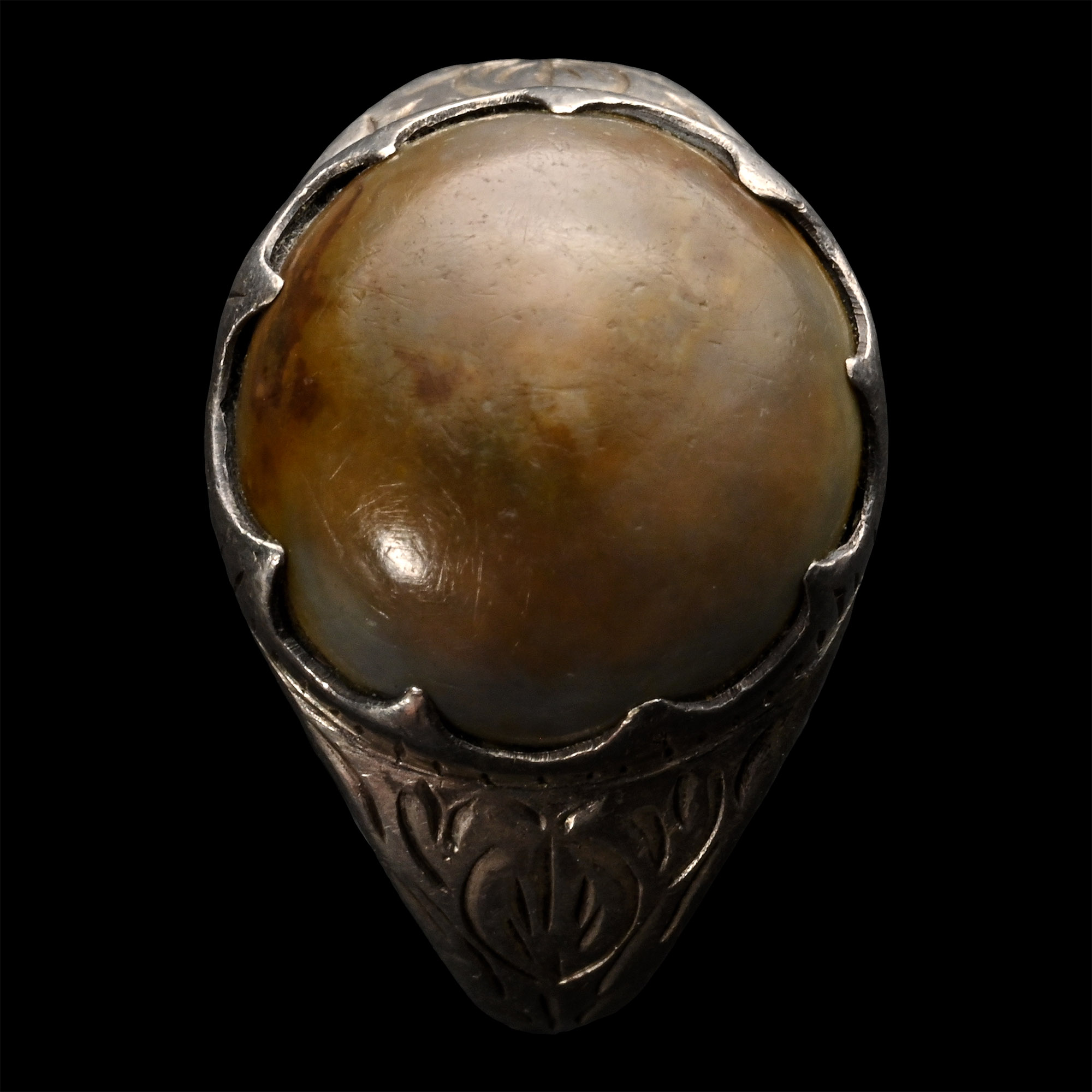
Toadstone rings still come to auction, and a silver one of the Tudor period sold at TimeLine in March 2026 for £5,720 with premium. Lot 387 is a substantial silver ring of the sixteenth or seventeenth century, close to ten grams in weight, engraved with leaves on the shoulders and set with a large rounded toadstone in a lobed bezel. The stone is mottled grey and brown and bare of any picture or word.
What is a bezoar stone?
A bezoar stone is a concretion that forms around indigestible matter in an animal's digestive system, and its name comes from the Persian pādzahr, "antidote". The most valued kind, the Oriental bezoar, came from the stomach of the Persian wild goat, and a true one was said to lie twelve hours in water without clouding it or losing weight. Owners kept them in gold or silver boxes, wore them as amulets against the plague, hung them on a gold chain to steep in a drink, and scraped off a few grains only in a grave case.
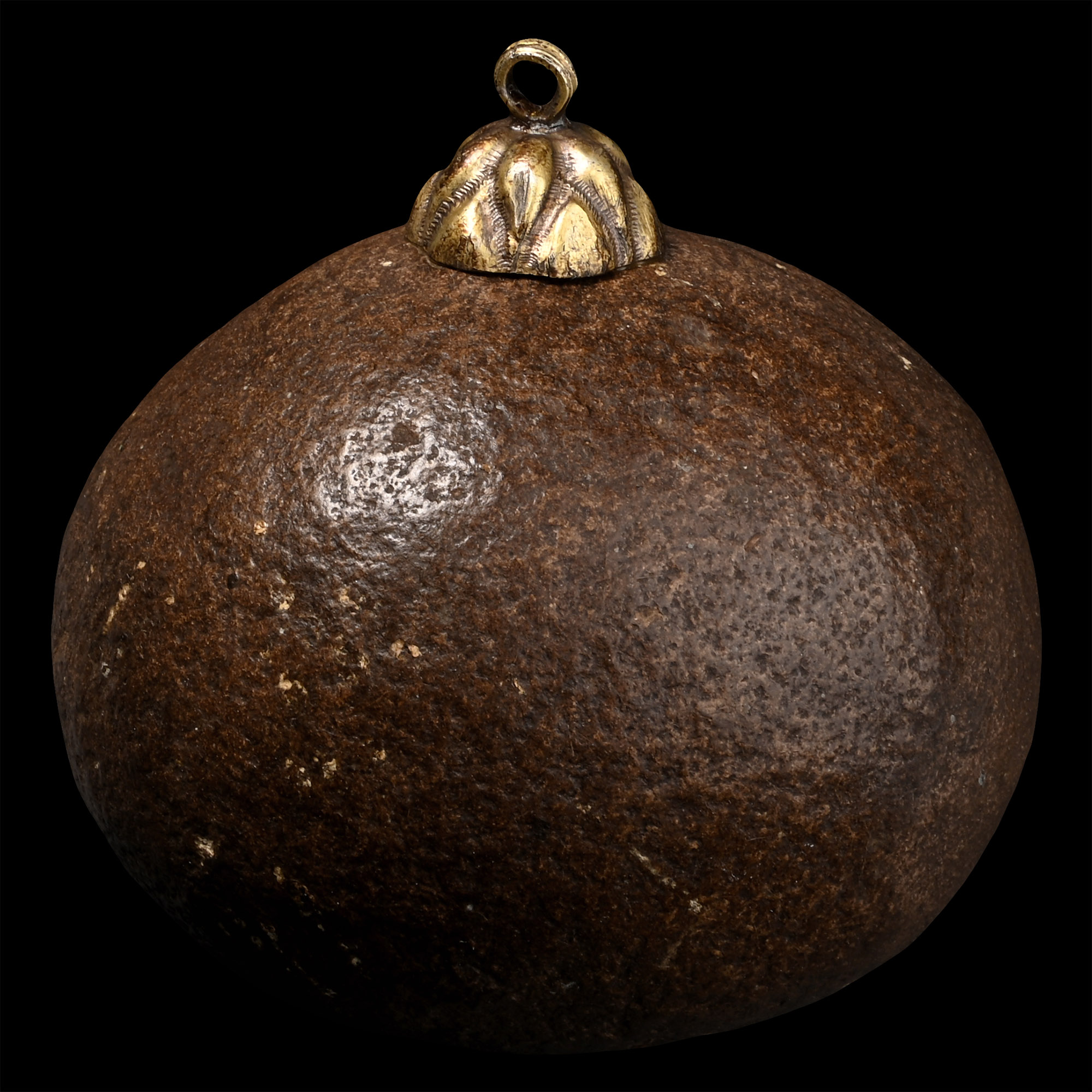
Lot 388 is a dark brown, rounded bezoar with a granular surface, of the seventeenth or eighteenth century, weighing 74 grams and fitted with a domed silver-gilt cap and a circular loop, so that it could be worn as a pendant or hung up for use. Silver-mounted bezoars of the same two centuries are kept in the London Museum and the Museo Nacional de Ciencias Naturales in Madrid.
Ambroise Paré tests a bezoar stone
A lord brought Charles IX a bezoar from Spain at Clermont in Auvergne, assuring him it was good against all poisons, and the king called Paré over and asked whether any single drug could be. Paré answered at once that none could, since poisons work in different ways and each has to be met by its contrary. The lord held to his stone, so Paré proposed a trial on "some rogue who had earned a hanging".
In the prison of the king's household was a cook who had stolen two silver dishes from his master and was to be hanged the next day. Promised his life if he survived a poison and an antidote, the cook agreed readily, saying he would much rather die of poison in the prison than be strangled in sight of the people. An apothecary gave him the poison and then the bezoar, and an hour later Paré found him on all fours, "walking like a beast", bleeding from the ears, nose and mouth. After about seven hours the cook died "crying that it would have been better for him to die on the gallows".
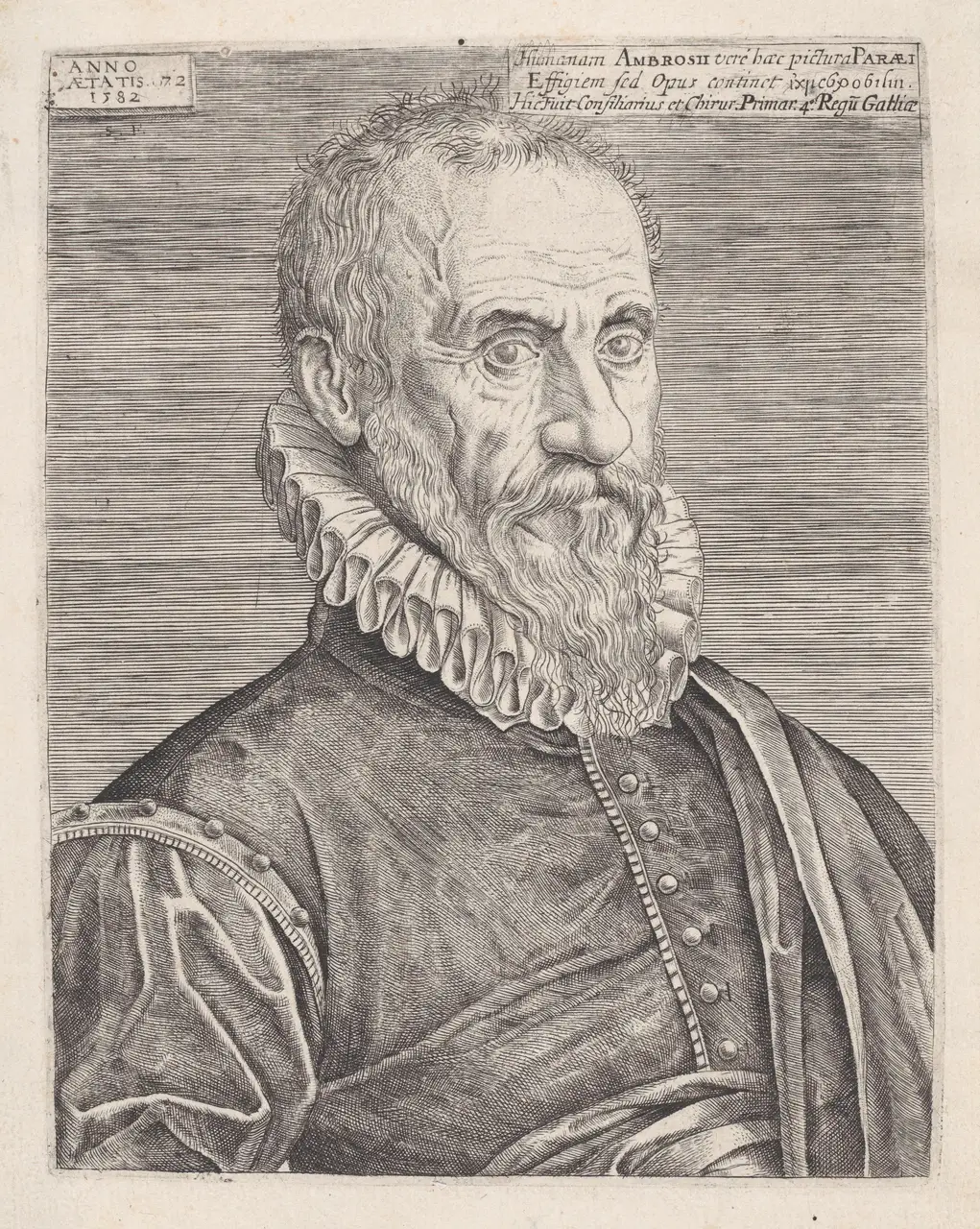 Ambroise Paré at 72, engraved by Étienne Delaune in 1582; the Latin above calls him counsellor and first surgeon to four kings of France. Metropolitan Museum of Art, CC0, via Wikimedia Commons.
Paré opened the body, found the bottom of the stomach "black, arid and dry, as if a cautery had passed over it", and knew the man had swallowed sublimate, mercuric chloride. "And so the stone from Spain, as experience showed, had no virtue. For that reason the king commanded that it be thrown on the fire, which was done."
A treasure for the children
In 1673 Molière's imaginary invalid, Argan, was still being billed five livres by his apothecary for "a cordial and preservative potion, composed with twelve grains of bezoar". In 1741 Savary's Dictionnaire du commerce reported that bezoars arriving in Amsterdam sold for three or four hundred livres apiece and sometimes more. The buyers were the richest burghers, who made presents of them to persons of consequence or kept them in their families "as a very great treasure, which they then pass on to their children".
The stone from Spain went on the fire at Clermont; lot 388 was given a domed cap of pointed silver-gilt leaves, each outlined and veined against a textured ground, and a circular loop to hang it by.
TimeLine Auctions