Home > Stories by TimeLine Auctions
Stories by TimeLine Auctions
Bronzes from the Gravona: A Corsican Hoard from the Turn of the First Millennium BC
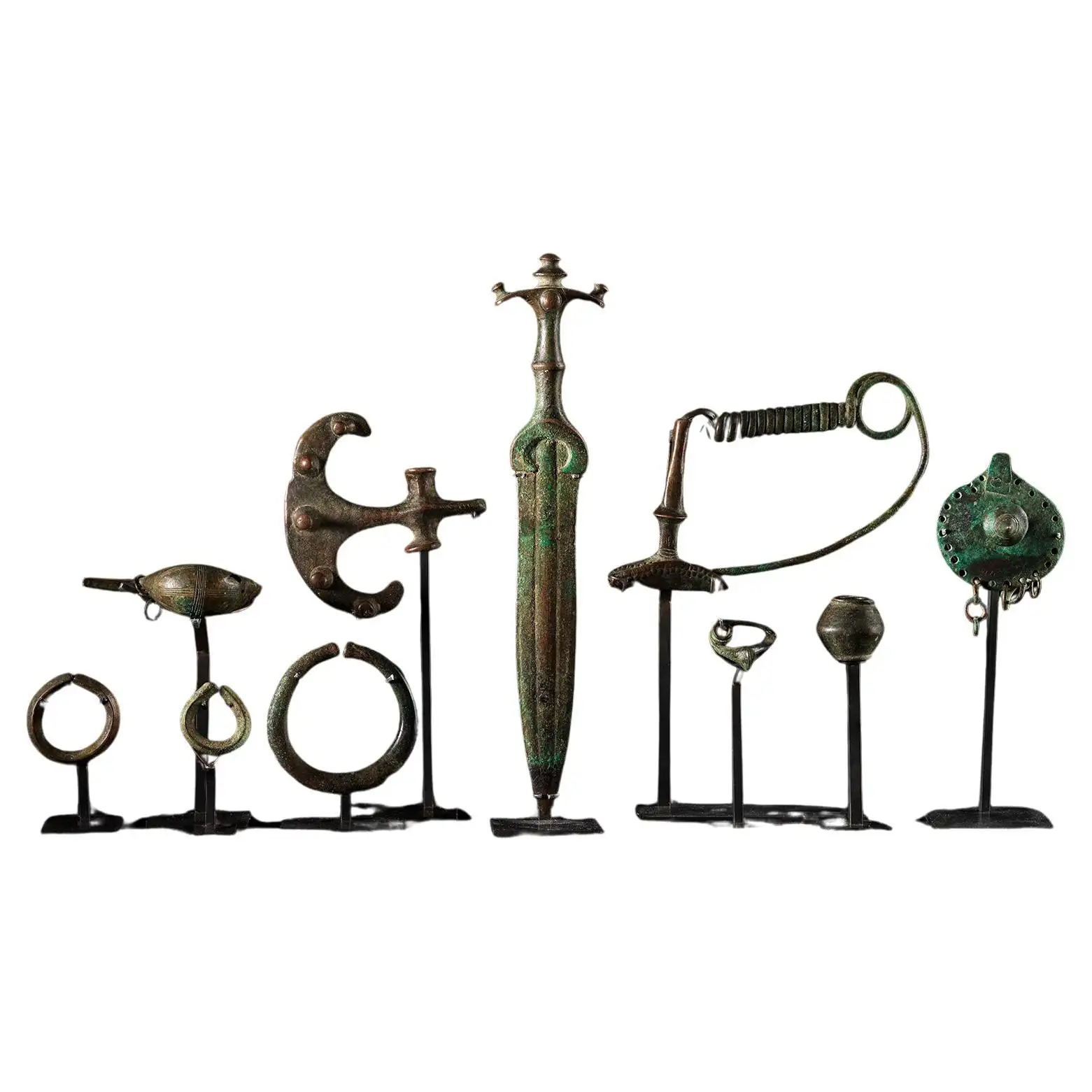
Sometime between 1880 and 1890, workmen digging footings for the railway bridge that would carry the Ajaccio–Bastia line across the Gravona river uncovered a cluster of bronzes. The exact spot was not recorded, but the two candidates are Carbuccia, twenty kilometres north-east of Ajaccio, or Bocognano, ten kilometres further up the valley where the line again crosses the river. Both sit deep in the mountainous interior of Corsica, well away from the coast. The objects passed to a local official, Monsieur Ducasse, and from there by descent to his son Jean Dimitri Ducasse, sub-prefect at Sarrebourg. In 1923, Professor Linkenheld of Sarrebourg brought them to the archaeologist Robert Forrer at Strasbourg, who published the hoard the following year in the Bulletin de la Société préhistorique de France.
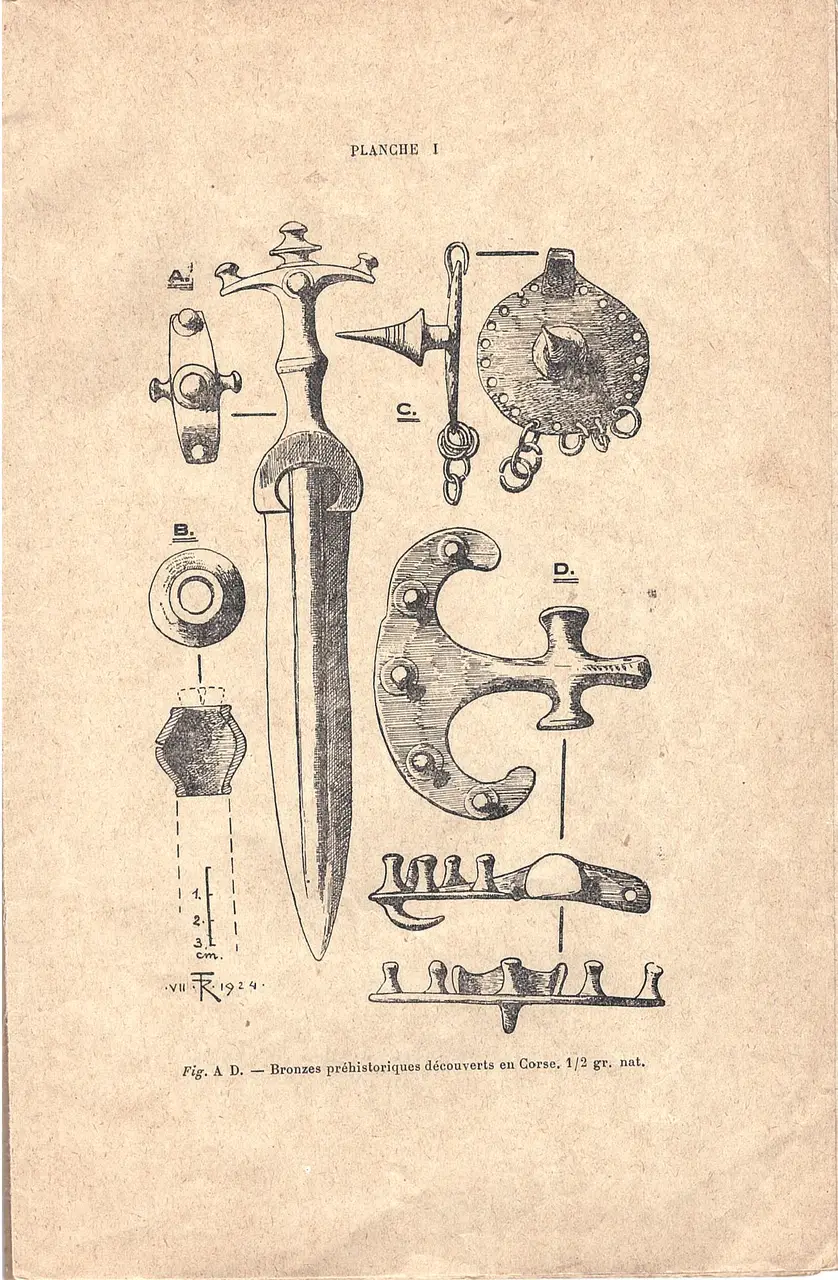
Forrer counted ten pieces: a dagger or short sword, a second pommel, a crescent-shaped bronze studded with bosses, a spiked disc, three fibulae, and three rings. He suspected the find was only part of a larger deposit, since the workmen would almost certainly have kept intact objects and discarded damaged ones. No long sword, no lance, no axe-head, no horse-bit, no ornamented bracelet accompanies the dagger and the phalera. The patina, a deep green over a reddish ground occasionally mottled with a lighter green, pointed to burial in dry earth rather than in the water itself; Forrer concluded that the hoard had probably been cut into during the excavation of the abutment foundations on the bank rather than in the river bed proper.
The dagger
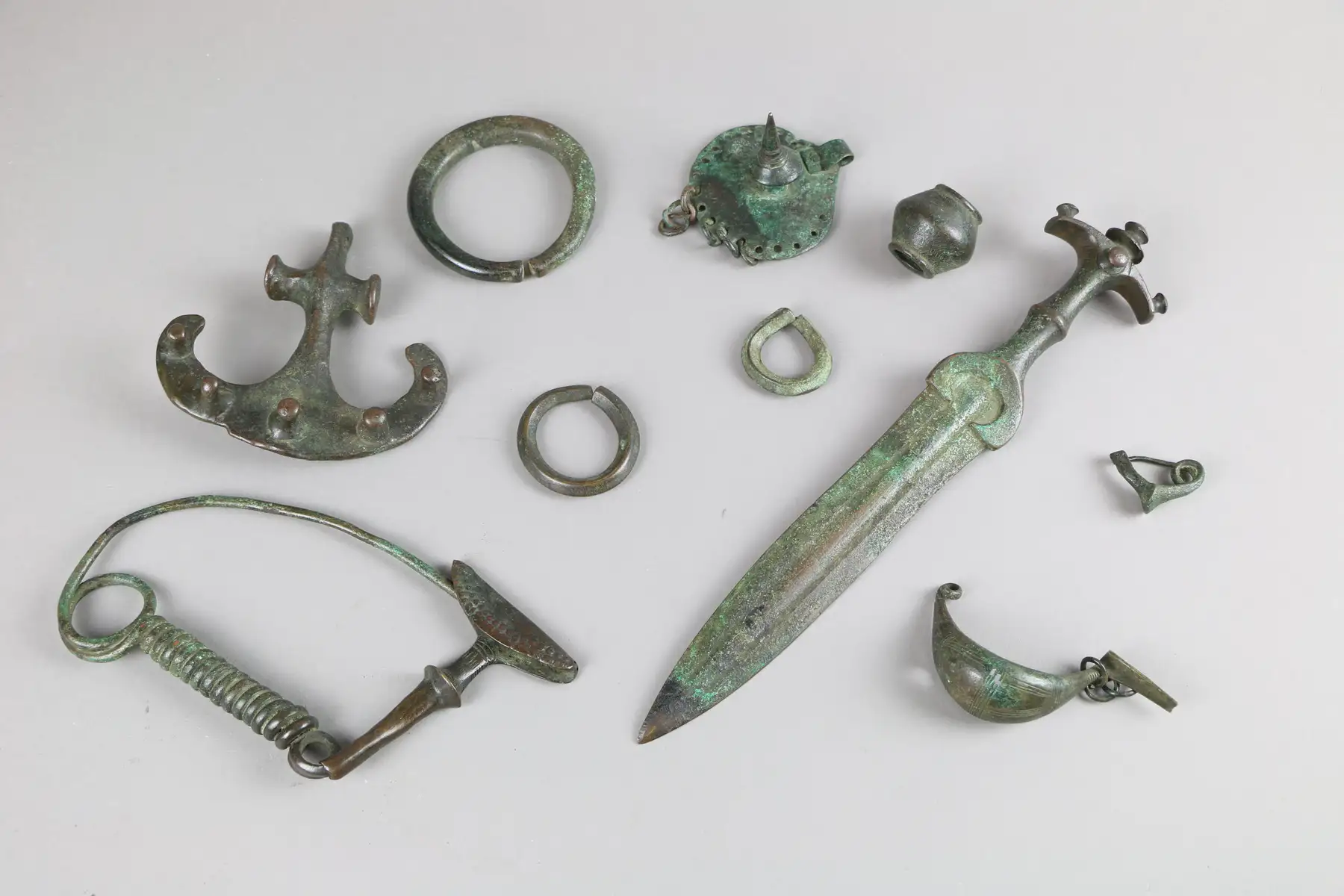
The most substantial piece is the dagger: 278 millimetres long, 311 grams, with a palm-leaf blade grooved along its length and set off by a semicircular guard. Blade and hilt were cast in a single pour, a technique Forrer noted as common on short weapons at the close of the Bronze Age. The hilt carries a ring-like swelling at its mid-point, echoing the form of longer swords of the same period.
It is the pommel that marks this dagger out. An oval, slightly curved plate carries a large two-tiered button at its centre, two smaller buttons at the ends, and two more at the sides. Forrer read these bosses as functional rather than purely decorative. He suggested they may have anchored coloured leather cords, or held the weapon suspended in a prescribed position, comparing the arrangement to medieval daggers hung by a chain from the pommel. On later Hallstatt-period weapons, particularly in Spain, similar bosses appear as pure ornament, their original purpose lost. The Corsican example, on his reading, stands at an earlier stage in that transition.
The second item in the hoard, a smaller hollow bronze sphere 37 millimetres across and pierced top and bottom, is the pommel of another weapon, perhaps a club or a staff of office. Forrer judged it too light for a practical mace-head and suspected a ceremonial function. Its surface was once covered with fine punched striations, now partly rubbed away by handling.
The crescent
Of the ten pieces, the crescent is the one Forrer could not confidently identify. Cast in a single pour by the lost-wax method, 10.8 centimetres across, weighing 214 grams, it carries five upright horn-shaped bosses along its outer edge, each about 1.5 centimetres tall. A heavy hook is moulded on the reverse. A cruciform projection terminates in two flattened spheres, and the opposite end is perforated.
Forrer thought every element looked functional. The bosses are too solid to read as pure ornament, the hook was clearly made to hold the object in a fixed position, the spheres suited to anchoring a leather strap or cord, the perforation sized to take a hook. He considered several possibilities: a belt buckle, a chape for the dagger's scabbard, a piece of horse harness. He could not choose between them. A century later, the object has not, to our knowledge, been securely paralleled. The current catalogue description takes one position among Forrer's options and calls it a small crescent axe, arguing from the absence of a shaft-hole that the hoard is votive. Forrer drew no such conclusion.
The spiked phalera
The spiked disc is the piece most often reproduced in later discussion. Six and a half centimetres across, ninety-eight grams, perforated around its edge with twenty-one holes, it retains fragments of small bronze rings hanging from four of them. Forrer proposed these once carried pendants that would have jangled as a horse moved. A hook at the top fixed the disc so that it hung freely rather than being sewn to leather. What gives the piece its character is the sharply cast bronze spike, 4.1 centimetres long, rising from the centre. Forrer connected the combination (round plate, central spike) to the shields carried by the bronze warrior statuettes of Sardinia, and by extension to the Shardana warriors depicted on Egyptian reliefs. Whether ornament, badge, or practical chamfron-like protection, the piece borrows the shape of a shield and applies it to something worn by a horse.
The fibulae
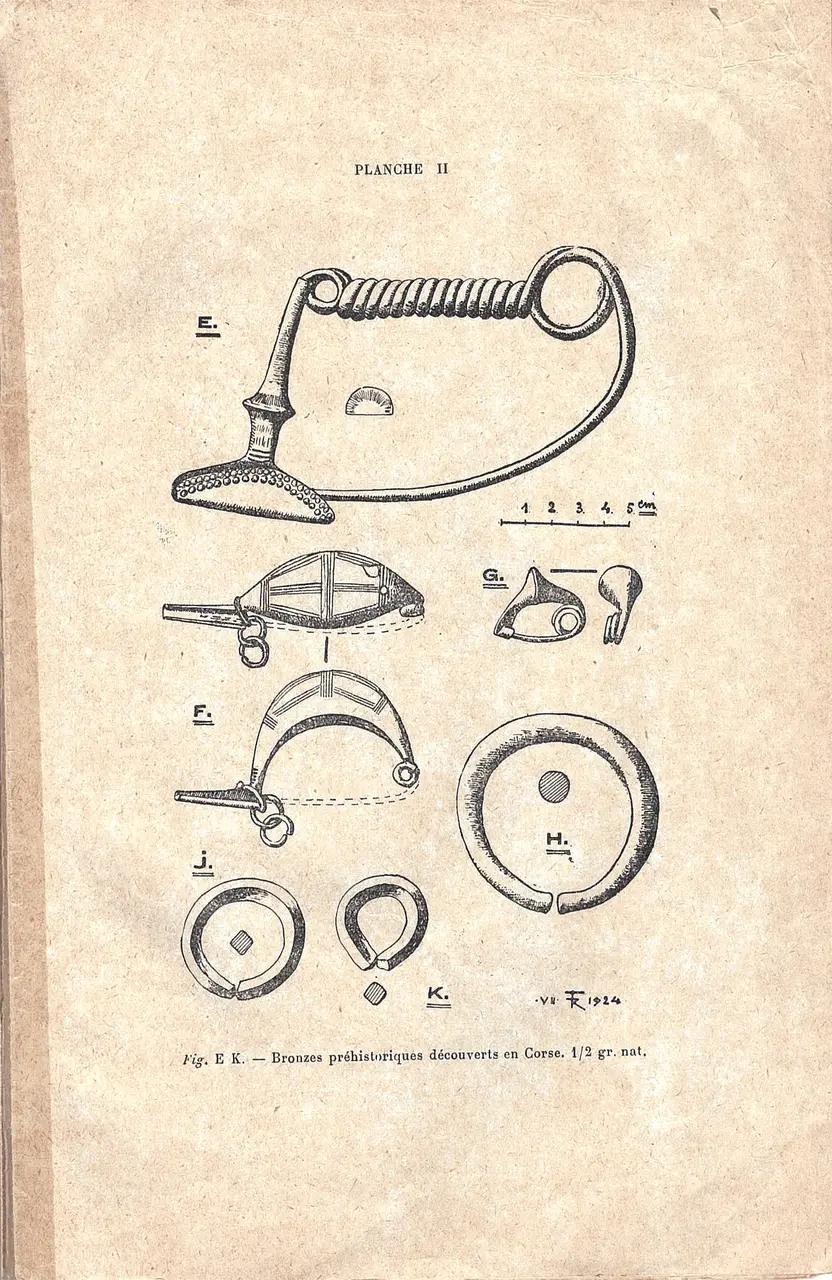
Three fibulae complete the personal ornament in the hoard, and they range widely in scale and technique. The largest is a violin-bow fibula of unusual size: 17.5 centimetres long by 10 high, weighing 164 grams. Its pin, 4 millimetres thick, rises into a broad spiral at one end, twists through a hollow spiraliform tube seven centimetres long which forms the bow itself, then exits in a smaller spiral riveted into a hammered sleeve. The foot is worked into a channel edged on both sides by a double row of repoussé dots. Forrer called it one of the most interesting fibulae of the early Iron Age known in France.
The small boat fibula (navicella) is more standard in form: a hollow body decorated with incised lines forming a cross, an elongated catch-plate, three chain-links at the foot from which a pendant once hung. The pin is missing. The third fibula is the smallest and most telling: arched, heavy-bodied, its foot repaired in antiquity. The catch-plate had broken off, and the remaining stem was hammered out to form a new one. The repair is the sort of detail that pulls the object away from any reading of the hoard as purely ceremonial deposit and returns it to daily wear.
The rings and the question of weight
Three rings round out the hoard. One, 7.7 centimetres in external diameter, sized and shaped as a bracelet, weighs 141 grams. The other two are smaller, rhomboid in section, too tight to have fitted around a wrist. Forrer read these as ring-money rather than ornaments. He noted that the smaller of the pair weighs almost exactly two-thirds of the larger, and that the bracelet weighs roughly four times the larger of the two small rings. From this he ventured a speculative comparison to the Egyptian mina of 437 grams and the Lydian-Persian mina of 432 grams, suggesting that the weights might reflect eastern Mediterranean standards reaching the western Mediterranean by the early Iron Age. The argument is tentative, as he acknowledged, and rests on a ratio set that would need far more material to be tested against. [VERIFY: whether subsequent metrological work has engaged with Forrer's ring-weight hypothesis]
The Shardana question
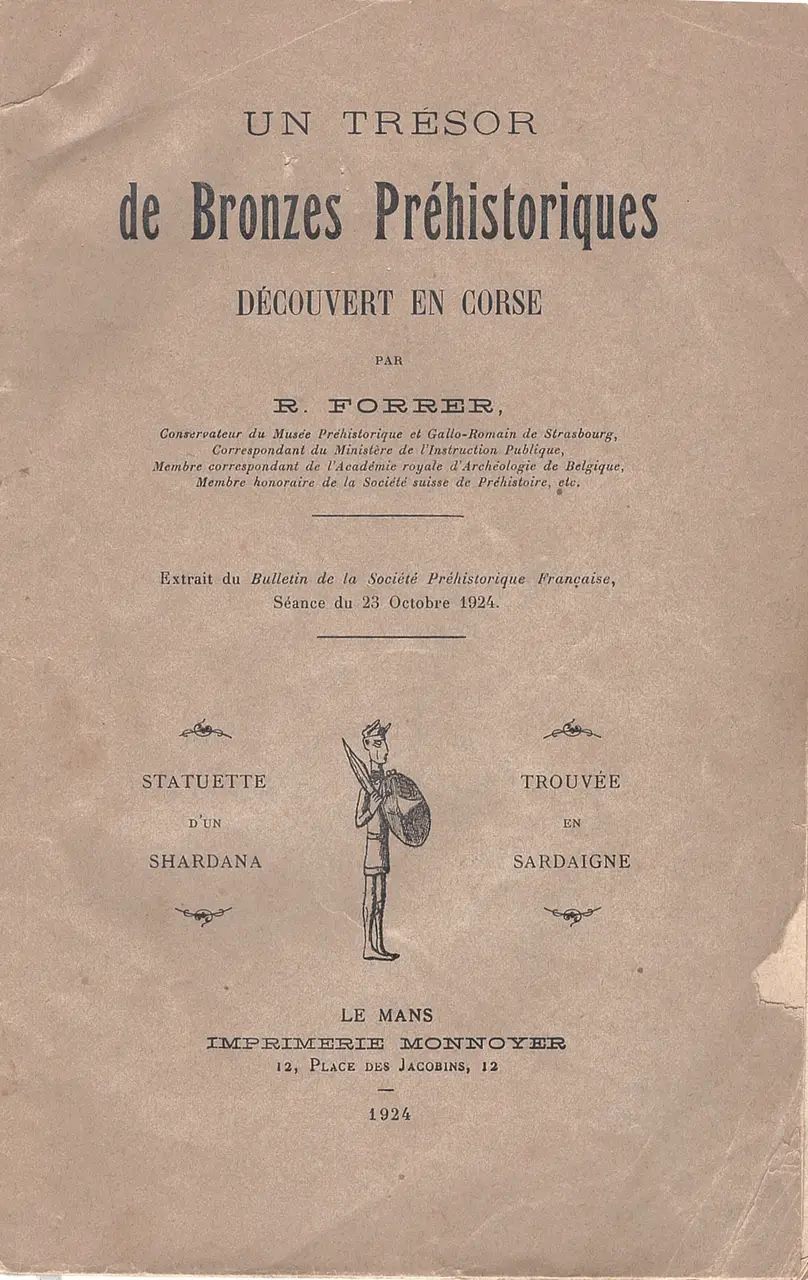
Forrer dated the hoard to about 900 BC and assigned it to the Shardana, one of the groups named among the "Peoples of the Sea" who harassed the Egyptian coast in the late second millennium BC. His reasoning rested partly on the spiked disc's resemblance to Sardinian warrior imagery and partly on an older scholarly tradition, going back to Vicomte de Rougé in 1867, that linked the Shardana to Sardinia.
The Shardana framework dominated Corsican and Sardinian Bronze Age archaeology for much of the twentieth century, largely through the work of Roger Grosjean. He read the statue-menhirs of the south, with their engraved swords and daggers, as effigies of defeated Shardana invaders, and tied them to the construction of the fortified tower-sites (torre) that characterise the island from the Bronze Age onward.
That reading has not survived recent fieldwork. By 1990, Gabriel Camps had refuted the visual comparison with the Medinet Habu reliefs in detail, and subsequent excavation, particularly at Renaghju, I Stantari and sites across the Taravo valley, has shown a long, continuous local sequence without the cultural rupture Grosjean's invasion model required. The builders of the torre, the sculptors of the statue-menhirs, and the local metalworkers are now understood as the same population. Where Shardana-type armament appears on the statues, it reflects the circulation of weapon forms across the central and western Mediterranean rather than a foreign incursion.
What has persisted in a modified form is a hypothesis first raised by Grosjean himself in 1973 and developed more recently by André d'Anna: that Corsicans and Sardinians may have contributed to the Shardana bands as emigrants rather than as the targets of colonisation. Under demographic pressure, with fortified sites multiplying across the south of Corsica in the Late Bronze Age, some part of the population may have looked east for service as mercenaries and pirates. On that reading, a hoard like the one from the Gravona represents the equipment of a local warrior elite, made by local workshops in dialogue with wider Mediterranean forms.
What the hoard amounts to
Forrer himself concluded that the assemblage was most likely the buried wealth of a warrior chief, though he left the alternatives on the table: grave goods from one or several disturbed burials beside the Gravona; the stock of an itinerant trader. The circumstances of recovery (workmen, a bridge abutment, no controlled excavation) mean that the question is unlikely to be closed. What the hoard shows clearly is that in the interior of Corsica around the turn of the first millennium BC, someone owned and eventually gave up ten bronzes that combined locally made forms with reference points running from the Italian peninsula to Sardinia and, more distantly, to the eastern Mediterranean. The dagger could still be held. The small fibula had been worn, broken, and repaired. The crescent, whatever its function was, has not been matched elsewhere.
The Gravona bronzes are offered as a single lot in the TimeLine Antiquities auction on 2 June 2026.
TimeLine Auctions, 28h April 2026