Home > Stories by TimeLine Auctions
Stories by TimeLine Auctions
Cataphract Armour and the Roman Horsemen Who Rode Like Statues
"They wear greaves that fit the legs closely, and knee-caps, and on their thighs the same sort of iron covering. They ride their horses exactly like statues, and need no shield." The future emperor Julian wrote that in the 350s about the armoured lancers who rode for his cousin Constantius II at the battle of Mursa in 351. He was describing cataphract armour, the head-to-foot metal casing of Rome's heaviest cavalry, and his first sentence would do as a description of the pair of greaves in TimeLine's December sale.
Each greave is built of curved, overlapping copper-alloy strips, nineteen on the left leg and twenty on the right. Every strip is U-shaped to wrap the front and sides of the shin and is riveted at both ends. Above them, larger plates are shaped over the knee and cut away at the sides so the joint can bend. The two stand 45 and 50.5 centimetres tall and weigh 1.8 kilograms together. They are Roman, of the second or third century AD, and they were made for a cataphractarius, a heavily armoured mounted soldier.
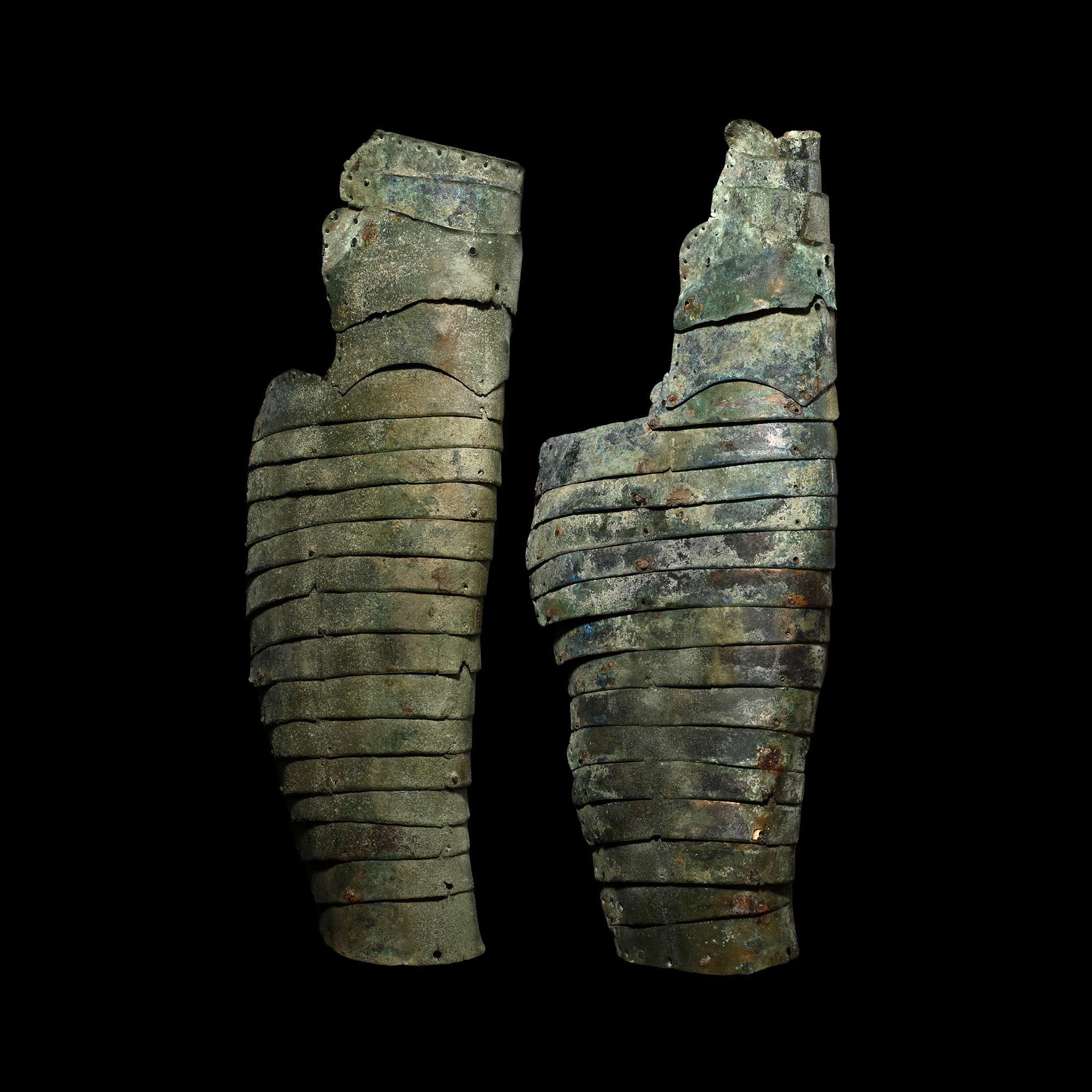
Roman writers described the limb armour of these riders more than once, down to how it fastened and how a man wearing it got onto his horse. The ground has been far less generous: excavation along Rome's frontiers has produced a few arm guards and some fragments, and no published leg defence as complete as this pair.
What was a Roman cataphract?
The Greek kataphraktos means "covered over", and Latin borrowed it as cataphractarius. The other name for these troops, clibanarius, comes from klibanos, a covered oven for baking bread, and a rider sealed in metal from head to foot was a mounted oven. Some fourth-century writers use the two names for the same men, and scholars still argue over whether they were different kinds of trooper.
Rome met this kind of cavalry as an enemy long before it raised its own: at Carrhae in 53 BC, Plutarch writes, the Parthians who destroyed Crassus's army rode horses "clad in plates of bronze and steel". Tacitus describes Sarmatian horsemen from the steppe, raiding across the Danube in AD 69, in armour of iron plates or hardened leather so heavy that a man who fell could not get up again. The first regular Roman unit of armoured cavalry was raised under Hadrian, and more followed in the third century. The greaves in the sale date from this first stretch of Roman armoured cavalry, before the units multiplied in the fourth century.
The orator Libanius, speaking in about 348, had a story about where the Persian version came from. The Persians were short of iron ore at home, he said, so they asked the emperor Constantine for leave to import iron from the empire, and then used it to armour both horse and rider. Julian credits Constantius with Rome's answer, and says the emperor wore the new kit before anyone else: "First you trained yourself to wear them, and then you taught others how to use such weapons."
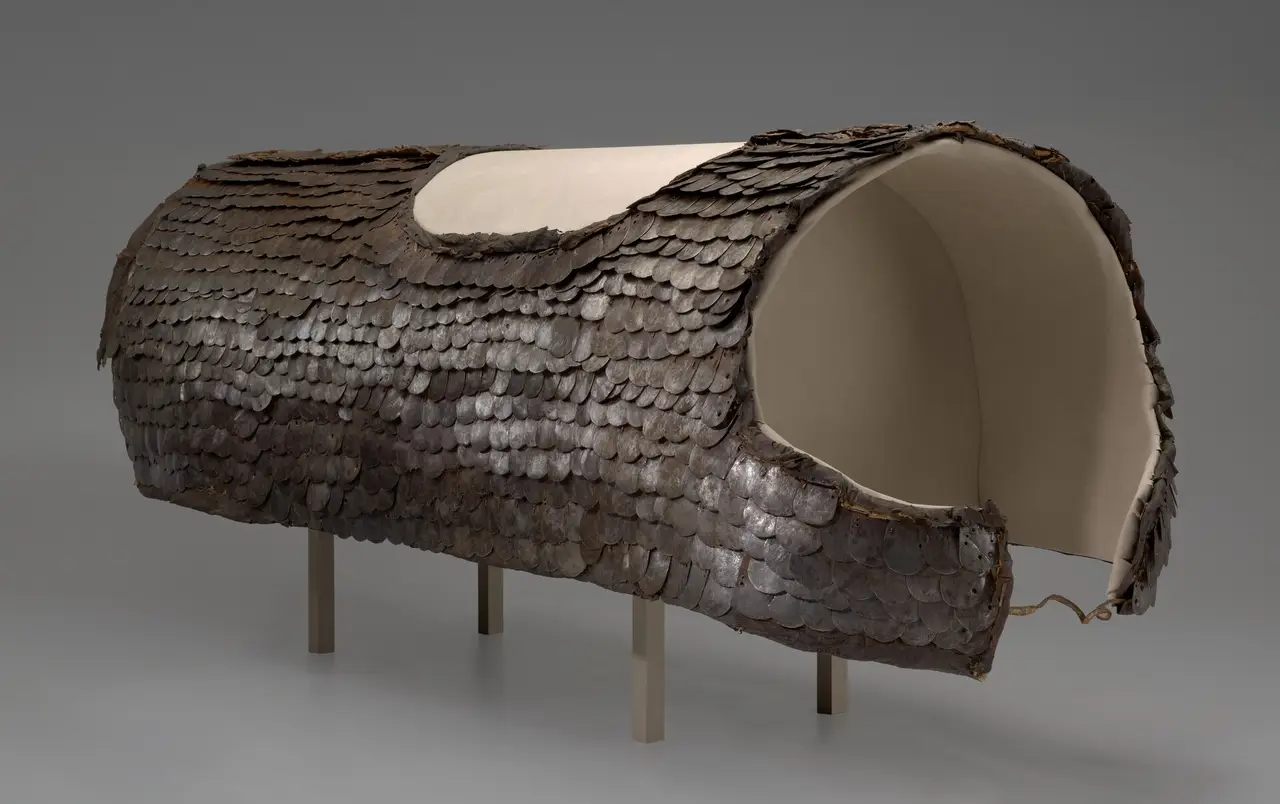 Iron scale armour for a horse, third century AD, found in Tower 19 at Dura-Europos on the Euphrates; the opening on top was left for the saddle. Yale University Art Gallery. Photo: Yale University Art Gallery, CC BY-SA 4.0, via Wikimedia Commons.
Why cataphracts looked like statues
In 357 Constantius entered Rome in procession, riding alone in a golden carriage between twin lines of infantry. The historian Ammianus Marcellinus describes the horsemen scattered among them: "the full-armoured cavalry (whom they called clibanarii), all masked, furnished with protecting breastplates and girt with iron belts, so that you might have supposed them statues polished by the hand of Praxiteles, not men. Thin circles of iron plates, fitted to the curves of their bodies, completely covered their limbs; so that whichever way they had to move their members, their garment fitted, so skilfully were the joinings made."
Julian says the metal face mask "makes its wearer look like a glittering statue". The novelist Heliodorus, writing about a Persian heavy cavalryman, gives him "the appearance of a hammer-wrought statue, or of an iron man". Around 600 the Persians carved the type themselves, almost in the round, in the grotto at Taq-e Bostan, where a king usually identified as Khusrau II sits his armoured horse in mail.
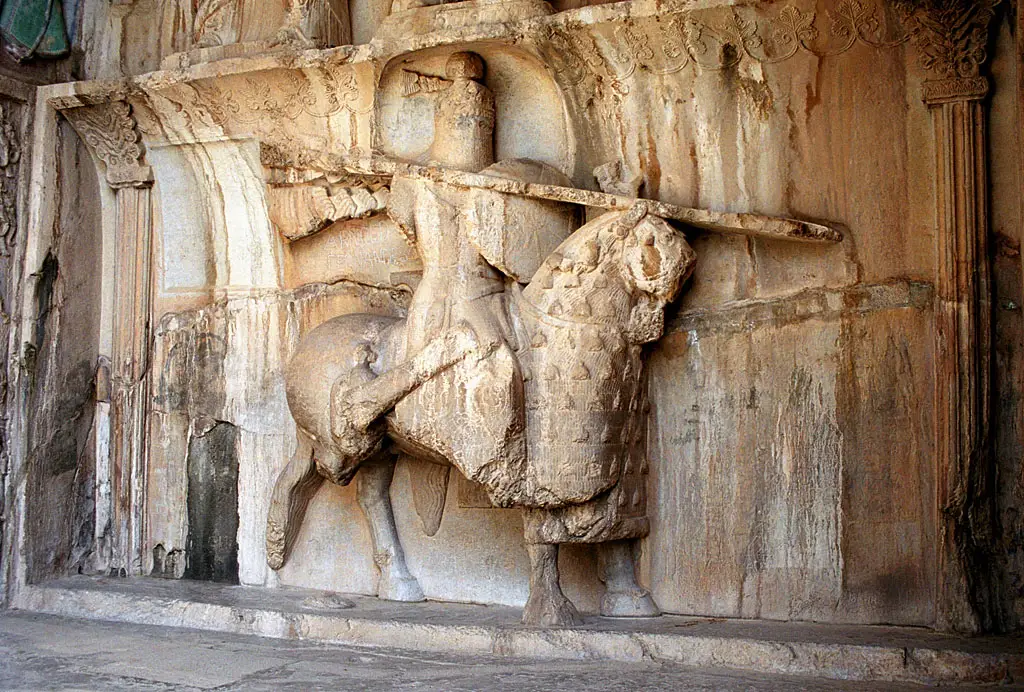 The armoured horseman in the large grotto at Taq-e Bostan, near Kermanshah in western Iran, carved about AD 600: the king wears mail and carries a lance, and his horse is armoured across the head and chest. Photo: Philippe Chavin, CC BY 2.5, via Wikimedia Commons.
A bronze statue is a body in metal, and so was a masked man sitting still in hoops that followed his calves and the turn of his knees. The greaves are shaped to the leg in the same way, with strips that narrow towards the ankle and widen over the calf, and knee plates cut to the joint.
In August 357, a few months after the procession, Julian met the Alamanni outside Strasbourg, and the armoured cavalry on his right wing, who had looked so fine in Rome, broke. Ammianus says they scattered after their commander was slightly wounded and one of their companions slipped "over the neck of his horse, which had collapsed under the weight of his armour". The infantry held, Julian rode out to turn the horsemen back, and the battle was won. Peter Connolly, the historian and illustrator of the Roman army, summed up their record: "There is in fact no good evidence that clibanarii were effective against disciplined opposition; as parade-troops, however, they made a deep impression."
Greaves, knee-guards and a rider lifted onto his horse
Heliodorus's horseman wears a coat of scales from neck to knee, and the only part of him left bare is the back of the thighs, where he sat on the saddle. He could not get up there by himself: "Thus accoutred and as it were fitted into his armour, this ponderous soldier sits his horse, unable to mount himself on account of his weight, but lifted on by another." Connolly reckoned that a cataphract's long shirt of mail or scale weighed 25 to 30 kilograms, and a clibanarius cased from head to foot carried more. The pair of greaves adds 1.8.
In Julian's Greek the greaves at Mursa fit closely "at the ankles", and the knee-caps have a word of their own, perigonatides, knee-guards made as separate pieces. Knee-guards are one of the things that mark a Roman greave as a cavalryman's and not a foot soldier's. On the pair they are the larger plates at the top, and the row of small holes along the upper edge of the highest plate is where a lace could tie each greave to whatever its wearer had on above. Heliodorus's greave "extends from the feet to the knee, and is connected with the coat", and Julian's leg armour is "attached to the cuirass by fine chain-armour like a web".
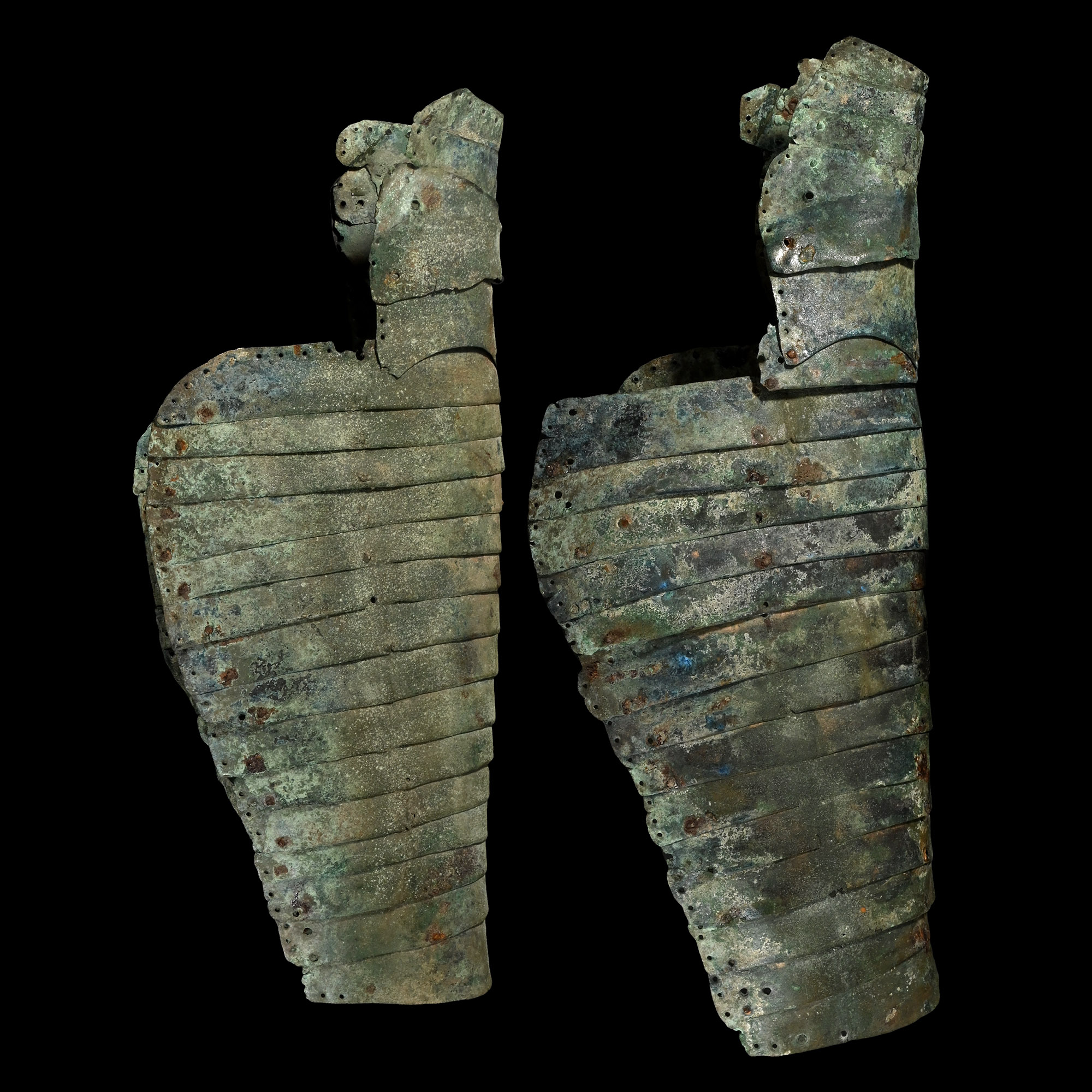
Greek greaves were sprung to clip round the calf, but Roman ones were strapped on, and the U-shaped strips of the pair leave the back of the leg open for the straps. The Roman garrison town of Dura-Europos, on the Euphrates, even kept what went underneath: a linen liner half a centimetre thick and 44 centimetres tall, its top curved to cover the knee, bound in leather and fitted with three pairs of ties that were once dyed red. Two cuts go right through it, and the scholars who first published it thought they might be the marks of actual combat.
Why so little cataphract armour survives
Dura-Europos fell to the Persians in about 256, and it is the richest source of Roman armour of its period anywhere in the empire. Two complete horse armours came out of one of its towers. A horseman scratched into the plaster of a courtyard wall has his arms, legs and feet drawn in bands, like the hoops Ammianus describes. Of the banded limb armour itself, though, Dura produced one piece: a few slightly curved iron plates from the fill of a tomb, 125 millimetres wide.
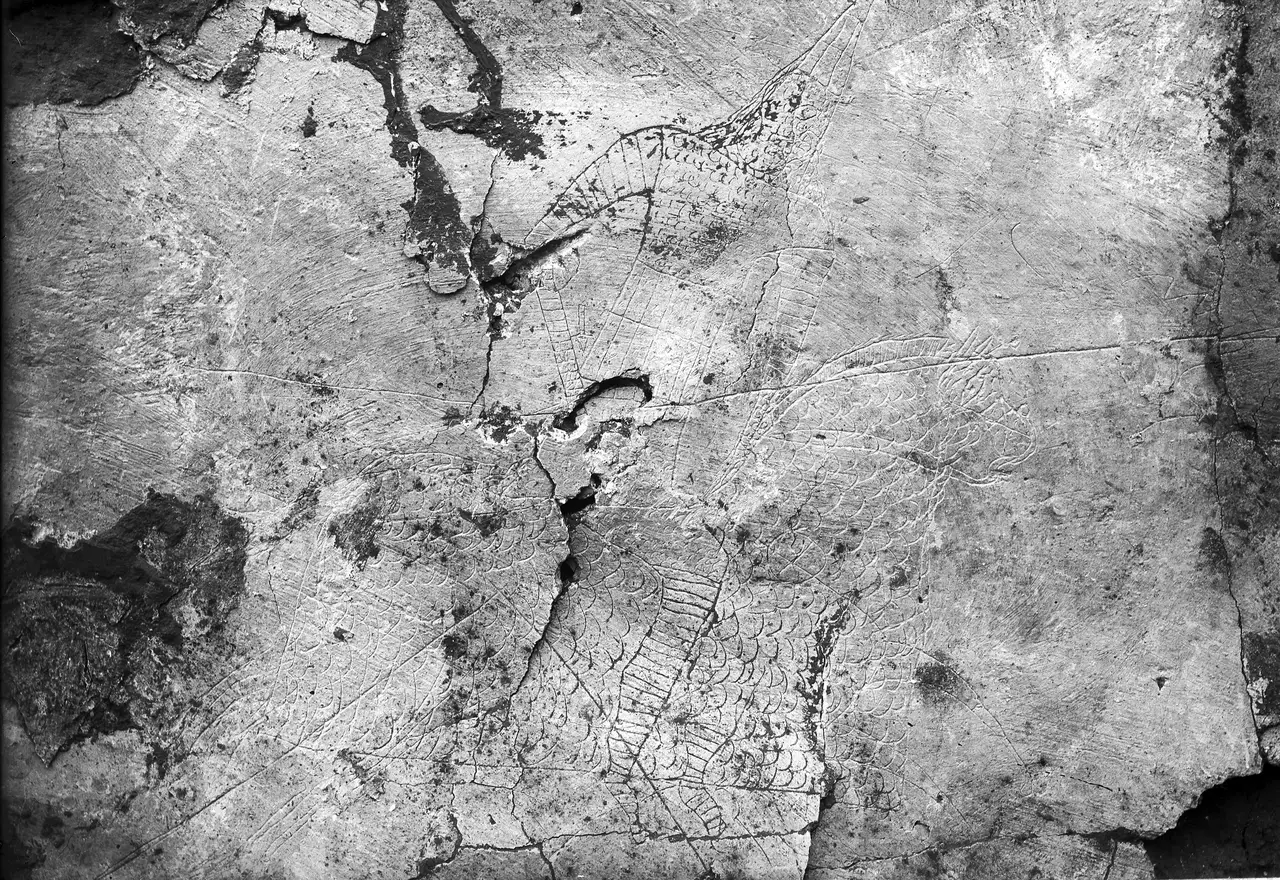 The armoured horseman scratched into plaster at Dura-Europos, photographed in 1930-31: the rider's limbs are drawn in bands and his horse in scales. Yale University Art Gallery, Dura-Europos archive, CC0, via Wikimedia Commons.
Armour was mended for as long as it could be, and when it was past mending the metal went back into the melting pot. In Roman Britain the share of recycled metal in copper-alloy objects rose steadily through the occupation, and iron armour that escaped the smith mostly rusted away in the ground, for the reasons set out in why bronze survived and iron didn't.
The strips of banded armour were also held together by leather, riveted inside and laced along the edges. When the leather rotted, a greave or an arm guard became a scatter of curved strips that nobody could read. In 1906 the excavators of the Roman fort at Newstead, in the Scottish Borders, found more than a hundred fragments of brass plate. They were first taken for body armour, then rebuilt in the 1970s as a cavalryman's thigh guard, and only in 1993 recognised from the curve of the plates as an arm guard. The pieces were finally fitted together for the British Museum's exhibition Legion: Life in the Roman Army in 2024. The Newstead arm guard is the closest match for the construction and material of the greaves in the sale. The other finds are few and mostly crushed: iron arm guards from Carlisle, and part of an iron thigh guard from Gamla in the Golan.
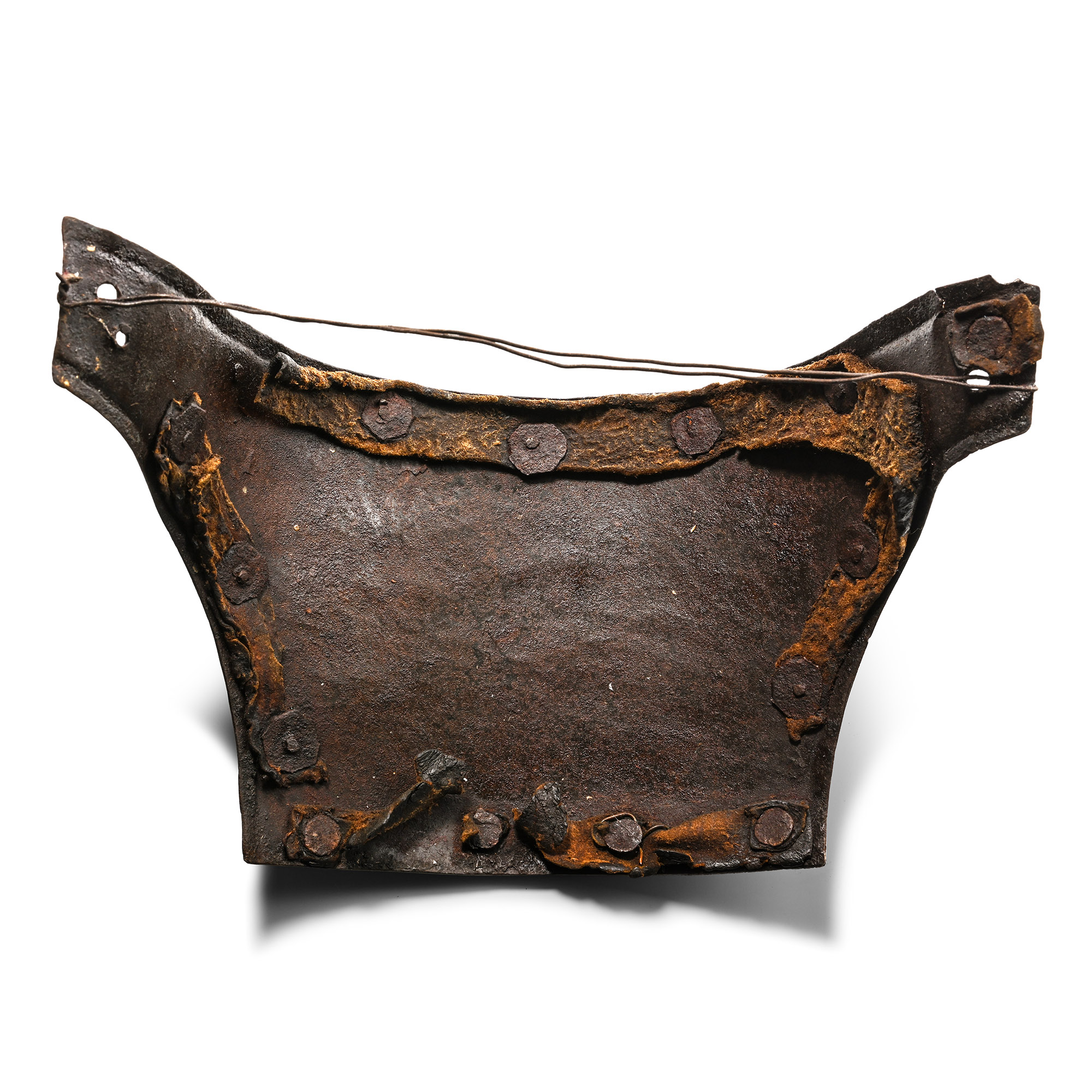
On later armour the leathers sometimes last. A seventeenth-century iron tasset in the same sale, the lower plate of a thigh defence, still has its leather lining strips riveted to the back, and it shows what the rivets at both ends of every strip of the greaves were there to grip.
Banded limb armour mostly reaches the saleroom as loose plates: four Roman bronze ones sold for £221 at TimeLine in December 2023. Complete greaves at auction are usually of the other kind, a single sheet of bronze modelled on the shin, most often Greek or Italic, and a Greek-Italic pair with embossed knees and calves made £16,510 here in November 2020.
The pair of cataphract greaves came from the Munich art market in the 1990s and has since been in a South German private collection. Dura gave 125 millimetres of banded armour from a tomb, and Newstead a hundred fragments that took nearly ninety years to be recognised as an arm guard. These are two whole greaves of nineteen strips and twenty, with the knee-guards Julian named at Mursa and, along the top of each, the holes for a lace that could tie it to the coat Heliodorus describes.
TimeLine Auctions