Home > Stories by TimeLine Auctions
Stories by TimeLine Auctions
The Collector's Guide to Ancient Oil Lamps: From Phoenician Saucers to Byzantine Bronzes
Introduction: The Most Accessible Antiquity You've Never Considered
Most people walk past ancient oil lamps in museum cases without a second glance. They gravitate toward the marble sculpture, the painted pottery, the glittering gold. That's a mistake, and it's one we see corrected almost every season at TimeLine when a new collector discovers what experienced hands have known for decades: oil lamps are among the most historically rich, typologically diverse, and affordable antiquities available on the market today.
Here's the practical reality. A Roman bronze figurine of museum quality might set you back five or six figures. A Greek black-figure vase with an intact scene? Similar territory. But a well-preserved Roman lamp from the first century A.D., complete with its original workshop signature on the base, can often be acquired for a few hundred pounds. We're not talking about fragments or compromised pieces either. We're talking about complete, displayable objects that someone held in their hand nearly two thousand years ago, objects that lit their evening meal, their reading, their worship.
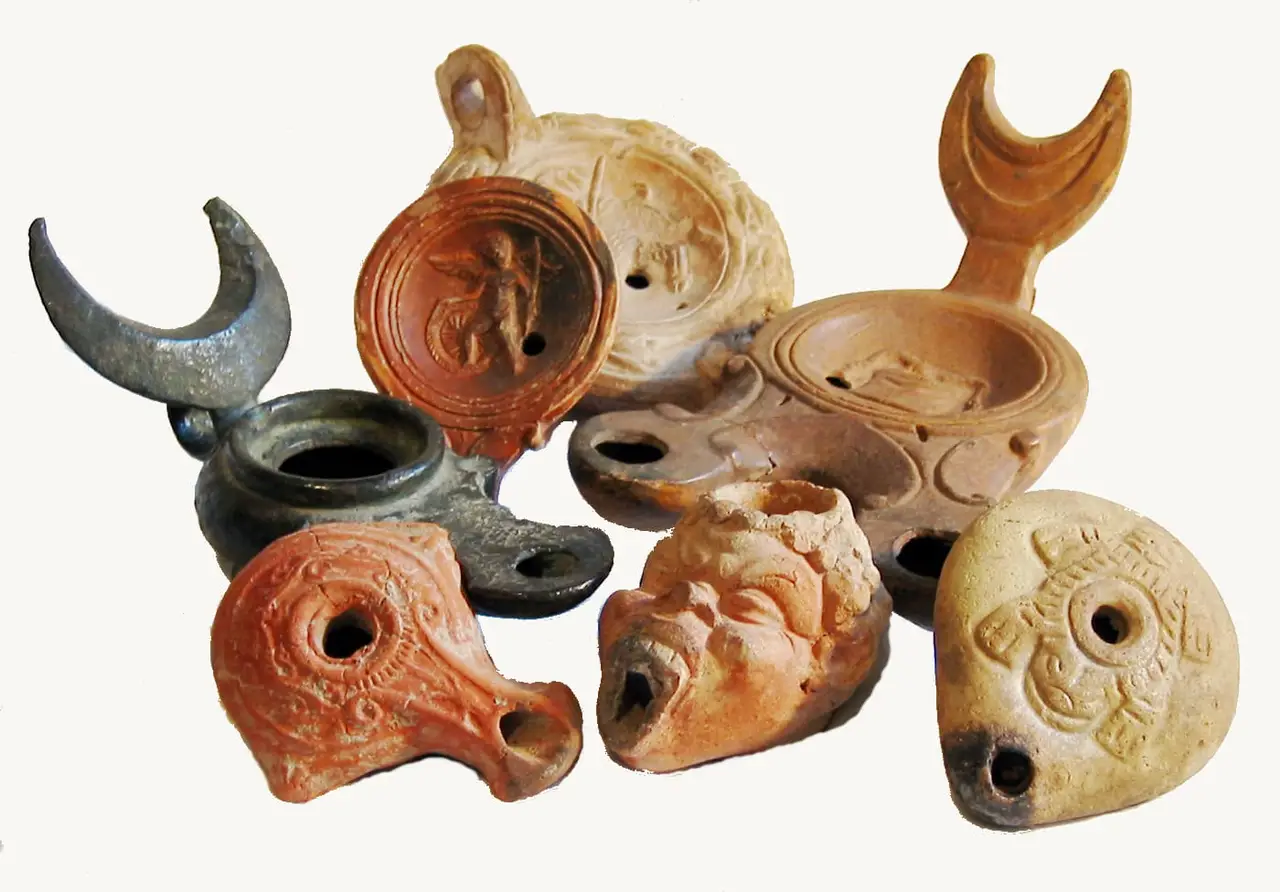
The diversity is staggering. Oil lamps were produced across the ancient Mediterranean world for nearly three millennia, from simple Phoenician saucers pinched at the corners in the seventh century B.C. to elaborate Byzantine bronze stands with Christian iconography in the sixth century A.D. That span encompasses the rise and fall of Carthage, the golden age of Athens, the Roman Republic and Empire, the spread of Christianity, and the emergence of Islam. Each period, each region, each workshop left its mark in clay and bronze. For collectors who appreciate depth over flash, who want to build something meaningful rather than simply acquire decorative objects, lamps offer an education in ancient history that unfolds with every new acquisition.
This guide is designed to give you the foundation you need to start collecting with confidence. We'll walk through the major typologies, explain what to look for when evaluating condition, discuss practical matters like storage and display, and offer strategies for building a coherent collection on a realistic budget. Whether you're considering your first purchase or looking to deepen an existing collection, the information here draws on decades of experience at TimeLine and the scholarly frameworks established by experts like Loeschcke, Broneer, Howland, Bailey, and Bussière.
Why Oil Lamps? The Case for a Neglected Category
Before we get into the technical details, let's address the fundamental question: why should you collect oil lamps rather than, say, coins, pottery, or sculpture?
The answer involves several practical considerations that work in the collector's favour.
First, provenance and legality. Oil lamps were produced in enormous quantities throughout antiquity. Unlike unique sculptural masterpieces or rare coins, they were everyday household objects, and they survive in vast numbers. This abundance means that the market includes many pieces with solid collection histories, often dating back to the nineteenth or early twentieth centuries when Mediterranean archaeology was in its formative stages. We regularly handle lamps that can be traced through old European collections, complete with handwritten labels and auction records. For collectors rightly concerned about the ethics and legality of antiquities acquisition, this established market provides reassurance that's harder to find in other categories.
Second, typological precision. The study of ancient lamps is remarkably well-developed. Scholars have created detailed classification systems that allow even relatively inexperienced collectors to identify, date, and attribute lamps with considerable accuracy. When you hold a Loeschcke Type I volute lamp, you can say with confidence that it was produced during the Augustan to Flavian period (roughly 27 B.C. to A.D. 96). When you see a lamp marked with the tria nomina (the three-part Roman name of a workshop owner), you're looking at a branded commercial product from an identifiable manufacturer. This precision transforms collecting from guesswork into genuine scholarship.
Third, affordability and accessibility. We mentioned this already, but it bears emphasis. A new collector can acquire authentic, well-preserved Roman lamps for prices that would buy only reproductions in most other antiquities categories. This low barrier to entry allows you to learn by handling actual objects rather than just reading about them. You can afford to make a few mistakes, acquire pieces that don't quite fit your collection, and gradually refine your eye without catastrophic financial consequences.
Fourth, display flexibility. Oil lamps are compact. A serious collection of fifty pieces can fit comfortably in a single display cabinet. Compare that to the space requirements for sculpture or large pottery vessels. For collectors with limited room, this matters enormously.
Understanding the Major Typologies: A Chronological Framework
The classification of ancient lamps can seem intimidating at first glance. Scholars have developed multiple overlapping systems, and the literature is dense with references to "Howland Type 25 A Prime" or "Bussière Form D II 1." Don't let this discourage you. Once you understand the basic chronological and geographic framework, the specific type names become useful tools rather than barriers.
We'll move through the major categories in roughly chronological order, highlighting what you're most likely to encounter on the market.
Phoenico-Punic Saucer Lamps (7th–2nd Century B.C.)
These are the earliest lamps you'll typically find for sale, and they're wonderfully simple objects. The form originated in the Near East in the late third millennium B.C. as handmade shallow bowls with pinched corners that served as wick-rests. By the seventh century B.C., potters were producing wheelmade versions with a distinctive shape: a broad, slightly concave basin with a flat rim folded upward and pinched at the front to create a narrow open spout.
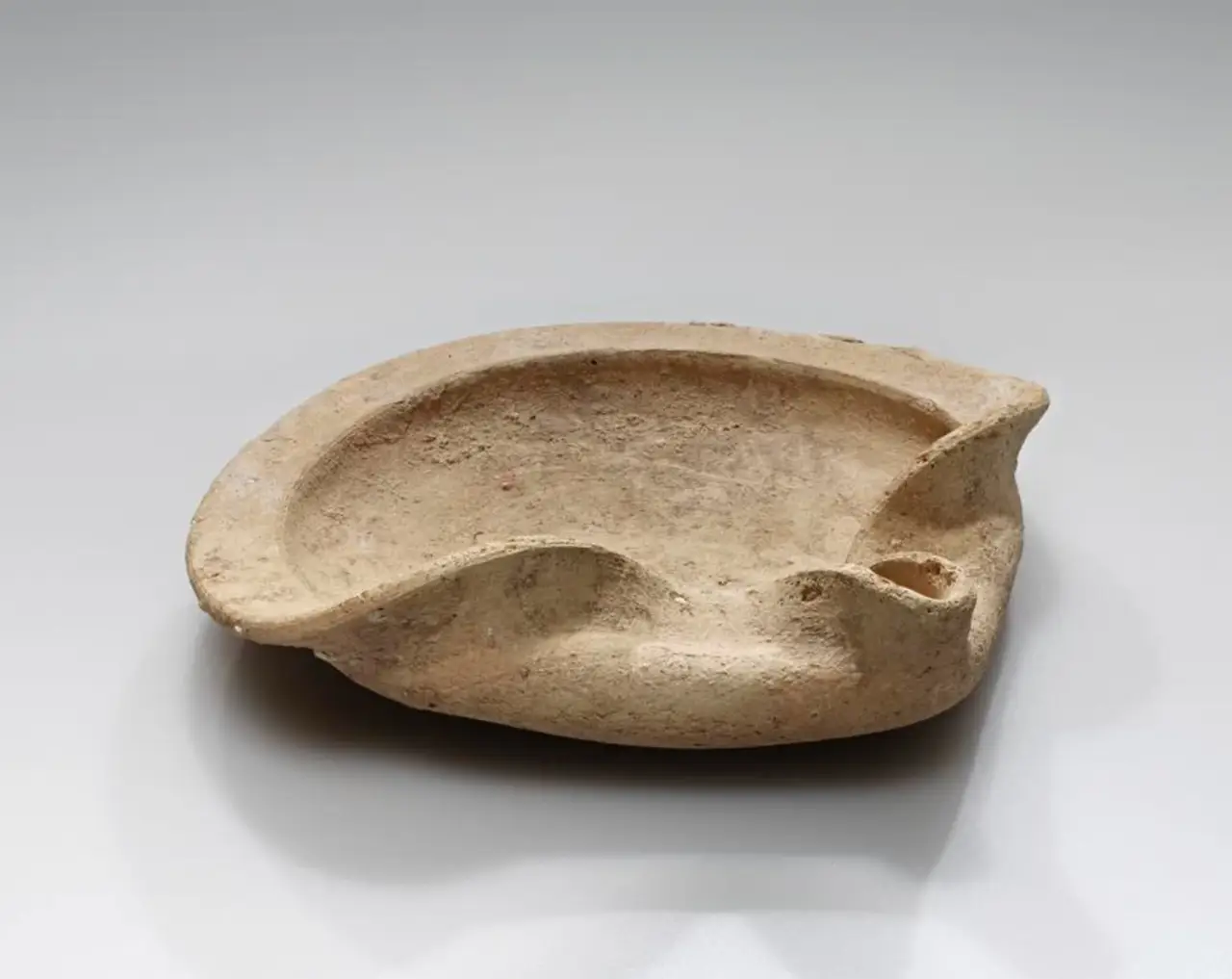
The key thing to understand about saucer lamps is their remarkable conservatism. The basic form persisted for nearly two thousand years with minimal change. A lamp from the sixth century B.C. looks much like one from the second century B.C. Dating depends heavily on archaeological context rather than stylistic evolution.
Shortly before the destruction of Carthage in 146 B.C., we see a significant modification: the open saucer becomes a closed vessel, with three sides of the rim folded together to create multiple wick-holes and a raised circular base. This represents the final stage of the Phoenico-Punic tradition.
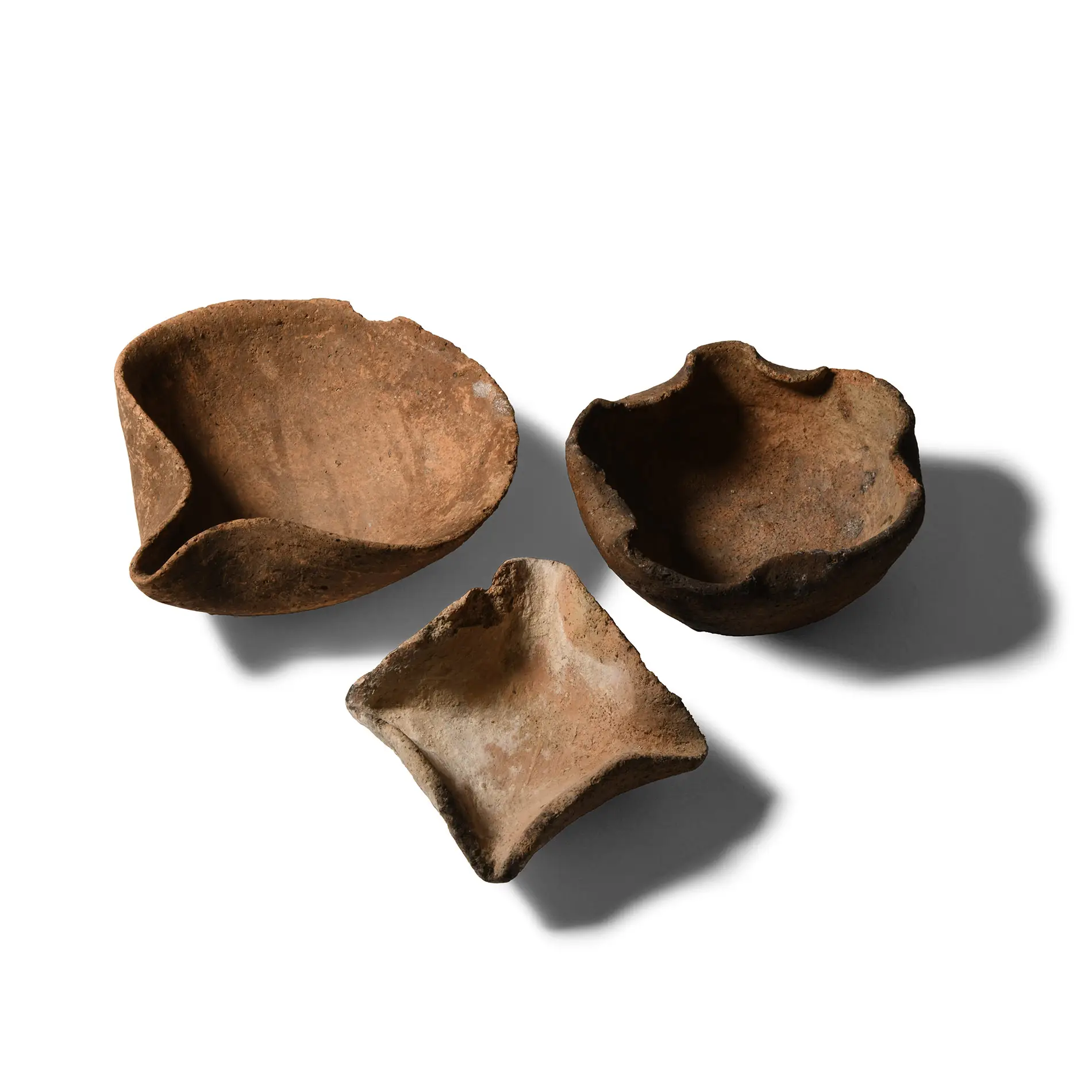
Collector's Note: Saucer lamps are relatively uncommon on the market compared to later Roman types. When they do appear, they're often fragmentary. A complete example with good provenance represents genuine rarity.
Greek Wheelmade Lamps (5th–3rd Century B.C.)
Greek potters developed increasingly sophisticated lamp forms during the Classical and early Hellenistic periods. These remain wheelmade rather than moldmade, so they're generally undecorated, focusing instead on functional geometry.
Several types deserve special attention:
Broneer Type IV lamps feature circular, deep, flat-bottomed bowls with nearly vertical sides and a flat rim. The nozzle is long with a large wick-hole. These date to the late fifth century B.C. and represent the Athenian lamp tradition at its most refined.
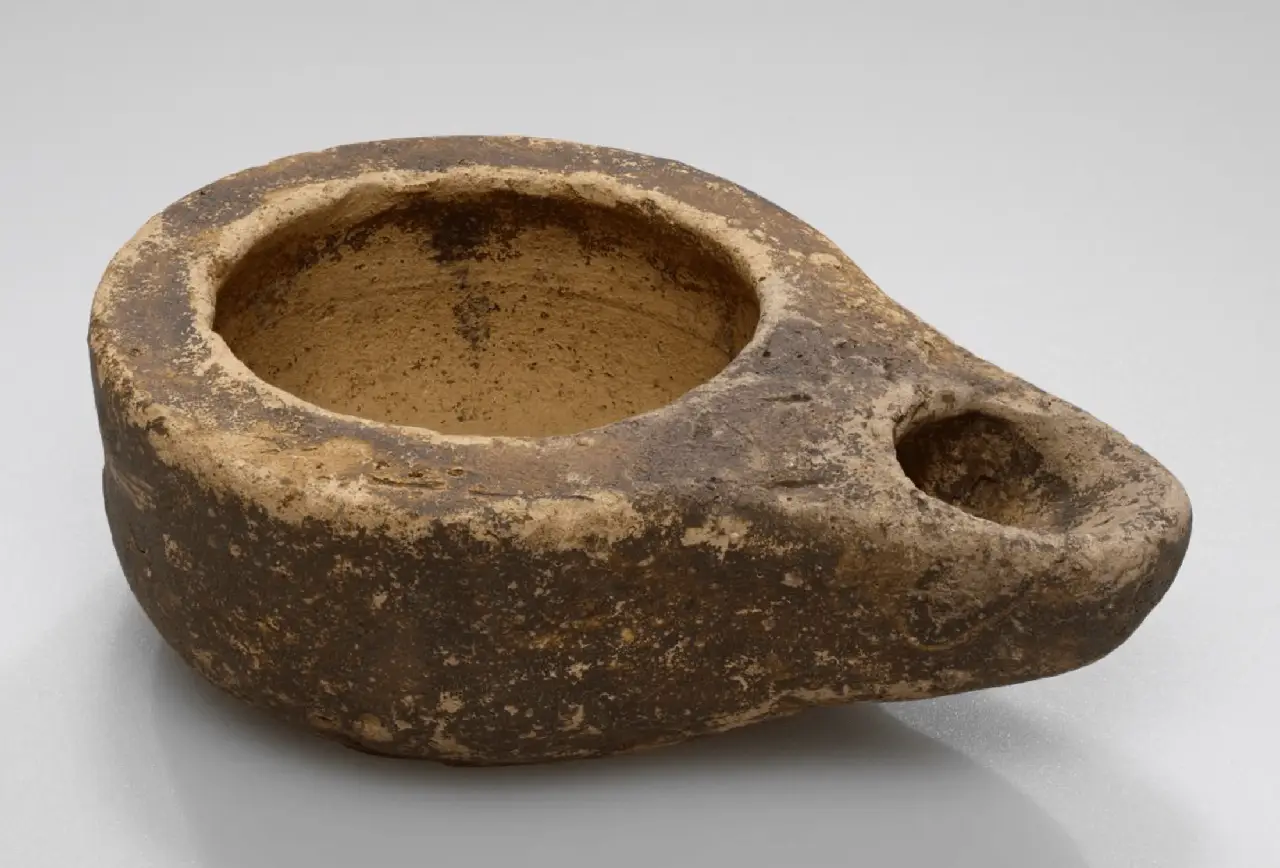
Howland Type 25 A Prime / Broneer VII lamps have a distinctive globular body on a raised flat circular base, with a large filling-hole surrounded by a convex ring or deep groove. They date from the late fourth through the third century B.C.
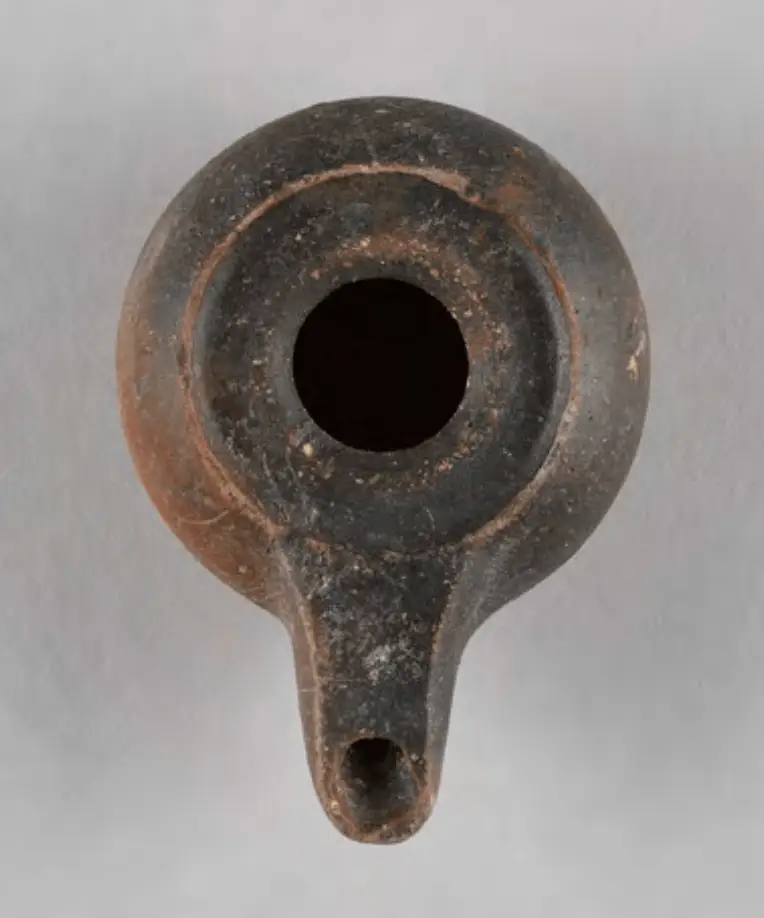
Howland Type 32 / Broneer VII lamps feature a sharply biconical body with a substantial concave top area. Instead of a handle, they usually have a pierced side-lug. These belong to the first half of the third century B.C.
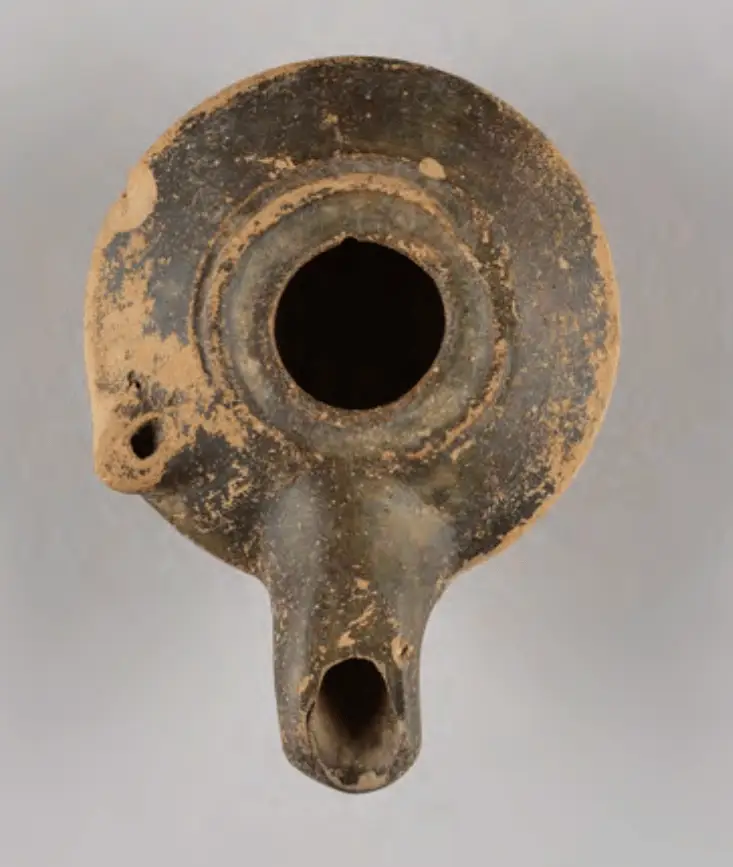
The "Cnidian" Type (Howland Type 40 A) is particularly attractive to collectors. Named for the hundreds discovered at Cnidus, these lamps have a biconical body with sharp carination and a short, splayed nozzle with an anchor-shaped tip. The shoulder often bears separately molded relief motifs (like the characteristic "Cnidian" bilobate leaf) applied when the clay was leather-hard. Dating runs from the end of the third century B.C. to the early first century B.C.
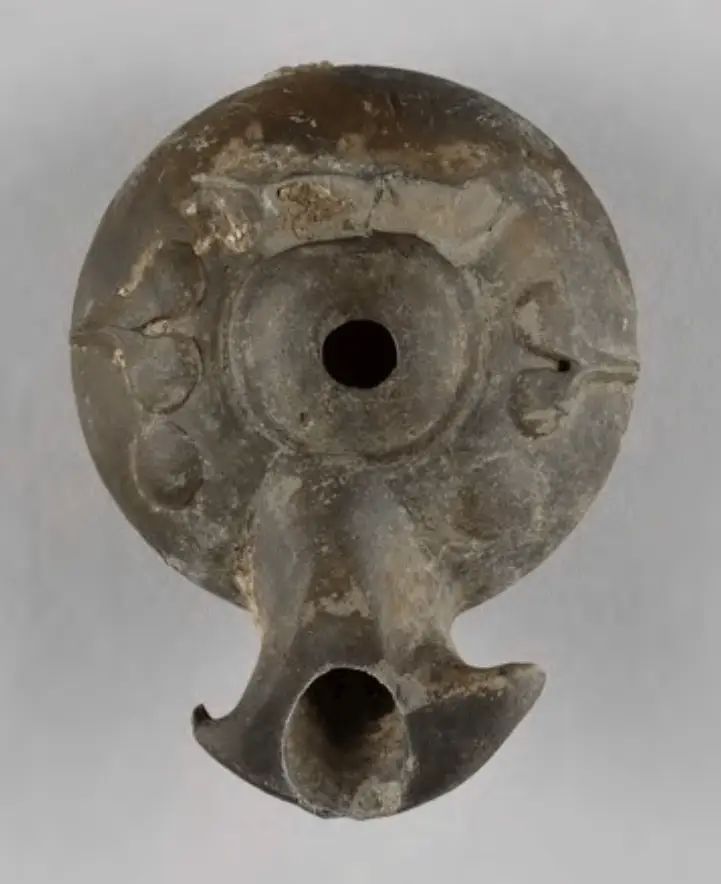
Collector's Note: Greek wheelmade lamps require more expertise to appreciate than their Roman successors. The subtleties of form and the quality of potting distinguish fine examples from ordinary ones. We recommend handling as many authenticated pieces as possible before making significant purchases.
Hellenistic Moldmade Lamps (3rd–1st Century B.C.)
The introduction of molding technology in the early third century B.C. transformed lamp production. Suddenly, potters could create elaborate relief decoration and produce multiple identical copies from the same molds. Mass production had arrived in the ancient lighting industry.
"Ephesus Lamps" (Howland Type 49 A / Bruneau VII) dominate this category. Produced in Ephesus and Sardis, they're characterized by a fine gray fabric and a dark glaze intended to imitate the appearance of bronze. Two subtypes appear regularly:
- Lamps with triangular beveled nozzles (generally considered earlier)
- Lamps with round nozzles featuring a flat plate surrounding the wick-hole
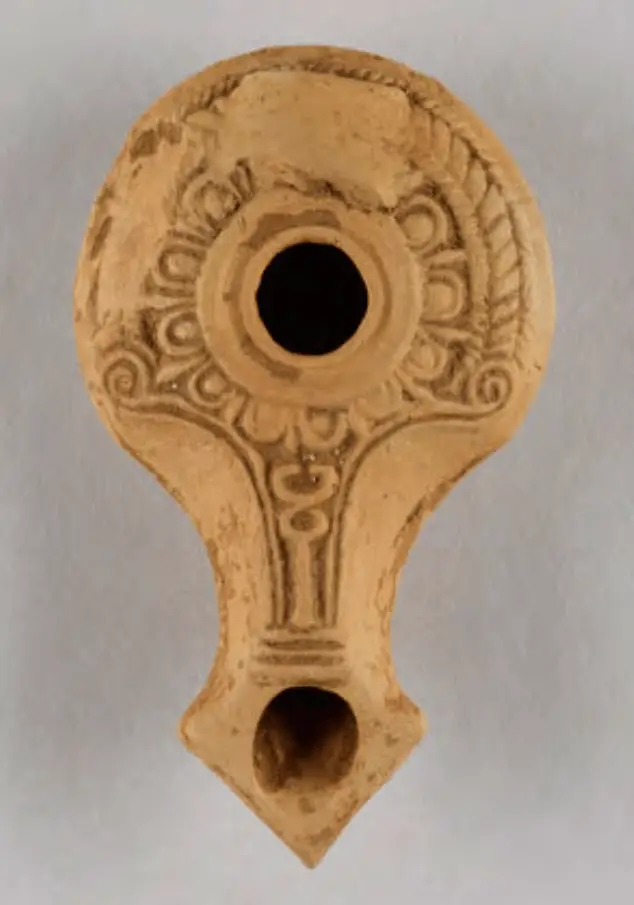
Decorative motifs include vegetal ornaments, floral patterns, and occasionally theatrical masks. Some examples feature nozzles modeled as human heads.
The appeal of Ephesus lamps lies in their aesthetic quality. The metallic glaze, when well-preserved, gives these objects a sophistication that belies their utilitarian function. They represent the height of Hellenistic decorative ambition in this category.
Late Republican Lamps (1st Century B.C.)
The transition from the Hellenistic to the Roman world brought new forms and decorative sensibilities. Three types stand out:
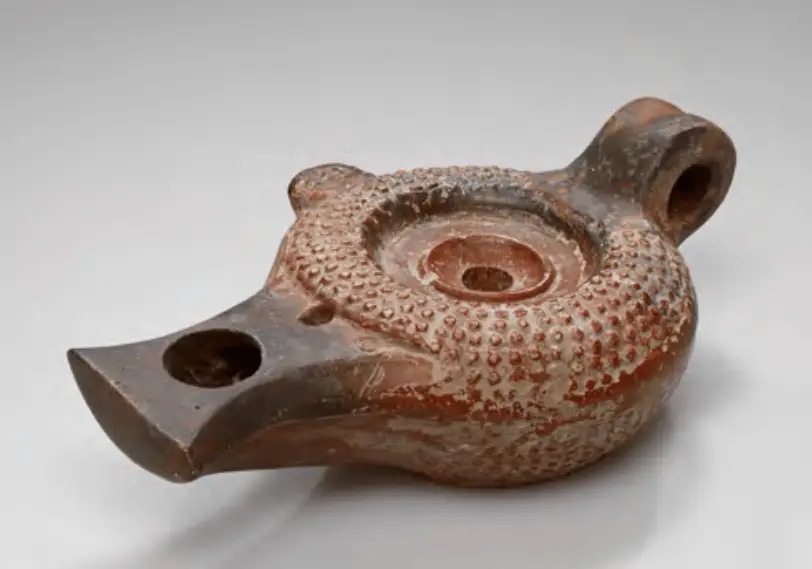
Dressel Type 2 / Warzenlampen ("wart lamps") have rounded bodies and long, flat-topped nozzles with splayed ends. Their defining feature is the decoration: rows of closely spaced globules (Warzen) covering the shoulder and basin. Dating runs from approximately 70 B.C. to A.D. 15. These are visually distinctive and instantly recognizable.
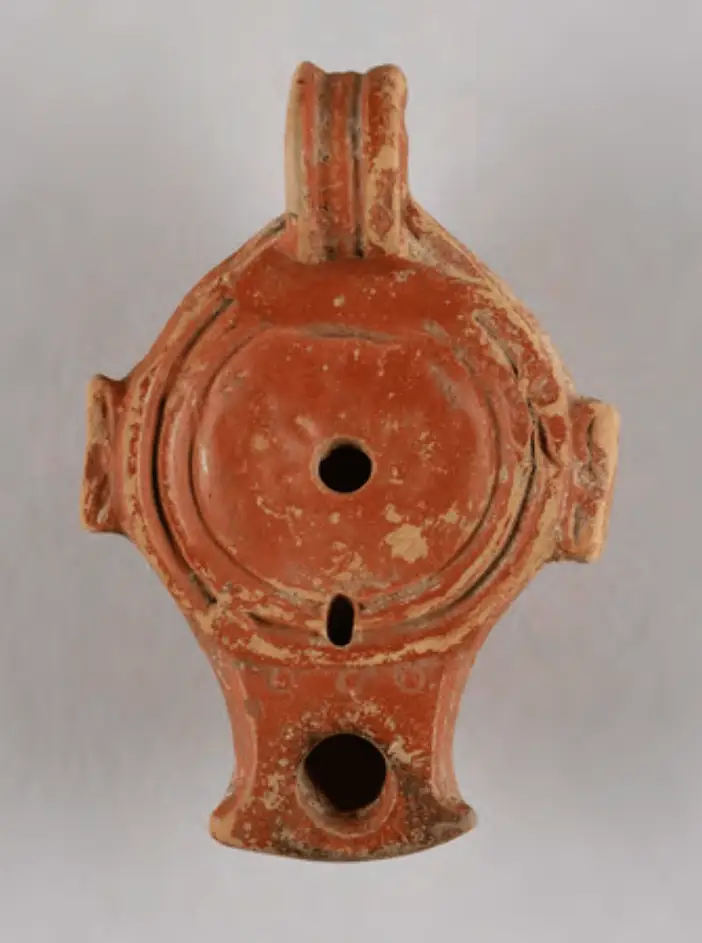
Dressel Type 3 lamps feature rounded bodies, broad concave discuses, and anvil-shaped nozzles. They represent the transitional moment before the development of the classic Roman volute types.
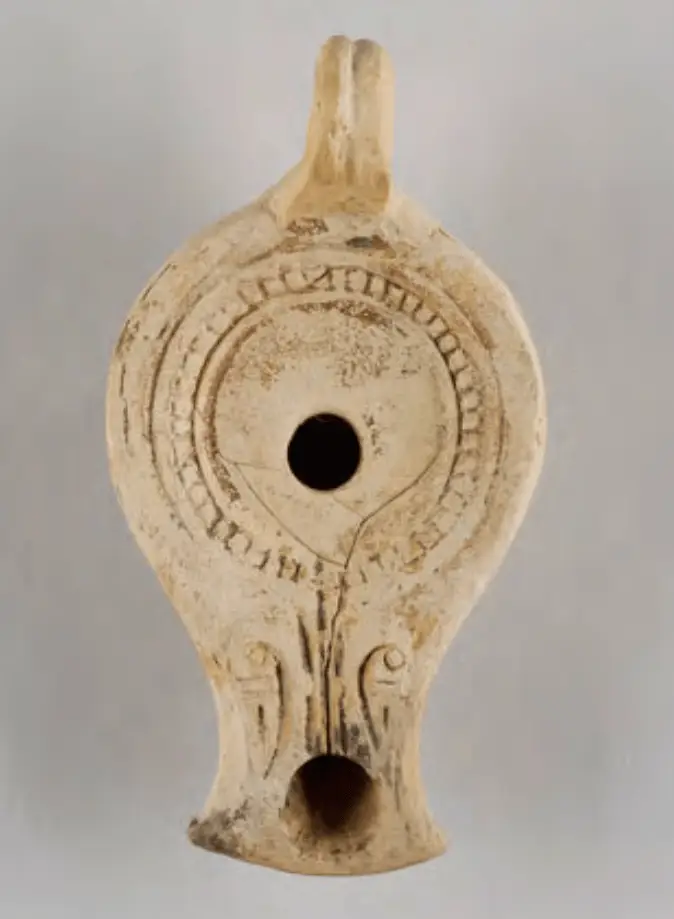
Dressel Type 4 / Vogelkopflampe ("bird's head lamp") can be identified by a single feature: the nozzle top displays two stylized bird heads facing in opposite directions. This Augustan-period type has considerable charm.
Collector's Note: Late Republican lamps often appear in Italian collections dating to the nineteenth century. The type names (Dressel, Warzenlampen, Vogelkopflampe) derive from German scholarship, reflecting the international character of Roman lamp studies.
The Great Roman Imperial Types (1st–3rd Century A.D.)
Here we reach the core of most lamp collections. The classification system developed by Siegfried Loeschcke in the early twentieth century remains the standard reference, and familiarity with his type numbers is essential.
Loeschcke Type I (Bailey Type A): The Volute Lamp
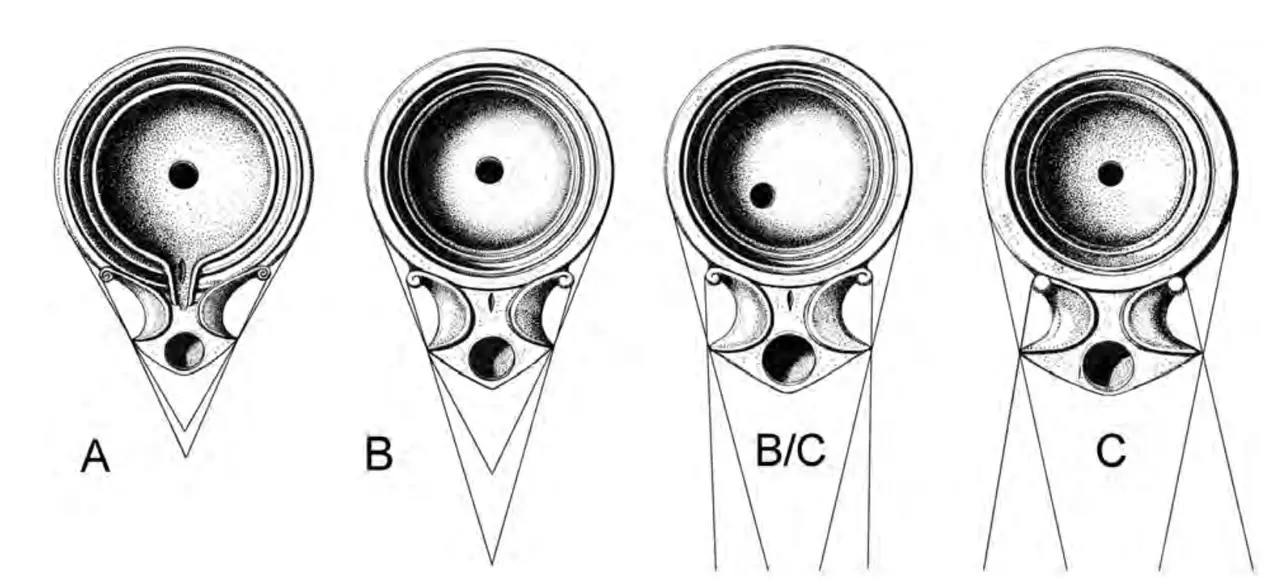
The defining characteristic of Type I is a nozzle flanked by two volutes (spiral ornaments). The form is elegant and immediately recognizable. Three subtypes exist:
- Type I A: Features a shallow V-shaped channel between the discus (the decorated central area) and the nozzle. Dates from the Augustan to Tiberian periods.
- Type I B: Larger nozzle, lacking the V-shaped channel. Late Augustan to Early Flavian.
- Type I C: The distance between the volute-spines is less than the distance between the nozzle tip angles. Claudian to Flavian.
Type I lamps represent the aristocracy of Roman lighting. They were produced by skilled workshops, often bear elaborate discus decoration depicting mythological scenes, gladiatorial combats, or erotic subjects, and many carry workshop signatures. A fine example with a complex figural scene and a legible maker's mark is a prize acquisition.
Loeschcke Type IV (Bailey Type B)
Similar to Type I, but the nozzle tip is rounded rather than angular. Type IV was scarce during the Augustan period; main production began later and continued until the first third of the second century A.D. The distinction between Type I and Type IV nozzles is fundamental to dating.
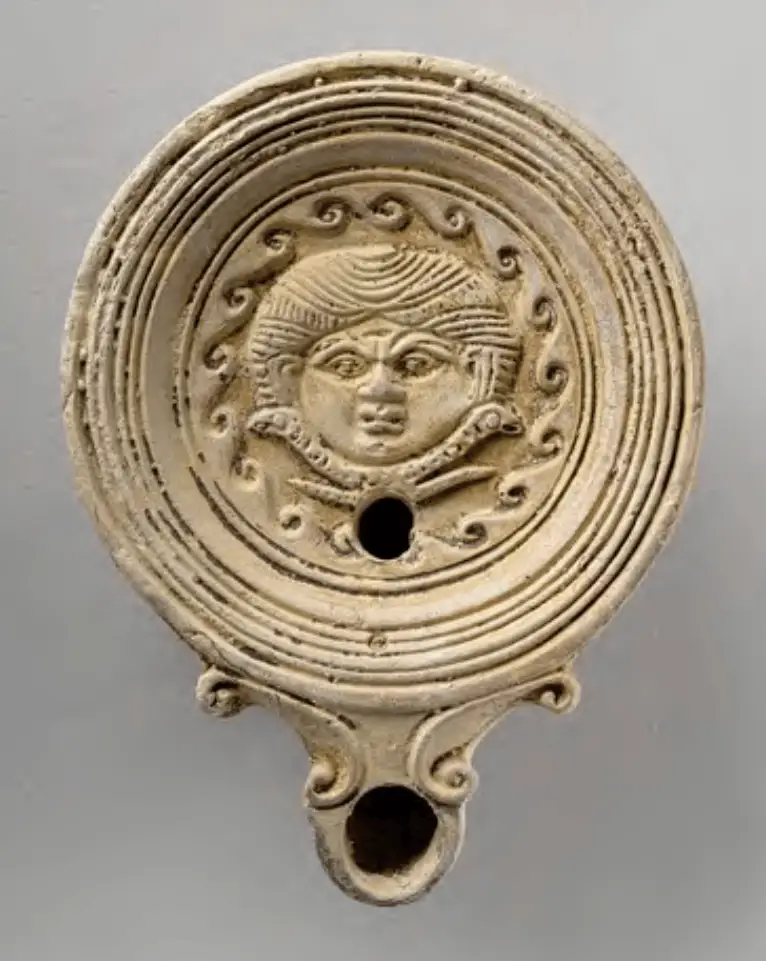
Loeschcke Type V (Bailey Type C)
Type V features "shoulder-volutes," simplified volutes with only one knob that act as extensions of the shoulder rather than flanking the nozzle. The nozzle itself is ogival (pointed). These represent a stylistic simplification that became popular as the first century progressed.
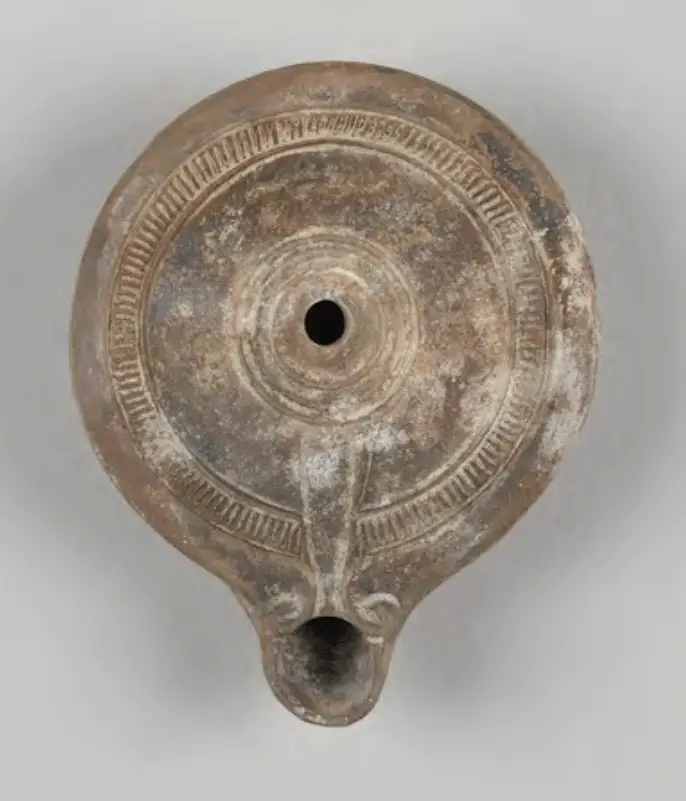
Loeschcke Type VIII: The Workhorse
This is the type you'll encounter most frequently. Type VIII lamps have circular bodies with short, rounded nozzles, no volutes. Production spanned the first through fifth centuries A.D., making them the longest-lived Roman lamp form.
The standard form (Bussière Form D II 1) features a nozzle separated from the discus by a straight horizontal line flanked by two dots. Variations are endless, and distinguishing production centers requires attention to several diagnostic features:
Distinguishing Eastern Mediterranean (Group C) from Italian/African (Group A) production:
- Presence of globules on the shoulder
- Small incised circles at the foot of the handle
- Pronounced basin depth
- Large, plain planta pedis (footprint-shaped) stamps on the base
- Presence of gold or silver mica in the clay
These details matter because Eastern Mediterranean lamps were often produced in different commercial networks than their Italian counterparts. The planta pedis stamp, while originally an Italian trademark, became characteristic of second-century Eastern production when rendered in large, plain versions.
Firmalampen: The Factory Standard (1st–3rd Century A.D.)
The term "Firmalampen" (factory lamps) refers to a category defined by extreme functionalism and the presence of workshop signatures in relief on the base. These were mass-produced utility objects, the ancient equivalent of industrial standardization.
Loeschcke Type IX has a cylindrical nozzle with a beveled top and rounded flat tip. Subtypes (Buchi IX-a, IX-b, IX-c) are distinguished by variations in the nozzle groove and the configuration of the discus rim.
Loeschcke Type X features a discus rim prolonged down the nozzle to the tip, surrounding a broad channel. The "Kurzform" (short form) variant has a very short nozzle and wide, shallow body.
Collector's Note: Firmalampen are excellent for collectors interested in ancient commerce and manufacturing. The workshop names preserved on these lamps allow us to track the distribution networks of specific producers across the Roman world.
Specialty and Figurine Lamps
Beyond the standard utilitarian forms, ancient potters created lamps that served as decorative objects, religious offerings, or apotropaic devices.
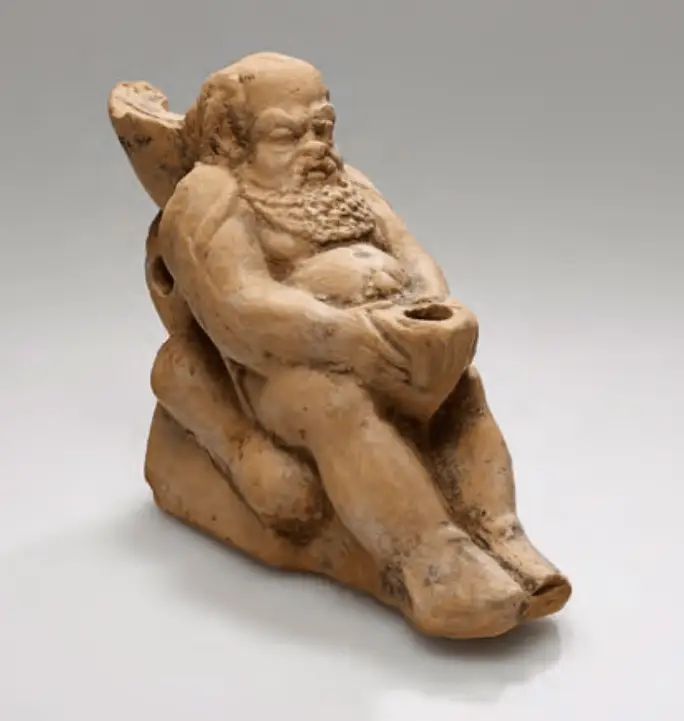
Plastic (Figurine) Lamps have bodies molded into complete figures:
- Grotesque human figures
- Deities like Bacchus
- Human body parts (sandaled feet were surprisingly popular)
- Phallic forms, used as tintinnabula (charms) to ward off the evil eye
- Animals including monkeys, dogs, doves, and bull heads
Multinozzled and Corona Lamps served religious or ceremonial purposes. Some have multiple burners arranged in a line; others are large hollow rings with up to twenty or more nozzles, used in sanctuaries or wealthy households.
Terracotta Lanterns are technically lamp-holders designed to protect the flame from drafts. Some examples are elaborately modeled as human heads with holes in the eyes and mouth to emit light.
Metal Lamps: The Luxury Market
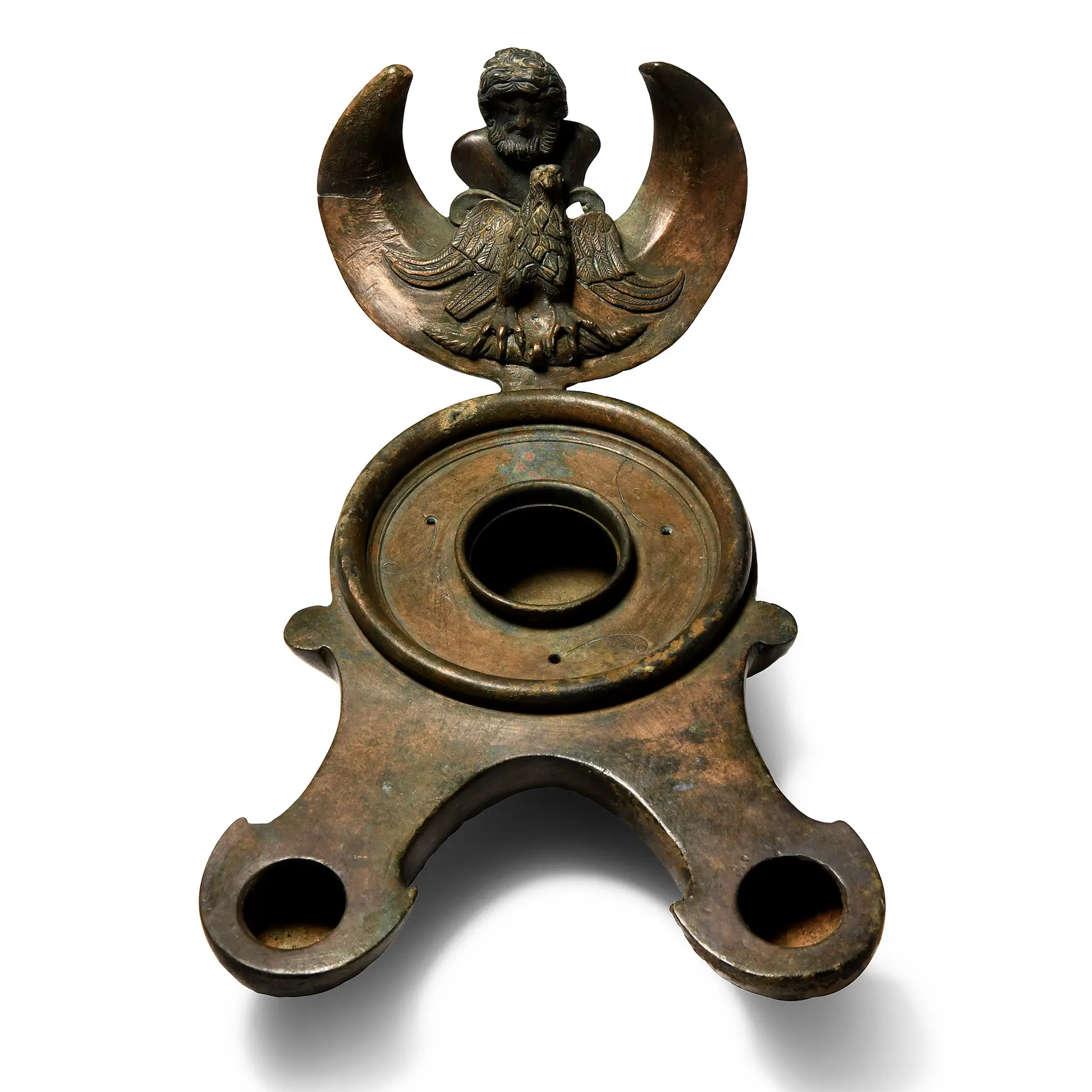
While clay lamps constituted the vast majority of ancient production, metal lamps represent the luxury end of the market. Most bronze and silver lamps were created using the cire perdue (lost wax) casting process, which means each piece is essentially unique.
Metal lamps are rare on the market and command premium prices, but they offer qualities that clay cannot match. Bronze lamps often feature handles ending in animal heads (horses, panthers, griffins), chains for suspension, or elaborate decorative schemes. Silver and gold examples are extreme rarities; a gold lamp, made of gold foil over an inner substance and decorated with glass inlays, represents the pinnacle of ancient lighting craftsmanship.
The Sardinian Boat Lamp, dating to the eighth or seventh century B.C., represents the oldest category of metal lamp you might encounter. These are distinctive objects from the Nuragic civilization that preceded Roman domination of Sardinia.
Loeschcke Type XIX bronze lamps have elongated nozzles with substantial handle shields. These are among the more commonly available bronze forms from the Roman Imperial period.
Lead Lamps represent the opposite end of the metal spectrum. Coarse, open triangular troughs, they were used primarily in military camps where tallow (animal fat) rather than olive oil served as fuel. They're not beautiful, but they're historically significant as evidence of Roman military provisioning.
Reading Lamp Signatures and Marks: The Epigraphy of Lighting
One of the most rewarding aspects of lamp collecting is the study of workshop signatures and marks. These inscriptions transform anonymous objects into evidence of ancient commercial activity.
The Tria Nomina
Roman citizens bore three names: praenomen (personal name), nomen (clan name), and cognomen (family branch or individual nickname). Workshop owners frequently stamped their lamps with abbreviated versions of their tria nomina, creating a form of ancient branding.
When you see a mark like "C. OPPI. RES" on a lamp base, you're looking at the signature of Gaius Oppius Restitutus (or a similar name), the proprietor of a commercial lampmaking workshop. These names can be cross-referenced in scholarly catalogues to identify production centers and date ranges.
The Planta Pedis
The footprint-shaped mark (planta pedis) is one of the most common stamps on Roman lamps. Its meaning and significance shifted over time. Originally an Italian workshop practice, large plain versions of the planta pedis became characteristic of Eastern Mediterranean production during the second century A.D. The presence or absence of detail within the footprint outline, combined with its size and proportions, provides dating evidence.
Greek Inscriptions
Later lamps, particularly those from the Christian and Byzantine periods, often bear Greek inscriptions. These range from religious proclamations (such as "Christ's light shines for all") to secular messages like New Year greetings. Reading these inscriptions requires familiarity with Greek script, but even collectors without Greek can learn to recognize common formulae.
Condition Assessment: What to Look For
Every antiquities category has its own condition considerations. For oil lamps, the following checklist covers the essential points.
Essential Condition Checklist:
- Completeness: Is the lamp whole, or has it been reconstructed from fragments? Minor rim chips are acceptable; extensive restoration dramatically affects value.
- Nozzle condition: The nozzle is the most vulnerable part. Check for damage, burning (which may be ancient and authentic), or modern repairs.
- Handle: If the lamp type typically has a handle, is it present and original? Handle loss is common.
- Discus integrity: Is the decorated central area intact, with the scene or pattern clearly visible?
- Base marks: Are any workshop signatures or stamps legible?
- Surface condition: Is the original slip or glaze preserved? Has the surface been overcleaned?
- Evidence of use: Ancient burning at the nozzle is desirable as evidence of authenticity. Modern burning is a red flag.
Q&A: Common Condition Questions
Q: Is ancient burning damage bad?
A: Generally, no. Ancient burning at the nozzle demonstrates that the lamp was actually used, which supports authenticity. Heavy burning that obscures important details is less desirable, but some evidence of ancient use is reassuring rather than problematic.
Q: How much restoration is acceptable?
A: This depends on your goals. For study collections, significant restoration may be acceptable if documented. For display collections, we recommend limiting acceptable restoration to minor chip fills and stable repairs that don't obscure significant features. Heavily restored pieces should be priced accordingly.
Q: What about fakes?
A: Oil lamp forgeries exist, particularly for desirable types with elaborate discus decoration. Learn to recognize authentic clay fabrics, proper signs of age (not artificially induced), and genuine wear patterns. Handle as many authenticated pieces as possible to train your eye. When in doubt, request thermoluminescence testing.
Q: Should I avoid lamps with incomplete decoration?
A: Not necessarily. A sharp, clean impression from a well-used mold (even if some details are soft) is preferable to a crisp impression on a lamp with structural problems. Molds wore over time, and late impressions have their own historical interest.
Storage and Display: Practical Considerations
We've seen beautiful collections undermined by poor storage and disastrous displays. A few practical principles will protect your investment.
Storage
Clay is stable but fragile. Store lamps in compartmentalized containers where pieces cannot contact each other. Avoid extreme temperature fluctuations and high humidity, which can stress ancient clay bodies.
For long-term storage, consider archival-quality boxes with custom foam inserts cut to fit each piece. The initial investment pays dividends in preservation.
Never stack lamps directly on top of each other. Even minor pressure can cause invisible stress fractures that worsen over time.
Display
The key question for lamp display is lighting (appropriately enough). Here are our recommendations:
Use LED lighting. LEDs produce minimal heat and no ultraviolet radiation. Both heat and UV can damage ancient organic residues and accelerate deterioration of some slip finishes.
Avoid direct sunlight. This applies to all antiquities, but lamps with traces of original pigment are particularly vulnerable.
Consider the viewing angle. Lamps were designed to be seen from above (looking down into the discus) and from the side (appreciating the profile). Flat shelf display works for small collections, but tiered or angled mounts allow better appreciation of form and decoration.
Avoid overcrowding. Give each piece room to breathe. A crowded display diminishes every object; a well-spaced arrangement elevates them all.
Building a Collection: Strategic Approaches
Random acquisition produces random results. The most satisfying collections follow some organizing principle, whether obvious or subtle. We'll suggest several approaches.
The Chronological Survey
Build a collection that spans the history of lamp production, from Phoenician saucers through Islamic examples. This approach provides maximum educational value and allows you to trace technological and aesthetic changes across millennia. The challenge is acquiring good examples of rarer early types, but patience and persistence will be rewarded.
The Typological Deep Dive
Choose a single major type (Loeschcke Type I volute lamps, for example) and collect comprehensively within that category. Acquire examples of each subtype, variations in discus decoration, pieces from different workshops, and examples showing the full range of condition from mint to heavily used. This approach produces genuine expertise in your chosen area.
The Regional Focus
Concentrate on lamps from a single production center or region: Athenian lamps, North African lamps, Eastern Mediterranean lamps. Regional collections illuminate local stylistic preferences, workshop practices, and economic patterns. They also often align with existing scholarly literature, making research more accessible.
The Iconographic Collection
Collect lamps based on their discus decoration rather than typology. Focus on gladiatorial scenes, erotic subjects, mythological figures, Christian symbols, or any theme that interests you. This approach privileges visual content over form, which suits collectors drawn to ancient imagery.
The Workshop Collection
Follow specific makers. When you find a lamp with a legible workshop signature that interests you, seek out other examples from the same producer. Over time, you may build an archive of a single ancient business's output. This approach appeals to collectors interested in ancient commerce and industry.
Budget Considerations: What Can You Expect to Spend?
We promised practical advice, so let's talk money. Prices vary significantly based on type, condition, rarity, provenance, and market conditions, but we can offer general guidance.
Entry Level (Under £200)
Common Roman types in average condition. Loeschcke Type VIII lamps with generic discus decoration, minor damage, or faint maker's marks frequently fall in this range. These pieces provide excellent learning opportunities and form the backbone of many serious collections.
Intermediate (£200–£800)
Better-preserved Roman types with clear decoration and legible marks. Good examples of Firmalampen. Hellenistic moldmade lamps in above-average condition. Small plastic lamps representing common subjects. At this level, you're acquiring pieces with genuine visual appeal and scholarly interest.
Advanced (£800–£3,000)
Fine Roman volute lamps with complex figural discus decoration. Rare Late Republican types in good condition. Greek wheelmade lamps of quality. Unusual plastic forms. Bronze lamps of modest size. These acquisitions anchor a serious collection.
Museum Quality (Above £3,000)
Exceptional examples of any type. Rare early forms with solid provenance. Large bronze lamps with decorative handles. Gold or silver examples (extremely rare). Signed pieces by documented workshops with scholarly publication. Multinozzled ceremonial lamps. At this level, you're competing with institutional buyers.
Budget Strategy Recommendations:
- Start modest. Your first ten purchases should teach, not impress. Learn from affordable examples before committing significant funds.
- Prioritize condition over type. A well-preserved common lamp teaches more than a damaged rare one.
- Build provenance documentation. When choosing between two similar pieces at similar prices, prefer the one with better collection history.
- Set a per-piece budget. Decide in advance what you're willing to spend on a given purchase and stick to it.
- Account for ancillary costs. Display cases, storage materials, insurance, and occasional conservation work all add up.
Common Mistakes and How to Avoid Them
We've watched collectors learn these lessons the hard way. We prefer that you don't have to.
Mistake: Buying based on photographs alone without understanding condition terminology.
We remember a client who purchased what the listing described as "minor professional restoration" only to discover that the restoration comprised approximately 40% of the lamp. Learn the vocabulary. Ask specific questions. Request additional photographs. When significant money is involved, request condition reports.
Mistake: Neglecting provenance.
The legal and ethical landscape of antiquities has changed dramatically in recent decades. Pieces without collection history prior to the 1970 UNESCO Convention may face scrutiny, import restrictions, or (in worst cases) seizure. We've seen collectors heartbroken when objects they purchased in good faith proved to have problematic backgrounds. Insist on documented provenance.
Mistake: Over-specializing too quickly.
Your first twenty purchases should explore the field. You don't yet know what will sustain your interest for decades. The collector who decided after three purchases that they would only collect gladiatorial discus lamps later regretted missing opportunities in other areas. Give yourself time to discover your genuine enthusiasms.
Mistake: Ignoring storage and insurance.
A £2,000 lamp deserves better than a cardboard box in the garage. Proper storage and adequate insurance are not optional. We've known collectors who lost significant portions of their holdings to preventable damage.
Mistake: Treating condition issues as fixable.
Ancient objects are not furniture. Refinishing is not an option. A lamp in poor condition today will be in poor condition twenty years from now (or worse, if poorly stored). Buy the best condition you can afford at the time rather than telling yourself you'll "fix it later."
Working With Auction Houses: A Practical Guide
Since you're reading a TimeLine publication, you're presumably considering auction as your primary acquisition method. Here's how to approach the process effectively.
Before the Sale:
- Study the catalogue carefully. Read every word of the lot descriptions for items that interest you. Note condition language, provenance information, and estimates.
- Request additional information. Auction houses expect questions. Ask about details not visible in photographs, request condition reports for higher-value lots, and inquire about provenance documentation.
- Research comparable sales. Review past auction results to understand market values. TimeLine's archives, along with other publicly available auction databases, provide essential context.
- Set maximum bids in advance. Decide what you're willing to pay before the sale begins. Write it down. Auction excitement can cloud judgment.
During the Sale:
- Bid confidently but within limits. If you've done your research and set your maximum, you can bid without anxiety. Either you'll win at an acceptable price or you'll wait for the next opportunity.
- Don't chase. When bidding exceeds your maximum, stop. Another lamp will come. Overpaying for one piece compromises your ability to acquire others.
After the Sale:
- Document your acquisition. Keep all paperwork: invoice, condition report, provenance materials, photographs. This documentation protects your investment and eases future sale or donation.
- Examine the piece carefully upon arrival. Report any discrepancies promptly. Reputable houses stand behind their descriptions.
Continuing Education: Resources for the Serious Collector
Learning never stops. Here are resources to deepen your knowledge.
Essential References:
The scholarly literature on ancient lamps is extensive. The catalogue Ancient Lamps in the J. Paul Getty Museum by Jean Bussière and Birgitta Lindros Wohl provides an outstanding introduction to the typological systems used by professionals. The works of Bailey (British Museum catalogues), Loeschcke, Broneer, and Howland remain foundational.
Museum Collections:
Nothing substitutes for examining original objects. Major lamp collections exist at:
- The British Museum (London)
- The J. Paul Getty Museum (Los Angeles)
- The Römisch-Germanisches Zentralmuseum (Mainz)
- The National Archaeological Museum (Athens)
Many museums allow study appointments with collections not on permanent display. Take advantage of these opportunities.
Auction Catalogues:
Past auction catalogues, including TimeLine's archived sales, provide invaluable comparative material. Study photographs, descriptions, estimates, and realized prices. This ongoing education trains your eye and market sense simultaneously.
Getting Started: Your Next Steps
You've made it through several thousand words on ancient oil lamps. What now?
Immediate Actions:
-
Browse the current catalogue. Look at the lamps on offer with fresh eyes. Practice applying what you've learned: identify types, assess condition from photographs, read the descriptions critically.
-
Register for the upcoming sale. Even if you're not ready to bid, following live auction prices provides essential market education. There's no cost to watch and learn.
-
Start your documentation system. Before your first acquisition, establish how you'll track your collection. A simple spreadsheet or database serves most collectors well.
-
Visit a museum. Plan a trip to see authenticated examples in person. Photographs cannot convey scale, surface quality, or the subtleties of form that distinguish fine pieces from ordinary ones.
-
Connect with other collectors. The community of lamp enthusiasts, while smaller than numismatics or pottery collecting, is knowledgeable and welcoming. Specialist societies and forums provide opportunities to learn from experienced hands.
A Final Word
The lamp in your hand once lit an ancient room. Someone purchased it, filled it with oil, trimmed its wick, and carried it from room to room as evening fell. The soot stains on the nozzle are marks of their life, not damage. The workshop signature on the base records a business transaction in an economy that collapsed two thousand years ago.
These objects reward attention. The more you learn, the more you see. The subtleties of form, the variations in decoration, the traces of production and use all become legible with experience. A lamp is never just a lamp once you know how to look.
We're here to help. TimeLine has guided collectors through their first acquisitions and their fiftieth. We answer questions, provide additional photographs, discuss condition honestly, and stand behind our attributions. This is what we do.
Welcome to the field. Your collection awaits.
[For specific object references and featured auction lot examples, please consult the current TimeLine catalogue or contact our Client Relations team.]
TimeLine Auctions, 4th February 2026