Home > Stories by TimeLine Auctions
Stories by TimeLine Auctions
CT Scans Reveal the Secrets of a Forgotten Egyptian Child Mummy in Poland
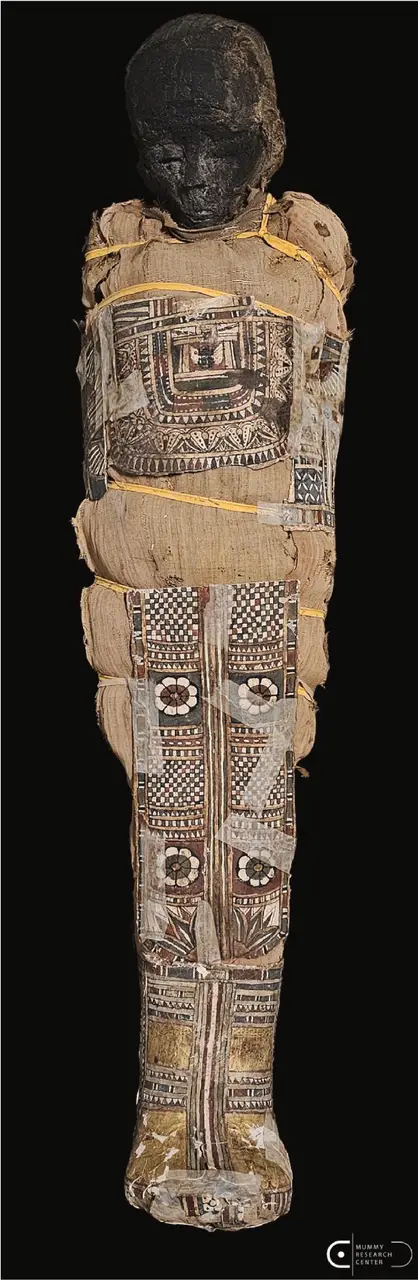
For more than a century, the small mummy of an Egyptian boy has lain in a church museum in Wrocław, Poland, without ever being formally studied. That changed in 2023, when a team from the Mummy Research Center and Wrocław University placed him inside a hospital CT scanner for the first time, producing thousands of detailed cross-sectional images that allowed them to reconstruct his age, sex, and the methods used to prepare his body for the afterlife. Their findings, published this February in Digital Applications in Archaeology and Cultural Heritage, tell the story of an eight-year-old boy who was embalmed with considerable care in southern Egypt, probably during the Ptolemaic period (4th to 1st century BCE), and whose body bears the scars of very different treatment in the modern era.
A Cardinal's Curiosity
The mummy arrived in Wrocław (then the German city of Breslau) in 1914, part of the personal antiquities collection of Cardinal Adolf Bertram, an avid collector who had just been appointed Bishop. According to the research team led by Wojciech Ejsmond of the Mummy Research Center, Bertram was close friends with Wilhelm Pelizaeus, a wealthy businessman who sponsored major German excavations at Giza and accumulated a large collection of Egyptian objects through both excavation finds and the antiquities market. The researchers speculate that the mummy may have reached Bertram through one of the Pelizaeus brothers, though the exact route remains unknown.
Any museum records that might have documented the acquisition were destroyed during the Second World War. A 1973 catalogue by Bishop Wincenty Urban described the object simply as a boy's mummy, dated to the 3rd or 2nd century BCE, without explaining how that date was determined. Until the present study, no one had looked deeper.
What the Scans Found
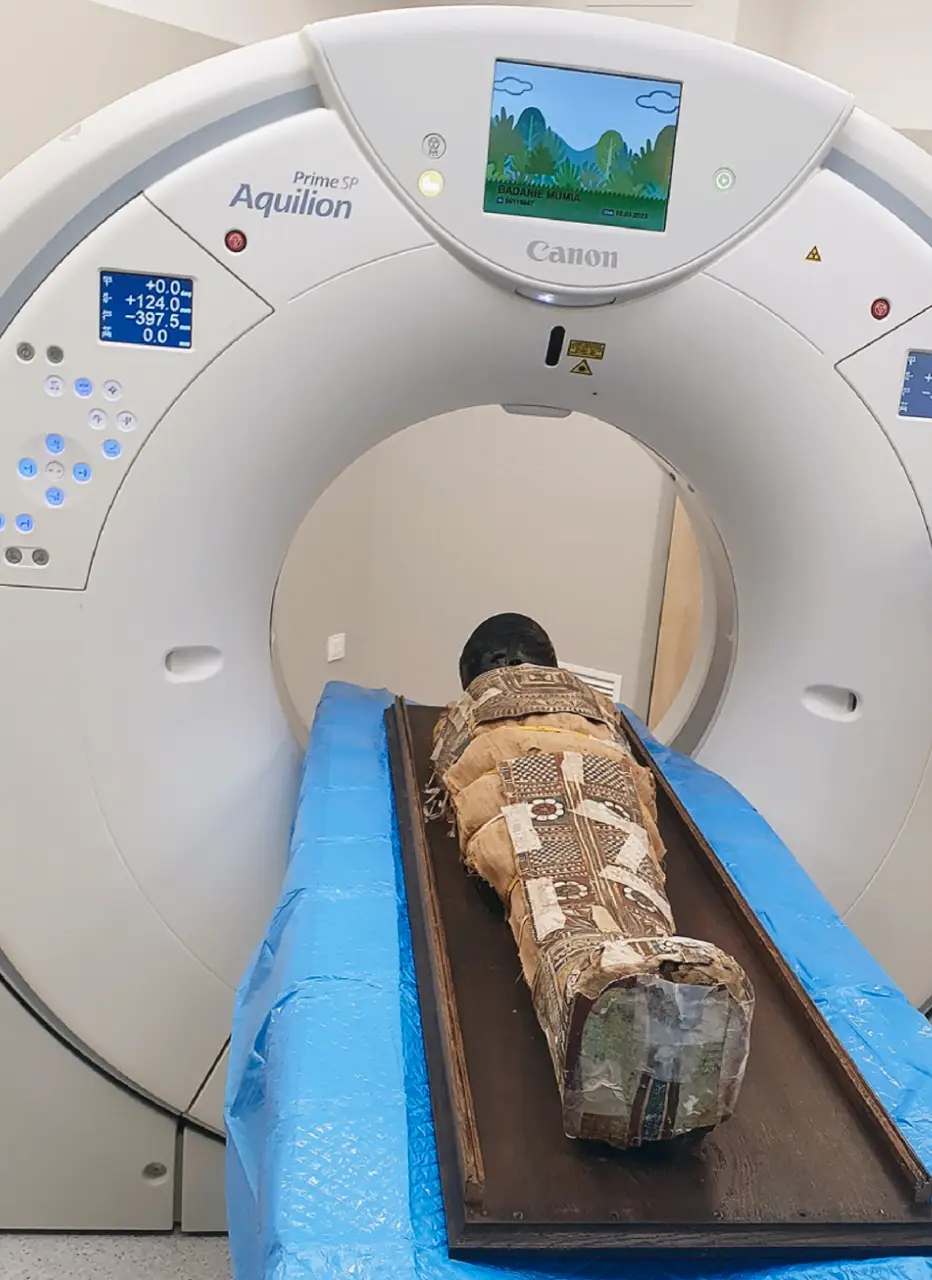
The radiological examination was carried out at the Stefan Cardinal Wyszyński Provincial Specialist Hospital in Lublin, using one of the most advanced CT scanners in Poland, a Canon Aquilion Prime ST capable of capturing data through 80 rows of detectors in a single rotation. The team, led by radiologist Maciej Mazgaj, produced over 10,000 individual slices, which were then processed using open-source 3Dslicer software to generate three-dimensional reconstructions of the skeleton, soft tissues, and wrappings.
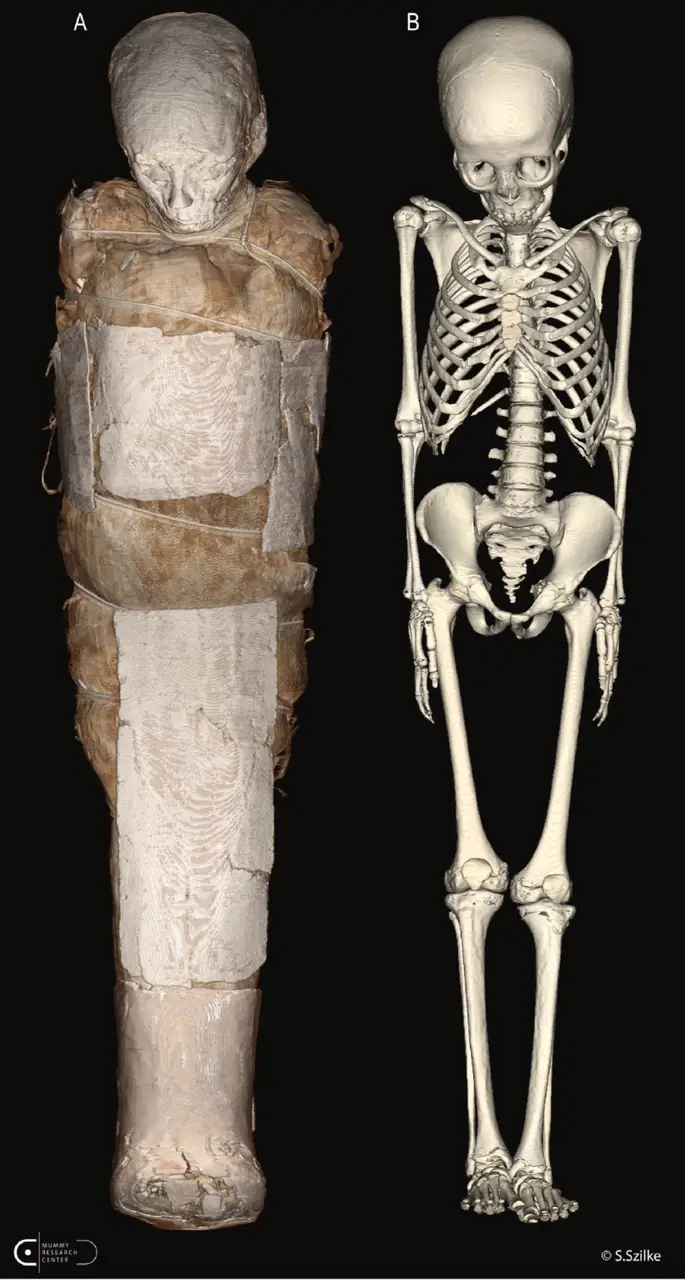
The scans confirmed that the child was male (his soft tissues, including external genitalia, are well preserved) and approximately eight years old at death, based on tooth development and the fusion state of his long bones. According to Agata Kubala of Wrocław University's Institute of Art History, the embalmers followed traditional Egyptian practices: the brain was extracted through the nose by breaking through the ethmoid bone, a procedure known as transnasal excerebration, while most internal organs, including the heart, were removed through the rectum rather than through an abdominal incision. No packing material or resin was placed inside the skull or body cavities, though loosely rolled fabric was used to fill the torso to some degree. CT imaging suggests the liver may still be present, along with small remnants of lung tissue clinging to the posterior chest wall.
Damage from the Display Case
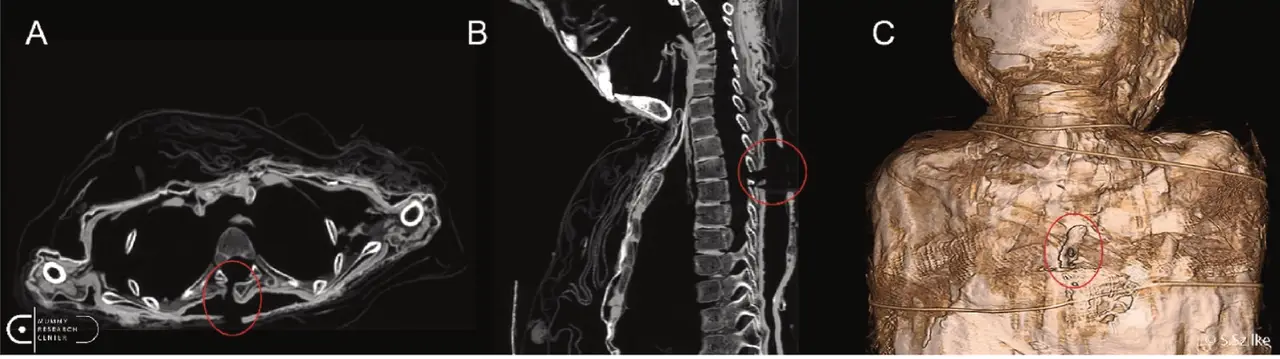
One of the more striking findings was evidence of what the mummy endured after it left Egypt. The CT scans revealed postmortem damage to two vertebrae (T4 and T5) and the surrounding tissues and fabrics, consistent with a rod having been pushed into the spinal column. According to the study's authors, this kind of modification was common in the 19th and early 20th centuries, when mummies were sometimes propped upright or hung for display.
The boy's right foot tells a similar story. Several toe bones are missing entirely, while one detached phalanx turned up loose inside the cartonnage covering the feet. The researchers believe the damage was caused by the weight of standing display, which would have put sustained pressure on the fragile extremities. His face, too, had been partially unwrapped at some point, probably to satisfy the curiosity of earlier owners or exhibitors. These kinds of interventions were widespread in the era before mummies were treated as archaeological subjects rather than cabinet curiosities, as historian Alice Stienne has documented extensively.
Tracing Its Origins
Without being able to take physical samples (the museum's custodians wanted to avoid any invasive procedures), the team could not pursue radiocarbon dating. In any case, as they note, the mummy's likely date falls close to the so-called Hallstatt Plateau, a frustrating flat spot in the radiocarbon calibration curve between roughly 800 and 250 BCE where dates tend to cluster together unhelpfully. Instead, the researchers turned to the painted cartonnage, the layered linen-and-plaster casing that still partially covers the body.

Its decorative programme, featuring chequered patterns, lotus flowers, rosettes, and a rare depiction of the god Nehebkau as a winged serpent with human limbs carrying a mummy on its back, closely matches cartonnages excavated from a necropolis near Kom Ombo in southern Upper Egypt by Louis Lortet and Claude Gaillard in 1908–09. A particularly close parallel exists in the cartonnage of a woman named Taubasthis, dating to the 1st century BCE and now held in the Musée Guimet d'Histoire naturelle in Lyon, as discussed in Annie Schweitzer's 1992 study. On the strength of these comparisons, the team dates the Wrocław mummy to the Ptolemaic period, most likely between the 4th and 1st centuries BCE, and places its origin in the Aswan to Kom Ombo region.
Why It Matters
The researchers also addressed a nagging question in Egyptology: is the set genuine? Up to 10% of Egyptian mummies in Western collections may be housed in coffins or cartonnages originally made for someone else, according to a widely cited 1975 estimate. Forgeries, particularly of child mummies, have been well documented. In this case, however, the cartonnage fits the boy's body closely, especially around the feet, which the team considers strong evidence that the casing was made for him.
Ptolemaic-era Egyptian objects, from scarabs and amulets to fragments of cartonnage and funerary linen, remain among the most widely collected categories of ancient material. We regularly handle similar items in our own sales at TimeLine Auctions, where small bronze figures of Egyptian deities and beadwork from the same broad period appear with some frequency. Browse our current catalogue to explore what's available.
TimeLine Auctions, 11th May 2026