Home > Stories by TimeLine Auctions
Stories by TimeLine Auctions
Deactivated for Burial: A Monumental Bronze Osiris of the 26th Dynasty
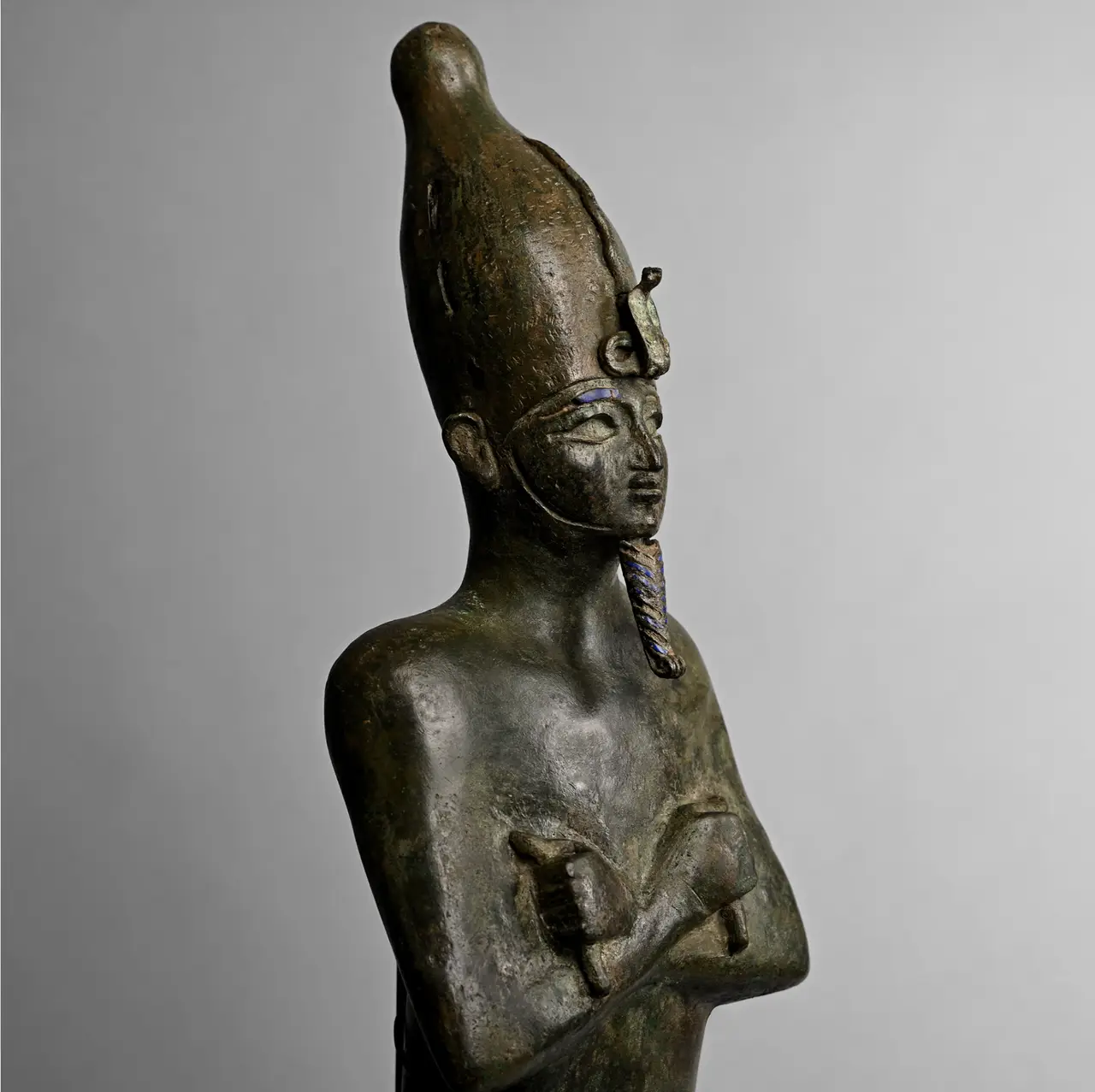
Three vertical slots run down each side of the tall crown, and a small hole sits at the top of each fist. The plumes that completed the Atef and the upper portions of the crook and flail are gone. What remains is the body of the figure: mummiform, frontal, arms crossed at the chest, standing some seventy centimetres high on a modern wooden base. The mortices and sockets where the missing parts were fitted are clean and deliberate, cut for assembly rather than worn through use.
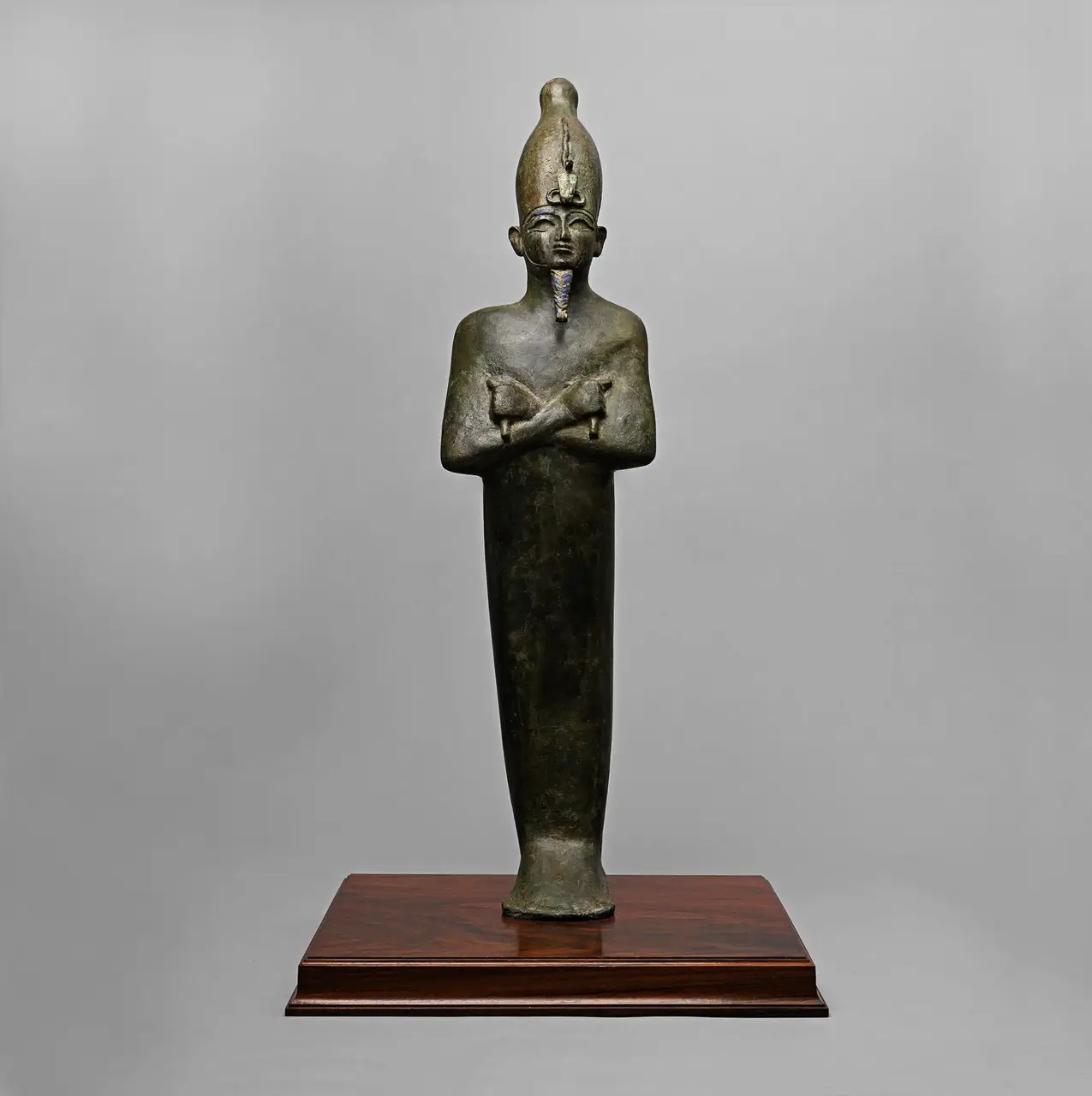
The bronze is hollow-cast, almost nine kilograms in weight, with a broad face, deeply recessed brows and almond eyes, a straight nose, and a small closed mouth. In the right eyebrow a fragment of lapis lazuli survives in its recess. The eye sockets are empty. The chin straps, once inlaid, run down from the temples to the divine beard, which is cast separately and attached at the chin; in some of its chevron grooves, traces of blue still hold. A uraeus rises at the front of the crown, its body coiled on either side and its tail extending up in a slight undulation.
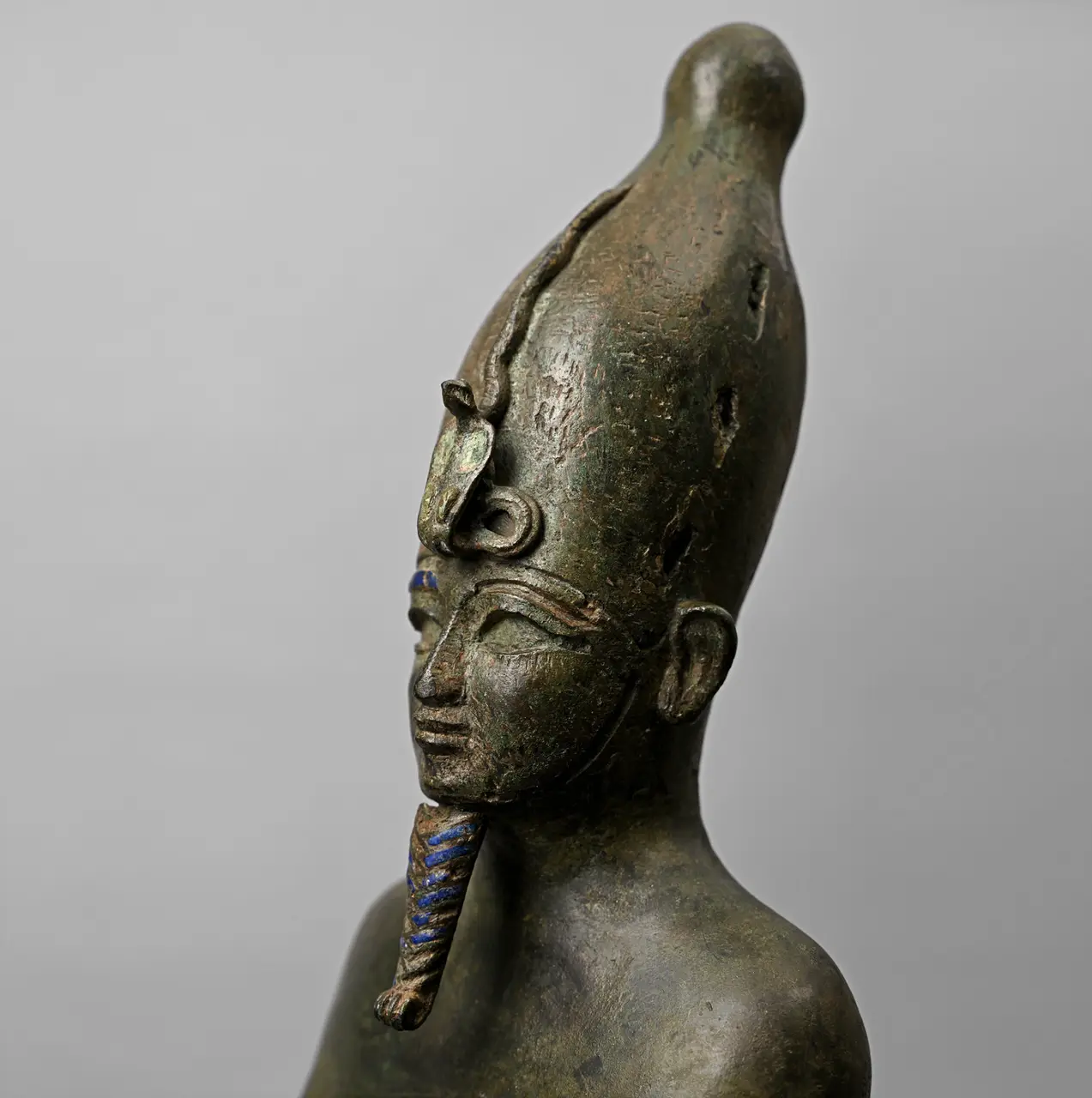
Everything about the construction is modular, with plumes that were never part of the main casting and an Osirian fixture beard made from its own mould. The upper portions of the heka and nekhakha, which would have risen above the fists in the standard grip, were fashioned separately and fitted into the sockets that remain. Late Period workshops cast monumental bronzes this way because the alternative of pouring a complex figure with all its projecting elements at once would invite cracks and voids. Splitting the figure into components let each piece be poured cleanly and let the inlays be set into shallow beds cut into the cooled metal.
The iconography belongs to the 26th Dynasty, the Saite period of 664–525 B.C. The form, while rather standard, is executed beautifully. Standardisation is part of the point, by the seventh century Osiris had been worshipped for more than two thousand years. His image had hardened into a shape recognisable in any temple in Egypt. Where this figure parts company with the run of votive bronzes is in scale and high quality finish. Small Osirises were produced in their thousands and deposited in temple precincts by ordinary worshippers; a figure of this size, with genuine lapis lazuli set into the brows and beard, belongs to a different order of commission and would have been produced by skilled artisans working to a high standard.
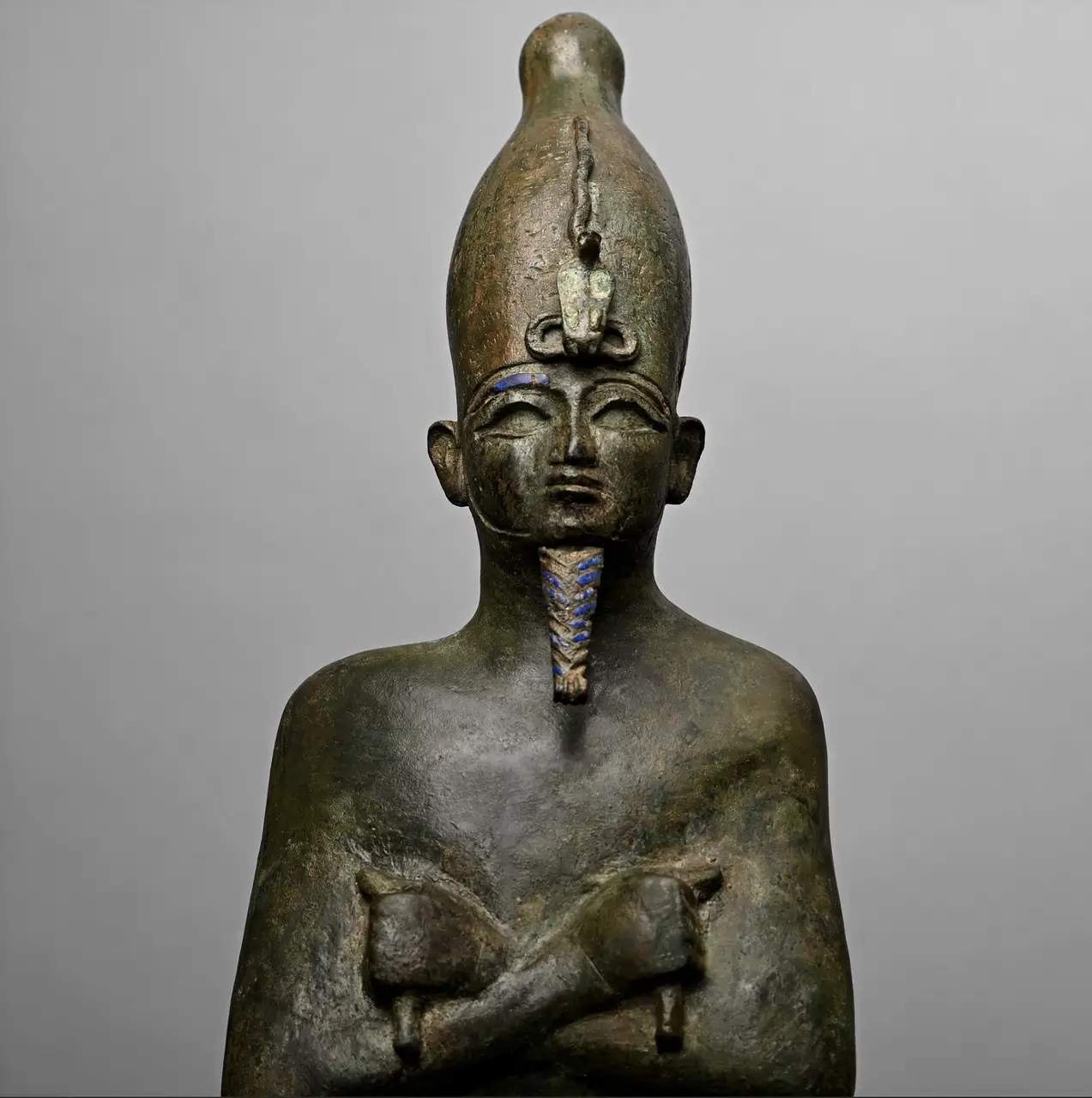
Bronzes of this class were not discarded when their cultic life ended, excavations at Karnak and elsewhere have recovered favissae, sacred caches in which temple objects were laid down with care, often on beds of sand, sometimes with smaller votives banked around them. The objects in these deposits are frequently incomplete, their projecting elements removed. The losses can look like damage, but the pattern seems rather consistent: the practice seems to have involved deactivating the figure before burial, taking away the parts that allowed it to act. Whether this Osiris underwent any such treatment cannot be said with certainty; the same losses occur for ordinary reasons over twenty-five centuries after all. But the inventory of what is gone: both plumes, both scepter heads, the inlays from the eye sockets and most of the brows, follows the pattern of deliberate "deactivation".
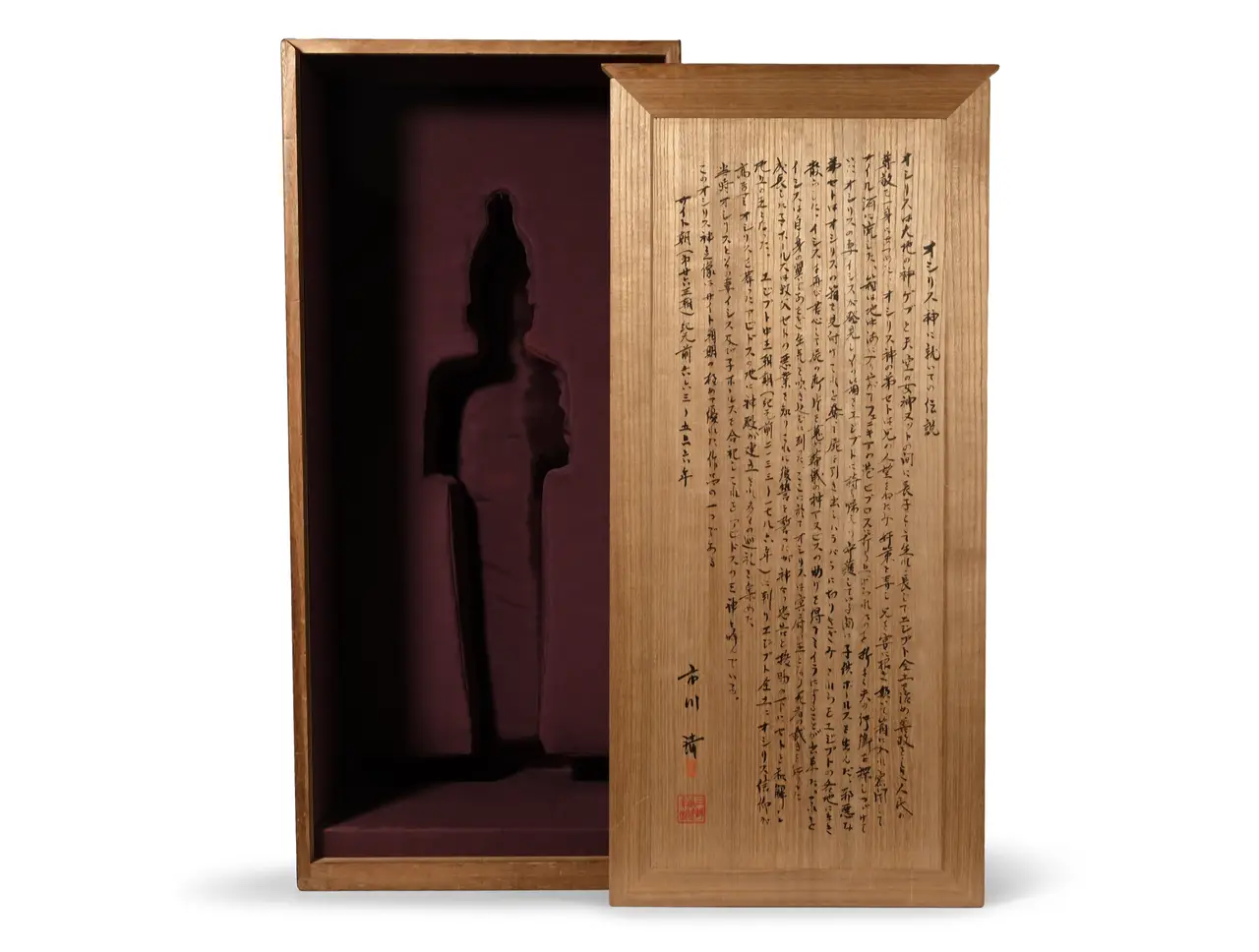
With Seiyou Kobijyutsu, Osaka, in the twentieth century, the acquisition facilitated by the firm's consultant Ichikawa Kiyoshi (1897–1976); acquired in the 1960s by a medical doctor in Kumamoto, Kyushu, on Ichikawa's recommendation; thence by descent until 2023. The fitted wooden box carries Ichikawa's signature and seal. An academic report by the Egyptologist Paul Whelan accompanies the piece.
The fragment of lapis in the right brow is small enough to overlook. It is also the only place where the colour of the original surface still touches the eye.
TimeLine Auctions, 18th May 2026