Home > Stories by TimeLine Auctions
Stories by TimeLine Auctions
Desmond Morris, zoologist and collector of ancient Cypriot art, dies at 98
Desmond Morris, the Oxford zoologist, broadcaster and surrealist painter best known for The Naked Ape, died on 19 April 2026 at his home in County Kildare, Ireland. He was 98.
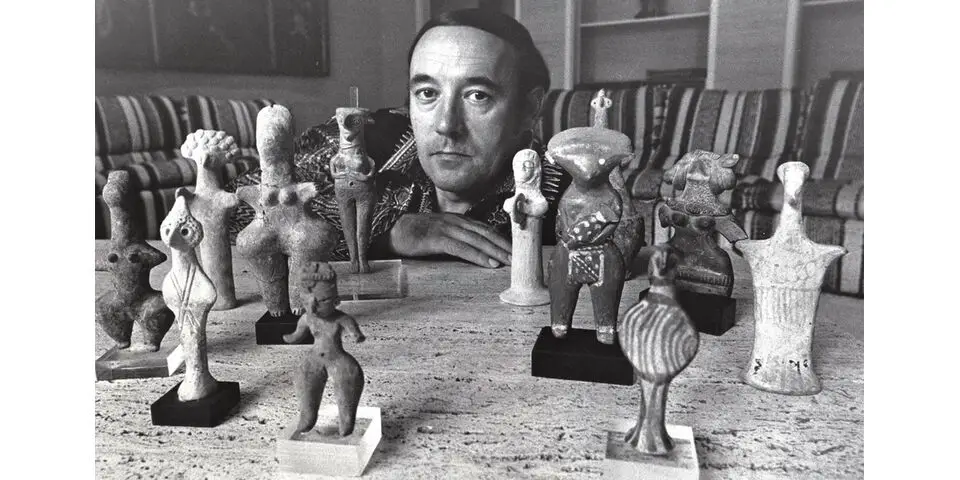
For antiquities collectors and dealers, Morris was also the builder of a collection of more than 1,100 objects from ancient Cyprus, formed between 1967 and the mid-1970s and published in 1985 as The Art of Ancient Cyprus. Morris described it in that volume as the largest private holding of Cypriot material outside the island. Francesca Hickin, then Head of Antiquities at Bonhams, called the catalogue "the definitive volume on the subject" when the final part of the collection came to auction in July 2019.
From Wiltshire to London Zoo
Morris was born in Purton, Wiltshire, on 24 January 1928, the son of the children's author Harry Morris and Marjorie (née Hunt). He read zoology at the University of Birmingham, took a doctorate at Oxford under Niko Tinbergen on the reproductive behaviour of the ten-spined stickleback, and moved to London in 1956 to run the Granada TV and Film Unit at the Zoological Society of London. He was Curator of Mammals at London Zoo from 1959 to 1967, and briefly Director of the Institute of Contemporary Arts in 1967, where he mounted the first London exhibition of Yoko Ono's work.
The Naked Ape, published in the autumn of 1967, sold in the millions and gave him the means to write full time. He left the ICA, moved with Ramona to Malta, and produced a run of books on human behaviour in the same zoological register: The Human Zoo (1969), Intimate Behaviour (1971), Manwatching (1977). He returned to Oxford in 1973 as a Research Fellow at Wolfson College, and continued to publish books on ethology, body language, painting, and animals into his nineties.
He painted in parallel throughout his career, though the pictures were little known until late in his life. His first surrealist exhibition, at the London Gallery in 1950, was shared with Joan Miró. The Tate accepted his painting archive in 2019. In later years he described himself as "the last living Surrealist"; the sale of one of his works, The Courtship of 1948, set an auction record of about £45,000 in 2021.
The 1967 Cyprus visit
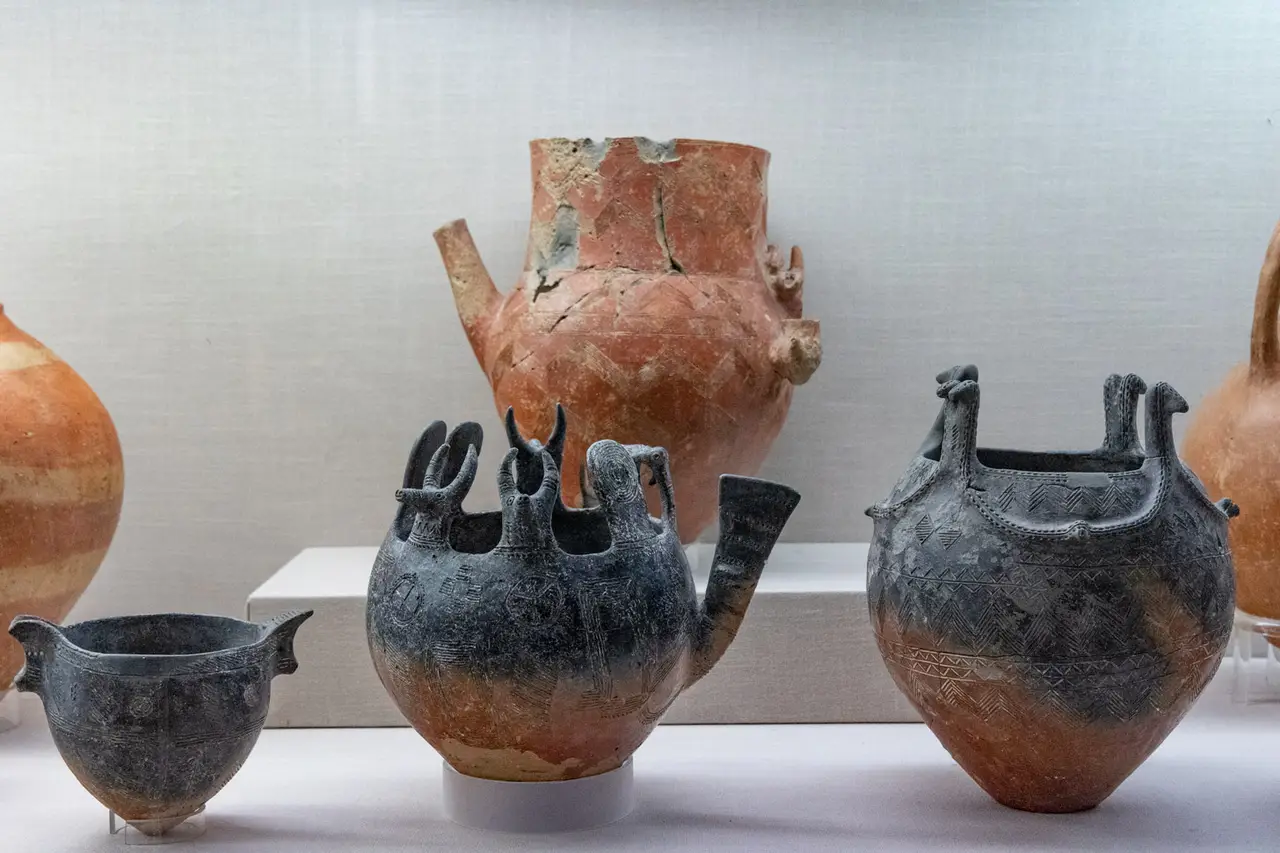
Morris dated his interest in Cypriot material to a single visit, in the summer of 1967, to Room Two of the Cyprus Museum in Nicosia. In the preface to his 1985 book he described the encounter in direct terms: the Bronze Age pottery on display had an "exuberant sense of sculptural humour" that he had not expected from objects made as funerary equipment. The figures modelled onto bowls and vessels, he later said in a Bonhams interview, read "like a strip cartoon of ancient life."
He returned to London determined to find comparable material for study, and within months discovered he could. That autumn a London saleroom catalogue offered more than a hundred Cypriot antiquities in a single sale. His first purchase, a figurine of an unfamiliar form that he said he had not realised could be bought at all, cost a quarter of his and Ramona's bank account. Over the following nine years he extended the search to New York, Boston, Amsterdam and Paris, buying almost entirely through Sotheby's and Christie's and through specialist dealers in those cities. His own account, in a 2019 interview with Antiques Trade Gazette, was that he preferred many comparable pieces to a few expensive ones, so that categories could be seen against each other.
What the collection actually was
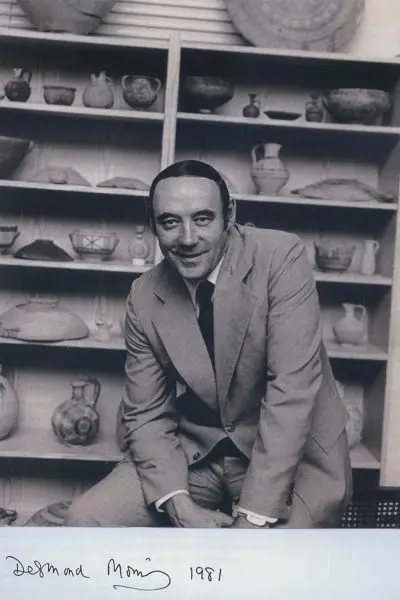
The centre of gravity of the collection was the Early and Middle Bronze Age on Cyprus, roughly 2500 to 1650 BC, a period dominated on the island by Red Polished Ware and its close relatives. These are hand-built, burnished ceramics in a glossy red or red-and-black slip; the shapes are freely modelled, often asymmetrical, and the decoration is largely applied in three dimensions rather than painted. They were made before the potter's wheel reached the island, and Morris argued in the 1985 volume that pre-wheel pottery was probably the work of women, noting that clay shards turned up alongside bread in the same domestic ovens. He referred to the Early Bronze Age potter as "she" in his text, a convention that drew some irritated correspondence at the time.
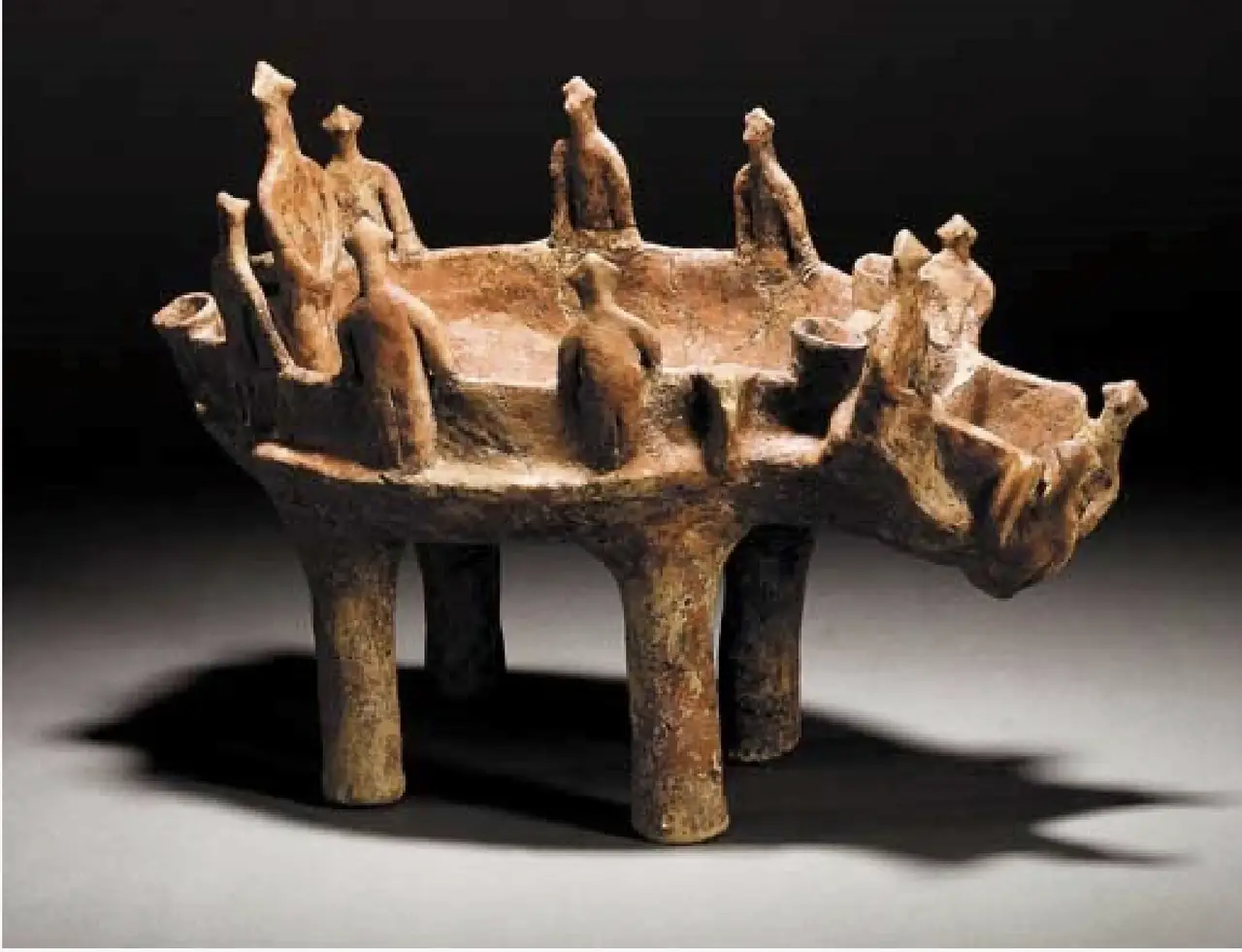
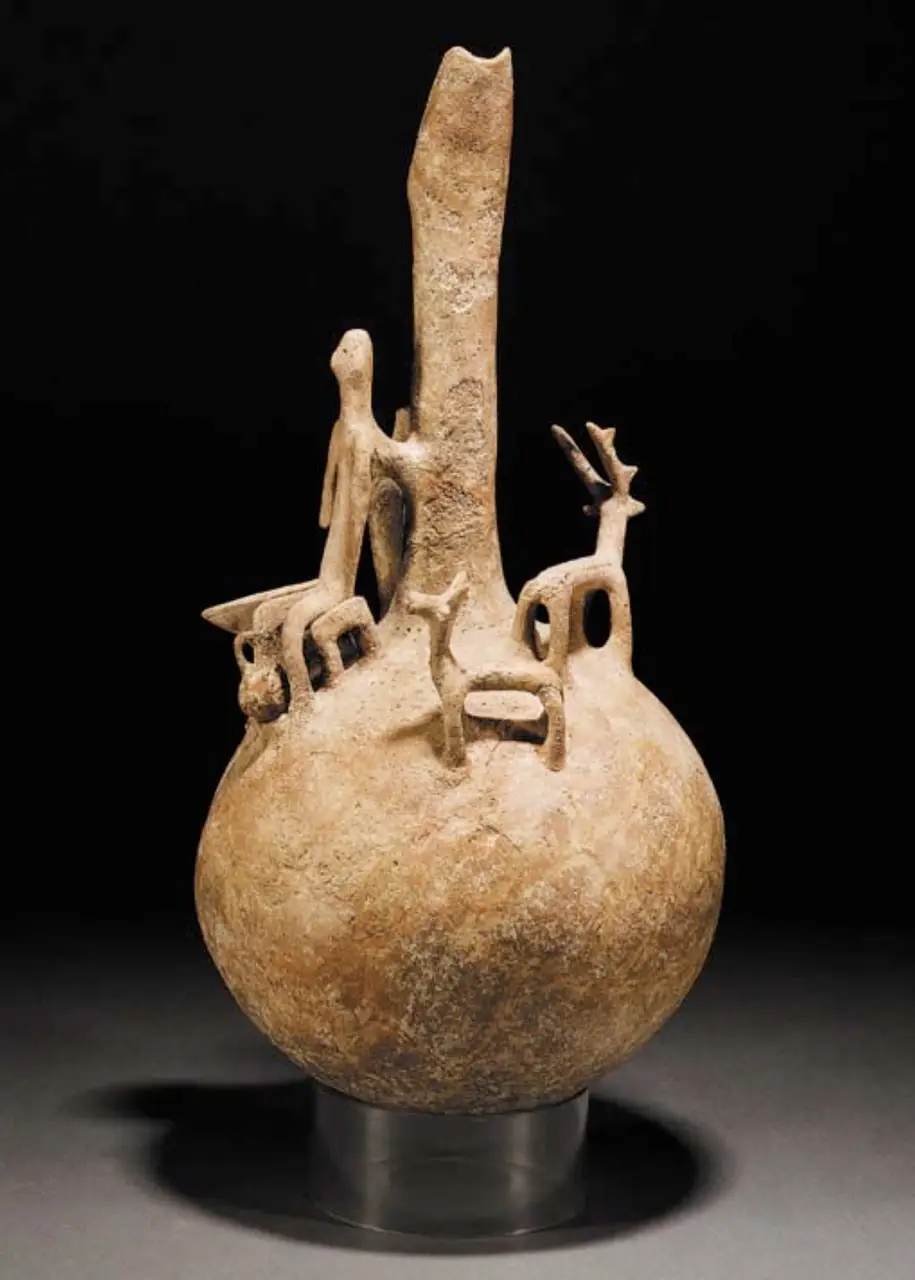
It was the figural work that made the collection distinctive. Early and Middle Bronze Age Cypriot potters modelled small human and animal figures onto the rims, spouts and shoulders of their vessels: people grinding grain, kneading dough, pouring liquids, tending livestock, or enacting scenes whose meaning is still debated. Composite scenic vessels of this kind are concentrated in good numbers only at the Cyprus Museum in Nicosia and in the Pierides holdings in Larnaca; they are scarce elsewhere. Morris's collection held a substantial run of them, enough that the 1985 volume organised chapters around the thematic patterns they described.
Among the better-documented pieces was a Middle Bronze Age jar decorated with three incised panels showing a hunt. A line of bearded goats walks uphill across one panel; a human figure stands on another holding a bow; a dog wearing a collar and lead stands opposite a bristling wolf with a horizontal tail. Morris argued, cautiously and as his own reading rather than as settled scholarship, that this was one of the earliest depictions on pottery of a domesticated dog clearly distinguished from its wild counterpart. The vessel was catalogued at Bonhams in 2019 as an early representation of a dog on a lead.
Other specific pieces included a Canaanite bronze offering figure of the fifteenth to thirteenth century BC, shown with bent arms extended and wearing a pleated kilt and conical hat; Cypriot terracotta horses carrying painted harnesses and trappings in black strips; a large Daunian pottery olla with handles modelled as hands; and a group of Iranian Amlash female figures which Morris treated, in the Bonhams interview, as a pictorial convention belonging to a wider prehistoric tradition of mother-goddess imagery rather than as an anatomical record.
Beyond the complete vessels there was a working archive of broken material: boxes of rim sherds, incised fragments, small bronze pins and blades, and figurine parts retained for reference. Morris gave one such case of Early and Middle Bronze Age Red Polished Ware fragments to a fellow collector in April 2021, noting that such material was often bundled into mixed auction lots in the London trade of the 1960s and 1970s and was sometimes used to restore other pots to which it had not originally belonged.
The collector's method
Morris was clear that his method was not that of a trained archaeologist. He had come to the material through Room Two of the Cyprus Museum, not through a dig, and he described the collection as a tool for aesthetic analysis. His parallel interest in the picture-making behaviour of apes, documented in The Biology of Art (1962) after his experimental work with the chimpanzee Congo at London Zoo, ran through the Cypriot project: he was attempting, across very different materials, to identify the point at which visual decision-making becomes art.
He held to a collecting rule he restated in late interviews: never acquire a piece simply because it belonged to a category of interest. "Each piece must sing to you," he told Antiques Trade Gazette in 2019. His working habit was to crowd the Oxford house with display, so that objects could be read against each other, rather than to shut them away in cupboards for occasional inspection.
The collecting phases of his life ran in sequence rather than in parallel. As a child he collected postage stamps, then fossils and minerals, then seashells. As a young adult he collected tribal art, picked up from London junk shops in the 1940s and 1950s when it was cheap and unregarded, and then modern art. Ancient Cypriot material took over in 1967 and dominated for a decade. It was followed in turn by Russian icons, Pre-Columbian art, Chinese art, and finally Algerian Berber pottery.
Karageorghis, the Ashmolean, and the 1985 book
The scholarly dimension of the Cypriot project developed through the 1970s, largely at the urging of Vassos Karageorghis, then Director of the Department of Antiquities of the Republic of Cyprus and one of the period's leading specialists on the island's material culture. Karageorghis visited the collection, pressed Morris to publish, and argued that material in private hands which was not made accessible was effectively lost to scholarship.
Morris agreed in 1973, then spent the better part of a decade teaching himself the discipline. By his own account, he devoted two years almost entirely to archaeological reading before beginning to write. He produced roughly a thousand line drawings for the book himself, took every photograph, and designed the pages. The resulting volume, The Art of Ancient Cyprus, was published by Phaidon at Oxford in 1985, running to 368 pages with 97 colour photographs and some 1,300 drawings. It was part catalogue of the Morris holdings, with a rule that every photographically illustrated piece belonged to the collection, and part extended essay on Cypriot aesthetics.
An exhibition of selected pieces opened at the Ashmolean Museum that April, with an introduction by Karageorghis. The book remains a reference. Scholars writing on Cypriot Late Bronze Age figurines still use Morris's typological vocabulary, including his term "headgear" figurines for the flat-headed type of Base Ring votive. In the preface he set out a position he held to throughout: private collectors unwilling to open their holdings to serious scholarly examination had no defensible case for keeping them. He had been receiving visiting archaeologists in his Oxford study since the early 1970s.
A longer chain of Cypriot collectors
Morris's material sat within a history of Cypriot collecting that reached back to the nineteenth century. A significant number of his pieces could be traced, through older auction records, to the excavations of Luigi Palma di Cesnola, United States consul on Cyprus between 1865 and 1877, and his brother Alessandro. Vast quantities of material removed by the Cesnola brothers entered European and American collections in the 1870s and 1880s. Part of this material passed into the hands of Lt. Gen. Pitt-Rivers and was displayed at the Pitt-Rivers Museum at Farnham, Dorset. When the Farnham museum was dispersed in the mid-twentieth century, pieces travelled through the London trade, where Morris encountered them from 1967 onward.
That provenance history is not uncomplicated. Some Cypriot material on the London market in the late 1960s and 1970s had no documented find-spot. A 2021 assessment published by the EU-funded Netcher project on cultural heritage argued that the stylistic profile of certain "orphan" Cypriot pieces on the market in the period was consistent with material from sites in the part of the island outside Republic of Cyprus control, and gave the example of a Red Polished model once held by Morris and now returned to the Cyprus Museum. Morris acquired on the open market in accordance with the practices and expectations of his time; some pieces from his collection have subsequently been repatriated, and examples formerly in his possession are now on display in Nicosia.
Dispersal
Morris began selling in the years after publication, with the main Cypriot block offered at Christie's South Kensington on 6 November 2001 in a sale catalogued as The Art of Ancient Cyprus: The Desmond Morris Collection. A second sale followed at the same rooms on 14 May 2002. The final pieces, including the hunting-scene jar, were sold at Bonhams London on 3 July 2019, shortly before he moved to Ireland to live near his son Jason after Ramona's death in 2018. His Pre-Columbian holdings went to Mallams in Oxford the same summer.
Individual pieces from the collection now surface regularly in the specialist trade and continue to attract collectors both for the Morris provenance and for the 1985 publication, which remains the standard point of comparison for figural Early and Middle Bronze Age Cypriot ceramics in private hands. Some pieces sit in museum collections from Nicosia to Oxford.
One object did not go. The small Bronze Age figurine bought in 1967, whose form Morris had called strange when he first saw it in a saleroom window, travelled with him to County Kildare.
Parallel lives
The collecting was one strand in a working life that ran in several directions at once. Morris produced more than 70 books, sat for several years as Vice-Chairman of Oxford United Football Club, mounted more than fifty one-man exhibitions of his paintings, travelled the world repeatedly into his seventies on research trips for TV series, and in 2022 opened a private art institute, the Dún Laoghaire Institute of Visual Arts (DIVA), near Dublin as a gift to Ireland. He continued to paint in the studio of his Irish home into his ninety-eighth year.
Morris married Ramona Baulch, an Oxford history graduate, in 1952. She co-authored Men and Snakes (1965), Men and Apes (1966) and Men and Pandas (1966) with him, and corresponded with dealers on his behalf through the Cypriot collecting years. She died in November 2018. He is survived by his son Jason and four grandchildren.
TimeLine Auctions, 21st April 2026