Home > Stories by TimeLine Auctions
Stories by TimeLine Auctions
Eleni Stathatos and the Ancient Gold She Gave Away
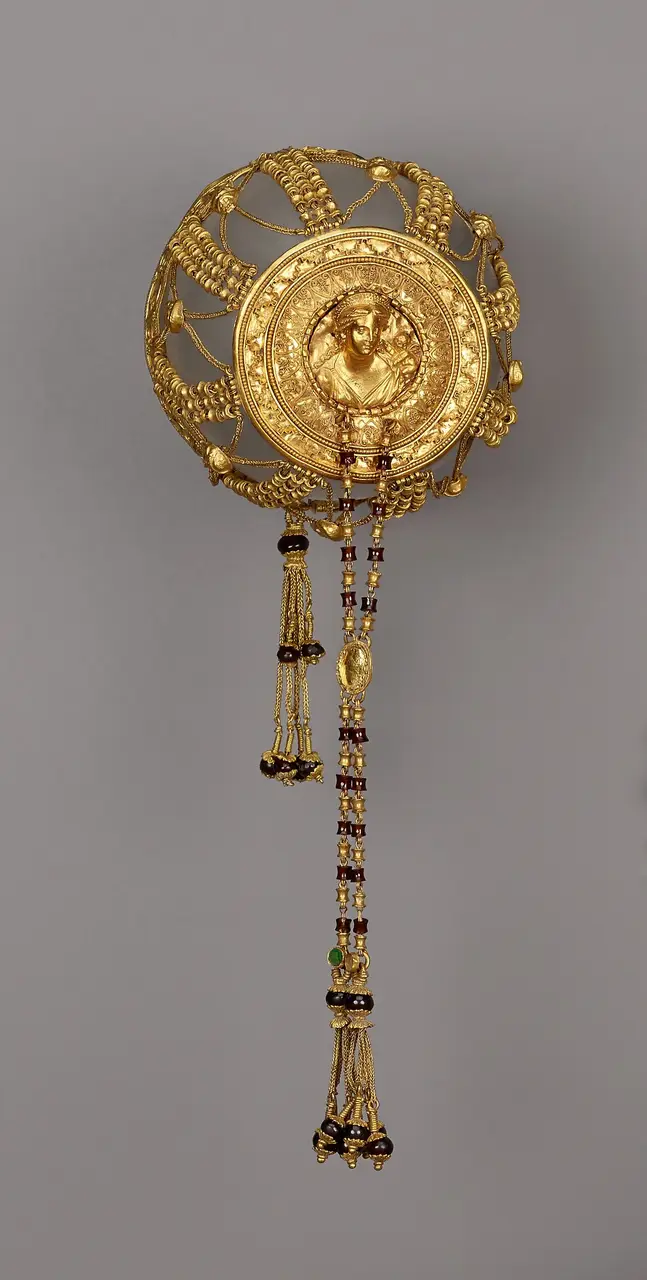 A Hellenistic gold hairnet of the type the Stathatos collection made famous, this late third to early second century BC example in the J. Paul Getty Museum, the medallion worked with Aphrodite and a small Eros. J. Paul Getty Museum (CC0), via Wikimedia Commons.
In a ground-floor gallery of the National Archaeological Museum in Athens stands a dome of gold the size of a small bowl, mounted on a clear stand so that visitors can read the work on every side. At its crown a goddess rises in repoussé from a single disc of sheet gold, her head turned and lifted, a laurel wreath and a ring of palmettes worked around her, the whole medallion edged with twisted wire and rows of minute beads. From the rim hang chains of gold spool-beads, threaded at intervals with carnelians, that once gathered a woman's hair into a net. It is a Hellenistic hairnet, a kekryphalos, of the late third or early second century BC, and it came out of the ground in Thessaly.
It reached the museum from a house in Kolonaki, the gift of Eleni Stathatos, who had bought it from an Athens dealer between the wars. The case it stands in is one she chose and paid for herself. That case is also, in its way, a fragment. Of the three rooms in which Stathatos kept her collection and lived among it, this gold was the contents of one. She gave the rooms away one at a time, to three institutions, and the house she had made came apart into the museums of the city.
From Alexandria to Kolonaki
Eleni Konstantinidi was born in Alexandria in 1887, into the wealthy and cosmopolitan Greek community of Egypt; her father, K. Konstantinidis, was a merchant of the kind that had made the city a second Greek capital since the 1830s. In 1911 she married Antonios Stathatos, a shipowner from the Greek community of Brăila on the Danube, with connections to the royal court in Athens. They had two daughters and settled in Greece.
She belonged to a generation and a class for whom collecting was close to a duty. As Alexandra Bounia has shown in her study of early-twentieth-century Greek women collectors, an educated woman of the diaspora was expected to put her taste in the service of the nation, to gather pieces of the Hellenic past and, in time, hand them to the state. Stathatos did exactly that, and did it on her own terms.
A House Built in Three Rooms
She assembled the collection as a set of interiors. Three rooms on the ground floor of the family house on Herodotou Street held it, and she put each together as a whole environment rather than a row of vitrines. The first, arranged around the 1920s, was organised on a fireplace she had built from bright blue antique ceramic tiles; the woodwork around it came from old churches near Arta, in Epirus, and she chose and placed every part of it.
The second room she bought more or less entire. In 1928 she acquired the carved wooden panelling and ceiling of a reception room from a town house in Kozani, in northern Greece, built in 1732, and had the whole salon reassembled in Athens. The third room was the smallest and the most valuable, a kind of treasury, lined with the icons and the ancient gold.
These were rooms she lived in. By the accounts Bounia gathered, the collection was the space she shared with her family and her friends, and almost no one recalled being received anywhere else in the house. When the German archaeologist Roland Hampe reviewed the published catalogue in 1966, the frontispiece showing the donor before a Byzantine icon reminded him of the Isabella Stewart Gardner Museum in Boston, another house arranged by a woman to be lived in and then left exactly as she left it.
The Thessalian Gold
The centre of the collection, and the part that made its name, was a body of Hellenistic gold she acquired from Athens dealers around 1929 to 1931, said to have been found in Thessaly. The hairnets are the best known. On one, a bust of Aphrodite is worked in high relief with a tiny winged Eros at her shoulder; on another, Artemis. Each medallion is ringed with palmettes, laurel and beaded wire, then finished with a net of looped chains and spool-beads that hung down over the wearer's bun. The goldsmith's whole repertoire is there at miniature scale: repoussé for the figures, filigree and granulation for the borders, bezels cut for garnets and coloured glass.
Other pieces in the group are as fine. A solid gold diadem from the so-called Demetrias treasure, found near Volos and dated to the last quarter of the fourth century BC, centres on a Herakles knot with a small Eros at the middle and clusters of gold pomegranates hanging below. A small gold shrine, a naiskos, holds a figure of Dionysos in high relief, leaning on a young satyr with a panther at his side. A necklace ends in two bulls' heads set between acorns. A medallion the width of a hand carries a second bust of Artemis.
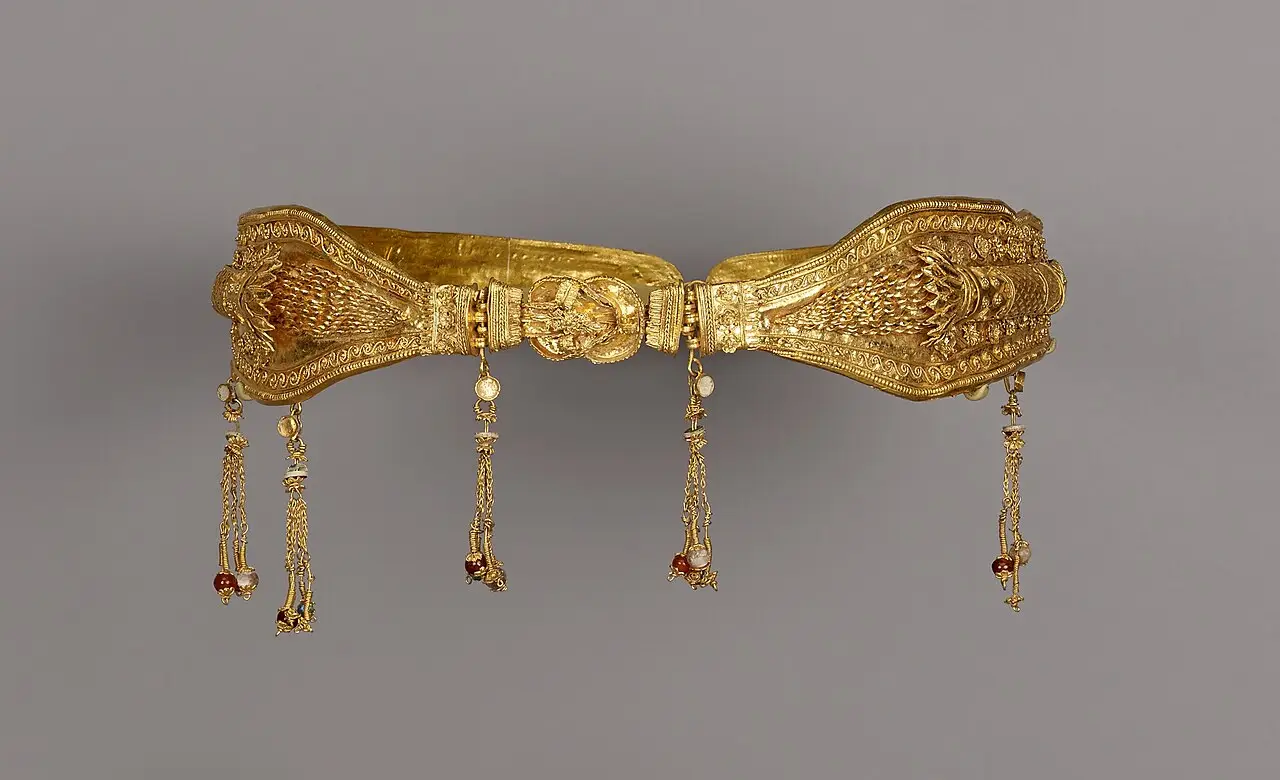 A Hellenistic gold diadem built around a central Herakles knot, with tasselled chains hanging from the band. The Stathatos gold includes a diadem of this kind, the "Demetrias" diadem found near Volos. J. Paul Getty Museum (CC0), via Wikimedia Commons.
The gold was only the centre. The Stathatos collection ran from the fifth millennium BC to late Byzantium: Neolithic finds from Chalcidice, Early Cycladic vases cut from stone, Minoan double-axes, Mycenaean jewellery, bronze pendants of the Geometric period, Archaic gold ornaments and bronze figurines, silver vessels of the fifth century BC and a group of Achaemenid Persian silver, then Hellenistic, Roman and Byzantine jewels and Post-Byzantine plate. The National Museum's Stathatos gallery, Room 42, now holds 971 objects across that span.
Giving the House Away
After her husband's death, Stathatos began handing the collection to the state, and she did it deliberately, in pieces. By her own account, given in interviews at the time, she felt the moment had come to offer her possessions to the country. The ancient and Byzantine gold and silver went first, to the National Archaeological Museum in 1957, on the condition that it be shown together in a gallery of its own, the Collection of Antonios and Eleni Stathatos. She arranged the room herself and opened it on 13 November 1957, in the display cases she had chosen and paid for. She did not stop collecting after the gift, and went on adding to the museum's holdings for years.
The two surviving period rooms followed, and they went to different homes. In 1964 she offered the Benaki Museum the great reception room from Kozani, the carved salon she had bought in 1928; it was installed in a gallery of its own and opened in 1968. In 1969 she gave the small reception room to the Gennadius Library of the American School of Classical Studies, which built a wing to hold it and rebuilt the panelling as she had kept it. It opened as the Macedonian Room, lined with the church woodcarvings from Arta and the icons and lamps she had set in it. She had been giving the Gennadius Byzantine manuscripts since 1947, among them a Four Gospels of 1226 copied by the protonotarios Vasileios Melitiniotis. The Greek state named her a Great Benefactor of the Greek Nation. She died in Athens in 1982, at ninety-five.
The Catalogue, and the Doubts
The collection had a scholar of its own. Between 1953 and 1971 four volumes of Collection Hélène Stathatos appeared, the work of the French archaeologist Pierre Amandry, later director of the French School at Athens, with collaborators who took on the Byzantine pieces. Amandry catalogued the ancient jewellery he knew best and added long discussions of the Achaemenid silver and of Greek goldwork generally. The books remain the reference for much of the material.
Any collection built this way, bought on the dealer market with little or no excavation record, raises the question of whether everything in it is what it appears to be. Reviewing the third volume in 1966, Hampe praised the collection and then listed a handful of pieces he thought worth closer scrutiny, the standing caution of a field that has always known ancient gold to be worth faking. Amandry's catalogue, with its patient marshalling of parallels, is part of what lets later scholars test such doubts rather than guess at them.
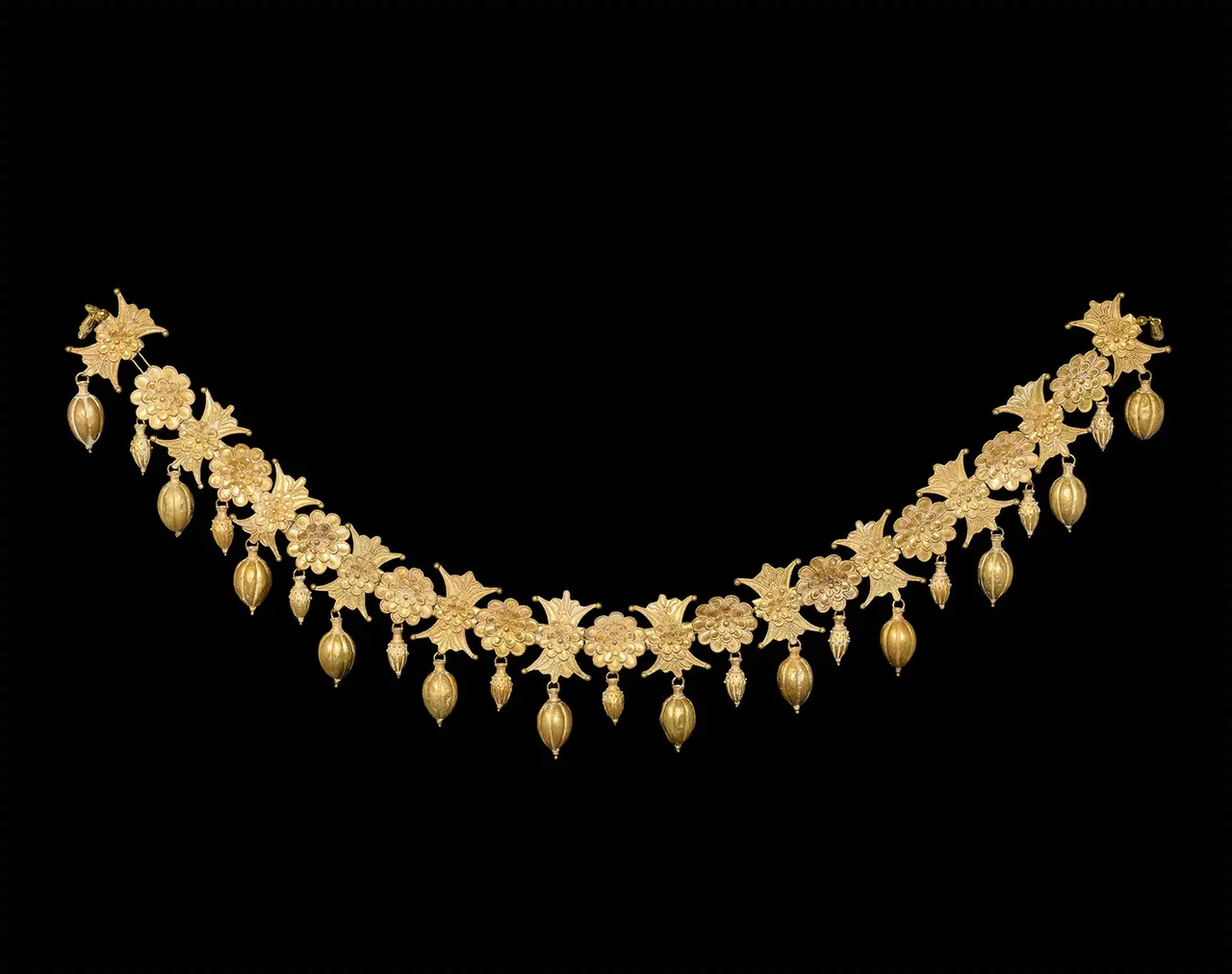
Gold of this quality rarely comes to market, and when a hairnet or a Herakles-knot diadem does, it tends to arrive with a known pedigree. The smaller currency of the same world still circulates within a private collector's reach: gold-and-garnet earrings, a Byzantine ring, a Roman pendant. TimeLine's ancient jewellery is one place to meet them.
The rooms are scattered now across Athens: the gold in Room 42 of the National Museum, the Kozani salon at the Benaki, the small room at the Gennadius under its Macedonian plaque. The hairnet from Thessaly still stands in the case Eleni Stathatos chose for it, the goddess at its crown lifting her head as she did in the house on Herodotou Street, where the merchant's daughter from Alexandria had set her among the icons.
TimeLine Auctions, 14th July 2026