Home > Stories by TimeLine Auctions
Stories by TimeLine Auctions
Fighting Evil with Evil: Pazuzu, Humbaba and Mesopotamia's Protective Monsters
A terracotta head, seventy-five millimetres of snarl, sits on a small custom stand: a grimacing face with the teeth bared, two long horns sweeping back from the brow towards the crown, and a hole bored through the rear edge so it could be threaded on a cord and hung up. It weighs seventy-three grams. It is Pazuzu, and almost everyone who knows the name knows it from the wrong story.
In 1971 William Peter Blatty gave the name to the demon who possesses a twelve-year-old girl in The Exorcist; the 1973 film made the face a fixture of late-night television. In Babylon the casting ran the other way. Pazuzu was not the thing you called a priest to expel. He was the thing you hung by the cradle to keep the child safe.
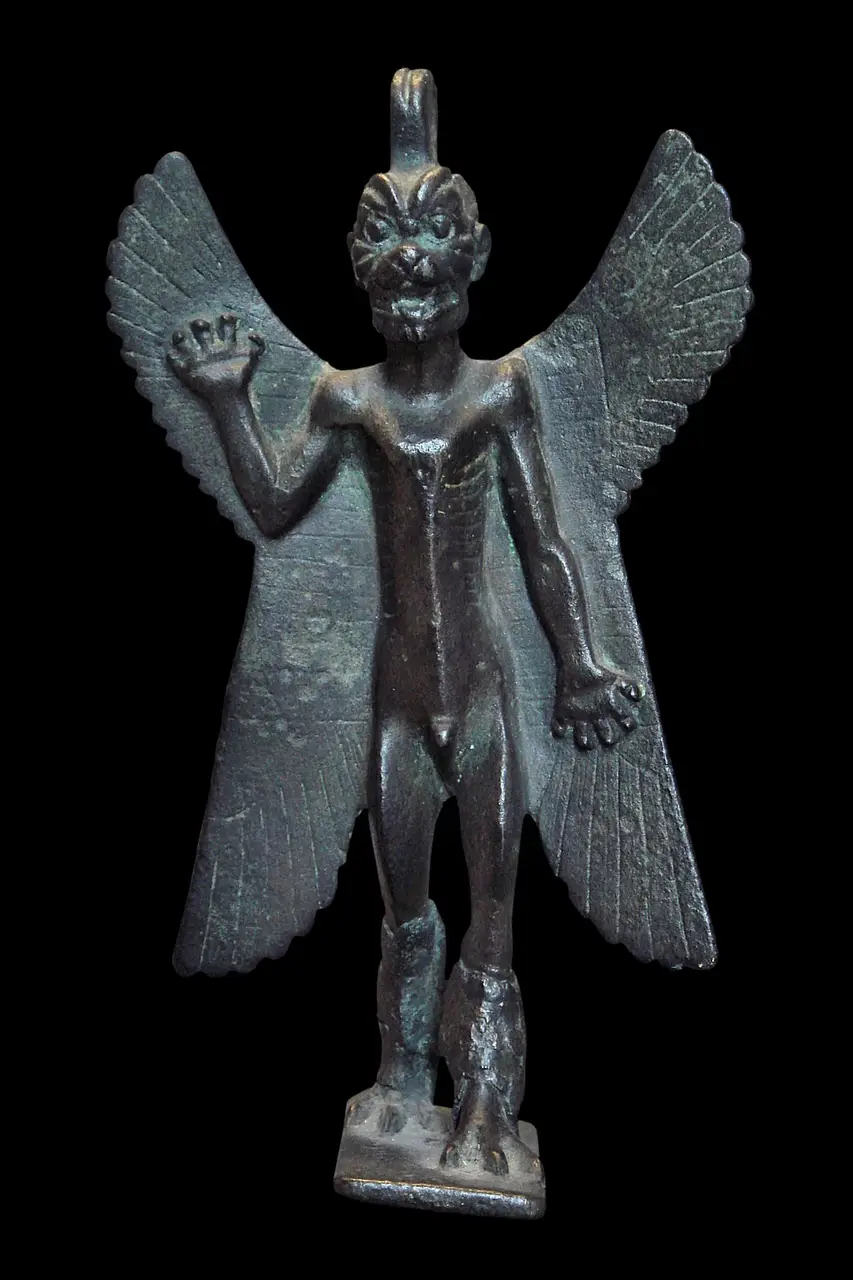 A complete Pazuzu in bronze: canine face, wings, bird's talons and a scorpion's tail. Louvre Museum, Paris. Photo: PHGCOM, CC BY-SA 3.0, via Wikimedia Commons.
He was still a demon. The texts call him "king of the evil wind-demons," and nobody in Mesopotamia mistook him for a kindly god. The point was never that Pazuzu was good; the point was that he was useful. A being frightening enough to terrify other frightening beings could be put on the door and set to work. Anthony Green, going through the ritual texts, found the principle stated almost as a slogan: a further concept had been introduced, to fight evil with evil. Eckart Frahm, writing on Pazuzu's origins, calls it an act of similia similibus curantur, like cured by like, in which the Babylonians "put his frightfulness to good use."
Three objects in TimeLine's sale of 8 September are specimens of that idea, and they are spread across a very long stretch of it. The Pazuzu head is catalogued to the eighth-to-sixth century BC. A small stone bust, catalogued as the ogre Humbaba, is roughly of the same date. A carved stone vessel, with a reclining human-headed creature on its flank, is catalogued a full thousand years earlier, to the early second millennium. The impulse holds steady across those fifteen centuries; the beings called on to serve it change.
The monster you conscript
Where the guardians come from is the part that makes the logic hang together, and it is not obvious. They are, for the most part, defeated monsters. Frans Wiggermann, whose 1992 edition of the ritual texts is the one book this subject cannot do without, traced the protective beings back to the combat myths, where they begin as the enemy. In the cycle of the god Ninurta the monsters are "captured warriors and kings" and "slain warriors"; in the Enūma Eliš the eleven horrors that Tiāmat breeds for her war on the young gods are beaten by Marduk and then kept, displayed as trophies, "an example not to be forgotten." The creature you feared is caught, subdued, and stood at your gate facing outward. Wiggermann puts the double duty plainly: as servants they stand watch, and as defeated enemies they frighten off other evil. This is what scholars mean by an apotropaic object, one whose whole job is to turn evil away.
What does the frightening is terror itself, and the Mesopotamians had a word for the weapon. The melammu is the awe-inspiring radiance that clings to gods, kings and monsters; the fear it strikes into whoever meets it is puluḫtu. One text calls that radiance "a most potent weapon against the enemy, causing the latter's paralysis," and names the forest-ogre Huwawa in the same breath. A face terrible enough stops what approaches before it can act. This is why, as Wiggermann noticed, the protective monsters are almost never shown armed: with a single exception they carry no weapon, because the weapon is the face.
Evil, in the Mesopotamian imagination, comes in at the door. The house-protection ritual the exorcists called šēp lemutti, "the foot of evil," has the exorcist mould figurines of protective monsters and sages and bury them under the floors, in the corners, and at the thresholds and gateways, "to block the entry of the enemy in someone's house." The plague it guards against is pictured as an invading army working through the country house by house. The buried figures are doorkeepers with a job in two directions: bar the evil, admit the good. This was not theory. Under the floors of a house at Assur that belonged to a family of exorcists, excavators found the brick boxes with the little figures still inside them, buried exactly as the handbook prescribes.
The three objects in the sale are the portable, domestic end of this system, not the colossal end. None of them is a gate-guardian the height of a room. They are the kind of protection a household could own, and the kind that still reaches the market.
Pazuzu and the demon he was set against
Frahm describes him as a partly canine body with a scorpion's tail, a snake-headed phallus, bird's talons, and wings; how many wings is the one thing the images will not agree on, so that "two pairs," "four," and simply "winged, but not always" are all on record, and the four-winged demon of the handbooks is a tidier creature than the ancient one. He does not appear in the record before the eighth century BC. His father is the god Hanbu; the old idea that he personified the west wind has since been doubted, and the safer description is a wind-demon who broke the wings of the disease-bearing winds, evil turned against evil once again.
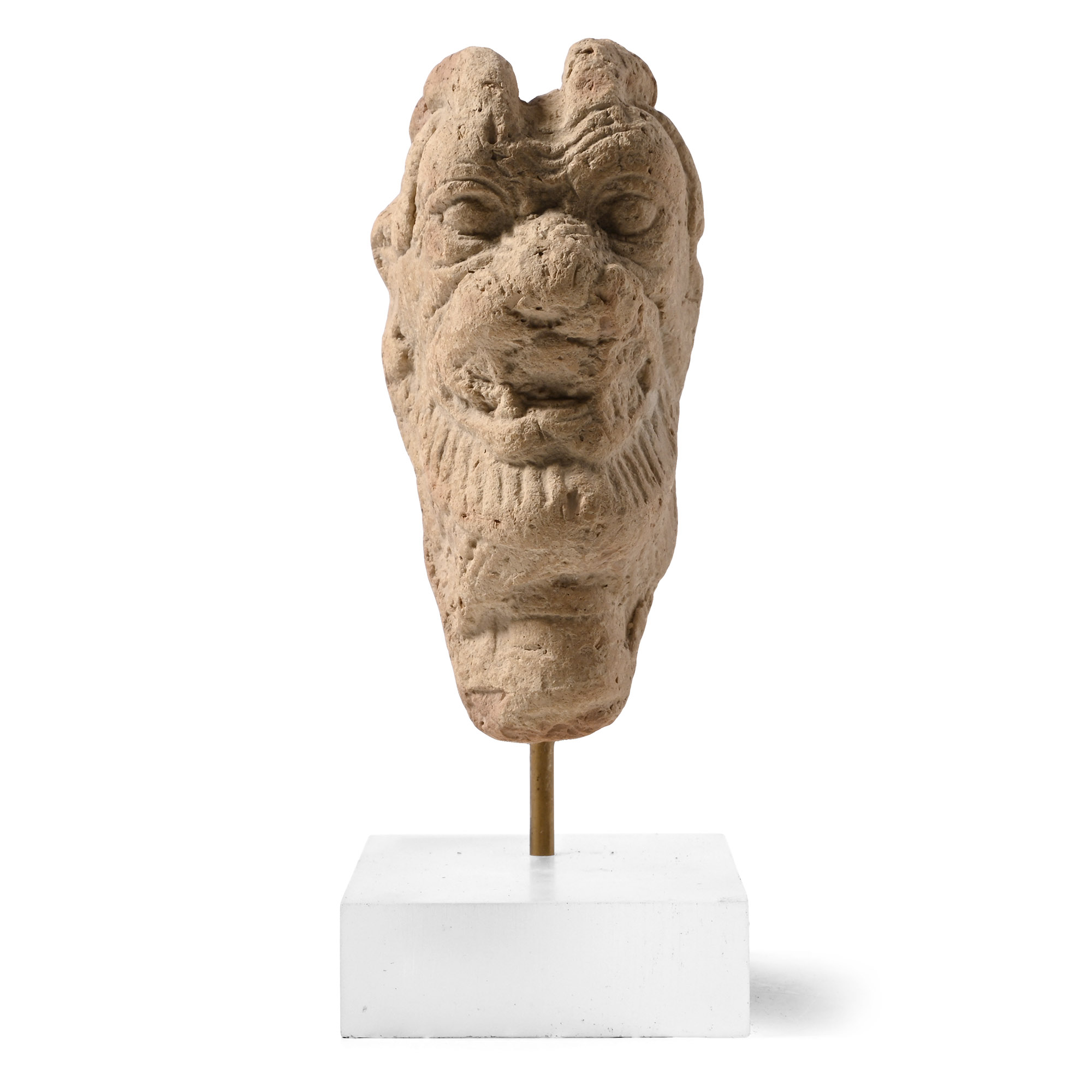
The detached head is the commonest form Pazuzu takes. P. R. S. Moorey, cataloguing the type in 1965, noted that full figures are "not nearly so commonly reported as the well known detached-head pendants," and that the heads were usually made in moulds and turned out in quantity. Many are bored through for hanging; this one is pierced through the rear edge. The power sits in the face, the part standing in for the whole, and there is a further reason the head could work alone: on the finer examples the back of the head carries Pazuzu's own words, the self-introduction that begins "I am Pazuzu, son of Hanbu, king of the evil lilû-demons." Those inscribed heads are the ones in bronze and stone. A mass-produced clay head like this carries no text, which is what you would expect.
Lamashtu is the daughter of the sky-god Anu, and she kills mothers and infants. The incantations against her are specific to the point of cruelty. She "wreaks havoc among the babies" and "lays hands on the wombs of women in labour"; she "pulls the babies from the nannies"; she "counts the pregnant women daily." Jo Ann Scurlock has argued that behind the demon lies typhoid fever, which causes miscarriage. Her image is as composite as Pazuzu's: a lion's head, a donkey's teeth, sagging breasts that suckle a dog and a pig, standing on a donkey that rides a boat down the river of the underworld.
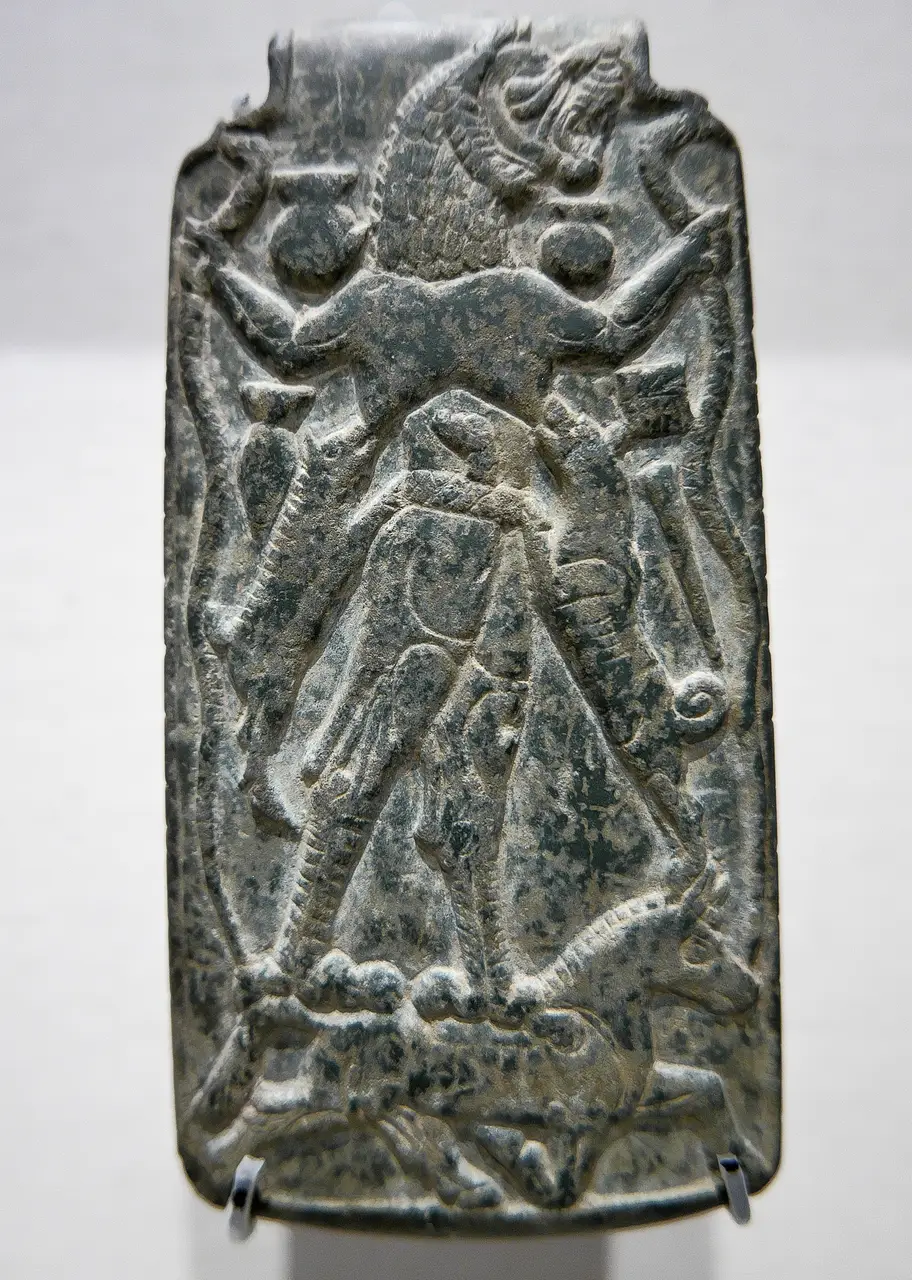 Lamashtu on her donkey, suckling a dog and a pig and gripping serpents. British Museum, London. Public domain, via Wikimedia Commons.
On the bronze plaques made to drive Lamashtu off, she is shown in the middle being sent away down the underworld river, and Pazuzu's head appears at the very top, looking over the edge of the scene and herding her out; on one class the whole demon stands on the reverse. Frahm's summary is exact: "Pazuzu's head on top of the amulets prevented the evil child-snatcher from approaching her victims." Lamashtu is driven out over the Ulai River and the ocean, never to return.
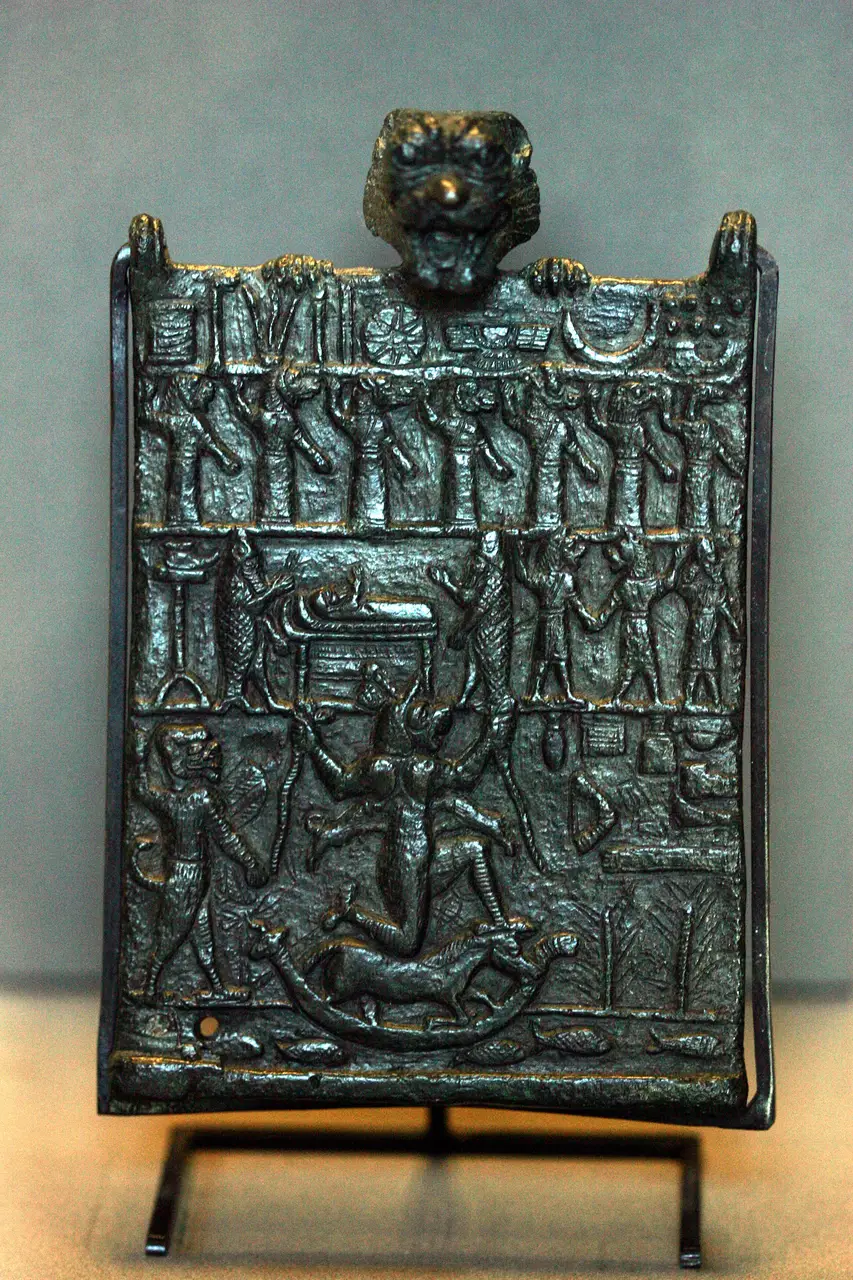 The bronze "Plaque des Enfers": Pazuzu's head arches over the top edge while Lamashtu is driven down toward the underworld river. Louvre Museum, Paris. Photo: Rama, CC BY-SA 2.0 fr, via Wikimedia Commons.
The British Museum's Art and Empire catalogue, discussing a bronze Pazuzu head, records that such a head "was probably suspended close to a woman in labour, for protection against the female demon Lamashtu," and that the texts prescribe a "bronze Pazuzu," an amulet smaller than that, "to be worn for this purpose." Green found the same prescription in the ritual literature. The wording has to be careful here, because the prescription names a bronze amulet and this head is clay. Moorey thought the instruction "almost certainly only applies to the detached-head pendants in bronze," not to the heavier pieces. What can be said honestly is that the ritual existed, that heads pierced for suspension are its physical form, and that the cheap moulded clay heads are the popular version of an idea the well-off carried in bronze. Heads of exactly this shape were made and hung to protect the newborn against Lamashtu. That is what the hole through the back edge is for.
The face read in the entrails
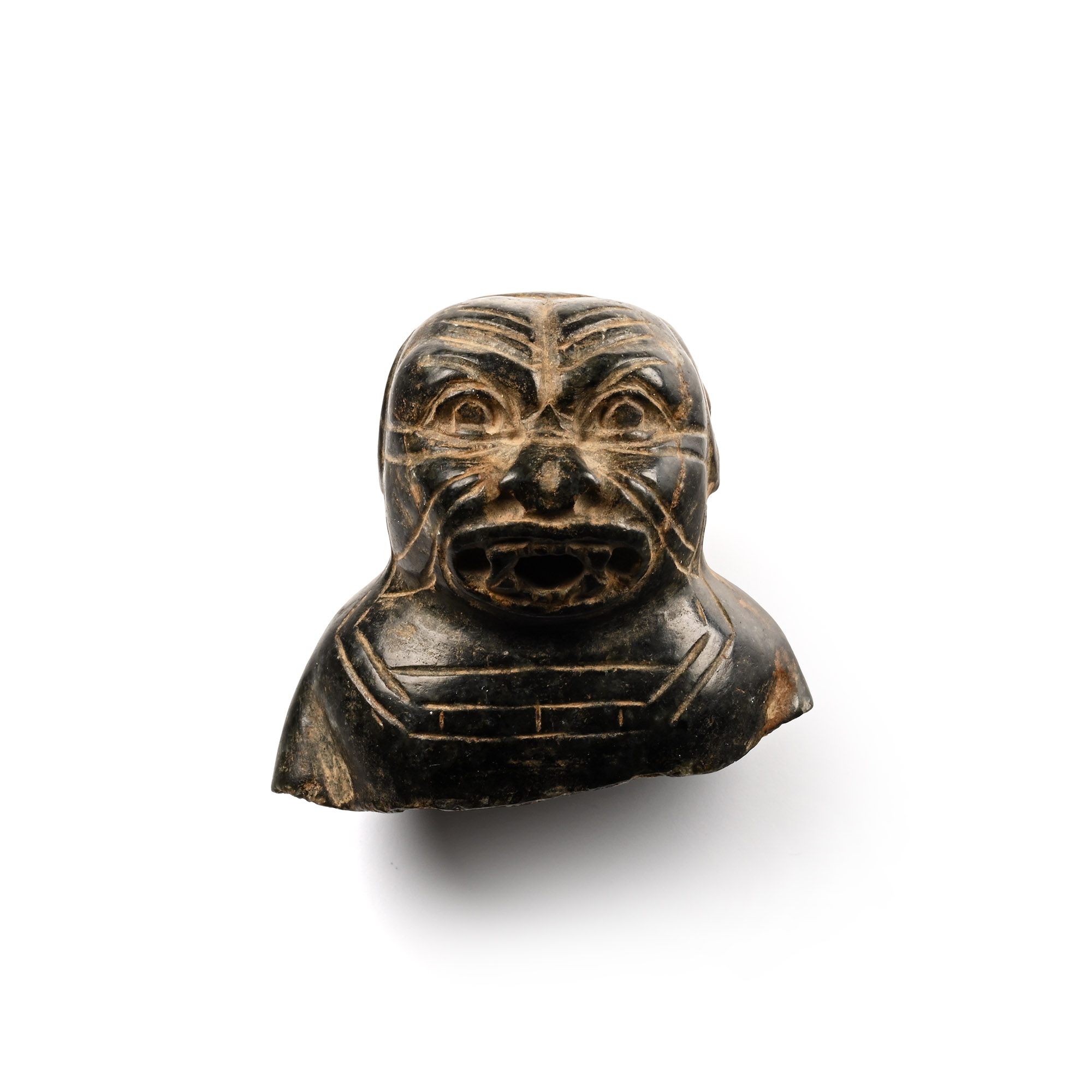
The second object is a small stone bust, thirty-seven millimetres high, its brow and cheeks worked in heavy hatching, the eyes cut as flat D-shapes, the nose a snubbed feline muzzle, the mouth an oval gape with the teeth showing. The catalogue calls it Humbaba.
Humbaba, or Huwawa in the older Sumerian, is the ogre the god Enlil set to guard the Cedar Forest, and whom Gilgamesh and Enkidu kill to make their names. In the epic his terror is absolute: "his voice is the Deluge, his speech is fire, his breath is death," and Enlil "made it his lot to terrify men." He wears the seven radiances, the melammu again, the same weaponised awe that clings to Pazuzu. And here the logic of the conscripted monster works itself out with a certain grim neatness. Once Gilgamesh has cut the guardian's head off, the head goes to work as a guard. Detached, the face itself turns protective, good at driving off evil spirits. Jane Burr Carter lists where it turned up in the Old Babylonian period: nailed on tombs, carved on a temple door, fastened to divine furniture, hung above scenes of sacrifice. Wiggermann sees the same destiny in the object itself, the mouth agape and the tongue showing "just like the heads of the apotropaic lions," and concludes that Humbaba "seems to be destined to become a doorkeeper." Karen Sonik draws the line to the first object directly: Pazuzu, she notes, "largely replaced Huwawa as an apotropaic boundary marker in the first millennium," the two of them doing the same work with the same weapon, a frightening face at a boundary.
Sidney Smith, in a study that still sets the terms, saw that the faces are built from a single line twisted round on itself to make all the features at once, and that the line "is, of course, the intestinal tract." The diviners who read the future in a slaughtered sheep paid close attention to the tīrānū, the coils of the colon, which fall into a tight spiral, and the resemblance was not lost on them. It produced an omen, attested in several versions: "if the intestines look like Huwawa's head, it is an omen of Sargon, who ruled the land." A seventh-century clay guide to the shapes gives the omen in full and signs off "Hand of Ardi-Nannar, the seer." The monster's face and the coil of gut in which usurpation could be read were, quite literally, the same shape.
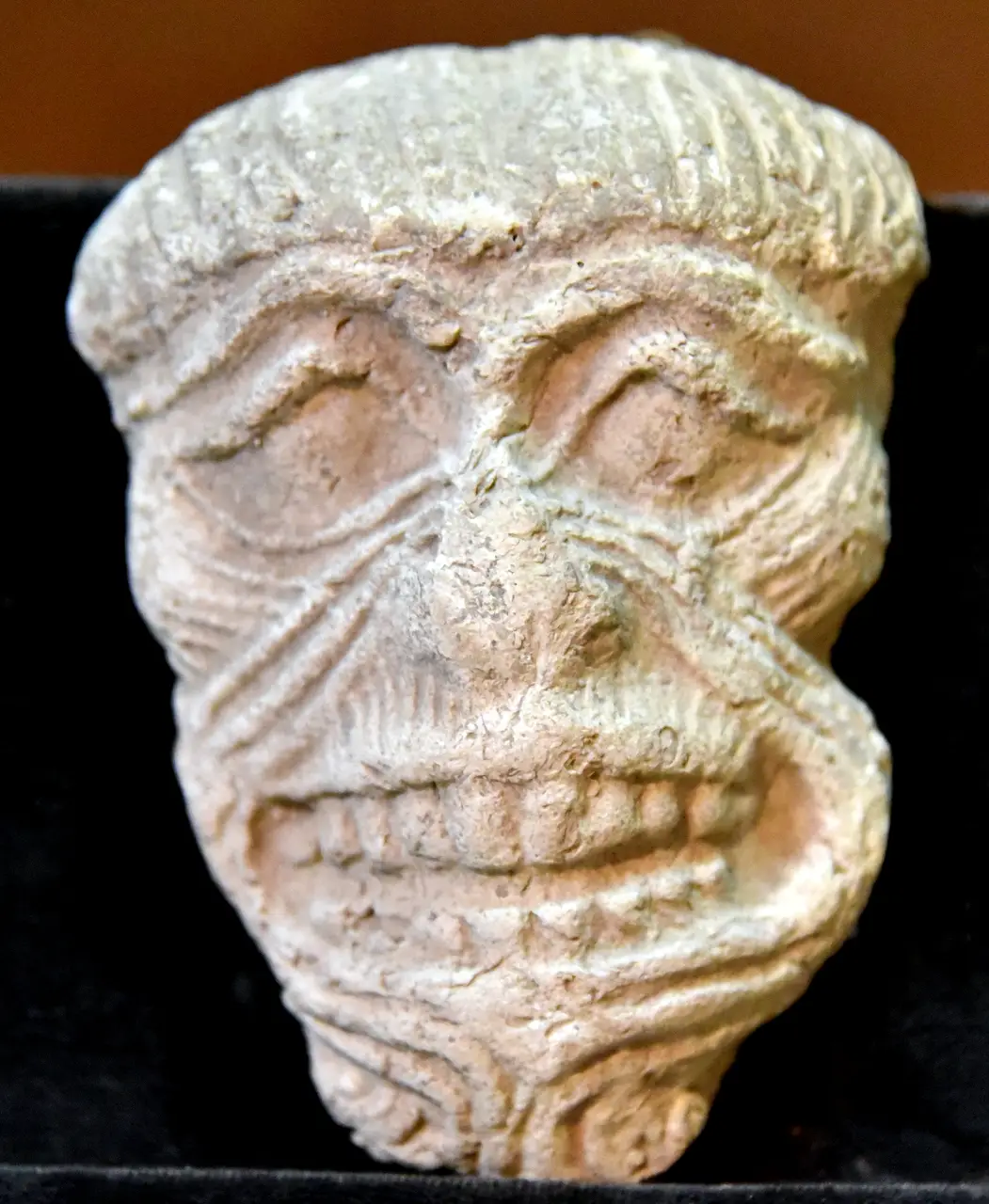 The classic Humbaba face in fired clay, its features drawn as one continuous coiled line. From Ur, Old Babylonian. Sulaymaniyah Museum, Iraq. Photo: Osama Shukir Muhammed Amin FRCP(Glasg), CC BY-SA 4.0, via Wikimedia Commons.
The face is overwhelmingly a terracotta object: as Sarah Graff puts it, "by far the largest segment of the corpus of Humbaba images is terracotta plaques," mould-made and cheap. Stone versions are not unknown, on hard-stone cylinder seals, on small amulets, and once on a monumental relief block from Tell al-Rimah that its excavators called unique in the medium. What is genuinely scarce is a Humbaba bust carved fully in the round, as this one is. Scarce is the honest word; the type is otherwise clay.
Pazuzu, or Humbaba?
There is a complication with the little bust, and it is the best thing about it. This same object, its description matching word for word, has been offered in the saleroom before. In that earlier listing it is not called Humbaba. It is called Pazuzu.
The identification, in other words, is not settled, and the piece itself is the evidence. Smith saw the problem coming. For anything made after about 1000 BC, he warned, it is "more than doubtful" whether an object is meant for Humbaba "unless that characteristic feature, the single line, belongs to it," and without the coil the mask "might represent any one of half a dozen demons." This bust has no single coiled line; its face is hatched, not drawn in one intestinal stroke. It has neither the horns and scorpion-tail body that would settle it as Pazuzu nor the coil that would settle it as Humbaba. It is an uninscribed, first-millennium grotesque, and it sits squarely in the class Smith flagged as beyond safe naming.
That is not a defect in the cataloguing; it follows from what these faces were for. A face built to be as frightening as possible was not built to be recognisable. Terror is a general-purpose quality, and the more purely a face delivers it, the less it belongs to any one demon. The interchangeability that makes the bust hard to name is the same interchangeability that let it work: it could stand at a threshold and frighten off whatever came, precisely because it did not need to be anyone in particular.
The lamassu that is not quite a lamassu
The third and priciest object, catalogued at three to four thousand pounds, is a deep stone vessel a little under twenty centimetres long, carved on one side with a reclining human-headed creature: the legs tucked under, the left foreleg raised against the side of the head, and the head itself modelled in the half-round, with a long beard and hair framing the face. The catalogue calls it a lamassu, and glosses the word with the image everyone has of one, the great winged human-headed bull that guarded Assyrian palace gates.
The colossal winged bull, the aladlammû of the doorways at Nimrud and Nineveh, is a Neo-Assyrian creation of the ninth to seventh century BC; the word itself turns up only in Neo-Assyrian building inscriptions. This vessel is catalogued to the early second millennium, long before any of that. And the lamassu that did exist in the vessel's own day was a different being altogether: a protective goddess, robed and female, the interceding Lama who leads a worshipper by the wrist toward a greater god. A bearded, reclining animal is not her.
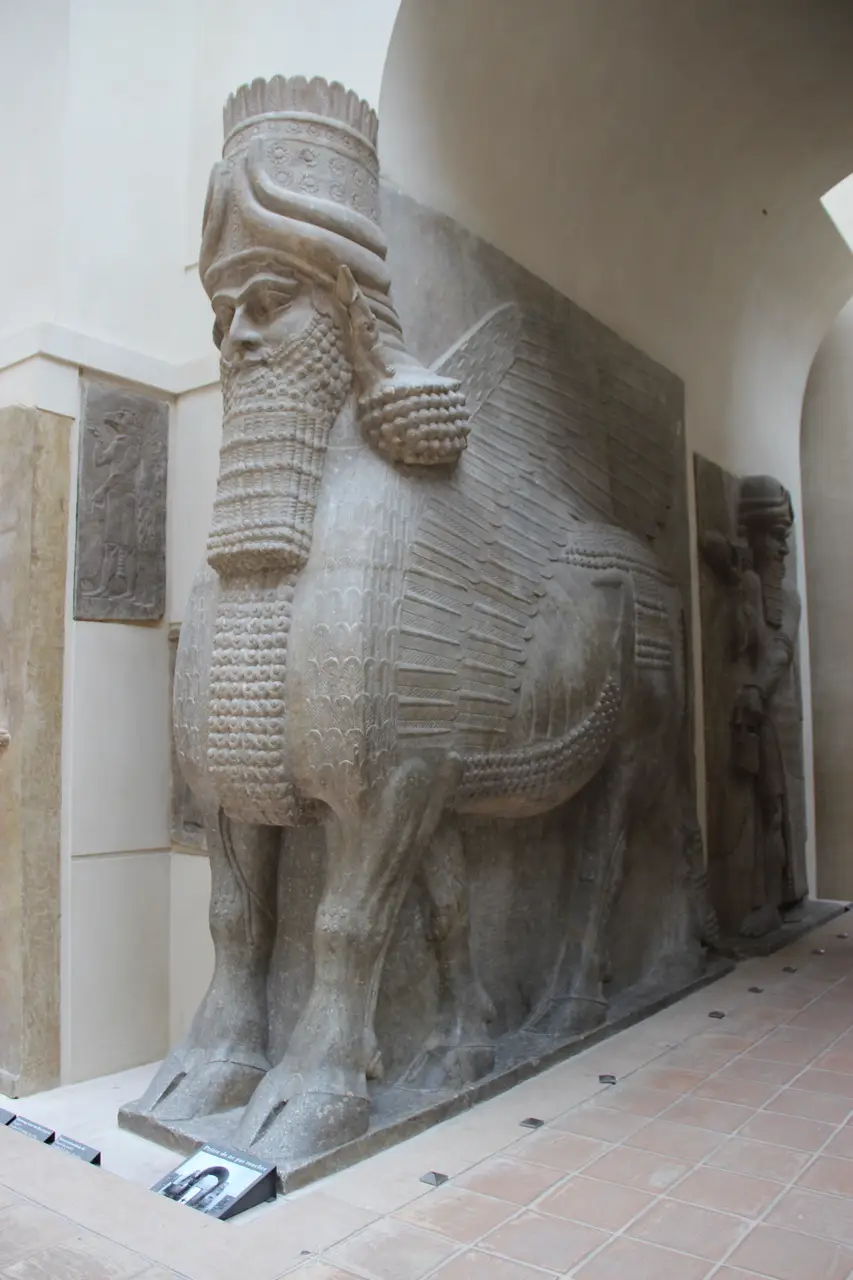 The lamassu everyone pictures: a colossal winged, human-headed bull from an Assyrian palace gate, a Neo-Assyrian creation roughly a thousand years younger than the vessel in the sale. From the palace of Sargon II, Khorsabad. Louvre Museum, Paris. Photo: Gary Todd, CC0, via Wikimedia Commons.
What the creature most likely is has a homelier pedigree. Wiggermann calls the recumbent human-faced bull or bison the very image of settled calm, "the apogee of unshakeable peace," a benign guardian linked from the third millennium onward with the sun-god. The close parallels are stone vessels of just this kind. A calcite lamp from Ur, now in Philadelphia, is decorated with a reclining bearded human-headed bull; a steatite figure in the Louvre, dated to the late third millennium, is described by the Metropolitan Museum in words that could be the catalogue entry for this lot, a beneficent bison "bearded, with bovine ears and a horned tiara, and in a recumbent position with its head turned," and with a cavity that "may have accommodated a removable offering bowl." The Met's own version of the creature is labelled, precisely, "Human-headed bison," not lamassu.
So "lamassu" is a reasonable shorthand for the guardian-spirit idea, and the word has always been slippery; Wiggermann concedes "the many difficulties surrounding this term." But the being the reader pictures on hearing it, the winged colossus, is the later and grander outcome of the same doorkeeper logic that buried a clay figure under a floor, not the modest reclining bull on this vessel. The colossus is the crescendo. This reclining bull is the older, quieter note.
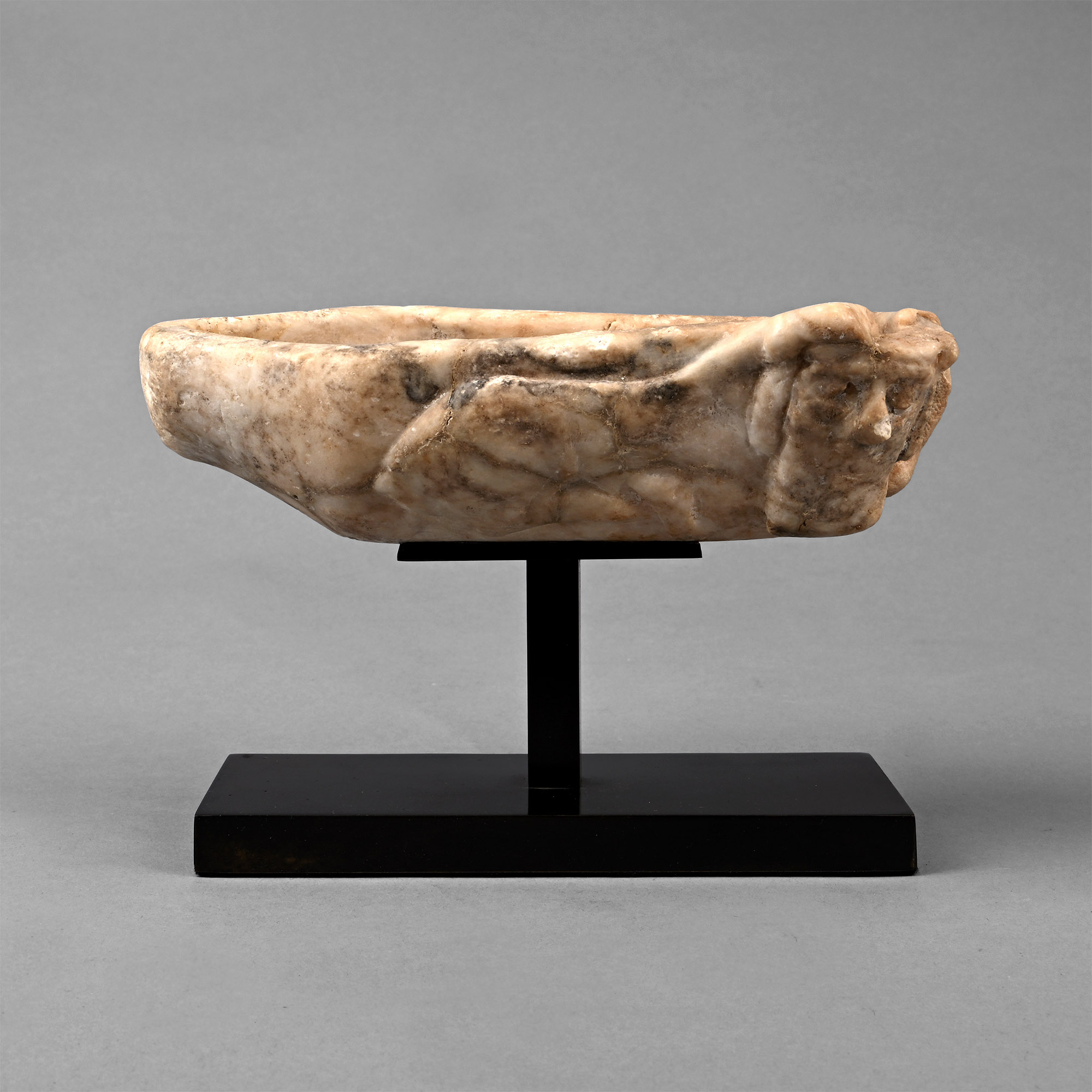
There are two reasons to hold the label at arm's length rather than take it as fact. The first is date. Carved figural stone vessels of this sort peak in the third millennium and only trail into the second; documented Old Babylonian examples are sparse, the securely dated parallels all sit earlier, and a projecting head modelled in the half-round is hard to match on any Mesopotamian stone vessel at all. An "early second millennium" label on an unexcavated figural piece is soft by nature. The second reason is sharper. The most convincingly Old-Babylonian-looking recumbent human-headed-bull vessel in the British Museum turned out, on examination, to be partly modern: its head had been recut and its inscription added, in the curator's words, "by a modern forger." The profile of this lot, a reclining guardian on an Old Babylonian stone vessel with a market-only provenance and no find-spot, going back to a London and Geneva collection said to have been formed before 1988, is exactly the profile that has been faked before. That does not condemn it. It means the attribution belongs, for now, to the catalogue rather than to the record. The "alabaster," incidentally, is a trade term for a translucent stone that is as likely to be calcite or travertine as true gypsum, and has not been analysed.
Did the face travel west?
One more question hangs over these frontal, glaring faces, and it runs a long way past Mesopotamia. A line of scholarship, from Clark Hopkins in 1934 to Jane Burr Carter in 1987, traced the face of the Greek Gorgon, Medusa and her sisters, back to the mask of Humbaba, carried west through Phoenician and Cypriot workshops. Carter built the fullest chain of objects, from Kish through Enkomi on Cyprus to the Levantine coast, Carthage, Sparta and Crete. That a frontal monster-face guards a threshold, and that a hero is shown killing a face-on demon, did cross into Greek art during the orientalizing period; even the doubters grant that the images travelled, and the standard Assyriological reference allows that the look of Humbaba fed the look of the Gorgon.
Whether Medusa is specifically Humbaba's descendant is another matter, and the honest answer is that it has never been shown. Carter supplied the objections herself. Humbaba's face drops out of Near Eastern art after the middle of the second millennium, some seven hundred years before the Gorgon surfaces in Greece, and no text or inscription ties his name to the grotesque masks of Cyprus, Phoenicia, Sparta or the Punic cities. Other scholars reach for other ancestors: Walter Burkert reassigned the borrowed face to Lamashtu and called the whole process one of "creative misunderstanding," while William Culican preferred Pazuzu, and older writers floated the Egyptian Bes and the goddess Hathor. That so many eastern candidates have been proposed is itself the argument that none is proven. And the Gorgon carries features no Humbaba has: the lolling tongue, the snake hair, the wings, the female sex. The shared idea is solid enough, that a fearful face set at a boundary turns evil away. The family tree is a guess.
The face on the little bust in the September sale has already answered to two names in the saleroom, Pazuzu and Humbaba, and it could answer to a third without anyone being able to prove it wrong. Catalogued this time as Humbaba, it goes to the block on 8 September as lot 211. Last time it went as Pazuzu.
TimeLine Auctions, 7th August 2026