Home > Stories by TimeLine Auctions
Stories by TimeLine Auctions
Fired Upside-Down: How Ancient Egypt's Black-Topped Pottery Got Its Two Colours
The border between the two colours is the first thing to look at. On this jar it runs round the shoulder in a slow wave, dropping a hand's width lower on one side than on the other, and nowhere is it straight. A workshop dividing a pot into a red body and a black top with a brush would have ruled a line. What divided this one was the surface of a bed of ashes, on the one morning of its firing, about five and a half thousand years ago.
The jar is Egyptian and Predynastic, made centuries before the first pharaohs, and it is a tall example of what archaeologists call black-topped ware: forty centimetres of Nile silt clay, raised by hand from coils, coated in red ochre, polished with a pebble and blackened from the rim down to that wavering line. There was no potter's wheel in Egypt yet, and would not be for another thousand years. There was no kiln involved either. Nicholson and Shaw's Ancient Egyptian Materials and Technology, the standard reference for how Egyptian things were made, calls this "some of the finest pottery known from ancient Egypt", then concedes that "the exact method of its manufacture is unknown". The jar is lot 15 in our sale of 8 September.
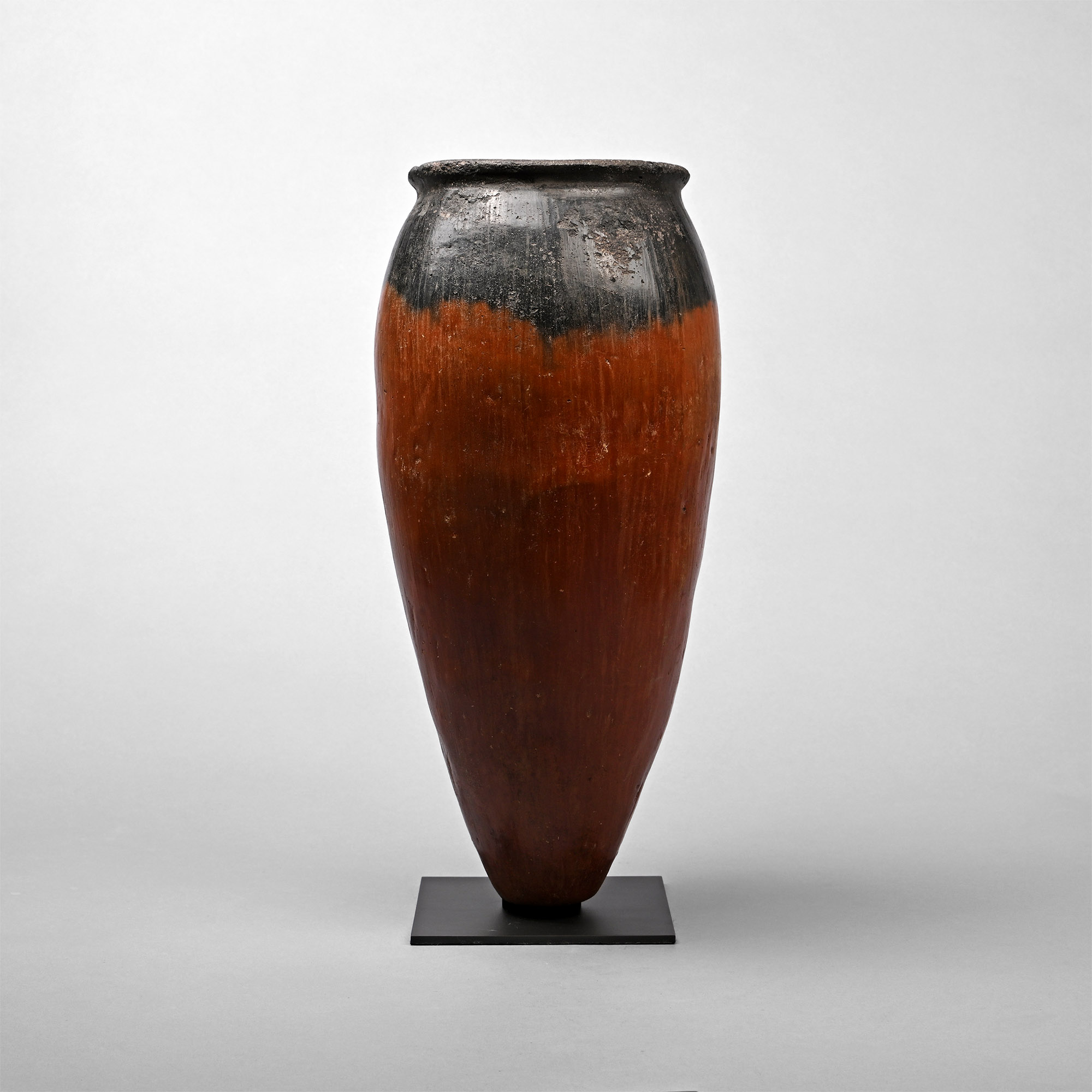
No wheel, no kiln
The vessel went up as coils of Nile silt, ring on ring, the walls thinned and trued by hand as they rose; the same handbook judges black-topped vessels "probably the most carefully executed coil-built vessels" of their period. The wheel that would eventually make such work routine reached Egypt only late in the Old Kingdom, around 2250 BC. Every Predynastic pot is handwork.
Over the finished body went a slip of red ochre, the iron mineral hematite ground into a wash, and then, before any fire, the burnish: stroke after stroke with a smooth pebble, compacting the clay until it shone. The long vertical streaks that catch the light down the body of this jar are those strokes, still individually legible. In older books the shine is sometimes called a glaze, which it is not. Glaze is glass; this is pressure.
Firing meant an open fire, fuel heaped around and over the stacked pots. Simple updraught kilns did exist in Egypt by the middle of the Predynastic, and excavation at Hierakonpolis has produced them, but no kiln has ever been linked to black-topped ware. The finest pottery of ancient Egypt came out of a managed bonfire.
Mouth-down in the ashes
The trick was in the setting. The pot went into that fire upside-down, mouth pressed into the fuel, rim buried in ash. Flinders Petrie set the reconstruction down in 1896: the pots "were usually baked mouth downward", so that "the brim was covered with the ashes". Down in the ash bed the fire's gases could not clear, so the buried mouth sat in a pocket with little oxygen, much smoke and free carbon, while the exposed body above stood in open, air-fed flame and its iron slip burned red. One fire, two atmospheres. They met at the surface of the ash, and the meeting is the line that waves around the shoulder of lot 15: a tracing of exactly how the fuel lay against the clay.
The recipe has been rerun. John Coles's Archaeology by Experiment records Henry Mercer's replica, fired in a single operation with its rim in sawdust under a wire net, which came out "duplicating the ancient Egyptian examples"; at Hierakonpolis, Masahiro Baba has fired reconstructions on the ancient ground itself. The details are still argued. Alfred Lucas imagined two stages, a red firing with the blackening done afterwards; Hendrickx, Friedman and Loyens made the case in 2000 that a single firing did all the work at once. That so basic a dispute stays open says how far the makers outran the record they left.
What the black actually is
Naming the black took the better part of a century. Petrie, who had handled more of these pots than anyone alive, ruled in the same 1896 account that the red hematite of the slip had been reduced in the fire to magnetite, the black magnetic oxide of iron, and dismissed the obvious alternative, smoke-borne carbon, outright. His answer went into the handbooks and stayed for decades.
Lucas doubted it, and tested it. The black returned carbon on analysis, and the magnetic particles were too few to colour anything, probably native to the clay all along. Experimental firings published in the Journal of Egyptian Archaeology in 1962 agreed: the colour was "mainly due to particles of carbon", with some black iron oxide probably present in the grey band that separates black from red inside the fabric.
The nearest thing to a verdict came in 1989, from a study in the journal Archaeometry using Mössbauer spectroscopy, a technique that reads the chemical state of iron atoms directly. Applied to black-topped wares from Cyprus and Nubia, cousins of the Nile tradition, it found the black to be free carbon together with ferrous iron bound into the silicates of the clay, and reported that magnetite was "not found in any of the samples". The same study noted what any handler can check: the colours run below the surface into the core of the fabric, and the boundary between them is nothing like the line a brush leaves. Much of what Petrie built on these pots still stands; the chemistry of his own class B is the part that fell, and his version still surfaces in print.
Petrie's paper slips
Class B is Petrie's label. In two winters at Naqada and Ballas, 1894 to 1895, he and his workmen cleared between two and three thousand graves of a culture no one had seen before: bodies flexed on their sides on matting, pots of unfamiliar shapes set around them. He misread the find at first, publishing the cemeteries as a "New Race" that had entered Egypt after the collapse of the Old Kingdom; it was Jacques de Morgan who put the graves where they belong, before the first dynasty, in the centuries when the Nile valley was assembling the parts of the pharaonic state.
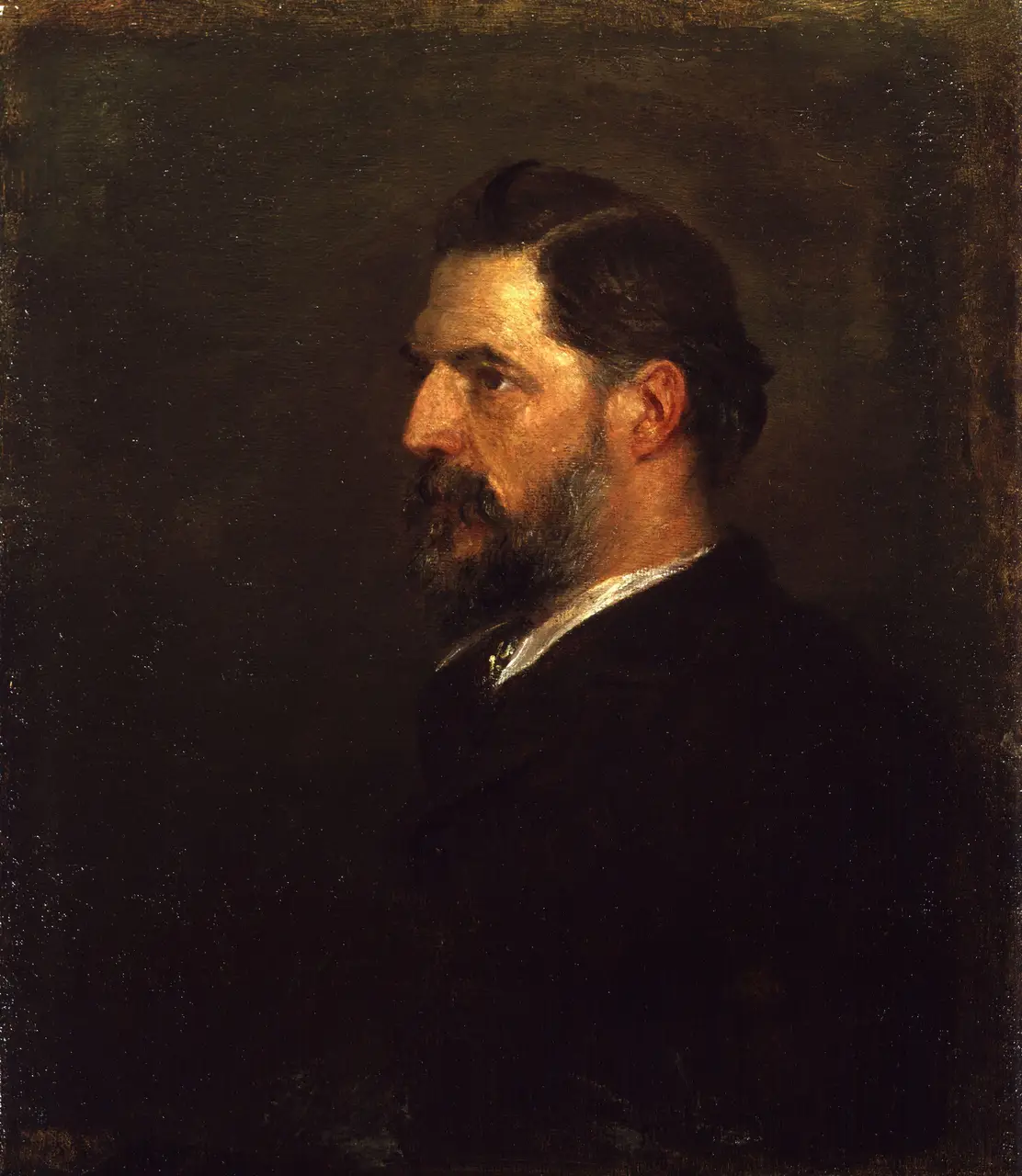 Flinders Petrie in 1900, five years after the Naqada winters, painted by George Frederic Watts. National Portrait Gallery, London; public domain, via Wikimedia Commons.
That left the dating. Thousands of graves, no texts, no stratigraphy worth the name: Petrie's solution was to write each grave's pottery onto a slip of paper and sort the slips, again and again, until the types fell into smooth overlapping runs, then cut the sequence into numbered stages, Sequence Date 30 to Sequence Date 80. It was the first seriation in archaeology, worked out on exactly this kind of pot. Nine pottery classes anchored the system. Black-topped red ware was class B; its red-polished twin without the black top, class P, is the same fabric, the same slip, the same burnish, separated only by how the pot met the fire.
Werner Kaiser re-sorted the material in the 1950s and gave the culture its modern name and divisions, Naqada I, II and III. Through every revision since, black-topped ware tells the same story: present in the Badarian, dominant in Naqada I, declining through Naqada II as painted and marl-clay wares take over the fine end of production, gone by Naqada III. The class had a run of roughly a thousand years, and a Naqada II jar stands in its last act.
The shape runs on a different clock. Elizabeth Finkenstaedt's study of 1976, devoted to the dating of the ware, found that the tall pointed bottles cluster at the very end of Naqada I and into Naqada II; Elise Baumgartel had already judged "the real bottle" a latecomer. Class and shape cross at exactly the point where this jar sits: a tall, late form of a fading ware, consistent with the label it carries.
Absolute years are the loosest part of any Predynastic label, best read as a wide bracket. "Circa 3900-3400 BC" spans what current schemes would divide between Naqada I and Naqada II together, with Naqada II proper opening nearer 3600 or 3500 BC. And the ground itself is moving: in 2013 Michael Dee and colleagues published a Bayesian radiocarbon model that opened the whole Predynastic sequence two to three centuries later than the estimates in the books, and ran it shorter. Hold on to "about five and a half thousand years old"; treat anything tighter as a position in an argument that has not finished.
What a two-coloured jar was for
Black-topped pottery was everyday ware. It turns up in settlement debris as well as cemeteries, in the graves of men, women and children alike, and its production was so uniform along the valley that the pots say almost nothing about the standing of their owners; wealth in a Predynastic grave announces itself in the grave's size and in the quantity and rarity of everything else in it. In the graves the jars stood around the flexed body. Some held food or drink for the dead. Excavators regularly find others empty: token offerings, or containers of goods that left no trace.
The black may have been earning its keep all along. Carbon choking the mouth and inner surface makes a silt vessel distinctly less porous, which matters in a jar meant to hold liquid, and, as David Wengrow has pointed out, the tradition died out just as Egyptian potters took up marl clays that hold liquids without help. On that reading the black top began as a seal.
What the ware became afterwards is where its ritual reputation comes from. Karin Sowada, in a 1999 study in the Journal of Egyptian Archaeology, gathered the black-topped vessels of the Early Dynastic period and the Old Kingdom, a corpus of around eighteen, made or kept long after the everyday ware was dead, and found them in temple deposits and important tombs. By then black-topped had turned into something specialised and backward-looking, a ceremonial type whose tall jars belong to the ancestry of the hes-vase, the spouted libation jar of the Dynastic temple rite, named from the verb "to praise". A tall ovoid jar like this one comes early in the line that leads there; the hes-jar proper, spout, lid, name and all, lies centuries in its future.
The colours have attracted a matching afterlife of meaning. In Dynastic texts black is the colour of the fertile silt and of rebirth, red of the desert and of danger, and it is tempting to read a two-coloured pot as the valley in miniature. Sowada, who set the idea out for the later vessels, also wrote the honest sentence about it, "It seems almost too logical", conceding that how far the reading comes from our own sense of order is difficult to determine. The texts are centuries younger than the pots; the practical advantage of the black is not. Whatever meanings later Egyptians attached to the scheme, they attached them looking back.
Forty centimetres
Most black-topped vessels are modest: bowls, beakers and jars between ten and twenty-six centimetres. The pieces museums label large run higher, 33 to 37 centimetres; a jar in Aberdeen measures 36.5, and one in the National Museum of Ireland, excavated at Hierakonpolis by James Quibell in 1899, measures 36. At forty centimetres this jar overtops them all. It is not unique in its size, since vessels of 38 centimetres and more are documented and one coarse marl-fabric example approaches half a metre; among the fine burnished class, the pots with the slip and the pebble-work, it belongs with the largest known. Height, incidentally, dates nothing. Tall forms carry Naqada I and Naqada II labels in roughly equal measure.
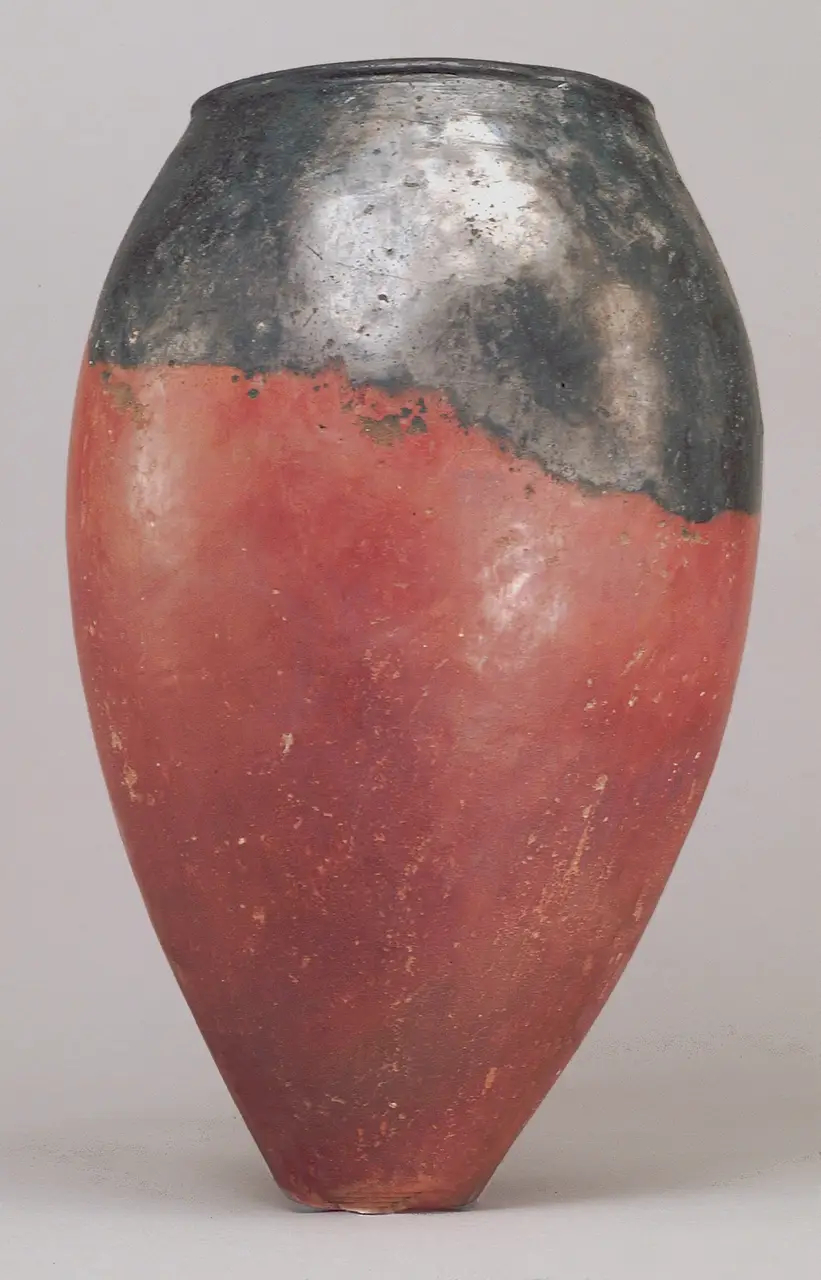 A black-topped jar of Naqada II date, about 3650-3300 BC, excavated from a grave in the Fort Cemetery at Hierakonpolis in 1934-35 and now in the Metropolitan Museum of Art. At 26 centimetres it sits at the top of the ware's usual range; the border between its colours runs in the same uneven wave. Public domain (CC0), via The Metropolitan Museum of Art.
Its modern history is quickly told: through the New York trade to a Texas private collection in the 1980s, back through New York, and, from 2018, into the Wyvern Collection, best known for its published medieval holdings.
What the jar keeps best is the record of one morning. The pebble strokes still run the length of the body; above them, the border where the ashes stood makes its slow wave around the shoulder. No two black-topped pots carry the same line, because no two fires were ever banked alike. On this one it rides high across one side and drops a hand's width on the other: the profile of a single heap of fuel, somewhere in the Nile valley, fifty-five centuries ago.
TimeLine Auctions, 9th August 2026