Home > Stories by TimeLine Auctions
Stories by TimeLine Auctions
For Better or Worse: What Made a Roman Marriage
On a little panel of wood, probably cedar, about fourteen centimetres square, a man named Iulius Flavianus is getting married. A groove runs down the outer face; to the left of it stand eleven lines of brown ink in a fast Roman hand, to the right a narrow column of witnesses. Turn it over and the other side is a shallow tray of wax inside a raised wooden frame, scored with the faint tracks of a stylus. The dowry that made the match came from the bride's mother, a woman called Aurelia Salvia, who is named in the text and who was, in law, giving her daughter away. The year, if the reading holds, is 322.
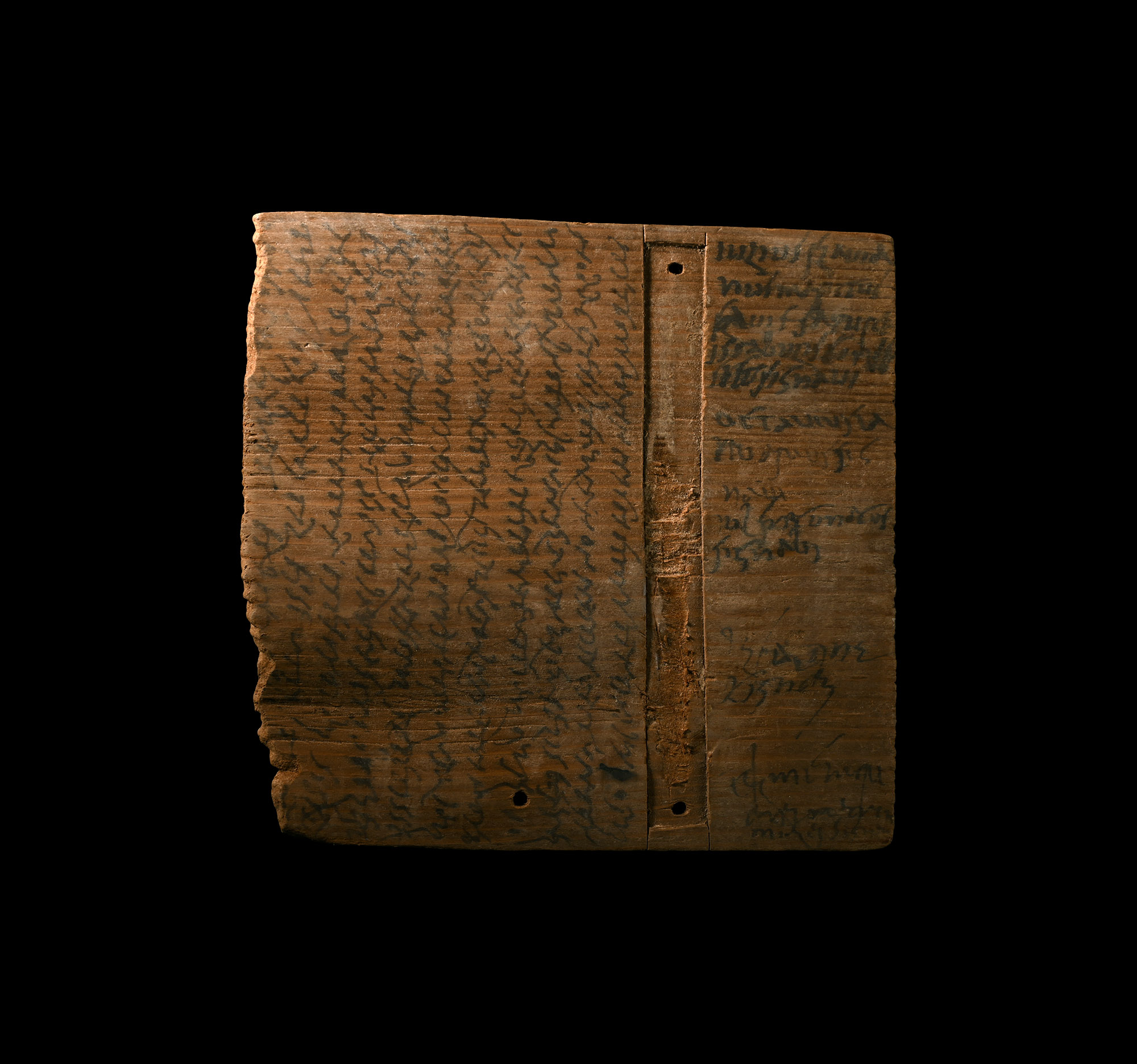
This is a marriage contract from a civilization that did not issue marriage contracts. Rome kept no register of weddings, printed no certificate, appointed no official whose job was to marry you. A man and a woman were married when they both meant to be, and they stopped being married when one of them stopped meaning it. A society that legislated obsessively about property, inheritance and status left the most consequential agreement of a private life almost entirely to the two people making it. What it produced, when it produced anything, was proof after the fact: side-documents that a marriage had happened, drawn up because a marriage that left no trace was a marriage you could lose in an argument. Four such things come up in our sale of 8 September, and between them they cover most of what a Roman marriage actually was. Two are dowry tablets. One is a soldier's bronze discharge diploma. The last is a mirror with a couple's faces on it.
A marriage no one had to register
The jurists were clear about what made a marriage, and it was neither a rite nor a document. "Marriage is made not by sleeping together but by consent," wrote Ulpian, and the rule ran past the wedding day into the whole of the union: what kept a marriage in being was maritalis affectio, the continuing intention to be married. A couple who lived apart for years but "kept the honour of marriage on both sides" counted as married; a couple under one roof who had let that intention lapse did not. Mary Beard puts the practical result plainly in SPQR: in most cases a man and a woman "were assumed to be married if they claimed that they were married, and they ceased to be married if they... claimed they no longer were." Divorce ran on the same principle in reverse, consent simply withdrawn, needing no judge and no paperwork unless someone disputed the return of the dowry.
Where other societies put a certificate, Rome had the dowry. Because the law asked for no contract, the dowry tablets became the ordinary written evidence that a wedding had taken place, setting down the property the bride brought and, above all, the terms on which it would come back. The documents proved a marriage; they never made one. A ruling of the emperors Diocletian and Maximian says as much: a marriage "lawfully contracted" is not undone by the want of documents. Gaius, a century earlier, had noted that "a marriage exists, though testimonies to it have not been put in writing." The dowry tablet was the nearest thing Rome had to a marriage certificate, and every Roman knew it was not one.
All of this is cleanest for the classical centuries. By the fourth, the age of these tablets, written proof mattered more than it once had, and the tablets belong to that drift; even so, in 428 an eastern law was still having to remind people that a missing marriage document did not dissolve a marriage.
The dowry stood in for the certificate
A dowry was not legally required, but a marriage without one invited a question. Judith Evans Grubbs, whose sourcebook gathers the Roman marriage texts, notes that a dowry "demonstrated to outside parties that a union was legitimate marriage and not concubinage": its presence, and later its orderly return, was how neighbours and courts told a wife from a mistress. The lawyers treated it as public business, too: "It is in the interest of the state that women have their dowries secure," wrote Paulus. There could be no dowry without a marriage, and by long custom no marriage of any standing without a dowry.
A dotal pact was mostly arithmetic. It listed what the bride brought, gold, jewellery, silver, clothing, now and then land or a slave, and set the rules for getting it back if the marriage ended in divorce or death. (The catalogue's Latin label, pactum dotis, is a modern coinage; the Romans wrote of instrumenta dotalia, dotal instruments.) The wife's property stayed legally hers. Her husband managed the dowry while the marriage lasted and had to restore it when it ended, minus fixed deductions, a sixth of the value for each child, more again for a wife's proven misconduct. In large part a dowry agreement was a divorce agreement drawn up in advance.
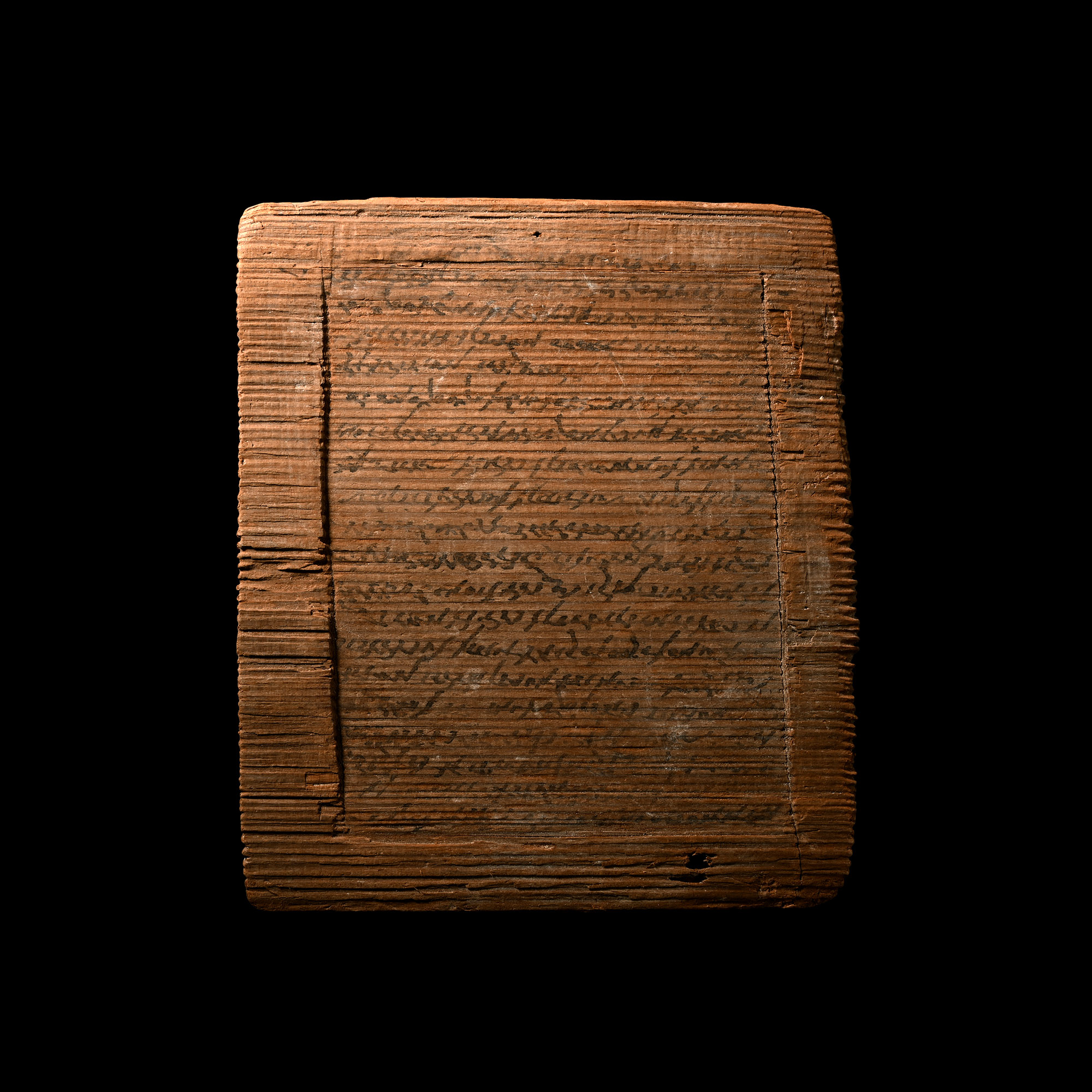
What lifts lot 115 out of the ordinary is who is putting up the money. A dowry from the bride's father was dos profecticia; a dowry from anyone else, the wife herself, a grandfather, a mother, was dos adventicia. When a mother constitutes the dowry, as Aurelia Salvia does, the usual reason is that the father is gone: dead, or captured abroad and so, by a grim Roman fiction, temporarily a slave with no power over his children. The household is effectively hers to run. And by 322 she could act in her own name without difficulty. The old guardianship of women, tutela mulierum, had shrunk to a formality and would soon be, in Grubbs's words, "no longer a living legal concept"; a mother of three children had for centuries been free under the ius liberorum to make her own will and set up dowries. The guardian's authorization that an earlier age would have demanded was, by the fourth century, all but gone.
Aurelia Salvia was doing nothing strange for her world, only for ours. A marriage settlement from Oxyrhynchus in Egypt, dated 260, has the same shape exactly: a woman named Aurelia Thaesis gives her daughter Aurelia Tausiris in marriage to one Aurelius Arsinous and supplies the dowry herself, gold, a necklace, ear-rings set with ten pearls, and clothing. Mother as giver, everyone bearing the name Aurelius or Aurelia (the surname half the empire took after the citizenship grant of 212), a dowry of jewellery and clothes: the Latin tablet of 322 is a cousin of that Greek papyrus, written a couple of generations and one sea apart.
Wood that should not have survived
The wood is as interesting as the writing on it, because objects like this are close to impossible. Wood rots. It comes down from antiquity only where the rot never got started: permanently waterlogged, permanently frozen, permanently dry, or turned to carbon in a fire. "Vast numbers of these documents were originally created," runs one survey of Roman writing tablets, "but they are rarely preserved." Whole classes of Roman record that we know were kept on wood have gone without leaving a single example. It is rare for wood of this age to survive at all, and rarer still for a piece of it to reach a saleroom.
What has come down survives in a few lucky pockets, and they are worth keeping apart. From the fort at Vindolanda on Hadrian's Wall, waterlogged in the ground, came the thin ink-written leaves that include a birthday invitation from one officer's wife to another, its closing line added in the sender's own hand and among the earliest known Latin written by a woman. Pompeii and Herculaneum yield the wax tablets, their letters pressed into a black wax skin over a sunken wooden panel and kept by being charred in the eruption of 79; at Herculaneum the heat melted the wax, leaving often only the inked witness-names across the frame. The closest match to our tablets in both form and material comes from the Roman gold mines at Alburnus Maior in Dacia, modern Roșia Montană in Romania, where twenty-five triptychs of fir and beech were found in the galleries, deeds of sale and loan from the second century, built exactly as lot 115 is built.
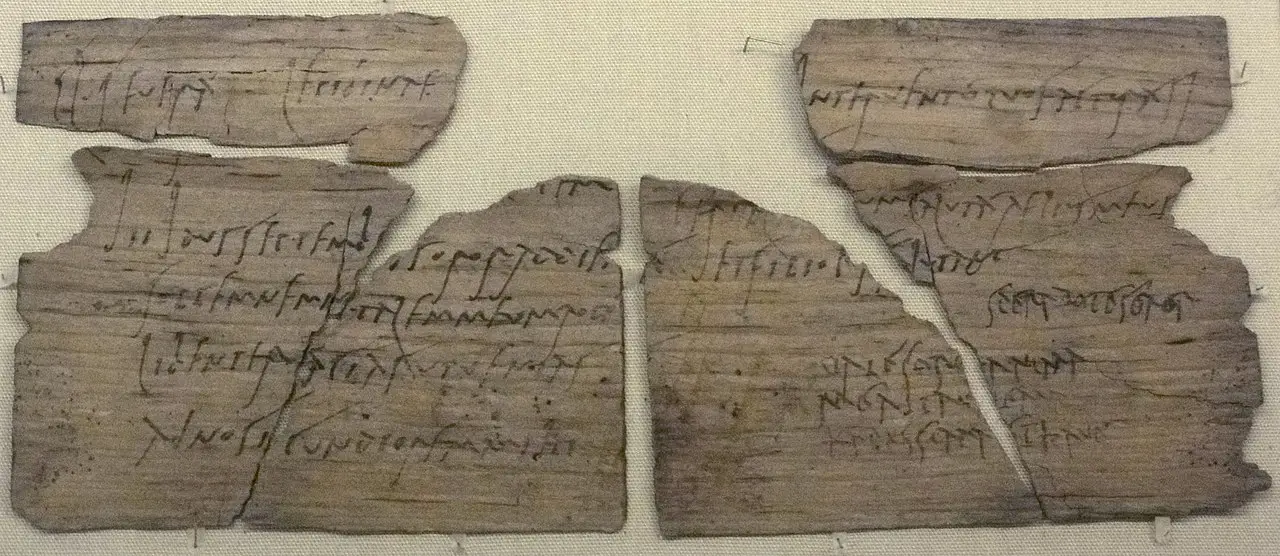 The birthday invitation from Claudia Severa to Sulpicia Lepidina, written in ink on wafer-thin wood at Vindolanda about AD 100. British Museum. Photo: Fæ, CC BY-SA 3.0, via Wikimedia Commons.
That construction is the clever part, and it is also what a forger would have to get right. A Roman legal deed of this kind was written out twice on the same tablets. One copy, the scriptura interior, was folded shut, tied with a cord threaded through holes in the wood, and sealed; the other, the scriptura exterior, lay open on the outer face for anyone to consult. If the open text were ever challenged, a magistrate could break the seals and check it against the sealed inner original that no hand had reached since the wedding. Down the outer face ran the groove, the sulcus, and along it the witnesses pressed their seals and wrote their names, which is precisely what the right-hand column of lot 115 holds. The system had statutory teeth. A decree of the Senate under Nero, in 61, required that such tablets be pierced, bound with a threefold thread and sealed just so, and ruled that tablets "produced in any other way shall not be considered to have legal effect." Seven witnesses was the usual floor. Elizabeth Meyer's Legitimacy and Law in the Roman World is the modern account of why Romans trusted a sealed slab of wood the way they did.
If the tablets are what they are said to be, they come from a place where such things can last. The trade describes the two as part of one family archive from Byzacena, in what is now Tunisia, the papers of a family called Iulius reaching across the second to fourth centuries and now being sold off document by document. North Africa is dry, and dryness is one of the four conditions that save wood. It is also where the best parallel of all turned up. On the Tunisian-Algerian border, found in 1928, the Tablettes Albertini are forty-five cedar-wood panels written in ink in Latin cursive, dated by the regnal years of a Vandal king to the 490s; among the deeds of sale is a dowry, a man named Januarius endowing his bride, Geminia Januarilla. Cedar, ink, Latin cursive, a named bride's dowry, witnesses, in North Africa: the type is documented fact, not a dealer's fancy. The choice of wood closes a small circle. Both tablets are catalogued as probably cedar, and cedar oil was worked into book-rolls to keep worm and rot away; Pliny records the highest compliment a Roman could pay writing meant to endure, cedro dignus, "worthy of cedar-oil." The wood chosen to help words outlive decay, on the one class of Roman document that decay almost always destroys.
All of which describes a plausible object. None of it authenticates this one. Neither tablet has a find-spot or any record before the 1950s, when they are said to have been acquired by a collector named Sfez, a chain the saleroom asserts and no one has confirmed from outside it. The readings, names and dates come from a report by Peter Rothenhöfer, a working Latin epigraphist who studies writing tablets; his full edition of the archive is announced but not yet published, and the legal historian Otto Vervaart notes that so far there exists only a one-page summary, in Chinese, of a paper Rothenhöfer gave in 2019. Search the scholarship for Aurelia Salvia and Iulius Flavianus and nothing comes back. The field carries a forgery history, running back to a nineteenth-century edition of the Dacian tablets that printed two fakes among the genuine deeds without knowing it, and the very fame of the Albertini archive makes it the obvious template for a capable forgery to copy. What would settle the question is the physical evidence Vervaart lists, the age of the wood, the make-up of the ink, the marks left by a stylus, and none of it has been published. The catalogue is best read with its own hedges kept in: reportedly a dowry pact of 322, readings per Rothenhöfer's report, edition forthcoming. And an ancient family archive is worth more whole than in fragments; dispersing it lot by lot quietly costs the context that would help read each piece, and help prove it.
The one marriage the state put in writing
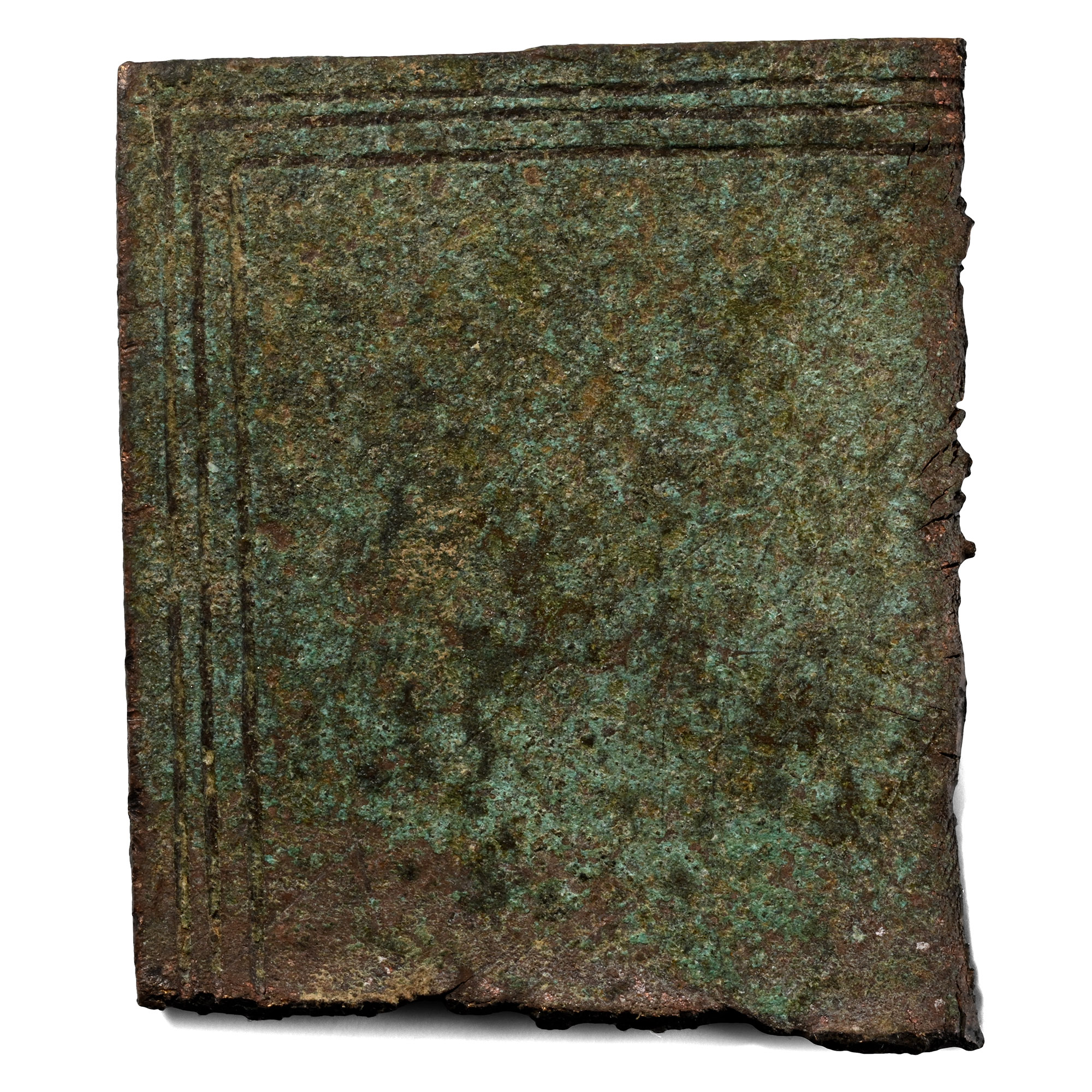
There was a single kind of document in which the Roman state itself put its name to the legality of a marriage, and it belonged to soldiers. The object is lot 125, a scrap of bronze fifty-six millimetres across, worn to a heavy green, a broken corner of what was once a hinged pair of bronze leaves about the size of a small book. Whole examples of these military diplomas survive in quantity, and they are all made the same way: an imperial grant to a discharged veteran, engraved twice over, inner and outer, on two bronze tablets wired together and sealed by seven witnesses whose names were cut beside the seal-holes. The master text was posted in Rome, on bronze, on the wall behind the temple of the deified Augustus. Every veteran carried home his own certified copy.
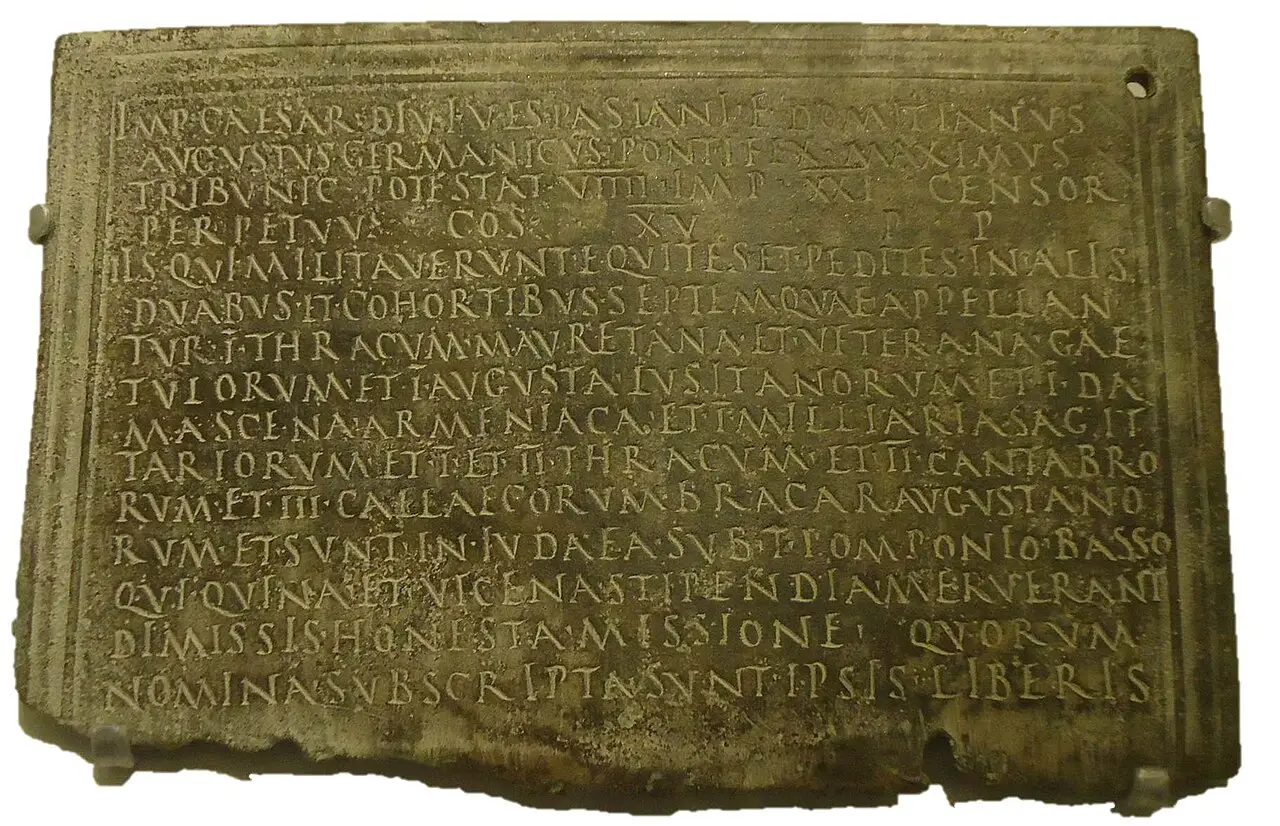 A complete veteran's bronze diploma of AD 90, granted to an auxiliary who had served in the province of Judaea under Domitian, its edge pierced for the wires that once bound its two leaves. Israel Museum, Jerusalem. Photo: Or P, CC BY-SA 3.0, via Wikimedia Commons.
The grant, in its classic form, gave two things in one breath: Roman citizenship, and conubium, the right of lawful marriage. Conubium is the technical hinge of the whole subject. A marriage in the full legal sense, a iustum matrimonium whose children were citizens and stood under their father's authority, could exist only between two people who held conubium with each other. Grant a man conubium and his union became a marriage in law; withhold it and his household, however loving and lifelong, was not a marriage and his children were illegitimate.
That mattered to soldiers more than to anyone, because for two centuries they were denied it. From Augustus, around 13 BC, down to 197, a serving soldier could not contract a legal marriage; his relationships had no standing and his children were born bastards. Claudius, Cassius Dio reports, granted soldiers "the privileges of married men... since they could not legally have wives," a fix that gives the game away. Septimius Severus lifted the ban in 197, and in Herodian's phrase let soldiers "wear the gold ring and live with their wives." Brian Campbell's 1978 study of the soldiers' marriage ban and Sara Phang's 2001 book on it are the standard treatments; how far the ban really reached is still argued, and Werner Eck has shown soldiers' children being counted illegitimate as late as 206, a decade after it was supposed to be gone.
By the date of this fragment the citizenship half of the grant had lost its point. In 212 the emperor Caracalla made almost every free inhabitant of the empire a citizen, which is why so many people in this story are suddenly called Aurelius; there were no peregrines left to promote. The ordinary auxiliary diplomas had already stopped. What went on, into the middle of the third century and only for the elite Italian units, the praetorians and the fleets, was a diploma that now certified honourable discharge and marriage in place of a change of status. Lot 125 is one of these. Its worn text does not carry the common auxiliary wording; it carries the distinctive praetorian clause, which promised that even if a guardsman took a wife who lacked citizen status, he might raise their children exactly as if born from two Roman citizens. Set against a well-published praetorian diploma of the same year, the surviving letters reconstruct to that clause, though the bronze is too far gone to read cold and the result is reconstruction, not transcription.
The year is fixed by its consuls. The fragment names one of them, Maecius Probus, and the ordinary consuls for 228 were Modestus, in his second term, and Marcus Pomponius Maecius Probus; the surviving scrap of the dating clause, "the Ides of January," sets it at the 13th of that month. So this is a soldier's marriage-and-discharge certificate of January 228, under Severus Alexander. Placed beside a civilian dowry tablet, it is the same institution seen from the far side. The dowry pact is how a family proved a marriage to the neighbours; the diploma is the one case in which the state proved it for them.
Two faces on a disc of bronze
The fourth object carries no text to speak of. Lot 103 is a bronze disc ninety-one millimetres across, a beaded rim over concentric rings, and at its centre two draped busts turned to face one another, a man on the left, a woman on the right, with the ghost of an inscription in the field between them. The back was polished and tinned, the reflecting face of the thing. Confronted busts of a man and a woman are one of the two standard images of Roman marriage; the other is a pair of clasped right hands, the dextrarum iunctio, the joining that stood for the wedding itself and belonged to Concordia, the goddess of harmony between husband and wife. Catherine Johns, cataloguing the marriage rings of Roman Britain, found the clasped hands leaning pagan and the confronted "portraits" of man and wife leaning Christian; the paired faces come down from imperial coin images of Concordia, emperor and empress posed as the model married couple.
"Marriage mirror" is a modern shorthand, not an ancient class of object; the words describe what the disc shows without naming a known type, and the older idea of the mirror as a wedding gift belongs properly to the Etruscans, centuries before. The catalogue goes further and offers names: Constantine with his wife Fausta, or Constantine with his mother Helena. The costume fits the period, since the diademed imperial bust becomes standard after Constantine's victory of 324, but the identification cannot be held. Roman portraitists deliberately made the women of an imperial house resemble one another, and specialists often cannot separate Fausta from Helena even on good marble; one paper on precisely this problem admits that "the nose, alas, offers no help in choosing between the two ladies." On a small bronze with a rubbed face and a faint inscription, the pairing is a guess. It is a tempting one, because the two women it names came to such different ends. Fausta was put to death by her husband in 326, said to have been shut in an overheated bath, in the wreckage of the scandal that had already destroyed his eldest son Crispus; Helena, his mother, died revered and was made a saint. But that whole tragic reading hangs on an attribution the disc cannot bear, and it is fairer to the object to let it be a couple, unnamed, in the pose of concord.
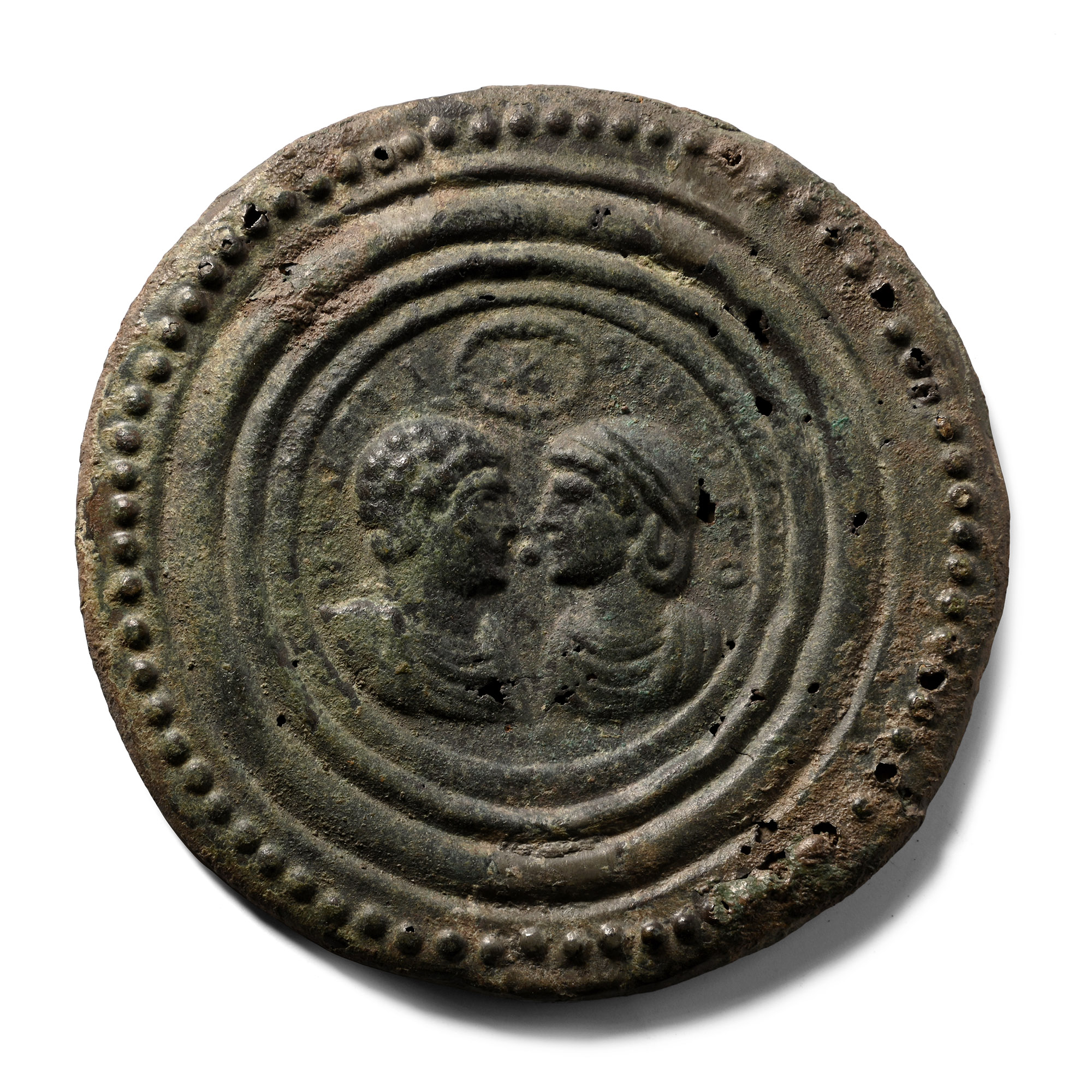
The pose had a future. Over the fourth century the figure of Concordia between the two busts gave way to the figure of Christ, and the pagan token of married harmony turned Christian without altering its composition. The same sale carries the sequel: a Byzantine gold ring of the sixth or seventh century with two facing busts, a cross set between them, Christ blessing above, and around the hoop the Greek word OMONOIA, "harmony," the old concordia under new management.
Go back to the sealed tablet. The inner copy of lot 115, folded and tied and sealed beneath its witnesses' names, was written to stay shut. It was meant to be opened only if the marriage it recorded ever went wrong: if the dowry had to be reclaimed, the terms fought over, the union undone by the same plain consent that had made it. A Roman dowry pact was in good part a set of instructions for the end of a marriage, drawn up on the day it began. Whether that day ever came for Iulius Flavianus, whether the seals were broken in anger or the wood simply outlived everyone it named and was put away, the tablet does not say. It reached us shut.
TimeLine Auctions, 13th August 2026