Home > Stories by TimeLine Auctions
Stories by TimeLine Auctions
God or Man: A Kassite Seal and Its Unanswered Question
The seal is banded agate, white stone crossed with brown bands, 42 mm long and 16 mm in diameter. It is large for a Mesopotamian cylinder seal, large enough to carry what its owner required: a single standing figure and, filling the rest of the surface, eight lines of cuneiform. Perforated lengthwise for a cord, it weighs just under 19 grams and remains in very good condition.
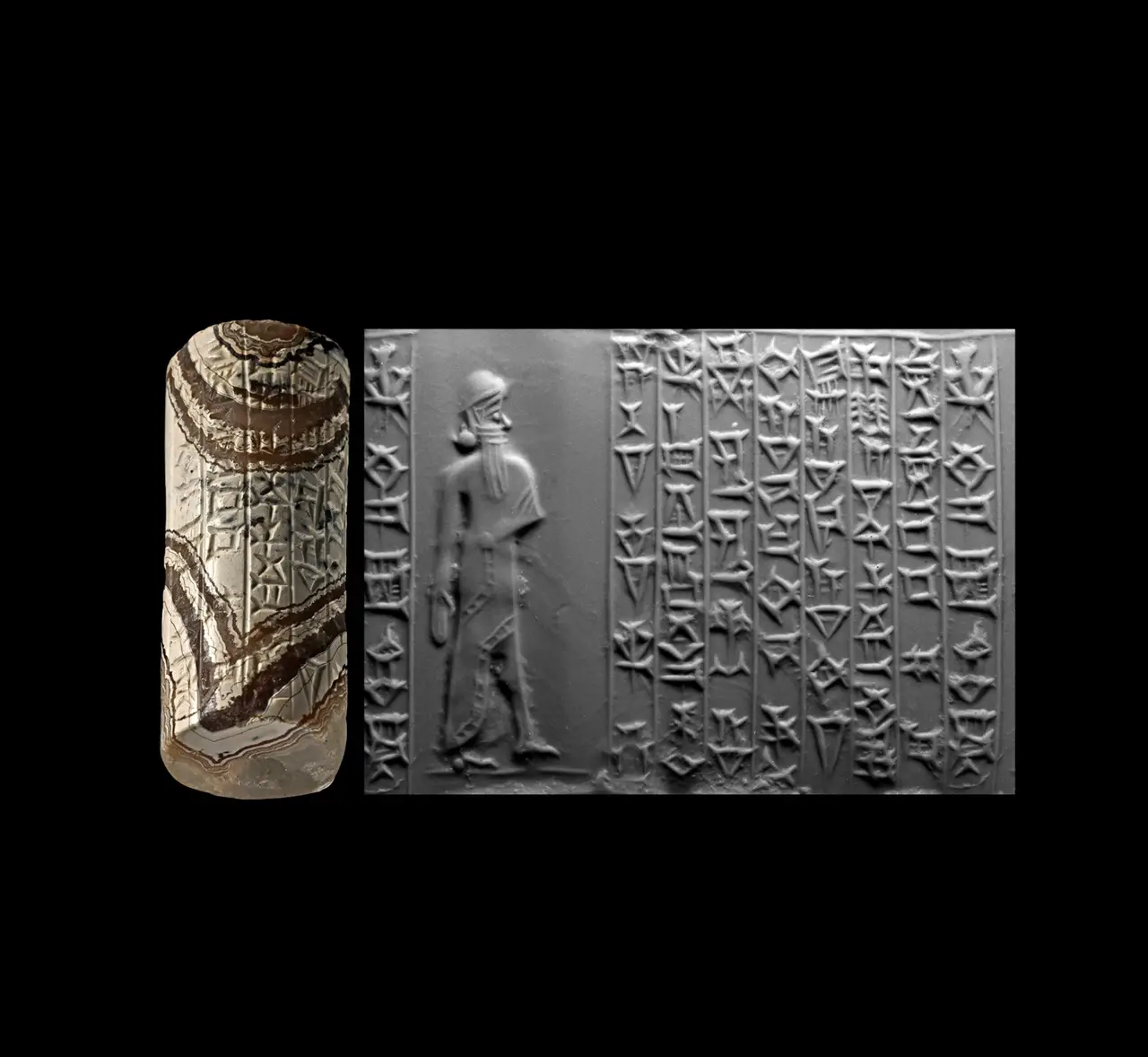
The figure stands to one side, hemmed in by the text. He wears a wraparound robe that falls from waist to feet but parts at the front, leaving one leg bare. A heavy beard covers the lower face. The head may carry a simple cap; the hair gathers in a bun at the nape. One hand rests at the waist, the other hangs down. W.G. Lambert, who translated the inscription, described the figure as "the god or man," conceding that the image alone does not settle the question. In earlier Babylonian glyptic, gods wore horned crowns and flounced robes. By the Kassite period those markers had largely vanished. A bearded figure in a plain cap could be the deity addressed in the prayer or the man who paid for the seal. The exposed leg, which on Old Babylonian cylinders signalled a god ascending or striding, here only sharpens the ambiguity.
The inscription dominates the composition, as is typical of Kassite cylinder seals from the fourteenth to twelfth centuries B.C. These eight lines are Sumerian, but of a particular kind. By the late second millennium the language had been dead for centuries. Scribes who composed seal prayers thought in Akkadian and translated, almost morpheme by morpheme, into a liturgical Sumerian no native speaker would have recognized. Lambert offered his translation "with reserves."
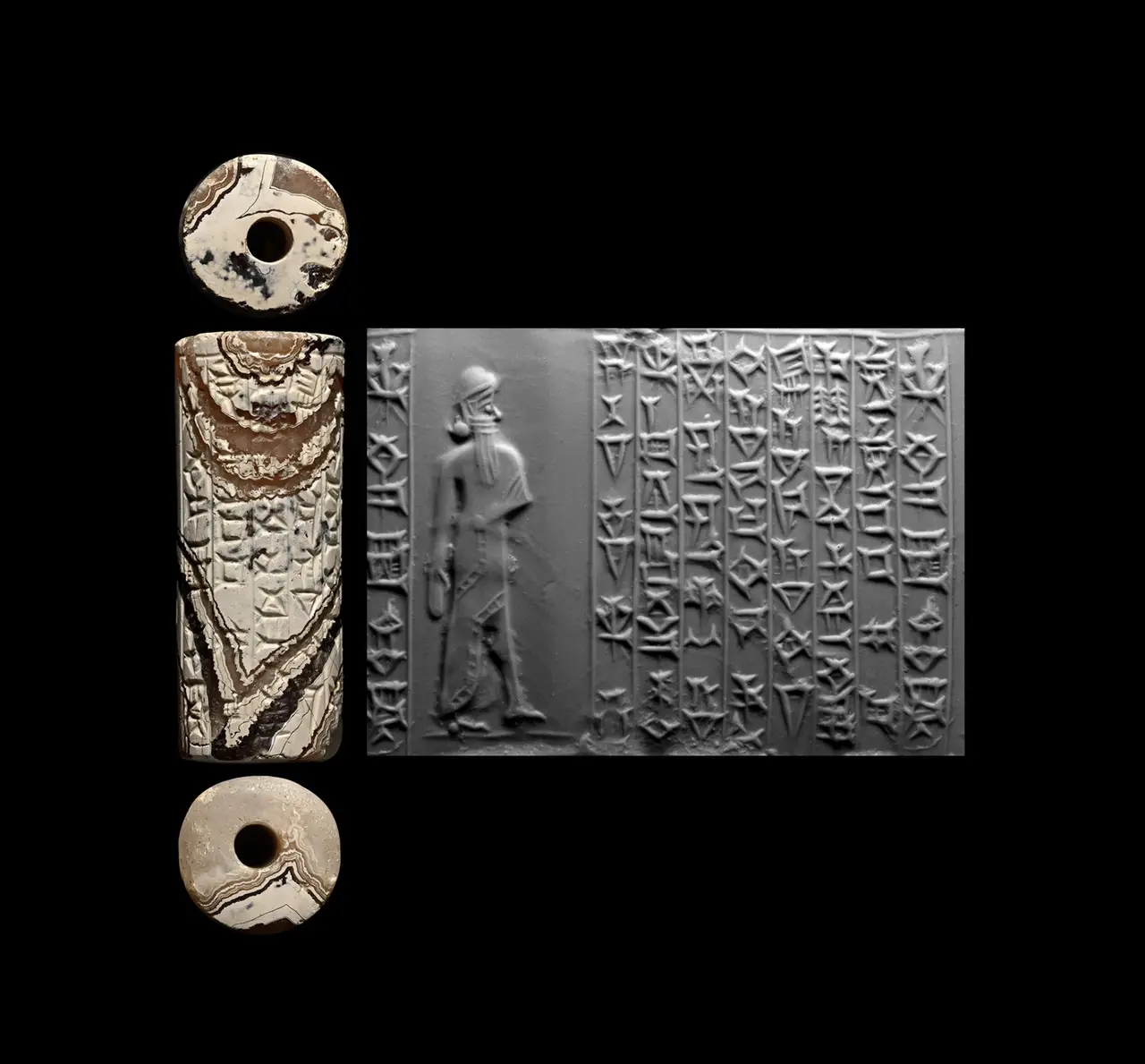
The prayer addresses Adad, the storm god, as "lofty lord, who rejoices the heart, who strengthens living creatures." It asks the god to look upon his servant, grant him a dwelling, make it prosper, and establish justice at his place. The beneficiary is named: Sîn-rā'im-zēri, son of [...]-Marduk. The father's name is only partially legible. Sîn-rā'im-zēri translates from Akkadian as "the moon god loves the offspring." To own a banded agate seal of this size, carrying a custom eight-line inscription, he would have belonged to the administrative or scribal elite of Kassite Babylonia. He does not appear in any published archive. The seal may be his only surviving trace.
Cutting eight lines of cuneiform into agate, a stone with a Mohs hardness of 7, required a bow-driven lapidary engraving wheel charged with abrasive. The straight, deep wedges visible on the surface are the product of that technology, established in Mesopotamian workshops around 1400 B.C. The prayer's difficulty was not only compositional but physical.
A close parallel in the Penn Museum: the banded agate cylinder of the Kassite king Kurigalzu (CBS 2789, c. 1390 B.C.) — shares this seal's material, format, and eight-line Sumerian prayer. That Sîn-rā'im-zēri's seal matches a royal commission in scale says something about the resources available to the Kassite upper bureaucracy.
The seal was examined and translated by Lambert in December 1994. It is in a private collection, London. The text and its owner remain unpublished.
Lambert could read what the scribe had written, or most of it. What he could not say was whether the figure standing beside those words, one leg bared in a pose borrowed from gods, was the storm god himself or the man who prayed to him. Perhaps that question will fall to the next owner when the seal appears at TimeLine Auctions on 2 June 2026 as lot 216, estimated at £20,000–30,000.
TimeLine Auctions, 21st May 2026