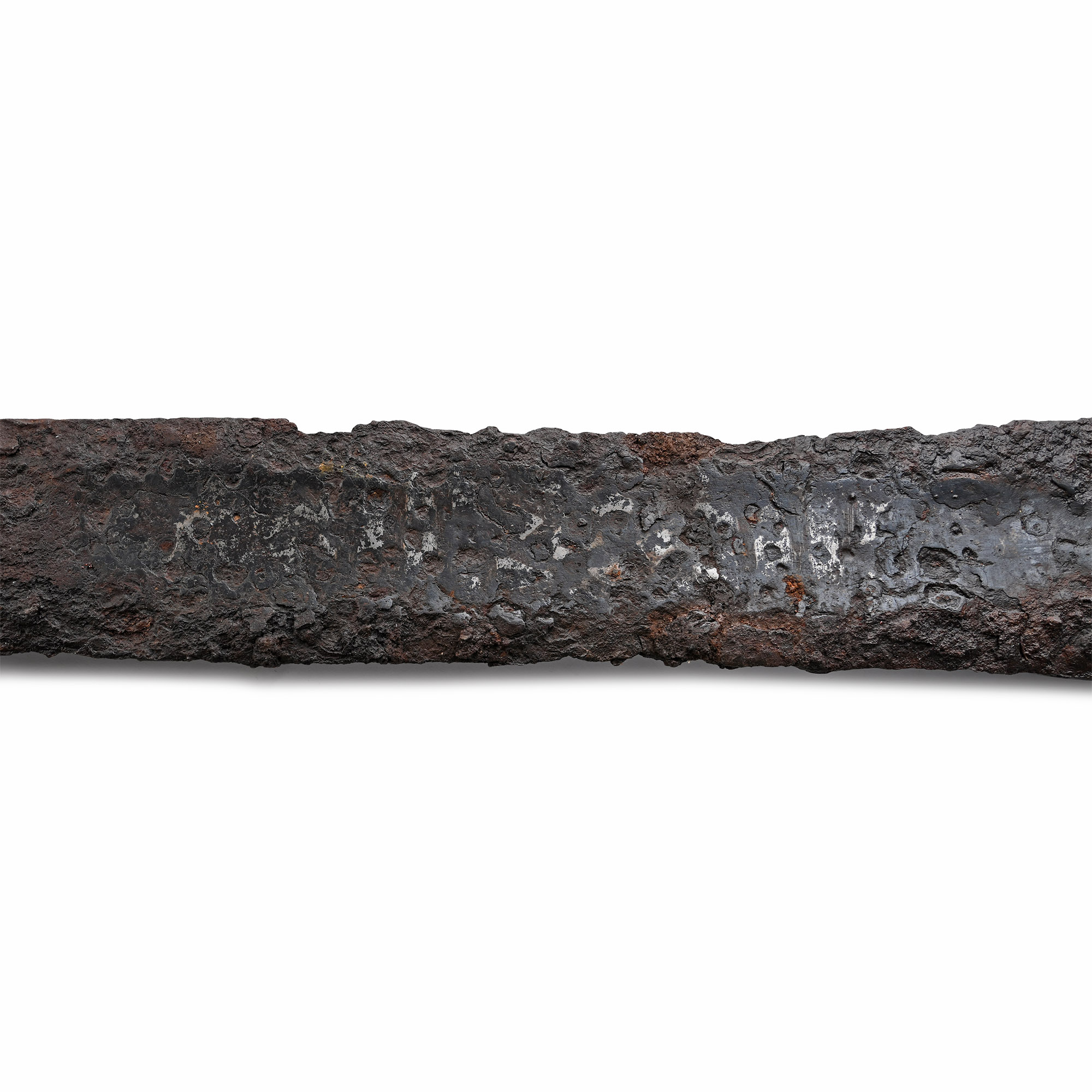
Two Viking swords of the same type came up one after the other in TimeLine's sale of 3 June 2025. Both were of the form known as Petersen's Type X, with the rounded pommel nicknamed the tea-cosy, with both being over ninety centimetres long. Lot 334, which still had traces of its wooden scabbard on the blade, reached £3,901. Lot 333 had lines of silver and copper across its guards and pommel and a name, ULFBERH+T, inlaid in the fuller, the groove that runs down the blade, and it made £16,900.
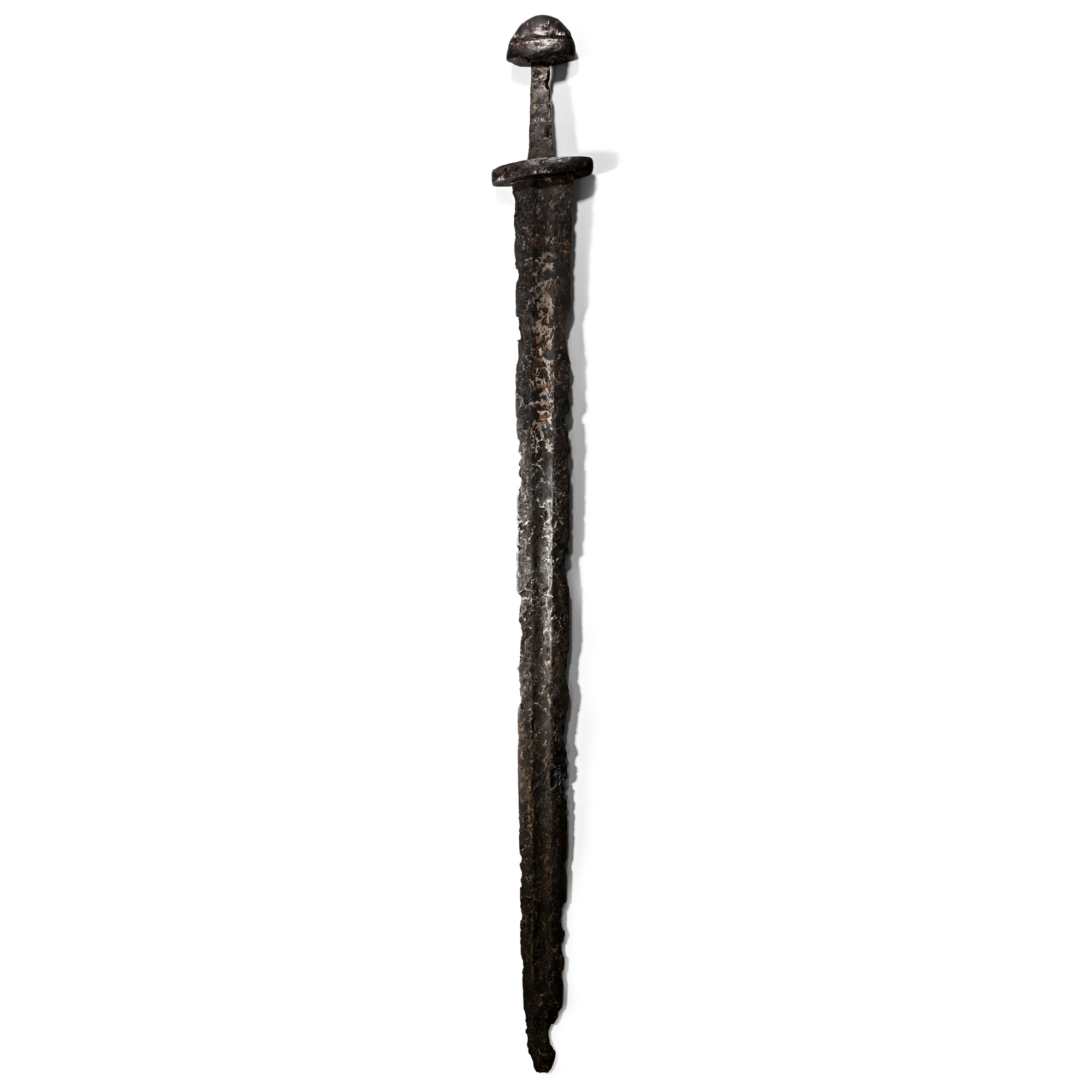
TimeLine has sold thirty-five complete Viking swords since 2011, and the higher prices go to swords with a hilt whose shape helps us more securely date it, with silver still on the hilt, or with a name inlaid in the blade. The best-known of these names, Ulfberht, belonged to a Frank, and swords with his name still reached the Vikings even though by 864 Frankish law made arming a Northman punishable by death.
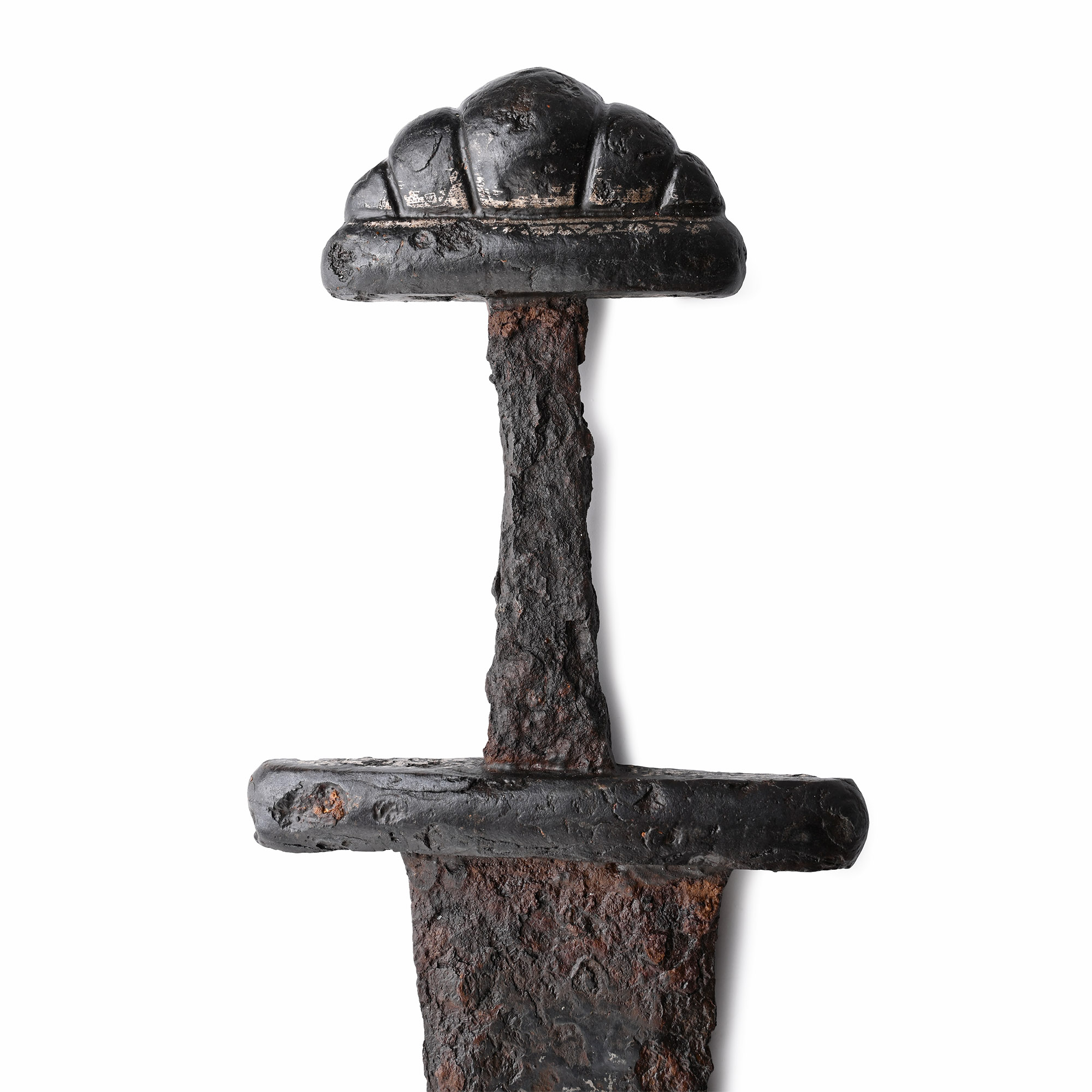
In the December 2026 sale, lot 287 is a long sword of the tenth to early eleventh century with a silver-inlaid hilt and Ringerike-style ornament on its guard, and lot 288 has a five-lobed pommel, silver on its hilt and what may be the name +VLFBERHT+ inlaid in the fullers of its blade.
What is a Viking sword worth?
A plain iron sword with a recognisable hilt type has usually sold at TimeLine for a few thousand pounds, and one with substantial silver on its hilt or a name in its blade can go well beyond that. The highest so far went to an Anglo-Scandinavian sword whose massive five-lobed pommel is carved from nephrite jade. Loose Viking pommels and other weapons usually cost much less, and the December sale also has a Viking Age socketed spearhead and a long-bladed axehead.
The law code of the Franks of the Rhineland let a man who owed wergild, the blood price for a killing, pay it in goods at fixed values: a healthy horned ox counted for two solidi, a helmet for six and a good mail coat for twelve, the same as a trained hawk. A bare sword counted for three solidi and a sword with its scabbard for seven, so the scabbard and its mounts were worth more than the sword inside. In the saleroom the hilt does that work now, and silver on the hilt is what most often lifts a sword above the plain ones, and both of the December swords have it.
Is it legal to own a Viking sword in the UK?
It is legal, and no licence is needed. The order under the Criminal Justice Act 1988 that lists prohibited weapons exempts antiques, meaning anything made more than 100 years ago, which puts a Viking sword well outside it. Our guide to owning antiquities in the UK and Europe covers the wider rules.
How do you date a Viking sword? Read the hilt
Viking swords are dated by their hilts, using a scheme that Jan Petersen published in 1919. He sorted more than a thousand swords found in Norway into twenty-six main hilt types, lettered A to Æ. His letters are still the standard shorthand, which is why a sword is called a Type K or a Type S. The hilt dates a sword more accurately than the blade, with the two usually being produced by different craftsmen: on two Type K swords found in Ireland the hilt-makers put their own names, HILTIPREHT and HARTOLFR, on the guards.
Type K has a pommel of five upright lobes, with the middle one being little wider and taller. The Pommel and guards were usually covered with silver plates hammered onto iron, often with twisted silver or bronze wire in the grooves between the lobes. Petersen was sure the form was foreign. It began, he argued, in the Frankish lands along the Rhine in the eighth century, and came to Norway with the Viking expeditions in the first half of the ninth century.
Lot 288 is a Type K sword of about the ninth to tenth century, the Frankish form that the raids brought to the north. Its blade is parallel-sided, its boat-shaped lower guard has silver ring-chain ornament on the upper face, and remains of silver sheet run along the lower edge of its five-lobed pommel.
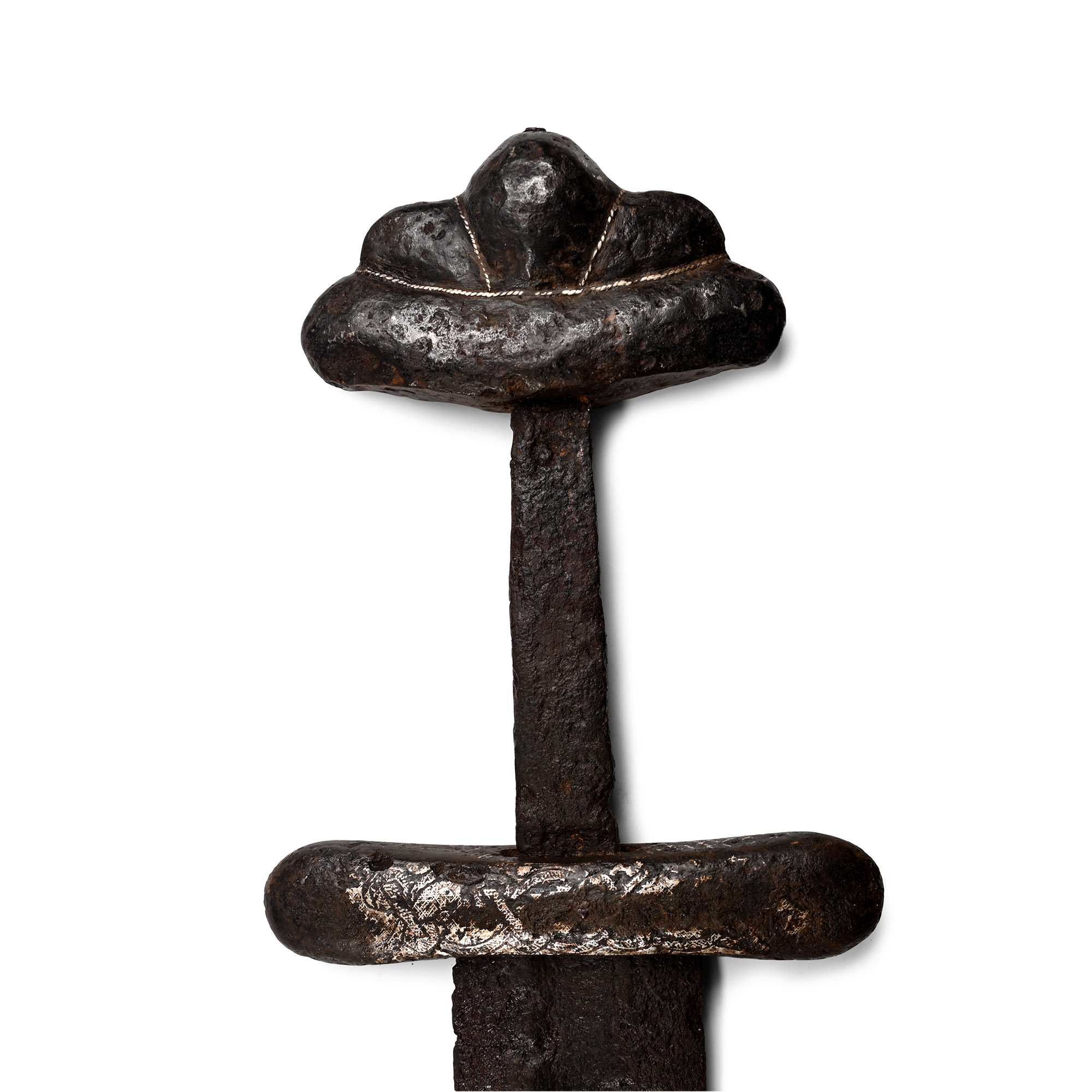
About a century after Type K reached Norway, Type S brought with it a much heavier hilt, with a three-part pommel whose massive middle lobe can reach 4.5 centimetres tall. These hilts were always adorned with silver, Petersen wrote, and the silver was worked into interlace or animal ornament where other types made do with simple stripe patterns. He knew twenty-two from Norway, and Ian Peirce, in Swords of the Viking Age (2002), knew of only two from England. One of them, the Chertsey sword, was found in 1981 by Harry Cooper, a gravel worker at Mixnam's Pit in Surrey. It is 98.4 centimetres long, and the decoration on its guard was made by winding silver wire round copper wire and hammering it onto iron.
Lot 287 is a Type S sword of the tenth to early eleventh century. The Chertsey sword is its parallel. At 91.3 centimetres it is a long sword, with a gently tapering blade, a well-preserved rounded point and battle-nicks along its edges. The boat-shaped guard carries applied ornament in the Ringerike style, which took shape in Scandinavia around the year 1000 and is named after the Norwegian district whose sandstone was used for many of its carved monuments. Inlaid silver wire separates the upper guard from the three-lobed pommel.
How a Viking sword blade was made
Every Viking blade began as a bloom, the spongy lump of iron left in a furnace where the metal never melted. It was full of slag and holes, with its carbon scattered unevenly, so the smith hammered it out, folded it and welded it again and again, and even a plain blade ended up with a layered structure.
Pattern-welding turned that layering into decoration. The smith welded a pack of alternating iron and steel layers into a rod and twisted it, then laid two or more twisted rods side by side, welded them together and welded separately made edges onto them. When the finished blade was etched with acid (fruit juice and urine are among the suggestions for what was used), the steel came up darker than the iron and the twists showed as herringbone or rippling bands down the centre.
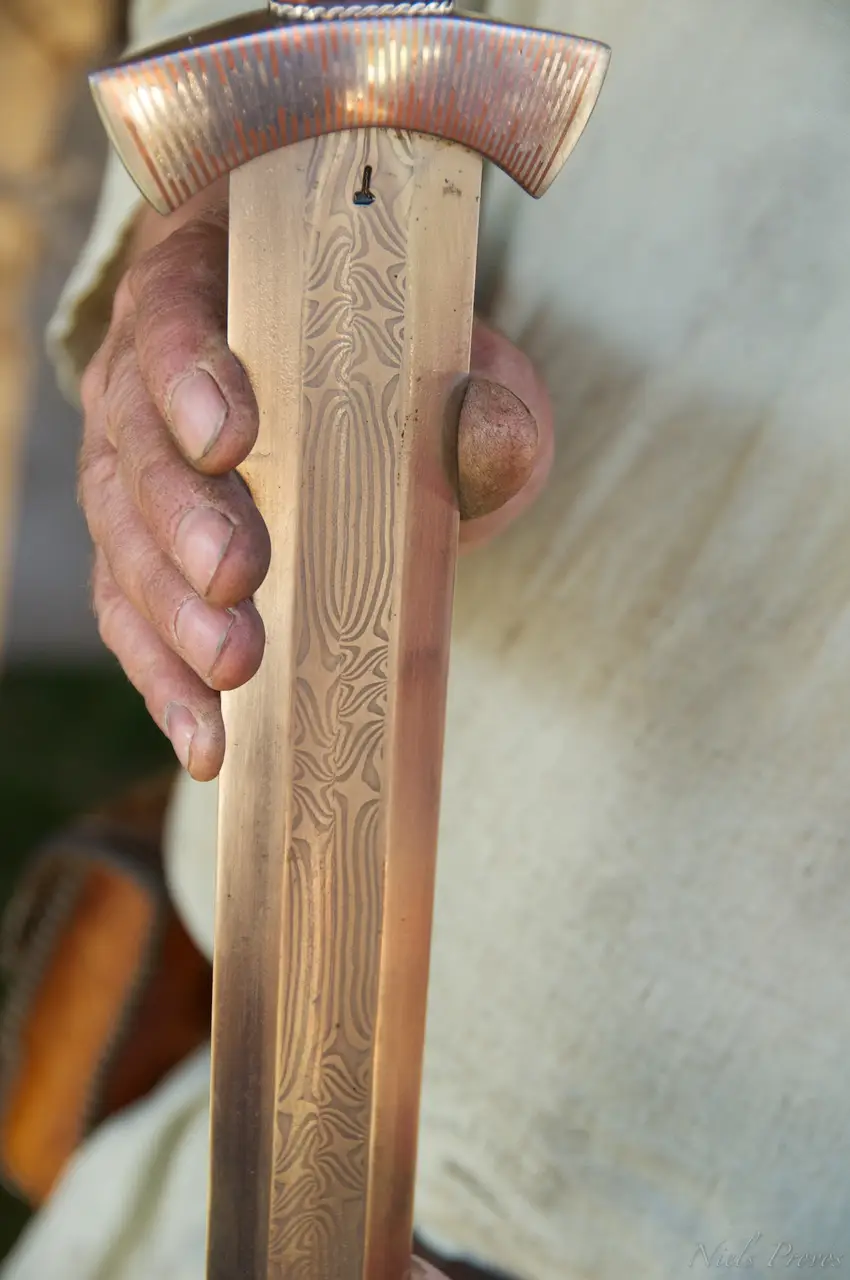 A modern reconstruction: a pattern-welded blade forged by the Danish swordsmith Ejvind Nørgård, photographed at Ribe in 2011, with bands of opposed twists alternating with straight layers down its centre. Photo: Niels Provos, CC BY-SA 4.0, via Wikimedia Commons.
Iron fares far worse in the ground than bronze, but corrosion destroys the welding seams and the steel faster than the iron, so the pattern can show again on a rusted blade, and an X-ray will find it where the eye cannot. Lot 287 has shallow traces of pattern-welding in its tapering fullers, and lot 288 has traces of pattern-welded construction in the blade and pattern-welded iron for the inlay in its fullers.
The letters of an Ulfberht inscription are themselves made of pattern-welded iron wire, welded into the fuller in the upper third of the blade. Blades seem to have travelled bare and been given hilts where they arrived, which is how a Frankish blade could end up under a Scandinavian hilt. Three of Petersen's twenty-two Norwegian Type S swords had Ulfberht blades, one of them a sword now in Copenhagen, and the Chertsey blade has the name too.
Who was Ulfberht?
By 2008 the Norwegian archaeologist Anne Stalsberg had gathered 166 blades signed VLFBERHT (the V served for U in the Latin script of the time) from twenty-three European countries, and more have come to light since. Only sixteen to nineteen were found in the Frankish lands where they were made, against seventy-four from the countries around the Baltic, early Rus' and Volga Bulgaria.
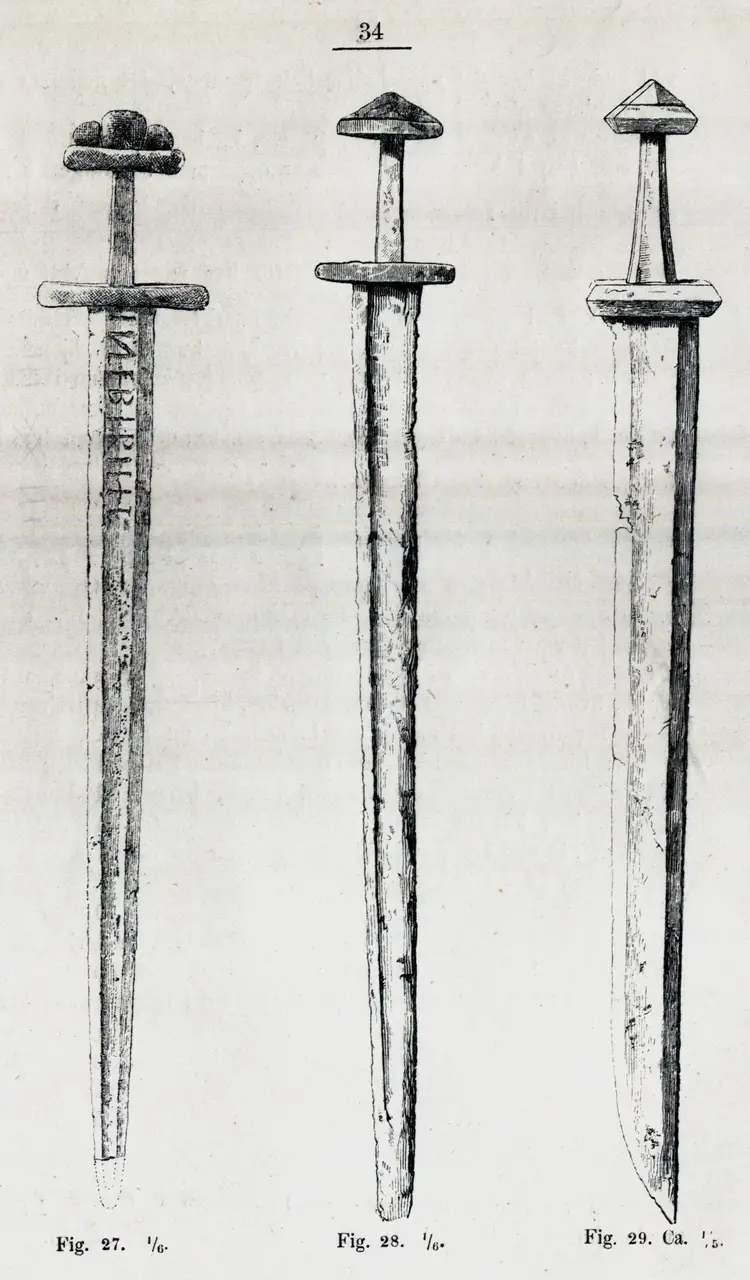 A plate from Ingvald Undset's Norske Oldsager i fremmede Museer (Norwegian antiquities in foreign museums, 1878): on the left, fig. 27, the Copenhagen Type S sword with its Ulfberht blade, 90 centimetres long. Public domain, via Wikimedia Commons.
Pagan Scandinavians, Balts and Rus buried swords with their dead, and Christian Franks and English did not. Every Ulfberht from the Frankish lands or Christian England whose find circumstances are known came out of a river, so the map of finds shows where swords went into graves more than where they were forged.
The Franks did their best to keep them at home. Laws forbade selling arms and mail coats outside the kingdom, and in 864 Charles the Bald announced: a man who gave a Northman a mail coat, a weapon or a horse, "either as ransom or for a price", was to be treated as "a traitor and a lapsed Christian" and "shall suffer death". Swords changed hands as ransom all the same. When Arab raiders captured the archbishop of Arles in 869, the city paid for him with 150 pounds of silver, 150 coats, 150 slaves and 150 swords, and Stalsberg concluded that plunder and ransom were the likeliest ways Frankish swords reached the Vikings.
Ulfberht is a Frankish man's name, and it appears in the ninth- to eleventh-century record books of the abbey of St Gall. Abbots and bishops signed with a cross before their names, so Stalsberg reads the + before VLFBERHT as the mark of a man with a place in the church or a monastery who oversaw the making of blades. The smiths who did the work probably could not read. One of the earliest Ulfberht blades, found in the Rhine at Mannheim, is mounted in a fine Frankish hilt of around 800 and is signed +VLFBEHT+, with the R left out.
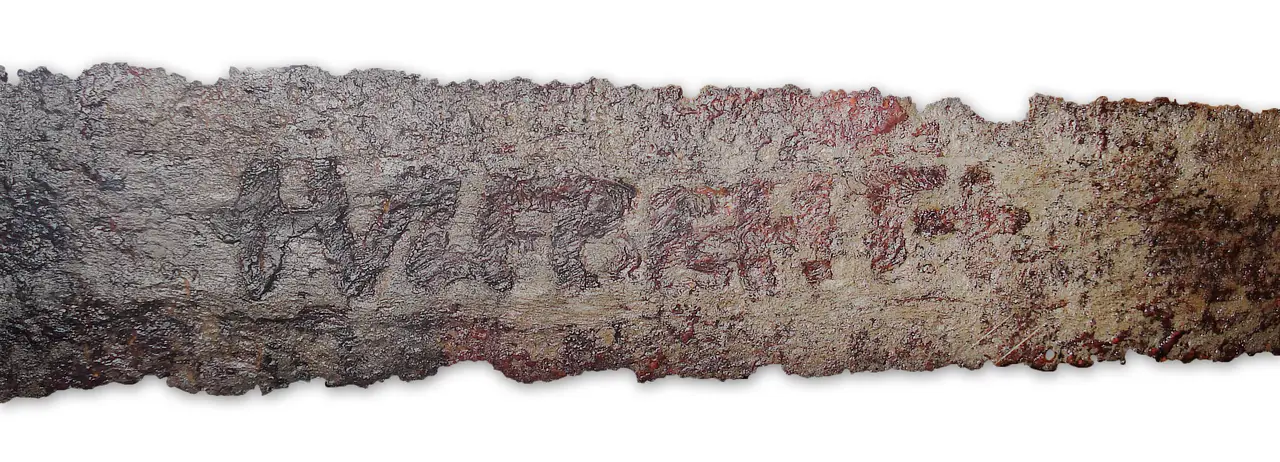 The signature on the Mannheim blade, found in 1960 in the Old Rhine near the Friesenheimer Insel (Germanisches Nationalmuseum, FG 2187). Photo: Torana, derivative work by Martin Kraft, CC BY-SA 3.0, via Wikimedia Commons.
Is an Ulfberht sword made of better steel?
In Stalsberg's tally +VLFBERH+T, with the cross before the T as on the June 2025 sword, accounts for 46 to 51 blades, and +VLFBERHT+, with the cross after it, for 18 to 23. The rest are misspelt or irregular in nature.
In 2009 the metallurgist Alan Williams published analyses of 44 swords. Nine of his fourteen +VLFBERH+T blades were of steel with a very high carbon content, which he suggested might be crucible steel brought from the Middle East up the Volga, and he suggested that the +VLFBERHT+ blades he tested were one workshop's copies of them. That version reached a wide audience in 2012 through the PBS Nova film "Secrets of the Viking Sword".
Two years after Williams, Astrup and Martens replied that the idea of the inscription as a mark of quality had been "repeated over and over again until it has become a truth", and that Williams's own results showed Ulfberht blades varying greatly in material and quality. Stalsberg dated the blades by the hilts they were found on and found that, if anything, +VLFBERHT+ tends to be the earlier spelling, and by 2017 she saw no difference in date between the two at all. Ingo Petri, reworking Williams's figures, sees the two spellings as two workshops or two methods, both of relatively high quality and both probably original.
In May 1928 Richard Greene, a Board of Works man cleaning a drainage ditch at Ballinderry in County Westmeath, "found the point of the sword sticking up in the bottom of the drain with its hilt embedded in marl". The hilt is a five-lobed Type K with every part of it cased in silver, cut through to show the iron beneath in a vine scroll and a name on the guard, HILTIPREHT. The blade reads +ULFBERHT+ in pattern-welded iron, with the second cross after the T. Peirce called it "the finest and indeed the most important to be found in Ireland", and it is in the National Museum of Ireland in Dublin.
When the Russian archaeologist Anatoly Kirpičnikov X-rayed ninety-eight sword blades in the museums of Trondheim, Oslo and Bergen in 1992, thirty of them carried Ulfberht signatures, eighteen of which nobody had recorded before, and Stalsberg reckoned that in Norway alone at least two and a half thousand blades had yet to be examined.
Lot 288 has the Ballinderry pairing: a five-lobed Type K hilt with silver ornament and, in the fullers on both sides of the blade, a possible inscription in the same spelling, +VLFBERHT+. It is offered in the December sale beside lot 287, the long Type S sword with the Ringerike guard.