Home > Stories by TimeLine Auctions
Stories by TimeLine Auctions
How St Martin's Cloak Gave Us the Word "Chapel"
In his right hand the saint still grips the hilt of a sword. The blade is gone, snapped off a finger's width above his fist, leaving a pale stub with a smear of red pigment where it broke. He is not swinging it. His left arm is thrown out to the side, lifting a great swathe of cloak clear of the horse's hindquarters, caught in the second before it is cut. This is Martin of Tours at the gate of Amiens, dividing his military cloak for a beggar, and the sword that is supposed to do the dividing is the one part of the composition that has not survived.
The rest is limestone, 78.5 centimetres high and a hundred and eight kilograms of it, carved almost fully in the round at the front and left rough behind, where the block once fixed against a wall. Martin is young and beardless, curly-haired, with a calm face. He wears no helmet: on his head sits a soft flat cap with a wide, upturned brim studded with ornament, the dress of a courtier rather than a cavalryman. Plate armour appears only on his legs, buckled at the shin; over a belted doublet a short cloak is pinned at the chest by a large round boss, or morse, with a tasselled cord hanging from it. His horse stands with one foreleg raised, head lowered and turned, harness hung with pendant drops and a fringed, star-flowered trapper across its back. At the lower right, gaunt and near-naked in a twisted loincloth, the beggar looks up with his hands pressed together, a rounded swelling on one thigh that may be a sign of disease or only a knot of cloth. Look closely and the old paint is still there: bluish-grey on the harness, red deep in the folds, the eyes once picked out.
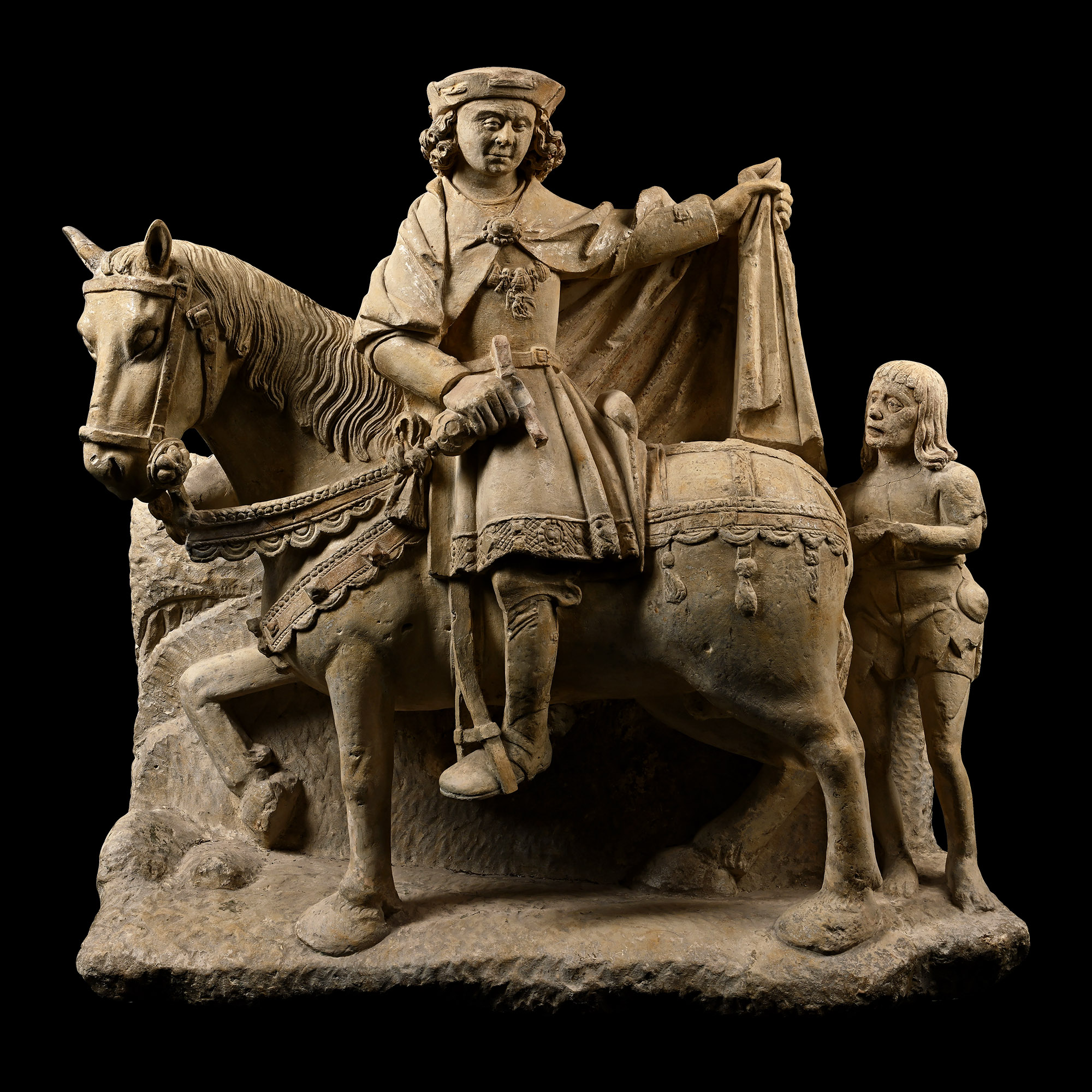
It is the headliner of our September sale, catalogued as Flemish and fifteenth-century, and it carries two stories at once. One is the scene it shows: a soldier who gave half his coat to a freezing man and then gave up soldiering altogether. The other is hidden inside that act, and it is the reason a devotional object about charity ended up furnishing English with a word for a room. We call that room a chapel because of this cloak.
The soldier at the gate of Amiens
Almost everything anyone knows about Martin's early life comes from a single book, the Vita Sancti Martini that Sulpicius Severus wrote around 397, while its subject was still alive or barely dead. Sulpicius knew Martin and admired him past the point of neutrality; the Life is a work of promotion, thick with miracles and built to make a saint, so its facts need holding at arm's length. Even the basic dates are soft. Martin was born in Pannonia, at Savaria in what is now Hungary, either in 316 or in 336; the year he left the army and the year he became a bishop are reconstructions, because Sulpicius supplies no chronology to hang them on.
The spine of it is firm enough. Martin was the son of a Roman officer, pressed into the cavalry himself, and stationed at Amiens in northern Gaul as a young trooper who had begun instruction as a Christian but was not yet baptised, a catechumen. The cloak episode belongs to those garrison years. Alban Butler, retelling Sulpicius in the eighteenth century, gives it plainly:
"One day, in the midst of a very hard winter and severe frost ... as he was marching with other officers and soldiers, he met at the gate of the city of Amiens a poor man, almost naked, trembling and shaking for cold ... drawing his sword, he cut his cloak in two pieces, gave one to the beggar, and wrapped himself in the other half. Some of the bystanders laughed at the figure he made ... In the following night St. Martin saw in his sleep Jesus Christ dressed in that half of the garment which he had given away."
In the dream Christ tells the surrounding angels that Martin, still only a catechumen, has clothed him. Martin kept the other half and wrapped himself in it. That detail matters more than it looks, because the two halves go on to lead separate lives, and it is the half he kept, not the half he gave away, that turns into a word.
The cloak was the beginning of the end of his military career. Soon after, according to Sulpicius, Martin refused to go into battle, telling his commander, "I am the soldier of Christ; it is not lawful for me to fight." He left the army, attached himself to Hilary of Poitiers, founded monastic communities at Ligugé and Marmoutier, and was made Bishop of Tours around 371. He died in 397 and was buried on 11 November, the date that became Martinmas. He was among the most popular saints of the medieval West, and an unusual kind of favourite: a confessor who died a bishop in his bed, where the age's other great names had mostly been martyrs killed for the faith. The defining image of him, all the same, is the young soldier with the sword.
The cloak that became a word
Here is the part that survives longest, and it survives as language. The Latin for a cape or hooded cloak was cappa. Its diminutive, cappella, meant a little cloak, and by extension the thing wrapped in it. When the Frankish kings acquired what they venerated as St Martin's cloak, they kept the relic close, carrying it into battle and swearing oaths over it; Louis Réau, the French historian of Christian iconography, called it un palladium national, the nation's talisman.
The relic needed housing, and the small oratory built to keep it took its name from the cloak inside: the cappella. The clergy who guarded it were the cappellani. From those two words the rest follows in a straight line. Cappella passed through Old French chapele into English as chapel; cappellanus became chaplain. The building where you pray and the priest attached to it are both named, at the root, after a scrap of a Roman soldier's coat. Réau put it flatly: the term chapelle originally meant the place where the chape of St Martin was kept.
The chain is easy to overstate, and the honest thing is to mark where the solid ground ends. That cappa gives cappella gives chapel is not in doubt; the Oxford English Dictionary and Du Cange's great glossary of medieval Latin agree on it. That the building-word grew specifically from Martin's cloak-relic is the traditional account, old and well attested but still a tradition: it turns up already in Marculf's Formulary, a collection of legal templates from the later seventh century, where Frankish subjects swear their loyalty super capella domni Martini, over St Martin's cloak-shrine. The reference works that pass the story on tend to hedge it with a "by tradition," and they are right to.
The softest link is the last one. Sulpicius, writing the Life around 397, calls the garment Martin cut a chlamys, a soldier's short cloak, and never a cappa; the venerated cappa only surfaces three centuries later. So the honest way to put it is that the kings kept a relic venerated as Martin's cloak, and its identity with the very half he divided at Amiens is a later medieval association, not anything Sulpicius records. The word is real, its descent is real, and the cloak at the bottom of it is the cloak of the legend. That is enough. The relief shows Martin in the act of giving half away; the language remembers the half he kept.
A pacifist on a warhorse
The object carries a quiet contradiction. Martin's fame rests on two renunciations: he gave away half of what kept him warm, and then he refused to fight. The stone shows him mounted, armoured, sword in hand, on a horse dressed for parade. It has turned the man who laid down his arms into a man-at-arms.
The earliest artists did not do this. When the cloak-division first appears in medieval art, in manuscripts like the Fulda sacramentary of around 975 and the early books from Martin's own Tours, the saint is on foot, which matches the Sulpician story of a young soldier who wanted out. The mounted, sword-raised type, the holy warrior on his charger, took firm root only in the late eleventh century, in the age of the Crusades and the vogue for military saints. By the time this relief was carved the equestrian version had long won. So the composition is a period preference laid over an older story, and it pulls the saint in exactly the direction his legend refuses to go.
The armour deepens the anachronism rather than fixing it. A fourth-century Roman cavalryman is here fitted out in the plate and finery of a much later world, an idealised knight of chivalry standing in for a late-antique trooper. Nobody carving in this period expected otherwise; a saint was dressed in the honour-costume of the sculptor's own day, and the point was virtue in armour, not archaeology. The curators at the Denver Art Museum say as much of their own St Martin, a French relief of about 1520: its armour is "in the style of the late 1400s," an artist's way of making a Renaissance knight stand for saintly courage. The costume that dresses the pacifist as a knight also tells you, more precisely than the catalogue does, when and where he was carved.
Reading the stone
Start with the cap, because it is the single best clue on the whole relief. It is not a helmet and not a medieval hood. It is a soft, flat, wide-brimmed bonnet with the brim rolled up and pinned, its edge dense with ornament: the fashionable "French bonnet" or flat cap of the early sixteenth century, worn by well-dressed men across France, the Netherlands and the German lands from about 1500 into the 1540s, and at its sharpest between roughly 1510 and 1535. A study of dress-hooks and cap-hooks published by the Society of Antiquaries describes the type almost to the object: caps of around 1520 "made with folded brims or flaps which could be worn either up or down," the folds held by jewelled cap-hooks of rosette design, and a taste for "dense distributions of hat ornaments" in the early Tudor decades. That studded, rolled-up brim is not fifteenth-century. It is a courtier's hat of the first third of the sixteenth.
The stone tells the second half of the story. Medieval and Renaissance figure-carving in limestone is, to a striking degree, a French affair: the Metropolitan Museum's Limestone Sculpture Provenance Project has spent decades matching carved limestone to specific quarry groups in the Paris basin by chemical analysis, and the reference corpus of the material is essentially the Île-de-France and its neighbours. The southern Netherlands of around 1500, the world a "Flemish" label points to, was something else entirely: a wood-and-alabaster culture, turning out the great carved oak altarpieces of Antwerp, Brussels and Mechelen and, in stone, small alabaster reliefs, not monumental limestone groups. A hundred-kilogram limestone high-relief sits outside that industry and squarely inside the French one.
The comparanda close the case, or nearly. The nearest match in composition is in Lisbon, at the Calouste Gulbenkian Museum: a limestone St Martin on horseback, the same young civilian-dressed saint, the same contrapposto horse with a raised foreleg, the same emaciated beggar reaching up, the same lifted cloak. It has been dated to the Loire around 1531, the year read from a crowned salamander, the personal device of Francis I, worked into the piece; the museum's own scholars place its origins in early-Renaissance Normandy. Either way, French and early sixteenth-century. The Denver relief is French, about 1520, and came from a small chapel near Le Mans. At Rigny-le-Ferron in Champagne a limestone Martin on horseback of the first quarter of the sixteenth century still stands in the parish church. The type, an early-Renaissance limestone St Martin cutting his cloak, is a documented northern-French parish subject, and every securely dated example lands in the same three decades.
Restoration, which the catalogue notes, blurs any fine stylistic reading, so the safe verdict is a range and not a year. But the material, the costume and the closest surviving parallels all pull the same way: this reads most naturally as French work, from the Loire, Normandy or Champagne, made in the early sixteenth century rather than the fifteenth. Limestone saints of this kind, prised off the walls they were carved for as churches were rebuilt or stripped, do reach the open market, though a piece on this scale seldom comes up.
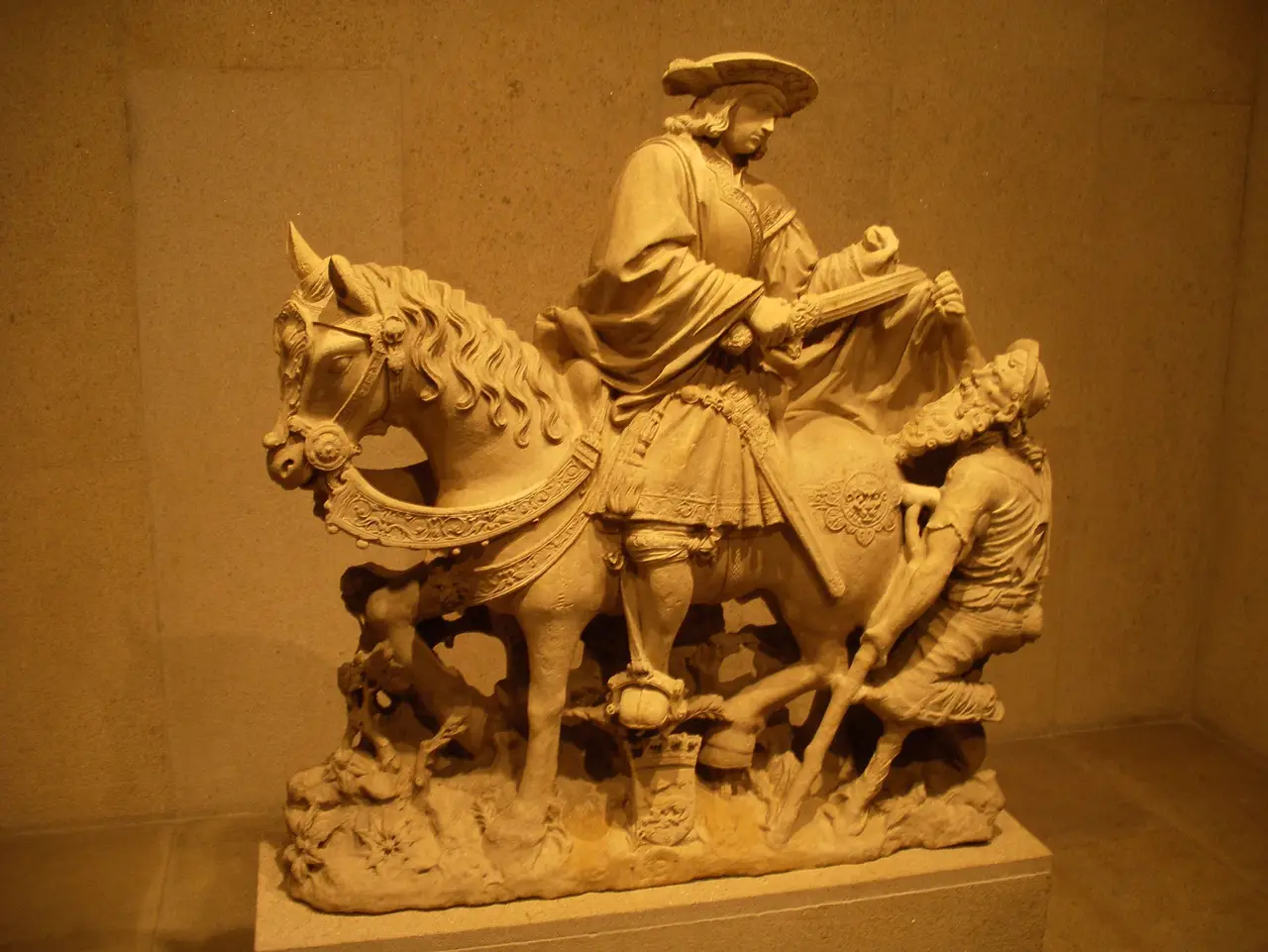 A limestone St Martin on horseback in the Calouste Gulbenkian Museum, Lisbon, dated to about 1531 and attributed to the Loire or Normandy. Photo: shadowgate, CC BY 2.0, via Wikimedia Commons.
The blade that ought to cut the cloak is the one thing on the relief that did not last. The cloak lasted. Not the cloth, which perished, and not the relic the Frankish kings carried into battle, which vanished somewhere in the long history of France. What came through whole was a word for the room where such things were kept, a word we still say without hearing the cloak inside it. On 8 September it is lited for sale as lot 306.
TimeLine Auctions, 30th August 2026