Home > Stories by TimeLine Auctions
Stories by TimeLine Auctions
How the Export of Antiquities Built the World's Museums and Private Collections
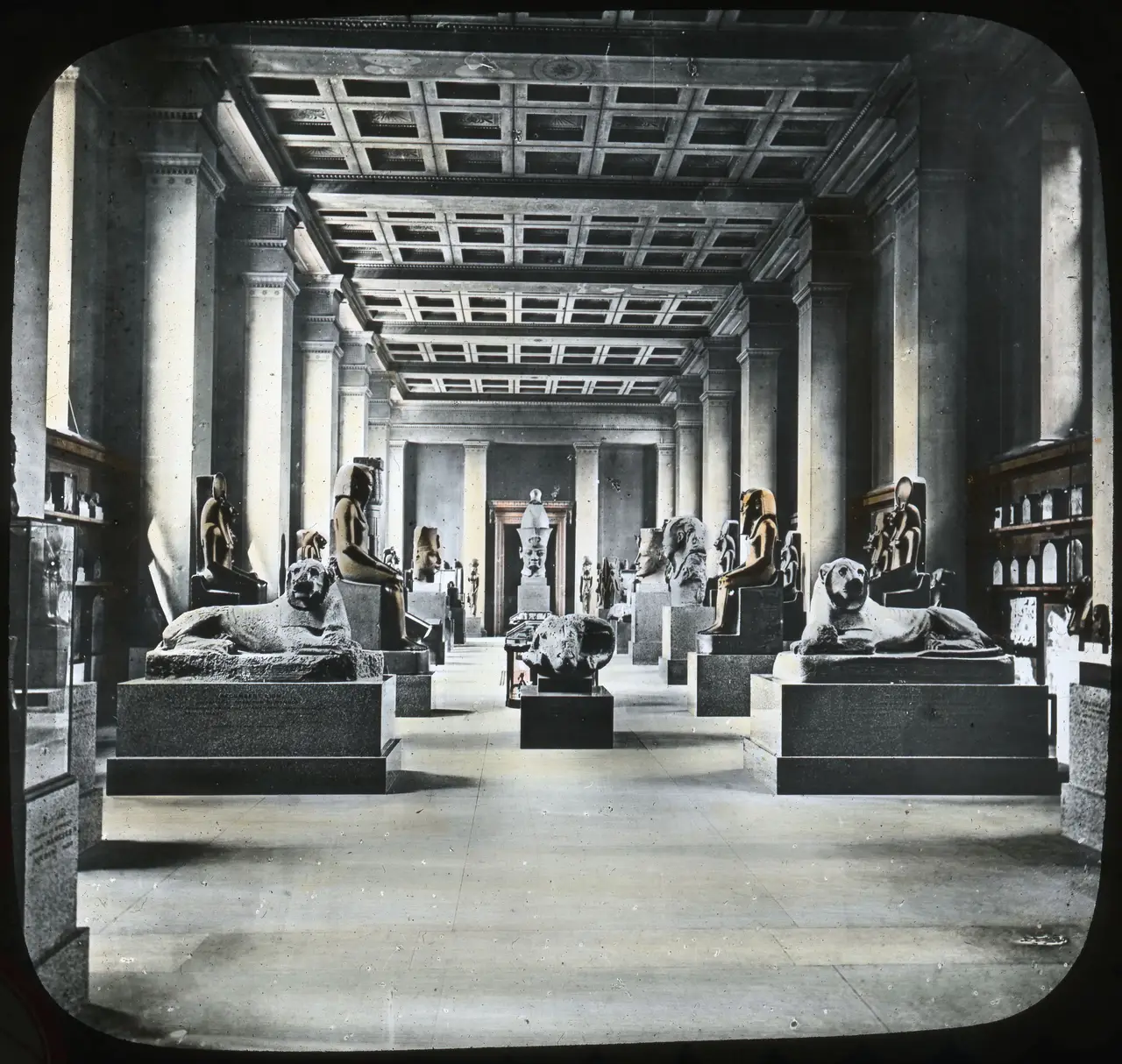 The British Museum's Egyptian Sculpture Gallery, photographed about 1913, its hall lined with colossal pharaonic statuary acquired through the nineteenth-century trade. Public domain, via Wikimedia Commons.
In 1895 a visitor to the Egyptian Museum in Cairo could buy a mummy and take it home with the state's blessing. Baedeker's handbook gave the directions: inside the museum was a room where "antiques, the authenticity of which is vouched for by the museum-authorities," were for sale, and where "a permit to export is given with each purchase." The room was the Salle de Vente, the official Sales Room, open since 1888. It sold papyri, scarabs, bronze figures, coffins, ushabti, on occasion an entire tomb. Egypt's antiquities regulator was also their licensed vendor, and it dug to keep the shelves full: in 1905 the inspector Georges Legrain offered his director, Gaston Maspero, as many as five hundred statuettes from Karnak for the counter. Maspero admitted to his wife that he could not have run the Service "sans les ventes d'objets et de momies," without the sale of objects and mummies.
The usual account of how ancient objects ended up far from home is a story of plunder: sculpture prised off temples, tombs emptied in the dark, the strong helping themselves to the weak. There was a great deal of plunder, but most of what fills the encyclopedic museums did not arrive that way. For roughly a century and a half it left its source country legally, licensed and stamped, under export laws those countries wrote themselves: by a ruler's firman, by a dealer's permit, by purchase across a counter like the one in Cairo, and above all by partage, the official division of excavated finds between a national museum and the foreigners who paid for the dig. The objects are contested now because the countries that issued the paperwork have since torn the system up.
The result is a map no ancient person would recognise. The Rosetta Stone and half the Parthenon's surviving sculpture sit in Bloomsbury. The bust of Nefertiti is in Berlin, a short walk from the Pergamon Altar, which is a thousand miles from Pergamon. The Code of Hammurabi is in Paris and the Standard of Ur in London; Cypriot terracottas by the thousand are in New York and Stockholm. How that geography was drawn, by whom, and under what rules is the real history of the world's collections, and it is stranger than theft.
Two Consuls Divide a Country
In the first decades of the nineteenth century there was, across most of the Mediterranean and the Near East, simply no law against taking antiquities away. The lands that held them belonged to the Ottoman Empire or its semi-independent provinces, and there was no statute to break. What governed removal was the firman, a ruler's written permit, usually obtained for a European by his embassy. The Ottoman government of the day, as the Assyriologist Julian Reade puts it, "had little interest in antiquities as such." Into that vacuum stepped the consuls.
In Egypt the two giants were Bernardino Drovetti, France's consul-general, and Henry Salt, Britain's. Because Muhammad Ali courted both powers, both men held the firmans they needed, and to reduce friction they agreed to divide Egypt between them for, in the phrase of the period, "more efficient exploitation." Working through agents like Giovanni Belzoni, they extracted antiquities by the boatload. The collections they assembled became, by straightforward purchase, the founding cores of Europe's great Egyptian galleries. Drovetti's first collection was bought by the King of Sardinia in 1824 and founded the Museo Egizio in Turin; his second went to the Louvre, his third to Berlin. Salt's collections went to the British Museum and the Louvre. None of it was illegal, because there was as yet nothing to make it so.
The most famous removal of the era is also the one whose legality has been argued over ever since. Between 1801 and 1812 the agents of Lord Elgin, Britain's ambassador to the Porte, took down roughly half the surviving sculptures of the Parthenon and shipped them to London, where Parliament bought them for the British Museum in 1816. Elgin's authority was an Ottoman document of July 1801, which survives only in an Italian translation and grants permission to draw, model, erect scaffolding, and "take away any sculptures or inscriptions" that did not interfere with the citadel walls. Whether that licensed the dismantling of a standing temple is the question. Elgin could not produce the original before the parliamentary committee of 1816, and scholars since, the legal historian David Rudenstine among them, have called the removal reading of the document "specious." The honest position, then and now, is that the legality was never settled. Elgin's scale, in any case, set a fashion: "open season," one historian writes, "was declared on Greek architectural sculpture." When the Anglo-German party that stripped the frieze from the temple at Bassae a decade later needed the local Ottoman governor's consent, he sold his share for £750, disappointed to learn the marbles "were not of silver as he had dreamed"; the frieze went to public auction and into the British Museum.
When the Regulator Kept a Shop
The first real export laws did not abolish the trade. They nationalised it. Egypt is the clearest case, because its sequence is unusually well documented. In August 1835 Muhammad Ali issued a "High Order" forbidding the unlicensed export of antiquities, ordering them gathered in Cairo, and projecting a national museum, one of the first such laws passed anywhere. It was also essentially unenforceable, and it said nothing about mummies. Enforcement arrived with institutions. In 1858 the Khedive appointed Auguste Mariette, lately of the Louvre, to run a new Service des Antiquités, and Mariette gathered the finds into the Bulaq Museum, the first national museum in the region.
What the Service built was a regulated pipeline, with that Cairo sales counter near its centre. Beneath the counter sat a tiered, licensed trade. The keystone statute, Law No. 14 of 1912, drafted largely by Maspero, vested every antiquity in the state, required dealers to hold a Service permit, and banned export without a special licence. Within months the Service had approved just under a hundred dealers, confined to a handful of tourist cities, among them Cairo, Alexandria, Luxor and Aswan. The grandest of them, Maurice Nahman, a bank cashier turned antiquaire, ran a shop that "sells to museums all over the world, and to tourists." To export a purchase you presented it to the museum, where it was valued, sealed with the official seal, and sent on to customs with a signed permit; a ministerial order of 1912 required the parcels to reach the railway and the post "with seals intact, on pain of being seized." As late as 1971 the Cairo Museum kept a Thursday "clinic day," when a collector could bring in an object, have it inspected, and, if the Service did not want it, have it sealed and cleared to leave.
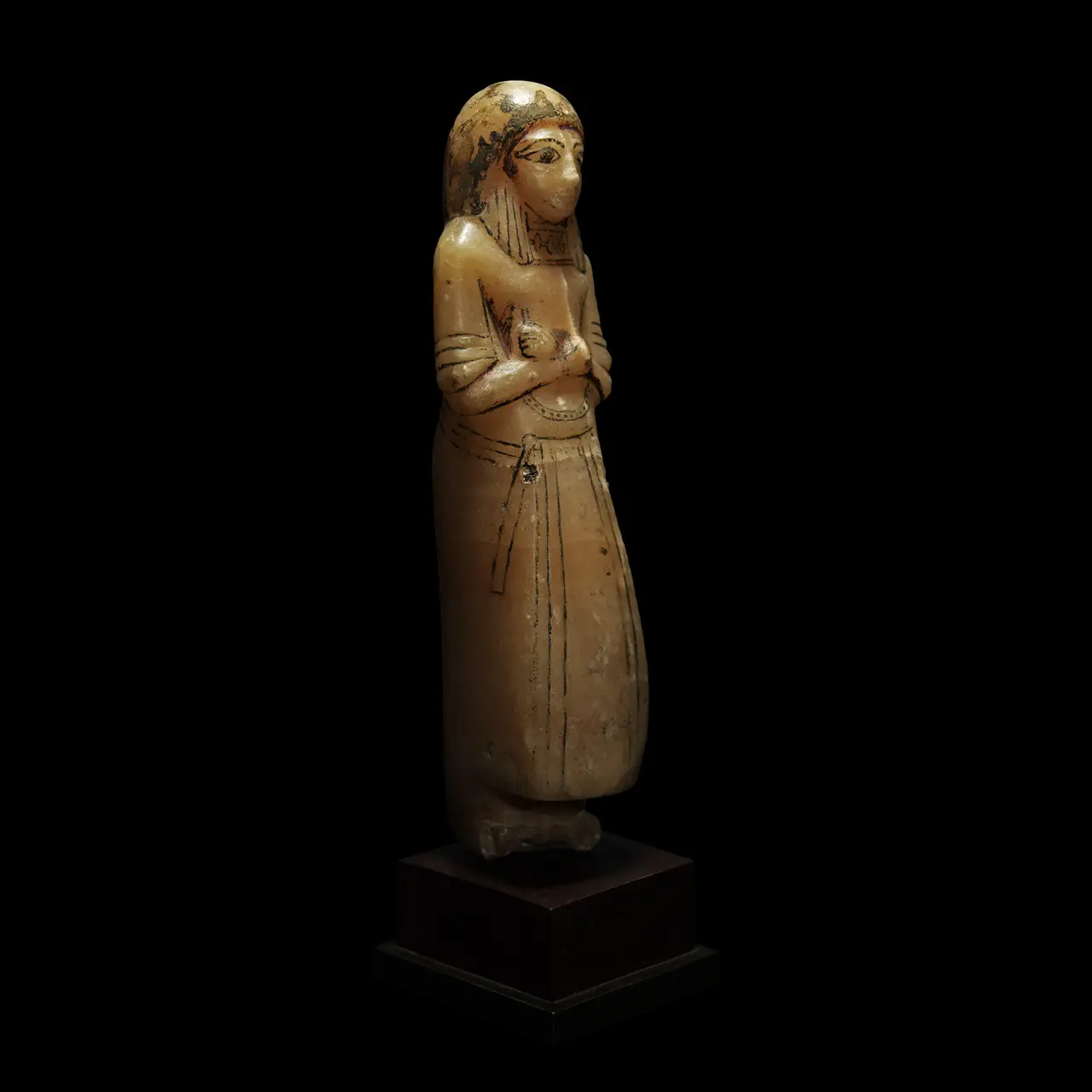
The people running this system were often its merchants too. Howard Carter, before Tutankhamun made him famous, took a fifteen per cent commission as a dealer's agent. Ludwig Borchardt bought for the Berlin museums. Even Flinders Petrie, the most scientific excavator of his generation, "bought rather than excavated a surprisingly large proportion of his teaching collection," in the words of Fredrik Hagen and Kim Ryholt, whose study of the Cairo trade reconstructs it in detail; the line between excavator and dealer, they conclude, was "blurred." This was the licit market the great collections were built on, and it ran on paperwork rather than stealth.
Half for Cairo, Half for Boston
If one mechanism explains the actual shape of the diaspora, it is partage, the division of finds. The arrangement was simple and, on its face, reasonable. A foreign museum or expedition paid for an excavation; in return for the permit it reported everything it found; the host country's antiquities service took first pick, kept anything unique, and the sponsor legally exported the rest. The map of ancient art in Western museums is, quite literally, a map of who funded which dig under which division law.
In Egypt the system turned learned societies into engines of distribution. The Egypt Exploration Fund, founded in London in 1882, promised its subscribers a share of each season's finds in proportion to what they gave, once the Cairo museum had taken first refusal. By 1910 it counted more than two hundred institutional subscribers, and the finds went out accordingly. The British Museum and the Museum of Fine Arts in Boston took the largest shares; then the provincial museums of Liverpool, Bolton, Sheffield and Norwich filled with predynastic pottery and shabtis, and the surplus reached as far as Dublin and Kyoto. A 2006 survey counted almost two hundred public Egyptian collections in Britain alone. Most of them were assembled, object by divided object, in a Cairo storeroom.
The mechanics could be intimate. When Leonard Woolley dug the Royal Cemetery of Ur through the 1920s, jointly funded by the British Museum and the University of Pennsylvania, each season's finds were split three ways between Baghdad, London and Philadelphia. The Iraqi share was decided by Gertrude Bell, who had founded the country's Antiquities Service and its museum and who conducted the divisions herself. Her letters catch the process in miniature. At one division she insisted on keeping a unique milking-scene frieze for Baghdad, "I must take the milking scene... I'm an Iraqi official and bound by the terms," and when she and Woolley could not agree over a gold scarab, they settled it on the toss of a coin. The Standard of Ur went to the British Museum; the cemetery's gold was parcelled among three cities. The setting was colonial and the results were unequal, and it was also a negotiation conducted under law, by an official who took the best pieces for the source country first.
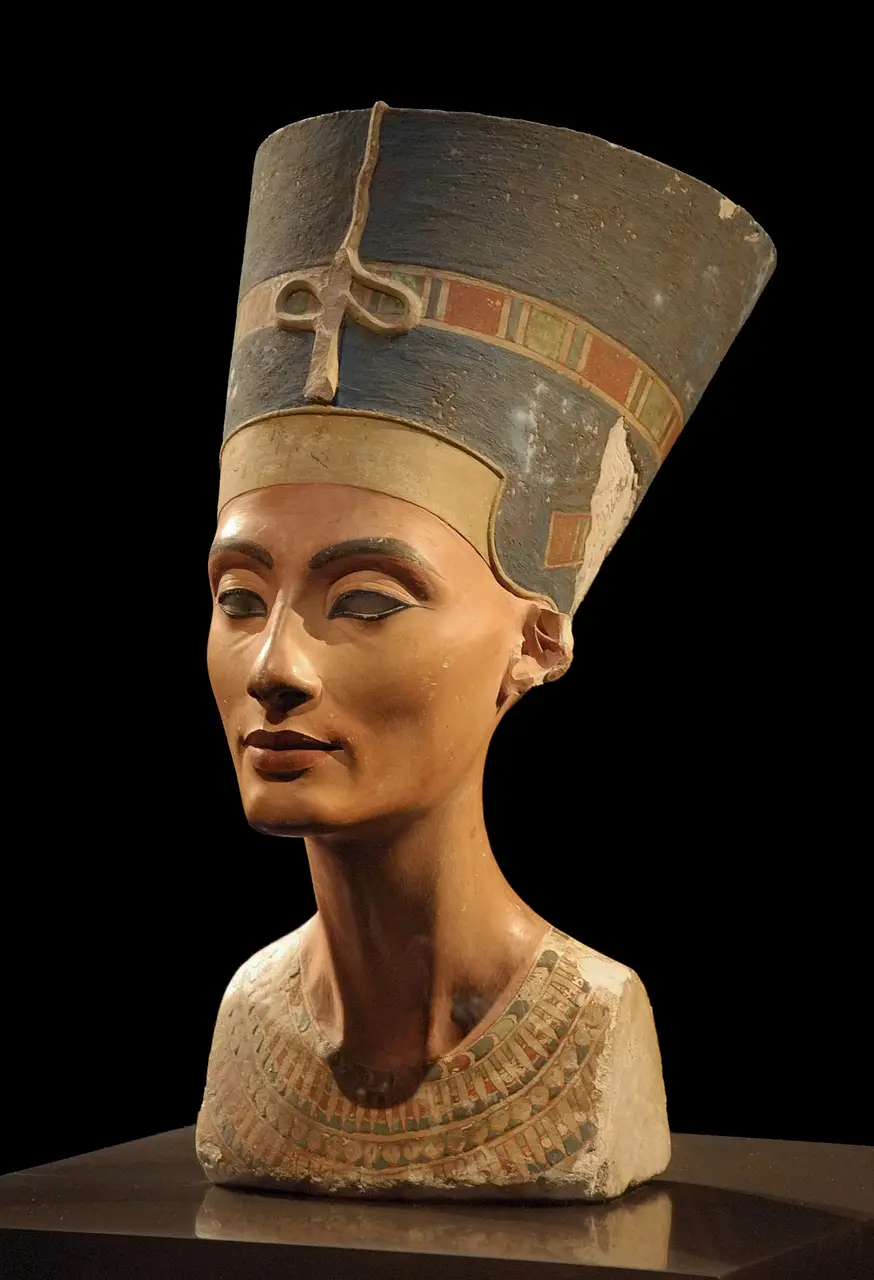 The painted limestone bust of Nefertiti, carved about 1340 BC and excavated at Amarna in 1912, now in the Neues Museum, Berlin. Photo: Philip Pikart, CC BY-SA 3.0, via Wikimedia Commons.
The paradigmatic partage object is the one Egypt has wanted back the longest. The painted bust of Nefertiti was found in 1912 by Ludwig Borchardt at Amarna, and at the division of 20 January 1913 the inspector Gustave Lefebvre allotted it to the German side rather than holding it in Cairo as a unique piece. Germany has maintained ever since that the division was legal; Egypt has argued ever since that Borchardt misled the inspector about the bust's material or its value to slip it past him. The records show a documented division with an export permit. What they cannot recover is what was said across the table that morning, which is exactly why the case has never closed. The same rule that let Nefertiti go kept Tutankhamun whole: partage reserved intact tombs and objects of "capital importance" to the state, so when Carter opened the untouched tomb in 1922 nothing was divided, and the excavators were paid compensation instead.
Partage built national museums abroad as readily as it filled galleries. The Swedish Cyprus Expedition, digging from 1927 to 1931 under British colonial law, divided some eighteen thousand finds with the Cyprus Museum on the principle that tomb-groups stayed together. Sweden's two-thirds, about twelve thousand objects, shipped to Stockholm in 1931 and became the founding collection of the Medelhavsmuseet. A museum of Mediterranean antiquities in Sweden exists because of a division list signed in Nicosia.
The Source Countries Were Never Only Sellers
It is tempting to read all of this as one-way traffic, the strong emptying the weak. The record is more complicated, because the source states were active players who wrote the rules, took the best, and increasingly said no. The Ottoman Empire is the clearest example. Its first antiquities ordinance, in 1869, banned the export of finds outright, coins excepted. A more liberal law of 1874 allowed a three-way division and licensed export, and it was through that open window that the Pergamon Altar left for Berlin: the German excavators took their share under the 1874 thirds, then bought out the Sultan's portion, which he relinquished by an irade for about twenty thousand Marks. Four hundred and sixty-two boxes of marble went to Berlin, lawfully, and a museum was built around the Gigantomachy frieze.
Then the window closed. The scale of these departures, the legal ones like Pergamon as much as the thefts, drove a clampdown. The thief was Heinrich Schliemann, who held a permit binding him to share the finds of Troy and instead smuggled "Priam's Treasure" out to Athens in 1873; the Ottomans sued him and settled, and the lesson was not lost. In 1884 a new law drafted by Osman Hamdi Bey, painter, archaeologist and director of the Imperial Museum, declared all antiquities imperial property, ended the foreign excavator's share, and forbade export without the museum's consent. Hamdi Bey then dug himself. When he excavated the royal necropolis at Sidon in 1887 and found the carved marble coffin that came to be called the Alexander Sarcophagus, he kept it for Istanbul, where it remains. The same partage system that filled Berlin also built the national museums of Istanbul, Cairo, Baghdad and Damascus, and the host services went on choosing first.
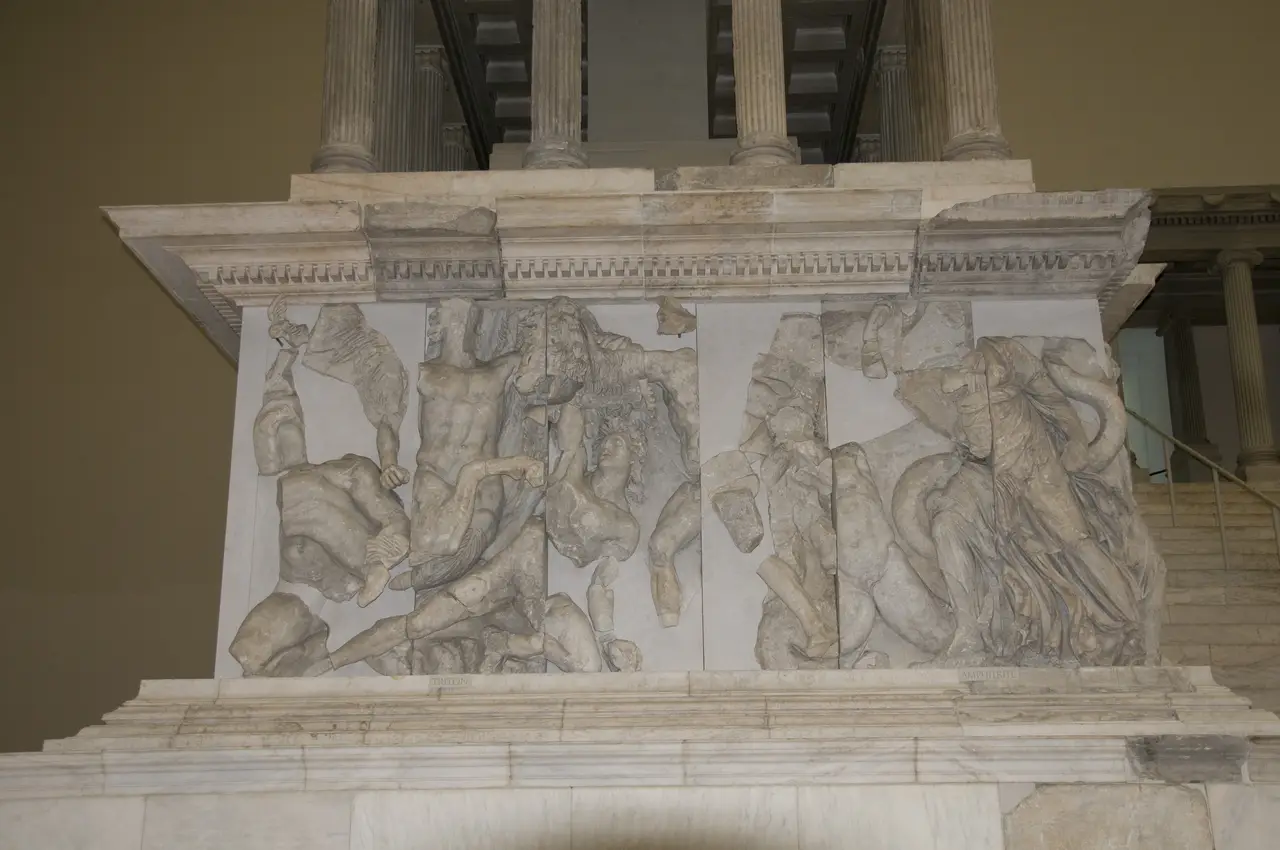 Part of the Gigantomachy frieze from the Great Altar of Pergamon, carved in the first half of the second century BC, reassembled in the Pergamonmuseum, Berlin. Photo: Hnapel, CC BY-SA 4.0, via Wikimedia Commons.
The Door Closes, and the Map Freezes
The closing was gradual, a century-long ratchet, country by country, each on its own clock. Italy had policed its antiquities since the papal edicts of the seventeenth century and the Pacca Edict of 1820. Greece declared its antiquities "national possessions of all Greeks" in 1834. The Ottomans tightened across the 1880s; Egypt's keystone law came in 1912. The colonial mandates built their regimes in the 1920s and 1930s, and then the post-colonial wave shut the door for good: Iraq made its antiquities inalienable in 1974, Egypt banned the trade outright in 1983, and one by one partage was abolished everywhere it had operated.
The international scaffolding behind this had a long history, older than the antiquities market itself. Its founding precedent was the settlement after Waterloo, when the Allies forced Napoleonic France to return the art it had carried off across Europe, more than five thousand pieces by one Louvre director's count, establishing for the first time the principle that loot must go back. That principle took a century and a half to reach the trade in excavated antiquities. It arrived as the UNESCO Convention of 1970, on the means of prohibiting the illicit import and export of cultural property, which became the hinge of the whole system.
It is widely believed that 1970 made the antiquities trade illegal. It did nothing of the kind. The Convention was not self-executing; it set principles and left enforcement to each country's own legislation, much of which took years to arrive, the United States' in 1983, Britain's not until 2003. What 1970 did was subtler and more far-reaching: it became the market's dividing line. A museum or a collector now asks whether an object was out of its source country before 1970 or was legally exported after, and treats everything documented before the line as clean and everything after it as suspect. As the legal scholar John Henry Merryman argued, the Convention was a charter for retention, the right of a nation to declare its own heritage inalienable, and the source countries read it exactly so.
The effect was to invert the meaning of the whole earlier history. Objects that had left under firman, permit and partage, legal by every standard of their day, were now legal only if their paperwork proved it. And a trade that had once run on official seals slid into one that ran on forged ones. The emblem of the new era is the Euphronios krater, a Greek vase looted from an Etruscan tomb at Cerveteri in 1971, sold up a chain of dealers on a false provenance, and bought by the Metropolitan Museum in 1972 for a million dollars; after a long Italian investigation the Met returned it in 2008. Where the nineteenth-century trade had stamped objects with permits, the late twentieth century's ran on laundered paper. It is the same history turned inside out.
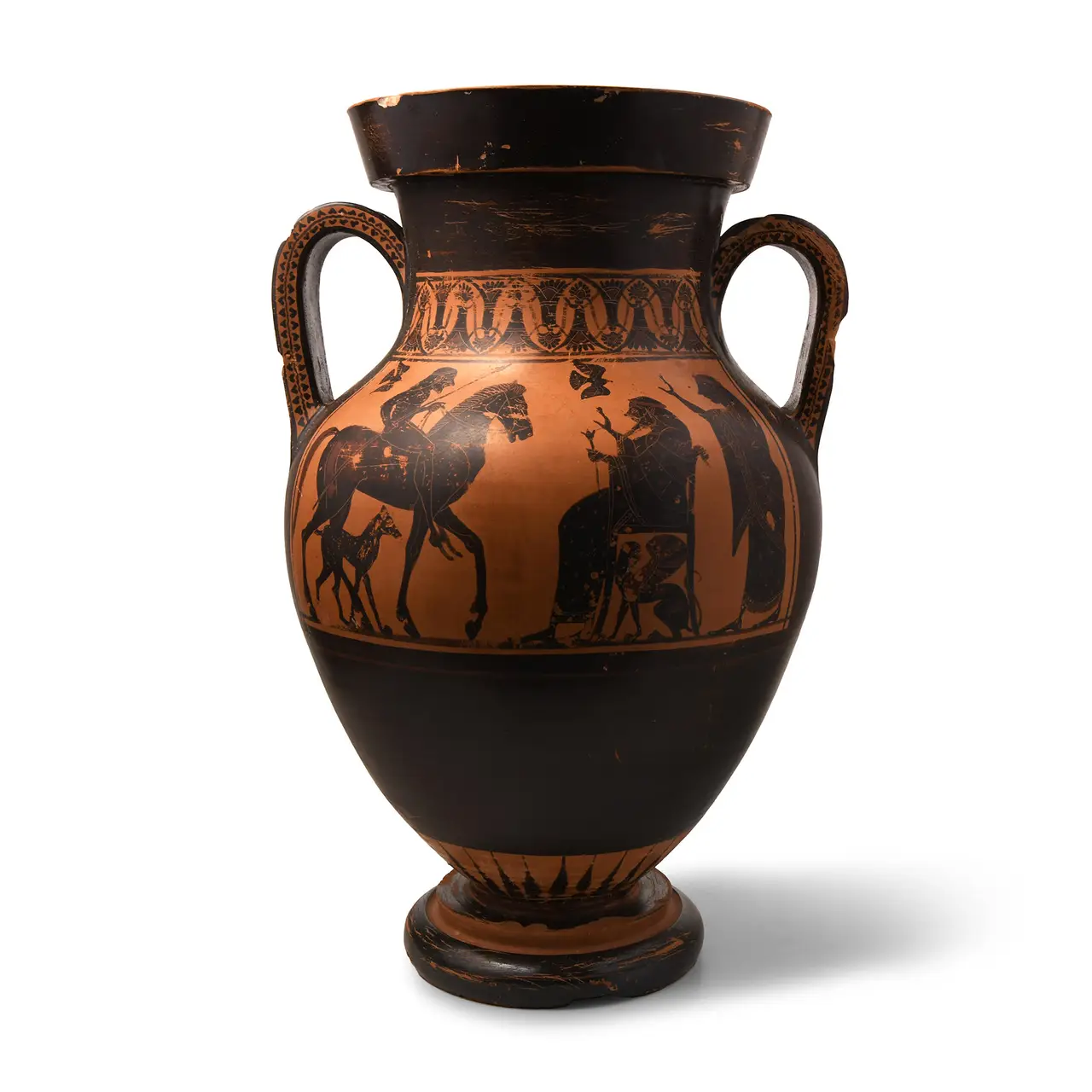
This is why provenance, the documented record of where an object has been, has become increasingly important. The very documents the old regimes generated, the division lists, the export permits, the Salle de Vente receipts, are now the evidence that legitimises a piece. Elgin's lost firman was the first of these missing papers, and its absence is why the Parthenon sculptures are still argued over while the Bassae frieze a few rooms away in the same museum, bought openly at auction, is not. When we handle an antiquity with a nineteenth-century collection history, the paper is part of what we are handling. For a collector the principle holds in miniature: a Greek vase or an Egyptian bronze whose trail runs back before 1970 stands on ground that an identical object without one does not, which is why a stated provenance now sits beside the antiquities offered for sale as plainly as the description of the object itself.
The old world has one survivor. In Jerusalem the Israel Antiquities Authority still licenses dealers and still issues export permits, each stamped with an object's register number, from offices in the Rockefeller Museum. It is the last working counter of a trade that once ran from Cairo to Athens to Rome, the only place where a visitor can still do, lawfully and under the state's seal, what Baedeker's readers did in the Cairo sales room in 1895.
TimeLine Auctions, 12th July 2026