Home > Stories by TimeLine Auctions
Stories by TimeLine Auctions
How Thousands of Greek Antiquities Left the Country, Legally
On Lycabettus Street in Athens, a visitor holding a calling card could be admitted, between two and five in the afternoon, to a private museum of antiquities. Murray's Handbook for Travellers in Greece listed it among the city's collections. The owner was Athanasios Rhousopoulos, professor of archaeology at the University of Athens, and the place was, as Yannis Galanakis put it after reconstructing the man's business from his surviving letters, best understood as a dealer's shop. An English traveller named Richard Farrer noted in 1880 that every object in it carried a price, running about twenty per cent above the going rate at the Minerva, a rival establishment on Hermes Street. Pedro II, the Emperor of Brazil, came to look in 1876. The Empress Elisabeth of Austria put a visit on her Athens schedule in 1891; her Greek tutor was Rhousopoulos's own son.
Rhousopoulos sold to the British Museum, to the Ashmolean, to Berlin and to Copenhagen. He advised foreign tourists on the safest way to get a purchase out of the country. Until 1893 he was a registered art dealer. None of this was hidden, and most of it was legal.
That last word is the surprising one. By the time Rhousopoulos was keeping his showroom, Greece had banned the export of antiquities, and had done so earlier and more flatly than almost anywhere else around the Mediterranean. Egypt let a foreign excavator carry off half of what he dug; Ottoman Cyprus split finds three ways; Mandate Iraq ran a fifty-fifty division. Greece allowed none of it. And yet genuine Greek antiquities left the country by the thousand, lawfully, for the better part of a century after the ban. The reason is that the law which shut the door wrote the side gate into its own text.
Before there was a Greek law to break
Until 1830 there was no Greek state and no Greek law of antiquities. What governed the removal of an ancient object was an Ottoman instrument, the firman, a written command from the central authority that could license travel, digging, and export. The chain was well worn. An ambassador obtained the firman at Constantinople, often after a bribe; a network of consuls and vice-consuls, many of them local merchants, did the work on the ground, with hired men following to lift the stones; and the cargo went out through Smyrna, Zante or Malta on a naval or chartered ship, bound for a king, a national museum, or an aristocrat's hall.
The traffic was old and openly defended. Buying marbles at Smyrna in the 1670s, the French antiquarian Jacob Spon wrote that "I do not disown this commerce, which honest folk make no difficulty about." A century later the type had a name in Athens: the consul-antiquarian. Louis-François-Sébastien Fauvel, sent to Athens by the Comte de Choiseul-Gouffier and later French consul there, built a house near the ancient Agora whose collection was called the first Athenian museum. He bought and sold antiquities, by most accounts to finance his own excavations.
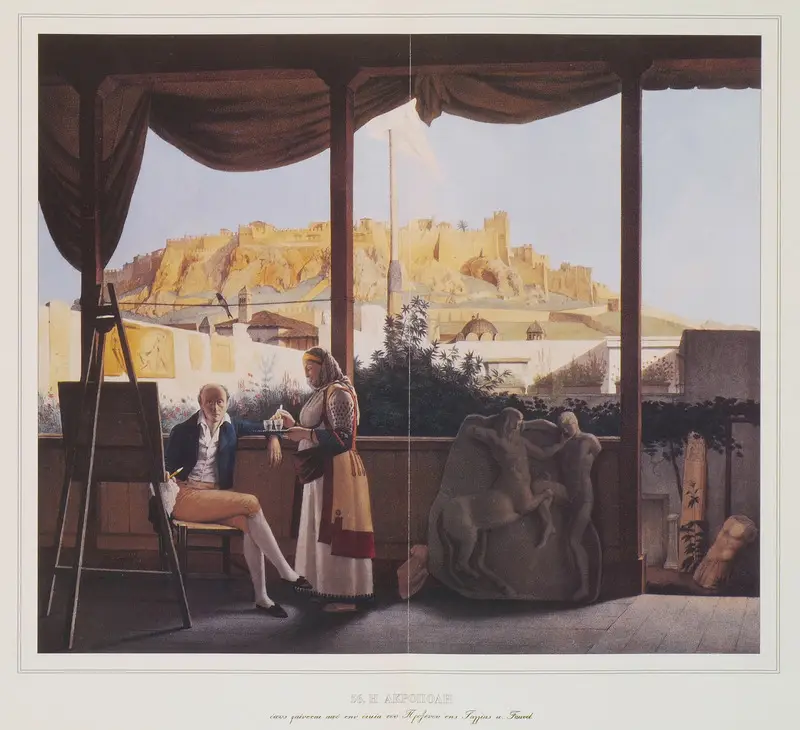 The Acropolis behind the terrace of the French consul Louis Fauvel's house in Athens, with antiquities set about the floor. A hand-coloured lithograph from Louis Dupré's Voyage à Athènes et à Constantinople, Paris 1825, after the artist's visit of 1819. Public domain, via Wikimedia Commons.
The monuments everyone has heard of left in this period, under this regime, before modern Greece existed to object. The Parthenon sculptures went to the British Museum by Act of Parliament in 1816, bought for about £35,000 after a parliamentary committee valued them well below Lord Elgin's asking price. The pediment figures from the Temple of Aphaia on Aegina were dug by an Anglo-German party in 1811 and auctioned the next year at Zante, where the agent of Crown Prince Ludwig of Bavaria bought all seventeen for 10,000 zecchini, sight unseen, on the strength of plaster casts Fauvel kept in Athens; they remain the centrepiece of Ludwig's Munich Glyptothek. The frieze of the Temple of Apollo at Bassae reached the British Museum around 1815. By the time the new kingdom could pass a law, its most famous sculpture was already abroad.
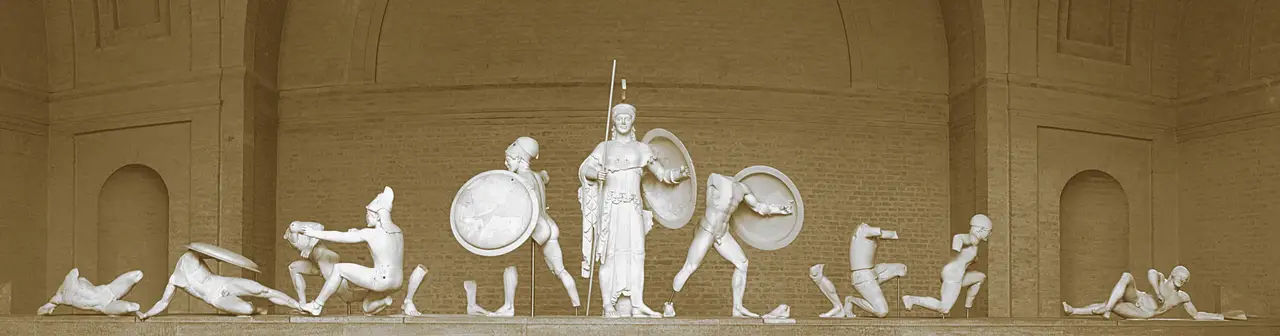 The fallen and fighting warriors of the Temple of Aphaia on Aegina, dug by an Anglo-German party in 1811 and knocked down to the agent of Crown Prince Ludwig of Bavaria at the Zante auction the next year, sight unseen. They have stood in his Munich Glyptothek ever since. Photo: Vitold Muratov, CC BY-SA 3.0, via Wikimedia Commons.
The law that banned export, then licensed it
When the law came, it was emphatic. The Fourth National Assembly banned the export of antiquities in 1829 and founded a national museum on Aegina. Then, in May 1834, the Bavarian regent Georg Ludwig von Maurer drafted the statute that set the frame for a century. Its first principle was uncompromising: all antiquities in Greece were "national possessions of all Greeks in general." Export was forbidden. The same law founded the Archaeological Service to investigate, supervise and protect.
The 1834 law also did three quieter things. It co-owned finds from private land between the landowner and the State. It permitted those finds to be sold and to circulate inside Greece. And it wrote its own export exemption: objects judged "insignificant," "superfluous," "useless," or "duplicate" could, once a committee had passed them, be licensed out of the country.
Chiara Mannoni, comparing the Greek statute with the contemporary edicts of the Papal States, found this the distinctive thing about it. The loopholes for exporting unwanted material "were provided by the law itself." The vocabulary that opened the gate was aesthetic. A piece could leave if an official called it ordinary, a copy, a duplicate, or "not interesting for scholarship and art." Taste, written into a customs rule, decided what counted as Greek heritage and what counted as surplus.
The co-ownership clause was the engine. To sell a find from his land, an owner had to advertise it and give the State first refusal; if he disliked the State's price he could sell to the highest bidder, surrendering half the proceeds to the archaeological fund, unless the object had been certified so unimportant that the State declined to bid at all, in which case he kept both the lot and the money. As Fabienne Marchand observes, this is why the national and international markets "could legally be fed with authentic specimens until very late in the nineteenth century."
How it ran in practice is visible in a single transaction of 1873. A dealer named Anastasios Erneris offered the State a set of painted plaques by the Athenian painter Exekias for 2,000 drachmae. The committee judging the price, Koumanoudis, Phintikles and Eustratiades among them, called it exaggeratedly high and countered with less than half, 800 drachmae. Erneris refused, and sold the plaques instead to the German scholar Gustav Hirschfeld, who took them out of the country. The General Ephor knew, and did nothing. The committee's reflex was to drive the price down or, failing that, to decline rather than ratify a high one, in the full knowledge that the object would then go abroad. The State's parsimony was itself an export mechanism.
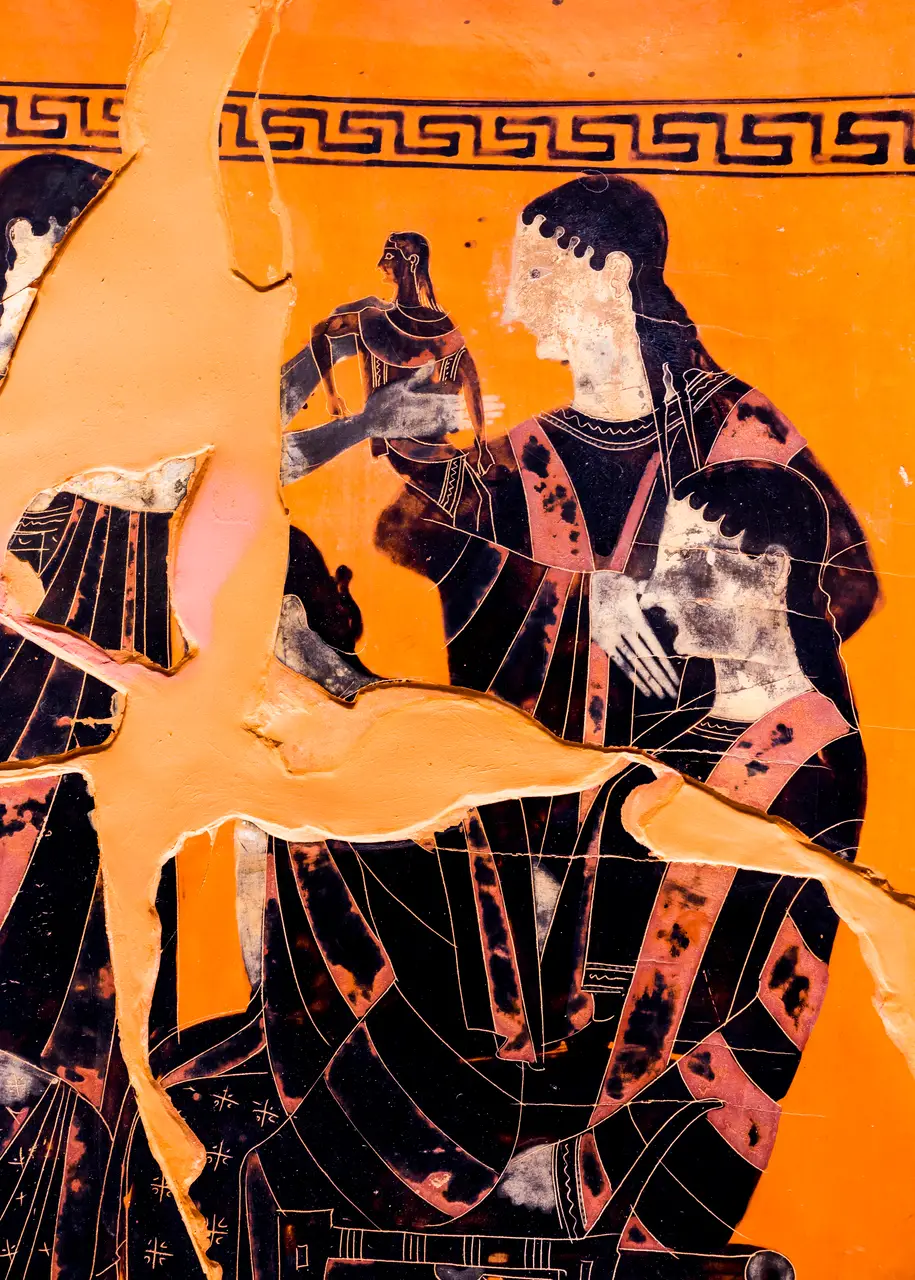 A funerary plaque by the Athenian master Exekias, mourners gathered about the dead, now in the Berlin Antikensammlung. In 1873 the State's committee haggled the price of just such a set of Exekias plaques down below half what the dealer asked; he refused, and sold them instead to a German scholar who carried them out of the country. Photo: ArchaiOptix, CC BY-SA 4.0, via Wikimedia Commons.
Athens had shops, and the shops kept cards
This was the world Rhousopoulos worked, and he worked it from the respectable end. Murray's Handbook of 1884 steered travellers to "a superior class of collectors, who, while not ostensibly dealers in antiquities, are willing to dispose of their possessions," and named only him: "His charges are moderate, and the traveller may have the satisfaction of knowing that anything purchased is undoubtedly genuine." The handbook was doing two jobs at once, and they are the two jobs a guide to collecting still does. It vouched for authenticity, against forgeries the same page admitted were "now very abundant." And it pointed the buyer toward the safest course for getting a purchase home, since a law existed, as it warned, "prohibiting the removal of all objects of antiquity (however insignificant)." Rhousopoulos, the record agrees, was among those who gave that advice.
He had rivals. Ioannis Lambros kept a shop in central Athens for coins, Tanagra figurines and Rhodian pottery, and sold to the British Museum and to Berlin. Ioannis Palaiologos handled the Dipylon Oinochoe, one of the earliest objects to carry writing in the Greek alphabet, and sold Cycladic grave groups to Arthur Evans before Evans went to Crete. The Minerva on Hermes Street, the shop Farrer used as his price benchmark, ran about fifty per cent dearer than London or Paris. By 1899 the American scholar Edward Capps could write that the Athenian dealers "have representatives in the principal capitals of Europe and do business directly with the management of museums on both sides of the Atlantic." This was a settled international trade with a shopfront in Athens and agents abroad.
The boundary Rhousopoulos lived along is clearest at the one moment he crossed it. In the mid-1860s he sold a small perfume flask, the Aineta aryballos, to the British Museum through Charles Merlin, the British consul at Piraeus who doubled as the Museum's buying agent. He had done it without a licence. In 1867 he was fined 1,000 drachmae and struck off the Archaeological Society. His defence was telling: he argued that the little vase had been a "duplicate," an "insignificant," "valueless," "superfluous" object, the exact words the 1834 law used for things that could lawfully leave. The trouble was that the judgment belonged to the State's conservator, not to the seller. The line between a legal export and a crime was a label and a piece of paper, and on this occasion he had supplied the label himself and skipped the paper.
The little clay women of Tanagra
After 1830 the trade changed shape. The age of carting off pediments was over; an 1888 article in the Athens paper Akropolis recorded that "massive, bulky objects were no longer in demand," and that interest had moved to jewellery, coins, terracotta figurines, bronzes and vases. This is the moment the collector's market as we would know it takes shape, built on small objects a visitor could afford and a grave could supply by the dozen. Baedeker's guide of 1873 told travellers that antiquities were "still found annually," and that the graves near Athens kept the city's dealers in "copious supplies of vases."
One object sat at the centre of the tourist trade. The small terracotta figures from Tanagra in Boeotia, mostly draped women, some holding a fan or a mirror, became the thing every visitor wanted. Thomas Cook had been running tours to Athens since 1868 and opened an Athens office in 1883. The Guide-Joanne of 1891 told the tourist who lingered at Skhimatari and fell into talk with the local farmers that he could come away with "une très jolie poupée," a very pretty doll, for a hundred or a hundred and fifty francs, the price having dropped from the early boom years. It added a warning in the same breath: "there are fakes at Tanagra as at Athens."
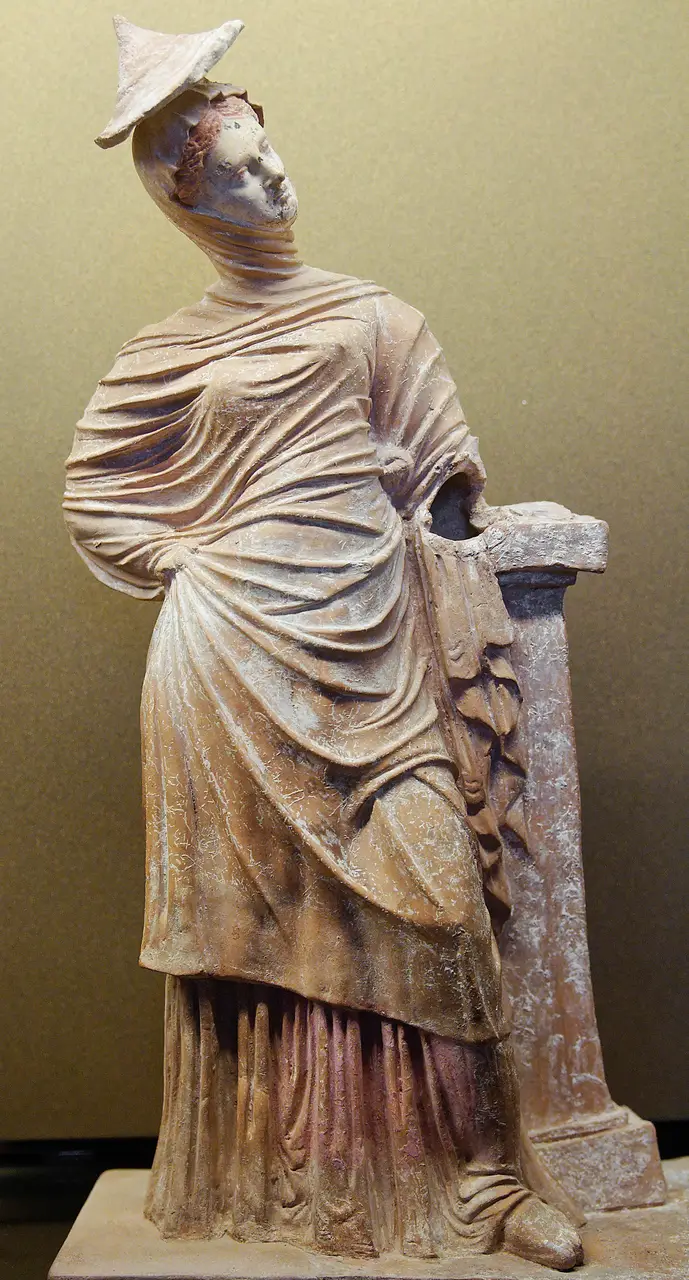 The thing every visitor wanted: a draped young woman leaning on a pillar, her sun hat pushed back, modelled in terracotta in the late third or early second century BC. It came out of a grave in the Tanagra necropolis and is now in the Louvre. Photo: Marie-Lan Nguyen, CC BY 3.0, via Wikimedia Commons.
The supply behind those prices was large and fast. In roughly two years from 1871, by Marchand's reckoning, between eight and ten thousand graves were opened around Tanagra, and more than five thousand figurines were scattered through the collections of Europe. Most of them moved as legal exports, treated as "multiples," the duplicate category the 1834 law let out, and the central administration gave the traffic its tacit support. "From Tanagra" became a selling label that dealers attached to figurines from elsewhere in Boeotia and Attica too. The label and the forgery warning belong together: by the time a figurine reached a shop in Athens or a dealer's window in Paris, the two questions worth asking were whether it was ancient and where it had really come from, which are the questions a careful buyer still asks first.
The forger's trade grew up beside the genuine one. A Greek dealer named E. Triantaphyllos, working from the Rue Cambon in Paris, supplied both the British Museum and the Louvre while turning out fake Tanagras on the side. Even the record pieces were not always clean. The famous "Cupid's Nurse" figurine, bought by the Russian minister Sabouroff for 9,000 francs, the highest price a terracotta statuette had then reached, turns out on inspection to carry an alien head added later and a good deal of retouching.
Kings, ambassadors, and the museums of Europe
At the top of the market the buyer was repeatedly a sovereign or a diplomat. Ludwig of Bavaria, who had taken the Aegina marbles, went on to build the core of Munich's Greek vase collection from a Sicilian collector's stock, once his architect had convinced him the pots were the equal of his sculpture. Pyotr Sabouroff, Russian minister in Athens through the 1870s, assembled a whole collection within a decade and broke it up in 1880: the vases, sculptures and bronzes to the Berlin Antiquarium, the gold and silver to the British Museum, the Tanagras to the Hermitage.
The prices stand out when set against the salaries of the men charged with keeping these objects in Greece. A university professor in Athens earned around 350 drachmae a month; the General Ephor, the country's senior antiquities official, earned 400. A single fine Tanagra could cost more than a year of either. A pair of figurines went from Lambros to Berlin for 18,000 francs in 1877. A complete Greek statue, at the top of the range, could reach 100,000 francs, four thousand pounds, at a time when the drachma ran at par with the franc and the pound bought twenty-five of either. The State competed where it could. The Archaeological Society spent up to 25,000 drachmae a year buying from the Athens dealers, and well over 200,000 across three decades, but it was outgunned, and on the best Tanagras it could afford only the moderate pieces while the exceptional ones sailed.
How the objects physically left is documented down to the bill of lading in one case Galanakis reconstructed. In 1871 Rhousopoulos sold a consignment to George Rolleston, professor of anatomy at Oxford, and handed the packed chest to the British Embassy in Athens. No British warship was sailing, so the embassy passed it to the British consul on Syros, who put it on a steamer to Liverpool and on to Oxford. On both bills of lading the chest was entered as "Books." It held, in fact, a vase, a mirror, a strigil and seven human skulls. When the Syros consul tried to relabel it more honestly as "Bones for scientific purposes," he was told the manifest could not be altered.
The embassy and the consulate were the ordinary carriers of the trade, and a diplomat's protection was the surest way past a customs officer. The same machinery could be bent when needed. The clearest demonstration came from Cyprus, where the American consul Luigi Palma di Cesnola, told that "the American Consul" was forbidden to ship his finds, noticed that the order named only the American consul, applied for the licence afresh as consul for Russia, a post he also held, had it in fifteen minutes, and loaded 360 cases aboard a chartered schooner within five hours. The logic of consular cover ran just as quietly through Athens and Piraeus.
Why Europe's museums needed the dealers
There was, in principle, another way for finds to leave a country legally, and most of the eastern Mediterranean used it. Partage, the division of excavated objects between the host country and the foreign excavator, was standard in Egypt, in Ottoman Cyprus, in Mandate Iraq and Palestine, and it is how a great deal of the British Museum and the Louvre was filled. The bust of Nefertiti left Egypt in a partage division. Greece refused it.
The refusal was settled at Olympia. The Greek-German convention of 1874 let a German team excavate the sanctuary of Zeus on these terms: Germany would pay the whole cost and hold the rights to publish and to take casts, and every object found would belong to Greece. Ernst Curtius had argued to the Prussian ministries that the Greeks possessed "neither the interest nor the means" to dig Olympia themselves. A deputy in the Reichstag complained in 1878 that the Reich was making "a heartily bad bargain," paying 150,000 Marks a year while "the excavated originals all go to Athens, and we for our part must content ourselves with plaster casts." The headline finds stayed. The Hermes attributed to Praxiteles, the flying Nike of Paionios, and the temple pediments are in the Olympia museum still. The model held everywhere it was tried next, at Delphi, Delos and Corinth. The bronze Charioteer the French School found at Delphi in 1896 stands today in the Delphi museum, a few minutes' walk from where it came up.
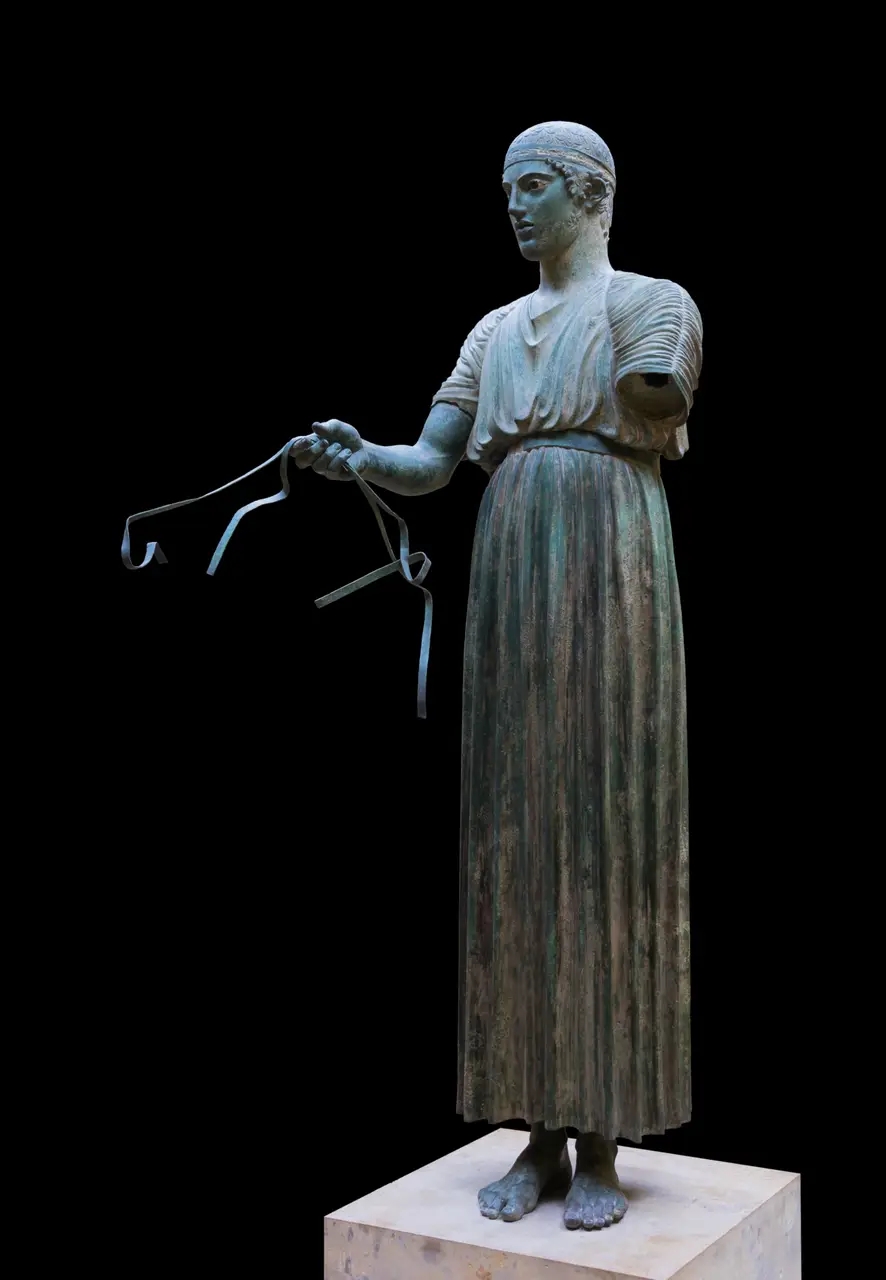 The bronze Charioteer, found by the French School at Delphi in 1896 and still in the museum there. Cast about 478 BC in the early classical severe style. Photo: Jebulon, CC0, via Wikimedia Commons.
The same principle had already been tested on Schliemann. His application to dig Mycenae was almost refused, because the Greeks doubted he would honour the rule that finds stayed; the 1876 permit made it a condition, set a state overseer named Stamatakis at his shoulder, and the Mycenae gold, the mask long mislabelled Agamemnon's among it, went to Athens, where it remains. The contrast with Schliemann's own earlier conduct is the proof of what mattered. At Troy, on Ottoman ground, he had smuggled "Priam's Treasure" out of the country. The same man, digging under a different law, could keep nothing. It was the legal regime, not the excavator's appetite, that decided whether the finds left.
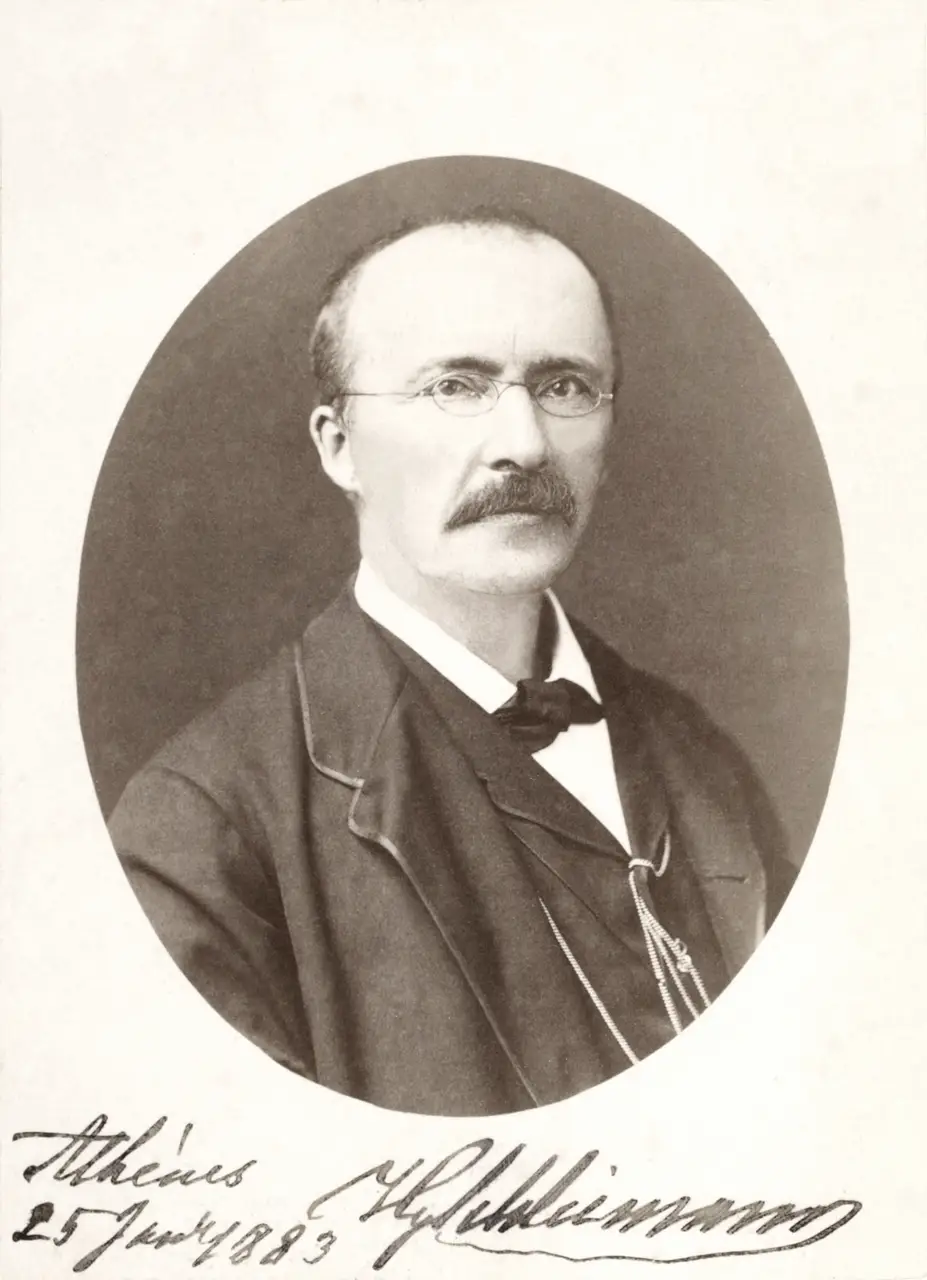 Heinrich Schliemann, who had smuggled "Priam's Treasure" out of Ottoman Troy but, digging at Mycenae under Greek law with a state overseer at his shoulder, could keep nothing. The portrait is signed at Athens in January 1883. Photo: S. Kohn, Karlsbad. Public domain, via Wikimedia Commons.
Even Olympia leaked, and through the familiar clause. After the Greek Chamber's approval the German team was licensed to export the "insignificant" pieces and the "duplicates," and 876 objects went to Berlin, out of more than two thousand requested. The model dig that kept its statues still fed the loophole with its small change.
Here the two halves of the story join. With the institutional door shut, the new museums of Greek art in Berlin, London and Paris could no longer be supplied by their own excavators. If they wanted Greek material, and they did, they had to buy it from the dealers. The German archaeologist Andreas Rumpf, in his history of the discipline, said as much without embarrassment: the strict Greek laws "prompted an illegitimate export of antiquities through the art trade," with Boeotia "the chief supplier" of such illegal finds, and the graceful Tanagra clay figures "secretly excavated and exported" as early as 1870. Greece's refusal to divide its finds is the precise reason the dealer market mattered as much as it did. After 1874, the shop on Lycabettus Street and the duplicate licence were the main legal channels by which a Greek object could reach a foreign collection.
The door closes
The law caught up with the trade by stages. Panagis Kavvadias's law of 1899 abolished the co-ownership that had powered the internal market and vested every antiquity in the State; it made illicit excavation and illegal export serious crimes carrying prison terms, a regime the French scholar Reinach called "très draconien." The codified Antiquities Law of 1932 declared the State's ownership "absolute and exclusive," and it stood for seventy years. Export, where it was allowed at all, now cost a licence and a surcharge of half the object's declared value. The statute in force today, passed in 2002, still prohibits export as a general rule. A tourist can no longer carry a genuine Greek antiquity home with a guidebook's blessing; anything ancient now offered to one is, almost by definition, already outside the law.
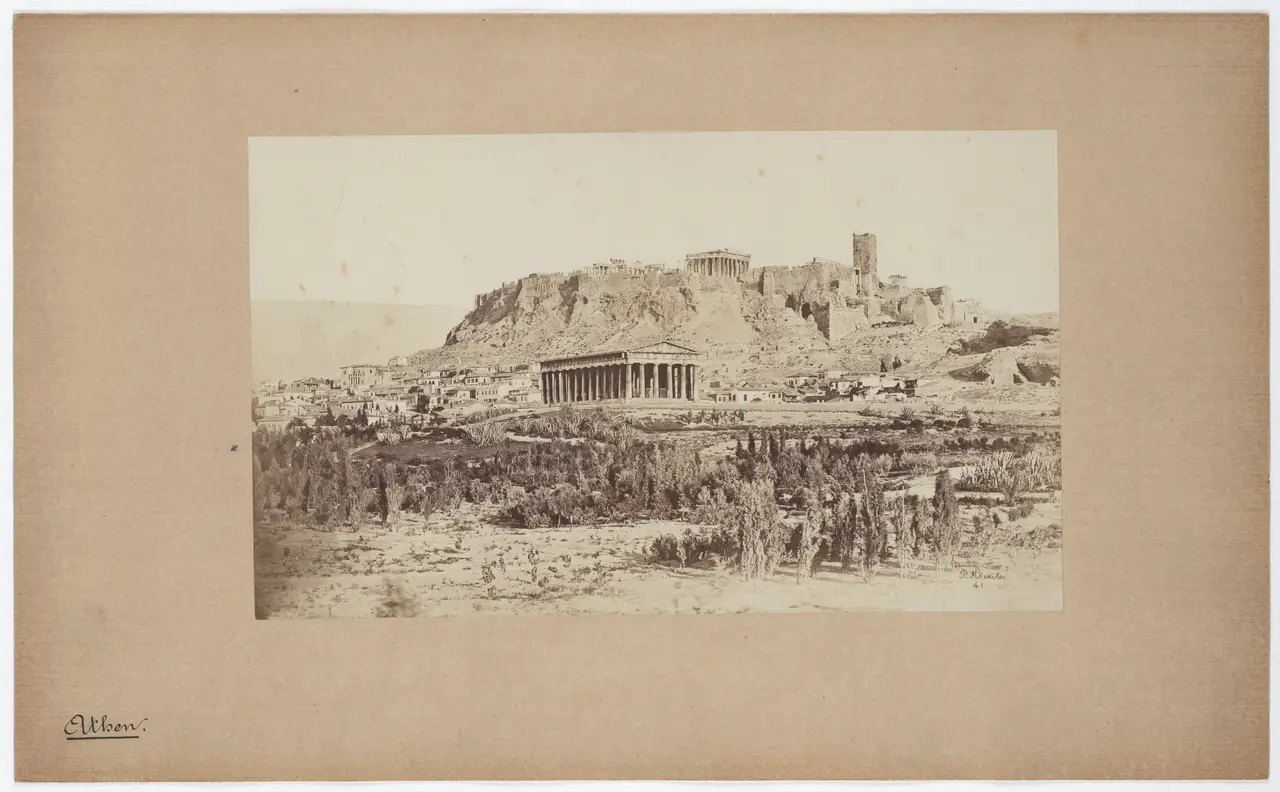 Athens in the decades the gate stood open, the Theseion in the foreground and the Acropolis beyond. The temple of Hephaestus served the young kingdom as one of its first antiquities stores. Photograph by Petros Moraites, about 1870. Public domain, via Wikimedia Commons.
For the better part of a century, though, between Maurer's law and Kavvadias's, the gate stood open, and a great deal went through it in good order: the find sold at home under the co-ownership rule, the figurine certified a duplicate, the vase carried out with a licence, the doll bought from a farmer at Skhimatari for 150 francs. Those objects acquired histories in European cabinets and private collections, and the documented ones still carry that paper. The portable categories the post-1830 market turned to, the figurines and vases, the coins and gems and small bronzes, are the same categories a collector meets today, and the best of them trace back through that lawful trade. Such pieces still reach the saleroom with their nineteenth-century provenance attached, and for a collector that older paper is the thing worth looking for.
When a Tanagra figurine with a French collection behind it comes up for sale now, it is the far end of a trail that runs back through a dealer's window in Paris, a tourist's trunk, an embassy chest marked "Books," and a customs licence that called the thing insignificant. The label was always half the value, and it still is.
TimeLine Auctions, 15th July 2026