Home > Stories by TimeLine Auctions
Stories by TimeLine Auctions
How to Display Antiquities on a Budget
Your first piece arrives. You unwrap it carefully, admire it for a few moments, and then realise you have absolutely no idea where to put it. The dining table seems wrong. The bookshelf feels precarious. The mantelpiece is too dusty. We see this moment of hesitation with nearly every new collector who walks through our doors at TimeLine, and it's one of the most underrated barriers to building a collection. The assumption is that displaying antiquities properly requires custom cabinetry, museum-grade lighting rigs, and a conservator on retainer. It doesn't.
What it does require is a practical understanding of what your objects actually need, which is often far less than you might expect, and a willingness to think creatively about furniture you can find at your local IKEA.
What Are You Actually Protecting Against?
Before you buy anything, it helps to understand what display is really for. The primary enemy of most antiquities isn't dramatic: it's dust. Dust settles into terracotta pores, dulls bronze patinas, and makes stone look tired. Cleaning antiquities is tedious at best and risky at worst, particularly with fragile surfaces or areas of ancient repair. The simplest solution is prevention. A glass-fronted cabinet, even a very basic one, will do more for the long-term appearance of your collection than any amount of careful dusting.
Beyond dust, you'll want to think about environmental stability. Here's where new collectors often over-worry. If you're collecting terracottas, stone, or ceramic, you don't need climate-controlled rooms or dehumidifiers running around the clock. These materials are remarkably robust. They've survived two thousand years in the ground; they can handle your living room. That said, very high humidity can encourage mould growth on porous terracotta, so avoid placing cabinets against exterior walls in damp climates or in bathrooms (we have, regrettably, heard of this happening).
Metals, wood, and organic materials are another matter. Bronze disease, iron corrosion, and wood cracking are all accelerated by humidity fluctuations. If your collection leans towards these categories, you'll want a more specialised display case with some form of humidity control, whether that's silica gel packets or a purpose-built unit. We'll focus here on the majority of collectors, whose pieces are ceramic, stone, or glass and require only basic protection.
Then there's lighting, which we'll touch on briefly because we're preparing a dedicated article on the subject. The short version: LED strips are affordable and easy to install, while spotlights offer more precision but require more planning. Most collectors start with LED strips tucked along the top or sides of their cabinets and find that perfectly adequate.
Three Cabinets Worth Knowing
We're going to recommend three specific pieces of IKEA furniture, not because they're the only options, but because we've seen them work well for collectors at different stages and budgets. None of them are perfect. All of them are good enough.
The BAGGEBO Glass Door Cabinet
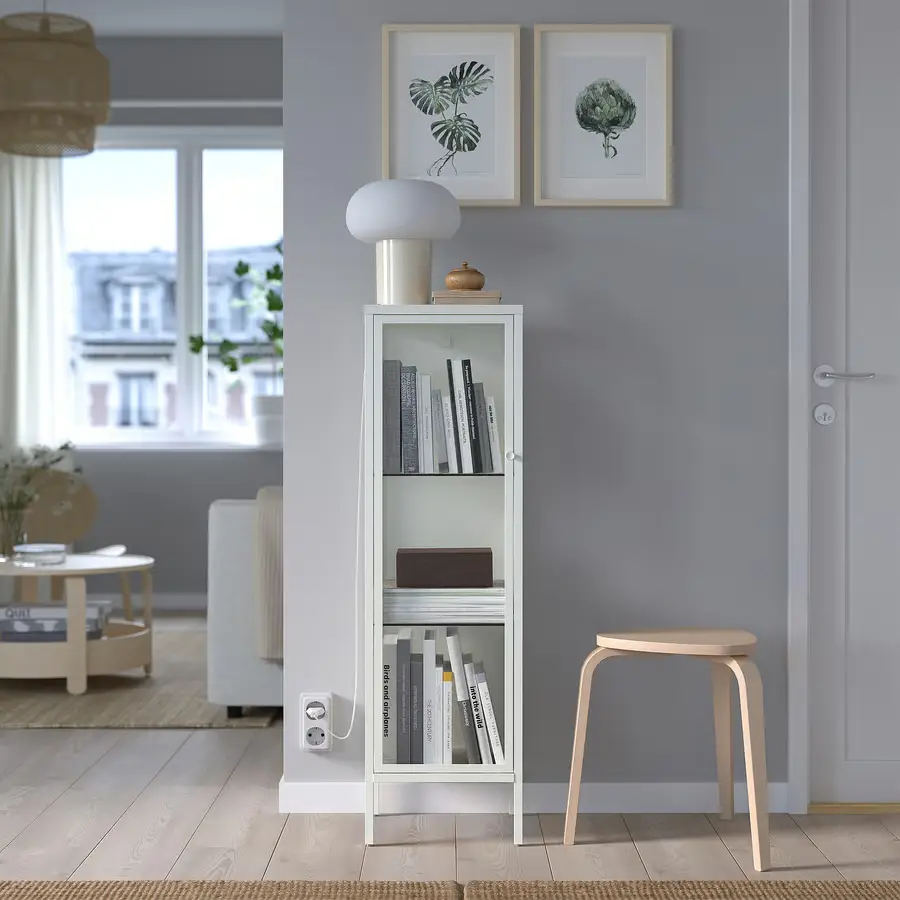
At around forty pounds, the BAGGEBO is the cheapest way to get your collection behind glass. It's a straightforward cabinet with glass doors and a few adjustable shelves, and it does exactly what you need it to do: keep dust out while letting you see in. The build quality is basic, which means you won't want to overload the shelves with heavy stone pieces, but for terracottas, small bronzes, and Roman glass, it's entirely adequate. We've seen collectors line their walls with three or four of these, creating an impressive display for less than the cost of a single custom case.
The aesthetic is utilitarian. If you're drawn to the "cabinet of curiosities" look, where objects crowd together in a kind of organised chaos, the BAGGEBO lends itself to that approach. Fill the shelves, vary the heights with small risers (acrylic blocks or even stacked books work), and let the density of the display do the visual work.
The BLÅLIDEN Glass Door Cabinet
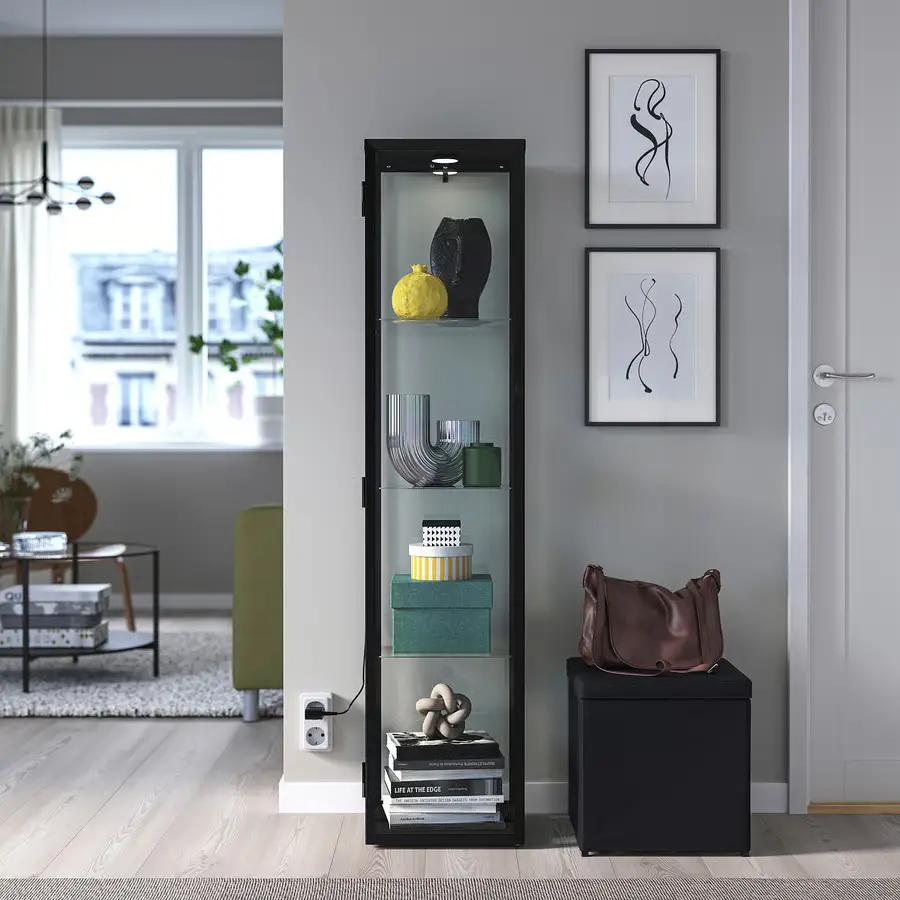
Step up to the BLÅLIDEN and you get a slightly taller, slightly nicer cabinet for around a hundred pounds. The proportions are more elegant, and the overall impression is less "student flat" and more "considered choice." If the BAGGEBO is functional, the BLÅLIDEN is functional with a bit of polish.
This cabinet works well for collectors who want something that looks intentional without veering into expensive territory. It's a good middle ground between raw budget and the kind of investment that makes new collectors hesitate.
The HEMNES Glass Door Cabinet
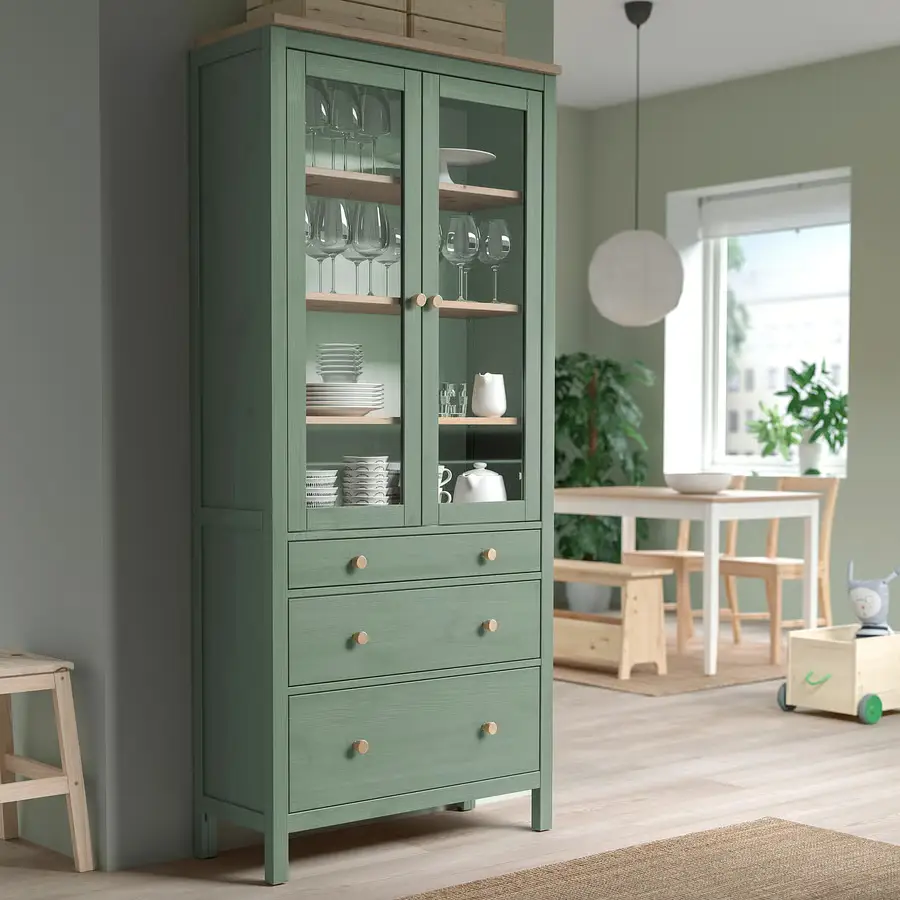
The HEMNES sits at around four hundred euros, which puts it in a different category. What you get for that price is a hybrid piece: a proper display cabinet on top, with enclosed storage below. This matters more than you might think. Collections accumulate paperwork (certificates, provenance documents, auction catalogues), spare stands, and the occasional piece that's between display rotations. Having somewhere to put all of that, integrated into the same piece of furniture, is genuinely useful.
The HEMNES is also designed for living spaces rather than galleries. It looks like furniture, not like museum equipment. If your goal is to integrate your collection into a room rather than dedicate a room to your collection, this is the piece to consider. There's space between the cabinet walls and the shelves to run LED strip lighting, which means you can illuminate objects without drilling holes or hiring an electrician.
How Do You Want to Live With Your Collection?
Before you buy a single cabinet, it's worth sitting with a more fundamental question: what role do you want antiquities to play in your home? This sounds abstract, but the answer will determine everything from furniture choices to room layout to how much you eventually spend.
We find that many collectors came to this hobby through museums. They remember a particular gallery that stopped them in their tracks, a Roman portrait bust lit just so, or a case of Greek pottery that made the ancient world feel suddenly present. That experience lodges somewhere, and years later, when they have the means and the space, they want to recreate something like it. There's nothing wrong with this impulse. In fact, it's one of the purest motivations for collecting: you loved something, and now you want to live with it.
For these collectors, the goal is often a dedicated display space. We've seen spare bedrooms transformed into private galleries, home offices lined with cabinets, even garden sheds converted into climate-controlled study rooms. The BAGGEBO and BLÅLIDEN cabinets work beautifully in this context. Line them along a wall, add consistent lighting across all units, and you create something that genuinely evokes a museum gallery. The uniformity matters here. When every cabinet matches, the eye moves across the objects rather than the furniture, which is exactly what museums aim for.
A dedicated "museum room" has practical advantages too. You can control the environment more easily, keep foot traffic to a minimum, and display pieces that might be too fragile or too visually demanding for shared living spaces. We remember one collector who kept his Greek pottery in glass cases in his study, arranged chronologically from Geometric through to Hellenistic. Visitors could trace five centuries of artistic development in a single slow walk around the room. That kind of curatorial coherence is difficult to achieve when pieces are scattered throughout a house.
But not everyone wants a museum at home. Some collectors prefer their antiquities to function as part of daily life, present but not separated, visible while you're cooking dinner or reading on the sofa. A Roman oil lamp on the hallway console. A fragment of Egyptian relief above the fireplace. A case of Byzantine coins in the living room, catching the afternoon light. This approach treats antiquities as you might treat any other decorative object: chosen for beauty, placed for effect, and encountered casually rather than ceremonially.
The HEMNES cabinet suits this style because it disappears into domestic space. It looks like a piece of living room furniture because it is one. Your collection lives alongside books, photographs, and the general clutter of a home. For many collectors, this integration is the whole point. They don't want to visit their objects; they want to live among them.
There are hybrid approaches too, and we see these more often than either extreme. A collector might keep their core pieces in a study or dedicated room while placing a few favourites in more public areas of the house. The bedroom might have a single lit cabinet; the living room might have a marble head on a plinth. This lets you enjoy the best of both worlds: concentrated display where you can study and appreciate the collection as a whole, and individual pieces positioned where they'll surprise you at odd moments of the day.
The question to ask yourself is this: when do you want to see your collection? If the answer is "when I choose to," a dedicated space makes sense. If the answer is "all the time, without thinking about it," integration is the way forward. If you're not sure yet, start small. Buy one cabinet, place it somewhere you spend time, and see how it feels after a month. Collections evolve, and so do the spaces that hold them.
Two Philosophies of Arrangement
Within whatever space you choose, you'll still need to decide how objects relate to each other. Here we see collectors divide again, this time along aesthetic lines.
The first philosophy draws on the cabinet of curiosities tradition, where objects accumulate over time and sit together in a way that tells a story about the collector's interests. Shelves are full. Pieces crowd companionably. A Roman lamp sits next to a Greek figurine sits next to an Egyptian amulet, connected not by period or culture but by the collector's eye. There's a maximalist pleasure in this approach: displays that reward close looking, where you notice something new every time. The BAGGEBO and BLÅLIDEN cabinets suit this style well. Buy multiples, fill them generously, and let the density create the effect.
The second philosophy is more minimal. Each piece is given room to breathe. Shelves hold one or two objects, carefully positioned. Negative space does as much work as the objects themselves. This approach borrows from contemporary gallery practice, where a single sculpture might occupy an entire room. It demands stronger individual pieces (a crowded shelf can hide a mediocre object; an empty one cannot), but the effect, when done well, is striking. The HEMNES works here because its scale and proportions feel domestic rather than institutional; a few well-chosen pieces won't look lost inside it.
Neither philosophy is more correct. We've seen both done beautifully and both done poorly. The key is knowing what you're after before you start arranging.
A Practical Checklist Before You Set Up
Here are the questions we suggest asking yourself before you buy any furniture or place any object:
- What materials are you collecting? Stone, ceramic, and terracotta need only dust protection. Metals and organics need humidity consideration.
- Where will the collection live? Dedicated room, shared space, or distributed throughout the house? Each demands different furniture and planning.
- How much natural light does the room get? Direct sunlight can fade some materials and creates unpleasant glare on glass-fronted cabinets. Choose your wall accordingly.
- Do you want to add lighting later? If so, check whether the cabinet design allows for cable routing. The HEMNES does; cheaper options may require creative solutions.
- What's the weight of your heaviest piece? Budget shelving has weight limits. If you're collecting substantial stone objects, factor this in.
- Is the cabinet against a damp wall? Exterior walls in older buildings can introduce moisture. Move the cabinet a few centimetres away from the wall or choose a different location.
Learning by Looking
The best way to develop your eye for display, like most things in collecting, is to look at how others do it. We'd encourage you to browse the current TimeLine catalogue with display in mind. When you see a piece photographed, ask yourself: how would I light this? Where would I put it? What would it sit next to?
Even if you're not ready to bid, registering for an upcoming auction is worthwhile. You can follow the prices, see what sells and what doesn't, and start to build a sense of the market. Think of it as research, because that's exactly what serious collectors do.
Your collection deserves to be seen, by you and by anyone you invite into your home. That doesn't require a fortune. It requires a bit of thought, a trip to IKEA, and the willingness to start somewhere. The furniture can always be upgraded later. The habit of displaying your objects well, and enjoying them daily, is what matters now.
TimeLine Auctions, 19th February 2026