Home > Stories by TimeLine Auctions
Stories by TimeLine Auctions
How to Identify Ancient Glass: A Technique-by-Technique Guide from Core-Formed to Cut
Set a Roman pillar-moulded bowl beside an ordinary Roman bottle and let your hands do the looking. The bowl is thick-walled, cold and unexpectedly heavy, ringed on the outside with raised ribs and polished on the inside to a soft sheen, closer in feel to carved stone than to anything from a glassblower's pipe. The bottle is its opposite: light as a dry leaf, walls thin enough to glow, a rough little scar hiding under the base. Perhaps a century separates them in date. What separates them in kind is how they were made, one cast in the old way and one blown in the new, and in ancient glass how a thing was made is very nearly when it was made.
That one equation makes glass the most learnable material in the antiquities market. Glassworkers found their techniques in a fixed order spread across three thousand years, and most of those techniques also went extinct, so a correctly identified method brackets an object in time from both ends. Core-forming came first, in the Bronze Age. Casting, with its polychrome branch, mosaic, ruled the centuries before Rome. Cameo was a brief luxury experiment in the decades around Augustus. Blowing arrived in the first century BC, made glass cheap, and swept everything else aside; mould-blowing, trailing and wheel-cutting then decorated what the blowpipe mass-produced; and when Rome faded, the workshops of the Islamic world picked up the same toolkit and ran it for another seven centuries. Every stage left physical tells that survive burial, and every stage has its own drawer in the reference books that auction catalogues cite in shorthand. This guide walks the sequence in order: how each kind of glass was made, how to recognise it in the hand, what the type-names and code numbers mean, and how tightly each one dates.
The worked examples are lots in our sale of 8 September 2026, which happens to carry nearly the entire sequence, from a Greek core-formed amphoriskos to a facet-cut bottle made in eastern Iran a thousand years after the Caesars. Most of these lots are estimated between £400 and £3,000; glass is the one collecting field where the whole history of a material sits within ordinary reach.
A timeline of glassmaking techniques
Each row of this table gets its own section below. The dates are working brackets rather than walls, and the two decorating crafts, trailing and cutting, ran alongside blowing rather than after it.
| Technique | How it was done | Main period | First things to look for |
|---|---|---|---|
| Core-forming | threads of hot glass wound over a removable core | c. 1550-1200 BC; revived late 6th century BC to c. AD 10 | small scent bottles; opaque; combed feather and zigzag patterns; rough pitted interior |
| Casting and sagging | a blank slumped over a mould, then polished | 5th century BC to 1st century AD | thick walls, real weight, lathe-polish inside |
| Mosaic (millefiori) | slices of patterned cane fused together | 3rd century BC to 1st century AD | florets and spirals running through the wall, not sitting on it |
| Pillar-moulded bowl | cast ribbed bowl, sagged over a former | c. 100 BC to the later 1st century AD | bold ribs outside, smooth polished interior |
| Cameo | dark glass cased in white, carved cold | c. 30 BC to AD 70; revival around the 4th century | white relief on a dark ground |
| Free blowing | inflated on the pipe, shaped by hand | c. 50 BC onwards | thin, light walls; pontil scar under the base |
| Mould-blowing | inflated into a patterned, multipart mould | c. AD 25 onwards | relief decoration repeated identically from vessel to vessel |
| Trailing | hot threads applied to a blown vessel | 1st century AD onwards; elaborate from the 3rd | zigzags, coils and collars, sometimes in a contrasting colour |
| Wheel-cutting | ground cold against a spinning wheel | 1st to 5th centuries AD; facets peak c. AD 70-120 | crisp grooves or facets with matt, ground surfaces |
| Islamic cutting and marvering | the Roman and Sasanian toolkit, continued | 8th to 14th centuries AD | deep relief facets; applied script; dragged white threads on dark glass |
The brackets hold because techniques died as well as arrived. Nobody was building glass around a core in the third century AD, so a genuine core-formed bottle cannot be late Roman; nobody cast a mosaic bowl under Constantine. The weak spot is plain blown ware, which changed slowly for centuries, and there the form typologies take over from technique; we will meet them on the way.
Core-formed glass: bottles built around a core
Glass is older than glass vessels by a thousand years. Sumerian workshops were making it as a material in its own right, for beads and seals, by the late third millennium BC, and "in its own right" is doing real work in that sentence: faience, the blue-green material of so many Egyptian amulets, is quartz paste sintered together under a glaze, while glass is melted right through. The first true glass vessels arrive around the middle of the sixteenth century BC, probably in the Hurrian kingdom of Mitanni in upper Mesopotamia; the earliest that can be closely dated is a bottle from Atchana, ancient Alalakh, in northern Syria. Egypt's industry then appears, in David Grose's phrase, "seemingly out of nowhere" early in the New Kingdom, and Donald Harden's explanation is still the favourite: Thutmose III brought Asiatic glassworkers home from his Syrian campaigns in the fifteenth century BC. The earliest Egyptian glass vessels all belong to his reign, and a stemmed beaker among them carries his name.
The know-how was even written down, and the copies survive. Thirty-eight cuneiform fragments from Ashurbanipal's library at Nineveh join up into five British Museum tablets of glassmaking recipes, seventh-century copies of instructions that were already the better part of a thousand years old when the scribes made them.
A core-formed vessel began inside out. On the end of a metal rod the maker shaped a core of clay, mud, sand and an organic binder into the form of the future interior; the old textbook label "sand-core" is a misnomer, since the core was never sand alone, which is why specialists now write core-formed instead. Hot glass was trailed over the core in threads as the rod turned, reheated, and rolled smooth on a flat stone slab, a step called marvering that will keep reappearing in this guide. Threads in a second colour were wound round the body and dragged up and down with a bronze point into feathers, festoons and zigzags; a rim-disc and handles went on separately, the disc probably doubling as an applicator; then the rod was withdrawn and the core scraped out.
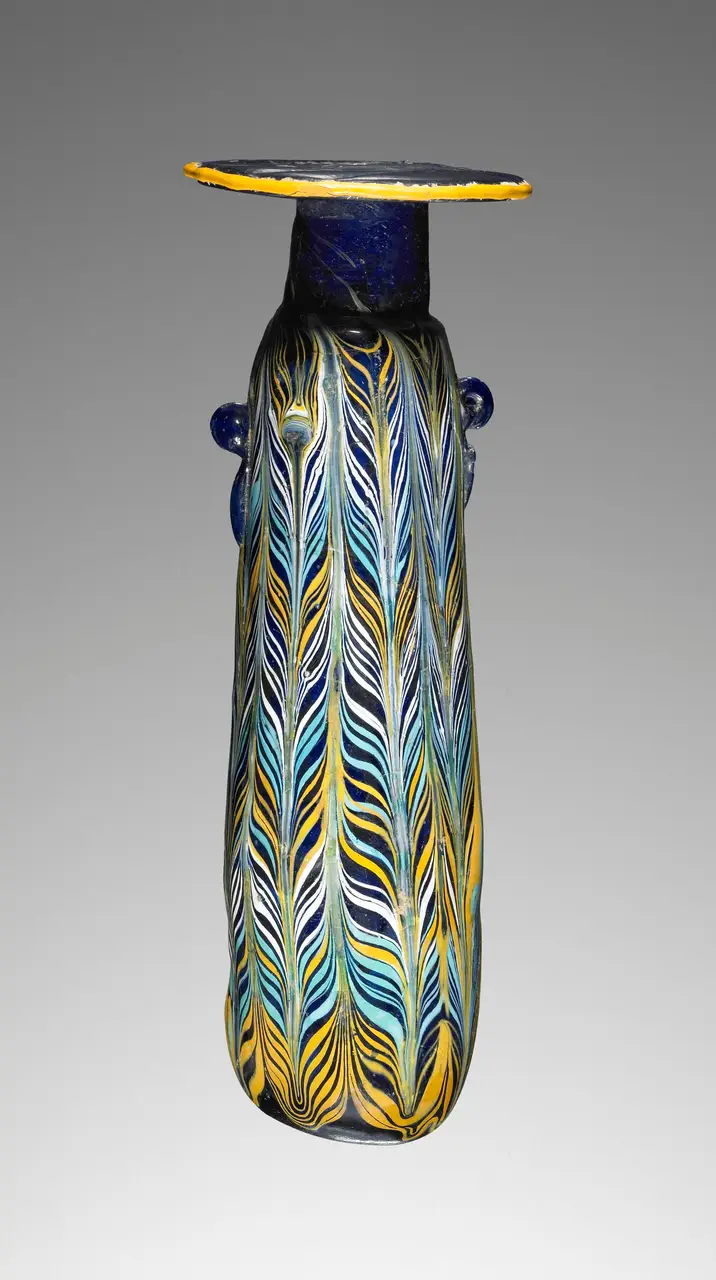 A core-formed alabastron for scented oil, eastern Mediterranean, fourth to third century BC. Threads of yellow, white and turquoise were wound on hot and combed into feathers with a metal point. J. Paul Getty Museum, public domain via Wikimedia Commons.
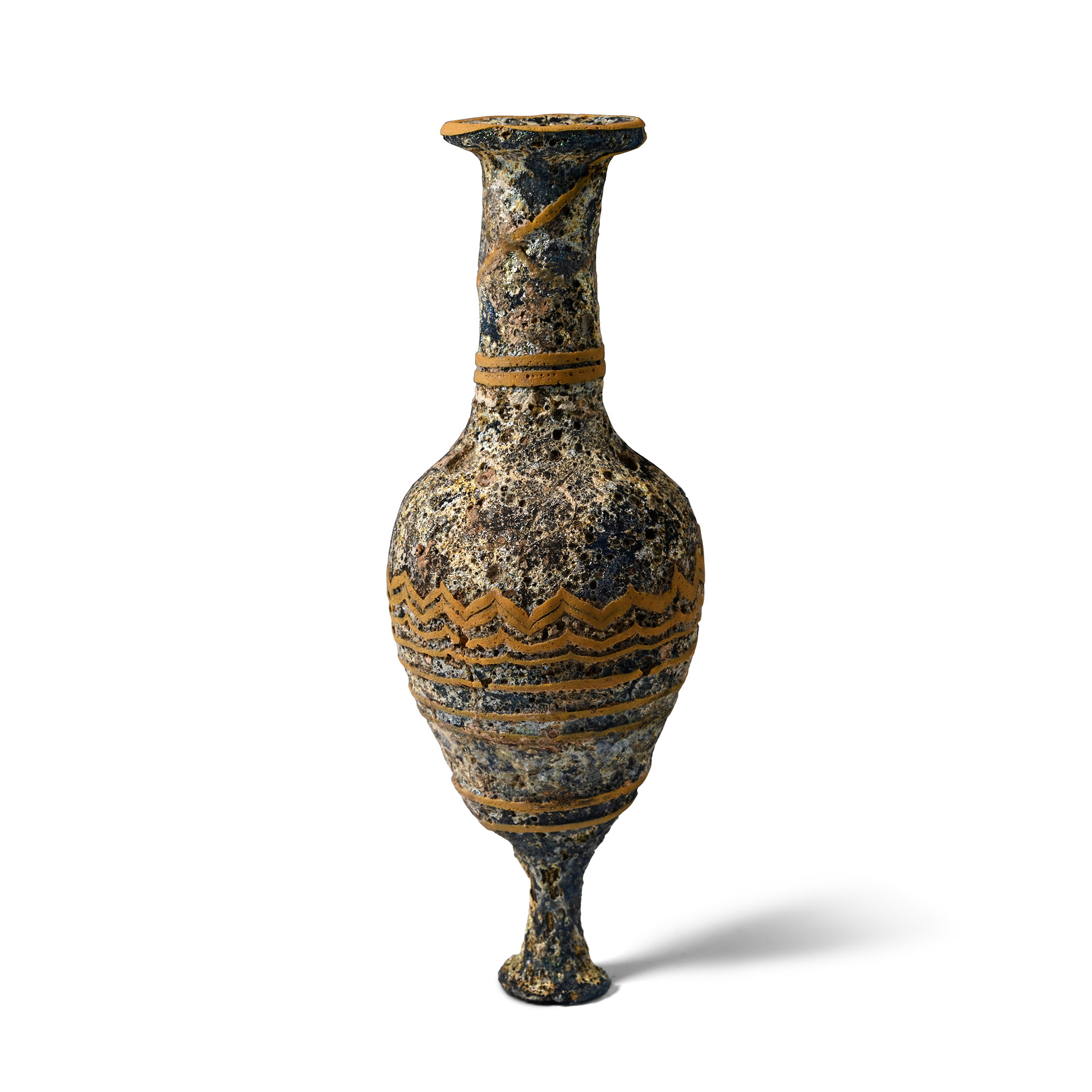
Each of those steps leaves a diagnostic behind. The scraped-out core leaves the interior rough, matte and pitted, nothing like the fire-smooth inside of any blown vessel; the wound and combed threads give a dense, opaque, striped body that reads more like patterned hardstone than like window glass; and the whole class is small, because nothing large could be built this way and nothing needed to be, these being containers for scented oil and kohl rather than tableware. Their shapes borrow names from Greek pottery, and catalogues still use them: alabastron, amphoriskos, aryballos, oinochoe.
Chronology inside the class rests on Harden, who sorted the revived Mediterranean industry of the later first millennium BC into three groups in his 1981 British Museum catalogue, and dealers have quoted him ever since. Mediterranean Group I runs from the late sixth to the early fourth century BC and is East Greek, tied to the Rhodian perfume trade; Group II covers the mid-fourth to late third century; Group III begins in the mid-second century BC on the Syro-Palestinian coast or on Cyprus and runs to the first decade of the first century AD, when casting and blowing finally put the core-formers out of work. So "Group III alabastron" in a sale description is a date range and a coastline compressed into three words. Genuinely early pieces, Bronze Age or Greek, are the oldest glass a private collector is ever likely to handle, and the September sale carries one: a Greek amphoriskos with yellow festoons combed over a dark body.
Cast glass: tableware before the blowpipe
For fine drinking vessels the pre-Roman answer was to treat glass like a stone that could be persuaded. Casting covers every method that melts glass in or over a mould, and the branch that matters most for tableware is sagging: a flat blank of glass is laid over a domed former, or into a hollow one, and softened in the kiln until it slumps into shape. The slumped bowl then went to the finishers, who ground and polished the interior on a rotary lathe and returned the outside to the furnace mouth for a flame polish. Run a fingertip around the inside of a cast bowl and you can sometimes feel the lathe's faint concentric lines; that surface, together with sheer thickness and weight, is casting's signature in the hand.
The habit of casting fine tableware goes back to the Achaemenid Persian court of the fifth and fourth centuries BC, whose cast bowls copied the profiles of palace metalwork. Hellenistic workshops industrialised the idea from the third century BC, and by the middle of the second century BC the Levantine coast was turning out plain "grooved bowls" in what Grose calls the first real commercial exploitation of glass tableware.
Mosaic glass and millefiori
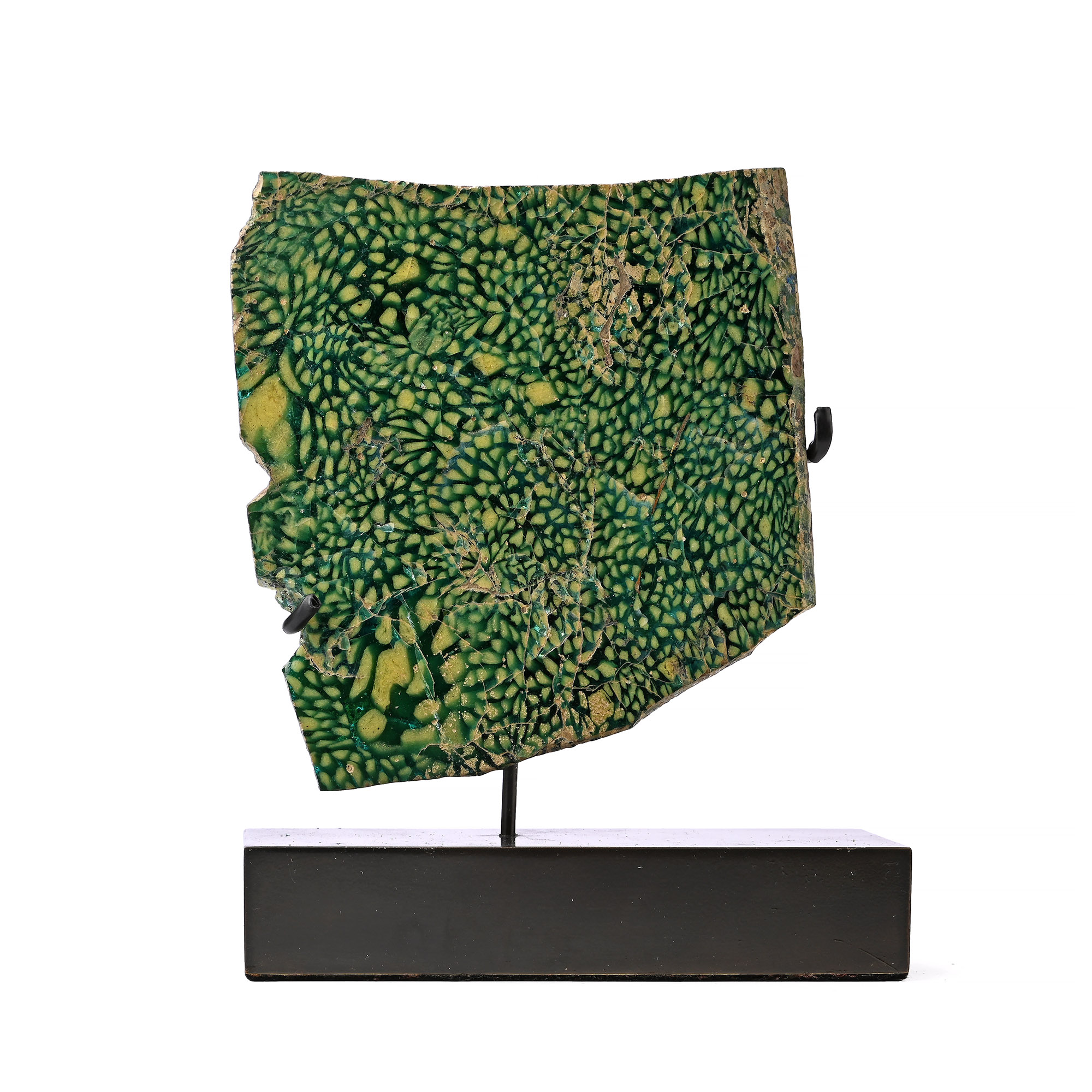
Casting's polychrome branch is mosaic glass, millefiori in the trade's later Italian. Its unit is the cane: rods of coloured glass bundled into a pattern, fused, and drawn out lengthwise so that the pattern shrinks in cross-section, the same trick a seaside rock-maker uses to run letters through a stick of rock. Slices of cane were laid edge to edge in a mould and fused in a kiln held for several hours somewhere between about 785 and 850 degrees centigrade, or fused into a flat blank and sagged over a former like any other; rims were often finished with a network cane, thin white or yellow threads spiralling round a clear rod, which the literature calls reticella. The colours are characteristically opaque, and the pattern is structural. Grind the surface of a mosaic bowl down and the florets are still there, because they run through the wall rather than sitting on it.
The technique has Bronze Age forerunners at Nuzi and Hasanlu, but its great age came late. Mosaic bowls travelled on the ship that sank off Antikythera around 80 BC, and Italian and Syro-Palestinian workshops kept the style in production into the Julio-Claudian decades. The fragment in our September sale belongs to exactly that horizon, a field of spiral and floret canes reading green and yellow-green in the hand. Its catalogue describes a white ground, and the mismatch is its own small lesson for a beginner: catalogue colour and object do not always agree, and the object wins. Complete Roman mosaic vessels are rare and priced accordingly, with a fine bowl of the class in Cleveland; fragments are how most collectors come to own the technique.
The pillar-moulded bowl: the first form number to learn
The single most recognisable object in Roman glass is a shallow hemisphere with bold vertical ribs standing proud of the outside wall, and it is the usual first test of a new collector's eye. The pillar-moulded bowl was made by adding ribs to a cast blank and sagging it over a former; the interior was then smoothed on the wheel, and on many examples, including ours, the lathe left one or two crisp wheel-cut lines running round the inside below the rim. Ribs outside, polish and cut lines inside, and real weight in the hand: no blown vessel shows that combination, and once you have held one you will not mistake the type again.
Catalogues call it Isings Form 3. The number comes from Clasina Isings's Roman Glass from Dated Finds of 1957, a corpus that numbered the Roman vessel forms by working outward from glass found in datable contexts: graves with coins, destruction layers, sealed deposits. A form number in a catalogue is dating evidence in compressed form, tying the vessel in front of you to every dated context in which the shape has turned up.
For Form 3 the dated contexts are good ones. Ribbed bowls were in production certainly by the second quarter of the first century BC, on finds from Tel Anafa, Delos and Jerusalem; in the early Empire they became, in Grose's words, "pre-eminent among cast tablewares," and a single shop at Herculaneum held eight matched examples when Vesuvius sealed it in AD 79. They were also among the last Roman glass still being cast after everything else had moved to the blowpipe, which is why the type brackets so neatly: a good ribbed bowl sits in the century either side of the birth of Christ, more or less regardless of findspot. Kourion on Cyprus and Kenchreai, the port of Corinth, have both produced them, and the Metropolitan Museum's Cesnola collection from Cyprus includes six bowls with vertical ribs of just this kind.
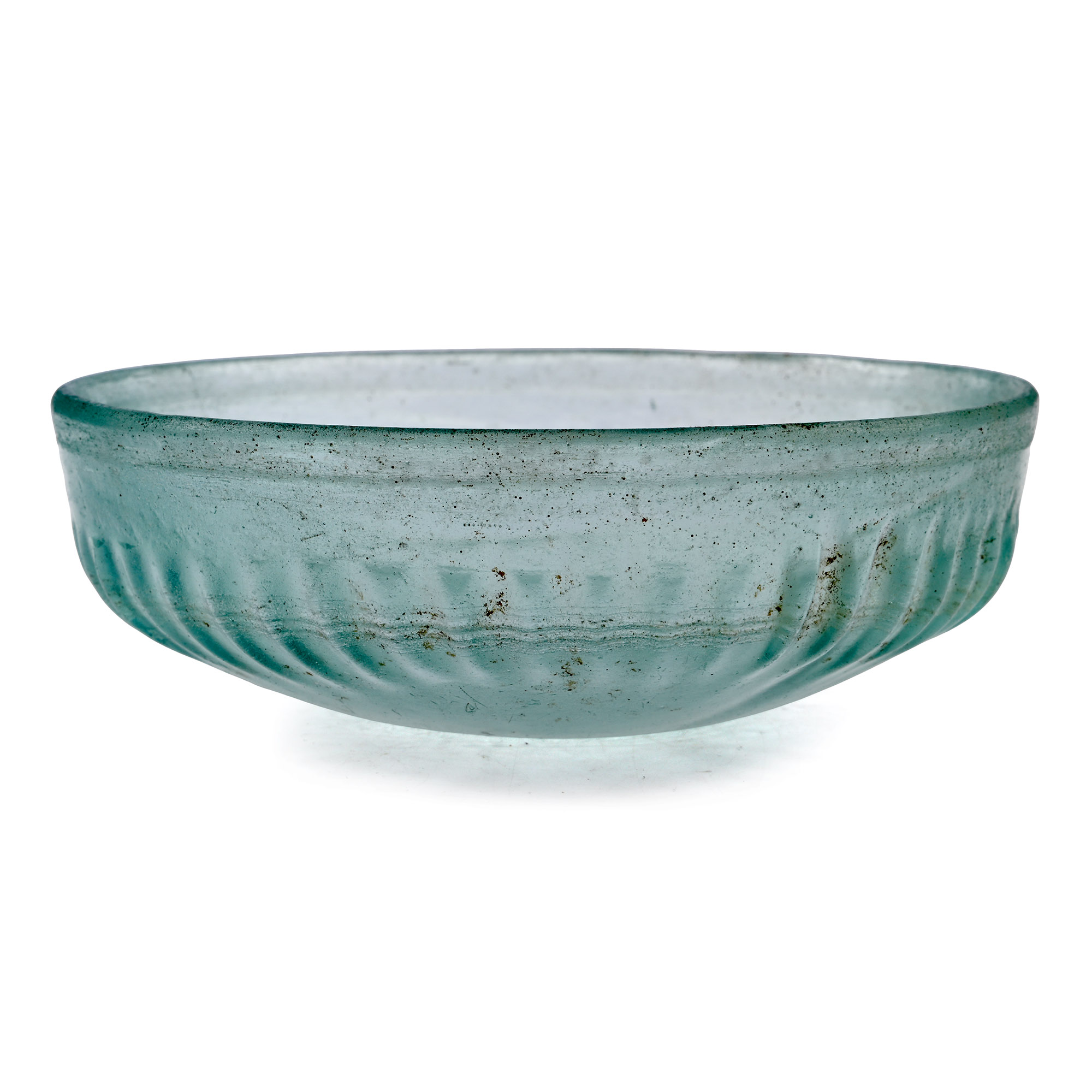
How the ribs themselves were formed is, in a small way, an open scholarly wound. Grose favoured tooling the ribs onto the blank before sagging, perhaps deepened by prolonged slumping, and admitted that the finished surfaces record only the last stages of the work; a rival school holds that such bowls were pressed in moulds; and nobody has settled whether the ribs strengthened the wall or only decorated it. None of that touches the dating, which rests on find contexts rather than on how the ribs got there.
Cameo glass: a luxury interlude
In the same decades as the ribbed bowl's peak, a few Roman workshops made glass in imitation of carved hardstone. Cameo glass copies the banded agate cameos of the court gem-cutters: a gather of dark glass, usually translucent blue, was cased in opaque white, and a carver then ground the white away cold, with sand or emery paste, leaving figures in white relief on the dark ground, some passages thinned until the blue glows through. The furnace supplied the blank, but the art is lapidary, slow cold work at the bench, and the output was never large: roughly sixteen complete vessels survive, a couple of hundred fragments, and a class of small plaques and gems that were cast flat and set into rings, pendants and furniture.
The class hangs on two famous vessels: the Portland Vase in the British Museum, blue under white, cut with the myth of Peleus and Thetis, and the Blue Vase from Pompeii, found in 1837 and now in Naples, which was standing in a buried house in AD 79 and remains the one hard archaeological date the class possesses. Stylistically the vessels cluster between about 30 BC and AD 70, with a separate, stranger revival around the fourth century.
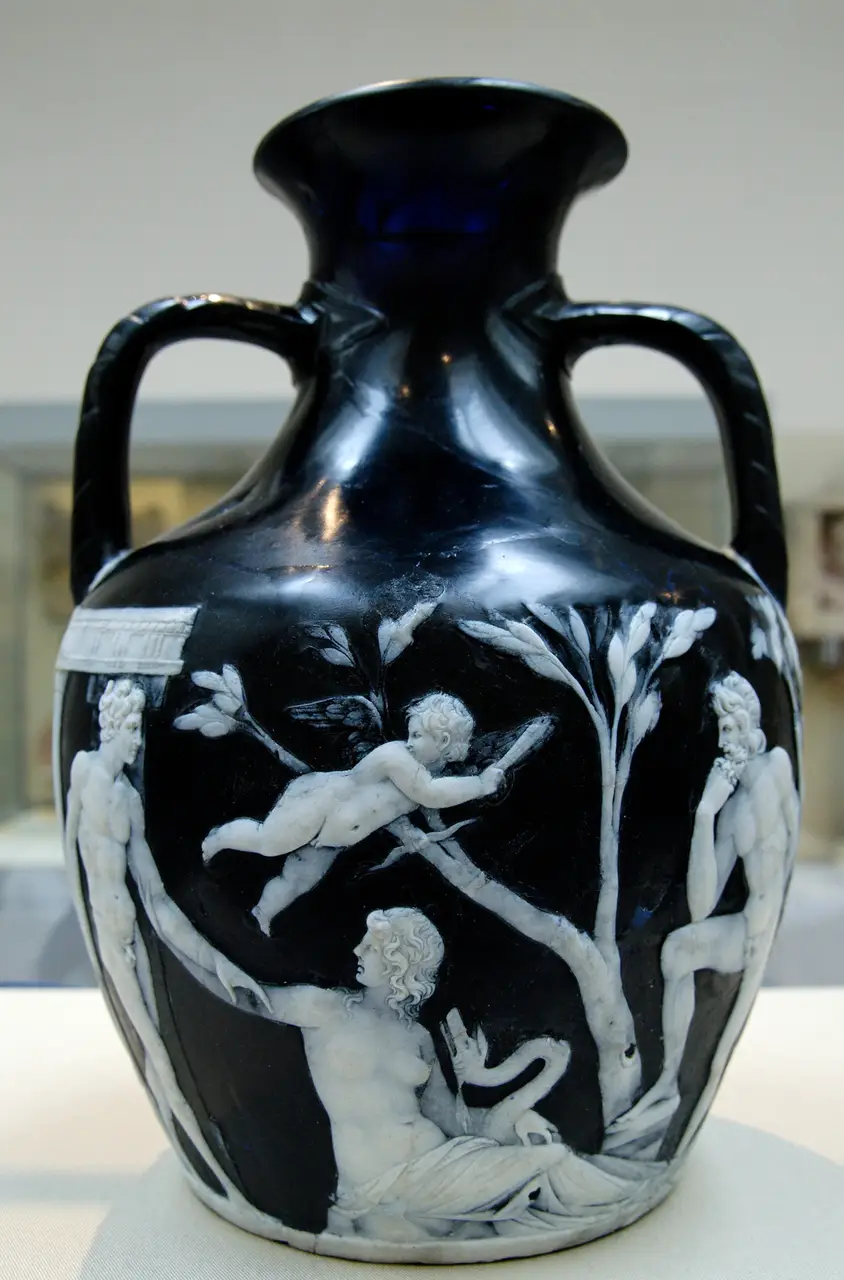 The Portland Vase, blue glass cased in white and cut back like a hardstone cameo, probably made in Italy in the early first century AD. British Museum. Photo: Marie-Lan Nguyen, CC BY 2.5, via Wikimedia Commons.
Our cameo belongs to the plaque class: a white bust of a young man on a blue-green ground, Julio-Claudian in style. The catalogue suggests he may be one of the imperial princes, possibly Drusus, by comparison with a signed hardstone cameo of the type. Treat the name as stylistic conjecture, since no glass cameo of a named prince is securely identified, and value the object for what it demonstrably is: a first-century luxury portrait at the scale of a thumbnail.
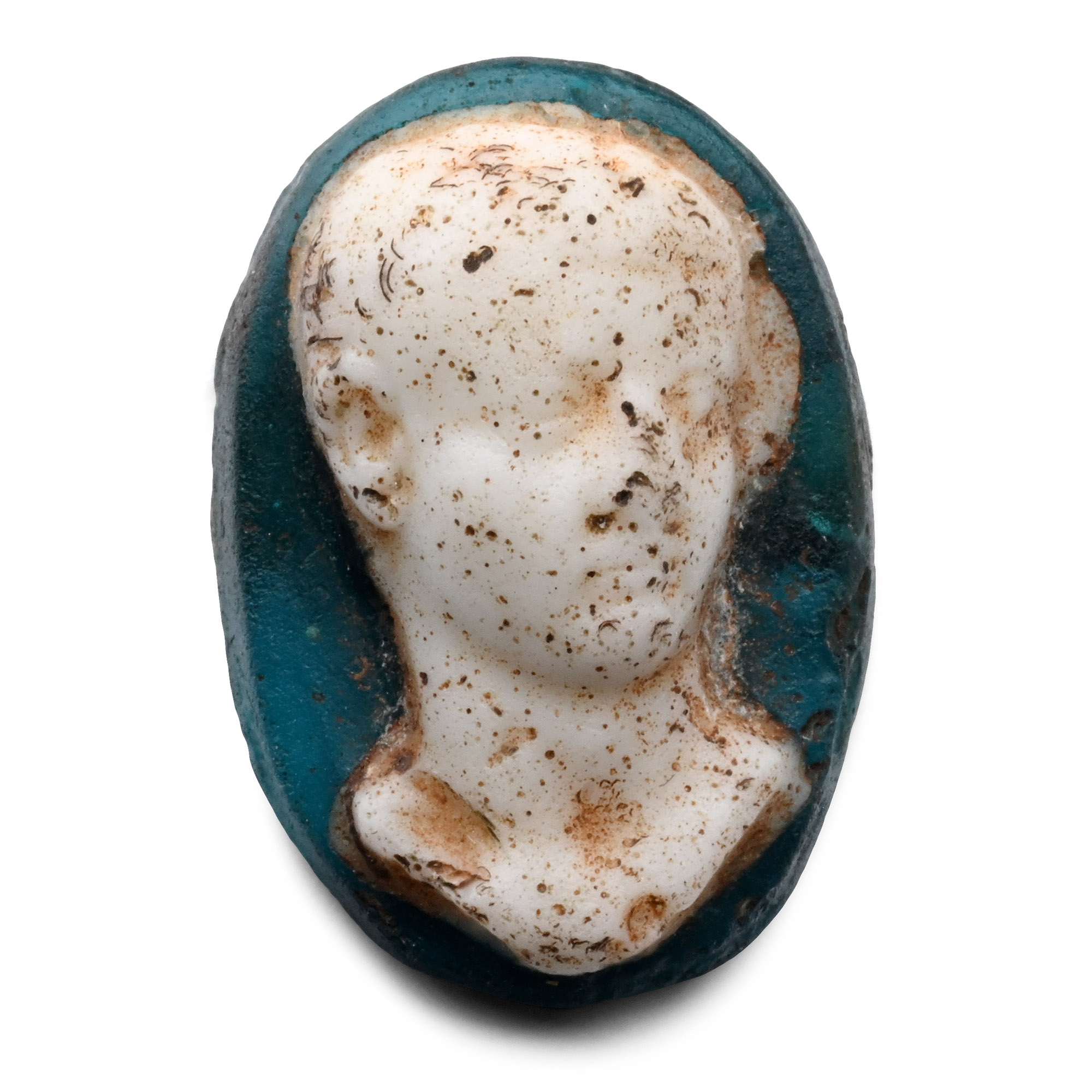
Two live debates ride along with any cameo purchase, and neither should worry a buyer. How the white was joined to the blue is unsettled: the textbook account dips the dark gather into molten white, while Rosemarie Lierke has argued the vessels were never blown at all and were pressed in moulds instead, and the specialist literature is honestly split. And the Portland Vase itself will not hold a date, with scholars ranging from Augustan to Tiberian. Both arguments are reminders that even the greatest objects in this class rest on style, not stratigraphy.
The blowpipe: glass becomes cheap
Every technique so far was slow: a day or more of winding and combing for one core-formed bottle, kiln-hours and lathe-hours for one cast bowl. Around the middle of the first century BC, on the southern Levantine coast, that economy broke. Workers found that a mass of molten glass on the end of a hollow tube could be inflated with a breath and shaped in moments, and one standard reference calls this, without much risk of exaggeration, "the most momentous development" in the material's history.
The earliest trace of the discovery is a heap of workshop rubbish. In the Jewish Quarter of Jerusalem, Nahman Avigad's excavations found the refuse of a glass shop, lumps of raw glass, rods, tubes and unfinished vessels, dumped into a ritual bath that was paved over in Herod's reign; published by Yael Israeli, it is the oldest evidence of glassblowing found anywhere. Read carefully, though, the deposit records an experiment rather than an industry. These workers were widening pre-formed glass tubes by blowing into them, which is some distance short of the true iron blowpipe, and blown glass only appears in quantity from the second quarter of the first century AD. The honest way to date the invention is as a process running from about 50 BC to about AD 50, with the Jerusalem dump near its start.
What followed is the hinge of the subject. A blower could gather, inflate, tool and finish a serviceable bottle in minutes, scores of them in a day; by about AD 50 the technique was in use across the Mediterranean, and within another two generations it was standard everywhere Rome reached. Glass fell from luxury to commodity, cheaper and more common than pottery for many uses, and Romans consumed it for tableware, cosmetics, storage, windows and cinerary urns, then buried great quantities of it intact with their dead. That funerary habit, two thousand years on, is why an eighteen-hundred-year-old blown bottle can still carry a three-figure estimate.
The Romans noticed the change themselves. Pliny preserves the legend of Phoenician natron traders whose cooking fire on the river Belus melted beach sand into a strange flowing liquid, his origin myth for the material, and Strabo was already remarking under Augustus on how cheap glass had become at Rome. Best of all is the story, told with variations by Pliny, Petronius and Dio Cassius, of the craftsman who showed the emperor Tiberius an unbreakable, flexible glass cup. Asked whether anyone else knew the secret, he said no, and Tiberius had the workshop destroyed, with Petronius beheading the inventor for good measure, so that glass should not drag down the value of gold and silver. A legend, almost certainly, and also a fair record of how disruptive the new economics felt.
Reading everyday blown glass: shapes, forms and catalogue codes
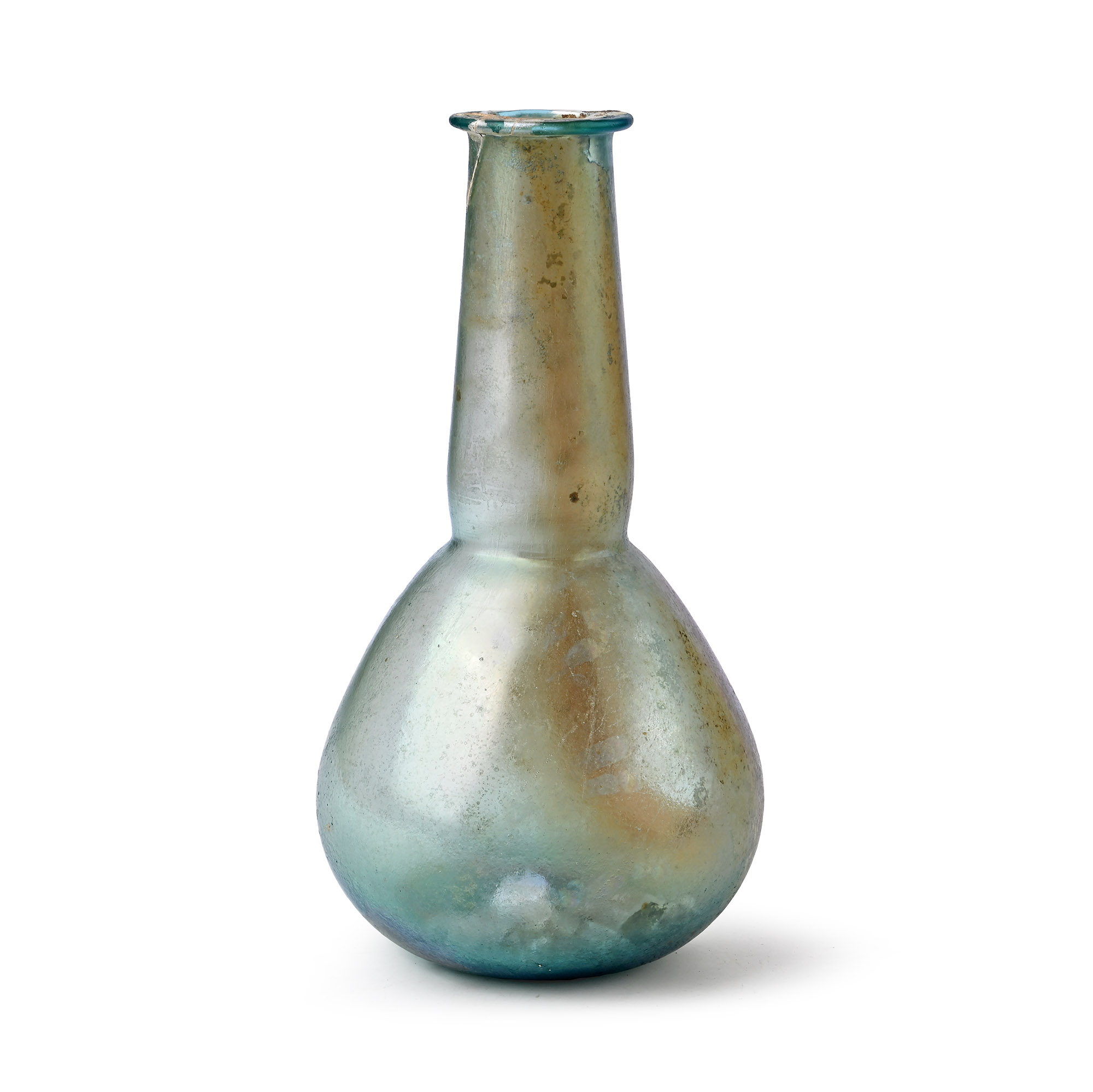
Free-blown ware is where technique stops helping, since a plain blown bottle of AD 100 and one of AD 400 were made the same way. Dating here runs on shape, and the shapes have a working vocabulary a collector absorbs quickly. The commonest survivor by far is the unguentarium or toilet bottle, a small flask for scented oil and cosmetics made in enormous numbers for the dressing table and the tomb. Jugs with the mouth pinched into three lobes are trefoil oinochoai, pouring vessels descended from a Greek wine shape. Twin tubes joined side by side are double kohl tubes, containers for eye-paint. Tall flasks that are mostly neck are the "candlestick" type. And wherever you find the pontil scar, the rough spot under the base where the finishing rod snapped off, check whether it has been ground smooth; on better pieces it was, and that grinding is a quiet grade of quality.
Lot 127 in the September sale shows the catalogue codes at work: a large blue toilet bottle of the first century AD, described as "Hayes' fabric 2 of Cypriot blown glass" and classed "Isings 28a / Vessberg A.III.a". Unpacked: Isings 28a is this bottle's shape in Isings's 1957 corpus, tying it to dated finds across the Empire; Vessberg A.III.a is the same shape in Olof Vessberg's classification of the glass found on Cyprus, the island's standard typology; and Hayes' fabric 2 places the glass itself, its colour and quality, within the fabric groups John Hayes defined for Cypriot blown ware. Three reference systems, built by three scholars on three bodies of dated material, converge on the same century for one everyday bottle. That is the work a catalogue line is doing under its abbreviations, and it is why a string of form numbers should raise rather than lower your confidence in a date.
Mould-blowing: shape and picture in one breath
Free-blowing forms the bubble by hand and eye; mould-blowing inflates it inside a hinged, multipart mould of terracotta or plaster, so the glass takes its shape and its surface decoration in the same instant, relief patterns pressed into the wall as the bubble fills the cavity. The point was replication: large numbers of identical, ornamented vessels, made quickly and cheaply, often copying the look of embossed metal cups. The idea belongs to the second quarter of the first century AD, and tradition ties it to Sidon on the Phoenician coast, though Grose suspected Italy. The tell is exactness, relief decoration that repeats from vessel to vessel in a way no hand-applied trail ever does, sometimes with the faint vertical seams of the mould still traceable.
Because a mould can carry writing, mould-blowing also gives glass its first named makers. A small early group of vessels bears signatures in raised Greek letters set in a little frame: Ennion epoiei, "Ennion made it," sometimes with a second line reading roughly "let the buyer be remembered." Ennion, active early in the first century AD, was so far as anyone knows the first glassmaker ever to sign his work; around him stand Jason, Meges, Neikaios, and Aristeas, who added "the Cypriot" after his name. Within a generation these workshops or their imitators had spread west, to Campania, to Aquileia, and to a glassworkers' quarter, the vicus vetrarius, near Rome's Porta Capena.
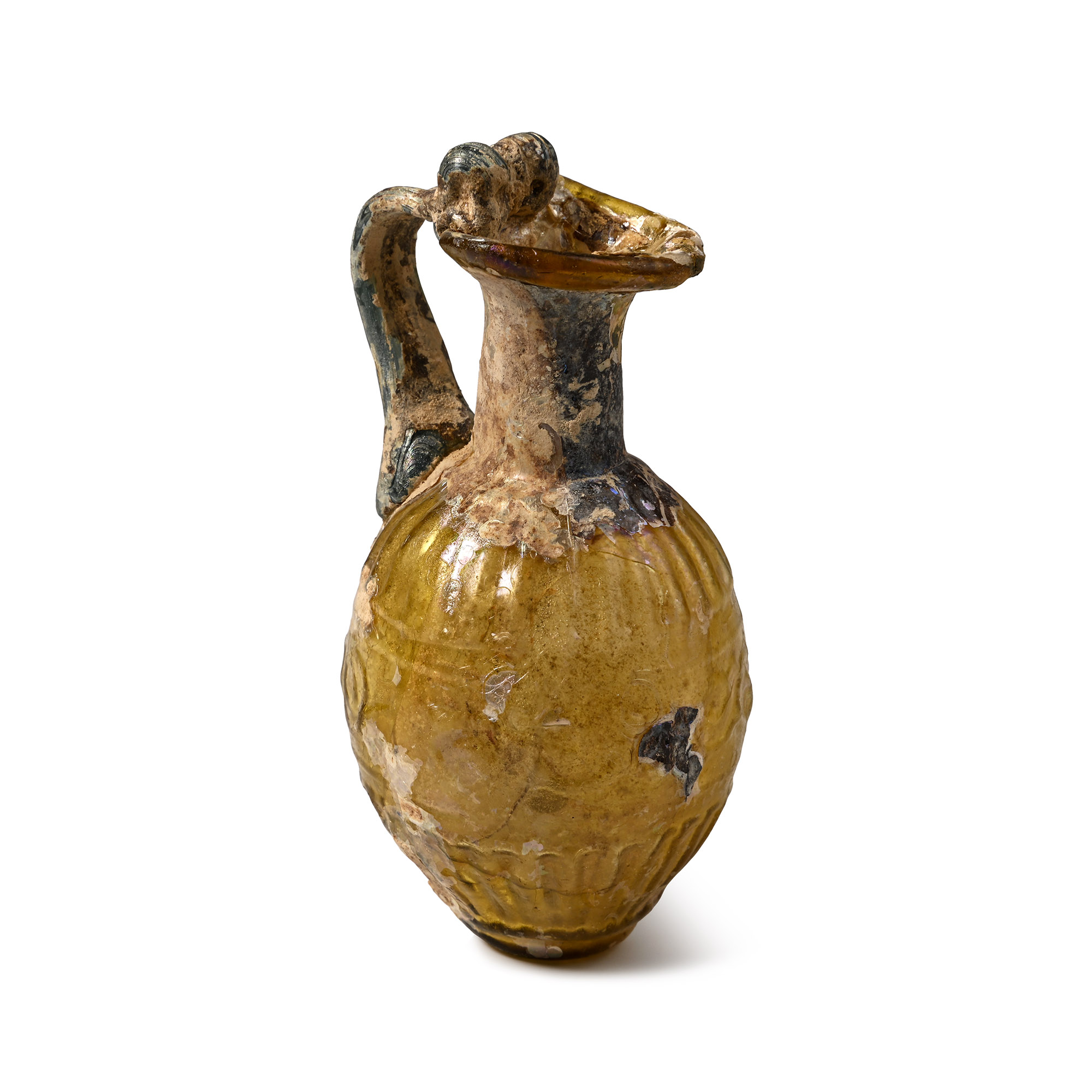
Mould-blowing then outlived its famous names by centuries, and the juglet in the September sale comes from that long afterlife: an amber juglet with vertical corrugations and scrolling tendrils, catalogued as Sidonian and dated to the third or fourth century AD. The late class was made by blowing into a small corrugated dip-mould and then inflating the piece again to full size, and "Sidonian" on such a juglet is a style label for the eastern tradition rather than a claim about the city itself. Two to three hundred years separate it from Ennion, with an unbroken craft in between.
Colour and trails: reading the decorated centuries
Fresh from the furnace, ancient glass is green to blue-green, tinted by the iron that rides in every natural sand, and everything else is chemistry the workshops learned to steer. Antimony, in use from the seventh century BC, and manganese, from the first century AD, pulled the tint towards colourless; deliberate additions pushed it the other way, cobalt to deep blue, copper to turquoise, green or opaque red, manganese in quantity to the purple the trade calls aubergine, antimony compounds to opaque white and yellow. Colour dates only loosely, and it places even more loosely. The sale's aubergine pitcher is catalogued to the Rhineland workshops around Cologne, but manganese purple was made everywhere the Empire ran, so treat any regional attribution resting on colour alone with caution.
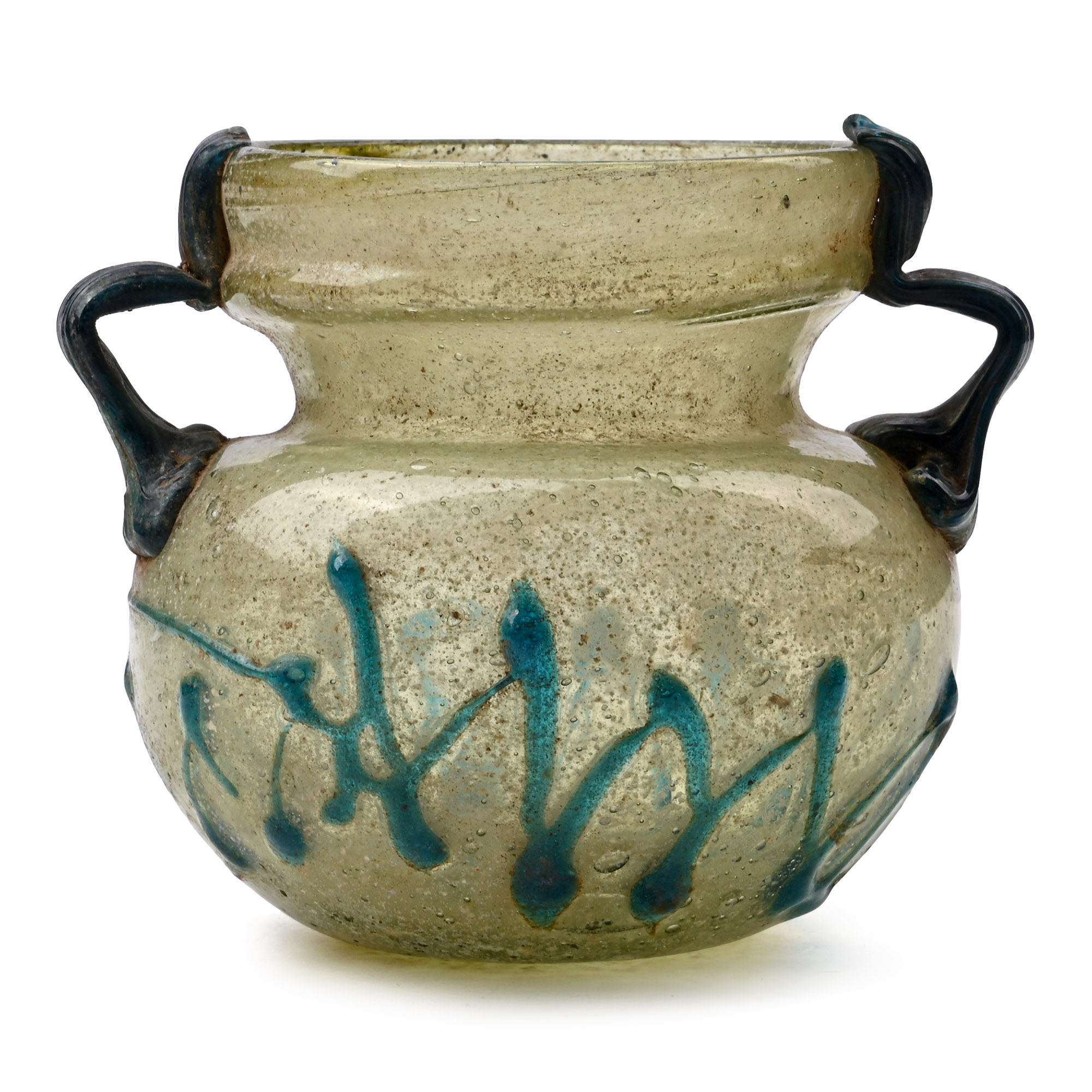
A trail, a thread of hot glass wound onto the turning vessel, left standing proud or marvered flush, then pinched and dragged into pattern, is a better dating tool: the practice runs right through the Roman period, and its variants date usefully. Snake-thread glass, with raised ribbons meandering over the body, points to the second and third centuries and to Cologne or the Syrian east. A zigzag trail applied between rim and shoulder points east and late: the pattern is common on fourth- and fifth-century vessels from Palestine and Egypt and, on the evidence of the glass factory excavated at Jalame in Galilee, unknown in the West. The green jar in the sale wears that chronology openly, its zigzag and both its handles in a contrasting deep blue, a combination the Jalame excavators single out as the exceptional decorative variant of the class.
Wheel-cutting: the cold craft
Cutting, the other decorating craft, never touched the furnace at all. Once a vessel had been annealed and cooled, a cutter, kin to the gem-engraver, worked it against bronze wheels and points on a bow-driven lathe fed with wet sand or emery. The workshops themselves are almost invisible archaeologically, the one document being a gem-cutter's headstone showing his lathe, though Roman law preserves, in the Digest, a clause on who pays when a cup shatters under the wheel: work routine enough to litigate and valuable enough to be worth it.
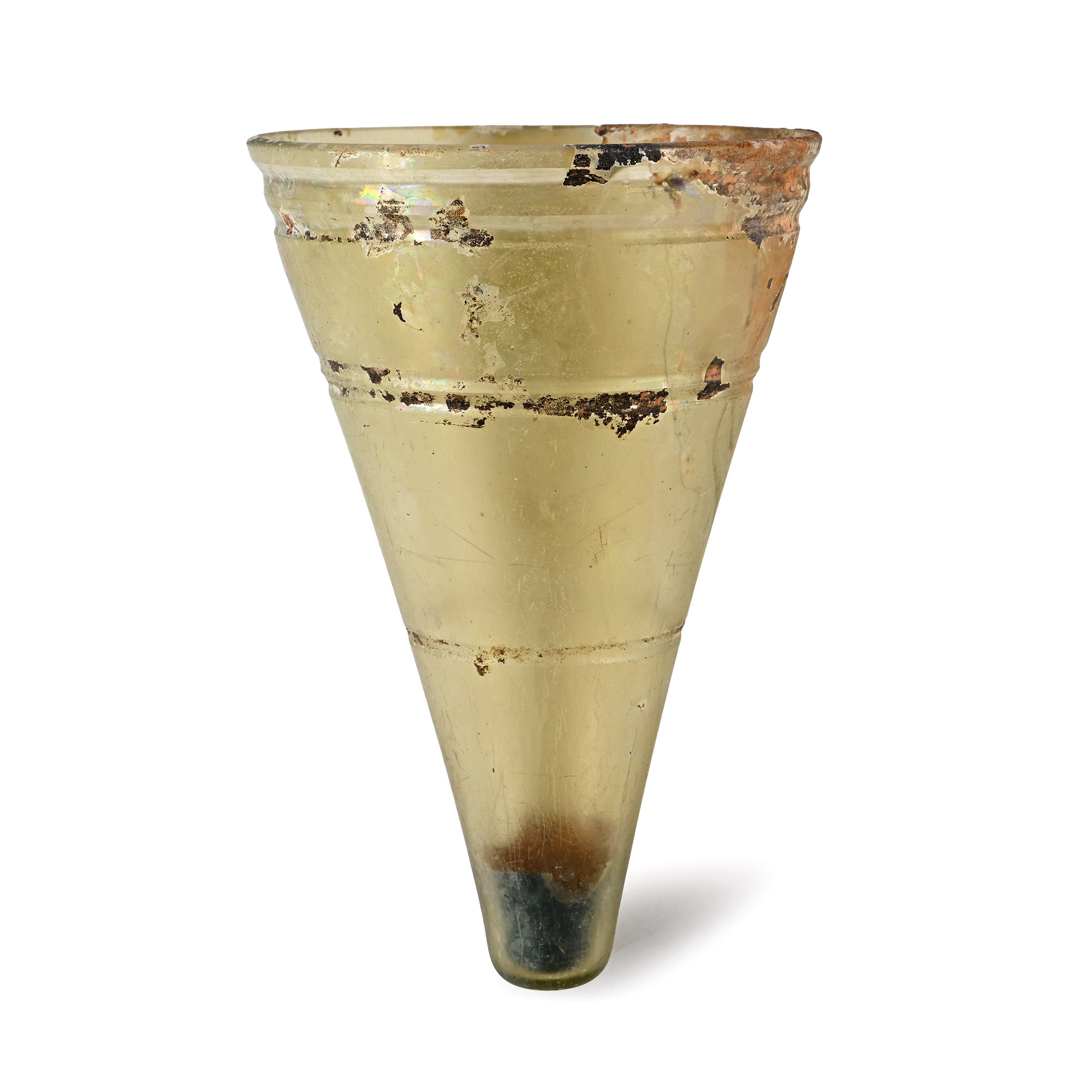
In ascending order of ambition, the cutter's repertoire ran from plain horizontal grooves, through allover facets, to figured scenes. Facet-cut beakers, their surfaces covered in rows of ground hollows, peak in the Flavian and Trajanic decades, roughly AD 70 to 120, which makes them a datable fashion in their own right. Plain grooved cutting had a far longer run, from the mid-first century into the fourth and beyond, and the sale's cut piece sits in that tradition's late phase: a large, near-colourless conical beaker of the fourth or fifth century with five clean horizontal grooves, a teaching object precisely because the cutting is so legible.
The ceiling of the same craft is the cage cup, or diatretum, a thick blank cut back and undercut until nothing remained but a vessel held inside an almost free-standing mesh of glass, joined to the body by small bridges. They belong to the mid-third to late fourth century, and about fifty survive, most fragmentary. The most famous, the Lycurgus Cup in the British Museum, does something no other Roman glass does, reading green in reflected light and red when lit from behind, because the melt was seeded with particles of silver and gold between fifty and a hundred nanometres across. No collector will meet a cage cup on the market; it earns its place here as the far end of the continuum that begins with five plain grooves on a beaker.
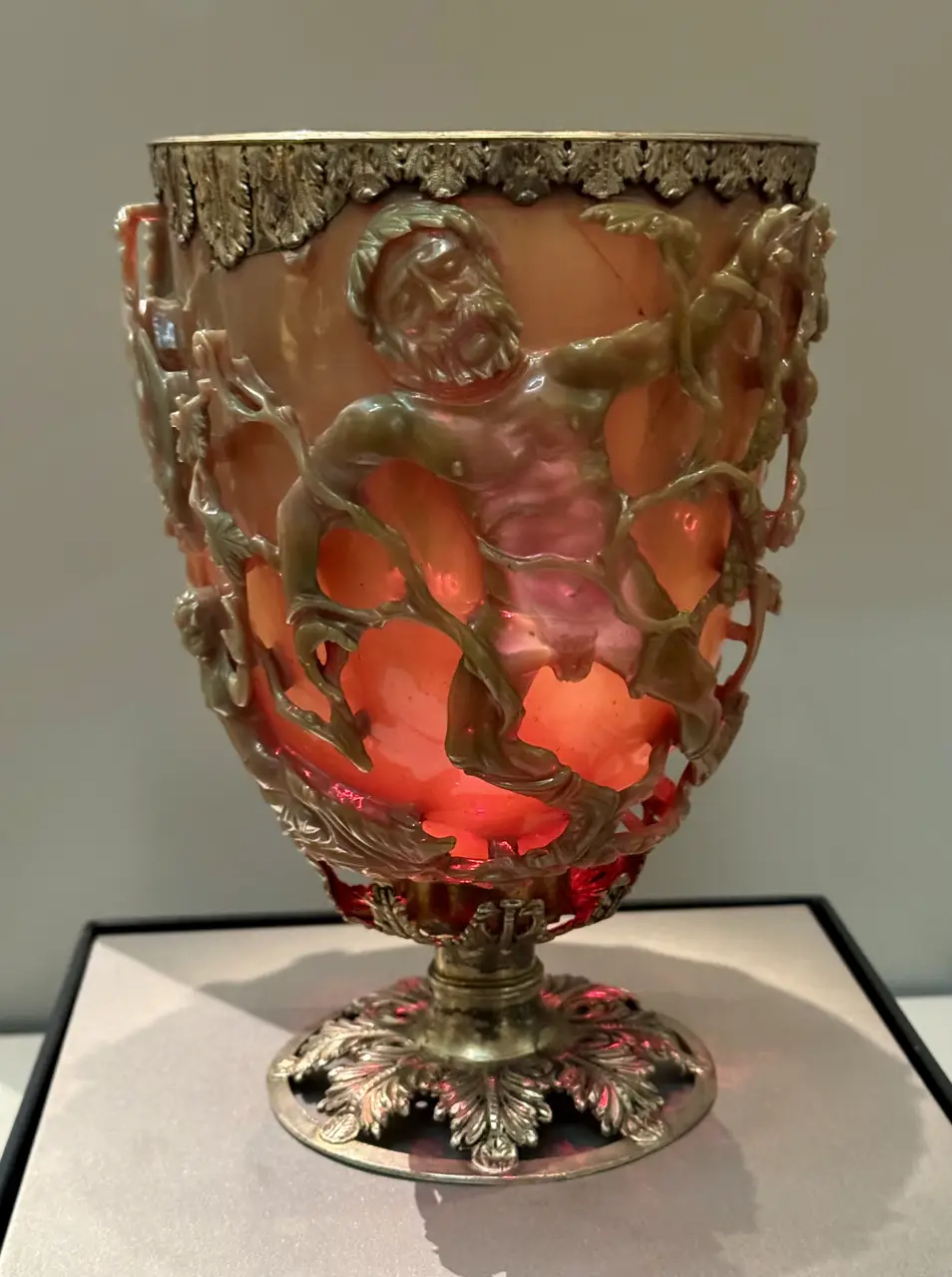 The Lycurgus Cup in the British Museum, a fourth-century cage cup cut and undercut from a single thick blank. Here it is lit from within, showing the red it turns when the light comes through from behind. Photo: Chappsnet, CC BY 4.0, via Wikimedia Commons.
Islamic glass: the sequence keeps going
Rome's glassmaking did not end with Rome. The workshops of the Islamic world inherited the whole Roman and Sasanian toolkit, blowing, mould-blowing, trailing, marvering and cutting, and pushed several parts of it further; Fustat, Old Cairo, ran furnaces from the eighth century. A collector who stops at the fifth century AD has walked out at the interval.
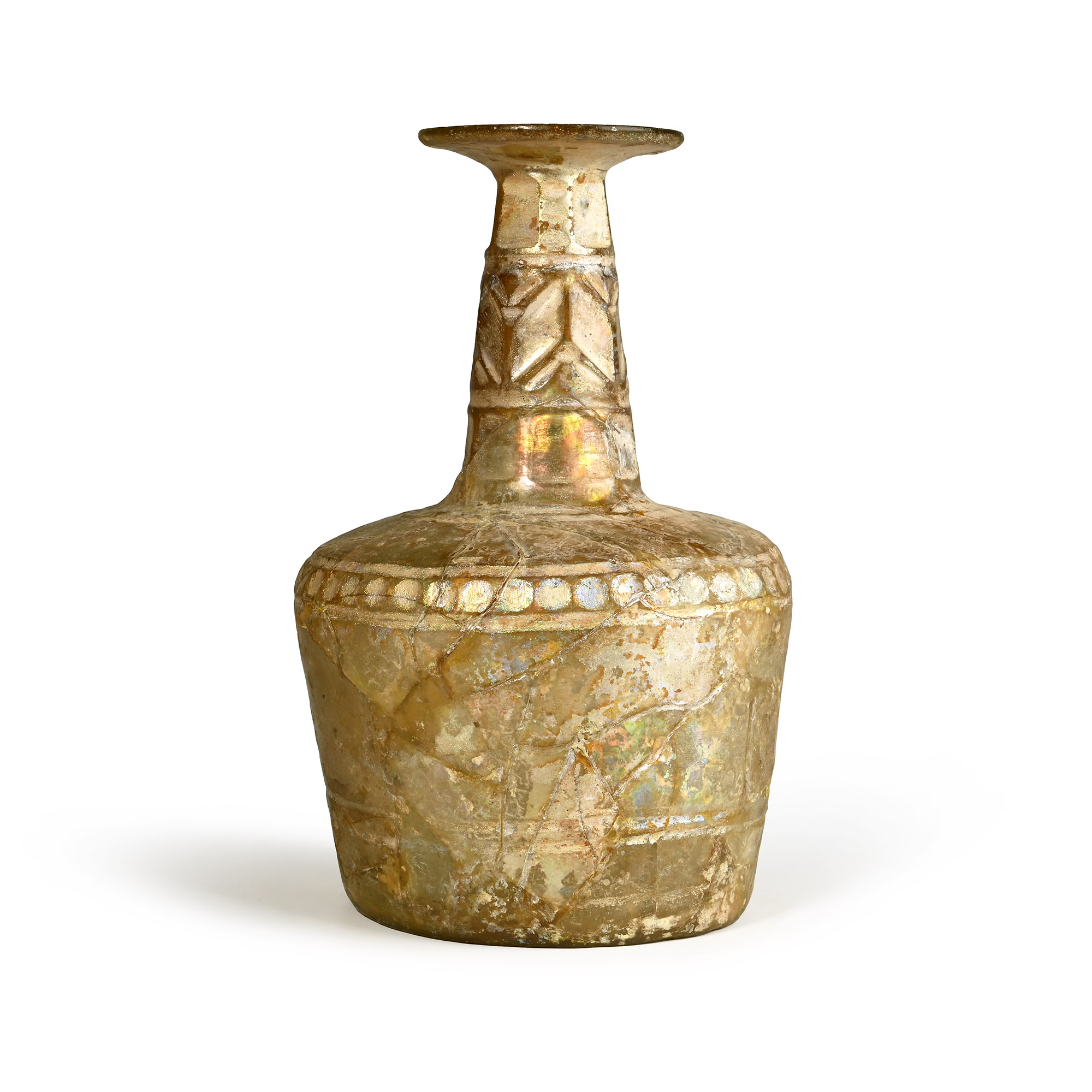
Deep relief- and facet-cutting, the cold craft's second act, flourished in ninth- to eleventh-century Iran, and Harden traced its descent directly from Sasanian cut glass of the fifth to seventh centuries. The type-site is Nishapur, the Silk Road city in the country's north-east, excavated by the Metropolitan Museum between 1935 and 1947 and published by Jens Kröger, and the facet-cut bottle in the September catalogue, golden and catalogued as "probably Nishapur," is at £5,000-7,000 the highest-estimated glass in the sale. Later, in this field, does not mean lesser.
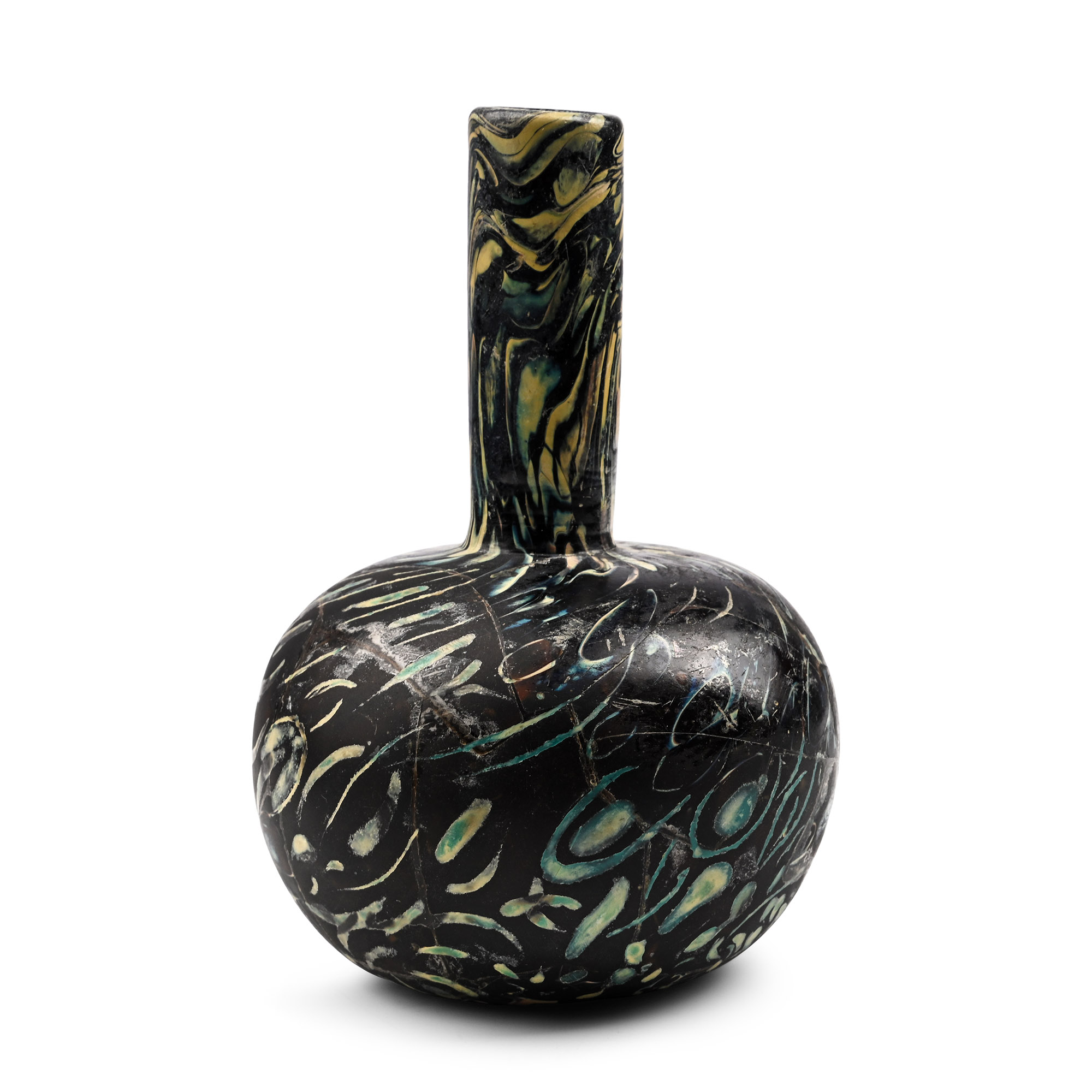
Two other Islamic lots read as chapters of this same guide. A calligraphic vessel of the thirteenth or fourteenth century carries an applied band of Kufic, the angular early Arabic script, in raised trailed glass, a standard Islamic mode whose closest dated survivors sit a little earlier, in the tenth and eleventh centuries. And a Fatimid vase of about the tenth to twelfth century closes the loop this guide opened: threads of opaque white dragged into swirls on a navy body and marvered flush, the same wind-comb-and-marver decoration the core-formers were using under Thutmose III. Historians of Egyptian glass describe that habit as continuous from the Pharaohs to the Mamluks, so on this one small vase the oldest decorative technique in glass is alive on one of the youngest objects in the sale.
Iridescence: what the rainbow surface really tells you
One reading skill remains, and it is the one most beginners have exactly backwards. The rainbow shimmer on ancient glass, the gold and violet sheen that photographs so well, was never made by any glassmaker. It is decay. Buried glass rots, and iridescence is what the rot looks like.
Glass is silica held together by an alkali flux, soda or potash. In damp ground, water slowly leaches the alkali out of the surface, leaving a skin of hydrated silica that dries, shrinks and splits into stacked films thinner than a wavelength of light; light reflecting between the films interferes with itself and produces the colours of an oil slick or a soap bubble. Cracks let more water through to fresh glass beneath, the attack repeats, and the crust thickens layer on layer. The chemist A. W. Laubengayer showed all this in 1931 on Roman glass found in Cyprus, finding the crust to be largely hydrated silica with its sodium and potassium all but gone.
Because the driver is moisture, iridescence records burial conditions and nothing else. Laubengayer's vessels made the point neatly: glass buried in wet silt came up brilliantly iridescent, while pieces from the same tombs that had rested dry in wall niches came up clear and barely altered. Alexander Palma di Cesnola, digging on Cyprus in the nineteenth century, recorded glasses "as clear and unchanged as they were left by the ancient workman" whose "antiquity cannot be questioned." Nor does the presence of iridescence prove anything, since the look can be induced: a dish in the Metropolitan Museum, catalogued as a nineteenth-century forgery, was aged with acid; Cesnola met fakers rubbing quicksilver inside modern vases; and from 1881 Louis Comfort Tiffany patented ways of giving new glass the same bloom; his Favrile line was built on the beauty of imitated decay. Iridescence is neither a dating test nor an authenticity test, and any purchase resting on it is resting on the weather underground.
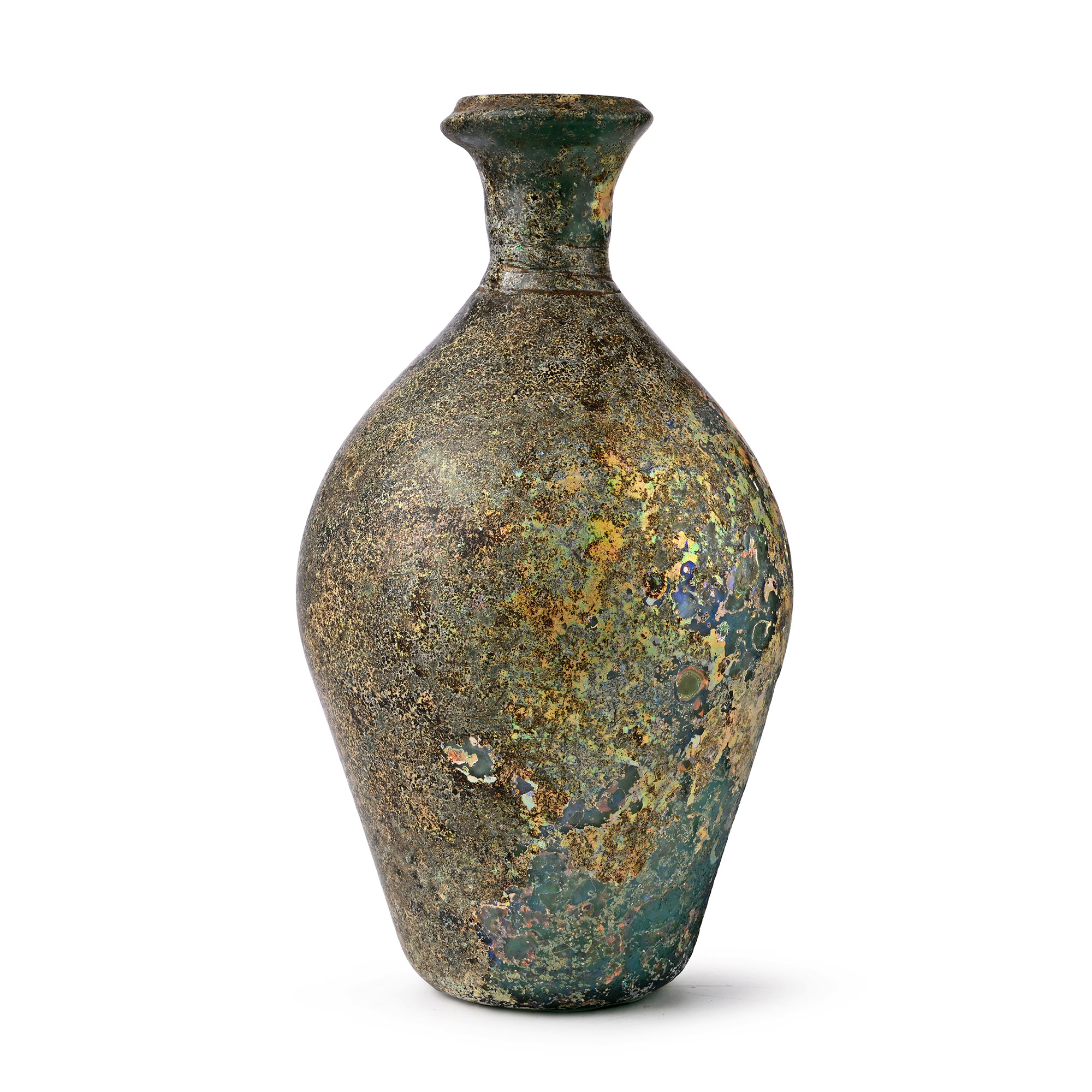
One practical rule follows: leave the crust alone. Conservators treat the weathered layers as the original surface of the object, and stripping them with acid, abrasion or enthusiasm removes part of the artefact itself. The showpiece of the sale's glass is the whole argument in one object, a very large eastern Roman bottle sheathed almost entirely in a golden-brown crust, the rainbow flashing only where the thin films have formed and flaked, and its own catalogue is candid that the effect is "not, by itself, a dating test." The bottle's beauty and its decay are the same fact, and neither can be cleaned off without destroying the other.
Using the sequence at a viewing
Weight and a polished interior mean cast; bold outside ribs mean Isings Form 3 and the century either side of the turn of the era; a pitted, matte interior means core-formed and pre-Roman; relief that repeats means a mould; applied threads mean the decorated blown centuries, and the pattern of the threads says which one; ground grooves and facets mean the cold lathe. The codes in the catalogue footnotes, Isings numbers, Vessberg classes, Harden's groups, are these same deductions made by people who spent careers on dated finds, so read them as evidence rather than decoration. The glass in the 8 September catalogue is online now, and the fastest education in it costs nothing: put the pillar-moulded bowl beside the great weathered bottle, the pair this guide opened with, a cast luxury and a blown commodity a century apart. Your hands will know which is which before the catalogue tells you.
TimeLine Auctions, 12th August 2026