Home > Stories by TimeLine Auctions
Stories by TimeLine Auctions
How to Sell Metal Detecting Finds Legally in the UK
A hammered silver penny, a gold posy ring, a Roman brooch green with corrosion: the moment any of them leaves the ground, the law has already sorted it into one of two piles, the one you can sell and the one you have to report first and may never own at all. Which pile a find lands in comes down to two things, whether it counts as treasure, and whether the landowner has agreed the object is yours.
In short: you can legally sell a find if it is not treasure and you hold title to it, meaning the person who owns the land has agreed the object is yours to keep and sell. If the find is treasure, you must report it, and you can only sell it in the narrow case where every museum passes on it and it is formally returned to you. Everything below is how to be sure which situation you are in, and how to get a fair price once you are clear to sell.
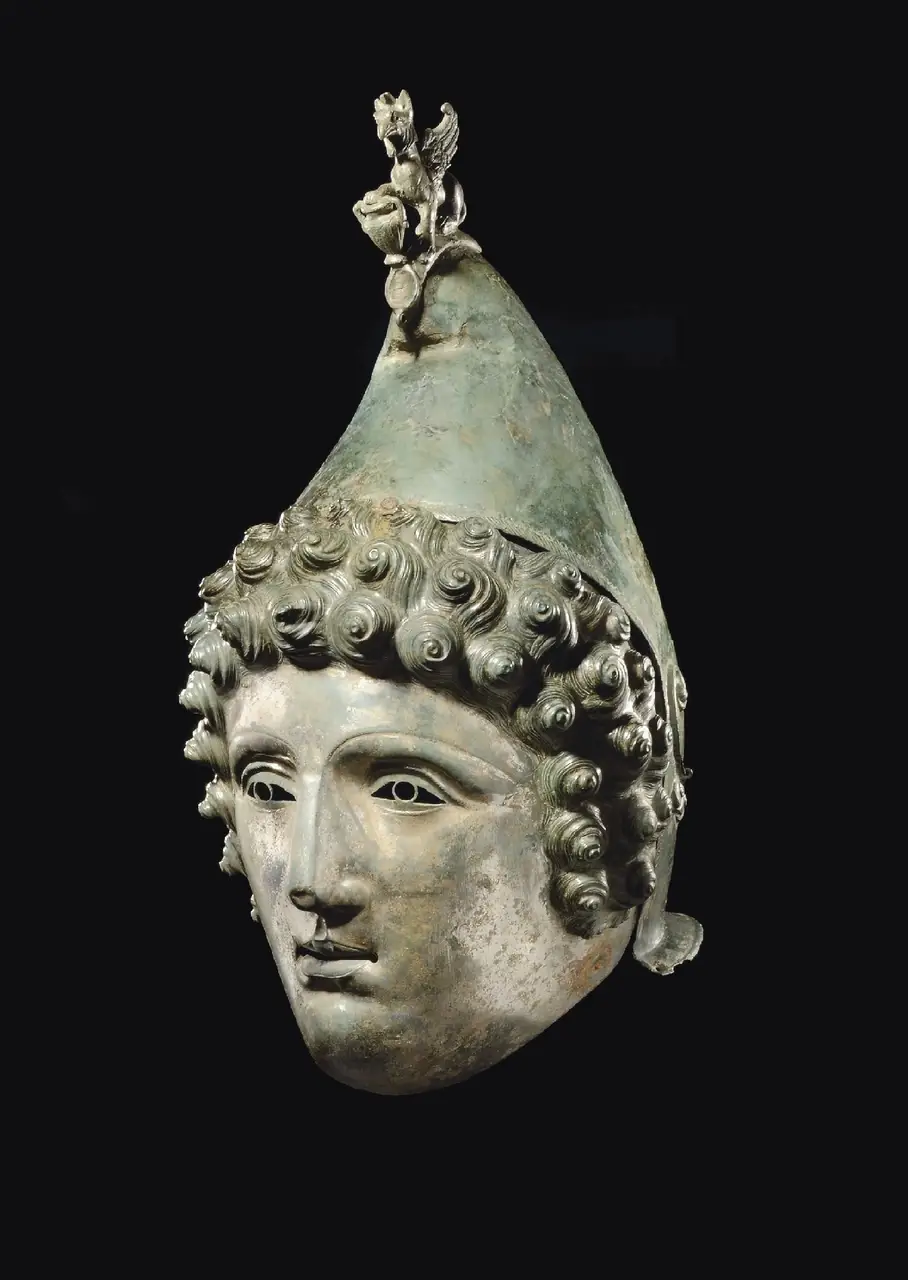 The Crosby Garrett helmet, a Roman copper-alloy cavalry parade helmet found by a metal detectorist in Cumbria in 2010. Holding almost no precious metal, it fell outside the Treasure Act and sold at open auction. Photo: Portable Antiquities Scheme, CC BY 2.0, via Wikimedia Commons.
First, is your find treasure?
Under the Treasure Act 1996, which covers England, Wales, and Northern Ireland, "treasure" is a legal category with a specific definition, and a valuable-looking object can fall entirely outside it. The core of the definition is age and material: objects at least 300 years old made of gold or silver, meaning at least 10% precious metal by weight, and hoards of coins of the same age. A single Roman bronze coin is not treasure; two or more silver coins from the same buried group can be.
Since the Treasure (Designation) (Amendment) Order 2023 took effect on 30 July 2023, the definition also catches a find of any metal that is at least 200 years old and judged to be of outstanding historical, archaeological, or cultural importance. That change closed a gap the older wording had left open. The Crosby Garrett Roman cavalry helmet and the Ryedale hoard had both gone to open auction precisely because they held little or no precious metal and so fell outside the Act, an outcome many in the field regarded as the wrong one for finds of that significance.
If your find might be treasure, you do not get to settle the question yourself. You are legally required to report it to the coroner within 14 days of finding it, or within 14 days of realising it might qualify, and failing to do so is a criminal offence. In practice you report through your local Finds Liaison Officer, part of the Portable Antiquities Scheme run by the British Museum. The officer will identify the object, log it, and notify the coroner and the British Museum's treasure team on your behalf.
Treasure gets reported and valued, not sold
Once reported, treasure follows its own track and never touches the open market. A museum that wants the object acquires it, and the Treasure Valuation Committee, an independent panel, sets a fair market value. That sum is paid out as a reward and, unless a written agreement between the parties says otherwise, split 50/50 between finder and landowner. There is no selling treasure to a dealer or a saleroom instead; the reward is the mechanism the Act provides.
The one route back to a private sale is disclaimer. If no museum wants the object, the Crown gives up its claim, the find is returned to you, and it becomes ordinary property you are free to sell like anything else. Many of the finds that reach the saleroom arrived there exactly this way, reported and then wanted by no museum.
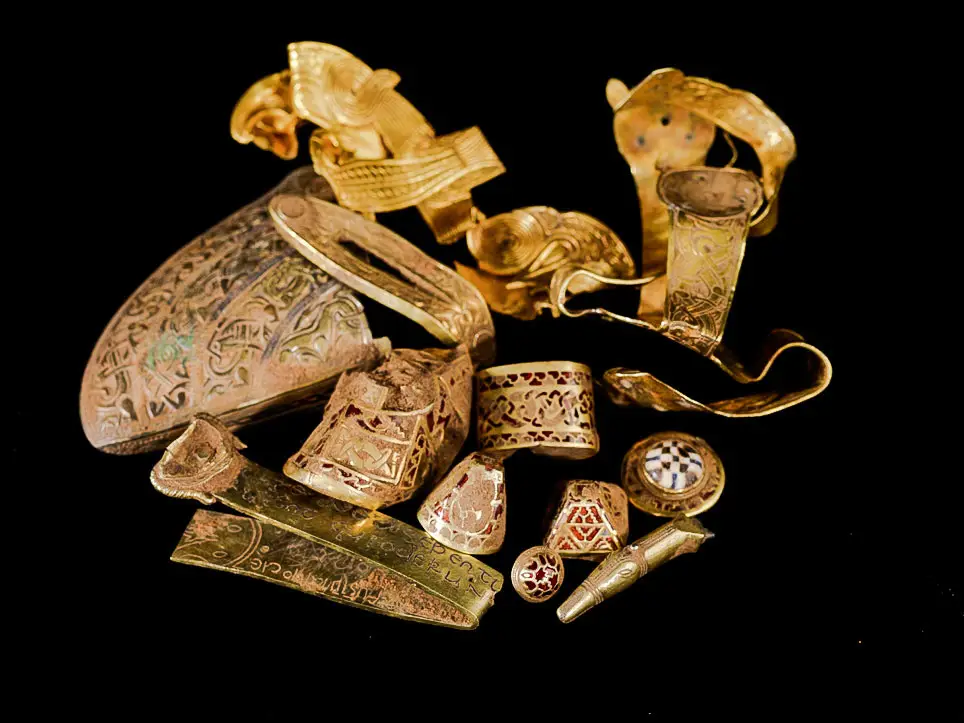 Gold fittings from the Staffordshire Hoard, the largest hoard of Anglo-Saxon gold yet found, unearthed by a metal detectorist near Hammerwich, Staffordshire, in 2009. Its £3.285 million reward was divided equally between the finder and the landowner. Photo: David Rowan, Birmingham Museums Trust, CC BY 2.0, via Wikimedia Commons.
Do you actually own what you dug up?
Assume the find is not treasure. That still does not make it automatically yours. Every find other than treasure belongs, by default, to the owner of the land it came out of, not to the person holding the detector. You acquire the right to sell it only through the agreement you reached before you set foot on the field.
This is why a written finds agreement matters as much as the permission to search in the first place. A verbal "yes, go ahead" gives you almost nothing to show a buyer and leaves a landowner room to dispute ownership later. A written agreement, of the kind the Country Land and Business Association and the National Farmers' Union both publish templates for, sets out who owns what is found and how any proceeds are divided, commonly 50/50 on items of value, though many landowners are happy for the finder to keep everything. Detecting without permission, or on a protected scheduled monument, is a separate matter and illegal, and nothing found that way can be sold with clean title.
Record the find with the Portable Antiquities Scheme
Recording a non-treasure find is voluntary, and worth doing anyway. The Portable Antiquities Scheme exists so that ordinary finds, the ones that never trouble a coroner, still enter the archaeological record. Your Finds Liaison Officer will examine the object and enter it on the PAS database with a unique reference number, a findspot, and a description.
For a seller that record is quietly useful. It is independent documentation of what the object is and where it came from, and a buyer, at auction especially, wants exactly that kind of provenance behind a lot. A find with a PAS number and a signed finds agreement is a far easier thing to catalogue and sell than one that arrives with no paper history at all.
Scotland runs on a different system
None of the above applies north of the border. Scotland does not use the Treasure Act; it runs on the older principle of bona vacantia, ownerless goods, under which every find of archaeological, historical, or cultural significance belongs to the Crown, whatever it is made of and however old it is. There is no 300-year rule, no precious-metal test, and no landowner share, since in Scotland the finder rather than the landowner is entitled to any reward.
In practice you must report qualifying finds to the Treasure Trove Unit at National Museums Scotland, which assesses them and, where a museum claims the object, recommends a reward. You cannot simply keep and sell a significant Scottish find. If you detect in Scotland, treat reporting as the default and any sale as something that follows only if the object comes back to you.
Three ways to sell, and when an auction earns its fee
Once you are clear, holding an ordinary find that is yours to sell or a piece of treasure disclaimed and returned, there are three realistic routes to market: sell privately, sell to a dealer, or consign to auction.
A private sale, to another collector or through a detecting forum, is the simplest and cheapest, and it works well for low-value, common finds where the price is easy to judge and the sums are small. A dealer will buy outright, which is fast and certain, but the price reflects that they intend to sell it on at a margin.
Auction suits the finds where value is uncertain or potentially high, which is exactly where a private sale tends to leave money on the table. Competitive bidding is the honest test of what a scarce object is worth, and a specialist saleroom does the work that turns a dug find into a lot: identification, dating, cataloguing, photography, and a provenance line that cites your finds agreement and PAS record. At TimeLine Auctions the seller's commission is 18% (terms are confirmed at consignment), and the antiquities sales run quarterly, so there is a regular calendar to aim a piece at rather than a single fixed date.
Selling to a buyer abroad
If your buyer is overseas, one more step applies, and detecting finds sit in the strictest category. An object recovered from British soil counts as archaeological material, and once it is more than fifty years old it needs an individual export licence to leave the country whatever it is worth. There is no value threshold below which the licence is waived, unlike the £65,000 open general licence that covers most other antiques. Arts Council England administers the system and assesses each application against the Waverley criteria, which weigh an object's importance rather than its price. A find judged to be of outstanding national importance can be referred to the government's Reviewing Committee on the Export of Works of Art and held back from export for a set period while a UK buyer is given the chance to match the price. Sell through an auction house and this is handled for you as part of the sale; sell privately to an overseas buyer and getting it right is your responsibility.
Keep the paperwork
Three documents separate a saleable find from an awkward one: the signed finds agreement that proves title, the coroner's acknowledgement or the disclaimer letter for anything that was treasure, and the PAS reference for the object itself. Keep that paper together from the day you dig, and the eventual sale, whichever of the three routes you choose, is a straightforward matter.
If you have a find and are unsure which pile it falls into or what it might be worth, TimeLine's specialists will give a view from good photographs before you commit to anything; the saleroom's chief operating officer, Aaron Hammond, handles consignments and can be reached at ah@timelineauctions.com.
TimeLine Auctions, 14th August 2026