Home > Stories by TimeLine Auctions
Stories by TimeLine Auctions
How Two Icons in Munich Became the Canellopoulos Collection
In 1923 a student from Athens, sent to Munich at fifteen to read law, philology and chemistry, bought two early-sixteenth-century icons: a Virgin and a Saint Nicholas. Greek panels of this kind had reached Bavaria with the courtiers of King Otto, the Wittelsbach prince who became the first king of modern Greece, and Paul Canellopoulos recognised these on the Munich market for what they were. He kept buying. By the time he left Bavaria he had forty-five Greek works, most of them sixteenth-century icons, and the first ten, acquired over two years, were the start of everything that followed.
What followed became, by his death, a collection of more than 6,500 objects across some six thousand years, from a Neolithic clay figure to nineteenth-century church silver, now a state museum on the north slope of the Acropolis. Canellopoulos spent the rest of his life adding to it, and always meant to give it away.
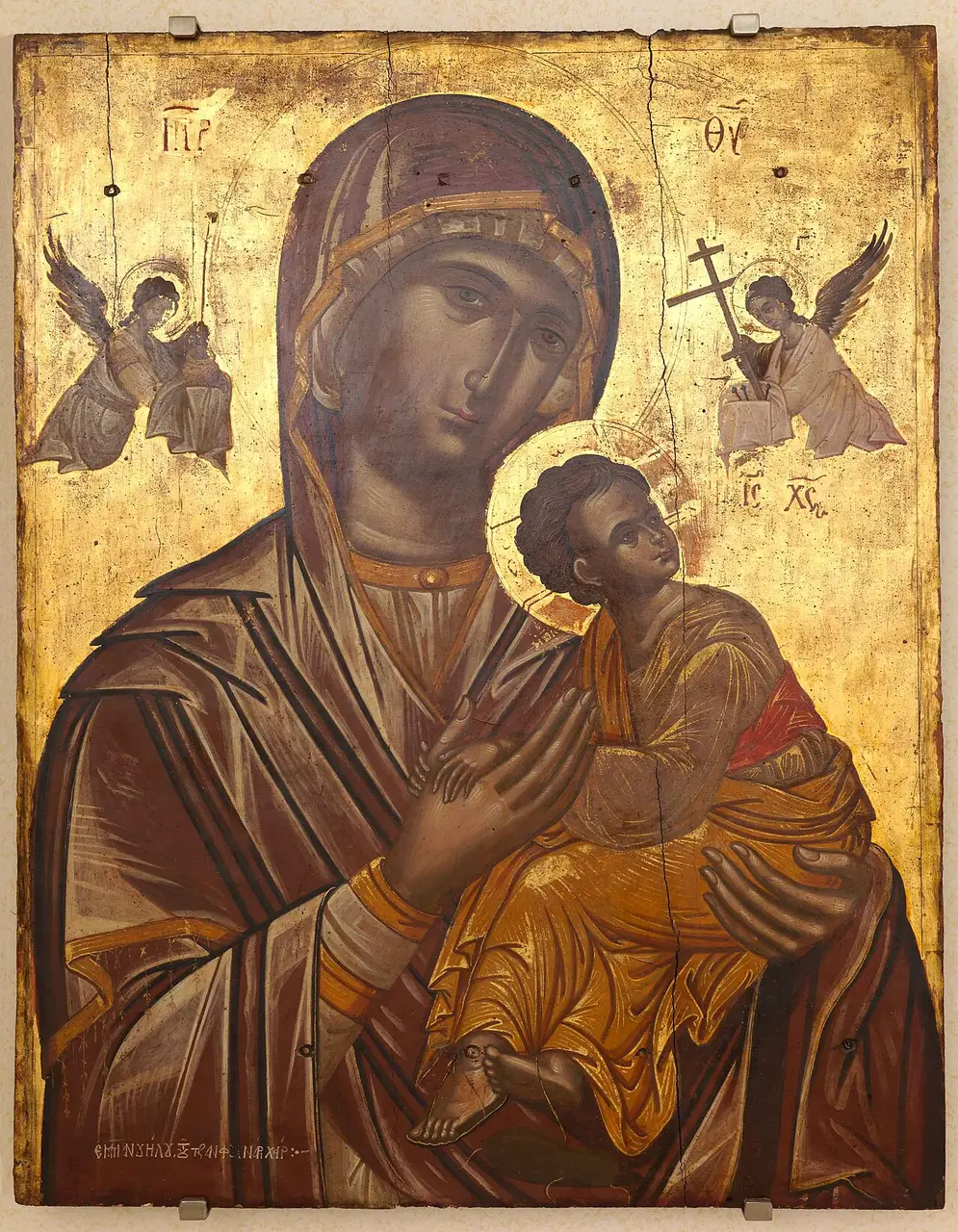 A post-Byzantine icon of the Virgin and Child, the Virgin of the Passion, by the Greek painter Emmanuel Tzanfournaris, late sixteenth to early seventeenth century. Panels of this kind, sold on the Munich market, started the Canellopoulos collection. Public domain, via Wikimedia Commons.
The shape of a collector
Born in Athens in 1906, the third son of the industrialist Angelos Canellopoulos, Paul ran Titan Cement as its chief executive from 1945 until 1979 and then as president. Collecting was the parallel life, and it began early and in earnest. After he finished in Munich in 1927 he travelled across Europe reading history, art and philosophy and buying Greek pieces that had ended up abroad.
Icons he could buy freely abroad, but Greek antiquities were a different matter: to collect them legally inside Greece required a state licence, which Canellopoulos obtained in 1940. It was not a calm year to take up a discipline. Within months Italy invaded across the Albanian border, and the new licence-holder volunteered for the front.
In 1945 he married Alexandra Londou, born in Athens in 1921, daughter of Dimitrios Londos, a politician and minister for the merchant marine. She had spent the war as a Red Cross nurse and would later give her time to musical and charitable causes in Athens. The collecting became a shared undertaking, and the museum that grew from it carries both their names. He was, by every account, a careful and bookish man who kept company with historians and archaeologists and worked at his collection like a research problem rather than a hoard. He bought on the licensed Greek market, one object at a time, for roughly half a century, and kept at it long after most collectors would have called the thing finished.
Why an icon collector started buying Bronze Age Antiquities
The collection's own account traces the widening to a habit of looking, Canellopoulos kept finding the same ornament in places separated by centuries and cultures: the rosette, the palmette, the meander, the running spiral, on the border of a Byzantine icon and on a Bronze Age pot and on a Classical bronze alike. Once he was following the ornament instead of the period, the unit that made sense stopped being "Byzantine art" and became the whole continuous run of Greek material culture, and he started buying backward in time.
The far end of that line is a small terracotta female figure modelled between 5000 and 4400 BC, the oldest object he owned, and an Early Cycladic marble figurine of the later third millennium BC, of the canonical folded-arm type, its body pared to a flat blade and its face to a tilted oval with a single ridge for a nose. Between that clay figure and the church silver of his own century sits most of what people mean by Greek art.
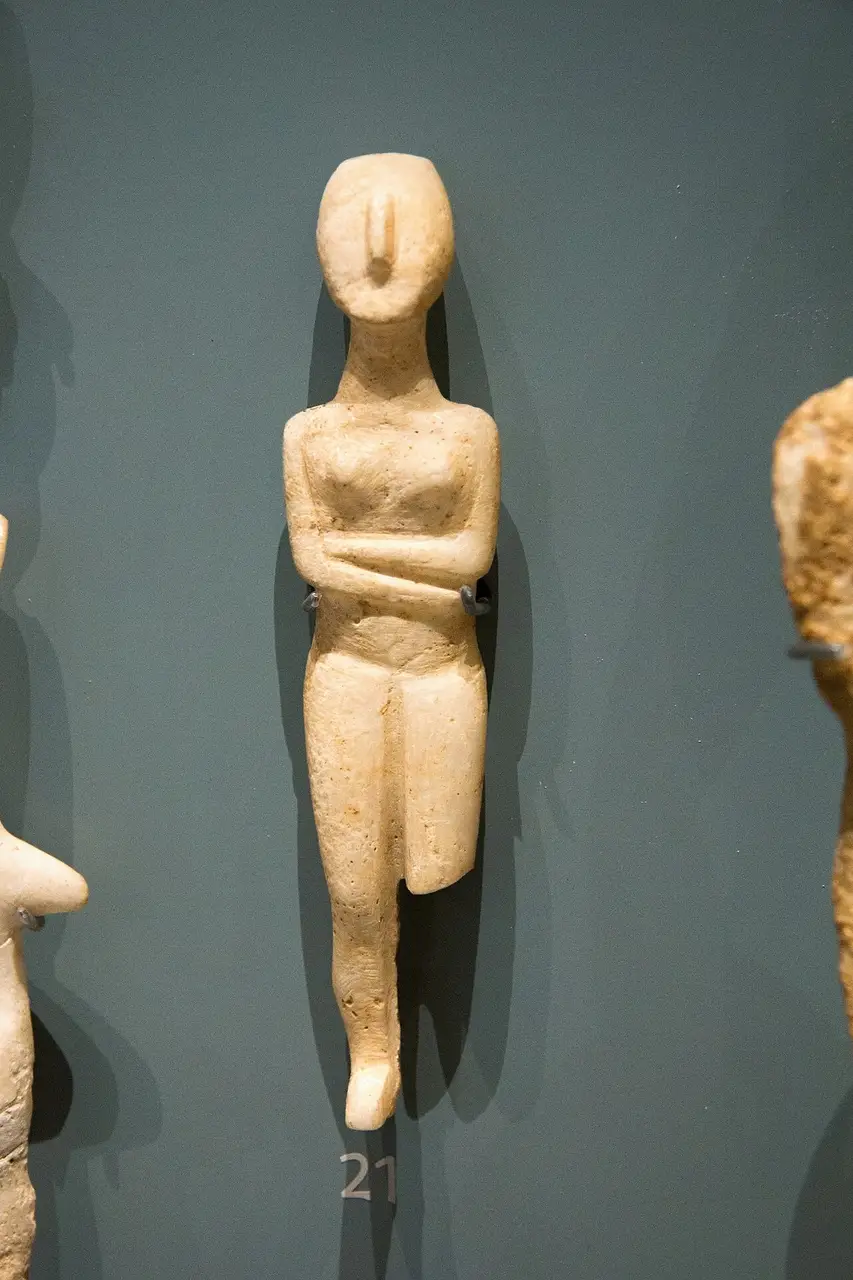 An Early Cycladic marble figurine of the folded-arm type, about 2800 to 2300 BC, the body pared to a flat blade and the face to a tilted oval. Ashmolean Museum, Oxford. Photo: Zde, CC BY-SA 3.0, via Wikimedia Commons.
A cauldron for the dead of Marathon
The object that most rewards a slow look is a bronze cauldron a little over forty centimetres across, its rim carrying an Attic inscription picked out in rows of punched dots. Read out, the text says the Athenians offered it as a prize in games for the men who fell in the war. It is said to have come from a tomb at Marathon, and the shapes of the letters place it around 480 BC, about a decade after the Athenians met the Persians on the beach there in 490. An identical cauldron with the same inscription sits in the Louvre. From the pair, scholars have proposed that the vessel was a prize at funeral games held for the Marathon dead, an honour the city is known to have paid the fallen of the Persian Wars.
A second object turns on the theatre. A terracotta plaque twenty-two centimetres high, a "Melian relief" of about 470 to 460 BC, shows Orestes arriving at the tomb of his father Agamemnon, where his sister Elektra sits in mourning. He puts out a hand toward her; she has not yet understood who he is. The same recognition runs through the tragedians and across South Italian vases of the following century, and the staging here, the held gesture, the woman who does not yet know, reads as a moment taken straight from the stage. Plaques of this Melian type, once painted and now bare, most likely decorated the wooden caskets in which they were buried.
The middle of the collection holds the everyday surfaces of Greek life across two thousand years. A Mycenaean clay figurine of about 1300 to 1200 BC, arms raised in the so-called Psi posture; a Lucanian red-figure bell-krater of 390 to 380 BC, painted in a South Italian workshop; the marble lion from a fourth-century BC grave monument; coins struck from the Archaic city-states down to a gold hyperpyron of the emperor Andronikos I, minted between 1183 and 1185. Set in a row they make Canellopoulos's point about continuity better than any label could: one culture, working the same handful of motifs, for six thousand years. The same run takes in a pair of gold bracelets finished with animal heads, made in the fourth century BC, the kind of Hellenistic goldwork that goldsmiths went on repeating for generations.
"It belongs to everyone"
In 1971 the collection was inventoried for the first time and came to 4,595 objects. The next year the Canellopouloi handed the whole of it to the Greek state. Paul had written that when a collector reaches the point of holding the greatest private collection of Greek antiquities it stops belonging to him and belongs to everyone, and the donation was that sentence carried out.
The state put it in the Michaleas mansion, an 1884 neoclassical house on Theorias street, on the north slope of the Acropolis in Plaka. Converting the building took years; the Paul and Alexandra Canellopoulos Museum opened in July 1976. The gift did not stop the collecting. By 1994 the holdings stood at 6,175; the museum now counts more than 6,500. The icons that had begun it became a collection in their own right: over 350 panels from the fourteenth to the nineteenth century, with the post-Byzantine centuries strongly present, alongside church metalwork such as a gilded-silver chalice set with gemstones from the sixteenth century and a wood-carved triptych of the eighteenth. They close the circle on the two panels a student carried out of Munich.
Those classes of object have never left the market. Byzantine and post-Byzantine icons, Greek terracottas and bronzes, Hellenistic gold and the coinage of the Greek cities still come up for sale, and the slow, licensed, decades-long way the couple went about it, buying steadily and reading constantly, remains a usable method rather than a closed chapter. A collector starting now with a single icon is nearer the beginning of the Canellopoulos story than its end.
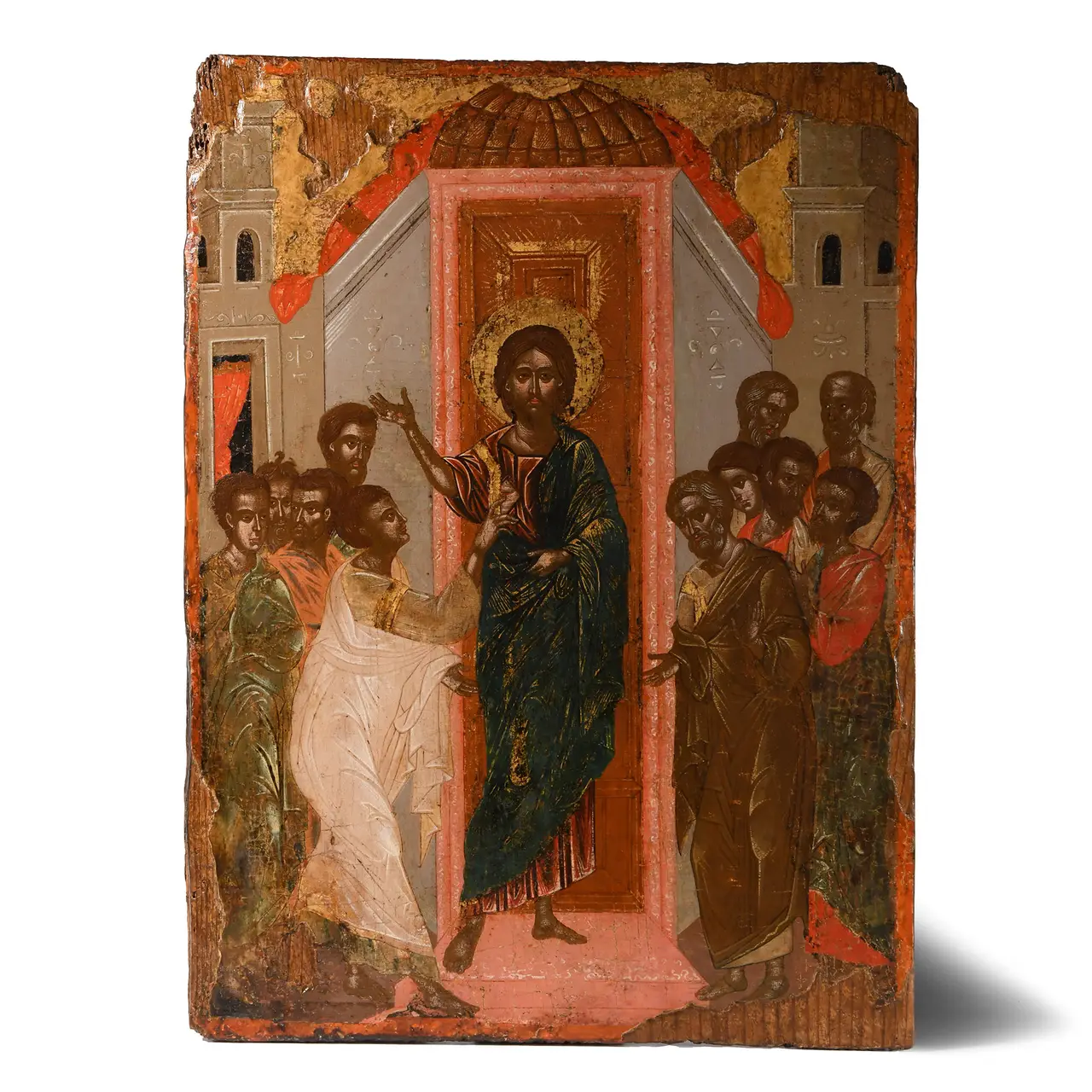
Canellopoulos lived to ninety-seven, dying in 2003; Alexandra died in 2008. In his last years, his sight failing, he still gave the tours himself, leading visitors through rooms that were no longer his.
TimeLine Auctions, 16th July 2026