Home > Stories by TimeLine Auctions
Stories by TimeLine Auctions
Kurigalzu's Stones: Small Inscriptions of a Major Reign
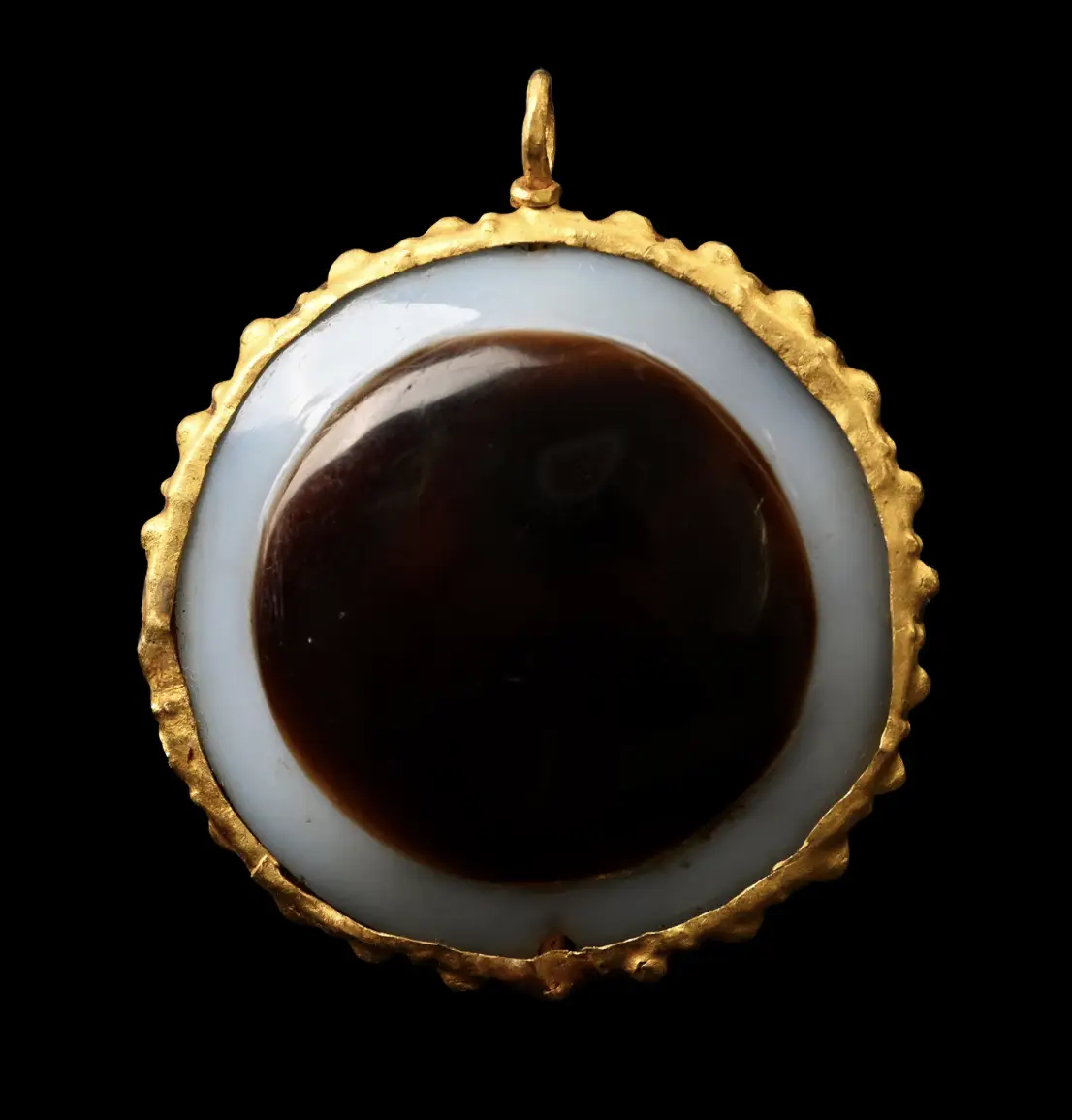
Between roughly 1332 and 1308 BC, Kurigalzu II of Babylon held the Kassite throne through a reign that included a hard-fought campaign against the Assyrians at the Tigris, building work at Nippur and the royal city of Dur-Kurigalzu, and a steady output of small inscribed stones dedicated in the temples of his kingdom. This agate cabochon, 42 mm across with four columns of cuneiform on its reverse, belongs to that output.
The disc is an agate eye-bead: a cabochon cut from banded chalcedony where the natural concentric layers, light against dark, produce something that reads unmistakably as an eye. Babylonian lapidaries selected such stones with care.
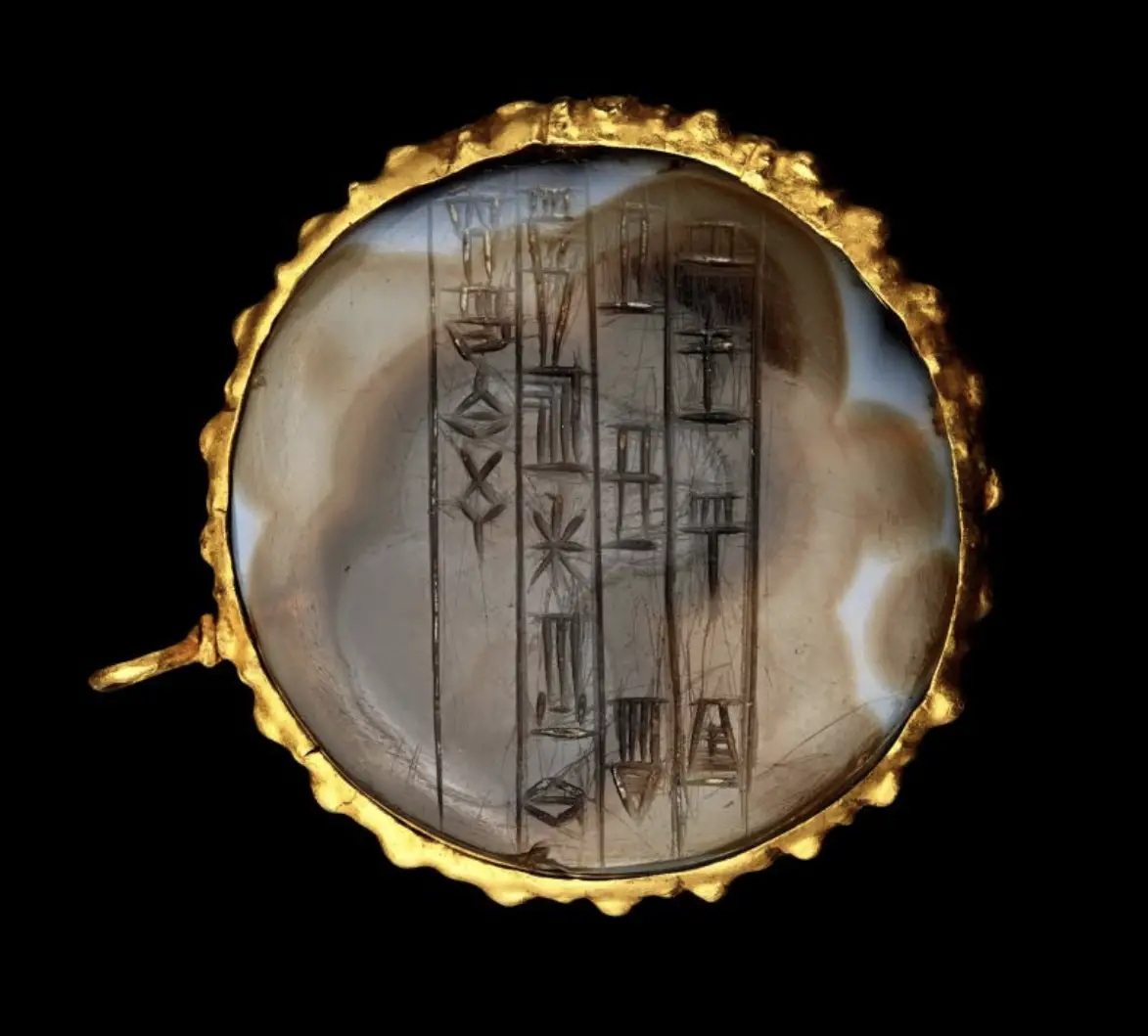
The reverse carries the inscription. The text follows a standard Kassite royal formula: Kurigalzu, strong man, King of Babylon, son of Burnaburiaš. "Strong man" renders the Sumerian nita kala-ga, the epithet the Kassites preferred for royal titulature. The patronymic does the work of identification. There were two Kassite kings called Kurigalzu, separated by about forty years and difficult to tell apart on short inscriptions: the earlier (d. c. 1375 BC) was the son of Kadašman-Harbe; the later, the son of Burnaburiaš II. The patronymic on this stone fixes the attribution to Kurigalzu II, whose own royal inscriptions consistently name Burnaburiaš as his father.
Inscribed agate eye-stones of this kind were votive objects. The eye effect was the point: the banding of the stone made it read as an eye, and the stone, attached at a cult statue, materialised the king's petition to be looked upon with favour by the god. Surviving examples bearing the name Kurigalzu are dedicated to deities including Adad, Ninlil, Enlil, Ishtaran and Zababa; a small handful are held in major collections at the Louvre, the British Museum and the Metropolitan Museum. Some are perforated through the centre so that they could be strung and hung around the necks of cult statues; others were set in gold mounts and attached in a similar way. T. Clayden's 2009 study has argued that the broader class of eye-stones is best understood as decorative rather than apotropaic, but the inscribed Kurigalzu pieces are squarely votive in their own terms: given by the king, in the temple, for his life.
Where they ended up depended on what happened next. A high concentration of them came out of Nippur. Others were carried off as booty in later raids: agate beads of Kurigalzu have been excavated at Susa, and inscribed eye-stones bearing his name have turned up at various levels at Assur. Eye-stones of Kurigalzu have been recorded as far east as Luristan. The known corpus is small and widely scattered.
The current setting, a gold-coloured frame with an integral loop, is a modern mount; the antiquity is the stone and its inscription. The traceable history begins with the collection of Mrs M.V. in the 1980s, and the object has been kept in Switzerland since the late 1980s. A comparable eye-stone of Kurigalzu I is held at the Morgan Library & Museum in New York under the reference '086. Eye Stone Amulet'.
An eye-stone of the same class, inscribed for the Neo-Babylonian king Nebuchadnezzar II, sold at Bonhams on 4 December 2025 for £190,900. The stone of King Kurigalzu II will be on auction at TimeLine Auctions on the 2nd of June 2026 as lot 250, with an estimate of £80,000–100,000.
TimeLine Auctions, 19th May 2026