Home > Stories by TimeLine Auctions
Stories by TimeLine Auctions
Master of the Lion: The God Who Came Before Hercules
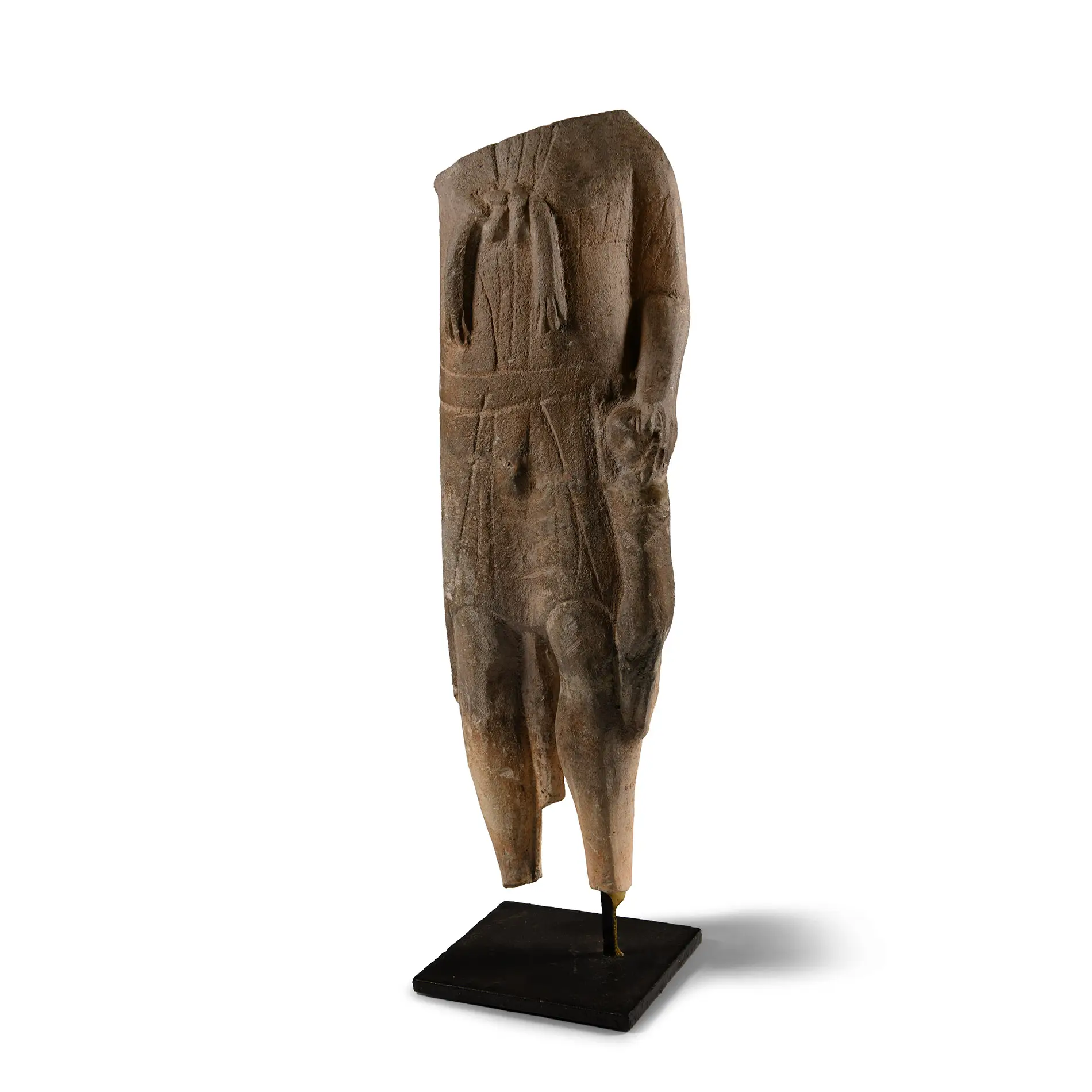
Somewhere in southwestern Cyprus, perhaps in a workshop near the quarries that supplied Kition or Idalion, a sculptor worked a block of pale limestone into the shape of a god. The stone was soft, almost cheese-like when freshly cut, yielding easily to iron chisels. He carved the figure to be seen only from the front; the back remained flat, unworked, because this was a votive offering destined to stand against the wall of a shrine. He shaped a short-sleeved tunic belted at the waist, a lion's pelt draped over the shoulders with its forelegs knotted across the chest, and beneath one hand, stretched down the figure's thigh, a small lion subdued under the god's grip. The right arm, now lost, would have been raised in a pose familiar throughout the ancient Near East: the threatening gesture of the smiting god, club in hand.
This figure, missing its head, right arm, and feet but still standing some 48 centimetres tall, survives today as a characteristic example of Cypriot religious sculpture from the Iron Age. It represents a deity known to the Phoenicians as Melqart, "King of the City," though later Greek visitors to Cyprus would have seen something else entirely: their own Heracles, slayer of the Nemean lion.
King of the City
Melqart was the patron god of Tyre, the great Phoenician maritime city on the coast of what is now Lebanon. His name tells us his role: mlk qrt, "king of the city," a divine founder and protector whose cult travelled wherever Tyrian colonists established new settlements. By the early first millennium BCE, Phoenician traders and settlers had spread across the Mediterranean, founding colonies from Cyprus to Carthage to the coast of Spain, and they brought Melqart with them.
In his home city, Melqart was worshipped with elaborate rites, including an annual festival that may have involved the ritual "awakening" of the god, a ceremony that later Greek writers compared to the myth of Heracles' self-immolation and apotheosis. The connection between the two figures was not coincidental. Ancient sources suggest that stories about Heracles, particularly those involving his labours in the far west, may have developed partly from Phoenician tales about Melqart. The two gods shared attributes: both were associated with lions, both were portrayed as supremely powerful, and both had strong connections to the founding of cities.
When Greeks encountered Melqart in Phoenician ports and colonies, they called him "the Tyrian Heracles." The identification was so complete that by the Classical period, the two were often treated as the same deity under different names.
Cyprus: Where Gods Merged
Cyprus sat at the crossroads of these cultural currents. The island had absorbed influences from the Levant, Egypt, and the Aegean for millennia, and its religious landscape reflected this layered history. When Phoenicians from Tyre established a significant presence at Kition (modern Larnaka) in the ninth century BCE, they brought Melqart worship with them. But the god they established on Cyprus was not quite the Melqart of Tyre, nor the Heracles of mainland Greece.
The island already had its own traditions. Local deities with names like Reshef, borrowed from the Canaanite pantheon centuries earlier, held sway in certain sanctuaries. A powerful male figure associated with mastery over wild animals, sometimes called the "Master of the Lion" or simply "the Great God of Cyprus," appears in Cypriot art from the Bronze Age onwards. When Melqart arrived, his identity merged with these existing figures, producing a distinctly Cypriot synthesis.
The iconography of this hybrid deity drew from multiple sources. The lion skin, worn as a cloak with the animal's head forming a cap, came from Greek depictions of Heracles. The "smiting" pose, arm raised to strike, belonged to the Near Eastern tradition of warrior gods like Baal and Reshef. The small lion held in the figure's other hand, grasped by its scruff or hindquarters, demonstrated divine mastery over the wild. This last element created a curious doubling: the god wears the skin of one lion while subduing another, simultaneously displaying the trophy of a past victory and the act of present conquest.
Reading the Stone
The figure sold at TimeLine Auctions in March [lot 0088] belongs to a well-documented Cypriot type. Comparison with examples in the British Museum (1917,0701.285 and 1873,0320.38), the Museo Giovanni Barracco in Rome, and finds from the sanctuaries at Kition and Idalion confirms its place within this tradition. Several nearly identical figures have been recovered from Golgoi, another important Cypriot sanctuary, and two from the Sanctuary of Apollo at Idalion, which Kition conquered between 470 and 450 BCE, are close parallels.
Cypriot sculptors worked in soft limestone quarried from the island's own geological formations, particularly the Lefkara and Pachna deposits. Scientific analysis has shown that even limestone votives found at distant sites in Syria, the Aegean, and Egypt were carved from Cypriot stone, indicating either a trade in finished objects or the movement of Cypriot craftsmen who travelled with their raw materials. The tradition was deeply local even as its products spread across the Mediterranean.
The flat back of this figure is typical. Votives like this one were designed to stand in niches or against sanctuary walls, visible only from the front. Paint, now lost, would have supplied many details that the carving left undefined. Faces that seem generic or crude to modern eyes may once have had carefully rendered features, picked out in red, black, and yellow pigment. Without the head, precise dating becomes difficult; the shape of the eyes, when preserved, often provides the best chronological indicator. Based on style and parallels, this figure likely dates to the late sixth or fifth century BCE.
The loss of head, arm, and feet does not diminish what remains. The knotted lion's pelt across the chest, the subdued animal stretched along the thigh, the belted tunic, and the overall stance all survive intact. These are the elements that identified the figure to ancient worshippers and that still allow us to place it within its religious and artistic context.
A God for Everyone
The deliberate ambiguity of this Cypriot type may have been central to its success. In the sanctuaries where these figures were dedicated, worshippers from different backgrounds, Phoenician colonists, Greek traders, and the native Cypriot population, could each recognise their own deity. A visitor from Tyre saw Melqart. A Greek saw Heracles. A local devotee saw the island's own divine protector, whatever name they used. The image served as common ground in a society where cultural exchange, rather than assimilation, was the norm.
No dedicatory inscriptions securely linking this iconographic type to a specific divine name have survived from the Archaic or Classical periods. The conventional modern label "Herakles-Melqart" acknowledges this uncertainty while recognising the dual heritage visible in the figure's attributes. Some scholars prefer to speak of a "Master of the Lion" type, defined by its iconography rather than by a divine name that may have varied from sanctuary to sanctuary.
The figure that left Cyprus for David Jonson's collection began its existence as an act of devotion, a votive placed in a shrine to secure divine favour or to thank a god for blessings received. It stood for centuries in the half-light of a sanctuary, its painted features fading, its raised arm eventually breaking away. That it survives at all is remarkable; that it survives in identifiable form, with its iconographic programme still legible, is a gift to anyone interested in the religious imagination of the ancient Mediterranean. The god who wore the lion skin before Heracles claimed it still holds his prey.
TimeLine Auctions, 28th February 2026