Home > Stories by TimeLine Auctions
Stories by TimeLine Auctions
My father, the enemy ships are already here: The Late Bronze Age Collapse
"My father, the enemy ships are already here." Sometime around 1190 BC the king of Ugarit dictated those words in a reply to the king of Cyprus, who had written to steady his nerve: fortify your towns, bring the troops and chariots inside them, wait for the enemy with firm feet. The advice was sound and useless. "They have set fire to my towns and have done very great damage in the country," the king, Ammurapi, answered. He could do none of it, because his army was stationed in Hatti, hundreds of miles north, and his warships were off the coast of Lycia. "The country is abandoned to itself," he wrote. "There are seven enemy ships that have come and done very great damage."
Seven ships. Not a horde, not an armada: seven ships, against a wealthy kingdom of perhaps twenty-five thousand people that could not raise a defence because its army and its fleet were both somewhere else, fighting someone else's war or guarding someone else's coast. Ugarit burned and was never rebuilt. Excavators found arrowheads lying where they had fallen in the debris.
That letter holds, in miniature, the thing this article is about. A king whose forces are scattered across other people's territory; an enemy who needs only seven ships; a warning too late to act on. Around 1200 BC the whole connected world of the eastern Mediterranean came apart in roughly this manner, kingdom by kingdom, over the better part of a century. Why is still argued. What is not argued is that the connections themselves were part of the cause.
The world that came apart
For three centuries before it ended, the Bronze Age Near East ran what historians call the Club of Great Powers. Its members, the kings of Egypt, Hatti, Babylon, Assyria, Mitanni, Cyprus and others, wrote to one another in Akkadian, the diplomatic language of the day, and addressed each other as "brother." We can read their post because nearly four hundred clay tablets survived at El-Amarna in Egypt, the discarded foreign-office files of two pharaohs. The tone is lower than "brother" suggests: the kings haggle over the purity of gold and the size of dowries, and more than one notes, a little sourly, that in Egypt "gold is as plentiful as dirt."
Under the diplomacy ran a trade in metal the whole system leaned on. Bronze is copper and tin, roughly nine parts to one, and neither metal was evenly distributed: copper came above all from Cyprus, tin from far to the east, toward Afghanistan, and a kingdom that wanted weapons or tools needed dependable access to both. The clearest picture of how that worked is a wreck. Around 1300 BC a ship went down off the headland of Uluburun, on the southwest coast of Turkey, carrying about ten tons of copper ingots and a ton of tin, close to the exact ratio of finished bronze, along with Canaanite jars, ebony, ivory and raw glass. One hull held an army's worth of metalwork and a palace's worth of luxuries, moving between kingdoms that each supplied a piece of what the others lacked.
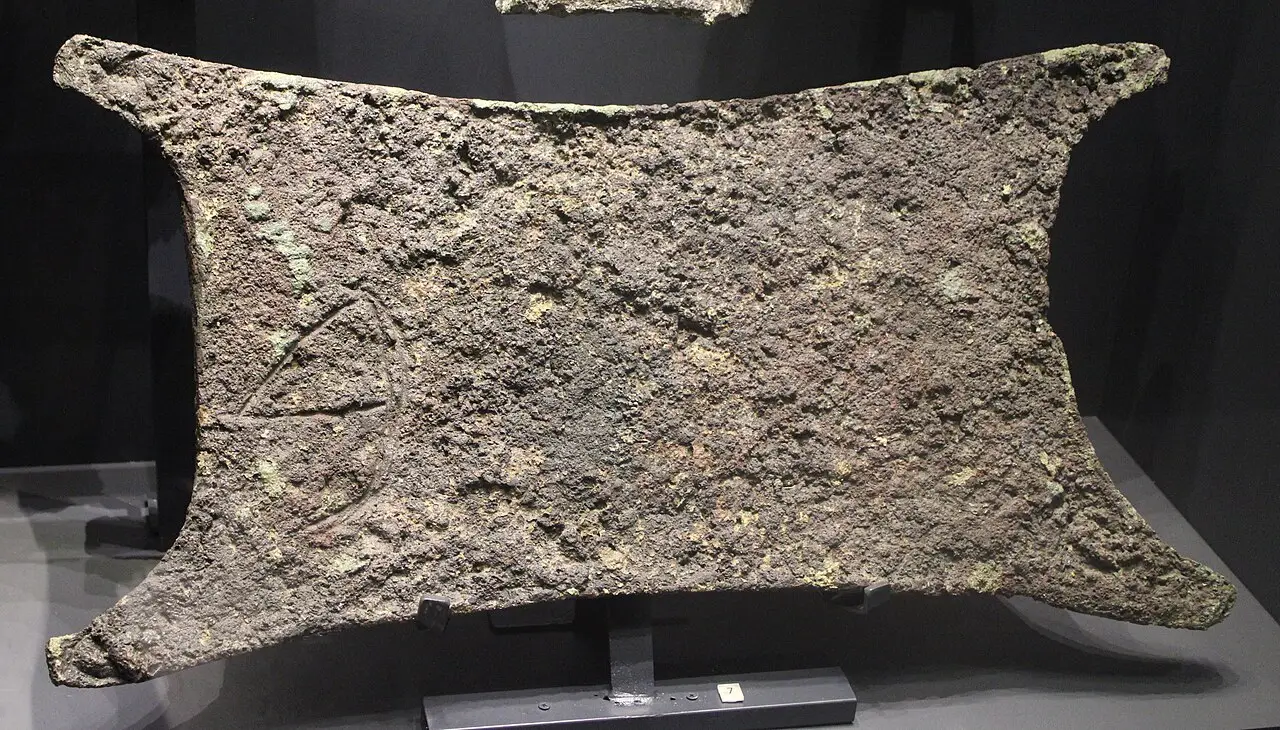 A copper oxhide ingot from the Uluburun wreck of about 1300 BC, now in the Bodrum Museum of Underwater Archaeology. The four-cornered form, with a grip at each corner, was the standard way copper moved by ship. Photo: Zunkir, CC BY-SA 4.0, via Wikimedia Commons.
The states that fell hardest, the Mycenaean kingdoms of Greece, the Hittite empire, Ugarit and its neighbours, ran their economies through the palace: it took in the harvest, stored it, handed it back out, commissioned the bronzework, managed the trade, kept the records. Mario Liverani put the consequence plainly: when everything is concentrated in the palace, the destruction of the palace becomes a general disaster for the whole kingdom. There was no second economy to fall back on, no merchant class running its own networks. Eric Cline's gloss is that the rulers "should have diversified their portfolios, but they did not." He borrows a term from complexity theory for the result: the Late Bronze Age world was "hypercoherent," each part so tightly bound to the rest that "change in any part produces instability in the system as a whole."
Not a single year
The popular version comes with a date stamped on it: 1177 BC, the year the pharaoh Ramesses III fought off a coalition the Egyptians called the Sea Peoples. The date is Cline's, from the 2014 book that made it famous, and he is the first to call it a convenience. "1177 BC is to the end of the Late Bronze Age," he writes, "as AD 476 is to the end of Rome": a marker driven into a long process for the sake of having somewhere to point. The destructions did not happen in a year. They spread across roughly a century, from the burning of Hazor in inland Canaan around 1230 BC, through the Aegean palaces and Ugarit around 1190, to Megiddo and Lachish in the southern Levant as late as 1130.
The temptation to compress comes from the length of the list. Robert Drews, who named the episode "the Catastrophe," framed it as a near-instant wave: "within a period of forty or fifty years almost every significant city or palace in the eastern Mediterranean world was destroyed, many of them never to be occupied again." Both things hold at once. The destruction was concentrated enough to look like a single event, and spread out enough that no one army, earthquake or failed harvest could have done all of it.
How much was lost is a figure to handle with tongs. The number that gets repeated is a population fall in Greece of around three-quarters, and it comes from counting settlements: Anthony Snodgrass tallied roughly 320 known sites in the thirteenth century and about 40 by the eleventh, and a population estimate was inferred from the drop, across two hundred years rather than a generation. Recent work treats that as too steep; Ian Morris and others put the real decline nearer one-half to two-thirds. What is not in question is that writing itself disappeared. Linear B, the script the Mycenaean palaces kept their accounts in, vanished with them, and Greece would not write again for some four centuries.
The suspects, one by one
For a long time the case looked closed, and the culprits were the Sea Peoples. Almost everything we have comes from two Egyptian monuments. The first records a campaign of Merneptah, around 1207 BC, who repelled a Libyan invasion that brought northern allies with unfamiliar names, several described as "of the countries of the sea." That phrase is where the modern label began. The second, larger and far more famous, is carved at Medinet Habu and dated to the eighth year of Ramesses III, conventionally 1177 BC. "The foreign countries made a conspiracy in their islands," it reads. "No land could stand before their arms, from Khatte, Qode, Carchemish, Arzawa, and Alashiya." The reliefs show two battles, one on land in the Levant and one in the mouths of the Nile, where the attackers' crews are "made into heaps." Among the fighters ride families in ox-carts, women and children and household goods piled high, which is why the scene reads as a people on the move rather than a raid.
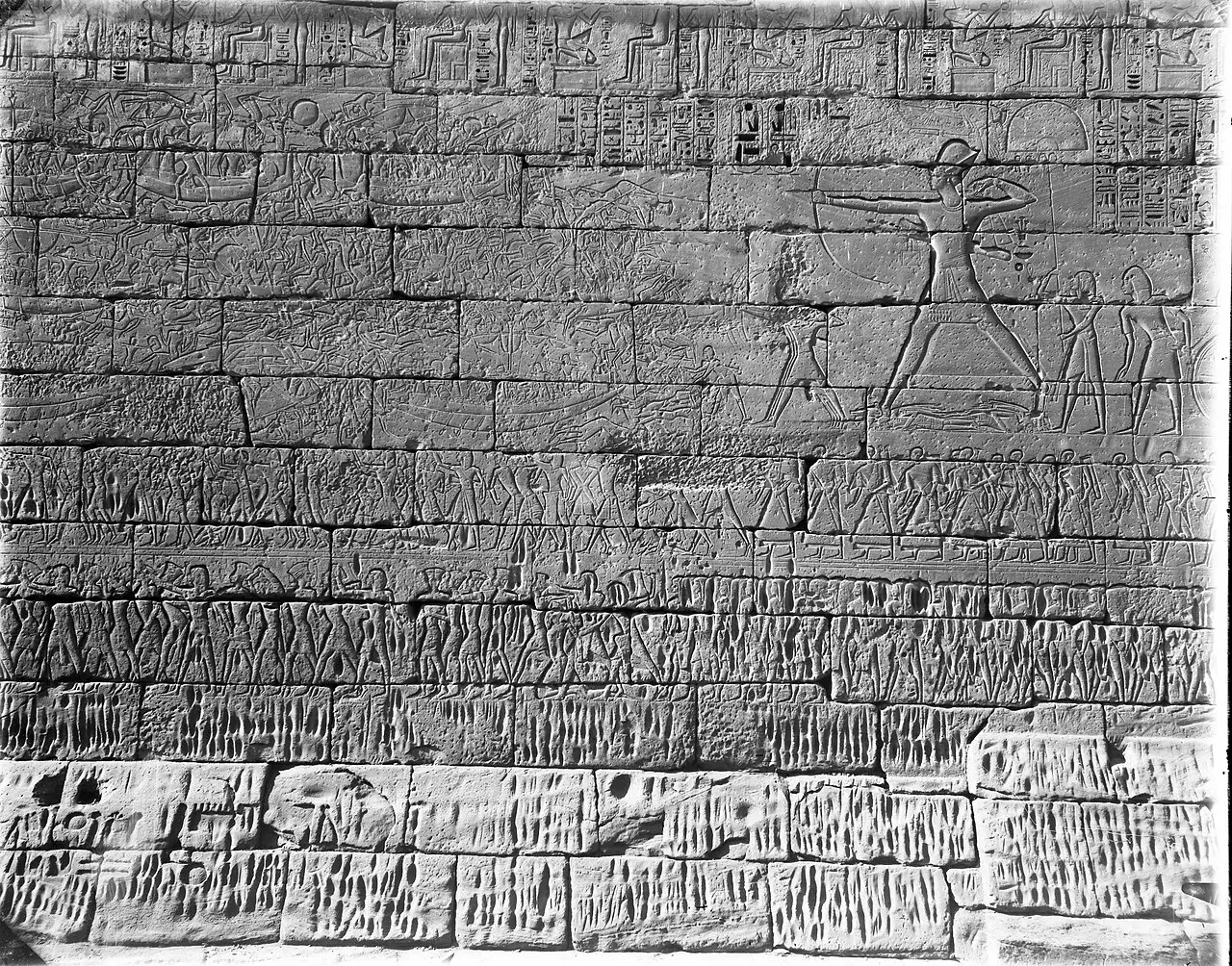 The sea battle against the Sea Peoples on the north wall of Ramesses III's mortuary temple at Medinet Habu, recording the campaign of his eighth year, conventionally dated 1177 BC. The pharaoh draws his bow at the right as the enemy ships founder. Photo: Archivio fotografico Museo Egizio, Turin, CC0, via Wikimedia Commons.
For a hundred years the Sea Peoples were the answer. The trouble is that the monument flatters, and in places it lies. Its roll-call of fallen lands is partly wrong: Carchemish, listed among the conquered, has no destruction layer at all and carried on under its own dynasty for centuries, and Arzawa had been dissolved well before. The text is royal propaganda, pharaoh-focused rather than fact-focused, and probably folds several separate episodes onto one triumphal wall. The Egyptians never even gave the Sea Peoples a single collective name; that came later, in the 1880s, when the French Egyptologist Gaston Maspero standardised "peuples de la mer." The reading that dominates now, following Liverani, treats them as a consequence rather than a cause, people set in motion by the same crisis they are blamed for starting.
One thread does hold up under the spade. Along the southern coast of Canaan, at the cities the Bible calls the Philistine pentapolis, the Canaanite towns end and something new takes their place: pottery made in the Aegean style but from local clay, Aegean-type cooking pots and loomweights, a sudden appetite for pork and, stranger still, for dog. In 2019 a team led by Michal Feldman recovered DNA from skeletons at Ashkelon, including infants buried beneath the floors of the new houses, and found a pulse of European-related ancestry absent before and washed out again within two centuries. It is the first direct physical evidence of incomers from the Aegean. The sample is small, a handful of individuals at one site, and worth exactly what it claims. But the Philistines, at least, were genuine migrants, and they arrived as part of the collapse, not as its engine.
The second suspect leaves no arrowheads. Since the 1990s a run of studies has found evidence for a sharp, sustained drought across the eastern Mediterranean right around 1200 BC, now labelled the 3.2-kiloyear event. Pollen from a salt lake on Cyprus, studied by David Kaniewski and colleagues, shows the driest interval in the whole record falling between roughly 1200 and 850 BC, dry enough that "precipitation and groundwater probably became insufficient to maintain sustainable agriculture." Cores from the Syrian coast and the Sea of Galilee agree; the Galilee pollen, read by Dafna Langgut and Israel Finkelstein, records "the driest event throughout the Bronze and Iron Ages" at about 1250 to 1100 BC.
The texts say the same in human terms, with no help from a pollen core. The Hittite queen Puduhepa wrote to Ramesses II, "I have no grain in my lands." A royal letter calls a single grain shipment of some 450 tons "a matter of life and death." At Emar, on the bend of the Euphrates, scribes dated documents by catastrophe, "the year of hardship," as grain prices roughly tripled and families were forced to sell their children. In 2023 a study of tree rings from ancient junipers at Gordion, in Anatolia, led by Sturt Manning, pinned down what the pollen never could: three consecutive bone-dry years, dated 1198 to 1196 BC, falling almost exactly when Hittite control gave way.
It is the most quoted cause now, and the easiest to push too far. The sharpest correction comes from Bernard Knapp and Sturt Manning, the same Manning who dated the Gordion rings. In a long review in 2016 they warned against turning climate into a single trigger: most pollen cores can be dated only to within a century or two, the famine letters cannot be put in firm order, and the driest regions of all, Cyprus and the southern Levant, make an odd place for desperate people to flee toward. Their position is that climatic shifts served "as catalysts rather than unique triggers," and that "the immediate cause of the destructions and collapse was human." The Aegean is a pointed exception: the Greek pollen shows no extreme dry spell, and the Pylos tablets, written in that palace's last weeks, mention no shortage of food.
The land itself is the third suspect. The eastern Mediterranean is seismically violent, and in 2000 the geophysicist Amos Nur and Eric Cline proposed an "earthquake storm," a clustered series of shocks spread over perhaps fifty years that brought buildings down faster than they could be raised again. The evidence is the kind a structural engineer reads: walls bowed and thrown off true at Tiryns and Midea, and at Mycenae the skeleton of a woman crushed in a doorway of the houses below the citadel, the place a person runs to when the ground starts to move. The objection is one the authors make themselves. Earthquakes, they grant, "would not, in and of themselves, have destroyed entire societies," because societies rebuild after them, and most of these sites were in fact reoccupied. A run of quakes might account for one destruction horizon. It cannot account for all of them.
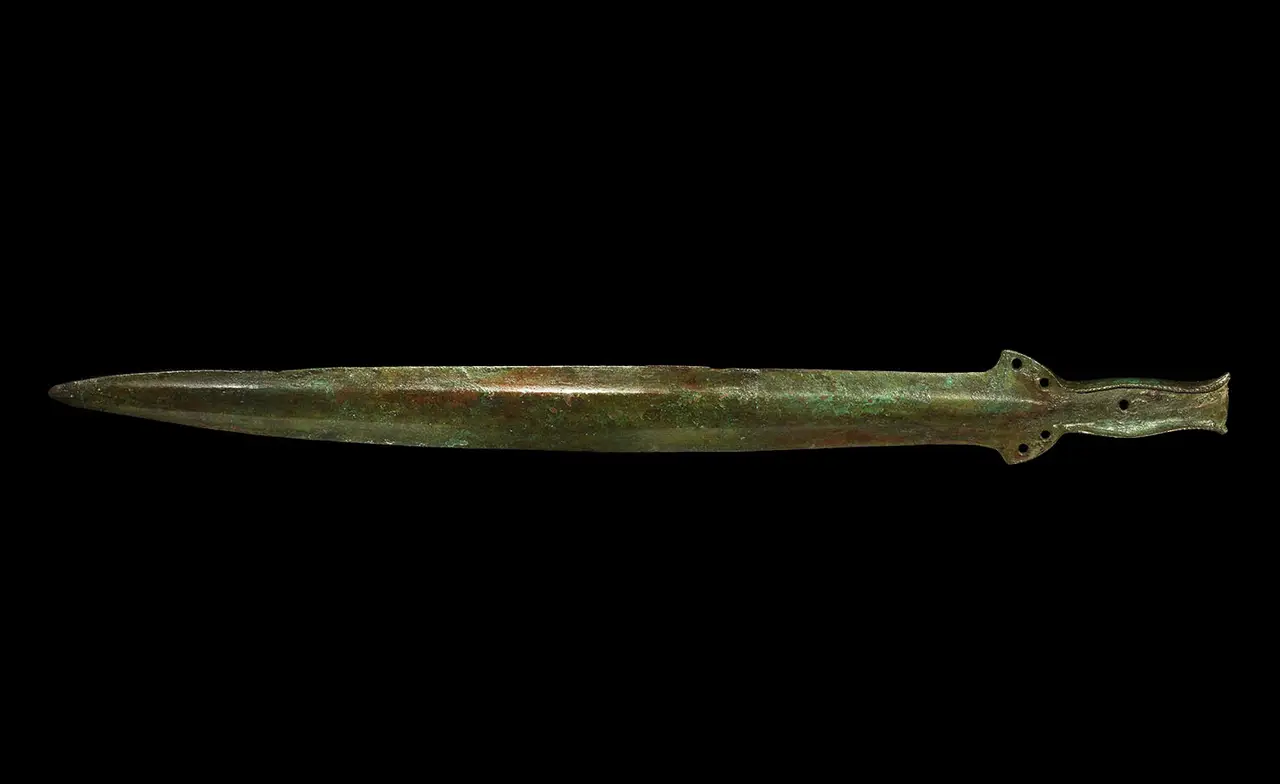
Two further suspects can be handled quickly. Robert Drews argued in 1993 that the driver was a change in warfare: massed infantry with javelins, round shields and a new cut-and-thrust blade, the Naue Type II sword, learning to swarm and bring down the expensive chariot armies the great kingdoms relied on. His exhibit was the sword itself, near-unknown in the Aegean in the thirteenth century and common in the twelfth. The thesis has not won wide support: the Naue II appears earlier and in far greater numbers in Italy and the Balkans, which makes it a weapon the Aegean adopted rather than an intruder's blade, and Bronze Age armies had always been mostly infantry anyway. The sword marks the change. It did not make it.
The last suspect is internal: famine and inequality turning the palace's own dependent population against it. At Hazor, the largest Canaanite city, the destruction around 1230 BC included statues with their heads struck off, which Sharon Zuckerman read as a revolt from within rather than an attack from without, since she found "no archaeological evidence of warfare ... anywhere in the site" (Amnon Ben-Tor, who has dug there for decades, disagrees). The standing objection is the obvious one. As Thomas and Conant put it, it is hard to see how "an unarmed, untrained, and unorganised peasantry" could prevail over a trained military elite. A riot is not a revolution.
The perfect storm
Every one of these suspects has an alibi. The Sea Peoples were partly a symptom; the drought, alone, should have been survivable, as earlier droughts had been; the earthquakes rebuild; the sword follows the change rather than causing it; the peasants lacked the means. Pressed alone, each theory comes apart. That is the clue.
The synthesis that holds the field now, argued most fully by Cline, is that no single cause is meant to carry the weight. Several pressures arrived close together, and because the system was so tightly coupled, each made the others worse. Drought brought famine; famine brought unrest and movement; movement and raiding cut the trade routes; severed trade starved the palace economies the whole structure stood on. Cline calls it a "multiplier effect," the failure of one part tripping the next like a row of dominoes. People who could have ridden out a single bad harvest, or raid, or earthquake could not ride out all of them together. N. K. Sandars framed the real question decades ago: catastrophes are normally survived, so what was different this time? Why did these civilizations not pick themselves up and carry on, as others had before and would again?
The honest reply is that this is a reconstruction, not a proven sequence, but it has the shape of the evidence. Go back to Liverani's palaces, and to the king of Ugarit with his army in Hatti and his fleet off Lycia. In a world where every part leaned on every other, the failure of some parts became the failure of all of them. The web of connection that had made the Bronze Age rich was the same web that would not let it heal.
Not every ruin was a last stand
Get close to the ruins, and the heroic picture frays. Take Hattusa, the Hittite capital, high on the Anatolian plateau, which generations of readers pictured stormed and sacked by the Sea Peoples in a final stand. Jürgen Seeher's excavations tell a quieter, stranger story. The royal family and the elite left first, in an orderly evacuation, taking the state archives and the valuables with them. The burning, when it came, was confined to the palaces, temples and gates; the ordinary houses show no destruction at all; and the public buildings had been "carefully cleaned out before they were put to the torch." There are no weapons in the debris and no bodies, and no single moment of destruction either, since the burnings were not even simultaneous. Whoever fired the empty shell, the Kaška hill-peoples who had harried the Hittites for generations, or simply looters working an abandoned city, did so well after the people with the most to lose had gone. The capital was not overrun. It was given up.
The same hunger for a dramatic last scene produced one of the most repeated images of the collapse, and it is false. The story runs that the final tablets of Ugarit were found inside a kiln, caught mid-firing as the city burned around them, a clerk's last act fixed in clay. There was an oven, and tablets near it. But the excavator Claude Schaeffer's "kiln" was installed by squatters after the destruction, and the tablets had dropped into it from an upper floor. As Itamar Singer has shown, not one of the more than 150 tablets can be dated to Ugarit's final days on the evidence of where it was found. The destruction was real. The human touch was added later, by people who wanted the ending to have a face. Even the Mycenaean palace records that read most like a kingdom bracing for attack, the Pylos tablets that post coastguards and muster rowers, may be no more than ordinary administration that looks ominous because we know how the story ends.
Who survived, and what came after
The word "collapse" suggests a single sheet of ice giving way, and that is not what the map shows. Egypt, Assyria and Babylonia all came through in reduced form. Egypt fared worst: it lost its Asian empire, the New Kingdom guttered out around 1070 BC, and the indignity of the new order is caught in the Report of Wenamun, the account of an Egyptian envoy sent to Byblos to buy timber, robbed on the way, travelling on a foreign ship and treated with contempt by a prince whose forefathers had served the pharaohs. Assyria under Tiglath-Pileser I briefly reached the Mediterranean, then fell back for a century and a half to a thin strip along the Tigris.
Some places did better than survive. Cyprus, hit hard around 1200, was flourishing again within a generation or two. The Phoenician cities of the coast, Byblos, Tyre and Sidon, came through almost untouched and then expanded into the very space the collapse had cleared, taking over the sea trade that Ugarit's fall and Egypt's retreat had left open. Cline borrows a modern word and calls them anti-fragile: the shock made them stronger. Within a few centuries Tyre would be planting colonies as far west as Spain and founding Carthage. Inland, the Hittite city of Carchemish kept its dynasty unbroken straight through the catastrophe, and its kings began to style themselves "Great King of Hatti," as though nothing had ended.
Out of the wreckage came things the palaces had never made. Iron-working spread in the centuries after 1200, long explained as a response to a tin shortage that starved the bronze trade, though Susan Sherratt argues the reverse: that iron spread because there was too much bronze in circulation rather than too little, as traders cut loose from the palace system looked for new things to sell. Writing returned in a wholly different form. Linear B had been a specialist's tool, a few scribes keeping inventories; when the Greeks wrote again they borrowed the 22-letter consonantal alphabet of the Phoenicians and added signs for vowels, turning the Phoenician aleph and bet into alpha and beta, so that writing became something nearly anyone could learn. New peoples settled the cleared ground: the Philistines on the southern coast, the Arameans across north Syria, and in the Canaanite highlands a scatter of small new villages, free of pig bones, that mark the first archaeological appearance of early Israel, a people named for the first time on that same stele of Merneptah.
The centuries that followed used to be called a Dark Age, and for parts of them the name half fits: fewer people, smaller settlements, no monuments, no writing for a long stretch. But the dark was patchy, and the clearest hole in it was dug at Lefkandi, on the island of Euboea. Under a long earthen mound, archaeologists found a building close to fifty metres long and, beneath its floor, a burial from around 950 BC: a man cremated and his ashes folded into an antique bronze urn brought from Cyprus, an iron sword beside him; a woman buried next to him with gold discs over her breasts and gilded coils in her hair; and four horses, killed and tipped into a shaft. It is a funeral, in one archaeologist's phrase, "beyond all comparison" with anything else in central Greece for the next three hundred years. The people who staged it were not living in the dark. Most scholars have quietly dropped the term; John Papadopoulos calls the Dark Age "more of a modern scholarly construction than one based on solid archaeological evidence," and Cline, surveying his colleagues, adds the obvious, that "the general public doesn't seem to have gotten the message yet."
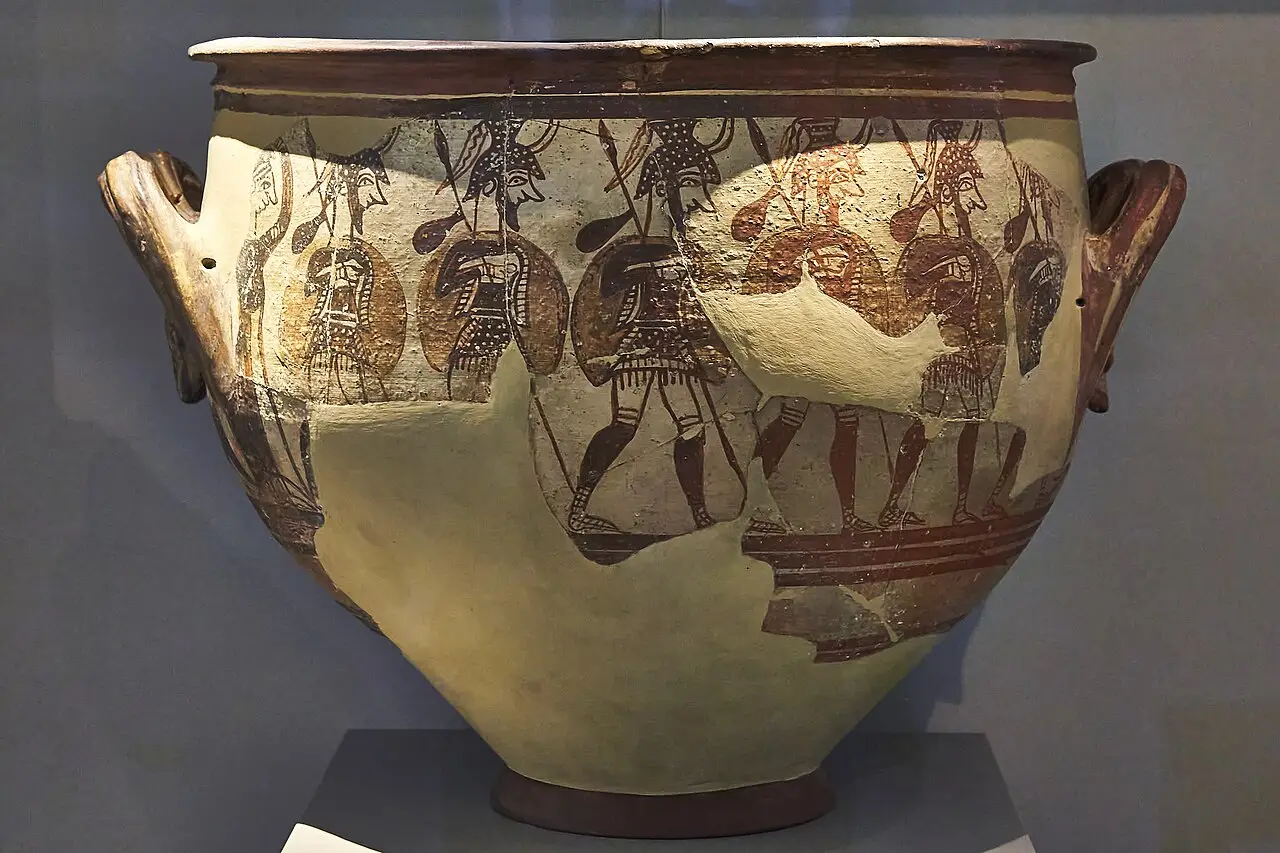 The Warrior Vase, a krater found by Schliemann at Mycenae, around 1200 BC. Helmeted spearmen march off to war while a woman at the left raises her hand in farewell. Athens, National Archaeological Museum. Photo: George E. Koronaios, CC BY-SA 4.0, via Wikimedia Commons.
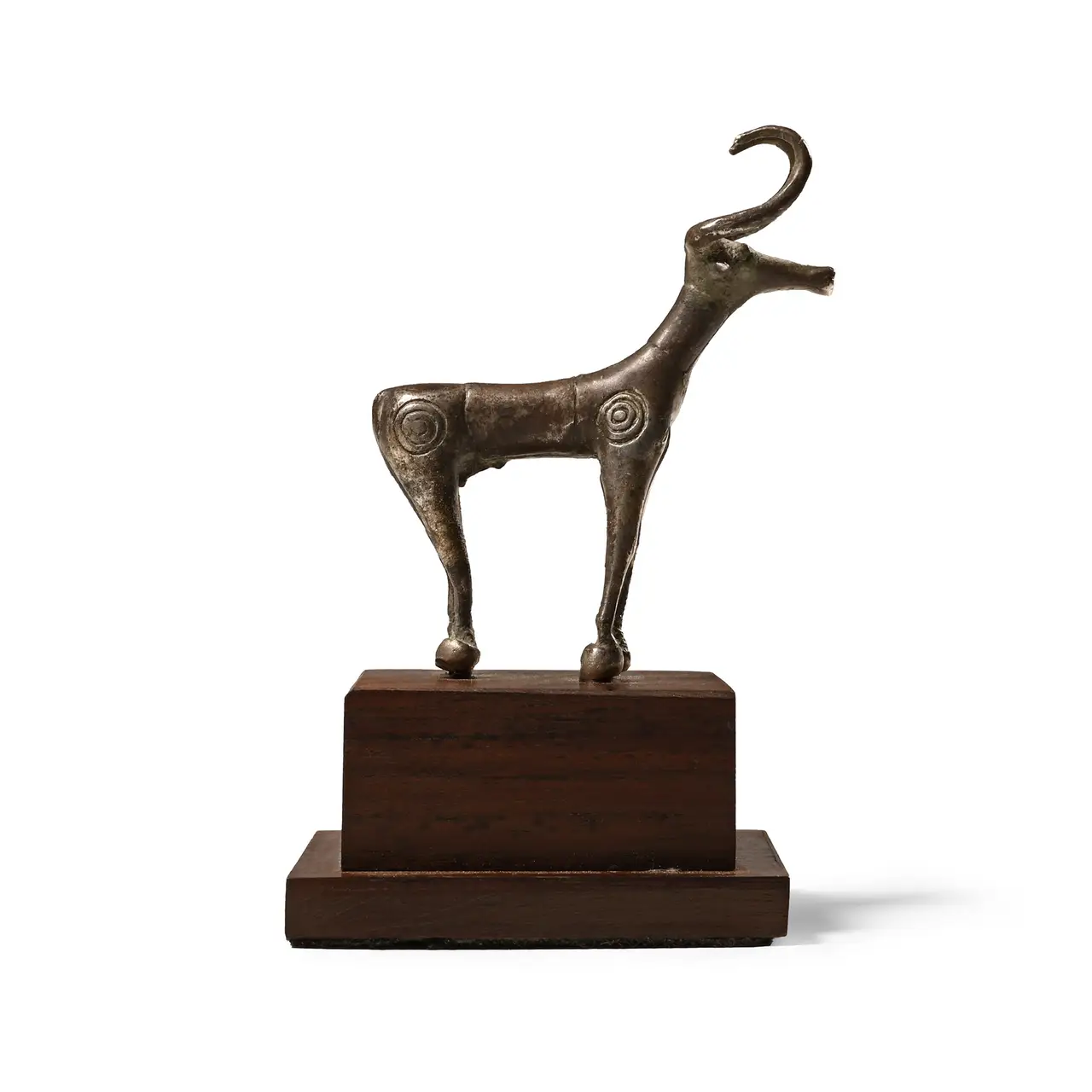
The objects that came through are also, often, the ones a collector meets today: Cypriot bronzes, the heavy-walled pottery of the postpalatial Aegean, the long blades of the twelfth century. Our catalogue of eastern Mediterranean antiquities carries pieces from both sides of the divide, the world that ended and the one that grew over it.
The story is also a mirror
That the public has not caught up is partly the field's own doing, because the story of 1200 BC has always worked as a mirror. Neil Silberman noticed that the Sea Peoples keep changing to suit whoever describes them: the marauding barbarians of Victorian scholarship, written in an age nervous about invasion, became "the dynamic entrepreneurs of the early 1990s" in the hands of historians who admired private enterprise. Our own version leans on climate, and the best people in the field say so out loud. Cline calls the megadrought "the proverbial eight-hundred-pound gorilla," and names the uncomfortable reason it looms so large for us: "especially given our own current concerns about the impact of climate change on today's world." The danger is not that the drought is invented. The tree rings at Gordion are real, and three rainless years from 1198 to 1196 BC is a hard, specific fact. The danger is that we do to it what every generation has done to its favourite cause, and let one suspect stand in for the whole.
Which brings us back to the king of Ugarit and his seven ships. He was not overwhelmed by a great force. He was overwhelmed by a small one, at the single moment when his army was away in Hatti and his fleet off the coast of Lycia, in a world he had helped to build that kept none of the means of its own rescue close to hand. As the city fell, someone inside it wrote one last letter, reporting that the enemy had already come ashore five kilometres down the coast at Ras Ibn Hani. The letter was finished. It was never sent. It was still in the house where it had been written when the excavators reached it, more than three thousand years later.
TimeLine Auctions, 6th July 2026