Home > Stories by TimeLine Auctions
Stories by TimeLine Auctions
Nearly Sixty Roman Phallus Carvings Counted Along Hadrian's Wall
Rob Collins, an archaeologist at Newcastle University who manages the Hadrian's Wall Community Archaeology Project, has counted 59 phallic carvings along the Roman frontier that ran across northern Britain, 39 of them cut as incised lines, 19 carved in relief and one a free-standing sculpture. They range from quick scratches in wall stones to deep reliefs at gates, bridges and quarries, and the fort at Vindolanda holds the densest cluster, more than a dozen examples.
In Roman belief the phallus, or fascinum, warded off the evil eye and ill luck and guarded the people and places marked with it. "Phallic objects are common in the Roman world, as larger carvings in rock or smaller pendants in bone or bronze, or depicted in art," Collins said of a carving identified at Vindolanda in 2024. "When presented like this, the phallus has a 'magical' function, as a symbol that evokes protection." A wall, a gateway or a bridge was an exposed point on the frontier, and the carved phallus was a charm set over it.
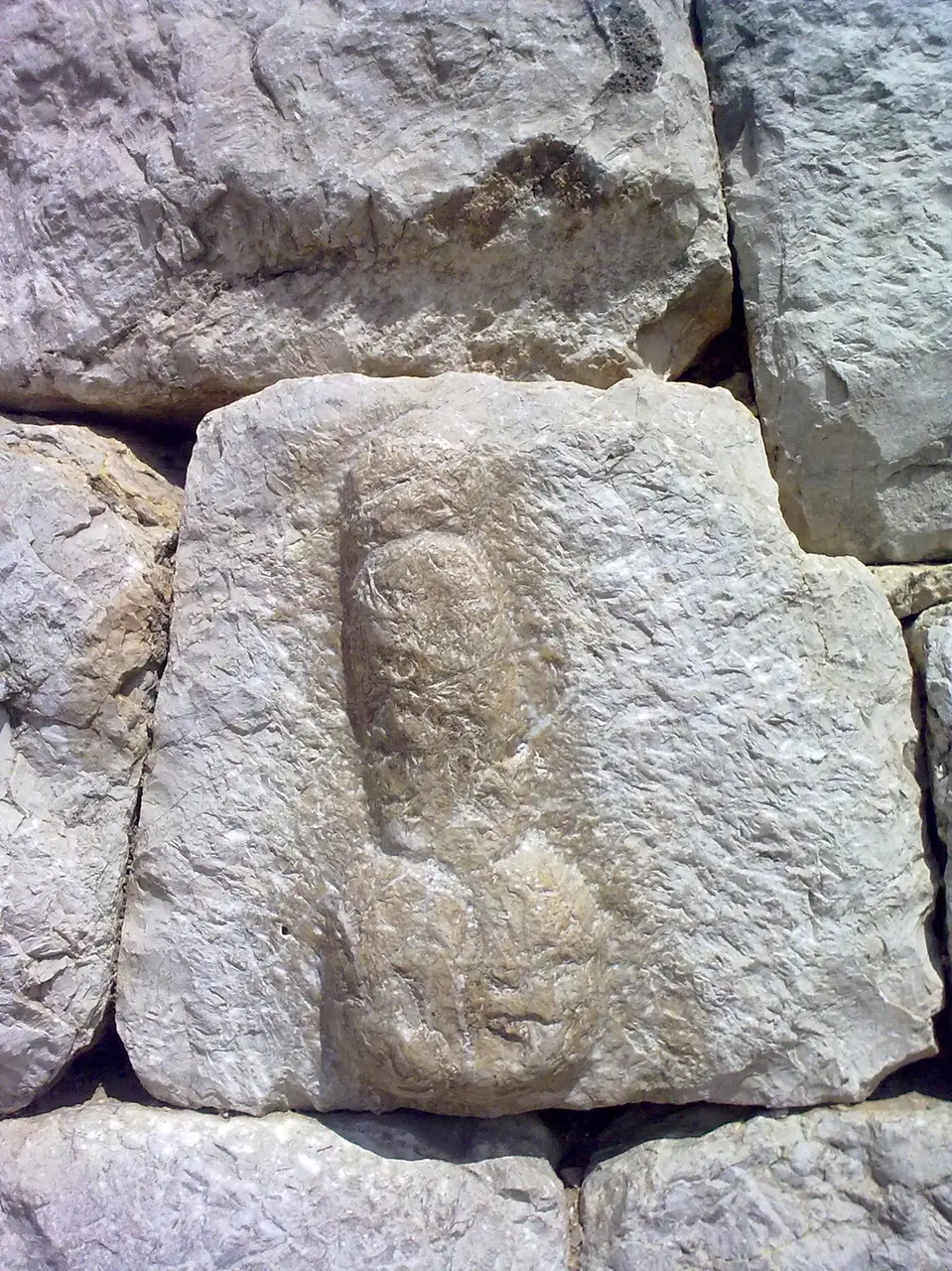 A phallus cut into the masonry at the entrance to the Greco-Roman town of Empúries, in Catalonia. Romans carved the same protective symbol into walls, gates and bridges across the empire, including along Hadrian's Wall. Photo: CeGe, CC BY-SA 3.0, via Wikimedia Commons.
Two finds from Vindolanda have been published in detail. A life-sized wooden phallus, recovered from a second-century ditch in 1992 and catalogued for three decades as a darning tool, was reinterpreted in 2023 by Collins and Rob Sands of University College Dublin. Writing in the journal Antiquity, they set out three readings of the ash object, about 16 centimetres long and worn smooth at both ends: a sexual implement, a pestle for grinding ingredients or cosmetics, or a good-luck charm handled for protection. They call it the only known life-sized wooden phallus from the Roman world, preserved by the waterlogged ground that keeps organic material intact at Vindolanda, and they settle on no single use.
The other find is a sandstone slab from a third-century level, uncovered in May 2022 by Dylan Herbert, a volunteer on the Vindolanda Trust's excavations directed by Andrew Birley. It carries a phallus that points toward a two-word inscription, SECVNDINVS CACOR. Alexander Meyer and colleagues, writing in the Roman-studies journal Britannia in 2023, read it as an insult aimed at a man named Secundinus, rendering it roughly as "Secundinus the shitter," with the phallus driving the message home. The reading is contested: David Woods proposed an alternative in the same journal the following year.
The count is provisional. New examples are still identified as the wall's forts are re-examined and older finds re-identified.
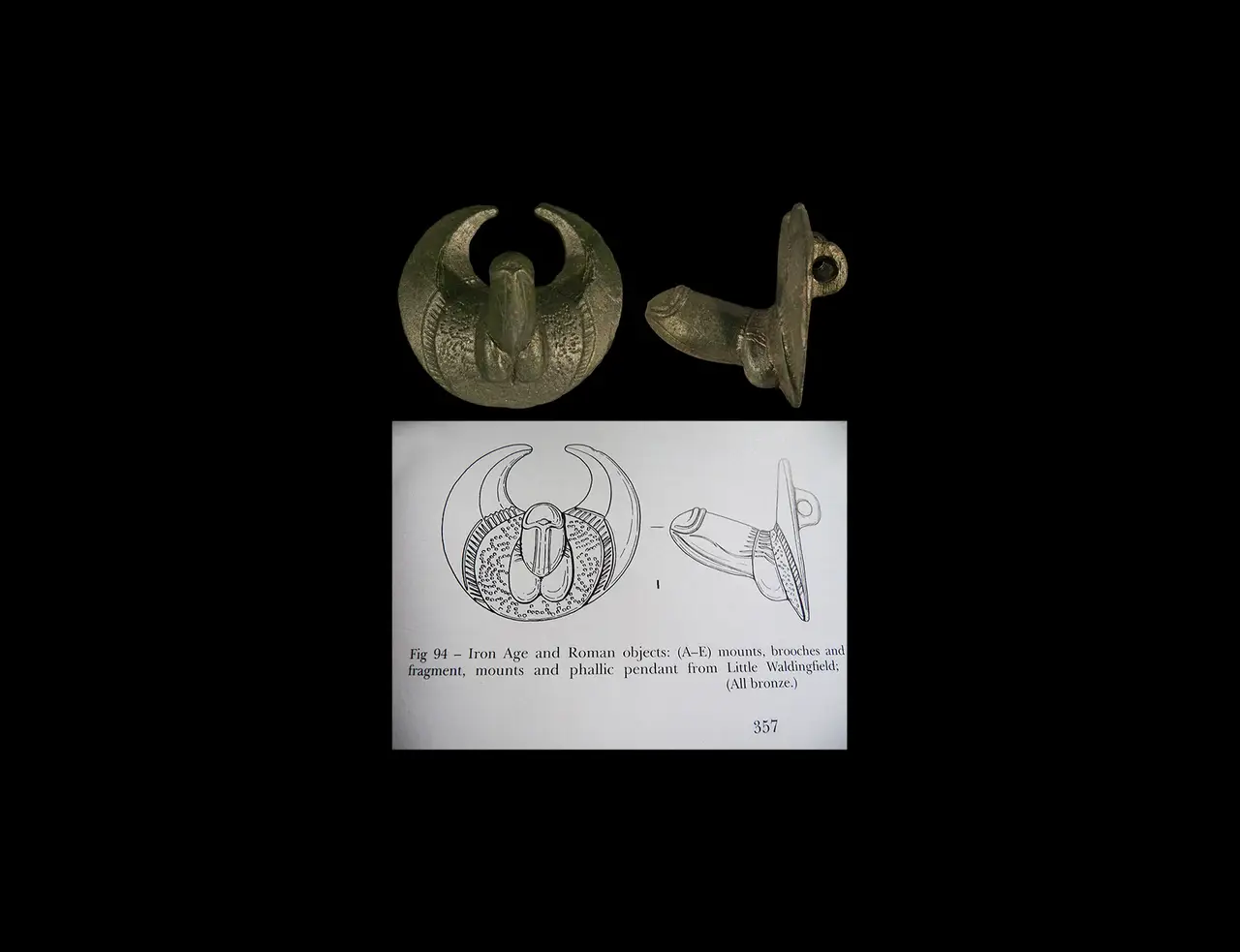
Roman fascinum pendants, small phallic amulets in bronze and bone worn for protection, pass regularly through specialist antiquities sales.
What any single carving meant to the soldier or mason who cut it is mostly beyond recovery. The same shape worked as a joke and a protective charm at once, and Collins's survey maps where the Romans cut their phalluses without settling why each one was put there.
TimeLine Auctions, 5th July 2026