Home > Stories by TimeLine Auctions
Stories by TimeLine Auctions
Painted Narratives on Ancient Greek and Apulian Clay
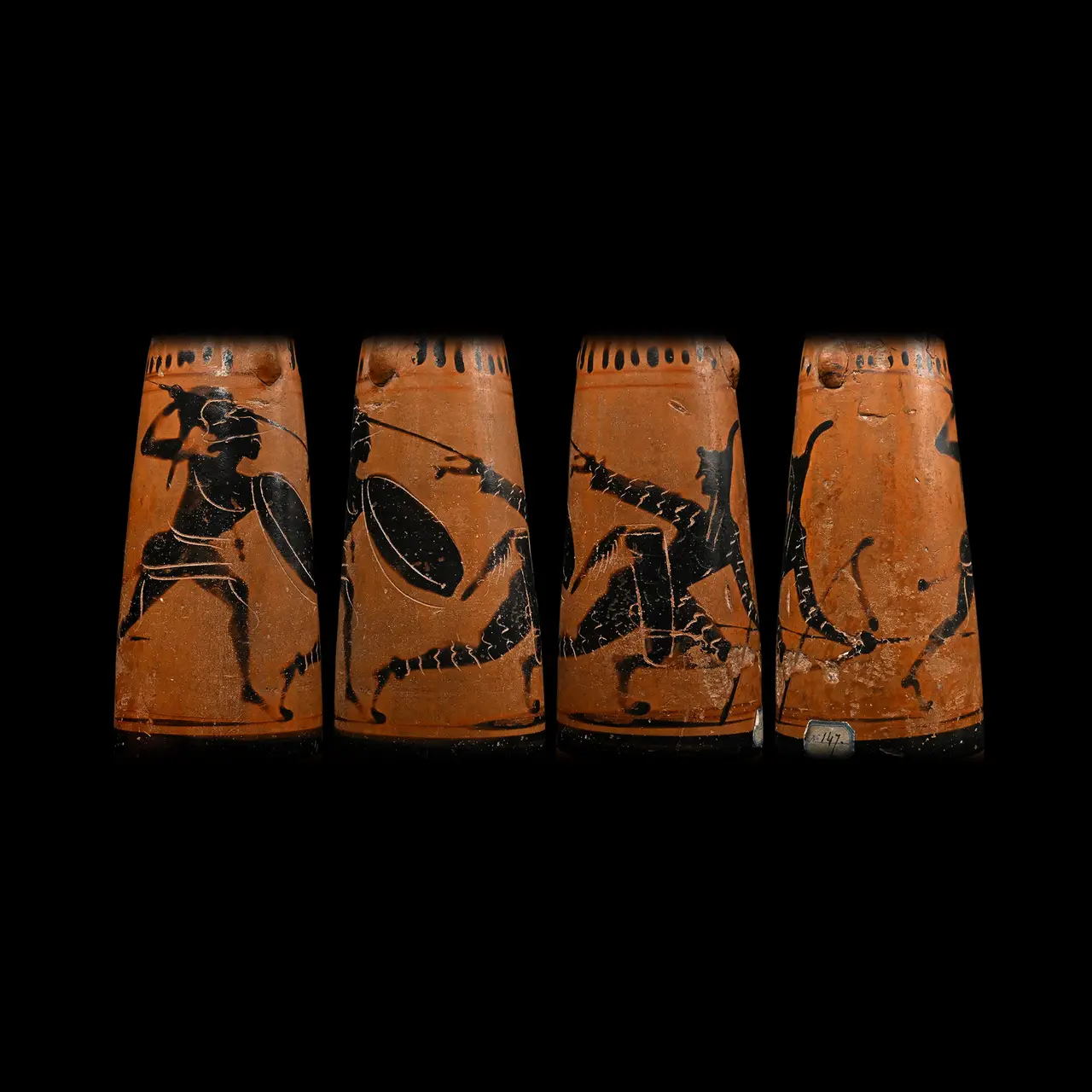
Two warriors lock in mortal combat across the curved surface of an Attic black-figure alabastron (Lot 0071), their contrasting identities rendered in stark silhouette. The Greek hoplite advances behind a large round shield, his crested Corinthian helmet firmly in place, while his opponent, a Scythian archer, draws back in a patterned tunic and pointed cap. Painted between 500 and 480 B.C., this vessel captures the anxieties and visual vocabulary of the Persian Wars, distilling geopolitical conflict onto a perfume container no taller than a human hand. Athenian workshops manufactured the mythological and political imagery that defined the classical world alongside functional domestic wares.
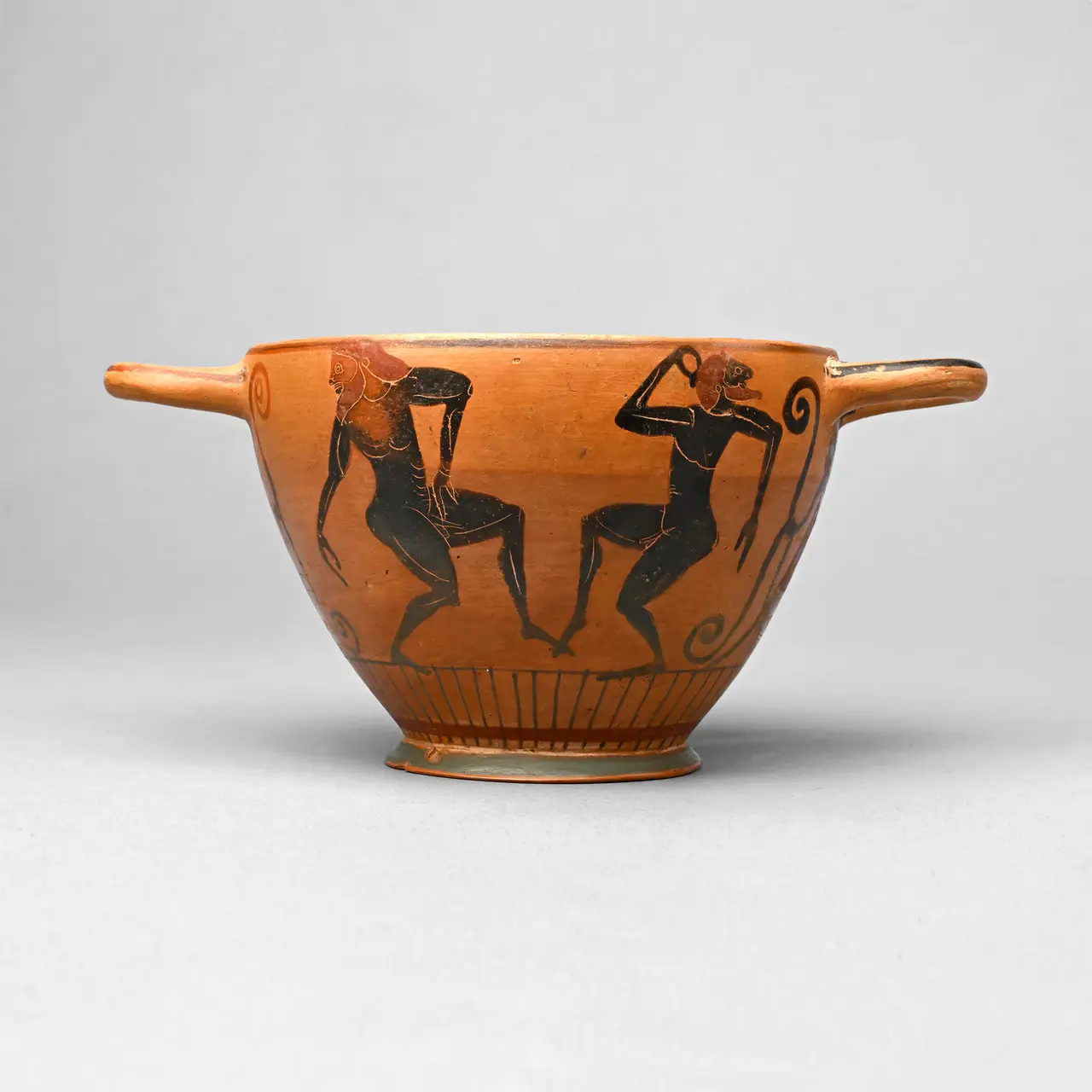
The social life of the Greek elite revolved around the symposium, a structured drinking party that demanded a highly specific ceramic repertoire. An early Attic black-figure skyphos from the Komast Painter Group (Lot 0063) illustrates the raucous energy of these gatherings. Dating to the early sixth century B.C., its deep bowl is ringed by nude satyrs engaged in a lively dance, their limbs articulated with precise incised lines.
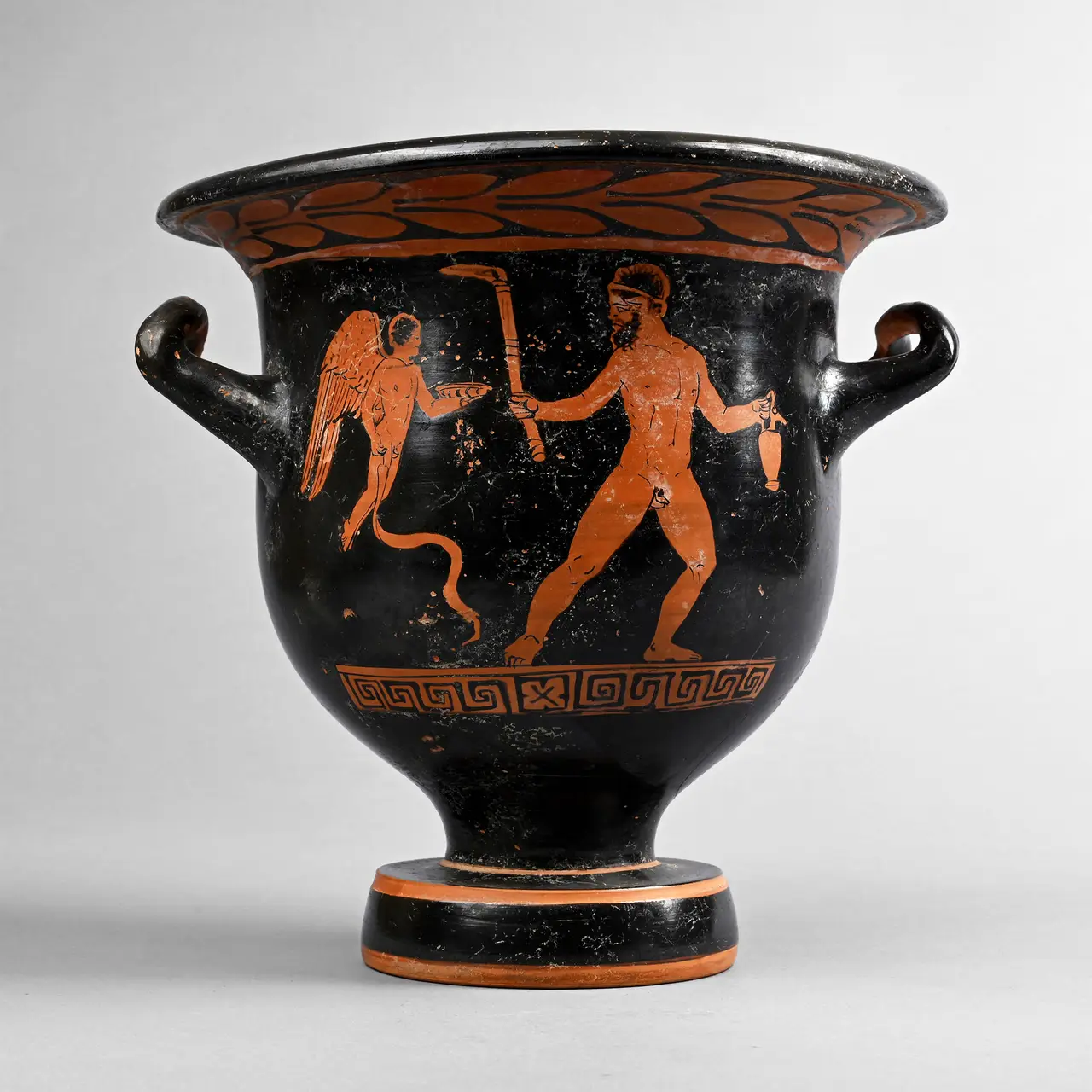
By the mid-fifth century, Athenian artisans had inverted this colour scheme to create the red-figure technique, allowing for greater fluidity in anatomical drawing. We see this transition clearly on a later Attic bell krater (Lot 0059), where a striding satyr carries a torch and an oinochoe, closely trailed by a winged Eros holding a scroll. The figures here are left reserved in the natural orange-red of the clay, with inner details painted using a fine brush rather than a sharp burin.
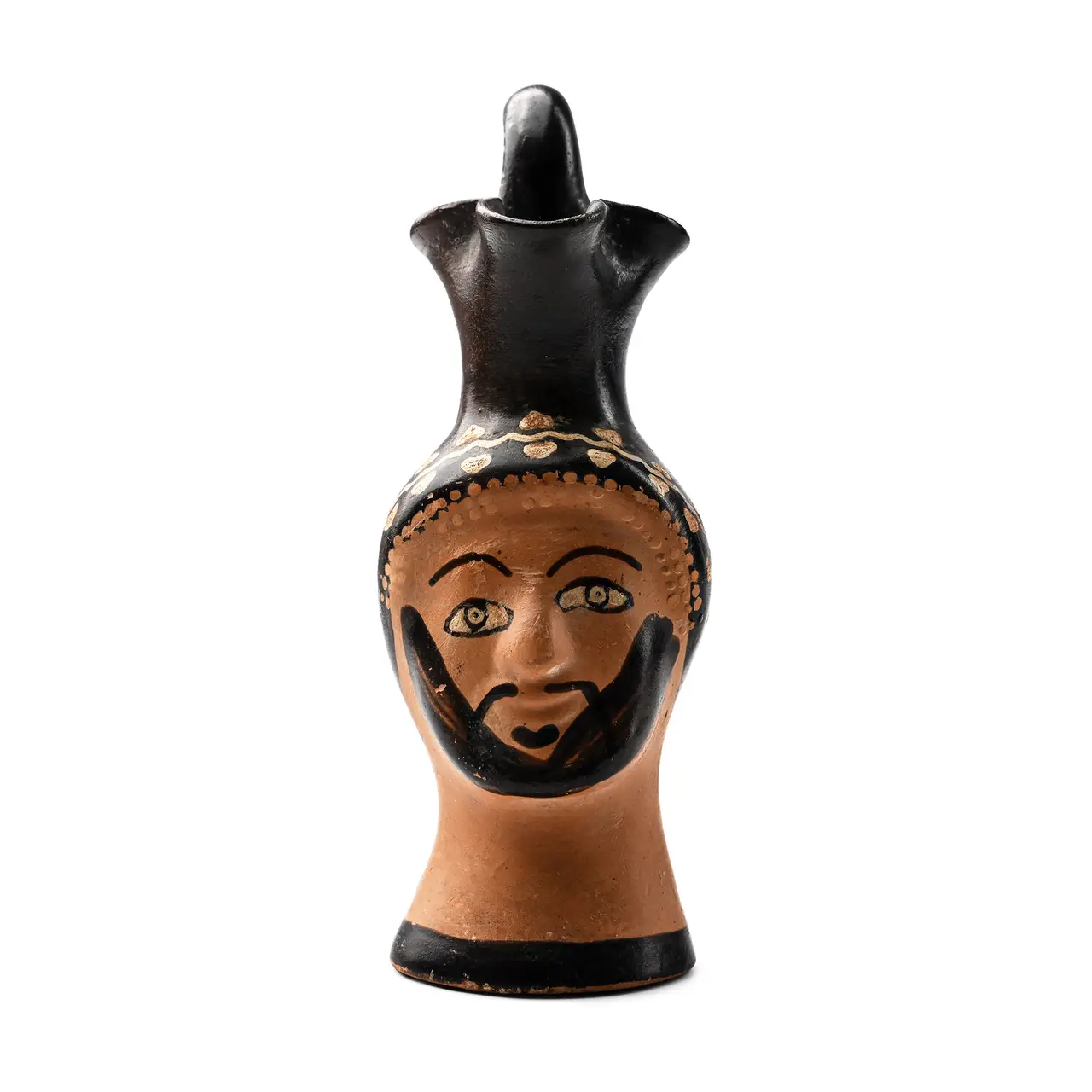
Sympotic vessels sometimes embraced sculptural playfulness, breaking from the standard wheel-thrown profiles. A fifth-century Attic plastic oinochoe (Lot 0069) takes the form of a bearded man’s head, his brow encircled by an ivy wreath. A handle and narrow neck rise from his crown, transforming the reveller into the very instrument of pouring. Perfume vessels also invited decorative experimentation.
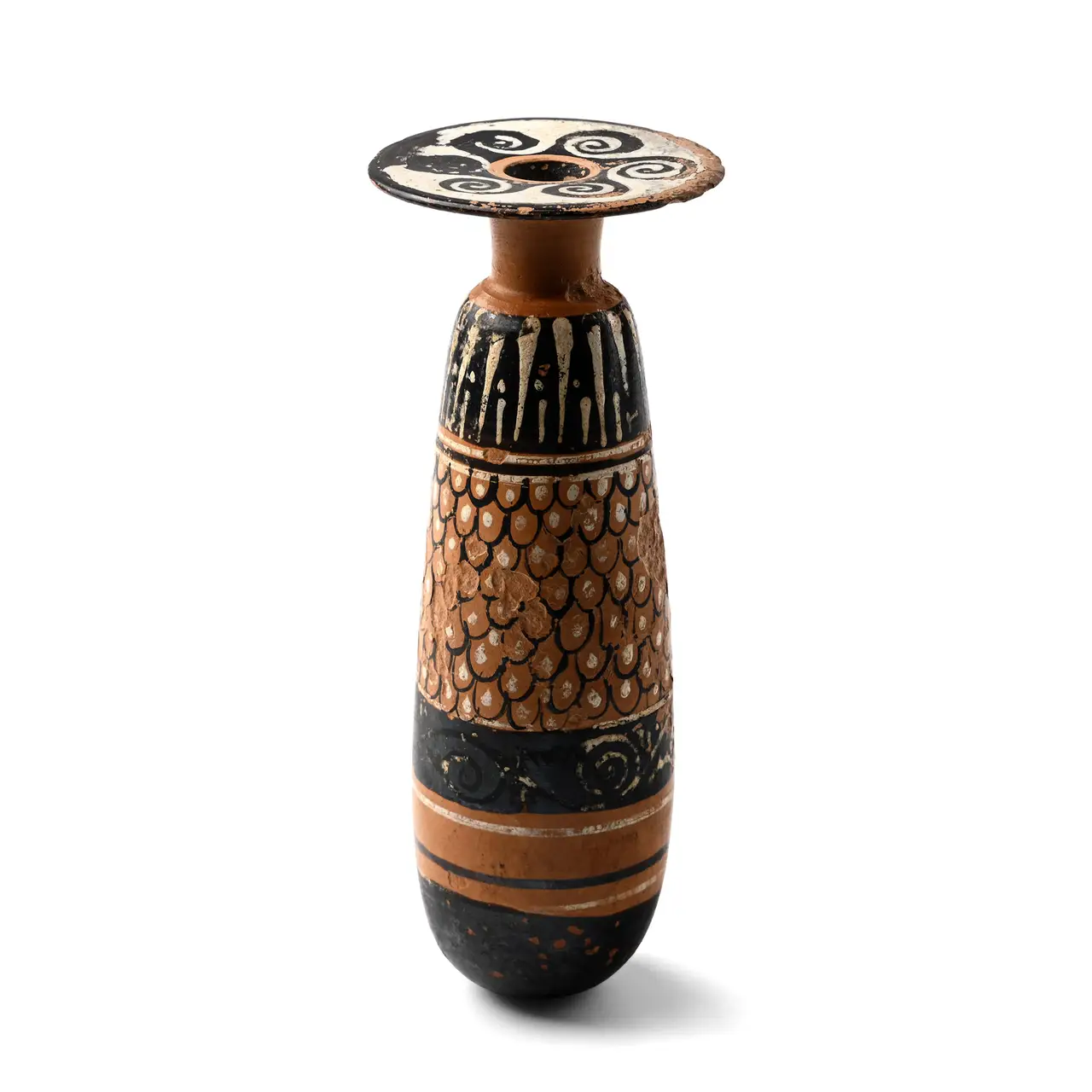
A contemporary Attic alabastron from the Bulas Group (Lot 0070) dispenses with narrative figures entirely, presenting instead a tight, overlapping fish-scale pattern bordered by scrolling tendrils. The potter demonstrates a total command of purely geometric ornament on this small, elongated form.
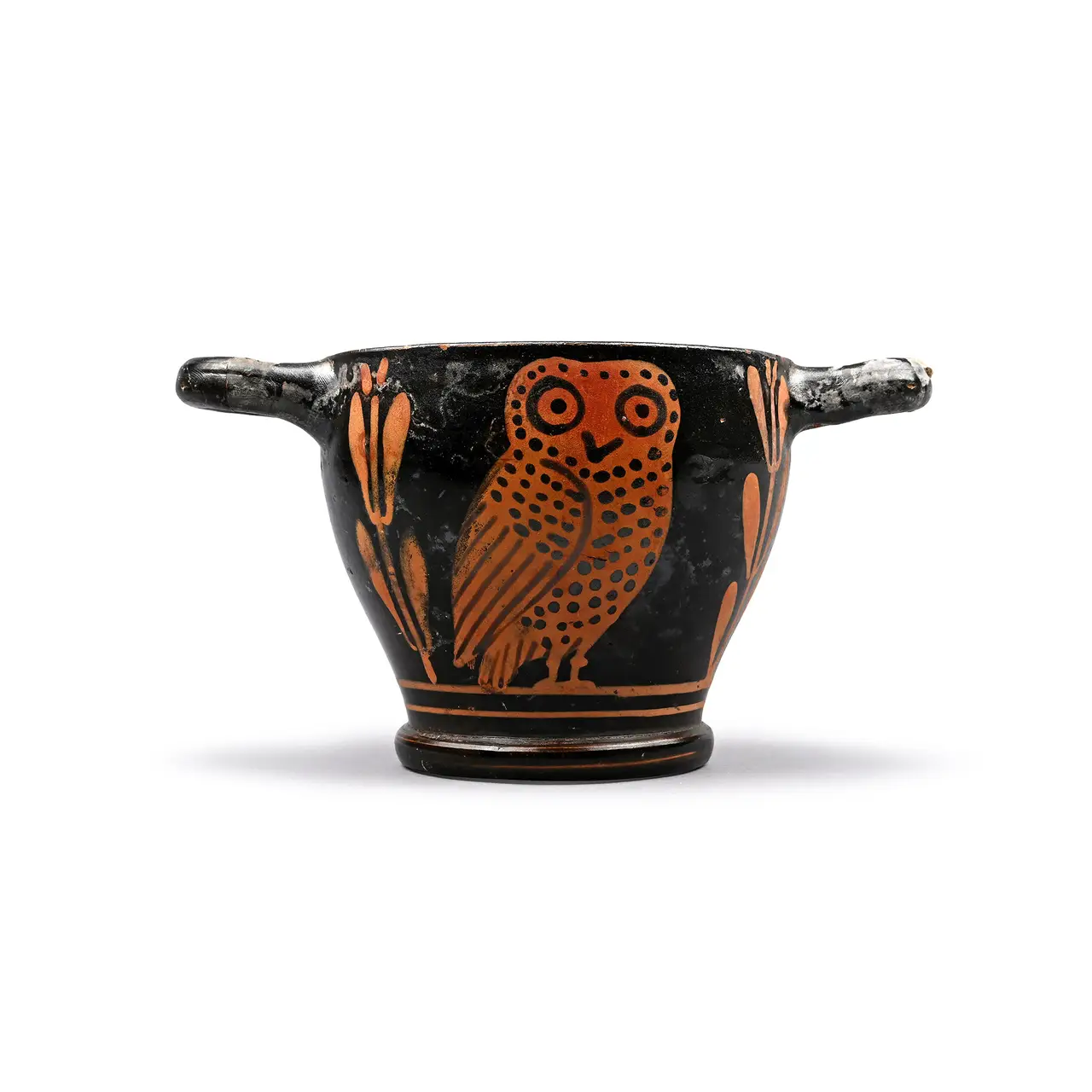
During the fifth century B.C., immigrant craftsmen brought the red-figure technique from Athens to the Greek colonies of Southern Italy, sparking a prolific regional industry. The artisans of Magna Graecia initially followed Athenian models closely. A South Italian skyphos (Lot 0064) features a wide-eyed owl standing between laurel fronds, a direct homage to the sacred bird of Athena that adorned countless Athenian exports. However, South Italian workshops soon developed a distinct aesthetic vocabulary, characterised by added white and yellow pigments and a fondness for elaborate floral borders. A Campanian bell krater from the late fourth century (Lot 0062) shows a woman carrying a cista, her garments and offerings heavily accented with white slip, a hallmark of the regional style.
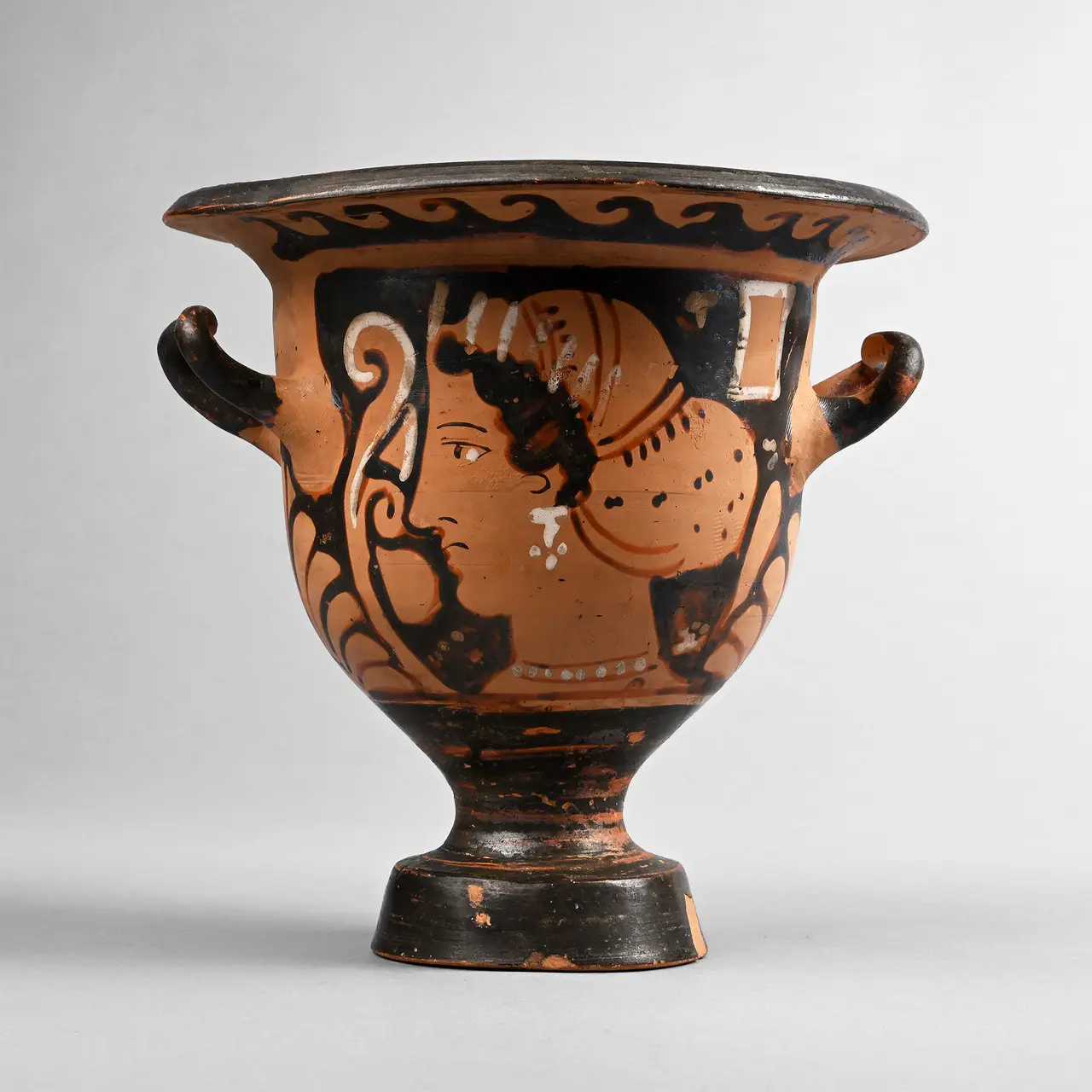
The largest and most complex South Italian production emerged in Apulia, where red-figure pottery became deeply entangled with the funerary practices of the indigenous population. Native communities in the region traditionally placed large vessels in adult graves, and by the fourth century B.C., Apulian kraters had largely usurped this role.
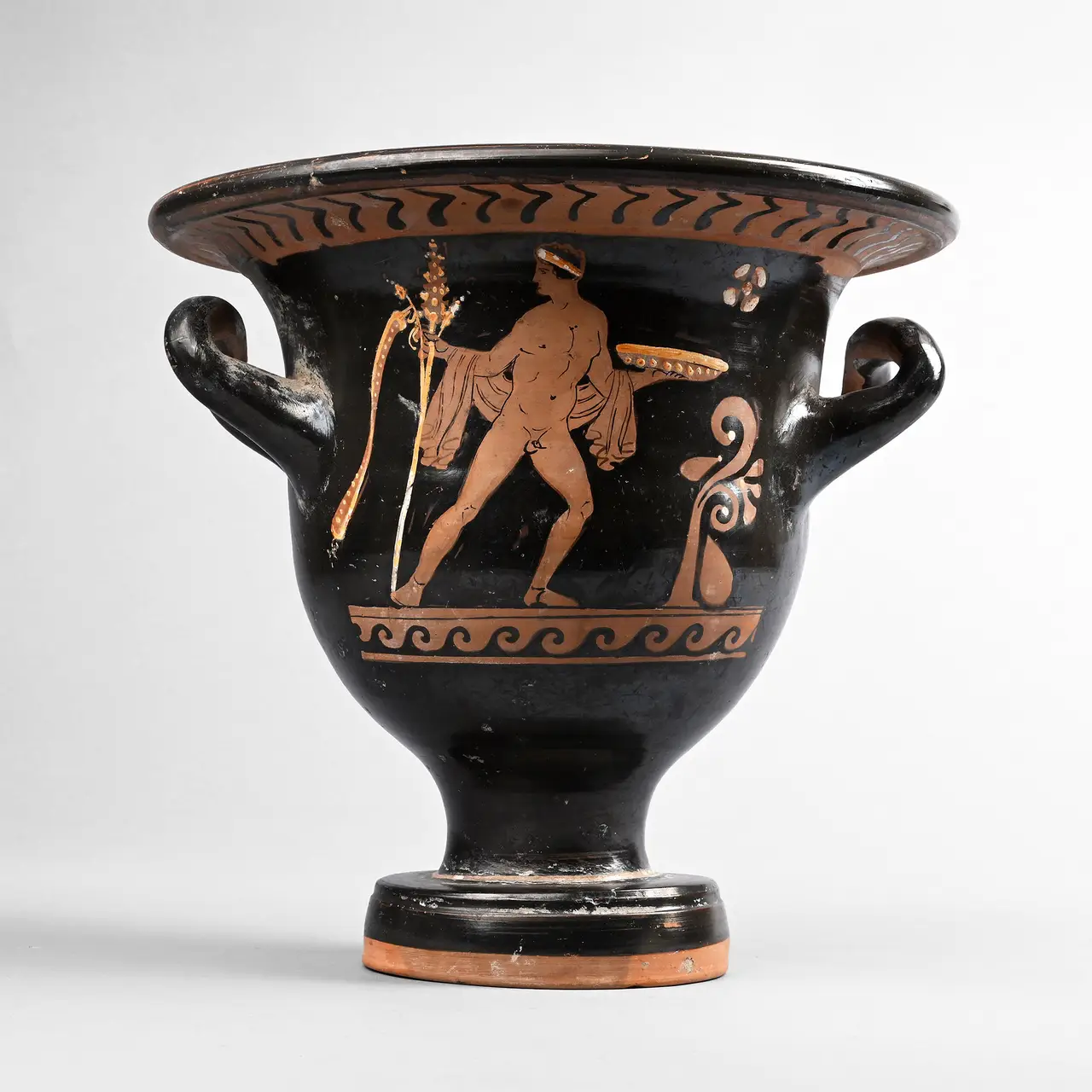
A wide bell krater attributed to the Chevron Group (Lot 0060) shows a nude youth holding a staff and a shallow phiale. These wine-mixing vessels served a dual purpose, functioning first as the centrepiece of the funerary banquet before being deposited with the deceased.
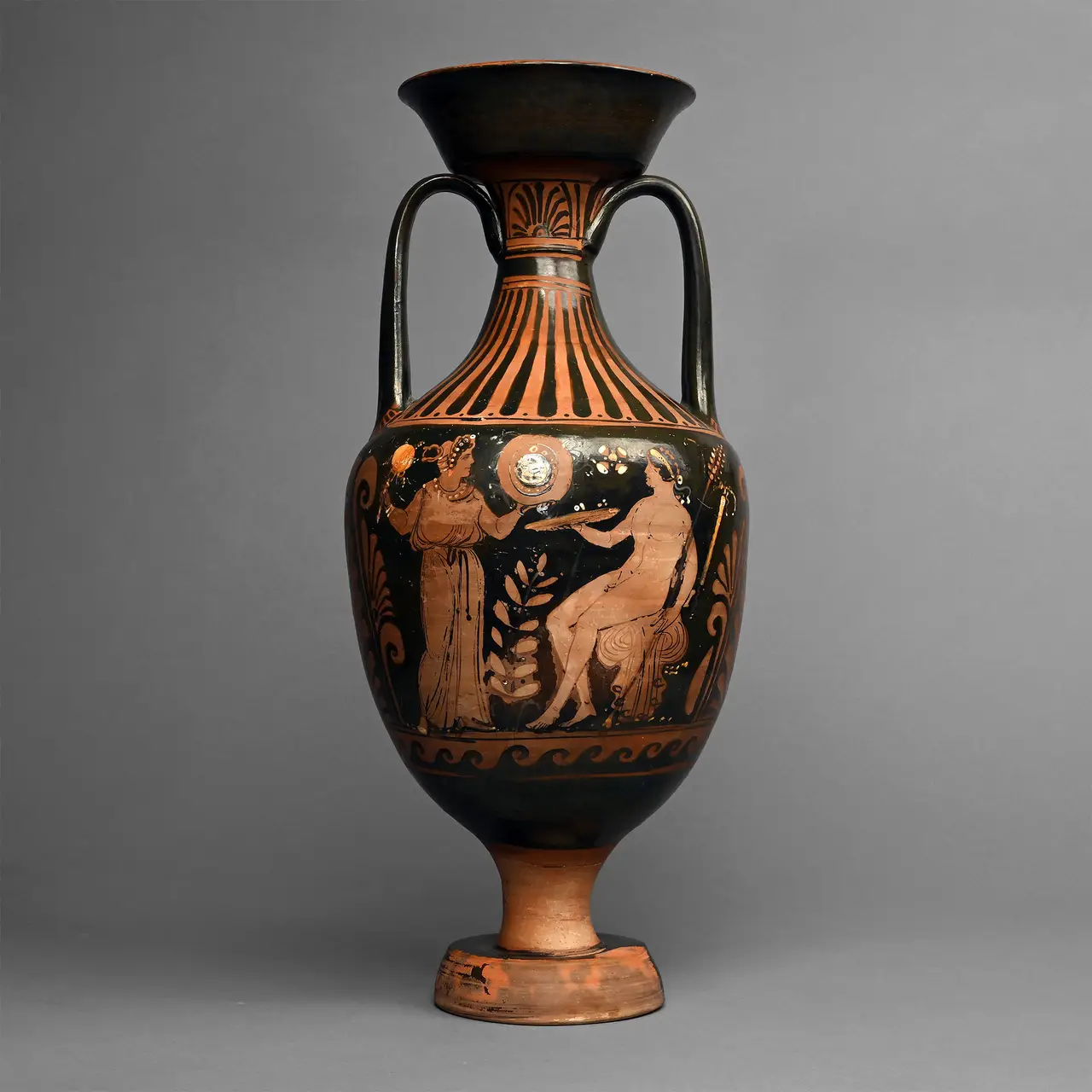
Similarly, a tall Apulian amphora (Lot 0057) depicts a standing woman bringing offerings to a seated male, a scene of tribute that closely mirrors the rituals of commemoration enacted by the burying community.
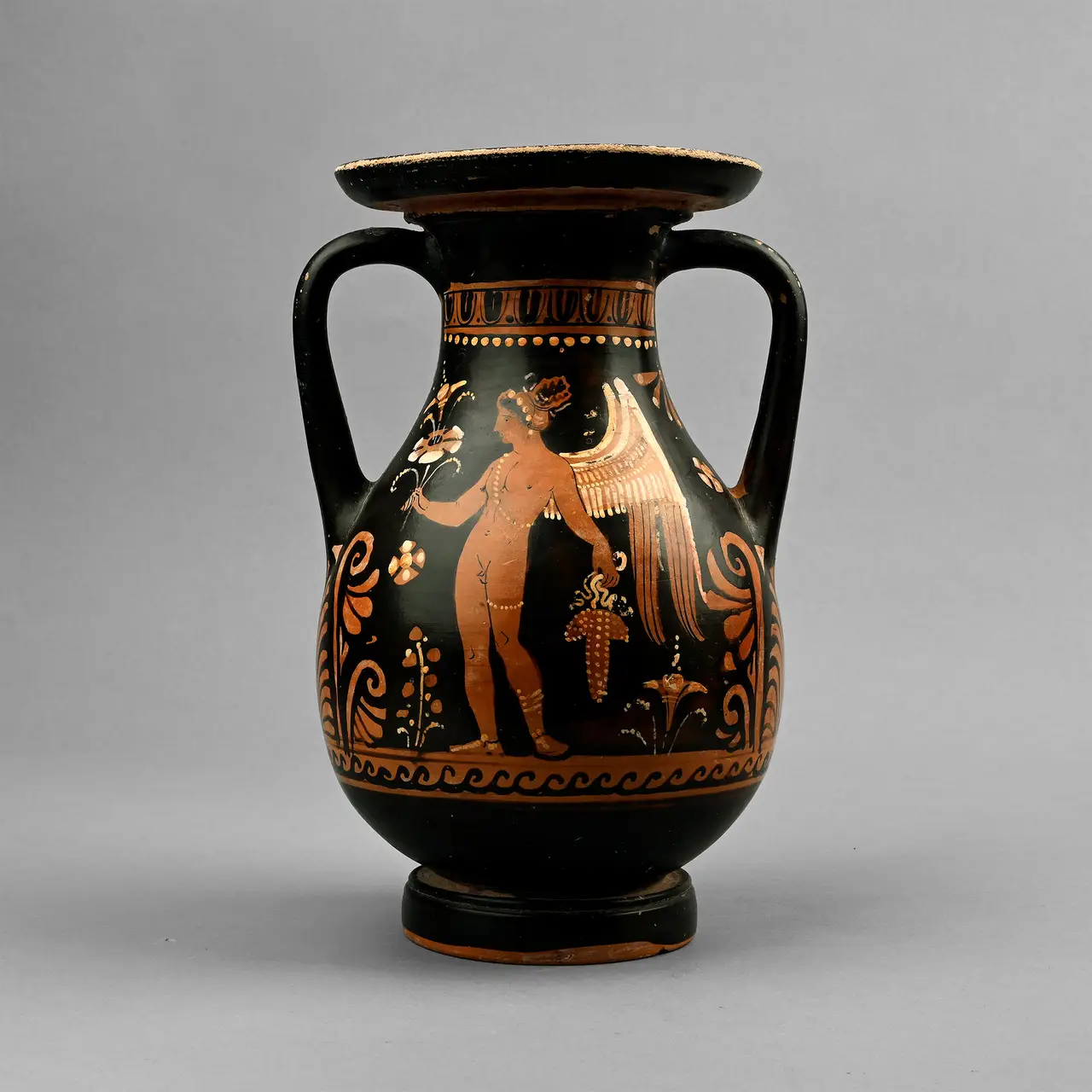
As Apulian production expanded massively in the late fourth and third centuries B.C., the iconographic focus shifted away from Dionysian revelry toward themes of love, success, and female adornment. This transition is evident on a large Apulian pelike (Lot 0061), which pairs the winged Eros with Nike, the goddess of victory. More pervasive still was the sudden ubiquity of female profile heads, conventionally known to scholars as ladies of fashion.
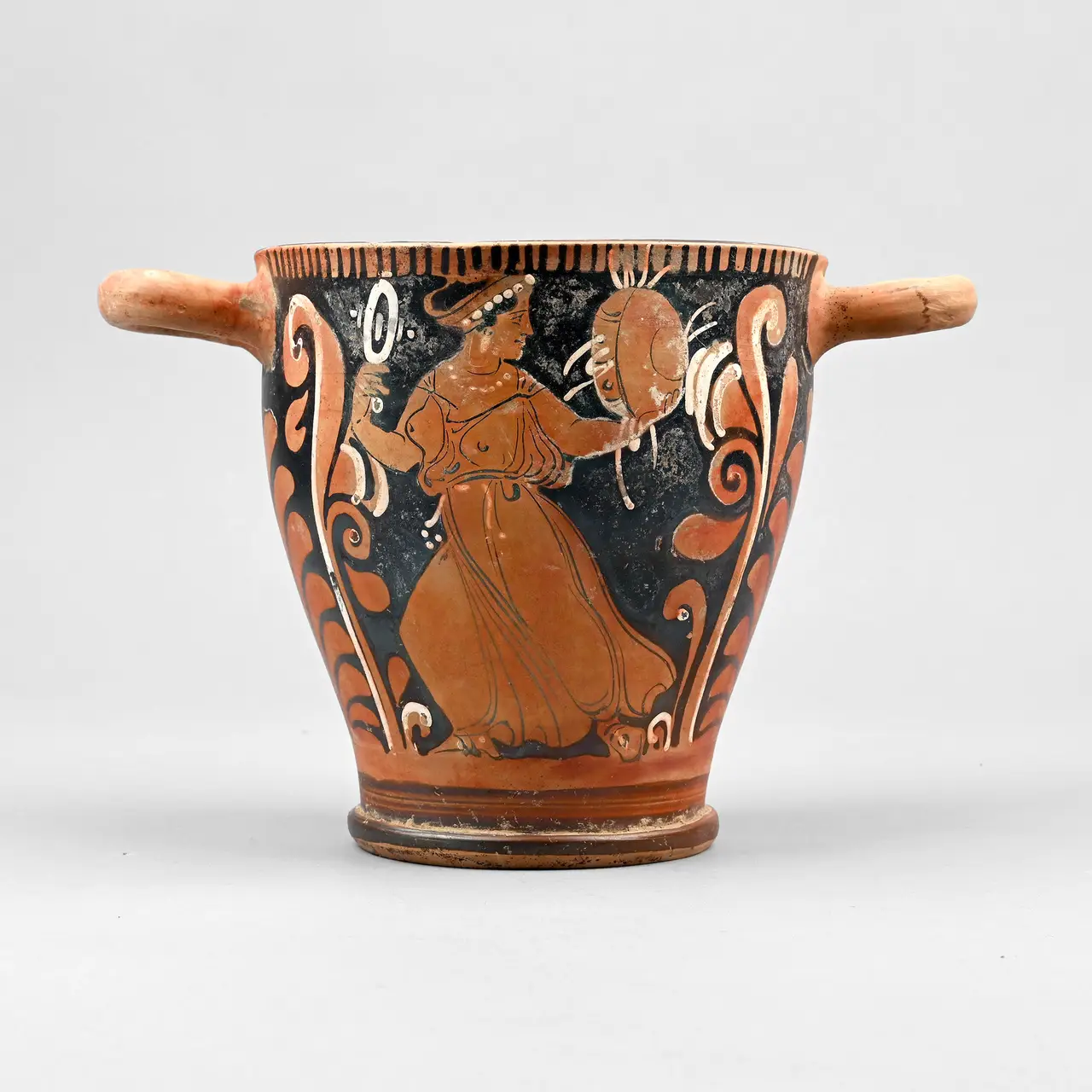
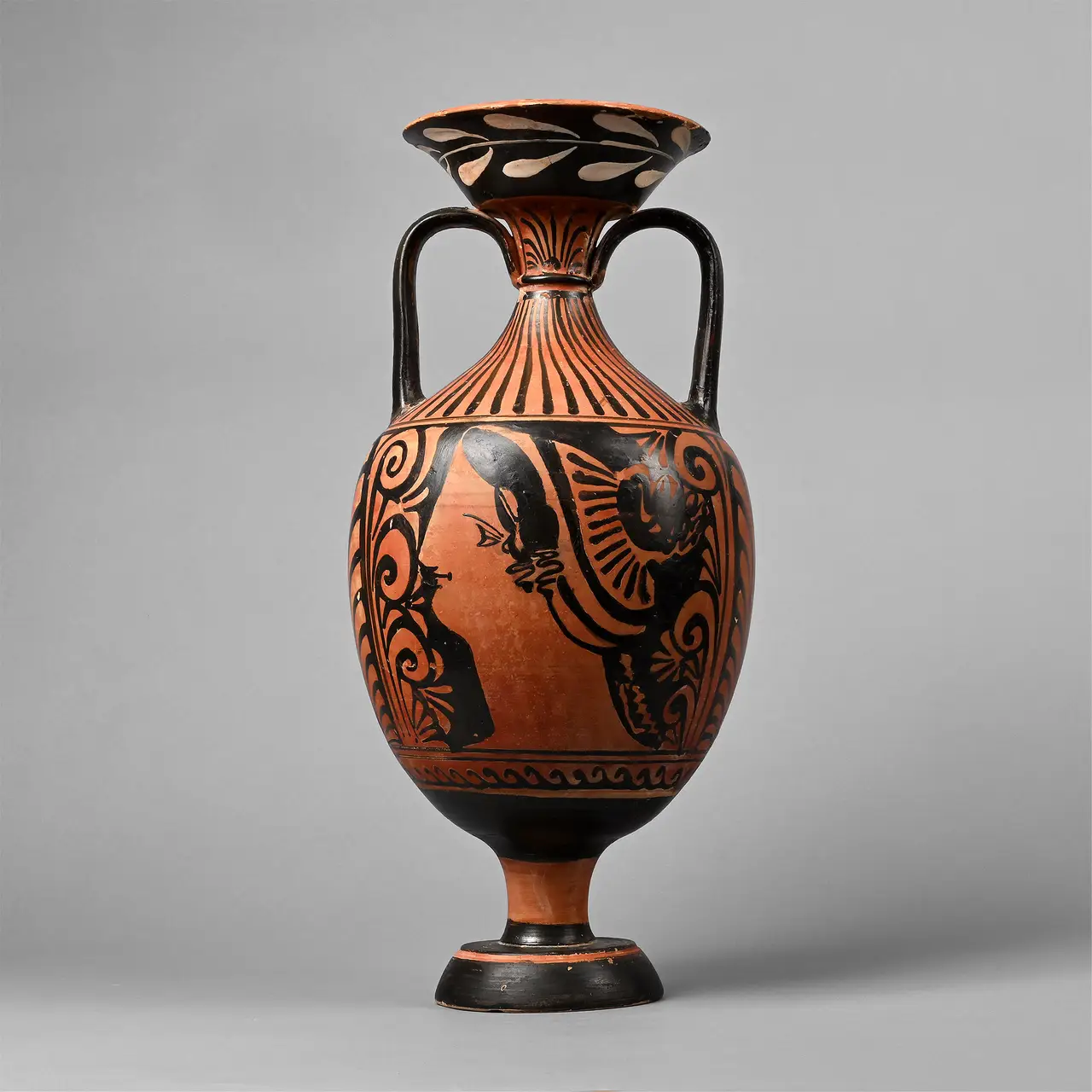
These female heads dominated the output of the Late Apulian phase. We find them staring out from the reverse of the Campanian krater, the obverse of a late Apulian skyphos (Lot 0065), and taking pride of place on a towering amphora associated with the Monopoli Group (Lot 0058).
The repetition of these female portraits was a deliberate choice that resonated strongly with local consumers. The women are always depicted wearing elaborate headdresses, known as sakkoi, along with carefully rendered earrings and necklaces. In indigenous Apulian society, adornment was a crucial component of female identity, and the graves of wealthy women were routinely provisioned with extensive suites of jewellery.
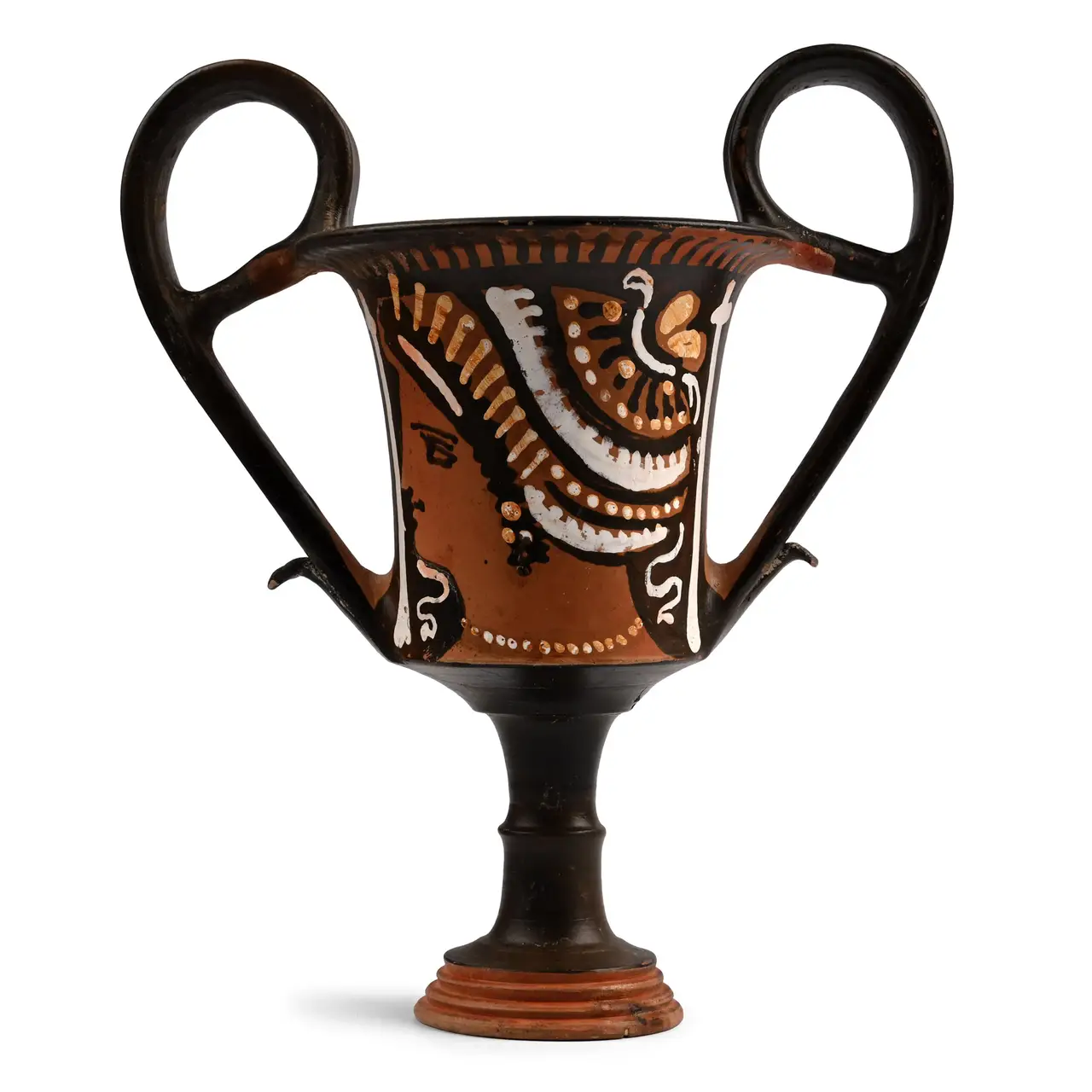
The face painted on a high-handled Apulian kantharos (Lot 0068), a drinking form that surged in popularity during this late period, reflects an idealised standard of beauty and status. Her presence on smaller vessels connected with the feminine sphere suggests that commemorating female identity became increasingly important in the final centuries of South Italian independence.
While Apulian painters adopted the red-figure technique from Greece, they applied it to vessel shapes born directly from local traditions. The patera, a broad, shallow dish with a raised rim, has no antecedent in Athenian pottery. An impressive fourth-century Apulian patera (Lot 0067) utilises its wide central tondo to display a striding Chimera, the mythical beast combining the features of a lion, goat, and serpent. Ringed by a continuous wave pattern, the creature commands the circular space with muscular confidence.
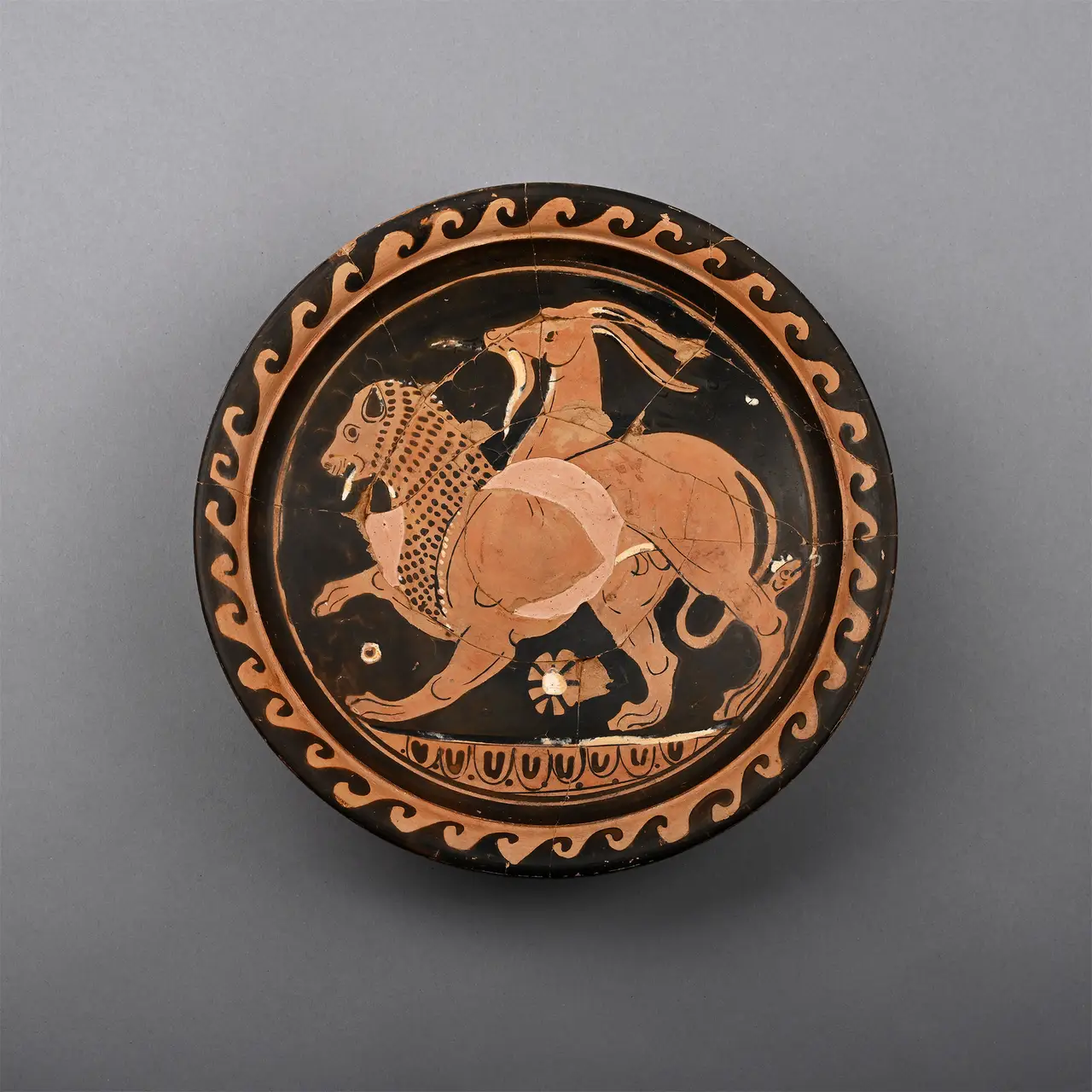
Objects like this patera reveal the true character of South Italian pottery. The artisans working in ancient Apulia synthesised Greek mythology and painting techniques with indigenous forms and social values to create a vital, independent artistic tradition.
TimeLine Auctions, 26th February 2026