Home > Stories by TimeLine Auctions
Stories by TimeLine Auctions
Provenance: The General, The Spy, and Thirty Thousand Objects
How Augustus Pitt Rivers Built Two Museums, and How a Suspected Nazi Spy Sold One
In the spring of 1880, a 53-year-old army officer named Augustus Henry Lane Fox received news that would transform his life. His cousin, Horace Pitt-Rivers, 6th Baron Rivers, had died, and Lane Fox had inherited more than 32,000 acres of prime English countryside in Cranborne Chase, along with a substantial fortune derived from the wealth of 18th-century paymaster Richard Rigby. With this inheritance came a condition: he must adopt the surname Pitt Rivers. The newly christened Lieutenant-General Augustus Pitt Rivers accepted the terms. He could not have known that his legacy would one day pass through the hands of his fascist grandson and into the care of a woman the British secret services would label a "nymphomaniac" whose stories were too "indescribably filthy" to include in official intelligence reports.
This is the story of two museums, three generations, and one of the most extraordinary dispersals of archaeological material in the twentieth century. It is also a story that matters profoundly to anyone who collects antiquities today, because the objects that once filled Pitt Rivers' private museum at Farnham are now scattered across the world, their provenance traceable through auction records, handwritten catalogue entries, and nine remarkable volumes of drawings that the General commissioned before his death in 1900.
From Rifleman to Archaeologist
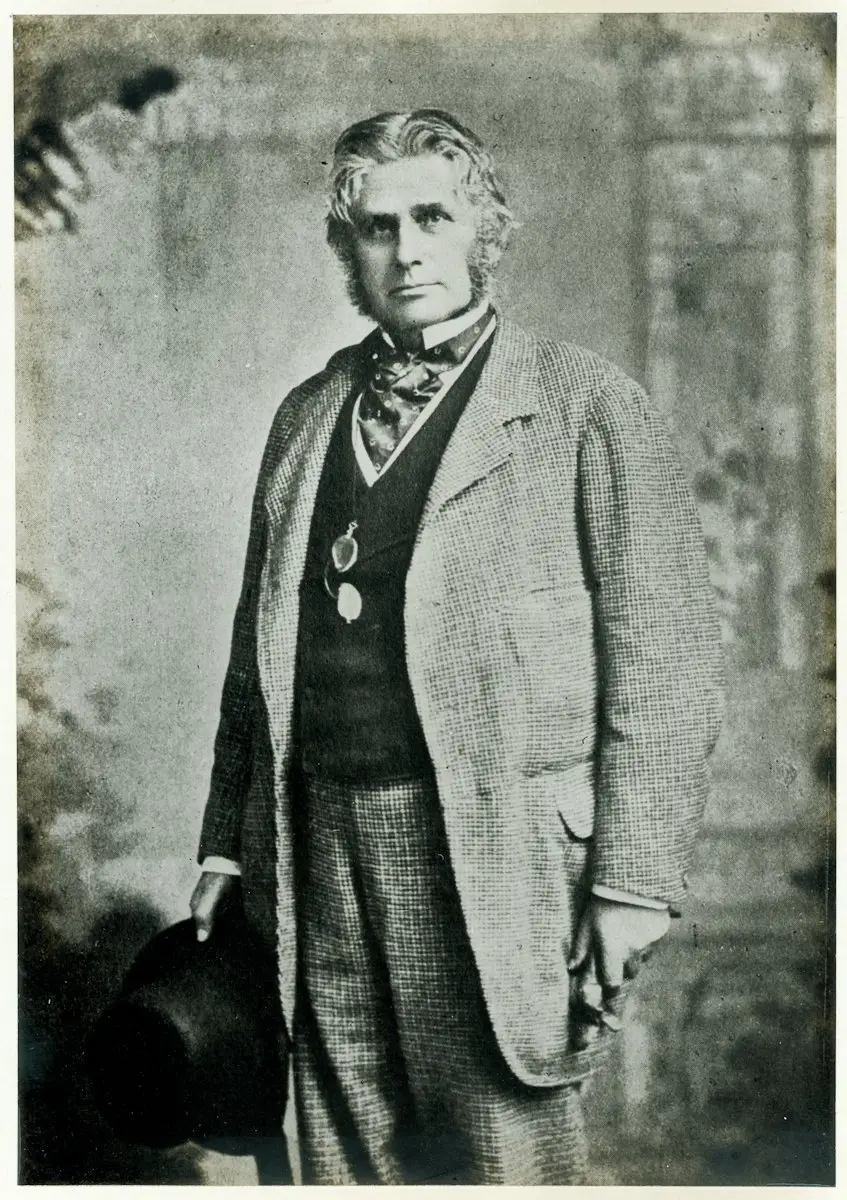
Augustus Henry Lane Fox was born on 14 April 1827 at Bramham cum Oglethorpe near Wetherby in Yorkshire, into a family of comfortable gentry with military connections. His father was William Lane-Fox; his mother, Lady Caroline Douglas, was sister to the 17th Earl of Morton. The young Augustus entered the Royal Military College at Sandhurst at the remarkably early age of fourteen, receiving his commission into the Grenadier Guards in 1845.
His military career would shape his entire approach to the past. In 1851, Lane Fox joined a committee tasked with evaluating the British Army's muskets, then in the process of being replaced by the new Minié rifle. He was appointed to Woolwich to instruct troops in its use, and later helped establish the School of Musketry at Hythe in Kent. This work demanded systematic study of how weapons had evolved, with each modification building upon previous designs. Lane Fox began collecting examples of firearms to illustrate this developmental sequence. He was, in effect, applying Darwinian thinking to material culture before Darwin's ideas had fully permeated British intellectual life.
The collector's habit, once acquired, proved impossible to shake. Lane Fox extended his interests from firearms to edged weapons, then to tools and implements of all kinds. He purchased from dealers and auction houses, accepted gifts from fellow officers returning from postings abroad, and began arranging his growing collection typologically rather than by geographical origin or period. Where other collectors might group all Egyptian objects together, Lane Fox placed an Egyptian knife alongside knives from Africa, Polynesia, and prehistoric Europe. The point was to show how human beings, regardless of their culture, had solved similar problems in similar ways, and how simple forms gave rise to complex ones through gradual modification.
He saw only one significant action during his military career: the Battle of Alma during the Crimean War in 1854. Shortly afterward, a medical examination pronounced him unfit for active service, and he returned to England. The remaining decades of his military life were spent largely on administrative duties and extended periods of leave. This arrangement suited him perfectly. It freed him to pursue archaeology and ethnology with the obsessive dedication that would make him famous.
In 1867, Lane Fox visited an excavation in the Yorkshire Wolds conducted by Canon William Greenwell, the librarian of Durham Cathedral. Greenwell was already an established archaeologist who viewed the discipline as a serious scholarly endeavour rather than mere treasure-hunting. Lane Fox received his first practical instruction in excavation under Greenwell's guidance. He would later describe himself as Greenwell's pupil, and he absorbed his mentor's insistence that all artefacts, not merely beautiful or valuable ones, deserved careful recording.
The First Collection: Gift to Oxford
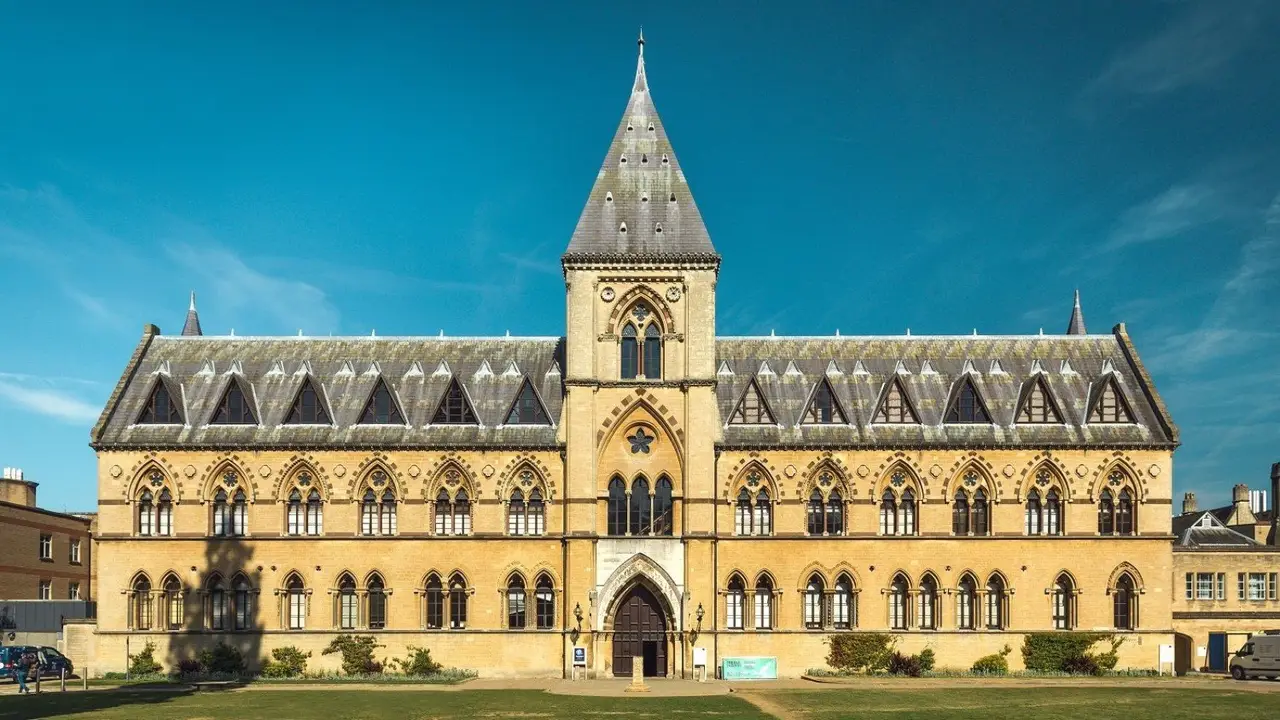
By the 1870s, Lane Fox's collection had grown to approximately 22,000 objects. It had outgrown his London home. In 1874, the collection was displayed at the Bethnal Green Museum, and from there it moved to the South Kensington Museum (now the Victoria and Albert). But Lane Fox was never satisfied with how the museum authorities handled his material. The arrangement was not quite right; the educational purpose he envisioned was being compromised.
The inheritance of 1880 changed everything. Pitt Rivers (as we must now call him) suddenly possessed both the means and the motivation to think about his collection's permanent future. In 1884, he donated approximately 22,000 objects to the University of Oxford on two conditions. First, the university must establish a permanent lecturer in anthropology. Second, a building must be constructed to house the collection and used for no other purpose. Both conditions were met. Edward Burnett Tylor became the first lecturer in anthropology in Britain, and Thomas Manly Deane designed a new structure adjoining the Oxford University Museum of Natural History. The Pitt Rivers Museum opened in 1886, and it remains one of Oxford's most distinctive institutions: a three-storey hall crammed with display cases arranged not by culture or period but by type. Boats hang from the ceiling. Masks stare from every wall. The effect is deliberately overwhelming, designed to demonstrate the unity of human experience across time and geography.
But Pitt Rivers had not finished collecting. Far from it. The inheritance that enabled him to give away 22,000 objects also enabled him to acquire thousands more. And these he kept.
The Second Collection: A Private Museum at Farnham
On his new estates in Dorset, Pitt Rivers decided to establish a second museum. He converted an old schoolhouse at Crossways, in the village of Farnham, into a nine-room display space. Here he would house the archaeological material excavated from his own lands (Cranborne Chase proved extraordinarily rich in Roman and Saxon remains), along with the thousands of ethnographic and archaeological objects he continued to purchase from dealers and auction houses between 1880 and his death in 1900.
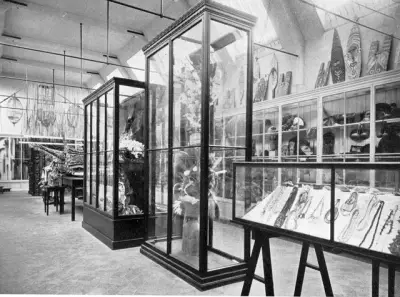
"I have formed another museum," Pitt Rivers wrote in 1891, "which, although it is a provincial one, is in some respects better than the first [at Oxford] because such series as it contains are more fully represented." This was characteristic understatement. The Farnham collection would grow to rival the Oxford donation in both size and importance. According to H. St George Gray, one of Pitt Rivers' assistants, the museum contained peasant costumes and ornamentation from around the world, household utensils, pottery, stone and bronze implements, examples of glass-making and enamelling, a series illustrating the development of the Christian cross in Celtic times, lighting apparatus, and a significant collection of material from the Benin kingdom.
The Farnham Museum served a different audience than the scholarly collection at Oxford. Pitt Rivers intended it primarily for the education of local agricultural workers. Every object bore a large ticket with a description. Divisions between subjects were marked by red satin tapes hung across the shelves. The museum was free to visitors, and the village inn was renamed the Museum Hotel to accommodate the curious who travelled from further afield.
Perhaps the most remarkable aspect of this second collection is how thoroughly Pitt Rivers documented it. Where records of his first collection (the material now at Oxford) are often scanty, the second collection was catalogued in nine large folio volumes containing detailed descriptions, measurements, prices, sources, and (most remarkably) hand-drawn illustrations of nearly every object. These volumes, now held by Cambridge University Library, constitute one of the most important documents in the history of collecting. They allow researchers today to trace the provenance of objects that passed through Pitt Rivers' hands more than a century ago.
The Nine Volumes: A Collector's Legacy in Drawings
The Cambridge University Library catalogue volumes are extraordinary documents. In the earlier volumes, each entry includes a textual description alongside a watercolour or pen-and-ink drawing. Objects are shown from multiple angles. Colours are carefully recorded. The drawings are executed with such precision that modern researchers can often identify specific objects when they appear at auction, simply by matching the physical characteristics against Pitt Rivers' visual record.
As the volumes progressed through the 1890s, the pace of acquisition accelerated. By volume nine, covering 1899 and 1900, batch-cataloguing was occurring. Speed had become the priority, presumably because the backlog of uncatalogued material was growing faster than the draughtsmen could work. In the final pages, objects are listed without illustrations, with only the briefest descriptions. Pitt Rivers died in May 1900. The cataloguing stopped.
Yet even with this late compression, the nine volumes document thousands upon thousands of acquisitions. Pitt Rivers seems to have marked volume and page numbers directly onto many objects. At least one Northwest Coast bow from America, now in a North American museum, was traced back to the Cambridge volumes by a reference found written on the object itself. For collectors and dealers today, these volumes represent an invaluable provenance resource. An object that can be matched to a drawing in the Cambridge catalogue carries with it more than a century of documented history.
Three Generations: From Augustus to George
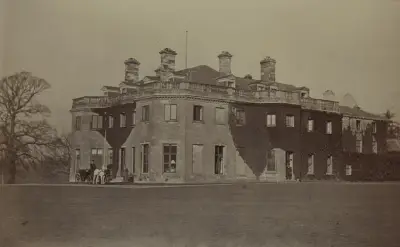
Augustus Pitt Rivers died at Rushmore, his country seat on Cranborne Chase, on 4 May 1900. His cremated remains (he was an advocate for cremation at a time when many considered it immoral) were interred at St Peter ad Vincula, Tollard Royal. The vast estate and its contents passed to his eldest son, Alexander Edward Lane Fox-Pitt-Rivers.
Alexander, born in 1855, was by all accounts a man of weak character despite possessing artistic talents. He became a Fellow of the Society of Antiquaries but showed little of his father's driving energy. The Farnham Museum continued to operate, but there was no continuation of the General's ambitious collecting programme. Alexander died in 1927, and the estate passed to his son George Henry Lane-Fox Pitt-Rivers.
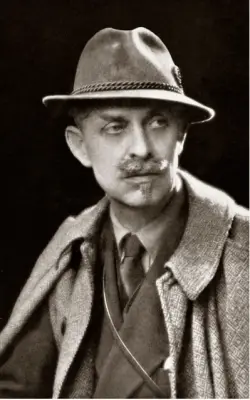
George Pitt-Rivers, born in 1890, was a very different man from his grandfather. Where Augustus had been a methodical scholar driven by intellectual curiosity, George was drawn to ideology. His inheritance was so vast that, as contemporary observers noted with some exaggeration, "he could ride from coast to coast without leaving his own land." He served as a captain in the Royal Dragoons during the First World War and was wounded at the First Battle of Ypres in 1914. The experience seems to have left him unsettled. After the war, he published a book titled "The World Significance of the Russian Revolution," the first of several works expressing virulent anti-Bolshevik and anti-Semitic views.
George trained as an anthropologist under Bronisław Malinowski at Oxford, and his academic interests focused obsessively on race. He described himself in Who's Who as having "established the methodology of the science of ethnogenics, interaction of race, population and culture." He represented the Eugenics Society at international conferences and developed connections with German eugenicists including Eugen Fischer. By the 1930s, he had become an open supporter of fascism. In the 1935 general election, he stood as an "Independent Agriculturist" in North Dorset with backing from the British Union of Fascists. Oswald Mosley and William Joyce both spoke at his campaign rallies.
George attended the Nazi Party rally at Nuremberg in 1937 and afterward wore a golden swastika badge, claiming personal friendship with Hitler. He visited Czechoslovakia to agitate on behalf of Sudeten Germans and was expelled as a troublemaker, telling British journalists he had been "working for Hitler." When war came in September 1939, he protested against plans to evacuate children from London to the tenant farms on his estate, threatening to evict any farmers who took in evacuees whom he described as "East End Jews, Polish Jews and Czech Communists." On 27 June 1940, the British government arrested him under Defence Regulation 18B as a Nazi sympathiser. He spent two years interned at Brixton Prison and Ascot.
Stella Lonsdale: The Woman MI5 Called a "Nymphomaniac"
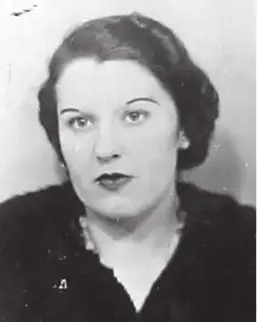
After the war, George Pitt-Rivers met a woman whose biography reads like a spy thriller conceived by a writer with no sense of plausibility. Stella Edith Clive was born on 9 January 1913 in Olton, Warwickshire, the daughter of a commercial traveller. By the age of 21, she was living with a financier named Paul Christian Bog Holme, who was 24 years her senior. In 1936, she went through a church ceremony in Monte Carlo with Nicolas Sidoroff, son of a White Russian prince, but the marriage was void under French civil law. They had one child who died at six months. In July 1939, she married John Christopher Mainwaring Lonsdale at Kensington Registry Office.
When war broke out, Stella was in France visiting her mother-in-law in Paris and her husband, who was stationed with the Royal Engineers in Nantes. When the Germans occupied the city in June 1940, Stella stayed. She found work teaching English at the local Berlitz school, where many of her students were German officers. The Germans tested her to see if she could be recruited as an agent. According to her later account, a French agent named Jean Plattieu denounced her as a Gaullist after she rejected his advances. She was arrested and taken to German Intelligence headquarters at Angers in November 1940.
What happened next is murky. Stella claimed that one of her interrogators, a man she knew from pre-war Paris and referred to only as "René," suggested she become a German agent. She also claimed that a German Intelligence colonel proposed she actually work for England by infiltrating escape lines in Marseille and then getting herself sent back to Britain. Once there, she was supposedly to convince the authorities that she could negotiate a peace treaty on behalf of her German sponsor.
Stella appeared in Marseille in mid-1941, hovering around the edges of the escape networks helping Allied servicemen reach neutral territory. She was present during the arrest of several resistance operatives at the Hotel Noailles in July 1941. Her role remains unclear. Captain Dutour of the Marseille Sûreté told one arrested operative that Stella was working for the French security services. Stella told French inspectors she worked for "the Organisation." Ian Garrow, who ran the escape line, never trusted her.
In late October 1941, Stella left France. She took a train to Barcelona and Madrid, then a Lufthansa flight to Lisbon, arriving on 4 November. The next day, she was flown into Bristol. The speed of her passage through neutral capitals strongly suggests someone with influence was smoothing her way. Within days, Guy Liddell, director of counter-espionage at MI5, noted in his private diary that her case was "extremely interesting." She was handed to TAR Robertson's German espionage section to assess whether she might be useful as a double agent.
The assessment did not go well. The intelligence officers who interviewed Stella (codenamed "Michael" in their reports) found her stories useful but her character appalling. One report noted that "much of Mrs Lonsdale's conversation cannot possibly be submitted in a report owing to its indescribably filthy nature." She was described as "utterly unscrupulous" and "a woman whose loose living would make her an object of shame on any farmyard." The popular press, getting wind of the case, called her a "champagne-loving brunette with a cesspool mind." Later accounts would apply a more clinical label: "the nymphomaniac Nazi spy."
In July 1942, Stella was arrested and charged with withholding information likely to be useful to the war effort. She was sent first to Aylesbury Gaol and then to Holloway Prison, where she spent the next three years. For a time, she shared a cell with Mathilde Carré, the famous double agent known as "La Chatte." The prison authorities encouraged Carré to report on Stella's conversations.
Modern historians, reviewing the fragmentary evidence, have suggested that Stella may genuinely have been working for Britain all along. In his book "Agent Provocateur for Hitler or Churchill?", David Tremain argues that she was a British agent pretending to be a German agent, imprisoned by both sides under the same mistaken suspicion. The truth may never be known. What is certain is that she emerged from the war with her reputation in tatters and her future uncertain.
An Unlikely Union
How George Pitt-Rivers and Stella Lonsdale met is not recorded. Both had spent portions of the war in confinement, he as a fascist sympathiser, she as a suspected German agent. Both were outsiders to respectable society. Both had colourful pasts. By the late 1940s, they were living together. Stella took his surname, though they never legally married. She became his "beloved," as he would describe her in his will.
George continued to manage the Farnham Museum through the 1950s, though with diminishing energy. The collection his grandfather had assembled remained largely intact, gathering dust in the converted schoolhouse at Crossways. George died on 17 June 1966, aged 76. In his will, he left Stella substantial property, including his Chelsea flat at Cadogan Gardens. He also left instructions that any estate properties to be sold should be offered to individual tenants rather than sold as a single estate. Much of the village of Okeford Fitzpaine thus passed to former tenants.
Most significantly for the history of collecting, George also left Stella the contents of the Pitt-Rivers Museum at Farnham.
The Great Dispersal
The Farnham Museum closed in 1966, the year of George's death. What happened next was one of the most significant dispersals of ethnographic and archaeological material in 20th-century Britain. Stella Pitt-Rivers began selling.
The sales took place primarily through Sotheby's in London, stretching from the mid-1960s through the late 1970s. Individual sales records, painstakingly reconstructed by researchers at the Pitt Rivers Museum in Oxford, reveal the scale of the dispersal. On 15 November 1965, a Sotheby's sale included objects from the Farnham collection. On 24 May 1966, more material went under the hammer. Sales continued in 1975, 1976, 1977, 1978, and 1979. Christie's also handled some material. In a 1979 Sotheby's sale, a Jivaro shrunken head was sold, described as "the property of Stella Pitt-Rivers from the Pitt-Rivers Museum, Farnham."
The British material from the Farnham collection, including objects excavated by Augustus Pitt Rivers from sites around Cranborne Chase, was transferred to the Salisbury and South Wiltshire Museum, where a gallery devoted to Pitt Rivers' work remains open to visitors today. But the ethnographic material, the worldwide collections that the General had spent two decades assembling, was scattered. Objects went to private collectors, dealers, and museums across the world. A standing figure purchased at Sotheby's in 1883, traced through Stella's sales in 1990, is now in the collection of the Museum of Fine Arts, Boston. Merovingian pottery purchased from Stella in 1978 is now in the British Museum. The trail of ownership winds through galleries and auction houses on three continents.
Why This Matters to Collectors Today
For anyone who collects antiquities, the Pitt Rivers dispersal represents both an opportunity and a responsibility. Objects with Pitt Rivers provenance carry exceptional documentation. The nine catalogue volumes in Cambridge University Library, now digitised and available online through the "Rethinking Pitt-Rivers" project at the Pitt Rivers Museum, allow collectors and scholars to match objects against detailed drawings made more than a century ago. The Sotheby's and Christie's sale catalogues from the 1960s and 1970s provide a second layer of documentation. For an object that can be traced through both sources, the provenance chain may extend back to the Victorian dealer or auction house from which Augustus Pitt Rivers originally purchased it.
At TimeLine Auctions, we actively cross-reference objects against the Cambridge catalogue volumes when provenance suggests a possible Pitt Rivers origin. The drawings are detailed enough that matches can often be made with confidence. When we can demonstrate that an object passed through Augustus Pitt Rivers' hands, we provide documentation of that history, because provenance of this quality is increasingly rare and increasingly valued.
The dispersal also serves as a reminder of how collections can be transformed by circumstance. Augustus Pitt Rivers assembled his Farnham museum over twenty years of systematic collecting. His son maintained it without passion. His grandson neglected it while pursuing political extremism. His grandson's partner, a woman whose wartime career remains genuinely mysterious, liquidated it over fifteen years of sales. Today, objects that once sat together in a converted schoolhouse in rural Dorset are scattered across the globe. Some are in major museums. Some are in private collections. Some may surface at auction tomorrow.
Stella Lonsdale (or Stella Pitt-Rivers, as she styled herself) died in January 1994, aged 81. She had outlived not only George but also the museum that bore his family name. Whatever secrets she carried about her wartime activities, she took to the grave.
The Weight of Objects
When Augustus Pitt Rivers drew a Bronze Age axe in one of his catalogue volumes, he recorded not merely its dimensions and acquisition price but something of himself: his belief that objects could teach, that careful documentation mattered, that even the humblest artefact deserved scholarly attention. That axe may now be in a museum, a private collection, or a dealer's inventory. Its journey from Pitt Rivers' shelves to wherever it rests today passed through the hands of a man who wore a golden swastika and a woman whom MI5 called unfit for decent company.
The objects themselves, of course, know nothing of this. They are what they have always been: stone, bronze, clay, bone. But the story of how they moved through the world tells us something about how collections are made, unmade, and remade by circumstance. It tells us why provenance matters, why documentation is precious, and why the catalogue volumes of a Victorian soldier-scholar remain relevant more than a century after his death.
Objects from the Pitt Rivers collections continue to appear at auction. When they do, they carry with them not merely their original archaeological or ethnographic significance, but a rich history of collecting, inheritance, scandal, and dispersal. For those who care about the past, there are few provenances more fascinating.
To learn more about TimeLine Auctions' approach to provenance research, including our use of historical catalogues and documentation to verify the history of objects in our sales. Browse our current catalogue to discover objects with documented collection histories.
TimeLine Auctions, 19th February 2026