Home > Stories by TimeLine Auctions
Stories by TimeLine Auctions
Ramesses II Had Around a Hundred Children. His Third Son Survives from the Knees Down
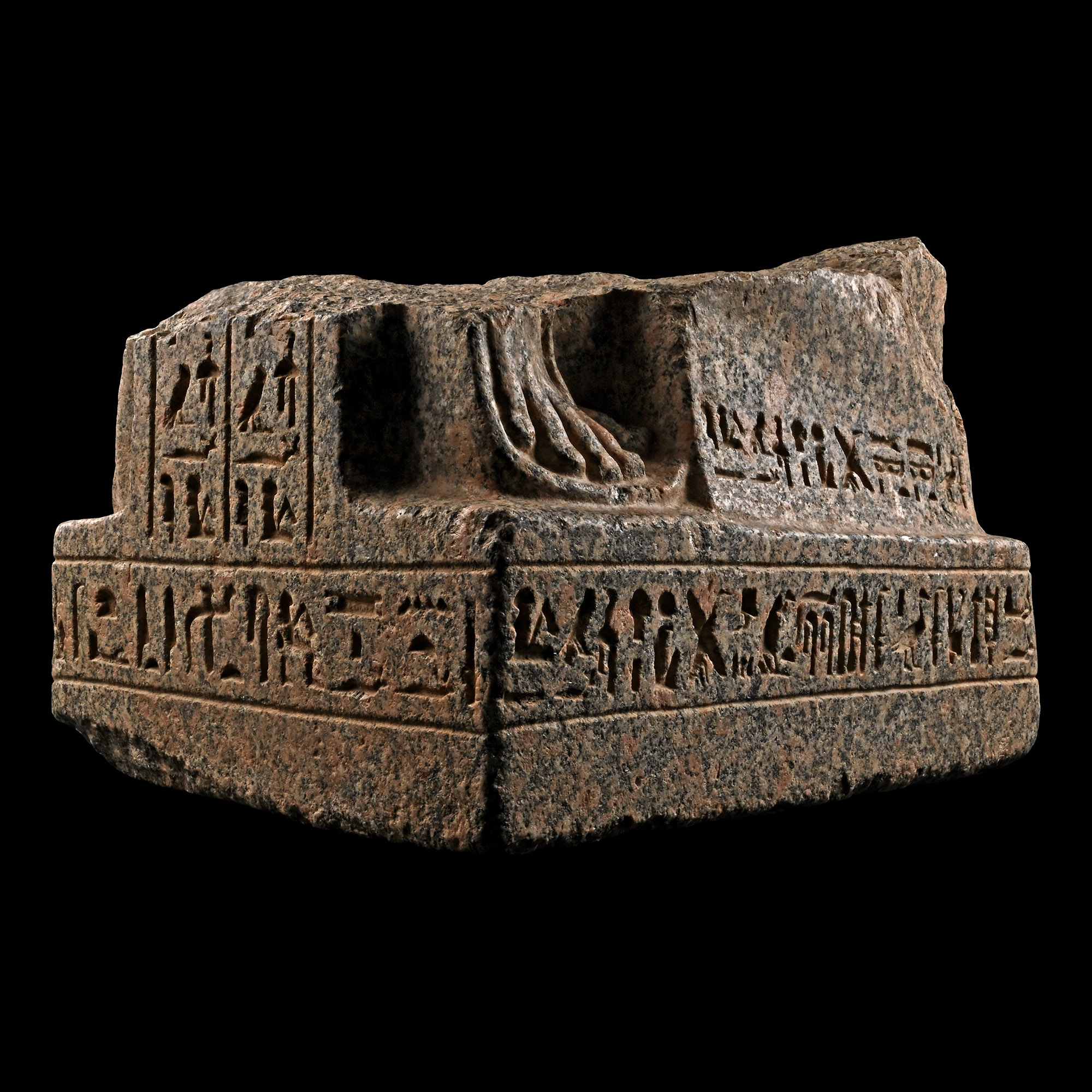
The feet are what remain: two of them, in reddish granite flecked with black, shod in carved sandals and lying as a man's feet do when he kneels back on his heels. On the better preserved of the two the sculptor cut each toe separately and fanned the tendons out above them. Above the feet are the lower legs, part of a kilt with a line of hieroglyphs along each edge, and then the break: rough stone where the rest of a prince used to be.
The granite is the kind Egypt cut at Aswan and kept, for the most part, for kings and their families. What survives is 58.5 centimetres tall, weighs 140 kilograms, and is covered in writing. A crisp band of sunk hieroglyphs runs around all four sides of the plinth; three columns descend the broad pillar rising at the front, and more run down the narrower pillar behind. The texts are prayers to Amun-Ra on behalf of the man whose feet these were, threaded with his titles, and they give his name: Pareherwenemef, third son of Ramesses II and the second borne to him by Queen Nefertari.
 Pareherwenemef in the princes' procession in the great pillared hall at Abu Simbel, his names and titles in the columns beside him. Photo: Olaf Tausch, CC BY 3.0, via Wikimedia Commons.
He is one of the obscure sons. He died in his twenties, almost half a century before his long-lived father; no tomb of his has been found; and one battered statue in Glasgow aside, no museum that can be searched holds an object bearing his name. This base, lot 16 in our sale of 8 September, out of a private collection where it has sat since the early 1980s, is close to the sum of what is left of him. And the writing on it holds two things nobody had seen before: an army title that may occur nowhere else in the Egyptian record, and the first solid trace of the woman who seems to have been his wife.
Son number three
The count of Ramesses II's children once stood at 170. Aidan Dodson and Dyan Hilton, in their genealogical survey of Egypt's royal families, bring it down to around a hundred, of whom forty-eight to fifty were sons, the older figure swollen by the same children being carved, renamed and counted twice. The head of the queue alternated between the two principal queens: the first son, Amenherkhepeshef, was Nefertari's; the second, Ramesses, was Isetnofret's; the third, Pareherwenemef, Nefertari's again; the fourth, Khaemwaset, Isetnofret's. Merneptah, the son who would eventually inherit, stood thirteenth in line.
Pareherwenemef was born before his father had a throne, while Ramesses was still crown prince under Seti I. His name, in Kenneth Kitchen's rendering, means "Re is at his right hand"; the name of Nefertari's eldest boy put Amun there instead, the queen's first two sons named as a pair. Egypt displayed the children in strict sequence: on temple wall after temple wall the sons file past in order of birth, each with his name and titles in a column overhead, and Pareherwenemef always marches third.
Hieroglyphs record consonants and leave the vowels to be guessed, so the literature offers Pareherwenemef, Prehirwenemef, Preherwenemef and Kitchen's Pre-hir-wonmef, and the auction catalogue's Parahirwenemef makes five.
A teenager at Kadesh
In the fifth year of his father's reign the Egyptian army marched into an ambush at Kadesh, on the Orontes in Syria. Four divisions went north, named for the gods Amun, Re, Ptah and Seth, conventionally reckoned at five thousand men apiece, and they went strung out along the road. Hittite chariotry cut through the division of Re on the march and burst into the royal camp itself; Kitchen calls the day "the cataclysm of Qadesh".
The royal household had travelled with the army, Pareherwenemef among it, "a lad in his early teens" in Kitchen's phrase, for whom Kadesh was a "baptism of fire". What the lad actually did depends on which page you read. Kitchen's narrative of the day has him leading the royal family in a dash westward, out of the path of the chariots; his summary of the prince's career has him instead going, like the vizier, to fetch help. Christiane Desroches Noblecourt takes the second view and sends him with the vizier to hurry the division of Ptah, still short of the field, into the fight. The Egyptian accounts, composed to the glory of the king alone, keep the princes at the margin; in Mark Healy's telling of the battle the royal children are hustled under guard to the far end of the camp with one precise instruction: do not go out on the west side, and keep clear of the fighting. Whichever way the boy rode, Egypt saw nothing strange in his being there: his father had carried the titular rank of commander-in-chief of the army from the age of ten.
The rest of the career reads like a soldier's, and Kitchen reconstructs it from the titles: "First Brave of the Army", a style granted "to commemorate his modest role at Qadesh?", the question mark being Kitchen's own; a commission in the chariotry as superintendent of horse; finally First Charioteer of His Majesty, successor in the post, Kitchen suggests, to Menna, the driver who had been at the king's side at Kadesh. The chariotry was the aristocratic arm, and royal sons, Anthony Spalinger writes, were expected to be chariot warriors. The war walls keep pace. In the camp scene at the Ramesseum, Pareherwenemef rides his chariot, named and titled. At Abu Simbel he and his brothers Amenherkhepeshef and Ramesses assault a Syrian citadel, each on his own smaller chariot. At Luxor he dismounts at the storming of a fortress.
A career carved around a plinth
The statue these feet belonged to knelt, and kneeling in Egyptian sculpture is specific: it is the pose of a man in the presence of a god, and it belongs inside temples. A statue of this kind let its owner attend the temple ritual daily, forever, and it nearly always held something out in front of it: a round-topped stela cut with a hymn to the sun, or a small shrine with a god's figure inside, a type that was all but an invention of the Ramesside age. The broad pillar at the front of this base is the lower end of whatever Pareherwenemef was holding; the break carried the answer away.
The prayers run twice, in mirror image. Hieroglyphs read equally well left to right or right to left, and Egyptian designers used that freedom for symmetry, cutting paired texts that match sign for sign except in the direction they face. Each of this pair opens with the fixed formula "an offering which the king gives", the phrase through which the king brokered every Egyptian's dealings with a god, and each asks Amun-Ra to provision the prince's ka, his spirit. The plinth is also where the substance tends to sit. On the statue of the treasury overseer Panehsy, Elizabeth Frood notes, the back pillar and the rear of the base carry ranking titles that the more visible front never mentions. The sculpture was the display; the base was the paperwork.
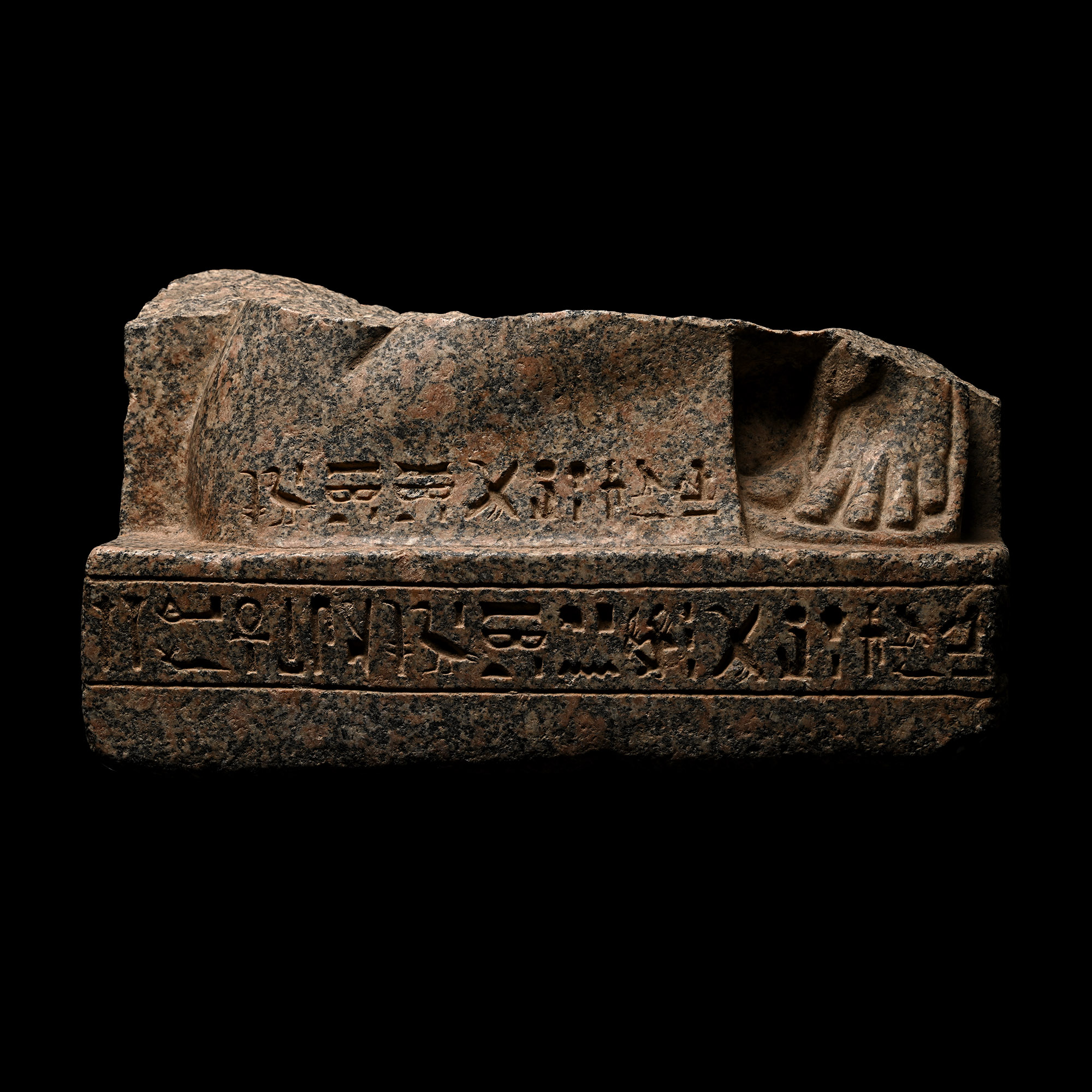 The band of sunk hieroglyphs around the plinth of lot 16, below the text line along the kilt edge
Threaded through the prince's prayers are his jobs: royal scribe, overseer of horses, troop commander, group marshaller. In 1987, when James K. Thomson published a fragmentary quartzite statue of the prince that had come to rest in the Burrell Collection in Glasgow, he could tabulate every title Pareherwenemef held on every monument then known. There were twelve, running from king's son and hereditary prince through fan-bearer on the right of the king to first deputy of the army and, on a Ramesseum wall, great overseer of the army: generalissimo. The Glasgow statue itself supplied two that had never been recorded before.
What a man in his twenties actually did with such a portfolio is an old argument. Betsy Bryan cautions that princes could carry military titles before they were old enough to fight; "royal scribe", Alan Lloyd writes, "probably should not be taken too literally", his comparison being with a British Foreign Secretary, who "does very little secretarial work". Lloyd is less dismissive of the army posts: "if we can trust the inscriptional evidence", he writes, the titles "were not empty labels but often, if not always, reflected some measure of direct involvement in military activities". They are, at least, specific. A troop commander, in Alan Schulman's reconstruction of the army lists, led a formation of two companies or more, and only some sixty men are known to have held the title across the whole New Kingdom; a group marshaller, in Spalinger's description, decided how the troops were drawn up and which route they marched. These were staff appointments in a working army, whatever allowance was made for royal birth.
Then there is the title with no twin. The catalogue reads one phrase on the base as tpy n mšꜥ, "chief of troops", and calls it previously unattested; searches of the published literature turn up no other example, though an absence of that kind can be searched for and never proved. It is the kind of title this prince collected. He demonstrably held idnw tpy n pꜣ mšꜥ, first deputy of the army, and Kitchen credits him with "First Brave of the Army", each a short step away in Egyptian; and a new monument enlarging his record has precedent, because the Glasgow statue did exactly that in 1987. The reading rests for now on a study of the base in preparation by Paul Whelan, an established Egyptologist giving the piece its first full publication. Until that appears, "chief of troops" is forthcoming scholarship: plausible in kind, and not yet in the books.
His sister, his beloved
Around the back of the plinth, behind the heels, is the other discovery: the name of a woman, Wadjet-khayty, who is called "his sister, his beloved".
She was almost certainly not his sister. From the middle of the Eighteenth Dynasty, as Gay Robins has traced, "sister" became the usual word Egyptian monuments used for a wife; in the tomb of the workman Pashed, the woman called "his sister" comes with named parents, and they differ from his. When Jaroslav Černý combed through some five hundred ordinary pharaonic marriages, he found around one per cent that might possibly have joined half-siblings, and no certain case of full brother and sister outside the royal family. Kings were the exception, and Ramesses II duly married one of his own sisters; for a prince, no such marriage is attested, and Wadjet-khayty carries no "king's daughter" title. On the evidence of her single line, she came from outside the royal family and married into the largest household in Egypt.
Married, probably. The formula is the standard one for a wife, and the catalogue reads it as strong evidence; on its own the phrase stops just short of proof, and no child of the couple is recorded anywhere. Until this base surfaced, she had one line in all of scholarship: a note in Kitchen's reference series records a statue base of Pareherwenemef at Karnak, since lost, with her name attached as his wife.
The note is where a complication starts. The lost Karnak base and this one sound alike: both statue bases of the same prince, both carrying troop titles, both attaching the same otherwise unknown woman. They may be two monuments of one marriage. This may equally be the Karnak base itself, resurfaced with its label changed; the old record calls that stone quartzite where this is granite, but stone identifications in early notes are unreliable. From the photographs and one published line there is no deciding it. Whelan's study, and the scrutiny that follows any publication, may settle the question. Either way Wadjet-khayty comes out ahead: her name is now cut into 140 kilograms of granite rather than resting on a line in a footnote.
The prince who vanished
By about Year 20 of the reign, on Kitchen's reading of the evidence, the front of the queue was dying. Amenherkhepeshef, the crown prince, was probably dead; so were three of his full brothers, Pareherwenemef among them, "all in their mid or late twenties at most". The fine chronology is disputed, and Kent Weeks would keep the crown prince alive years longer, though on any reading the third son died young. "It was Istnofret's sons who lived on," Kitchen writes. Merneptah, the thirteenth, followed his father onto the throne in 1213 BC, "a portly man already in his sixties"; Ramesses II had reigned sixty-six years and was about ninety when he died.
No tomb of Pareherwenemef has ever been identified. The likeliest address is KV5, the tomb in the Valley of the Kings that Kent Weeks relocated in the 1980s and that has grown under excavation into the largest tomb in the valley, a mausoleum cut for the sons of Ramesses II, with more than a hundred chambers and corridors mapped and more expected. The names read so far from its walls and fragments include his brothers Amenherkhepeshef, Ramesses, Sethy and Meryatum. His is absent. But only two sons, Khaemwaset and Merneptah, are positively known to be buried anywhere else, so KV5 may yet hold him; nothing found there says so.
The temples, meanwhile, kept him marching. The procession frieze at Wadi es-Sebua went up more than a decade after his death, and he files past in his fixed third place, name overhead. Then the trail thins to almost nothing. Beyond the Glasgow fragment, a search across two million object records from forty-nine museum and auction collections returns nothing under his name in any spelling: no statue, no relief fragment, no ushabti. His brother Khaemwaset has a quartzite statue in the British Museum, another statue in Brooklyn, a granite head in Atlanta, and a steady trade in ushabtis bearing his name.
Pareherwenemef's surviving list is short: the war reliefs and the temple processions; two small standing figures beside the colossi on the facade of the smaller temple at Abu Simbel, his mother's temple, where Nefertari's own colossi stand as tall as the king's, against every convention of royal statuary; the fragmentary statue in Glasgow; two scarabs recorded in old collections; the lost Karnak base; and lot 16.
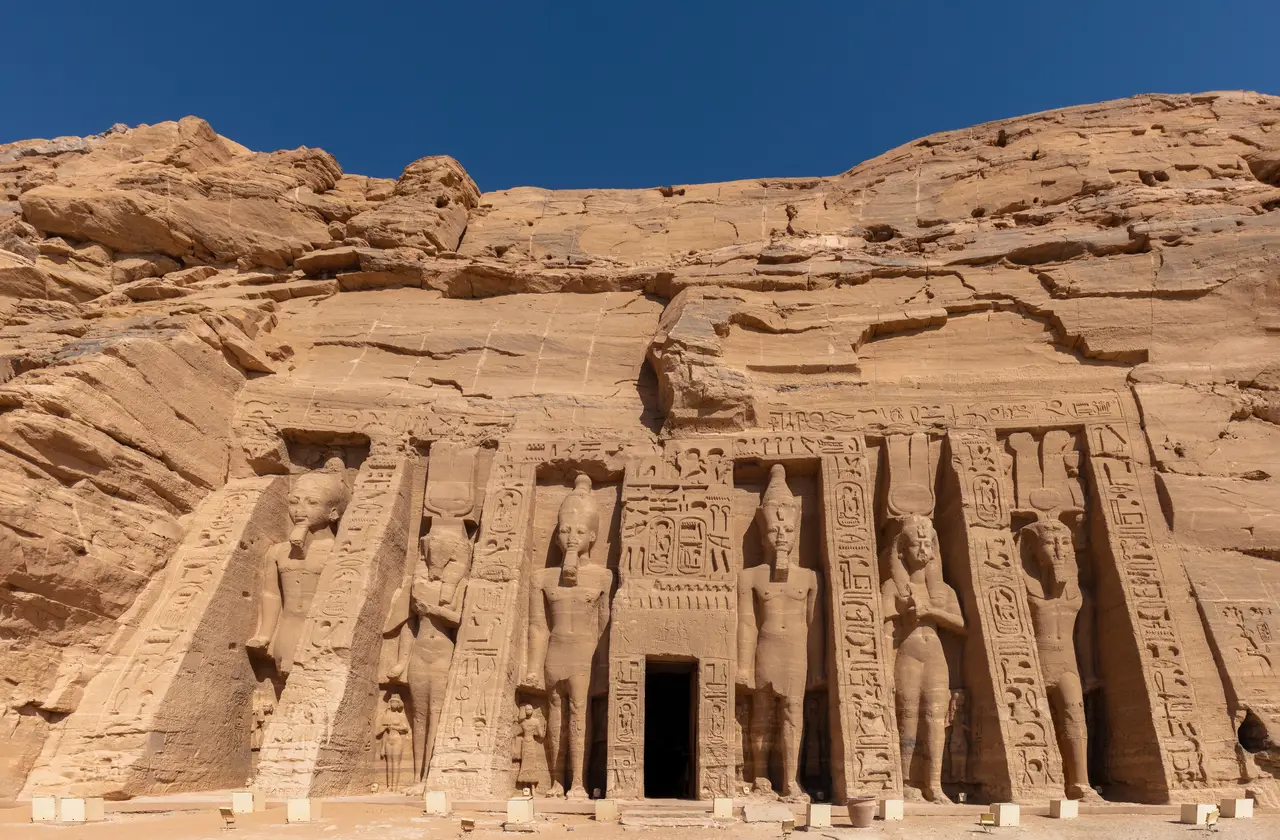 The temple of Nefertari at Abu Simbel, its colossi of the queen cut to the same height as the king's. Pareherwenemef's two surviving statues stand small beside the legs of his father's inner colossi. Photo: Diego Delso, CC BY-SA 4.0, via Wikimedia Commons.
What a base can say
Bases outlive statues. Old sculpture was raw material to later builders, and royal figures went to the breakers with the rest: Hatshepsut's red granite kneeling colossi at Deir el-Bahri were hauled out of the temple, decapitated and smashed, and one was rolled downhill in Graeco-Roman times to be cracked into millstones over a fire. Granite was stubborn: its hardness sometimes defeated the conversion, one recorded reason some stones were left alone. Temples had their own way of retiring statues, too: a figure that had stood in a sanctuary remained sacred even broken, and priests periodically cleared their crowded courts by burying old statues within the precinct, the practice behind the great cache found at Karnak.
The bottom, when it survives, is often the talkative end. In Turin, a quartzite statue base of Merneptah, the younger brother who outlived everyone and took the crown, preserves a single foot; the Museo Egizio shows it against a drawn outline of the missing king, with a label observing that even very fragmentary statues can often be identified. A statue of King Djoser lost everything above its inscribed base, and that base carries the name and titles of Imhotep, his master builder: the only titles of Imhotep known anywhere. And a headless kneeling statue in the British Museum proved, under Anthony Leahy's reading, to carry one man's inscription cut over another's: made for a son of Ramesses II, Leahy argues, and reinscribed three dynasties later for a high priest of Memphis. The son was Khaemwaset, this prince's own brother.
A foot is even a measuring instrument. Egyptian sculptors laid their figures out on a proportional grid, and in the standard canon the foot ran three grid squares, a sixth of a standing figure's height to the hairline. Working from such proportions, Leahy restored his British Museum statue from a preserved 85 centimetres to an original 1.2 metres, life-size. Nobody has published the arithmetic for lot 16, and we will not guess at it here. The feet hold the number.
Fragments of Ramesses II's own monuments reach the market from time to time; a serpentine statue base of the king has passed through Christie's. For a monumental statue of one of his named sons, we can find no recent parallel in the sale records at all.
The statue was cut so that Pareherwenemef could kneel before Amun-Ra for as long as the temple stood, holding his offering out to the god while the daily ritual went on around him. The temple is gone, wherever it stood. The offering is gone, with the hands that held it and the face above them. What is left is granite nobody found worth breaking up, two prayers running around the plinth in mirror image, and a pair of feet in their sandals, still kneeling.
TimeLine Auctions, 29th August 2026