Home > Stories by TimeLine Auctions
Stories by TimeLine Auctions
Reading Roman Gemstones
A Roman citizen did not sign documents with a pen. He pressed his ring into warm wax or clay, leaving behind an image chosen to represent him: a god he worshipped, a hero he admired, a scene that spoke to his profession or philosophy. The gem set into that ring was his signature. It authenticated contracts, sealed correspondence, and marked property. But it was also something more personal. In a world without photography, without business cards, the imagery a person chose for their seal was a deliberate act of self-presentation.
Our upcoming auction includes an important group of Roman gems from a private English collection formed between the late 1970s and early 1990s. For collectors unfamiliar with this category, these objects offer something rare: the chance to own something genuinely personal from the ancient world. A marble bust was public art, made for temples and forums. A gem was private. Someone selected that image, wore it daily, and used it to mark what mattered to them.
Understanding Intaglios and Cameos
The gems in this sale divide into two types. Most are intaglios, where the image is cut into the stone's surface. When pressed into wax, an intaglio produces a raised impression, readable like a coin. A smaller number are cameos, where the image stands in relief against the background. Cameos were typically display pieces or pendants rather than functional seals.
The distinction matters because it affects how you view the object. An intaglio often appears more impressive in impression than when examined directly; the engraver worked in reverse, carving a negative image to produce a positive result. We encourage collectors to view intaglio gems both ways when possible.
How Roman Gems Were Made
The engraving of gemstones is among the most demanding crafts of the ancient world. A gem engraver worked on a scale smaller than a thumbnail, carving images in reverse, often unable to see clearly what he was doing while he worked.
The basic technique had been refined hundreds of years before the Roman period. By the 5th century BC, Greek craftsmen had developed the diamond-tipped drill, a tool that remained essentially unchanged into modern times. The drill itself did not cut the stone directly. Instead, the metal or wooden drill point was dipped into an abrasive slurry and this grit, harder than the gemstone, did the actual cutting. As the engraver worked, both the stone and the abrasive wore into a dirty paste that obscured his progress. He would periodically wipe the surface clean to check his work, then continue.
The primary tool was the bow drill, which functioned somewhat like a bow being drawn across a violin string. The engraver pulled the bow back and forth, causing the drill to rotate rapidly. Different drill points produced different effects: rounded points for curves and depressions, finer points for detailed lines. By the Roman period, a horizontal wheel had also come into common use, allowing the engraver to hold the stone against a rotating abrasive surface for shaping and polishing.
The process followed a logical sequence. First, the rough stone was prepared and shaped into its basic form (oval, circular, or occasionally rectangular). Then the engraver visualised his design and likely scratched a preparatory outline onto the surface. He cut the major forms first, then added finer details, and finally polished the finished work. A completed gem might then be set into a metal mount by a jeweller, a separate specialist.
What makes this craft remarkable is its combination of physical difficulty and artistic subtlety. When you examine an intaglio, remember the engraver carved in negative. Every cut he made had to be imagined in reverse. This is why we encourage viewing these gems both ways: directly and in impression. He worked at a scale where the slightest slip could ruin days of labour. And he did this without magnification. Modern scholars have debated whether ancient craftsmen used rock crystal or water-filled glass spheres to enlarge their view. The evidence suggests they did not. Instead, the profession may have favoured those with natural short-sightedness, a condition that allows close focus and was often passed from father to son in family workshops.
We know from ancient sources that gem engraving was indeed a family trade. The emperor Augustus employed a master engraver named Dioskourides, whose three sons all followed their father's profession and signed their own works. Such dynasties of craftsmen developed techniques over generations, refining methods that remained closely guarded.
The Stones Themselves
The gems in this sale demonstrate the range of materials available to Roman engravers, though carnelian dominates. This reddish-orange variety of chalcedony was the standard stone for Roman intaglios. It was relatively affordable, widely available from sources in India and Egypt, and possessed a hardness suitable for detailed work without being impossibly difficult to cut. Most ancient gemstones fall around the same hardness as sand (quartz), which meant they could be worked with emery abrasives. Carnelian met this requirement perfectly. Its warm colour was considered attractive, and it produced clear impressions in wax.
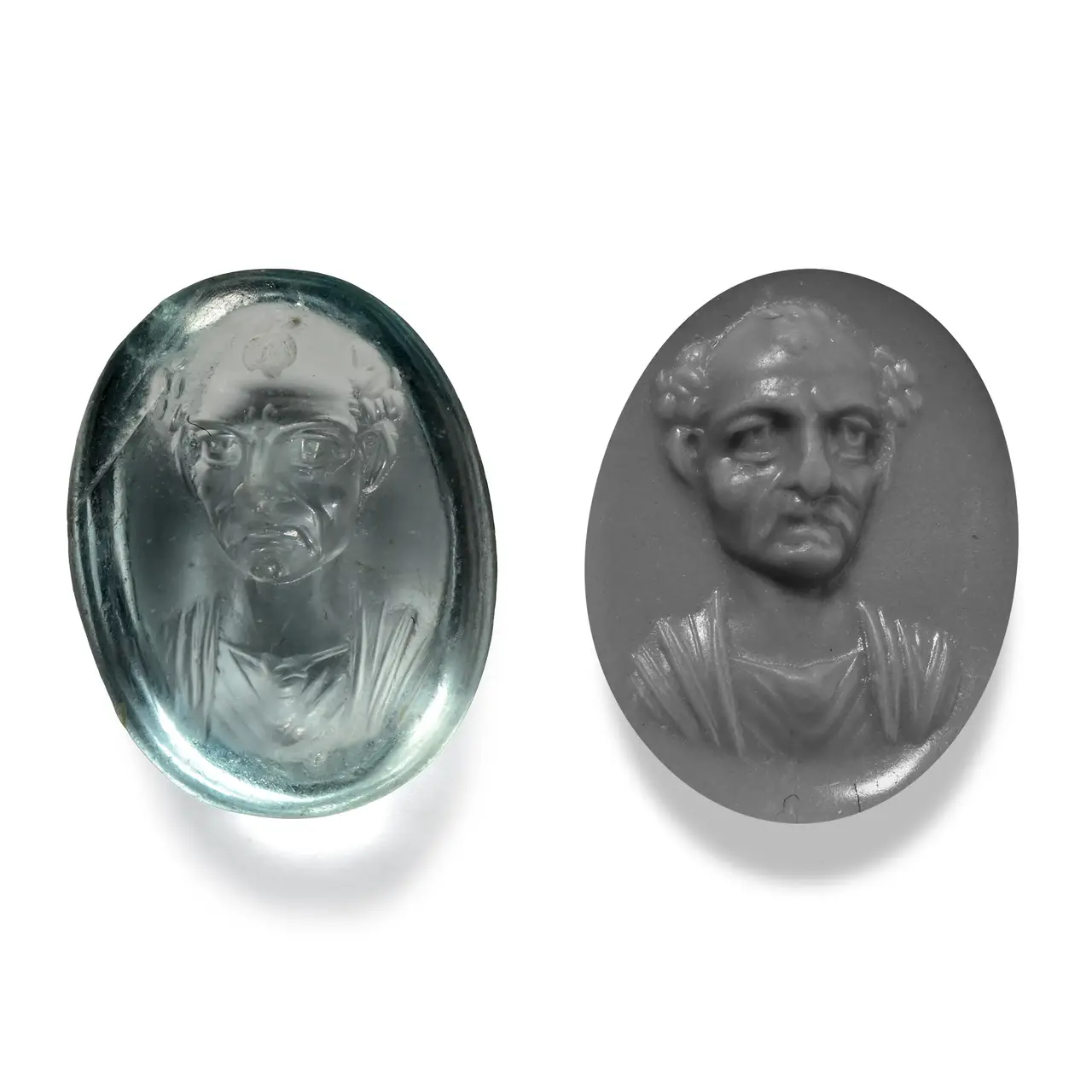
TimeLine Auctions, 3rd of March 2026, lot 2, Estimate £2,000 – £3,000
The aquamarine of the philosopher portrait (Lot 0002) represents a more ambitious choice. The clarity of Aquamarine meant that every cut showed plainly against the background, leaving the engraver no room for imprecision. Aquamarine was expensive and relatively rare in gem engraving. Its selection for a portrait subject suggests a patron of means who wanted something distinctive.
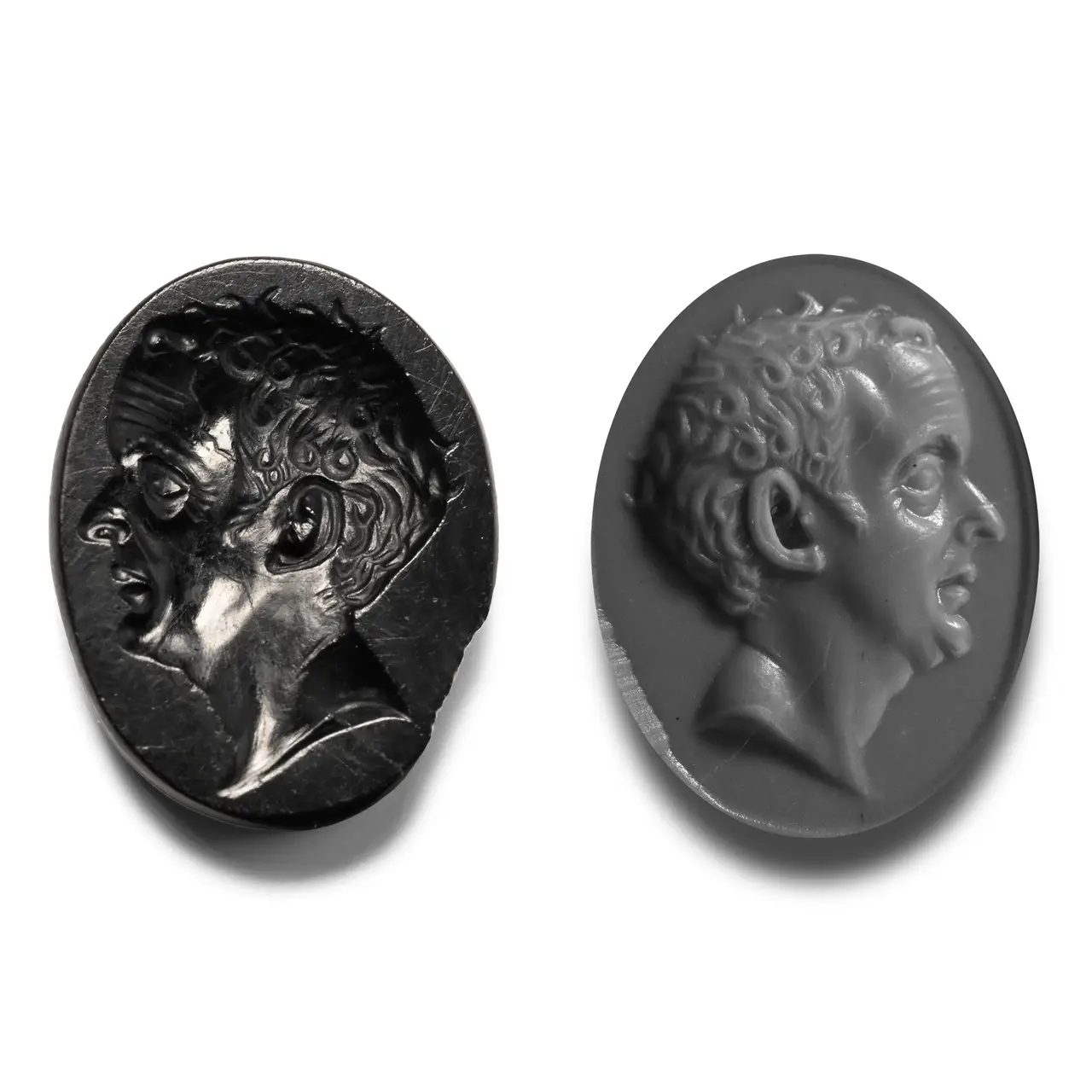 TimeLine Auctions, 3rd of March 2026, lot 6, Estimate £1,500 – £2,000
Black jasper, as seen in the Republican portrait (Lot 0006), offered different advantages. This opaque stone provided stark contrast when impressed into pale wax or clay, making the resulting seal highly legible. The choice suited the austere, unflinching style of the portrait itself.
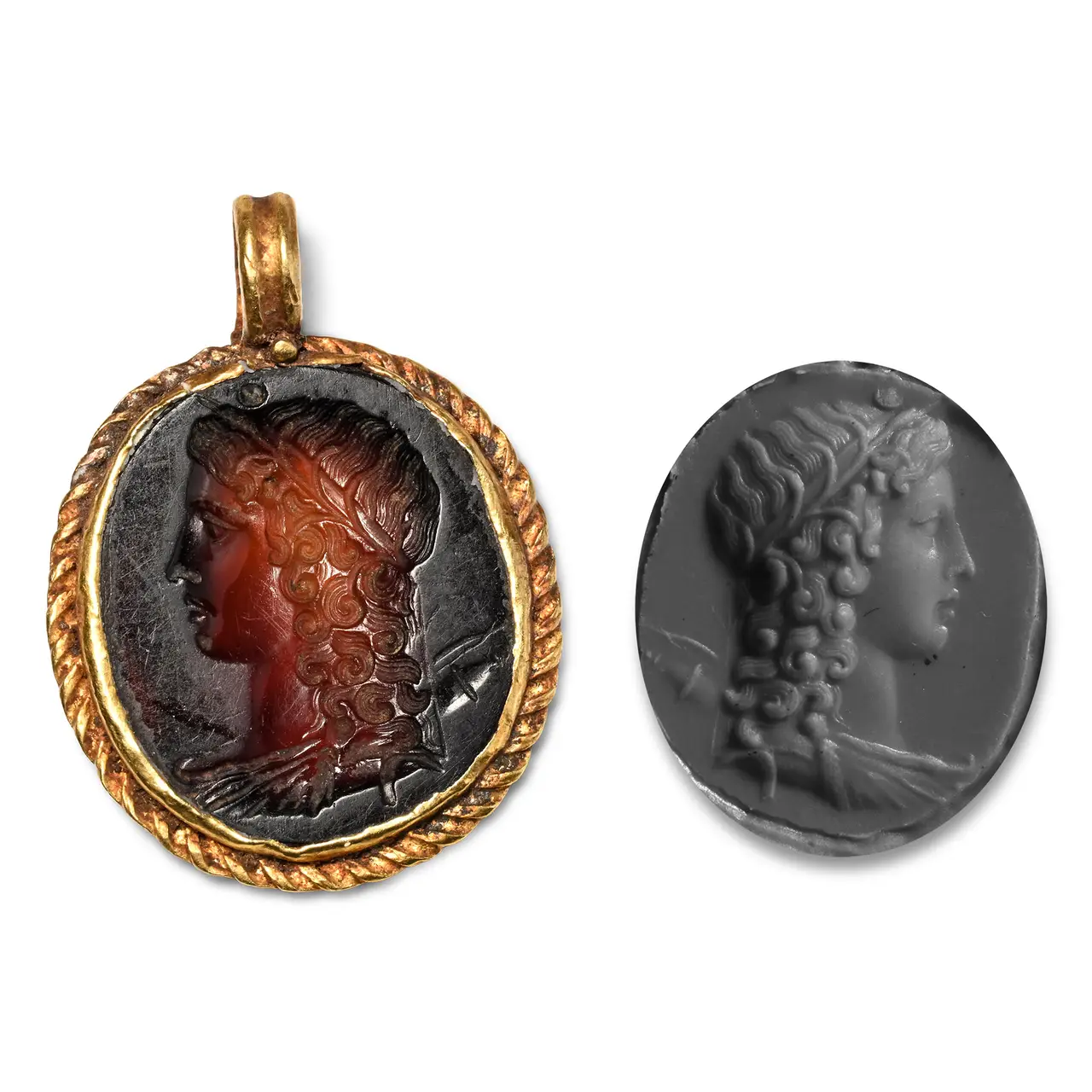 TimeLine Auctions, 3rd of March 2026, lot 25, Estimate £1,200 – £1,700
Sard, the brownish-red stone of the Apollo pendant (Lot 0025), falls between carnelian and darker brown tones. Like carnelian, it belongs to the chalcedony family and shares similar working properties.
Agate, used for the theatrical mask cameo (Lot 0007), presented particular opportunities for cameo work. Agate forms in bands of different colours, and a skilled carver could exploit these layers, cutting away the upper band to reveal a contrasting colour beneath. The result was an image that appeared to float against its background.
It is worth noting what the Romans did not commonly use. Diamonds, rubies, and sapphires (the stones we consider most precious today) were either unknown, unavailable, or too hard to work with ancient tools. Diamonds occasionally appear in late Roman rings, but always in their natural crystal form, uncut and unpolished. The technology to shape them simply did not exist. The stones we see in Roman gems, while considered semi-precious by modern standards, were the practical and aesthetic choices of their era.
Glass deserves mention as well. During the Hellenistic and Roman Republican periods, glass gems became extremely popular. These could be cast from moulds, making them far cheaper than hand-cut stones, and they allowed wider ownership of seal rings. None appear in this particular sale, but collectors should be aware that glass gems represent a legitimate and historically significant category, not a lesser substitute for "real" stones.
Gods, Heroes, and Healing
Several gems in this sale depict divine figures, each chosen for reasons we can sometimes infer.
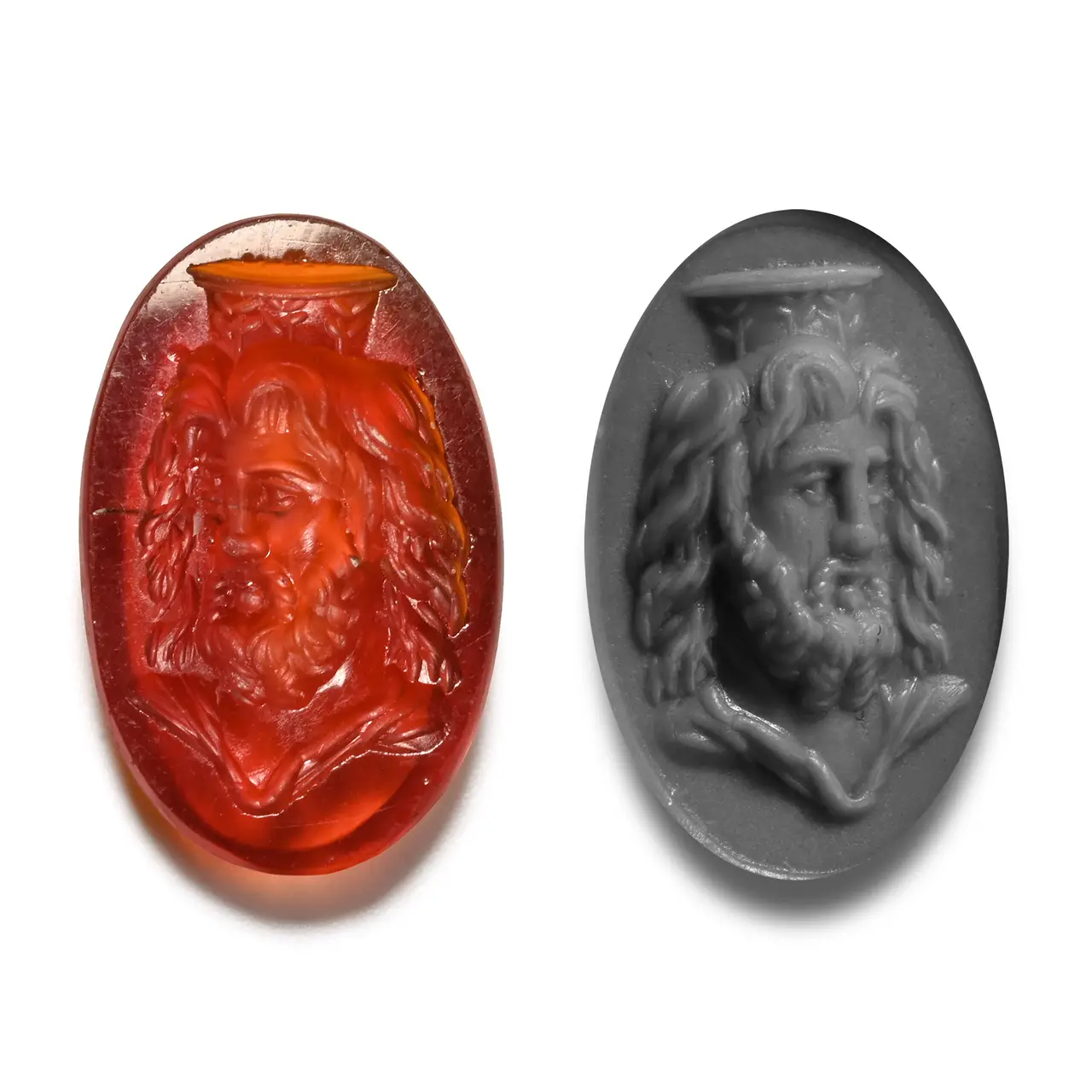 TimeLine Auctions, 3rd of March 2026, lot 1, Estimate £1,000 – £1,400
The carnelian intaglio of Serapis (Lot 0001) shows the syncretic deity wearing his distinctive calathus, the grain-measure basket that symbolised fertility and abundance. Serapis was worshipped across the Roman world, particularly in port cities and trading centres. A merchant or ship-owner might choose this image for protection on voyages and prosperity in commerce.
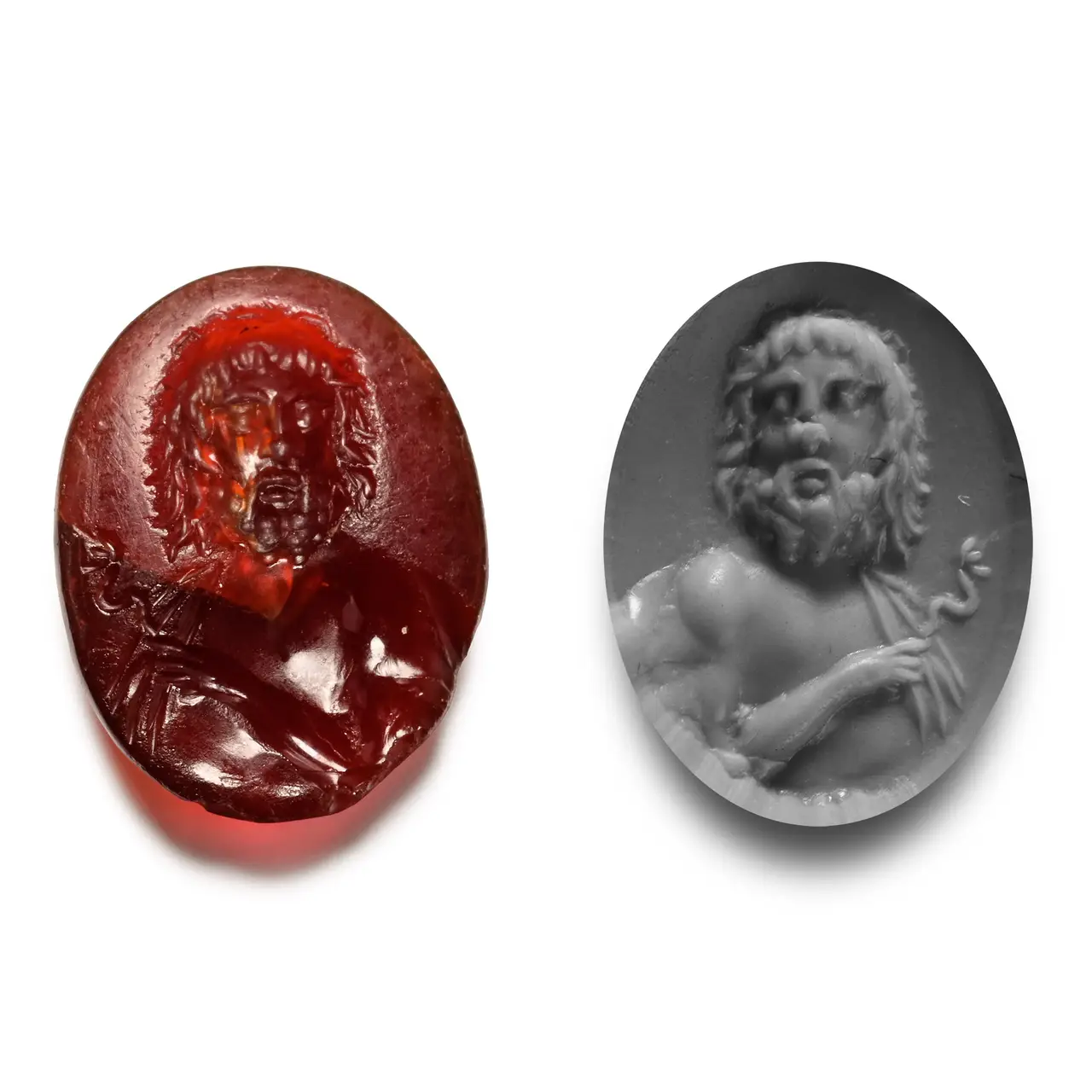 TimeLine Auctions, 3rd of March 2026, lot 26, Estimate £1,000 – £1,400
Asclepius, the god of medicine, appears on another carnelian (Lot 0026), holding his serpent attribute. This would suit a physician, but also anyone seeking protection from illness. The Romans were practical about their gods; you chose the deity whose domain matched your concerns.
The Apollo on a deep brownish-red sard (Lot 0025) presents a different case. This gem retains its later Roman-period gold mount, complete with a roped border and hanging loop. It was worn as a pendant, not a seal. Apollo represented reason, order, music, and prophecy. The stone itself, set in gold and suspended around the neck, would have been visible to others in a way that a seal ring was not. This was jewellery meant to be seen.
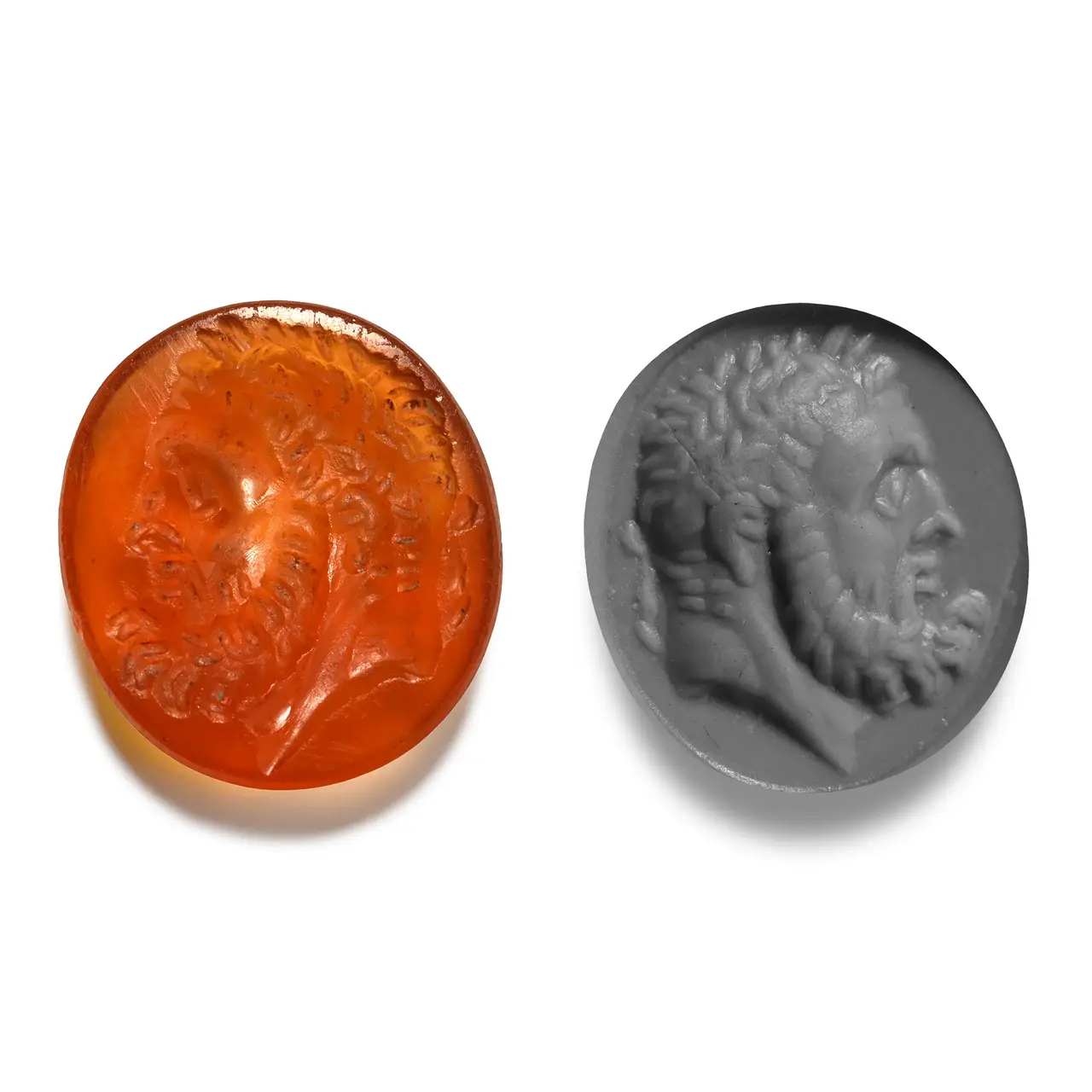 TimeLine Auctions, 3rd of March 2026, lot 32, Estimate £1,200 – £1,700
Hercules (Lot 0032), depicted in profile on translucent orange carnelian, offered a different kind of protection. The hero who completed impossible labours was a favourite subject for soldiers and athletes, for anyone facing physical challenges or seeking courage.
Portraits of Real Men
Two gems in this sale depict not gods but men, and both reveal something important about Roman taste in the late Republic.
The aquamarine gemstone of a philosopher (Lot 0002) shows an elderly man in tunic and toga, facing forward rather than in profile. The pale blue translucent stone is itself notable; aquamarine was expensive and relatively rare in gem engraving. The choice of a philosopher subject (the general term covering any intellectual or teacher) suggests an owner who valued learning or wished to project wisdom. In our experience, collectors respond strongly to these human portraits. They feel more immediate than divine imagery.
The black jasper Republican portrait (Lot 0006) takes this further. The elderly man depicted has thinning curly hair, a wrinkled brow, and hollow cheeks. This is "veristic" portraiture, the unflinching Roman style that celebrated age and experience rather than idealised youth. Where Greek art smoothed away wrinkles, Roman Republican art emphasised them. A face like this advertised a lifetime of service to the state. The gem has been restored after being split in two, with a small chip remaining at the edge. We note this condition openly; the damage affects value but not the object's historical significance or visual power.
Theatre, Hunting, and Daily Life
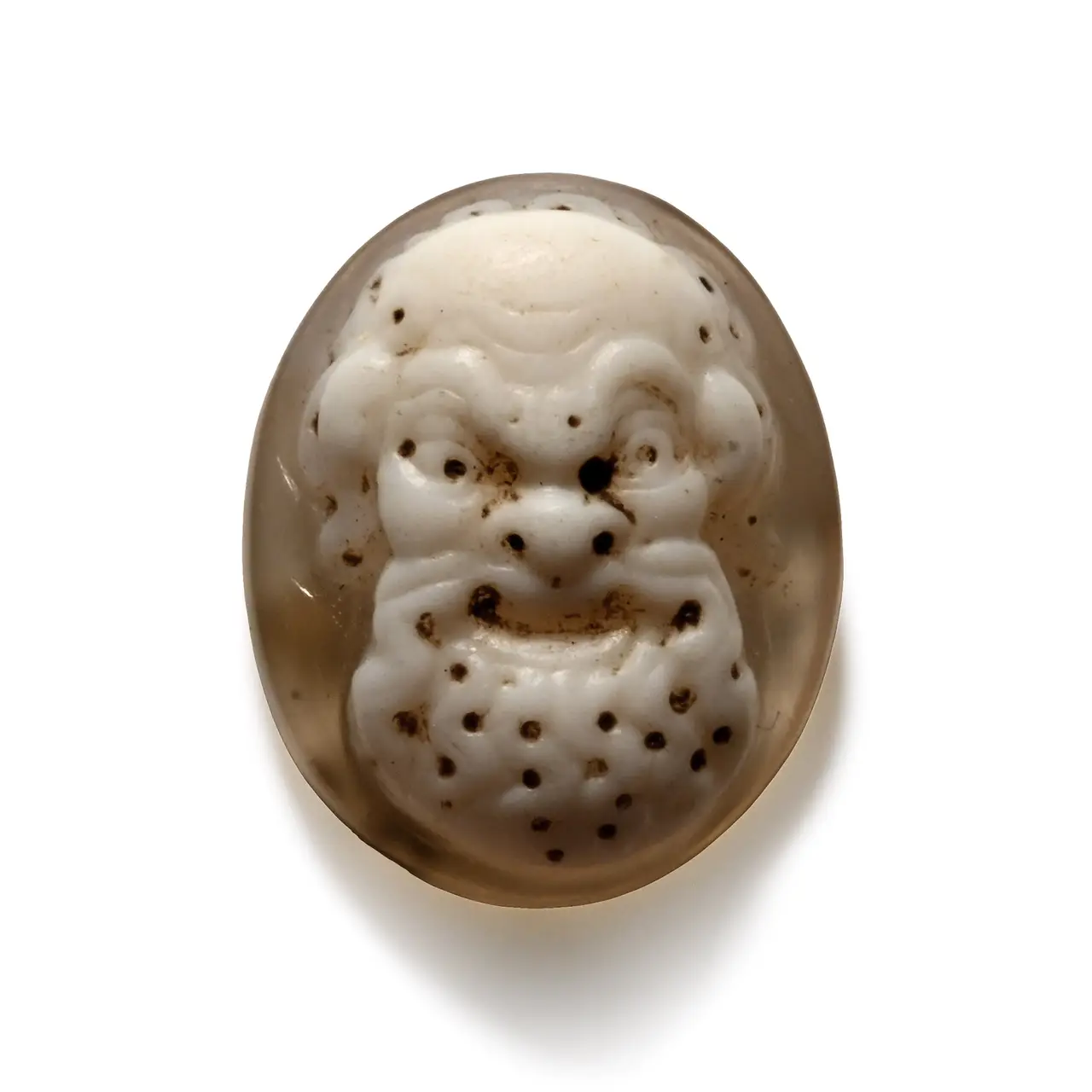 TimeLine Auctions, 3rd of March 2026, lot 7, Estimate £1,000 – £1,400
Not every gem depicts gods or great men. The agate cameo of Pornoboskos (Lot 0007) shows a theatrical mask from Roman New Comedy, specifically the stock character of the brothel-keeper: bald-headed with a bushy beard. Theatre was central to Roman public life. Someone who chose this mask for a cameo might have been connected to theatrical production, or simply enjoyed the plays, or appreciated the character's comic exaggeration.
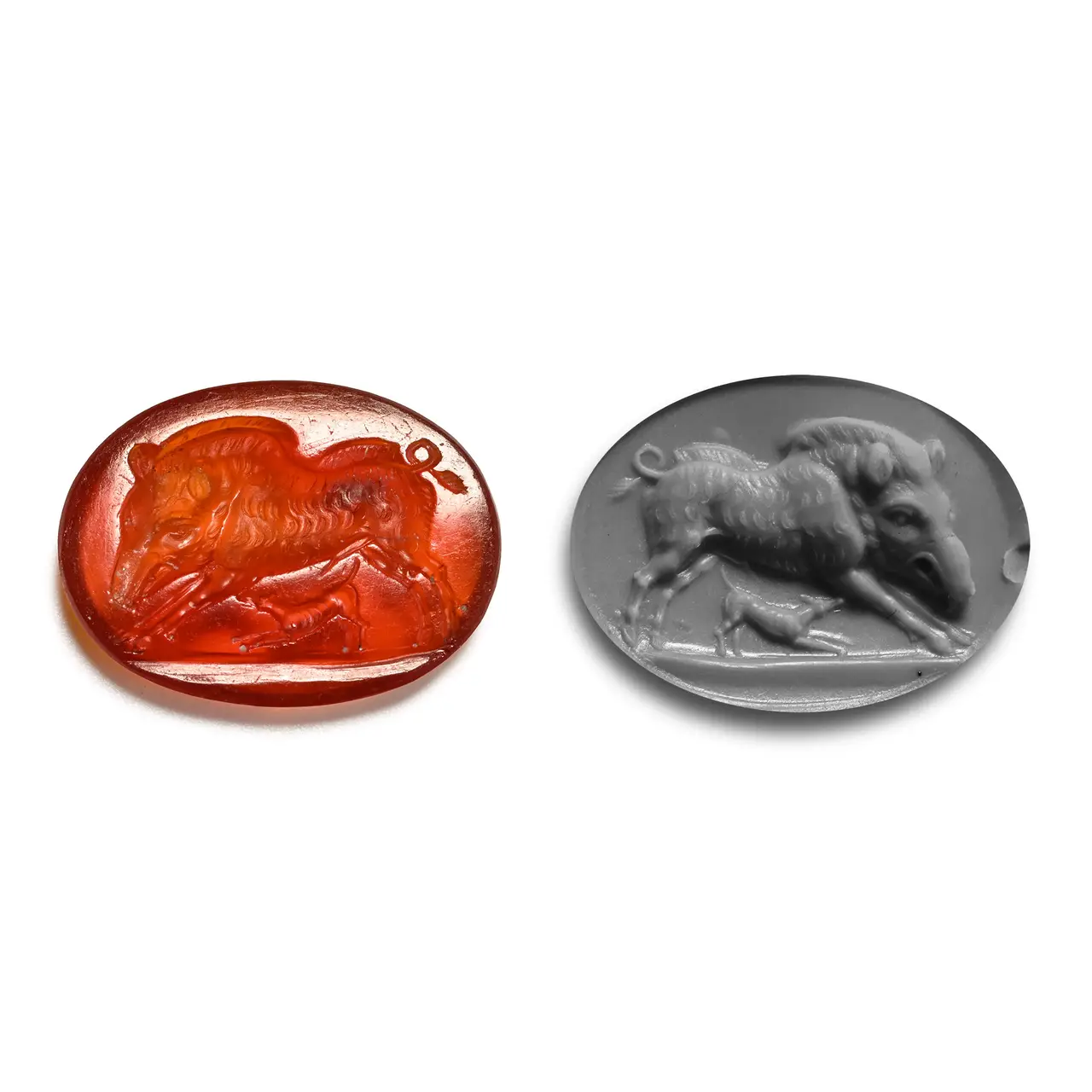 TimeLine Auctions, 3rd of March 2026, lot 15, Estimate £2,000 – £3,000
The carnelian hunting scene (Lot 0015) depicts a wild boar charged by a hunting dog. Hunting was elite recreation in the Roman world, a demonstration of skill and courage. A landowner, a sportsman, or anyone who wished to project vigour might select this subject. The composition is dynamic: the boar moves across a ground line while the dog attacks from below. This is competent, lively engraving.
The Lion in Gold
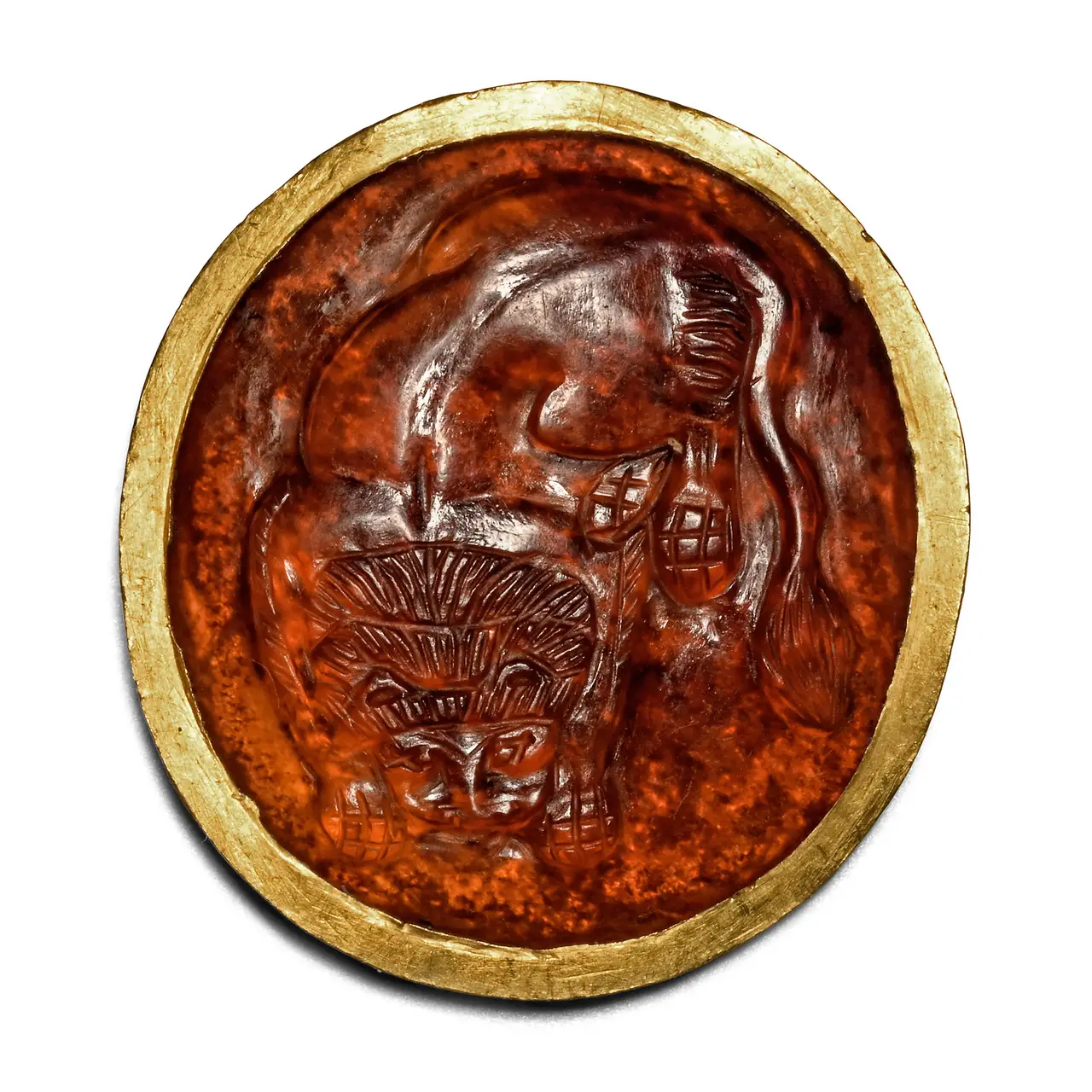 TimeLine Auctions, 3rd of March 2026, lot 30, Estimate £3,000 – £4,000
The Eastern Roman carnelian cameo of a crouching lion (Lot 0030), dated to the 3rd or 4th century AD, represents the later end of the Roman gem tradition. The lion rests with its head on its forepaws, peaceful rather than aggressive. The cameo sits in its original discoid gold cell with a flange rim, making this a complete piece of jewellery rather than a loose stone. Lions carried multiple meanings: royalty, strength, solar symbolism, protection. In the Eastern Roman context, Christian associations may also apply.
At an estimate of £3,000–£4,000, this is the most valuable gem in the group, reflecting both the quality of the carving and the survival of its gold mount.
Condition and Collecting
Ancient gems were made to be used. Expect minor wear, small chips, and surface scratches. The black jasper portrait's restoration is disclosed because it represents structural repair, but faint scratches from two thousand years of handling are not flaws. They are evidence of life.
When examining a gem, consider both the quality of the engraving and the clarity of the imagery. A well-cut gem should be legible at a glance. The lines should be confident, not scratchy or hesitant. Proportions should feel right, even at this miniature scale. Comparison helps. The more gems you examine (in person, in catalogues, in museum collections) the better your eye becomes.
We asked Aaron Hammond, our Chief Operating Officer and an avid collector of ancient art, what he looks for when examining a gem. His advice was simple: "Can I read the image at a glance? Do the lines look confident or scratchy? Does the figure's anatomy feel right, even at this scale? With this collection, I kept finding myself saying yes."
Beginning or Building
For those already collecting antiquities, gems offer a category that complements larger objects. A Roman bronze or a Greek pottery vessel shows what was made for public or domestic display. A gem shows what someone carried on their person, chose as their identifier, trusted to mark their correspondence.
For those new to antiquities, gems offer an accessible entry point. The opening bids in this sale range from £500 to £1,500, with estimates extending to £4,000 for the finest mounted pieces. These are genuine Roman objects, not fragments or reproductions.
We recommend browsing the current catalogue with attention to what draws your interest. Divine subjects? Portraits? Animals? Your own taste will guide you toward the pieces worth pursuing. And if you do not yet plan to bid, consider registering for the auction simply to follow the prices. Understanding what the market values is part of learning to collect well.
TimeLine Auctions, 4th February 2026