Home > Stories by TimeLine Auctions
Stories by TimeLine Auctions
Sir William Hamilton and the Birth of the British Collection
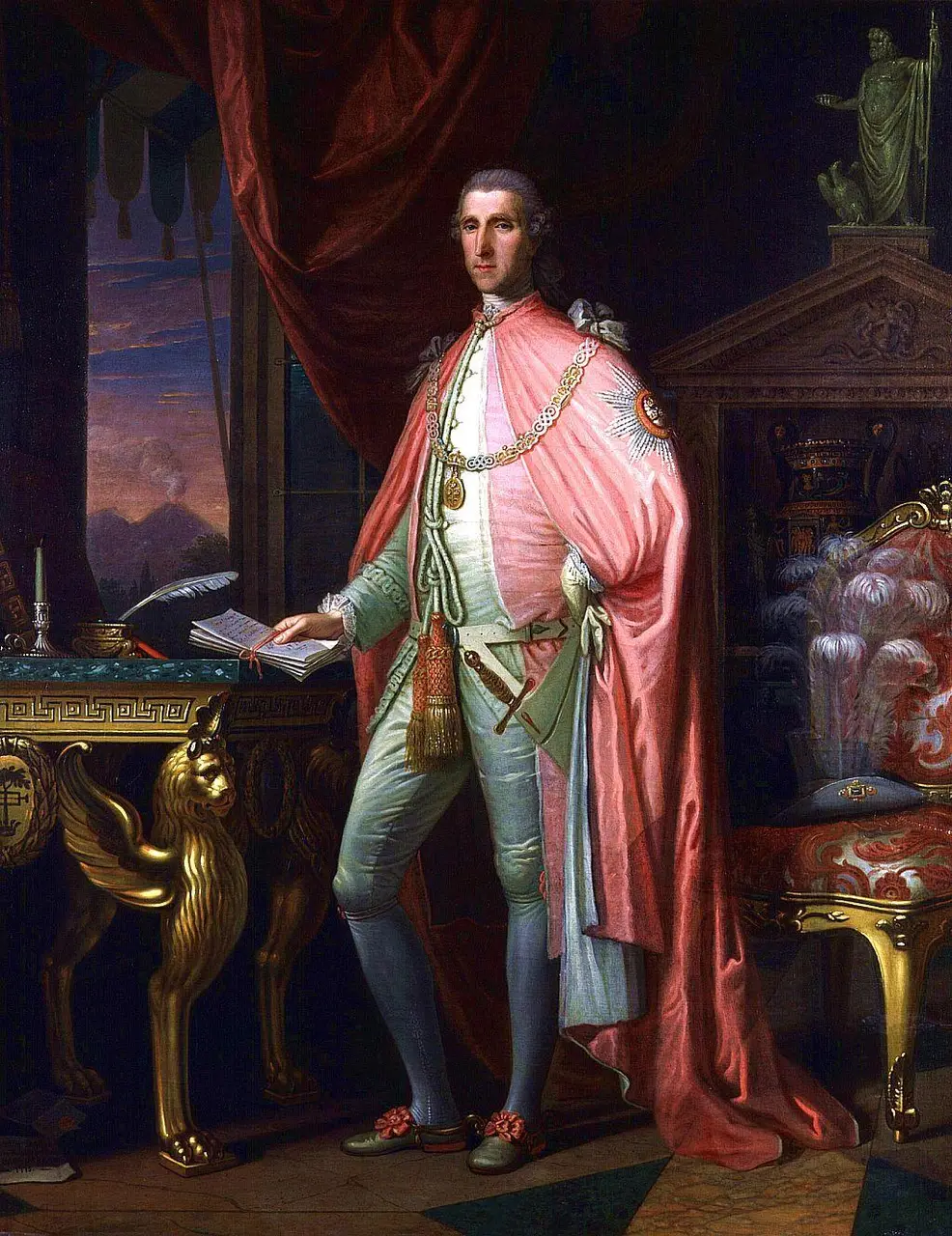 David Allan's portrait of Sir William Hamilton, 1775. Public domain, via Wikimedia Commons.
David Allan painted him in 1775 in the scarlet robes of the Order of the Bath. A Greek vase stands on a pedestal at his left; through the window at his right, Vesuvius is smoking. It is an unusually honest portrait, because it shows the three things Sir William Hamilton wished to be remembered for and sets them in one frame: the diplomat, the collector, the student of the volcano.
He is remembered for a fourth thing instead, one nobody thought to paint. To most people who know the name at all, Hamilton is the elderly husband of Emma, Lady Hamilton, the young woman who became Nelson's mistress under his roof. The scandal has comfortably outlived the achievement. The vase on its pedestal is the more consequential object in the picture. When Hamilton sold his vases to the British Museum in 1772, he turned a national library with a natural-history cabinet attached into a museum of classical art. Every antiquity that came after, the Townley marbles, the Egyptian sculpture, the carvings Lord Elgin stripped from the Parthenon, entered through a door that his pots had opened first.
An Ancient Name and a Thousand Pounds
He came to all of it as a younger son with a famous name and almost no money. His father was Lord Archibald Hamilton, seventh son of a duke and once Governor of Jamaica; his mother, a court beauty, was a favourite of Frederick, Prince of Wales, which placed the young William among the royal children and made him, by the affectionate fiction of the nursery, foster-brother to the future George III. He judged his own prospects without illusion. He was, he said, born "with an ancient name and a thousand pounds," and as a younger son would have to make his own way. For such men the way ran through marriage and office.
The marriage came first. In 1758 he married Catherine Barlow, a Welsh heiress whose estate was worth nearly five thousand pounds a year, and it was a happy match, childless and held together by a shared love of music. Catherine's poor health and her need of a warm climate gave him a reason to want the embassy at Naples when it fell vacant. He angled for the post and reached the city on 17 November 1764. He would stay thirty-six years.
The work was light. An envoy to the court of the Two Sicilies wrote home every ten days or so, encouraged British trade, and above all kept open house for the British gentlemen pouring south on the Grand Tour. That left a great deal of time, and Hamilton filled it with music, with the mountain on the horizon, and with antiquities. He ran his main residence, the Palazzo Sessa, as the social engine of British Naples; the surgeon Samuel Sharp, passing through, found its evenings full of "Ambassadors, Nuncios, Monsignoris, Envoys… and the first quality of Naples." He kept his footing at a hunting-obsessed and unbookish court by going shooting with King Ferdinand, which was the surest road to the queen's ear and the kingdom's business. The leisure the post afforded was the hidden subsidy behind everything he collected.
Bought, Dug, and Out-Bid
Naples sat on top of the dead. The tombs of Campania and the old Greek colonies further south were full of painted pottery, and a well-placed, well-funded foreigner with time on his hands could get at it three ways. Hamilton used all three. He bought whole cabinets from Neapolitan families: in 1766 alone he took the Porcinari collection and, more importantly, the famous Nola cabinet of the Marchese Mastrilli, forty-one of whose vases came to him when an heir broke up the holding. He bought single pieces on the open market, straight from fresh excavations and from the antiquaries who fed off them. And he dug. In 1766 he opened tombs himself near Capua, and he published the first accurate drawing of a South Italian tomb as it was found, the vases still standing where the mourners had left them.
Within a few years he had something no one in Britain had seen: roughly 730 Greek vases, with bronzes, terracottas, ancient glass, carved gems, coins, black Etruscan bucchero, and a small Egyptian group (a mummy and fifteen scarabs, bought from the Duca di Noia) gathered around them.
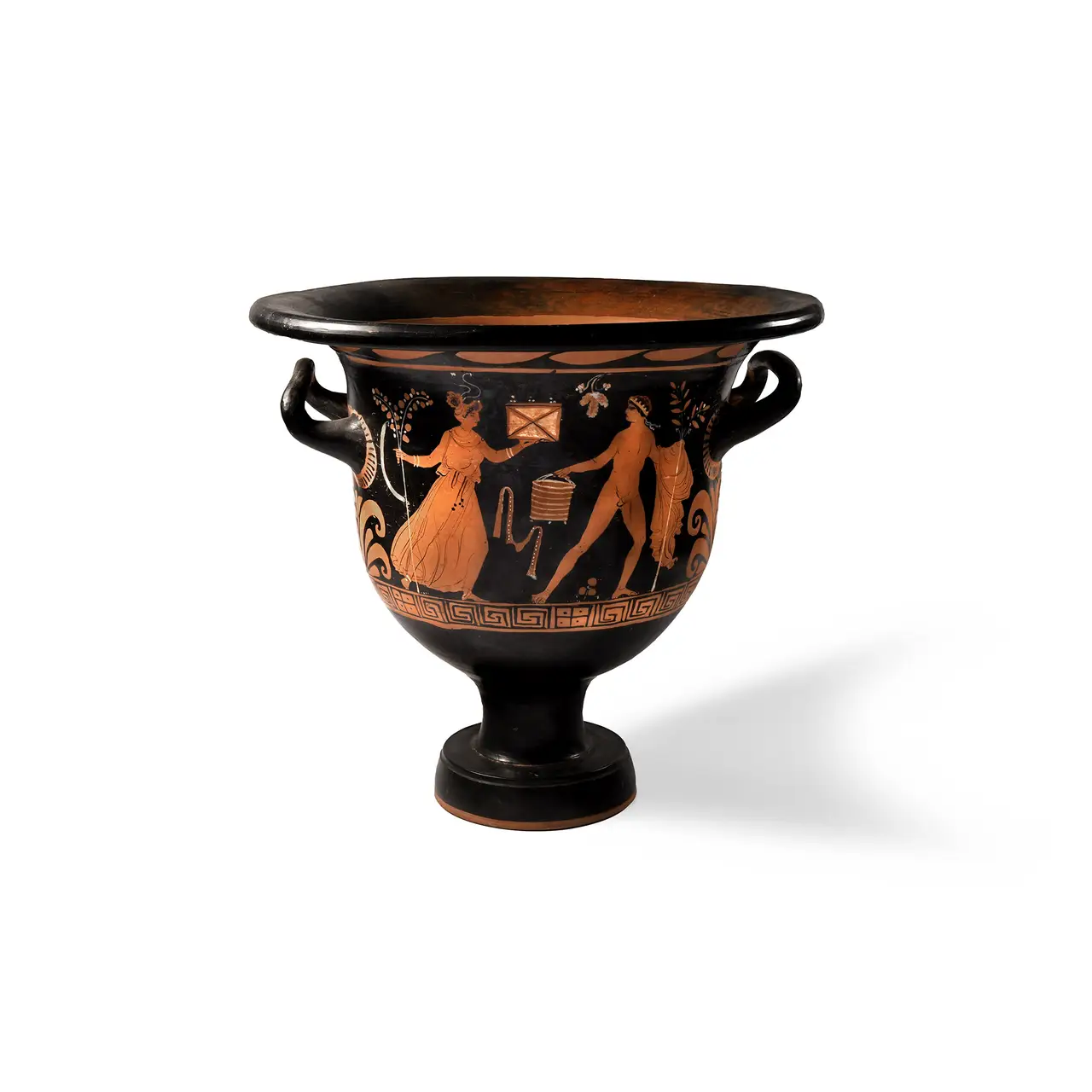
Hamilton collected with a reforming idea about what the vases were for. The painted figures on a Greek pot were, to his eye, the purest surviving record of ancient drawing, and he wanted them in front of British artists and manufacturers as "correct models" to be copied and learned from. Collecting, in his account of it, was a public service, an attempt to raise the taste of his own country by putting the best ancient design where designers could study it. It was a high-minded programme and he meant it. It also happened to suit a man who would need, more than once, to turn his collection into cash.
1772: The Year the Museum Changed
The Museum that bought the vases was barely a museum of art at all. Parliament had created the British Museum in 1753 out of three collections, the natural-history hoard and curiosities of Sir Hans Sloane, the Cotton manuscripts, and the Harley library, and it opened at Montagu House in Bloomsbury in 1759 as, in effect, a national library with a cabinet of natural specimens attached. For its first two decades it owned few antiquities of any weight. It had no royal collection of ancient art to build on, as the great continental museums did. That was the institution Hamilton walked into in 1771, on his first home leave in seven years, with a collection to sell.
He had reasons to sell beyond the public-spirited one: his accounts show him buying a house that September for £8,241. He also genuinely wanted the vases kept together in a great institution rather than scattered at his death. He opened negotiations with the Trustees; because the purchase money was public, it took an Act of Parliament to authorise it; and in 1772 the deal closed at eight thousand guineas, which is to say £8,400, recorded in the parliamentary papers as £8,410 once the stamp duty and fees were added.
It was the Museum's first major purchase of classical antiquities, and it changed the institution's direction. As Ana Gutiérrez-Folch has written, the acquisition "entirely changed the face and spirit of the British Museum," until then a repository of books, manuscripts and natural history. The vases seeded what would become the Department of Greek and Roman Antiquities. They were also the first in a sequence that defines the place to this day: the Egyptian sculpture that arrived after 1801, the Townley marbles in 1805, the frieze from Bassae in 1815, the Parthenon sculptures in 1816. The pots came first, and they set the road.
For a while the Museum honoured the source. The vases were shown together as Hamilton's collection at Montagu House and then, from 1808, in a "Hamilton Room" in the new Townley Gallery, lit at his own request in a strong light, and kept as a named group until the middle of the next century, when they were absorbed into the general holdings. More to Hamilton's purpose, artists were let in to draw them. The teaching the vases were meant to do began at once.
The Book That Changed Taste
Hamilton had meant to publish the collection from the start, and he did it on a scale that nearly matched the ambition. Between 1767 and 1776 he brought out, at his own expense, four enormous folio volumes of engravings of his vases, the text in French and English, many of the plates hand-coloured, printed at Naples and limited to five hundred copies. The books were luxury objects, designed in the prospectus's own words to decorate an apartment, fill a print portfolio, or stand in a library. They were also, frankly, advertising: by circulating his vases among the collectors and trustees of London, the volumes helped talk the British Museum into the 1772 purchase. And they were a pattern-book, the "correct models" laid out at folio size for anyone with the price of a subscription.
The scholarship in them was largely invented. Hamilton handed the text to a man calling himself the Baron d'Hancarville, in life Pierre-François Hugues, the son of a French cloth merchant and the most colourful figure in the eighteenth-century study of vases. He was a genuine linguist and a tireless fraud, a pornographer and bankrupt who in time robbed or swindled most of the English collectors he worked for, Hamilton, Charles Townley and Richard Payne Knight among them, and who finally absconded with the engraved copper plates of Hamilton's own books. His commentary ran to fantasy: he attached an Attic vase to the name of Raphael and read anything he could not explain as the relic of a secret religion. Ian Jenkins and Kim Sloan, whose 1996 study Vases and Volcanoes is the standard account of the collection, call him a cuckoo in the nest and "at worst a swindler." Winckelmann, who knew him, gave the plainest warning: when d'Hancarville is handling your gems, watch what he is doing with his hands. All of it went out under Hamilton's name.
On one point of substance, though, Hamilton was right and ahead of his field. The painted vases coming out of Campanian tombs were universally sold as "Etruscan." Hamilton, prompted by Winckelmann, argued that they were Greek, made by Greeks, on the evidence of their Greek inscriptions and of identical pieces turning up in the Greek cities of Sicily; finds at Athens and Melos later proved him correct. He kept the word "Etruscan" on his title page anyway, because it sold. The label carried a Grand-Tour glamour, and Hamilton was never above what sold.
The pattern-book did exactly what it was built to do, and it did it fastest in Staffordshire. In 1769 Josiah Wedgwood opened a new factory with his partner Thomas Bentley and named it Etruria, after the false label on Hamilton's vases. On the opening day, 13 June, Wedgwood threw six black vases by hand and had them painted with Hercules in the Garden of the Hesperides, a scene lifted straight from a plate in the first volume of Hamilton's folios and copied from a vase Hamilton owned, the Meidias Hydria. Around the foot of the vases ran the motto Artes Etruriae Renascuntur: the arts of Etruria reborn. Ten years on, Wedgwood's catalogue was still selling its "Etruscan" wares as copies after "the most choice and Comprehensive Collection of Sir William Hamilton; which… is now placed in the British Museum." d'Hancarville had even printed the vases' measurements, so that a potter could match the shapes.
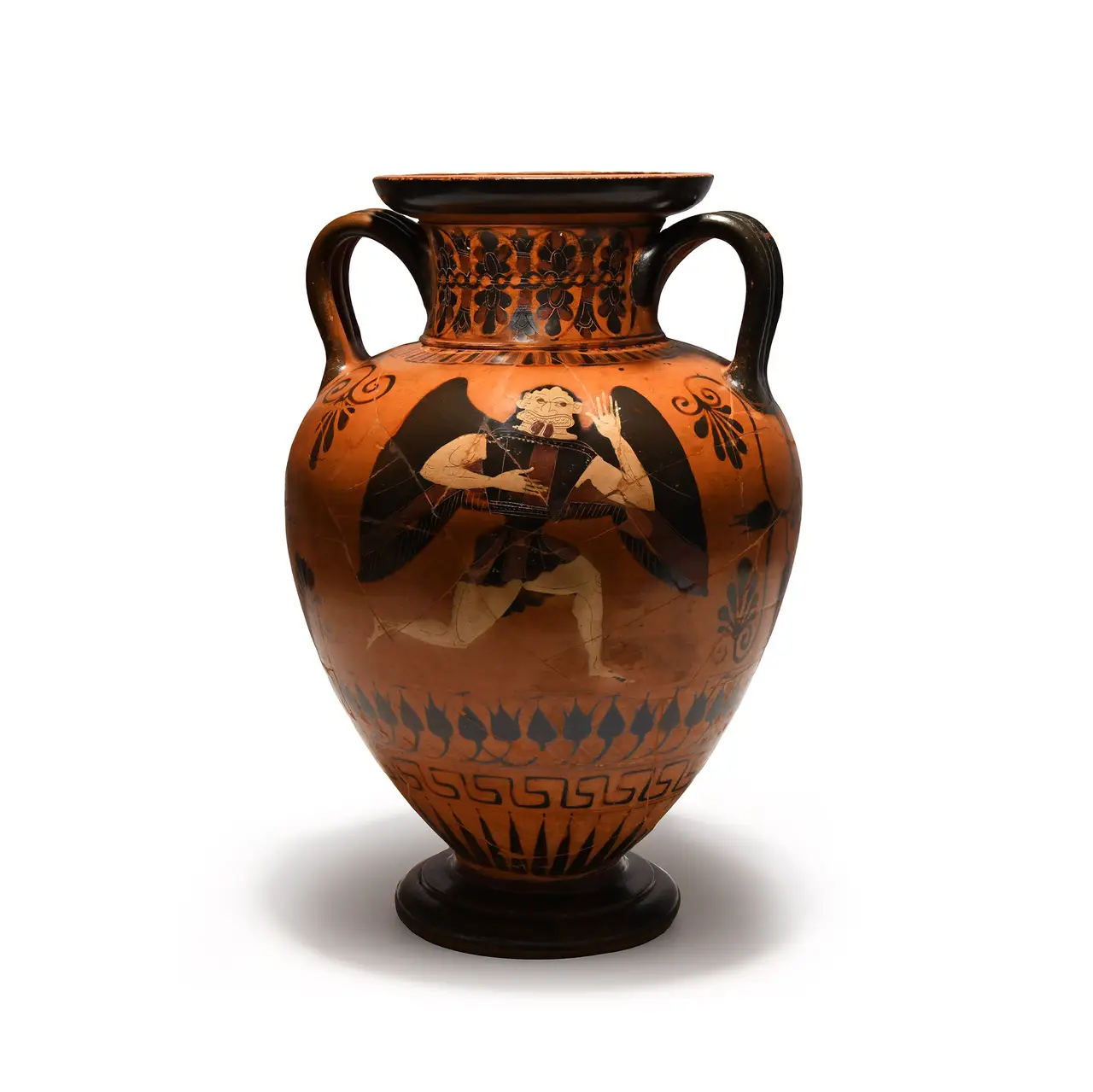
From there it spread. Robert Adam built an "Etruscan Room" at Osterley; the long silhouettes of Greek pots worked their way into furniture, into silver, and into the outline drawings of John Flaxman; a Europe-wide appetite for the antique took hold that contemporaries simply called vase mania. Far more people met Hamilton's vases as engravings than ever stood in front of the originals, and the engravings, fabricated commentary and all, did the work he wanted. British taste turned from Rococo toward the antique, and a private cabinet in Naples was one of the hinges it turned on.
Vases and Volcanoes
Wilhelm Tischbein, the painter who later engraved Hamilton's second collection, remembered him as a man who "loved two things in particular, Greek vases and volcanoes." Allan's portrait had put the first on its pedestal and the second in the window. Hamilton climbed Vesuvius again and again from a villa he kept at Portici as an observatory. Michael Vickers counts some three hundred ascents of the slopes and fifty-eight visits to the crater, several of them dangerous: a stone thrown up by the mountain struck one of his guests, the Bishop of Derry, and another block once landed a few feet from Hamilton. Naples called him le Pline moderne, the modern Pliny, after the elder Pliny who had died observing the eruption that buried Pompeii.
He watched, and he wrote it down. On Good Friday in 1767 he stood close enough to a lava flow to describe it as "a river of red hot and liquid metal, such as we see in the glass-houses," and noted, drily, that the city's panic subsided only when the relics of San Gennaro were carried out to confront the mountain. After the eruption that swallowed Torre del Greco in 1794 he set down the line that best catches his cast of mind: "Ten thousand men, in as many years, could not, surely, make such an alteration on the face of Vesuvius, as has been made by nature in the short space of five hours."
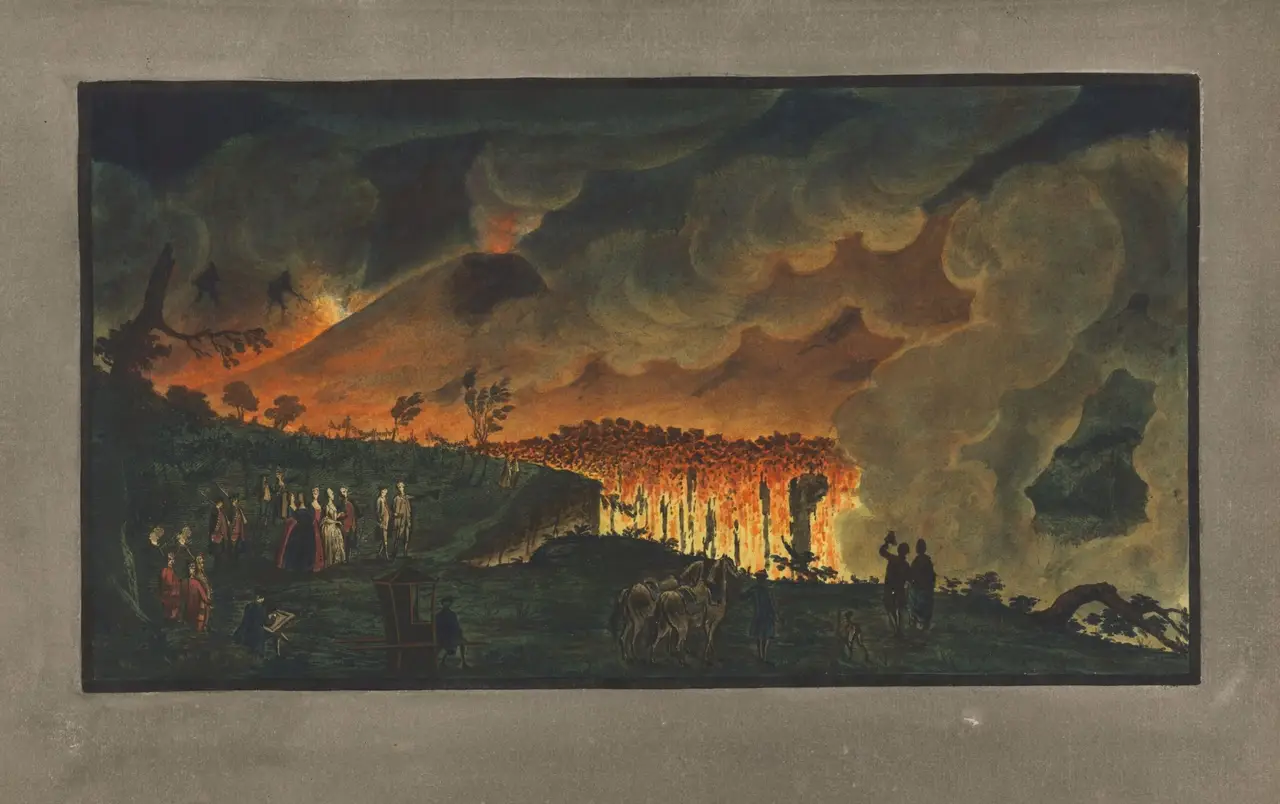 A night eruption of Vesuvius watched by onlookers, plate from Sir William Hamilton's Campi Phlegraei, 1776, hand-coloured after drawings by Pietro Fabris. Public domain, via Wikimedia Commons.
This was the same man and the same method. His letters were read out at the Royal Society and printed in its Philosophical Transactions; they won him the Copley Medal in 1770 and were gathered into a book in 1772, the year the Museum bought his vases. His great volcanic monument, Campi Phlegraei of 1776, carried fifty-four hand-coloured plates after the painter Pietro Fabris and, like the vase folios, nearly ruined him to produce. He distrusted theory built indoors, the "sistems" that other men "performed in their closets," and trusted only what he had seen, repeatedly, with his own eyes, in what he called "that great laboratory of nature." Historians of science now treat that stubborn empiricism as something close to the beginning of modern volcanology. It is the same temperament that bought the vases: look hard at the actual object, publish what you see, distrust the system that explains it away.
The Dealer Behind the Connoisseur
For all the language of public service, Hamilton was a working dealer, and his contemporaries knew it. He sold collections when he needed money, which was often, and the vases he prized as correct models had been pulled out of Campanian graves, his own hands sometimes among the diggers, and shipped abroad against Neapolitan export bans. The trade he fed sold such things, without embarrassment, as elegant ornaments for a chimney-piece. The two most famous pieces of glass and marble in his story are really dealer's stock.
The first is the Portland Vase, the finest piece of Roman cameo glass to survive, a small two-handled vessel of dark blue cased in carved white and made around the time of Augustus. It had belonged for a century and a half to the Barberini family in Rome; when a gambling Barberini princess needed money around 1780 she sold it to the Scottish dealer James Byres, and Byres sold it on to Hamilton for something like a thousand pounds. Hamilton carried it to London and, short of cash as usual, sold it at a healthy profit to the Dowager Duchess of Portland. From her heirs it went, on loan, to Josiah Wedgwood, whose jasperware copies of it around 1790 became the most admired things he ever made. The vase reached the British Museum, where a vandal smashed it in 1845 and a Museum restorer painstakingly rebuilt it. Through every step it kept the name of the Roman family or the English duchess. It was never the Hamilton Vase. He was the man who moved it, not the man it was named for.
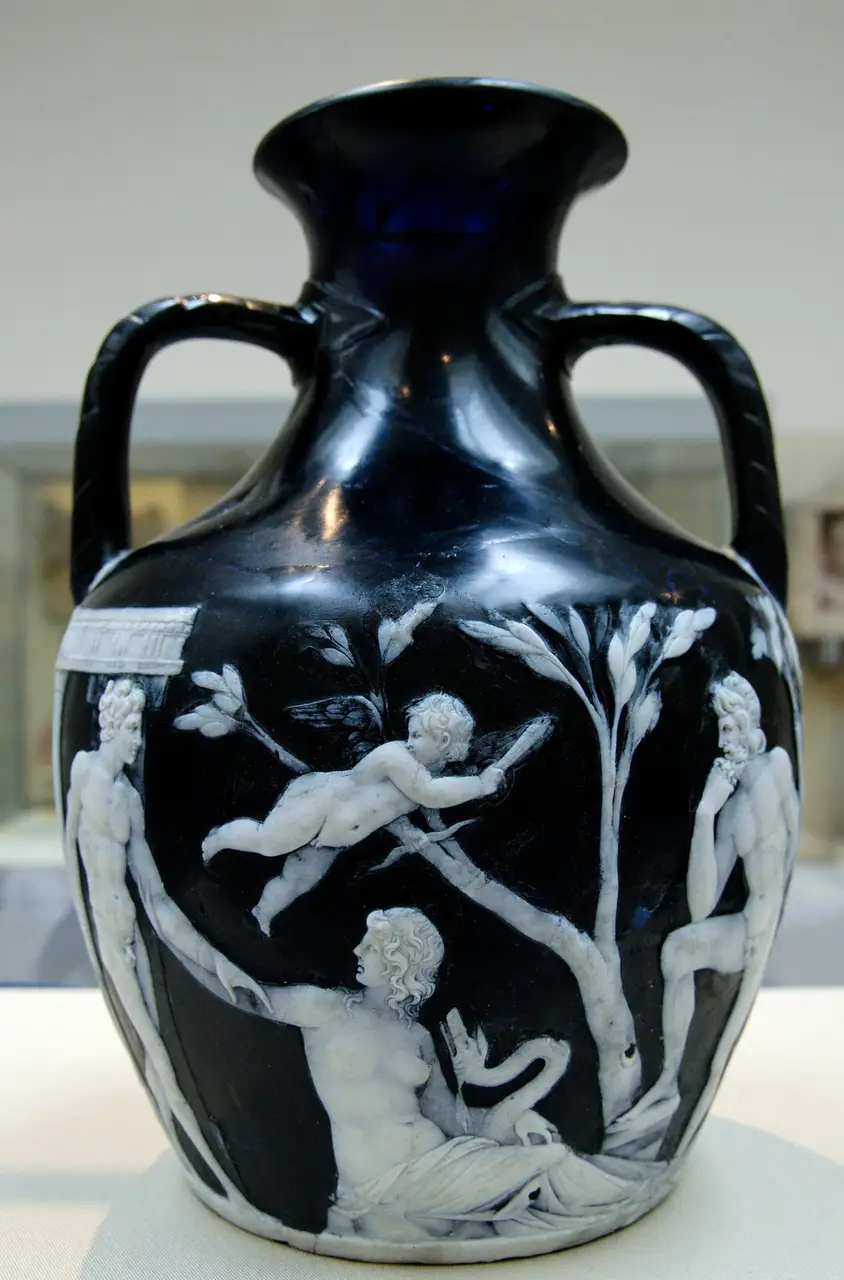 The Portland Vase, Roman cameo glass made around the time of Augustus, now in the British Museum. Photo: Marie-Lan Nguyen, CC BY 2.5, via Wikimedia Commons.
The second piece is a trap for the unwary. The Warwick Vase, a colossal marble wine-bowl of the second century, big enough to hold a hundred and sixty gallons, was dug in fragments from a pond at Hadrian's villa near Tivoli and rebuilt on a new marble core. It was found and restored by Gavin Hamilton, a Scottish painter and dealer in Rome of no relation to Sir William, a confusion that has dogged both men ever since. Sir William bought the restored vase and tried to sell it to the British Museum, as he had sold his pots; the Museum would not take it. "Keep it I cannot," he wrote, "as I shall never have a house big enough for it." It went instead to his nephew the Earl of Warwick, and so to Warwick Castle and, in our own time, to Glasgow. The appetite his vases had created had limits.
The Second Collection, and the Wreck
Hamilton had sworn off vases after 1772, and could not keep the oath. When Naples lifted its ban on excavation in 1789 he was back among the fresh tombs, collecting, as he admitted to his nephew, voraciously: "I have not let one essential vase escape me." This second collection leaned more heavily on Attic ware, and he published it again, this time through Tischbein and deliberately cheaply, in plain uncoloured outline, so that working artists could afford the models and copy them. Tischbein's spare line went straight into Flaxman's drawings and, through Flaxman, into Blake.
This time the collecting ended in salt water. As the French Revolutionary armies closed on Naples, Hamilton packed his vases into twenty-four cases and got eight of them aboard a homebound warship, HMS Colossus. On 10 December 1798 the Colossus was wrecked off the Isles of Scilly, and the eight cases, an estimated three hundred vases, went down with her. Hamilton consoled himself that drawings had been made of all of them, a claim Susan Woodford, who has studied the wreck, calls an exaggeration. Nearly two centuries later divers recovered some thirty thousand fragments from the seabed; they are in the British Museum now, sorted into about a hundred and twenty broken vases, and they have let scholars see exactly where Tischbein's engravers had quietly tidied up the originals.
What survived of the second collection was packed off to Christie's and saved from the auction at the last moment by the designer Thomas Hope, who bought the lot privately around 1801 for four thousand pounds. Hamilton had wanted seven, then five. The Hope vases went to Hope's house at Deepdene and were dispersed at last in the twentieth century, into the Fitzwilliam, the Ashmolean, the British Museum and beyond. The South Italian and Attic vases Hamilton chased through the Campanian tombs still surface in the salerooms today, where they remain among the more approachable antiquities a private collector can own; TimeLine's Greek and South Italian pottery is one place to meet them.
Emma, Nelson, and the Name That Stuck
The woman who would eclipse all of this came to Hamilton, in the most eighteenth-century way imaginable, as a gift from his heir. Catherine Barlow had died at Naples in 1782. Four years later Hamilton's nephew Charles Greville, deep in debt and needing to marry money, sent his own mistress out to his widowed uncle, to be taken off his hands and out of his accounts. Her name was Emma Hart, born Amy Lyon, a blacksmith's daughter from Cheshire who had worked in London as an artist's model. She believed she was going to Naples on a visit. She was being handed on.
In Naples she became famous on her own terms. She developed what she called her Attitudes: dressed in loose shawls, framed in a tall black-edged box that Hamilton had built for the purpose, she held a sequence of silent poses drawn from antique statues and from the figures on her husband's vases, and much of cultured Europe came to watch. Goethe, who saw the performance, left the fullest description of it. George Romney painted her again and again. The painted women on Hamilton's pots had stepped down into his drawing-room and taken the shape of his wife, twenty-six to his sixty when they married in 1791.
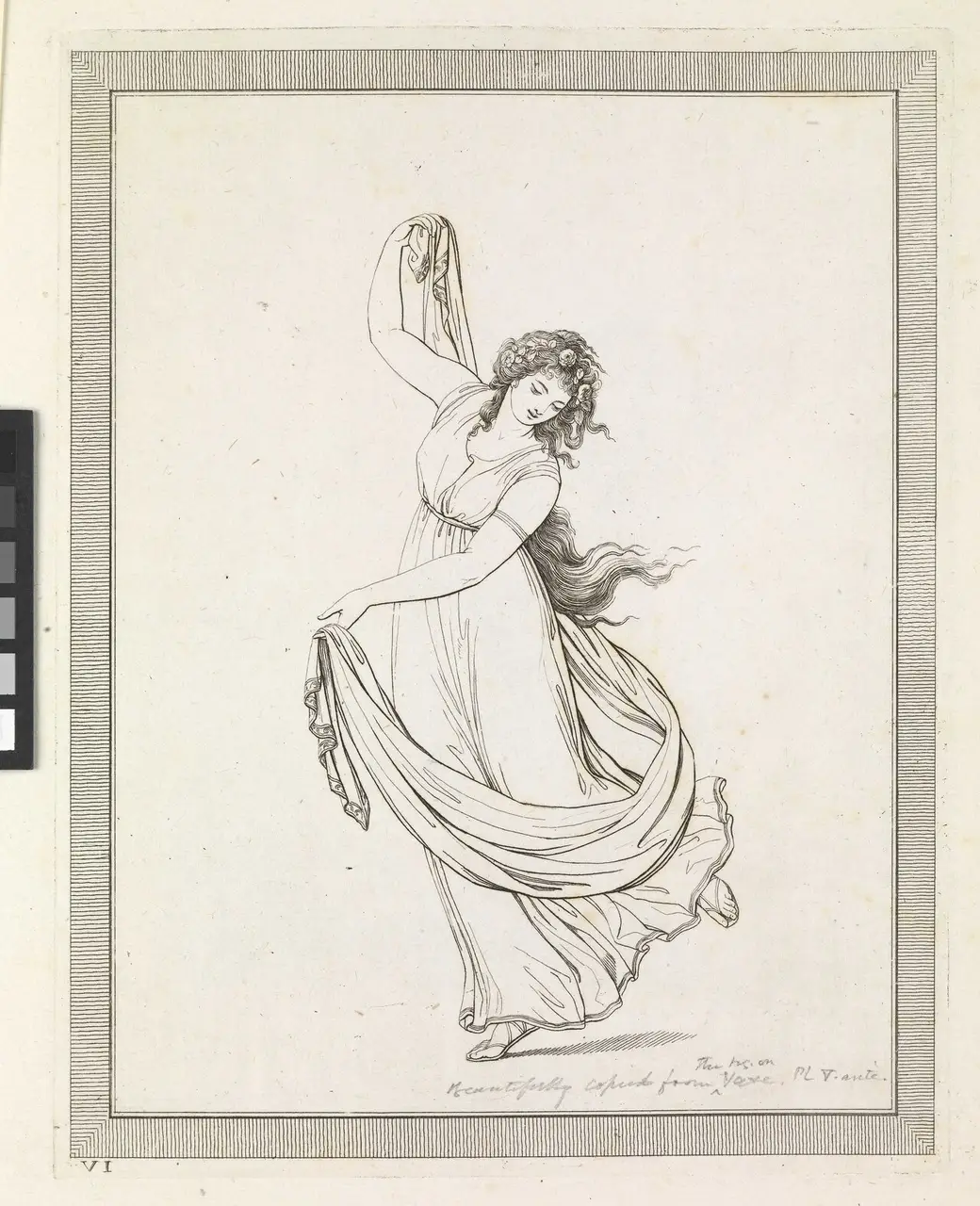 Emma, Lady Hamilton, in one of her "Attitudes." Engraving by Thomas Piroli after Friedrich Rehberg, 1794. Public domain, via Wikimedia Commons.
Then the war brought Nelson. Hamilton had met him in 1793; after the Battle of the Nile in 1798 the admiral and Emma became lovers, and the three of them settled into a household the newspapers and caricaturists never tired of, three joined in one, as they styled themselves. Emma bore Nelson a daughter. Hamilton, old and overtaken, carried the arrangement with a tolerance that was, by every account, genuine and far from serene. He died in London in 1803, by Emma's telling in her arms and holding Nelson's hand, though the telling is Emma's. His will left the bulk of his estate to Greville and only a modest annuity to his widow, with a warm word for Nelson. Two years later Nelson was dead at Trafalgar, having asked his country to provide for Emma; it declined. She died, drunk and bankrupt, at Calais in 1815.
The vase Wedgwood copied, the Meidias Hydria, is still in the British Museum, a few rooms from the marbles and the mummies that came in behind it. The rest of the first collection is there too, long since folded into the general holdings, the Hamilton Room closed and forgotten. Nothing in the building is named for him. The Portland Vase kept the name of a Roman cardinal and an English duchess; the Warwick Vase took the name of a castle he never owned; the pots that made the Museum a museum of art are simply Greek vases now, the old owner's name worn off them. He gave the nation its first collection of ancient art and got, in the public memory, a walk-on part in another man's love story. He lies in Pembrokeshire, beside Catherine Barlow, whose five thousand a year had bought the first vase of all.
TimeLine Auctions, 9th July 2026