Home > Stories by TimeLine Auctions
Stories by TimeLine Auctions
Slip, Paint, Glaze: How Cultures Coloured Clay and Stone
In the Worcester Art Museum there is a white-ground oil flask, a lekythos, painted in Athens around 450 BC by the hand known as the Achilles Painter. Two women stand at a grave. One still wears the dull red of her dress; the other, facing her, has been stripped to a bare outline and now seems to stand there naked, which no Athenian painter ever intended at a tomb. The clothing was there at the start, brushed on in reds and blues and yellows after the pot came out of the kiln, and over twenty-five centuries that added colour has gone, while the drawing beneath it, fired into the surface, stays as sharp as the day it was set down. The loss is so common on these grave-flasks that, as John Oakley, who catalogued the white lekythoi, notes, their figures often seem to wear transparent garments, the painted cloth vanished and only the outlines left.
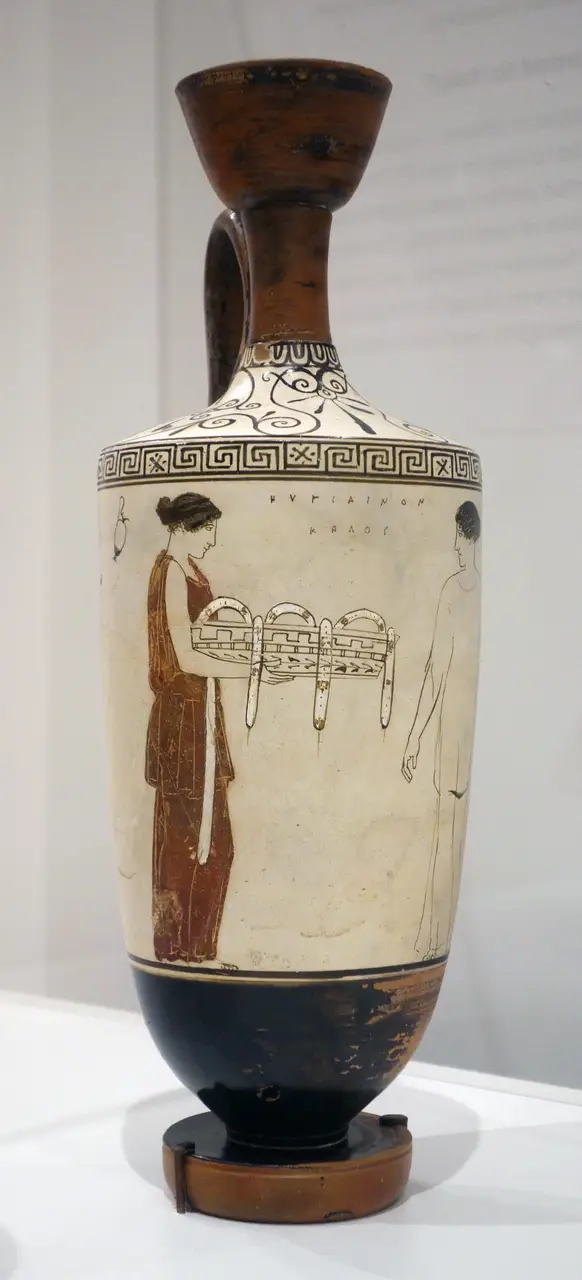 White-ground lekythos attributed to the Achilles Painter, Athens, around 450 BC. The woman keeps the red of her dress, while the figure beside her, its painted clothing lost, survives only as outline. Worcester Art Museum, 1900.65. Photo: Mark Landon, CC BY 4.0, via Wikimedia Commons.
Two kinds of decoration on one small pot, then, with opposite fates: lines that survived intact and colours that vanished without a trace. The difference between them is the whole subject. It is also, once you have it, a key that opens the decorated surfaces of half the ancient world, from a Babylonian gate to the buried army of the First Emperor, because the same rule decided what we can still see and what we have lost almost everywhere.
The rule is about when the colour met the fire.
Fired In, Melted On, Laid On Top
Strip away the vocabulary and there are only three things you can do to the surface of a pot or a statue, and they are not variations on a theme. They are three different materials doing three different jobs.
A slip is clay. A potter takes the finest fraction of a clay, suspends it in water to a thin cream, and coats the unfired object with it; in the kiln the slip hardens into the body as one piece, because it is the same substance as the body. One archaeology handbook defines it as plainly as the thing deserves: "a thin layer of fine clay adhering to the surface of a vessel and fired with it." Because a slip is fired into the pot, it does not flake. Its limit is colour. A slip can only be the colours that clay minerals turn in a kiln, which means iron and a little manganese, which means reds, oranges, browns, blacks and creams. That is the entire native palette of fired earth.
Paint is a pigment carried in a binder and laid on top, usually after firing. Free of the kiln's constraints, paint can be any colour a ground mineral or a manufactured powder will give: bright blue, green, vermilion, gold. Its limit is permanence. The binder is organic, egg or glue or wax or resin, and organic things rot. After centuries in the ground the binder has perished and the pigment is left as a loose powder, held to the surface by nothing. Conservators have a simple diagnostic for the difference: when an excavated pot dries out, its fired-on slip designs grow more stable, while its cold-painted designs dry, powder and flake away. The lekythos lost its clothes for exactly this reason.
A glaze is glass. It is silica melted with a flux until it flows and fuses to the surface as a thin coat of true glass, a different class of material from clay or pigment. Anna Shepard's Ceramics for the Archaeologist taught two generations of excavators to keep the categories apart, and Vladimir Fewkes set the boundary at its sharpest: "a glaze is not a slip. Glazing depends upon physical and chemical alterations which are totally absent in slips." P. R. S. Moorey, surveying the materials of ancient Mesopotamia, drew the other line as cleanly: "a glaze differs from a paint in that it has to be fused at high temperatures whereas the medium of paint is organic and will burn on heating." Glass survives; it also reaches colours clay never could.
The survival of ancient colour, then, comes down to one thing asked of every decorated surface: whether the colour was fired into the clay, melted into glass, or laid on top in something that rots. The first two last. The third is borrowed time. Everything that follows is what different cultures did inside those three limits.
Why Greek Vases Are Black and Orange
The clearest demonstration sits on the most familiar objects in any antiquities gallery: the black-and-orange figured vases of archaic and classical Greece. Almost everyone who looks at them assumes the black is a paint, or a glaze. It is neither. It is a slip, an iron-rich clay refined to a suspension of particles under a third of a micron across, applied as a coating only a few hundredths of a millimetre thick. That slip gives the lustrous black; the bare clay body gives the orange-red ground; no extra pigment goes on at any stage. The kiln does the rest.
The trick is a single firing taken in three breaths. The potter first heats the sealed kiln in open, oxygen-rich air to somewhere around 900 degrees; iron in both the body and the slip turns to red hematite, and the whole pot glows red. Then the vents are closed and green wood or wet sawdust is thrown in, filling the chamber with carbon monoxide. Starved of oxygen, the red hematite converts to black magnetite, and the pot goes black all over; at the same moment the fine, potassium-rich slip sinters and seals itself into a glassy skin, while the coarser, lime-rich body stays open and porous. In the third breath the vents are reopened. Oxygen floods back, the porous body breathes it in and reverts to red, but the sealed slip cannot take up oxygen and is locked black. As Joseph Veach Noble established in his classic reconstruction of the technique, the black surface "becomes a partly sintered mass so dense that it does not permit the re-entry of oxygen." The red and the black are the same iron, divided only by whether the surface could still breathe. The colour, in Noble's words, "is not created by the addition of a special ingredient or pigment."
This one slip, placed three ways, gave the Greeks their three great styles. In black-figure, the older manner that Corinth was using around 700 BC and Athens by 620, the figures are black silhouettes laid in the slip, their inner details incised through it with a needle to let the orange clay show, with touches of added red and white on top. Red-figure, which Athens worked out around 530 BC, reverses the scheme: the background is filled in with the slip and the figures left in reserve, their details now painted with a brush, full-strength slip standing proud in raised "relief lines," the same slip watered down to a translucent golden brown for softer shading. White-ground, the technique of the Worcester lekythos, lays a separate white slip as a ground and saves the bright work for last, applied cold, after the fire. The first two styles survive whole. The third, leaning on cold paint, does not.
These vases, or more often their smaller and broken kin, are among the antiquities a private collector is most likely to meet. When a black-figure lekythos crosses the cataloguing table, the first thing we read is the surface: which marks are slip fired into the clay, which are the sintered gloss, and which are the added red and white that may since have flaked. A good deal of what a piece is worth, and of whether it is what it claims to be, is written there.
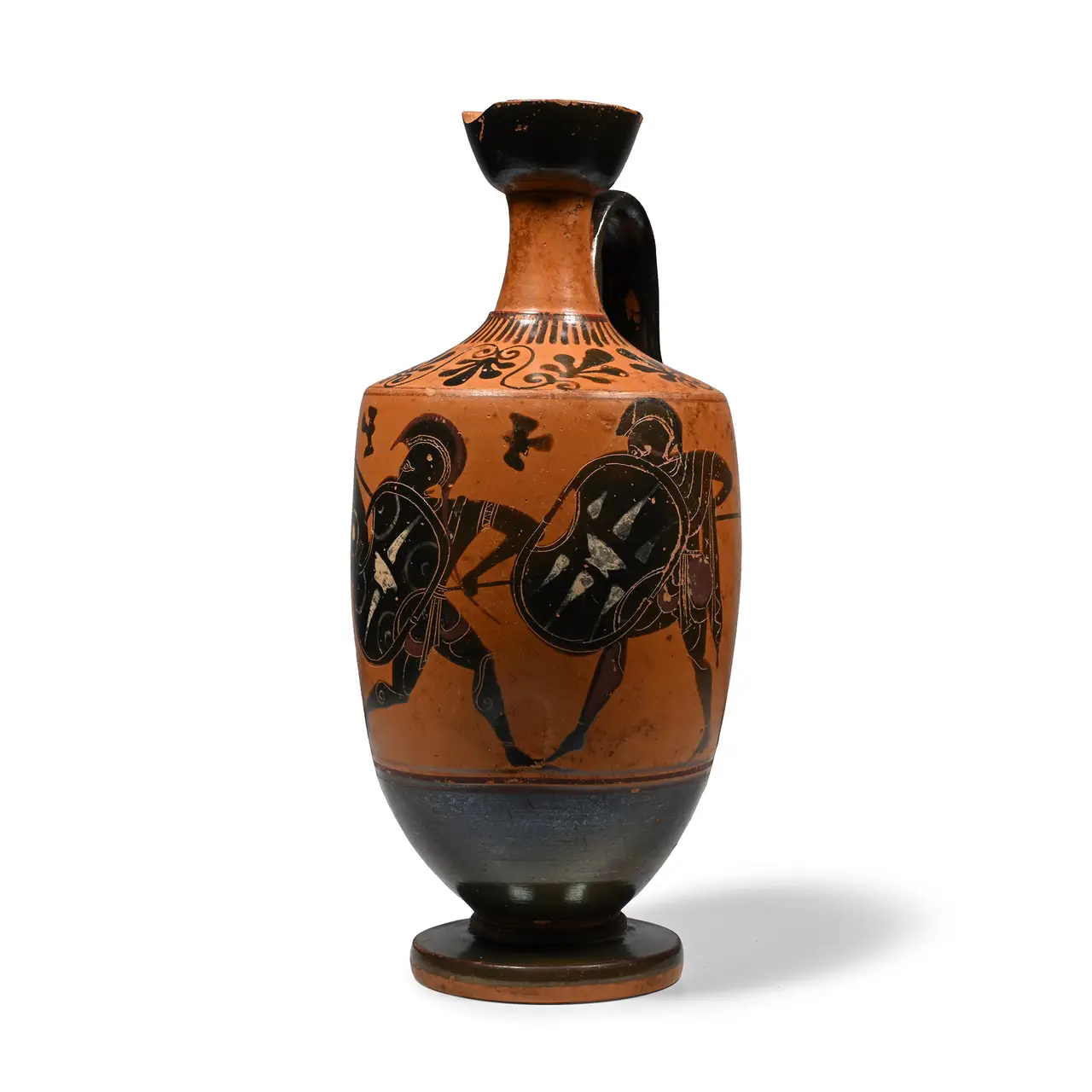
Even the name for the black is contested, which tells you what an odd material it is. "Glaze," "varnish," "lacquer" and the German "Firnis" have all been used, and all are wrong, since the surface is a sintered clay slip that never fully melts and carries no more silica than the body beneath it. Specialists settled on the neutral "gloss," a term R. J. Charleston had used for Roman pottery and Mavis Bimson pressed into Greek studies in 1956. Even so the question will not close. Two arguments still run through the laboratories. The first is whether body and gloss are one clay or two: older authorities, Noble and John Boardman among them, held they were a single clay separated only by particle size, while the team at the Demokritos laboratory in Athens, led by Yannis Maniatis and Eleni Aloupi, has shown the gloss to be a distinct, lime-poor, iron-rich clay from a separate bed. The second is whether the firing really was one three-stage cycle, as everyone long assumed, or several: a Getty synchrotron study in the 2010s found two superimposed gloss layers and argued for repeated firings, and the Demokritos group replied that the same layering forms in a single cycle from the clay's own minerals. Few ancient surfaces have been examined as exhaustively, and it is still under argument.
The Colour Clay Could Not Reach
The earth palette stops before it reaches blue, and that single limit divides the potters of the world. Iron and manganese, the two cheap colorants any clay bed offers, will give a potter red, orange, brown, black, purple and cream, and nothing past them. A pure blue or a bright green cannot be fired onto a low-temperature clay surface at all. The ceramicist Prudence Rice states the limit flatly: "colors such as pure yellow, blue, and green are virtually impossible to achieve on low-fired pottery except by special additives ... or as postfiring pigments." The chemistry is unforgiving. The blue copper minerals a potter might reach for, malachite and azurite, do not survive the kiln; they decompose in the fire to a dull black oxide of copper. Even the manufactured blue the Egyptians invented could only be brushed onto a pot after firing, where it tended to flake off as soon as the pot was handled.
So the world's potters split, and the line between them was temperature. To reach blue and green you had to make glass: a glaze, fused hot enough that copper dissolved into it would hold a colour, turquoise in an alkaline melt, grass-green in a lead one. Cultures that mastered high-temperature glaze could decorate in colours the slip-painters never touched. Cultures that did not, however accomplished their potting, were held to the iron earths. Skill had little to do with it. The divide was set by which fires people could light.
The Cultures That Made Glass
The oldest answer to the wall at blue is also the oddest, because it is barely pottery at all. Egyptian faience, the blue-green stuff of shabti figures and broad collars and the little hippopotamus in New York that curators nicknamed William, contains almost no clay. Its body is crushed quartz, up to ninety-nine per cent silica, worked into a paste and coated in a soda-lime glass glaze coloured with copper. It is among the oldest vitreous glazes known, in use by the middle of the fifth millennium BC, and the Egyptians called it tjehnet, "that which is dazzling," and prized it as a made substitute for turquoise and lapis lazuli. Cleverest of its tricks, it could glaze itself: soluble salts mixed into the paste migrated to the surface as the object dried and fused there in the fire, so the glaze grew out of the body instead of being laid onto it. (Other methods existed, one of them, burying the piece in a reactive powder, recorded as a still-living craft at Qom in Iran as recently as the 1960s.) Faience is the cleanest proof of the rule: to get blue you change the material, not the brush.
Babylon turned the same chemistry into architecture. The Ishtar Gate and the Processional Way that Nebuchadnezzar II raised in the early sixth century BC were faced in glazed brick of a deep lapis blue, against which strode rows of lions, bulls and dragons in white and gold. The animals are not painted onto flat tiles; they are modelled in relief on the faces of ordinary structural bricks, each beast assembled from dozens of separately moulded and glazed blocks, around forty-five bricks to a single bull, the figure standing thirteen courses tall. When the German archaeologist Robert Koldewey excavated the gate between 1899 and 1917 it came up as a heap of some three hundred thousand brick fragments, many of them glazed, from which the version now in Berlin's Pergamon Museum was reassembled. Nebuchadnezzar's own foundation inscription describes the result as built of shiny blue glazed brick. The deep blue came from cobalt in an alkaline glaze, with copper for the greener turquoise, the way the Near East then had to fix such colours in fired clay. (One correction the chemistry forces: the white in these glazes was opacified with calcium antimonate, not tin. Tin-white was an Islamic invention, still more than a thousand years off.)
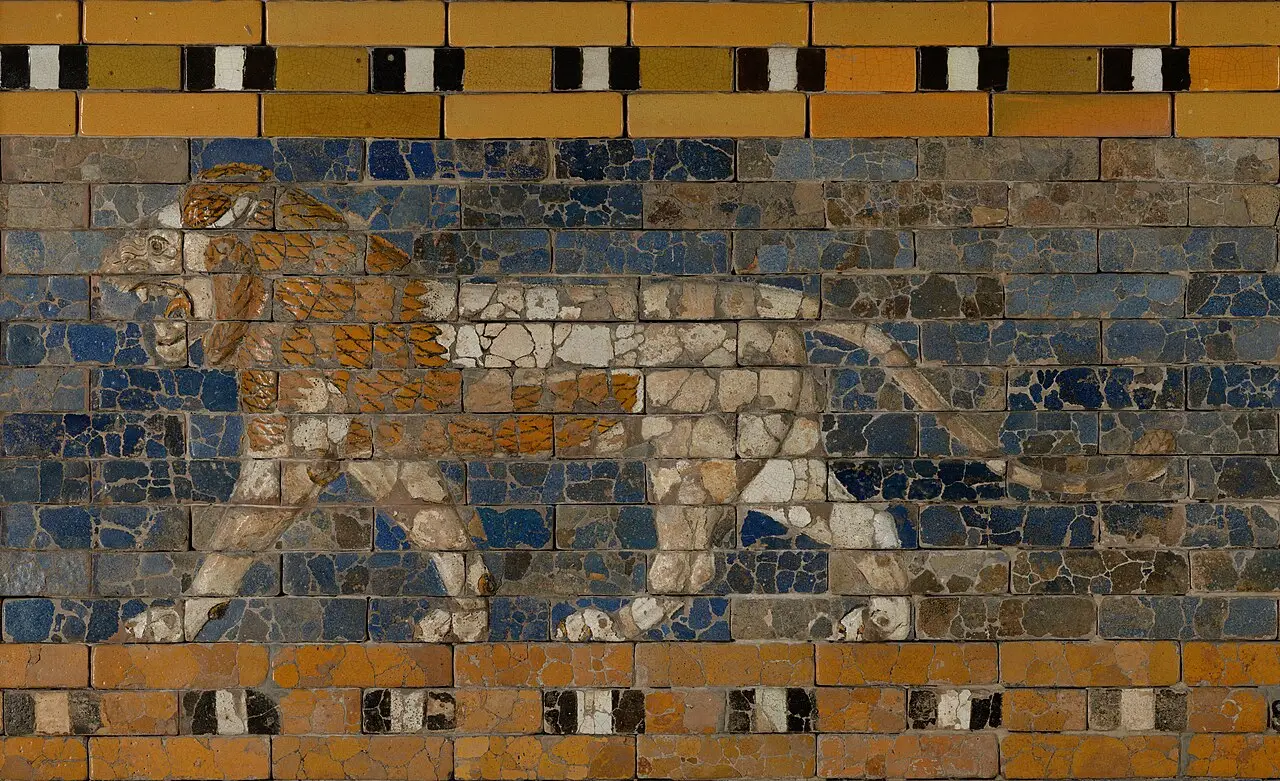 A lion of the Processional Way at Babylon, modelled in relief and glazed in blue, white and yellow over baked brick, raised under Nebuchadnezzar II in the early sixth century BC. Pergamon Museum, Berlin. Public domain, via Wikimedia Commons.
China went furthest of all, by making the fire itself the decorator. Where the Mediterranean leaned on slip and cold paint, East Asian potters drove their kilns hot enough to melt glaze and body into one another. Tang workshops around 700 AD produced the splashed sancai, "three-colour," tomb figures, their lead glazes running green from copper, amber from iron and blue from cobalt over a white slip, left deliberately to flow and pool in the heat. Higher still came the great stoneware and porcelain glazes: celadon, an iron glaze fired above 1150 degrees in a starved, reducing kiln to a green the colour of jade, its depth engineered from a thick glaze full of tiny bubbles and crystals that scatter the light; and true porcelain, white and translucent, fired as hot as 1400 degrees, which European potters could not match until the eighteenth century. The decisive refinement was blue-and-white, where cobalt is painted straight onto the raw body and sealed under a clear glaze before a single firing fuses the lot. Painted under glass, the blue can never flake. It is the exact inverse of the lekythos: colour put on before the fire, and locked in by it.
And it was a glaze, in the end, that carried this technology toward Europe. In Abbasid Iraq, across the eighth and ninth centuries, the potters of Basra, trying to imitate the white Chinese wares arriving by sea, learned to opacify a glaze with tin into a dense white ground and to paint that ground in cobalt blue and copper turquoise. The tin-glazed white, painted in blue, is the direct ancestor of a long line: Persian and Ottoman wares, Spanish and Italian maiolica, Dutch delft, the blue-on-white china of every later European table. The wall at blue, first breached in Egypt five thousand years earlier, had become the foundation of an industry.
The Slip-Painters Who Had No Glaze
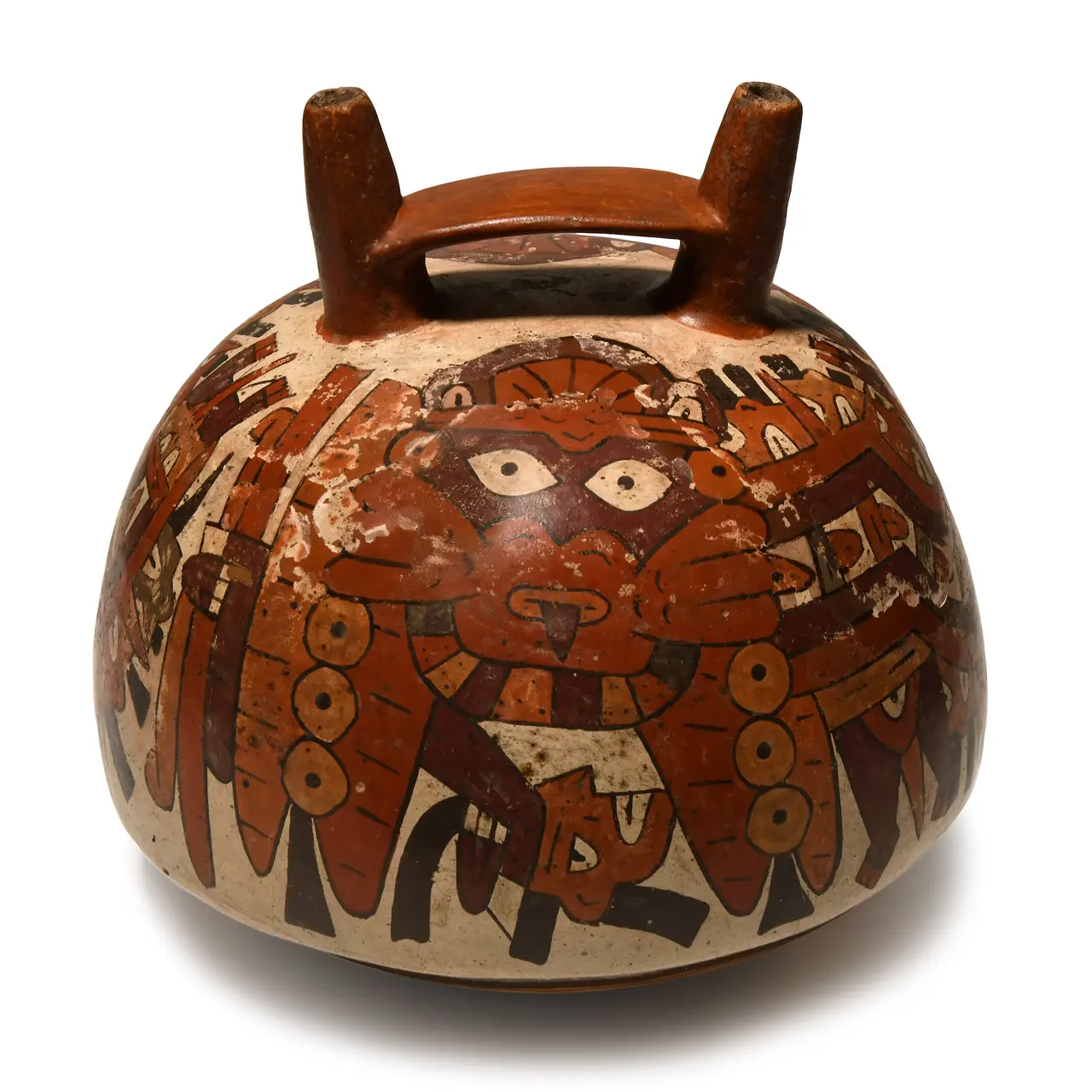
Run the same test on the other side of the world and the result inverts. The potters of the pre-Columbian Americas were masters of slip, and they had no true glaze at all; glazing, as one survey of indigenous technologies states flatly, "was introduced by the Spanish." They worked the iron earths with complete command, and stopped exactly where the chemistry stopped. Moche artists in Peru painted fineline narratives, and the only individualised portraits in ancient American art, in two slips, red on cream. Nazca potters built one of the broadest slip palettes of the ancient world, outlining mineral colours in black and firing them in oxygen; older accounts, following Donald Proulx, speak of up to fifteen distinct pigments, though, as the archaeologist Patrick Carmichael cautions, the dazzling many-coloured pieces are the carefully selected few and much surviving Nazca pottery is plain or painted in only a handful of colours. Even at its richest, it was a palette of earths, fired low.
The exception proves the rule. The Maya did have a famous, durable blue, the colour now called Maya blue, that holds on murals, on pottery, and on the bodies of victims thrown into the sacred well at Chichén Itzá, resisting acid, alkali and weather better than almost any pigment known. It is neither a slip nor a glaze. It is a manufactured paint: indigo, a plant dye, locked into the microscopic channels of a clay called palygorskite, a marriage of dye and mineral so durable that chemists were slow even to recognise it as part-organic. To reach a blue that lasted, a culture without glaze had to invent something else entirely, which is the lesson of the whole subject. Blue is never free. (The two moments when American potters did stumble on a real glass glaze only sharpen the point by their smallness. The Puebloan potters of New Mexico, around AD 1300, made a genuine lead glaze from roasted galena, and used it solely as a paint to draw lines and fill outlines, never as an all-over coat; a technology the rest of the world used to flood a pot with colour was here a drawing tool, and they had given it up by about 1700.)
The White Marble That Was Never White
Return now to where we began, to colour laid on top and lost, and follow it off the pot and onto the figure, because the most famous victims of fugitive paint are not vases at all. They are statues.
The white marble of classical antiquity, the white we take as the very emblem of Greek restraint, is an accident of survival and a long misunderstanding. The sculpture was painted. "It is now generally accepted," the art historian Mark Bradley writes, summing up a hard-won consensus, "that most, and perhaps all, Greco-Roman marble sculpture and architecture received some form of supplementary coating," hair and lips and eyes and drapery picked out in colour, the backgrounds of reliefs laid in flat bright fields. The paint went over the carved stone in an organic binder, encaustic wax or egg tempera, and like all such paint it perished. What we read as the pure white of marble is bare stone with its colour gone. The Acropolis korai still carry traces, red in the hair, patterns on the dress; the Alexander Sarcophagus in Istanbul kept enough Egyptian blue and azurite to reconstruct its scheme; the Augustus from Prima Porta, cleaned in 1999, gave up six or seven pigments, among them the blue painted along the fringe of his tunic to stand for purple, colour used as a sign rather than a copy of life.
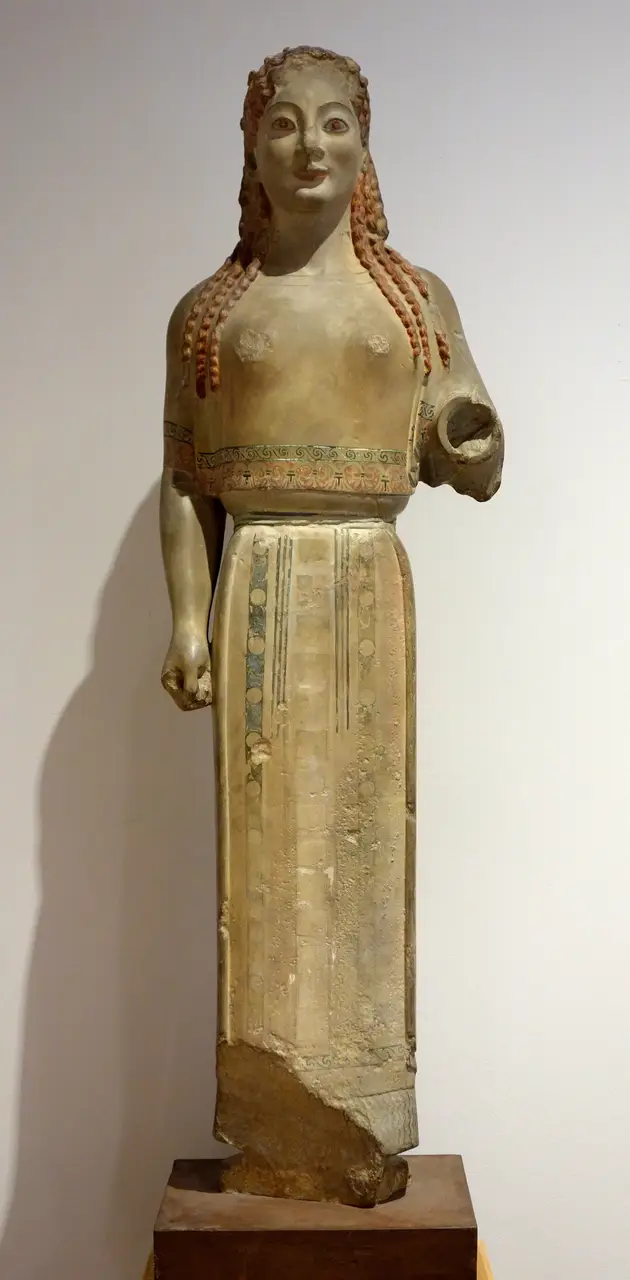 A painted plaster cast of the Peplos Kore (Acropolis kore 679), the colour reconstructed by Émile Gilliéron in the early twentieth century: red hair, a patterned dress, eyes and lips picked out. The marble original, its paint long gone, is the "white" statue we inherited. Photo: Mark Landon, CC BY 4.0, via Wikimedia Commons.
The white ideal that buried all this was itself manufactured, in Renaissance Rome, as the classical statues came out of the ground already stripped, and it hardened into doctrine with Winckelmann's praise of their "noble simplicity and quiet grandeur." It had consequences. In the 1930s, against the advice of the British Museum's own staff, workmen scrubbed the Parthenon sculptures with abrasives to make them whiter, taking off surface that can never be recovered, partly in service of an idea of antiquity that antiquity itself would not have recognised. The correction can overshoot the other way: specialists warn that the loud colours of the famous touring reconstructions are debated, that scholars publish rival versions of the same statue, and that later Roman taste in fact moved toward subtler, paler schemes. Few ancient statues were garish. Almost none were white.
Terracotta tells the same story in miniature, and on a single object the lesson from the pot and the lesson from the statue meet. The Etruscans, masters of fired clay, finished their architectural sculpture in a mix of techniques that the kiln then sorted into the lasting and the lost. A roof ornament of the kind made at Veii around 500 BC, in the workshop Pliny credited to a sculptor named Vulca, was coated first in a reddish slip, then a white slip on the face and hair, wiped back over cheeks and lips to let the red glow through, with a yellow slip for the jewellery. Those are slips, and they survive. The eyes were finished in black. Here the technical report says the only thing that matters: the black "was a pigment and not a slip," so "no trace remains." One small antefix holds the whole argument. The coloured clays fired into the surface are still there; the colour merely laid on top is gone.
So too the Tanagra figurines, those small Hellenistic women, sent out under a white clay slip that survives and a bloom of bright tempera that does not, so that they reach us as pale ghosts of painted originals. And so, at the largest scale anyone attempted, the terracotta army of the First Emperor of Qin. The soldiers buried near Xi'an around 210 BC were not the dust-coloured ranks we picture. They were painted in strong mineral colours, cinnabar red and malachite green and the synthetic Han purple and Han blue, over a ground of East Asian lacquer laid on the fired clay. They look bare now because of how that colour dies. In the dry air of the excavation the lacquer ground curls and lifts from the clay within minutes of exposure, carrying the paint with it; archaeologists slowed their own digging for years until conservators worked out how to hold the surface down. Paint on a body that sheds it: the lekythos again, and the Etruscan eye, and the white statue, at the scale of an army.
The Surface Still Under Argument
The cleanest thread runs back through the Greek black, the borderline material the whole distinction was built on. After a century of insisting the Athenian surface was a slip and not a glaze, of striking "glaze" and "varnish" from the catalogues in favour of the careful "gloss," the same Demokritos chemists who proved it was a clay have lately started calling it a glaze again, on the ground that the fired surface really is a potassium-rich glass, magnetite crystals and all. The other question, how many times the pot went through the fire, is no nearer settled than it was. The surface that first taught archaeologists to tell slip from paint from glaze still sits on the line between two of those words, and the people best equipped to place it are still arguing over which side it belongs on.
TimeLine Auctions, 7th July 2026