Home > Stories by TimeLine Auctions
Stories by TimeLine Auctions
Ten Great Pieces We Sold for Under £500
The flint handaxe at the top of this list was shaped around half a million years ago, by a human species that was not ours. It sold in our March sale for £468. People tend to assume that ancient art means museum budgets, and for the headline pieces it does. Most of the market is not like that. The bulk of what passes through an antiquities room is affordable, and a fair amount of it is genuinely good. Here are ten objects from our two most recent sales, in spring and summer 2026, in order of age, none of which made £500. They span nine cultures and roughly half a million years, and the dearest of them cost £494.
1. A handaxe older than our species
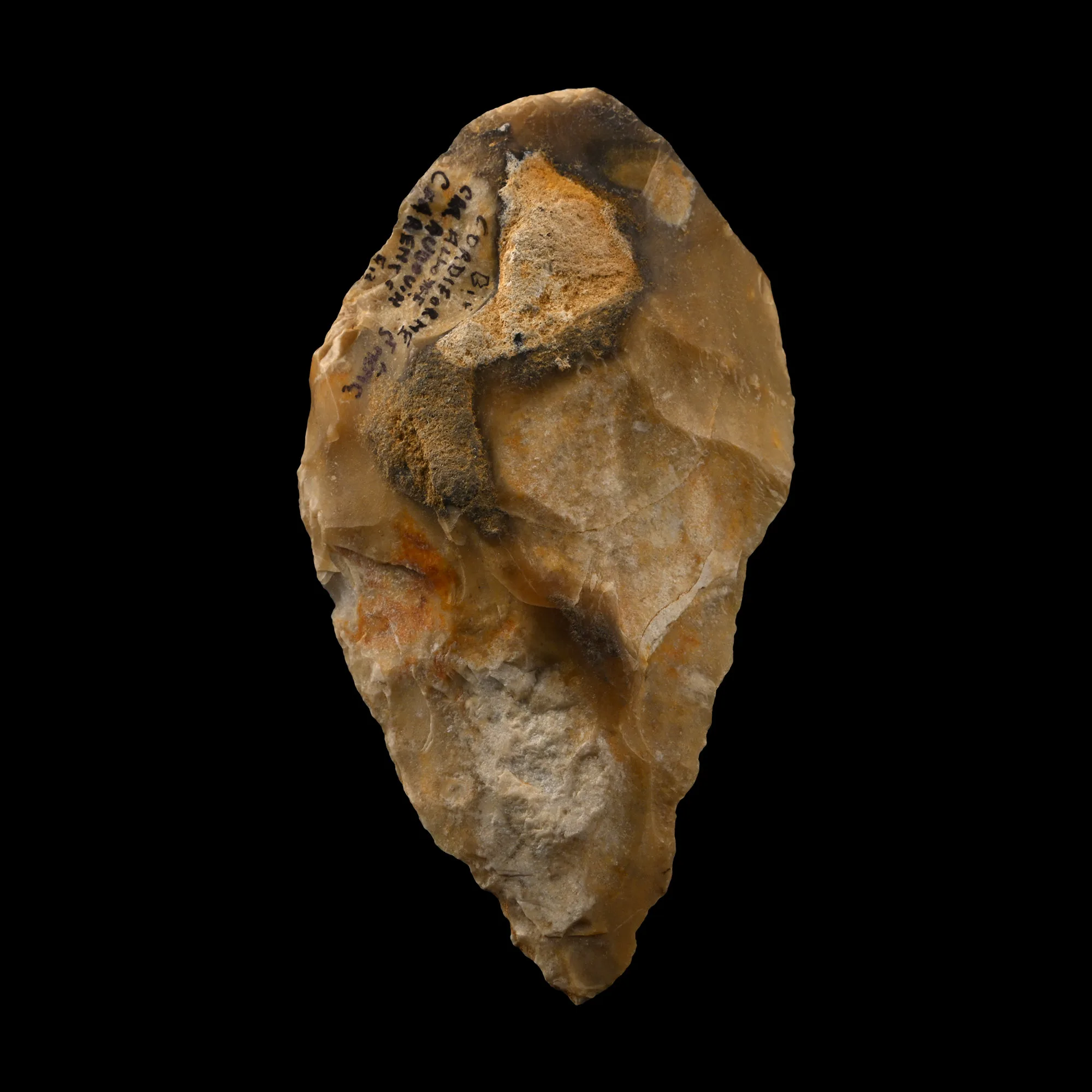
The teardrop biface is the longest-lived design humans have ever made. In recognisable form it was knapped for well over a million years, across Africa, the Near East and Europe, which makes the Acheulean tradition the most conservative episode in the whole of technology. This one is an elongated cordiform, a heart-shaped type in François Bordes's standard classification, collected from the old quarry terraces at Saint-Même in the Charente. As a surface find from gravels of mixed age, its date is a typological estimate rather than a measured one, and the maker is an inference too: a French biface of this period is the kind of tool generally credited to Homo heidelbergensis, an archaic human hundreds of thousands of years before Homo sapiens. Microscopic wear on the closely comparable handaxes from Boxgrove in Sussex points to one main job, butchery. Some archaeologists think the finest examples were also made to impress; that argument is unresolved.
2. A signature you wore round your neck
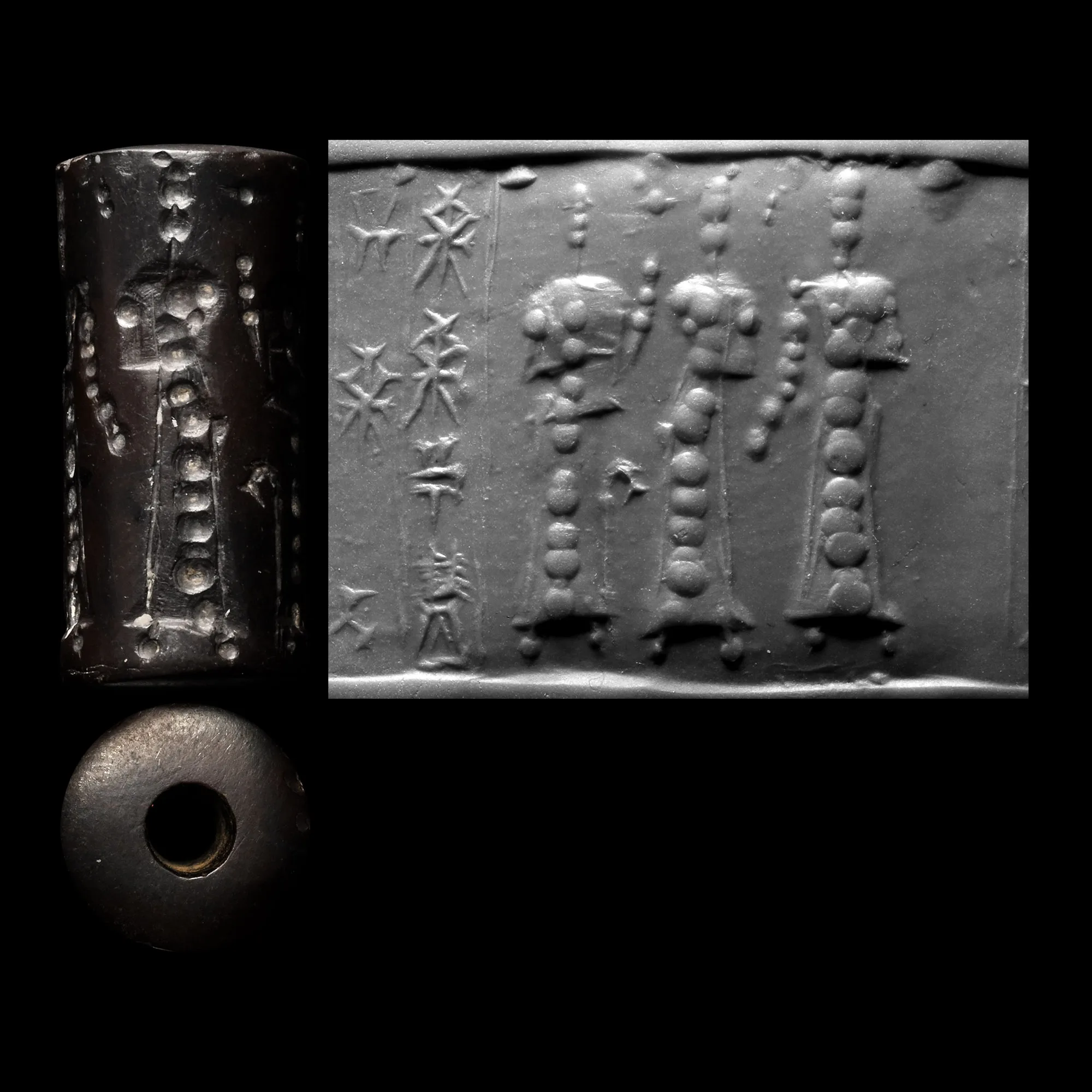
Rolled once across wet clay, a cylinder seal unspools a continuous frieze in relief. It was a legal signature, a mark of ownership and, being carved stone that often carried a god, an amulet, pierced down the middle to hang on a cord. This one is haematite, the hard iron-grey stone that came into fashion in the Old Babylonian period, and its two lines of cuneiform name the god Amurru, son of Anu. Amurru was the figure the Babylonians used to personify the Amorites, the herders of the western steppe, and his emblem, a shepherd's crook, appears in the design. The seal is half finished: the gods were blocked out with drill and cutting wheel but never given their final hand-cut detail, so it freezes a stage in the work that a finished seal was meant to hide. It comes with a reading by W. G. Lambert, one of the last century's foremost Assyriologists.
3. A blue servant for the next world
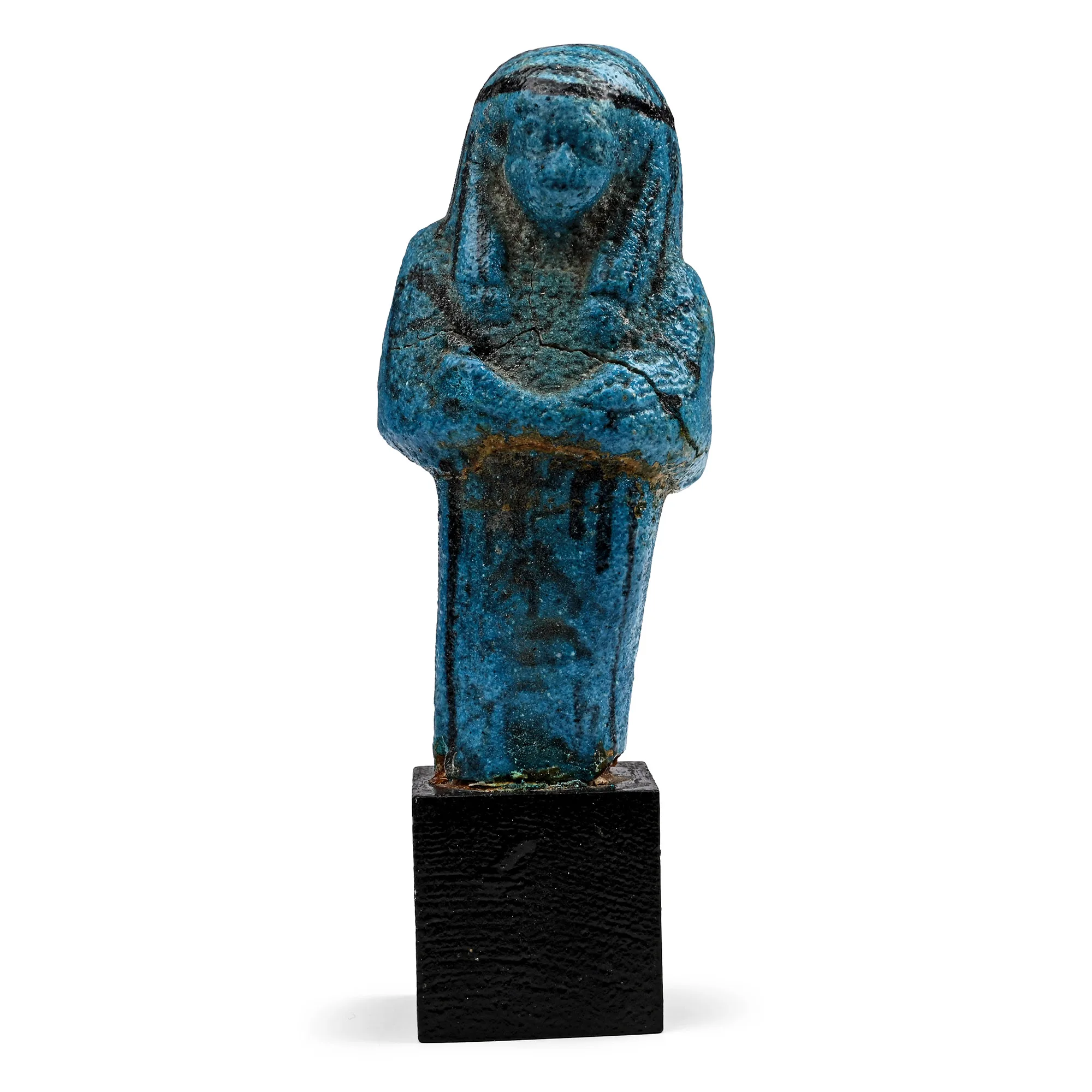
A shabti is a stand-in for the dead. The Egyptian afterlife, the Field of Reeds, was farmland like Egypt itself, and it came with the same obligation to dig and irrigate; the figurine was the deputy who answered "Here I am" when its owner was summoned to work. By the later periods people were calling them ushabti, "answerers", having forgotten the older word. The fully equipped burial held 401 of them: 365 labourers, one for each day, and 36 overseers to drive the gangs. This one holds its hoes and carries a seed bag on its back, with a single column of Chapter 6 of the Book of the Dead down the front. The deep blue is not paint. Copper salts mixed into the crushed-quartz paste rose to the surface as the figure dried and fused into a glassy skin in the kiln, a deliberate imitation of costly lapis and turquoise.
4. A short sword poured in one piece
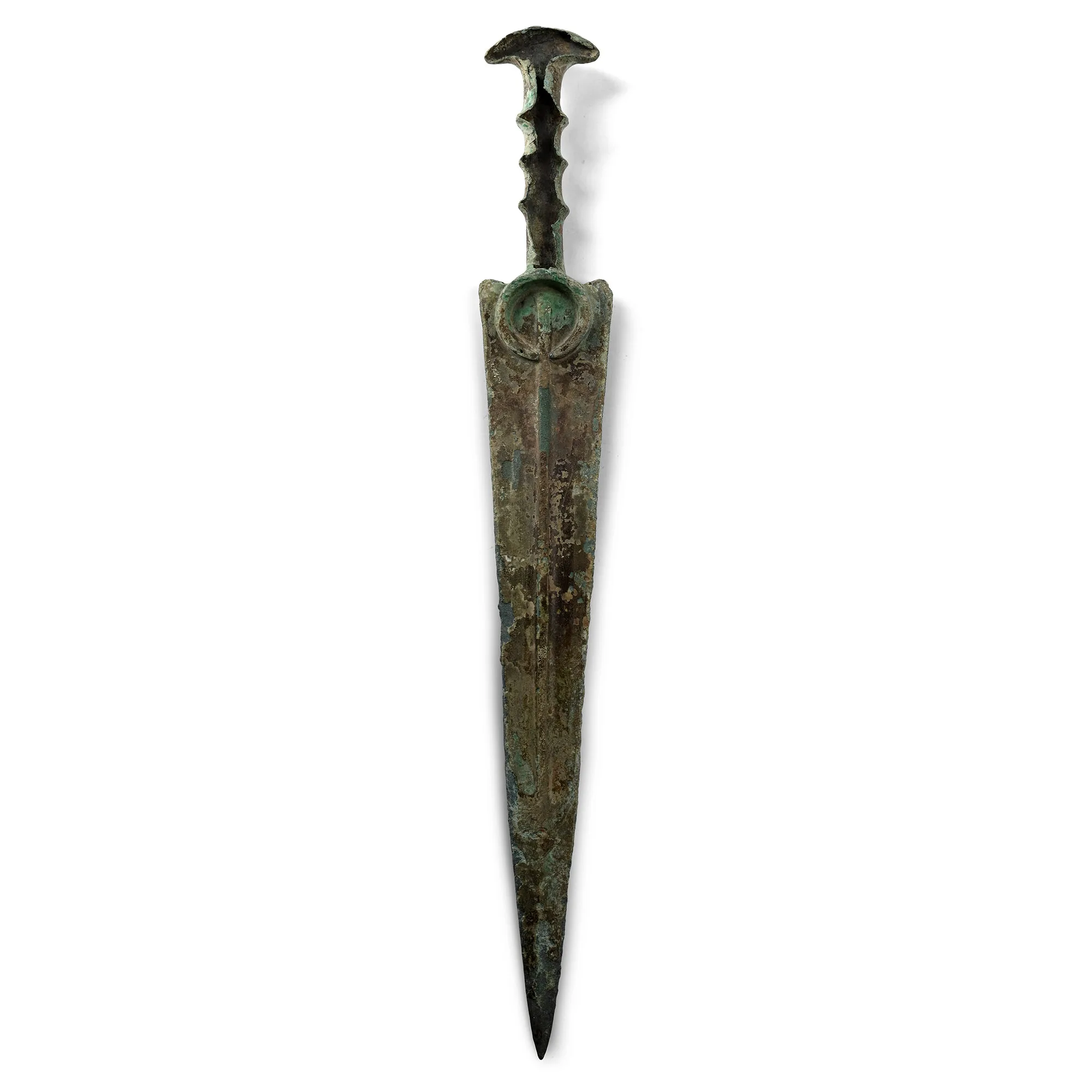
The bronzes of Luristan, in the Zagros mountains of western Iran, come almost entirely from graves and almost never from settlements, so we know a whole metalworking culture mainly at the moment it buried its dead. Their Iron Age peak runs from about 1000 to 650 BC. This dirk was cast in a single pour by the lost-wax method: blade, ridged grip, ring-decorated guard and crescent pommel emerged as one continuous object. At 43.5 centimetres it sits in the middle of P. R. S. Moorey's tidy length scale, where a dagger stops at 36 centimetres, a dirk runs to 50, and anything longer is a sword. One caution comes with the territory. When Luristan bronzes flooded the Paris and London markets after 1928, dealers attached the label to Iranian bronze of every kind, and forgers were at work almost at once, so the category is both genuine and partly unverifiable.
5. A sherd of an Athenian wine cup
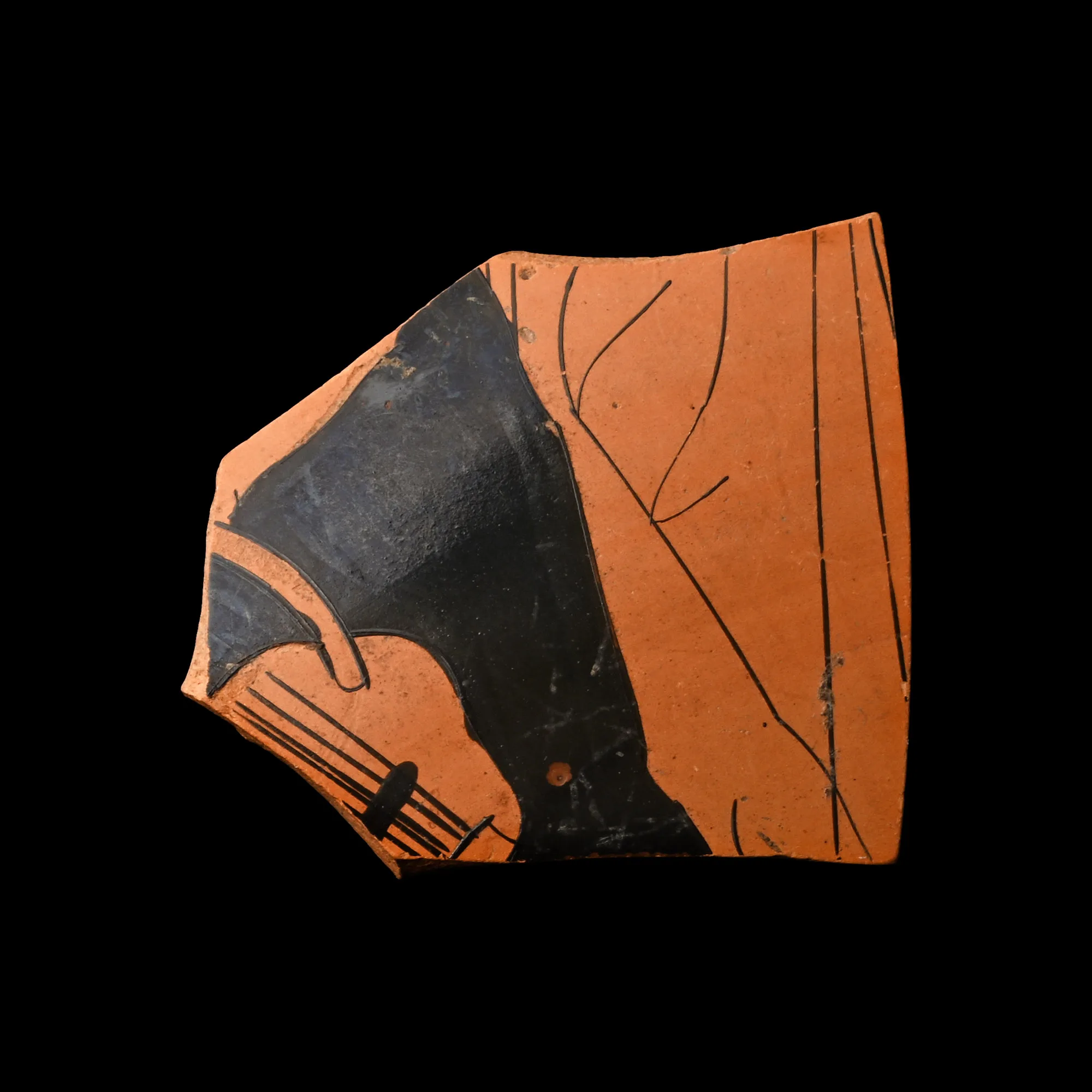
Red-figure was invented in Athens around 530 BC and reversed the older method: instead of painting the figures black, the painter blacked in the background and left the figures in the orange clay, drawing the interior detail with a brush rather than a graver. The freedom that gave for anatomy and drapery is visible even on a 42-millimetre chip of a kylix, the broad cup passed round at a symposium. The catalogue suggests the lyre-player might be Apollo. The instrument argues otherwise. This is the small tortoise-shell lyre that free-born boys learned at school, whereas the god is almost always shown with the big concert kithara; a symposiast or a Muse is the likelier subject. A fragment is not a consolation prize here. Athenian painters can be told apart by the run of a single brush-line, and scholars have reconstructed whole artistic personalities, and rejoined cups scattered between continents, from pieces this size.
6. Apollo dissolved into dots
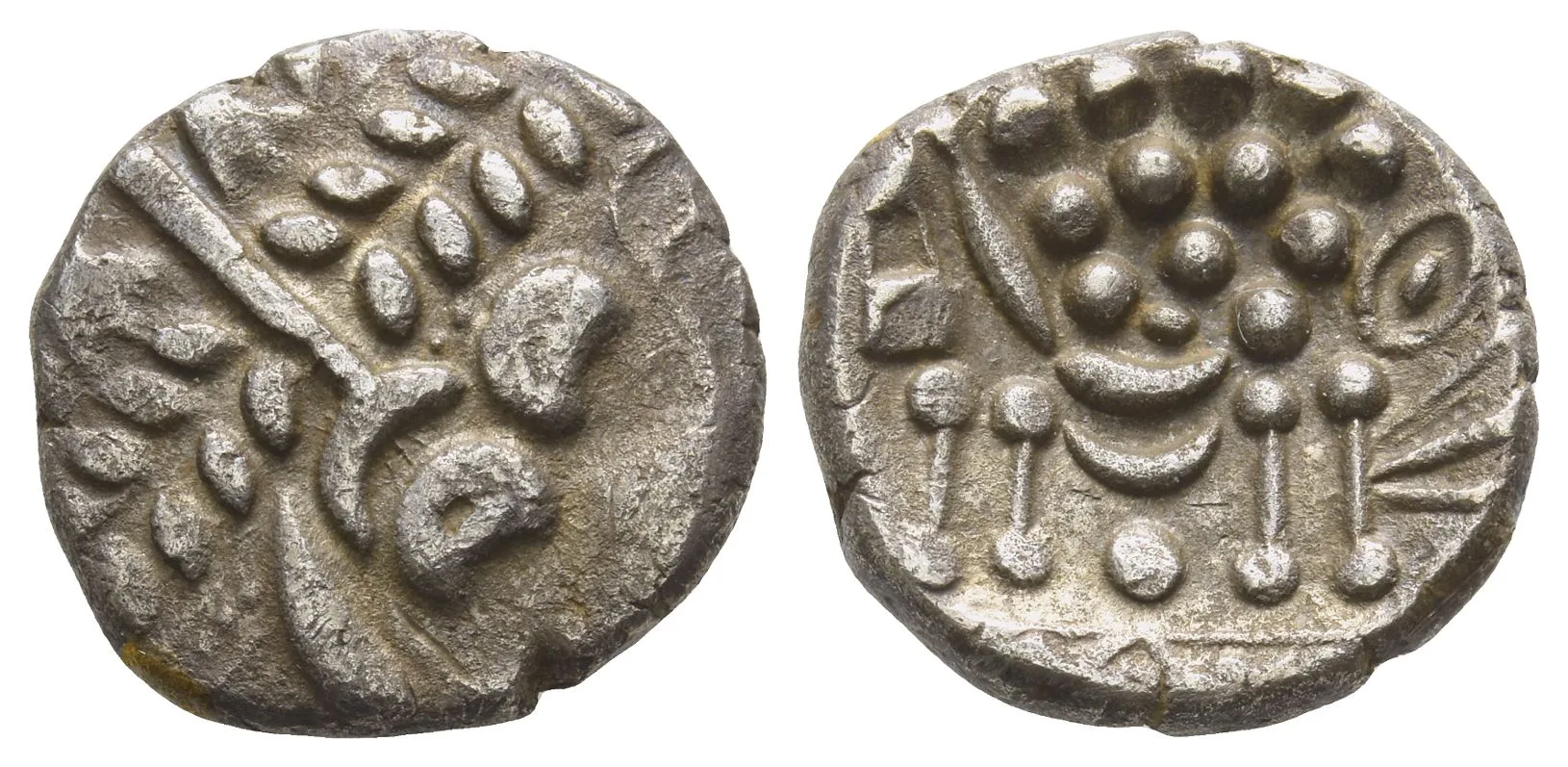
Look hard at the "head" on this Dorset stater and there is no face left, only crescents and a scatter of pellets. The reverse "horse" is a rectangle for a head, a body of crescents and four straight legs in a field of dots. Both descend, at many removes, from the gold stater of Philip II of Macedon, Alexander's father, whose Apollo and two-horse chariot were carried north in mercenaries' purses and copied across Gaul and Britain for two centuries, the design growing more abstract with each copy until the head and chariot dissolved into the crescents and pellets on coins like this one. The Durotriges were conservative non-inscribers, and their coinage debased steadily from gold to base silver as Rome drew closer. When Vespasian's Second Legion came west in AD 43, this was the money in local pockets. The old story of a last stand and a massacre at Maiden Castle, built on a skeleton with a Roman bolt in its spine, is now doubted: the bodies came from an established cemetery reusing the ramparts, not a single dramatic defeat.
7. A Spartan's last word, cut into sard
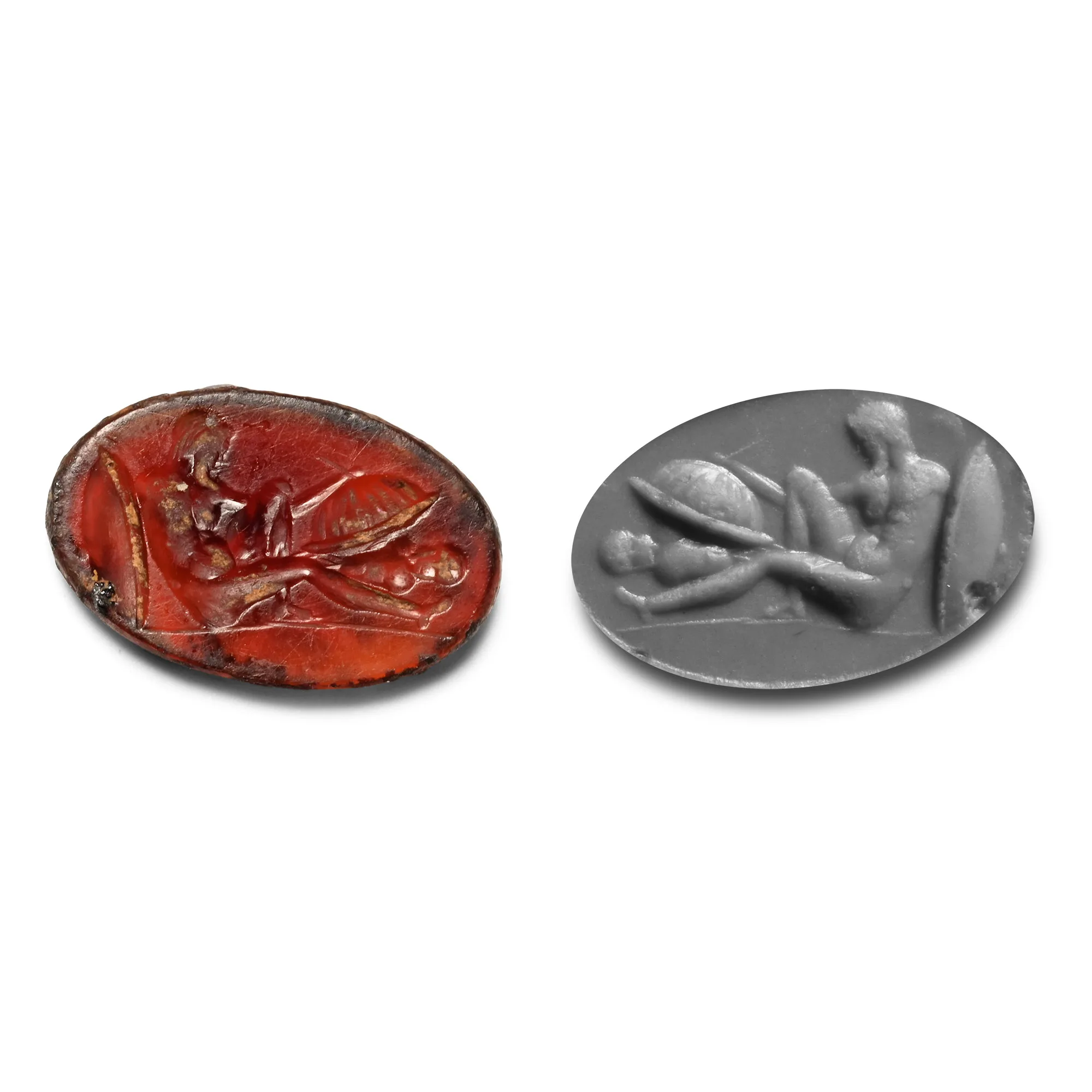
On a stone the width of a fingernail, a cutter compressed a whole legend. Herodotus (1.82) tells of the Battle of the Champions at Thyrea, around 546 BC, where Sparta and Argos each sent 300 picked men and let them fight it out alone. By nightfall three were alive: two Argives, who ran home to claim the win, and one Spartan, Othryades, who stayed on the field, stripped the enemy dead and held the ground. In Herodotus he then kills himself, ashamed to have outlived his company. The detail that made him famous comes from later writers, Plutarch and Lucian among them: that, dying, he wrote a dedication on a captured shield in his own blood. The gem shows him reaching out to inscribe the shield, the second warrior reduced to a head and trunk for want of room. There is a quiet twist. The same composition is also how the Romans drew Victory writing on a shield, which is why, on these gems, a legible word is what settles who it is.
8. Eye-paint in twinned tubes
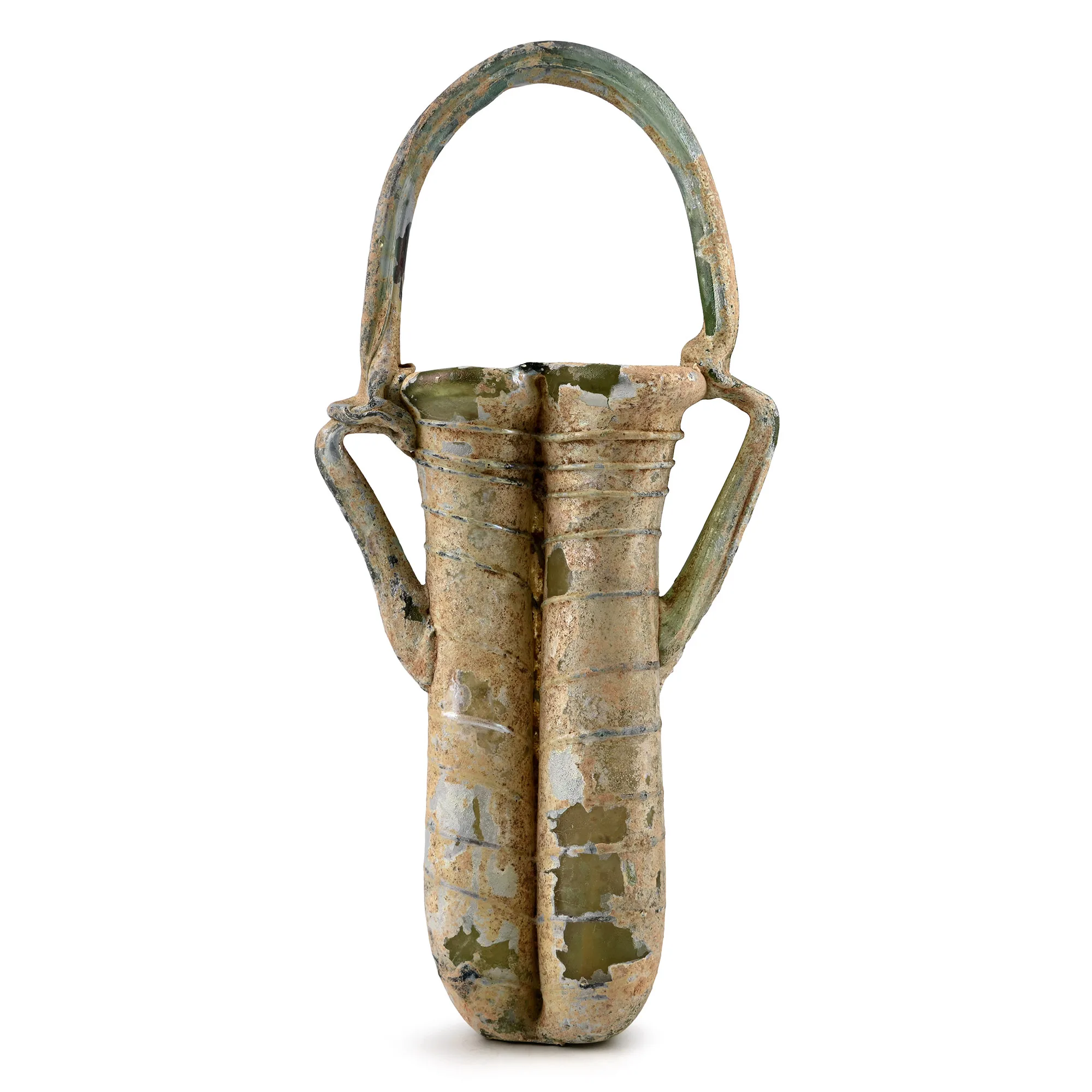
This is a double cosmetic tube, the kind made on the Syrian and Palestinian coast in the fourth and fifth centuries to hold kohl, the black eye-paint of the ancient world. Residue scraped from the bottom of vessels like it turns out to be finely ground galena, lead sulphide, much of it chemically altered by centuries underground. The form began as a single bubble of molten glass, pinched down the middle into two compartments, with threads trailed on and a handle looped over the top like a tiny basket. Glass this ordinary was a recent luxury made cheap: glassblowing, invented near here around the middle of the first century BC, dropped the price so far that Strabo could report a glass bowl in Rome going for a copper coin. The peacock sheen is the one thing about it that is not original. It is decay, light bouncing off wafer-thin weathered layers that are slowly flaking from a surface that began as plain pale green.
9. A beast that grips everything
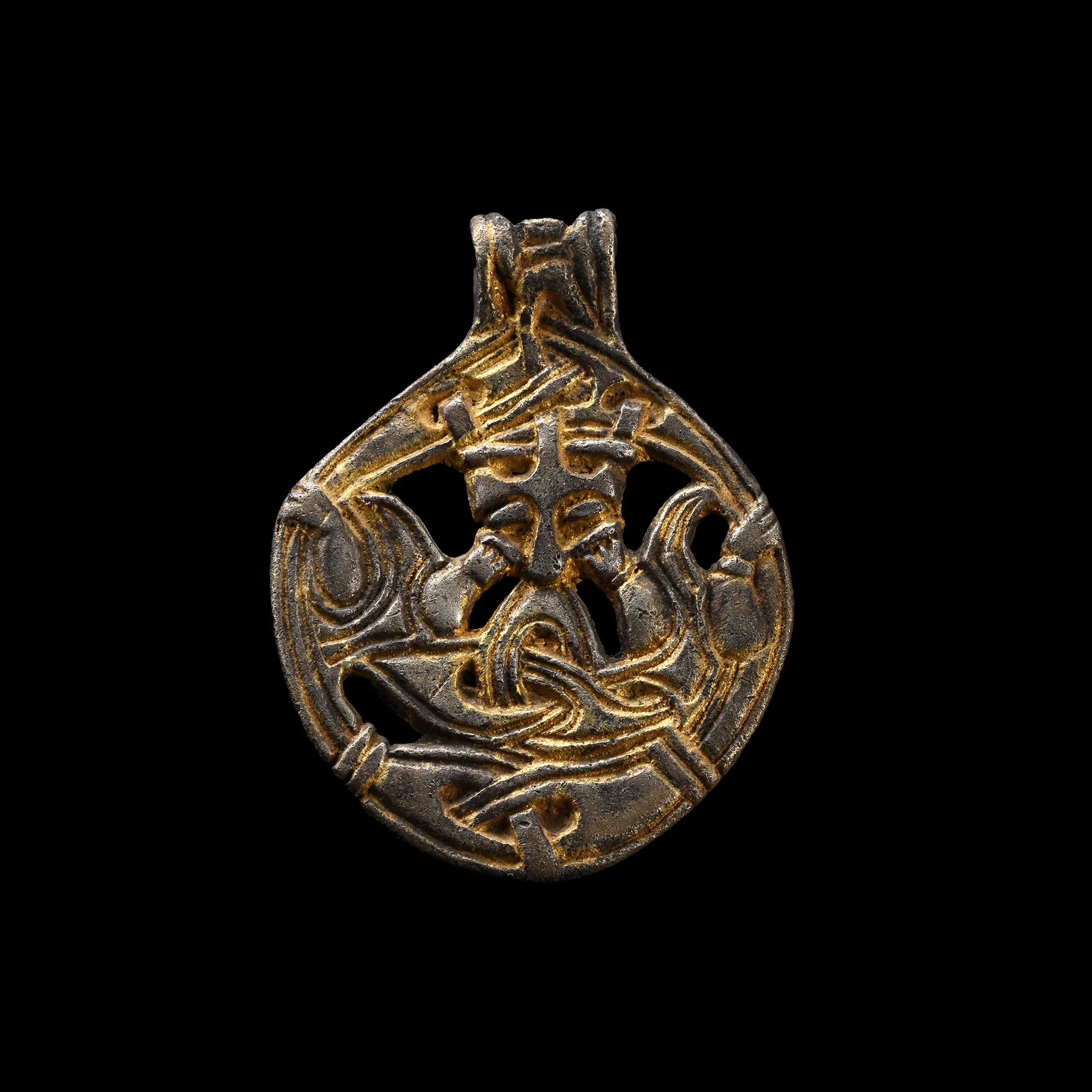
The contorted animal whose paws clutch its own body, its neighbours and the frame around it is the signature of early Viking art. It appears suddenly on late-eighth-century moulds at Ribe and runs for nearly two hundred years; this openwork pendant, in silver-gilt, belongs to the Borre style of the later ninth and tenth centuries, with one beast inside the ring and a small frontal mask below the loop. Pendants like it were ornament, status and, probably, protection, and the motif clusters on women's dress fittings. It is tempting to call the little face Odin, and best resisted: specialists are firm that Viking animal art cannot be read as a roll-call of named gods. Its closest published twin is a silver pendant found in Norfolk, now in the British Museum, which belongs to the same family as six pendants from a Swedish hoard buried around AD 940.
10. The badge from a shrine that no longer exists
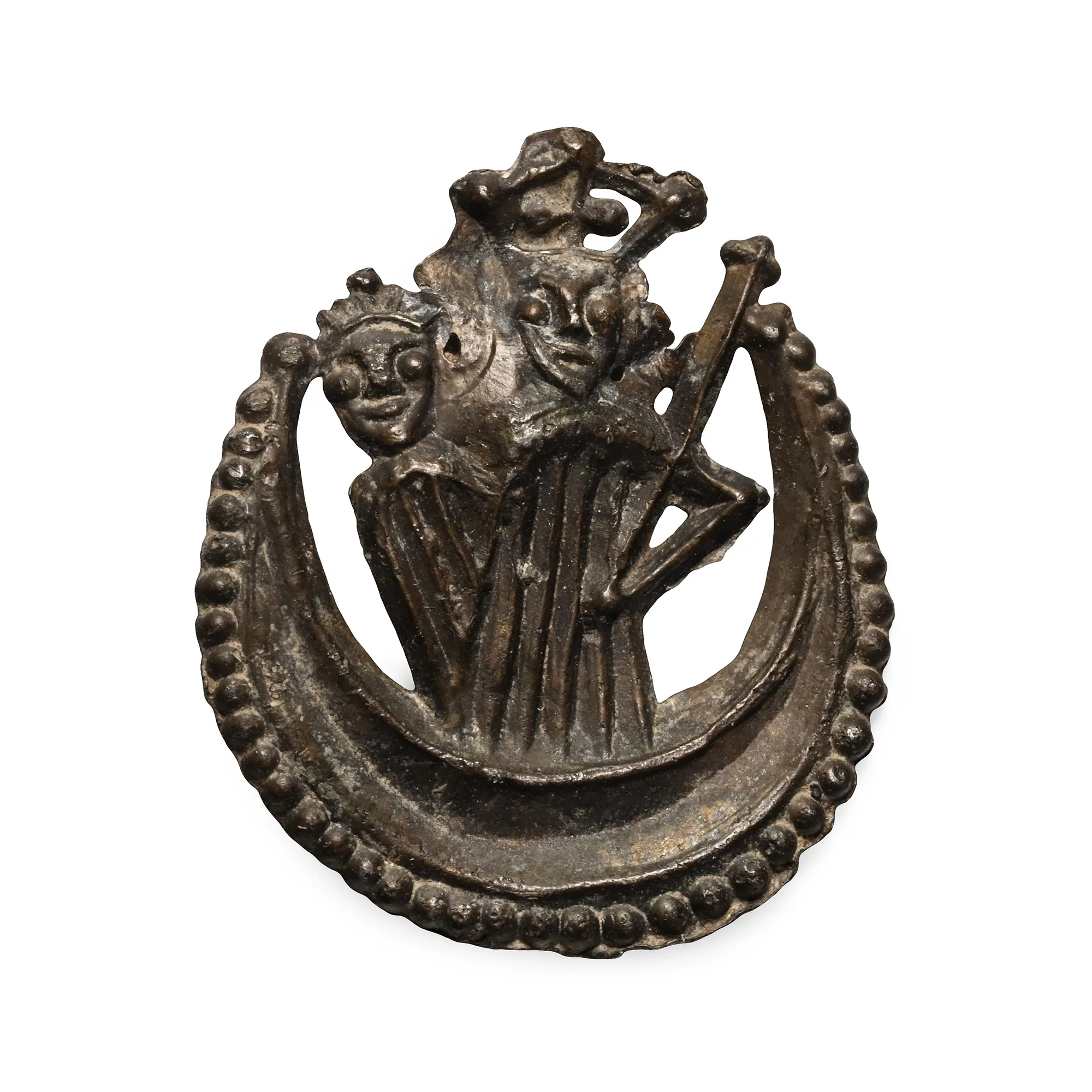
Pilgrim badges were the disposable souvenirs of medieval travel, cast in pewter in penny moulds, pinned to a hat to show where the wearer had been and to carry a little of the shrine's protection home. They survive in their thousands in the mud of the Thames, which preserves the soft tin-lead alloy that rots away anywhere drier. This one shows the Virgin standing in the horns of a crescent moon, holding a sceptre and the Christ child, the image of the woman of Revelation 12 "with the moon under her feet". It advertises Our Lady of Willesden, then a village shrine northwest of London with a venerated dark Madonna. In 1538 Thomas Cromwell's men carried that statue to Chelsea and burned it alongside the images of Walsingham, Ipswich and Worcester. The crescent-moon Virgin was shared by one or two other London shrines, so the attribution is the likely one rather than the certain one. Either way, the shrine the badge advertises is gone. The badge is still here, and it cost £494.
TimeLine Auctions, 26th August 2026