Home > Stories by TimeLine Auctions
Stories by TimeLine Auctions
Ten Real Antiquities We Sold for Under £100
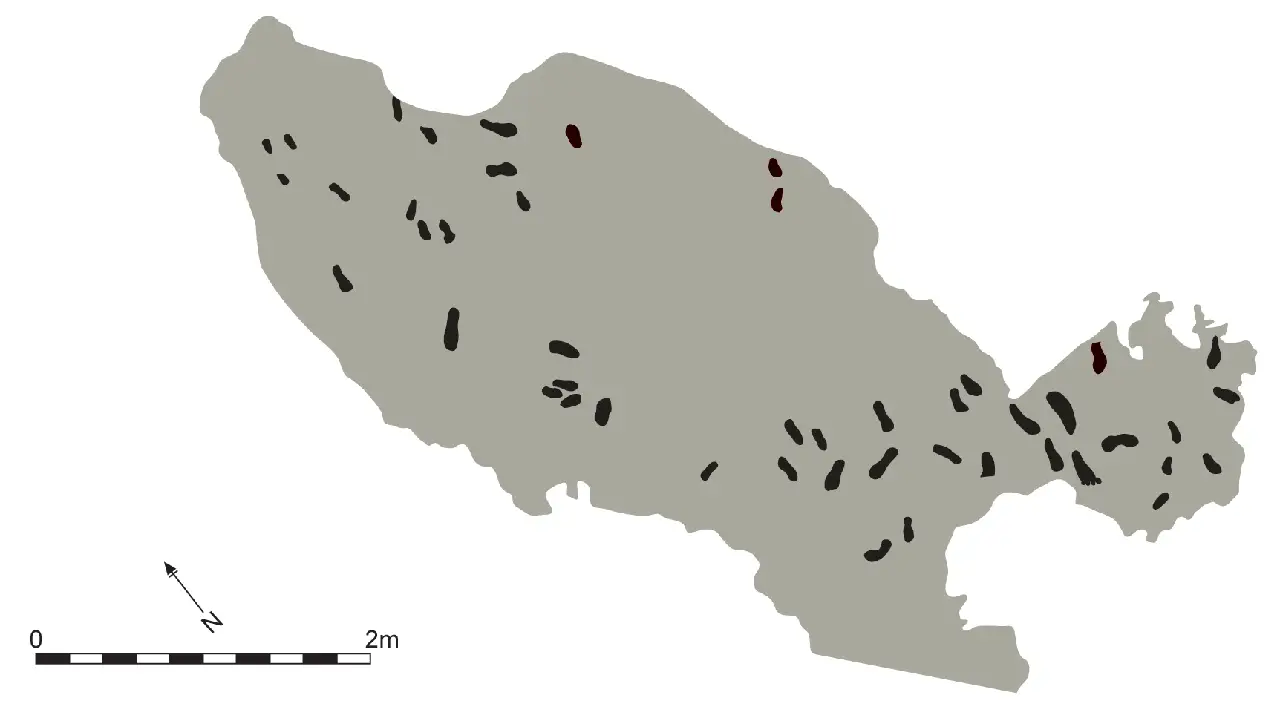 The footprint surface recorded at Happisburgh in Norfolk in May 2013 and washed away by the tide within a fortnight. The dark shapes are around fifty human footprints pressed into estuarine mud between 850,000 and 950,000 years ago, the oldest known outside Africa, on the same eroding foreshore that yields the worked flints in this list. After Ashton et al. 2014, CC BY 4.0, via Wikimedia Commons.
A struck flint older than our own species sold this spring for £91. In the same sales, a small blue figure made to do an Egyptian's farming in the afterlife went for £72, a Roman's personal seal cut smaller than a fingernail for £98, and a scrap of sheet gold granulated round its rim before Rome existed for £85. The cheapest object here, a bowl thrown in the workshops below Petra two thousand years ago, cost £39, which is less than dinner for two.
All ten are genuine antiquities, legally traded and mostly out of old private collections, and they are cheap for reasons that have nothing to do with being dull. They come from TimeLine's two most recent sales, and they run from a Norfolk beach perhaps 900,000 years ago to the silver economy of the Vikings: ten cultures, nine materials, nothing over £100.
Why are genuine antiquities this cheap?
A Late Period faience figurine, a Roman seal-stone cut with a stock god, an Egyptian oil lamp, a thick clay flask of the grenade type: all of these were turned out in antiquity in their tens of thousands, and they survive in those numbers. Their commonness is what sets the price.
Metal can be worth almost nothing. The two gold pendants below weigh a tenth and a seventh of a gram between them. The bullion in them costs pennies; what you pay for is the age and the handwork.
Finally, a description like "Western Asiatic, 1st millennium BC" or "Scythian, 6th century BC" spans centuries because a small, worn, unprovenanced object rarely supports anything tighter, and that breadth pulls the price down. The flip side is the whole appeal: for the cost of a takeaway you can hold something a museum would be glad to put on a shelf. Let's look at 10 recent lots that sold for less than £100 at TimeLine Auctions.
1. A struck flint from a Norfolk beach (£91)
It is a hard-hammer flake of the simplest Lower Palaeolithic kind: a blank knocked off a flint core to give a sharp working edge, with none of the bifacial shaping that makes a handaxe. The assemblages from this stretch of the East Anglian coast are like that almost without exception, all cores and flakes and "not a hint of handaxe manufacture," as the excavators of the nearby sites put it. The word "cordiform," heart-shaped, describes only the flake's outline; nothing about it was deliberately shaped.
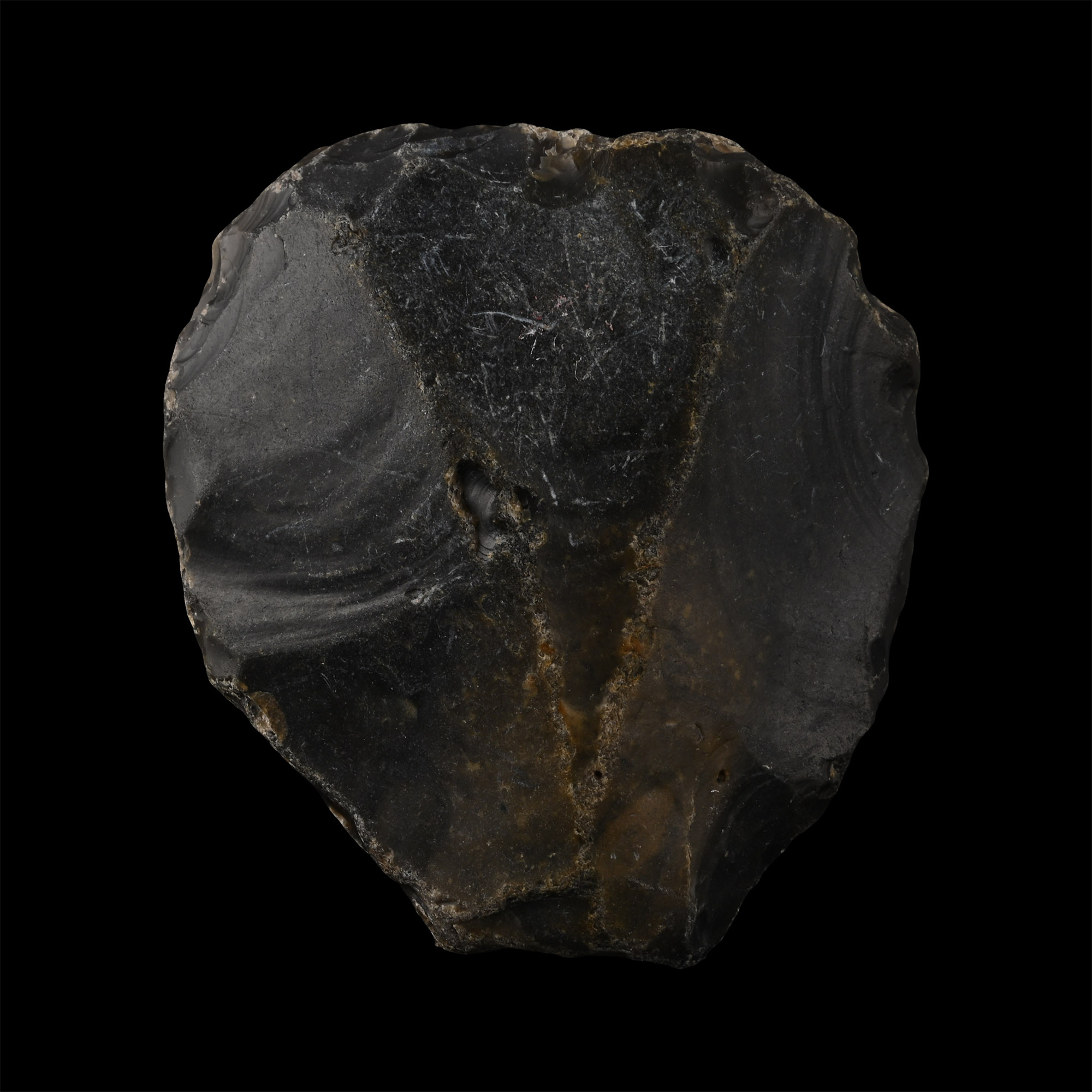
The find-story is the part you are really buying, and it is verifiable. The flake is marked Happisburgh 2019 JA Bay One AP. A Mr Anthony Pryke picked it up at Happisburgh, Norfolk, in January 2019, after the 2018 storm the papers called the Beast from the East stripped sand off the beach and eroded Palaeolithic material out of a buried ancient riverbed. Happisburgh, with nearby Pakefield, carries the human story in northern Europe back to around 900,000 years ago. The riverbed is real too: the ancestral Thames once ran north through Norfolk, joining the now-vanished Bytham River near here, until the Anglian glaciation about 450,000 years ago shoved it south to roughly its present London course. The flints weather out of those old floodplain deposits.
Who made it can only be guessed at. No human fossils have ever been found at Happisburgh, so the toolmakers are known only by inference, tentatively as Homo antecessor or possibly H. erectus, an older people than the half-million-year-old Homo heidelbergensis of Boxgrove and Swanscombe. And a loose surface flake, eroded from the foreshore with no layer around it, cannot be dated for itself; its age is the site's, borrowed. What you hold is a genuinely Palaeolithic worked flint from the place that carries the oldest known human presence in northern Europe. Its maker and its exact age stay with the site; the stone borrows them.
2. A blue servant for the afterlife (£72)
A shabti is a small mummiform figure, placed in the tomb to work in the dead person's place. Egyptians expected the dead to be called up for agricultural labour in the next life, and the shabti answered the call for them, animated by Spell 6 of the Book of the Dead, the "shabti chapter": when the owner's name is read out for forced work, "Here I am," the figure is to say. Hence the crossed arms of the Osiris pose and the little hoes it carries.
The fact to lead with is that faience is neither glass nor clay, and even the name is a mistake. Egyptian faience is a self-glazing ceramic of crushed quartz with a little lime and alkali, glazed with soda-lime-silica and coloured blue-green by copper. It is often called the first high-technology ceramic. The word "faience" was borrowed in modern times from the tin-glazed pottery of Faenza in Italy, which it has nothing to do with; the Egyptians called it ṯḥnt, "the dazzling," because it stood in for turquoise and lapis. It glazes itself by efflorescence: soluble salts migrate to the drying surface and fuse there in the kiln.
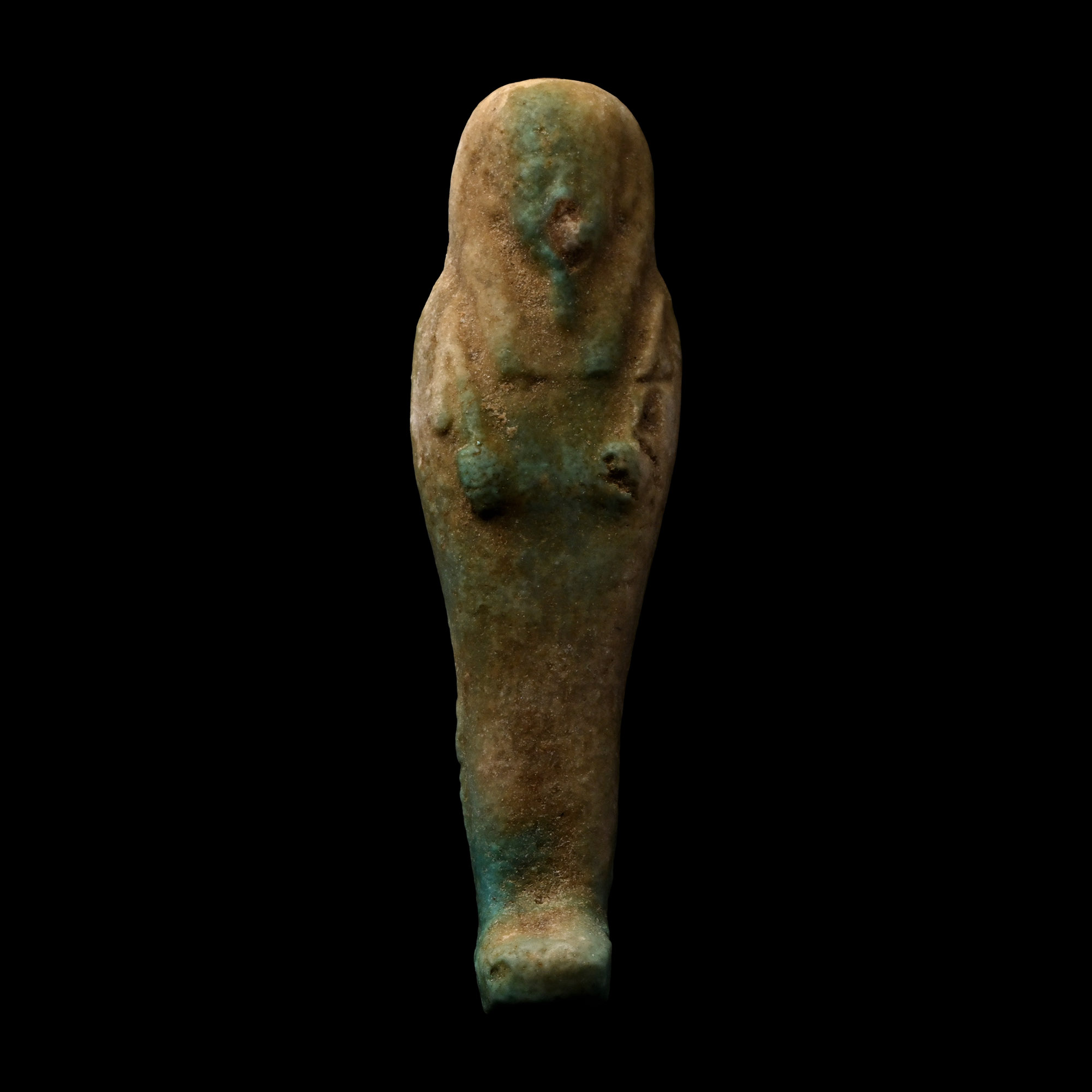
A fully equipped New Kingdom burial held 365 worker shabtis, one for each day of the year, plus 36 overseers, one per gang of ten, a set of 401 stored in a shabti-box; Seti I had around seven hundred. They are among the most numerous of all Egyptian antiquities, found in tombs across every class for some two thousand years, which is exactly why a real one costs £72. This example is worn, mould-made and uninscribed, so it names no owner; resist the urge to give it one. The type is also faked, which at this price matters less than the charm, and the charm needs no help.
3. The signature you rolled in clay (£91)
This is a small stone cylinder carved in the negative, made to be rolled across wet clay so that it prints a continuous scene in relief. It worked as a personal signature, an ownership mark and a tamper-seal all at once, rolled onto tablets, onto the clay "envelopes" that held them, and onto the lumps that sealed jar-lids and doors. It was also worn: pierced down its length like a bead, strung on a cord, and credited with protective power. This one carries an aquatic scene, a line of chevrons above fish and a crab, with small objects scattered through the field.
It is arguably the world's first reproducible image. The device was invented by the temple bureaucracy of Uruk, alongside cuneiform writing, around 3400 to 3100 BC, a printing tool four thousand years before the printing press. It went on to become the longest-running art form of the Near East, in use for some three thousand years and datable by the style of each period; Henri Frankfort's 1939 Cylinder Seals is still the landmark study. Because they are stone, seals reach us essentially intact, looking almost exactly as their owners saw them, which is why museums, and this lot, display the seal beside a fresh rolled impression so the whole scene can be read.
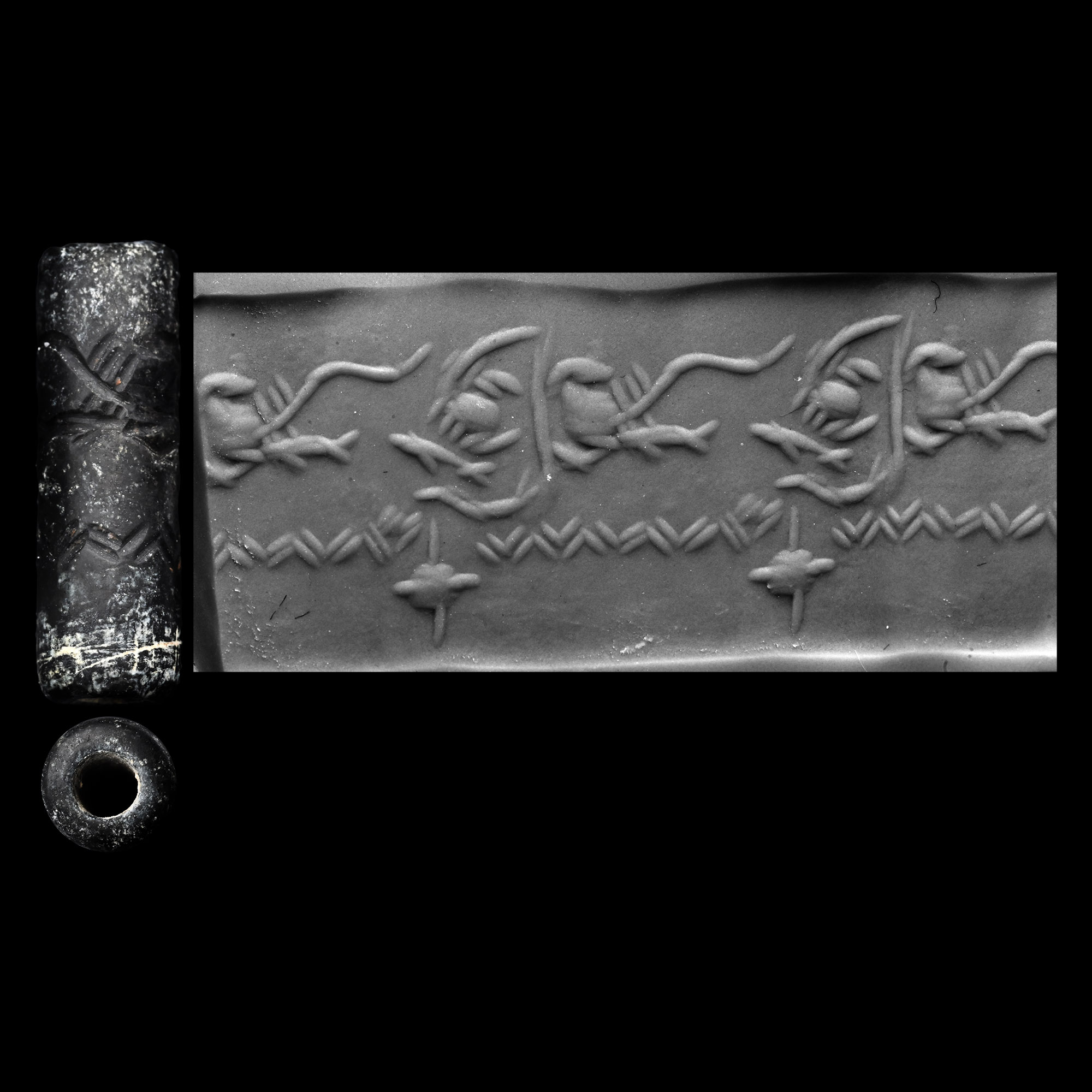
It is tempting to name the god. Water and leaping fish are the standard attributes of Ea, the Mesopotamian god of fresh water and wisdom, and the imagery genuinely evokes his world. Fish, crab, crescent and star are also common field-fillers, though, padding the empty space on many seals, so on a worn provincial piece like this they read as a generic pond more than a portrait of any one deity. Seals are dated by style, and a small schematic one resists tight dating; the date a seal was cut need not even be the date it was used. Let the idea carry it: a three-thousand-year-old signature you roll in clay.
4. An ibex painted before the first cities (£85)
A small breast-shaped terracotta vessel with an everted rim, painted with a frieze of a crouching ibex, a pecking bird, and dot-in-circle filler motifs. It belongs to the painted-pottery world of Chalcolithic Baluchistan, in what is now Pakistan, the Mehrgarh and Quetta and Kulli tradition that fed into the Indus, or Harappan, civilisation. The ibex is the signature animal of that whole tradition, and the dot-in-circle is one of its diagnostic marks.
This was something close to industrial production. Mehrgarh ran a pottery centre with professional potters and row-firing in the open of up to a thousand pots at once, a method still used near Pirak in our own day. And the site itself is a landmark of early humanity: one of South Asia's first farming villages, occupied from the sixth millennium BC, and the source of the earliest known dental drilling. People were painting ibexes on pots here while the first towns were being built.
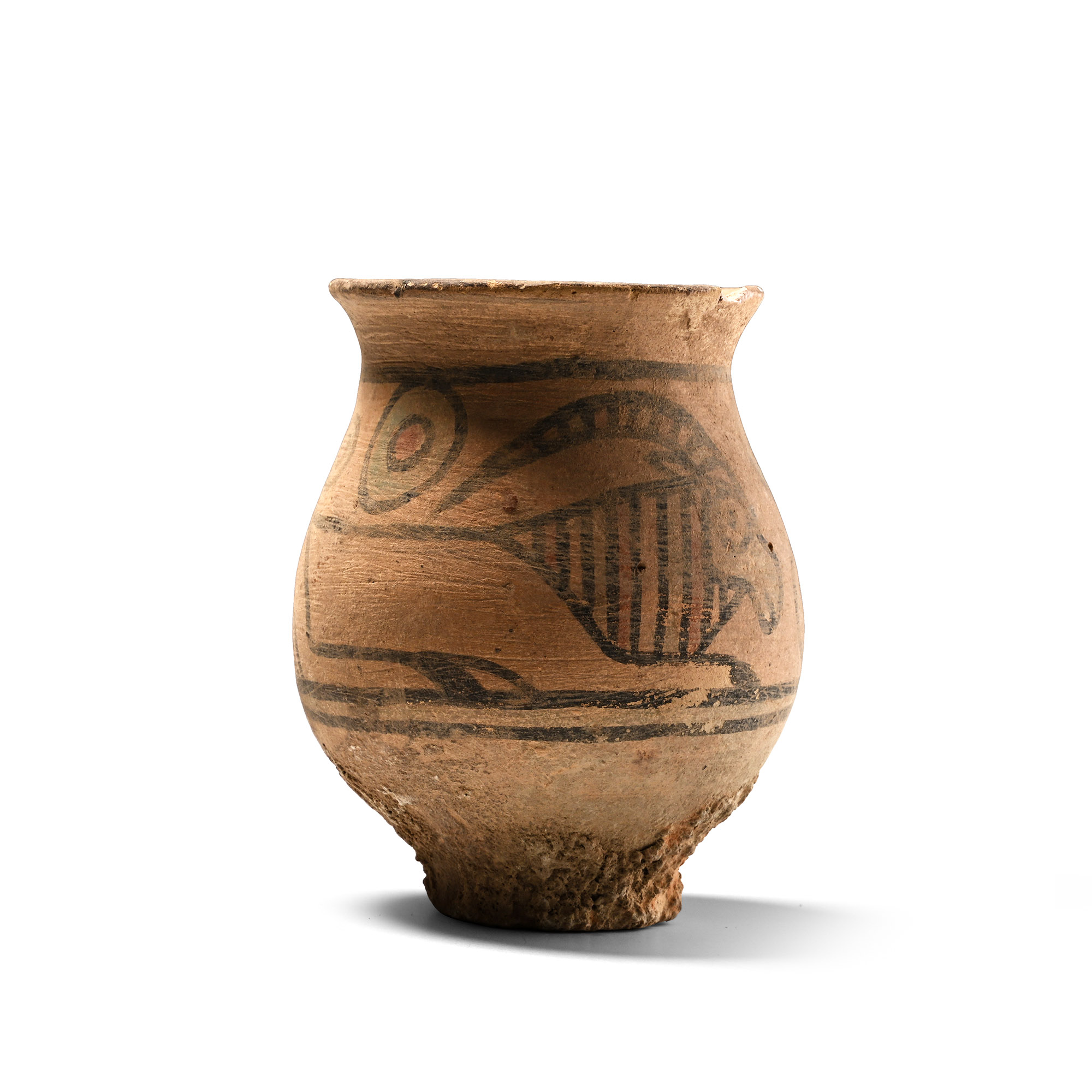
Two things sit behind the £85, and the second is serious. The first is dating: painted vessels like this belong to Chalcolithic Baluchistan of the later fourth and third millennia BC, the tradition that fed into the Indus world, and it was largely finished by the second millennium. The second is faking. Repainting is the real risk with this class of pottery, and a thermoluminescence certificate proves less than it seems: the test dates the clay's last firing, so a genuinely old pot that has been freshly repainted can still pass. This is where provenance earns its keep. The stated history here, from the collection of David Gold of Carnaby Street "Lord John" fashion fame, formed in the 1970s, is the reassuring kind: a documented English collection two generations old, which is the best guarantee that this pot is what it says it is.
5. A Roman seal cut blind (£98)
A carnelian intaglio: a device cut into hard stone in negative, so that pressed into wax or clay it leaves a tiny relief the right way round. Its proper home is the bezel of a finger-ring, which was simply a convenient and secure way to carry a personal seal, and sealing, as one historian of the practice puts it, "is as old as civilization, certainly older than writing," used to close a document, an amphora, "or even the door to the larder." Carnelian was the favourite stone because it is hard enough to wear well, soft enough to engrave, and wax will not stick to it.
What makes it human is that it was carved blind. Quartz gems were cut with a small rotating wheel and an abrasive of crushed Naxos emery in olive oil, and at the moment of cutting the surface was hidden under a slurry of emery and oil. The engraver worked by touch, without a lens, in a craft that "evidently worked without the aid of a lens" and often ran in short-sighted families. The device on this one is Minerva, goddess of war, wisdom and crafts, the Roman Athena and one of the Capitoline Triad. A signet was "part decorative, part amulet and part personal seal," and figures of deities were popular precisely for the amulet's sake.
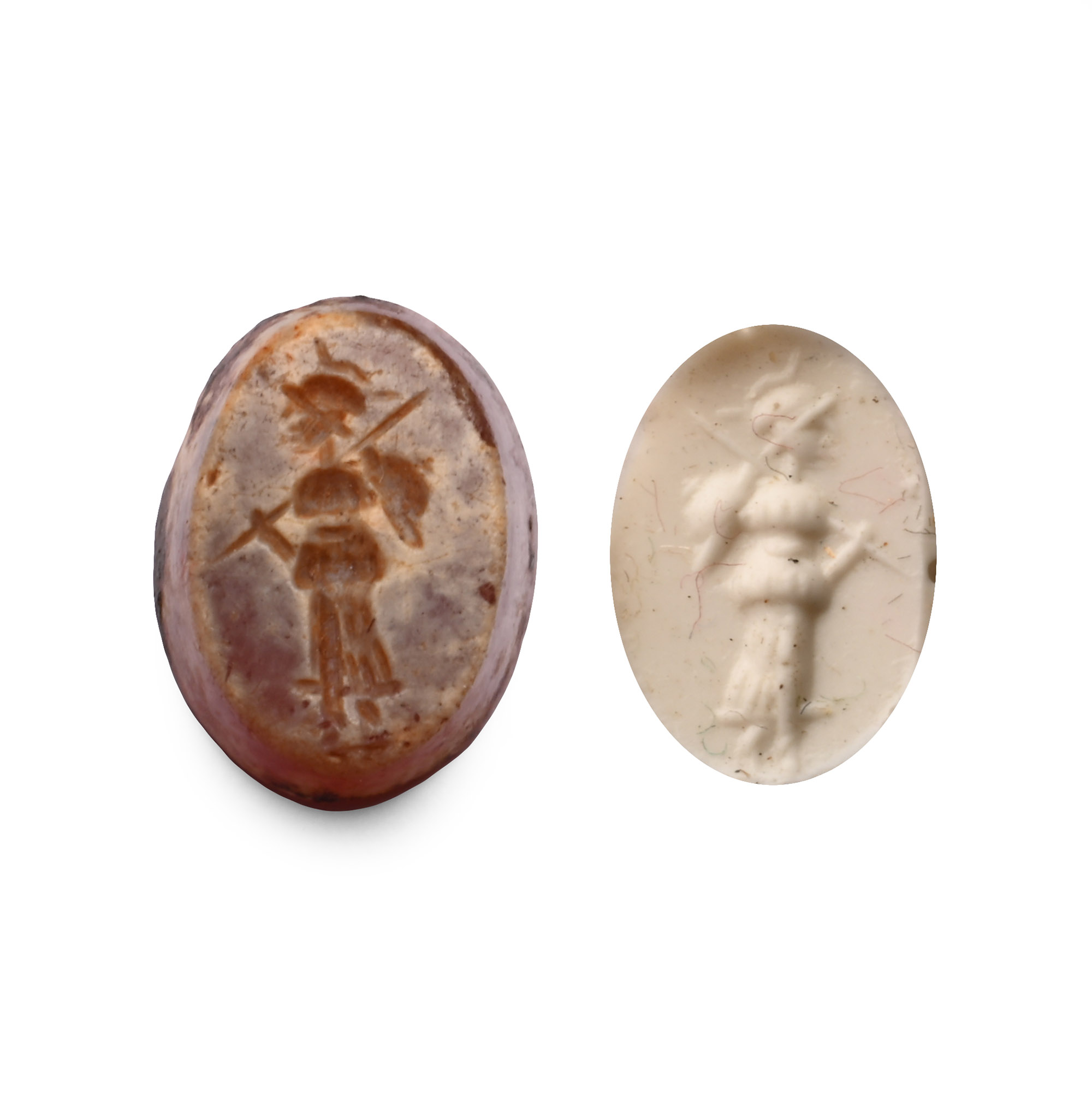
These were stock items, made by the hundred. Seals survive in quantity carved with the same motif, because there were only so many themes to go round, and a standing Minerva with a spear repeats across the empire in carnelian, jasper and glass; the poor sealed too, with cheaper signets cast in glass paste. There is a nice afterlife to the type: in Roman Britain many engraved gems turn up in bath-house drains, where the steam loosened the ring settings and the stones slipped into the water, with 88 gems recovered from the legionary baths at Caerleon alone. Pliny thought the whole habit a sign of decline, complaining that in the old days nothing was sealed, whereas now "even articles of food and drink have to be protected against theft by means of a ring." Such gems are dated by style, across a broad span; Martin Henig spreads the standing-deity carnelians widely, and a loose unset stone has lost the ring that once tied it to a person.
6. The hand grenade that probably wasn't (£98)
A small, thick-walled, pear-shaped ceramic vessel with a narrow filler hole and impressed lozenge-and-cross decoration on the shoulder. Vessels of this "sphero-conical" type turn up in large numbers across the Byzantine and, above all, the Islamic world from roughly the eighth or ninth century to the fourteenth, from Iran to Egypt; the kilns at Fustat held about 1,500 of them, and a single room at Tripoli held sixty. What they were for is one of the genuine unsolved arguments of medieval archaeology. The popular answer, the one that gives this pot its name, is a Greek Fire grenade.
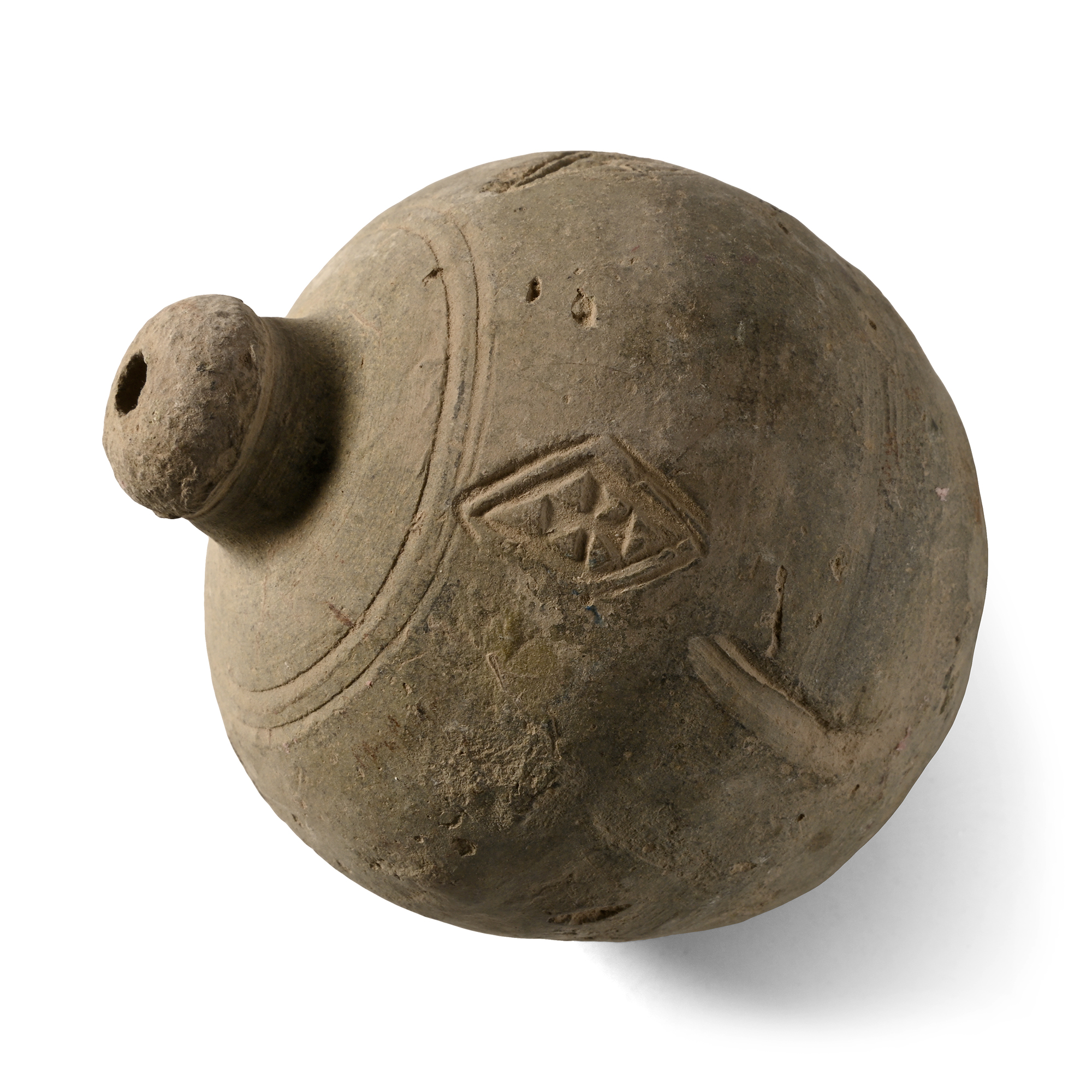
Start with what Greek fire actually was. It was a Byzantine incendiary attributed to an engineer named Kallinikos around 673, and it was projected mainly through bronze siphons mounted on warships; the Byzantines called it "sea fire." Its recipe was a state secret and is still unknown, probably a naphtha or petroleum base with perhaps resin and sulphur. It reportedly burned on water and helped break the Arab siege of Constantinople in 717 and 718, and it is famously pictured in the Madrid Skylitzes manuscript. None of that involves a clay flask.
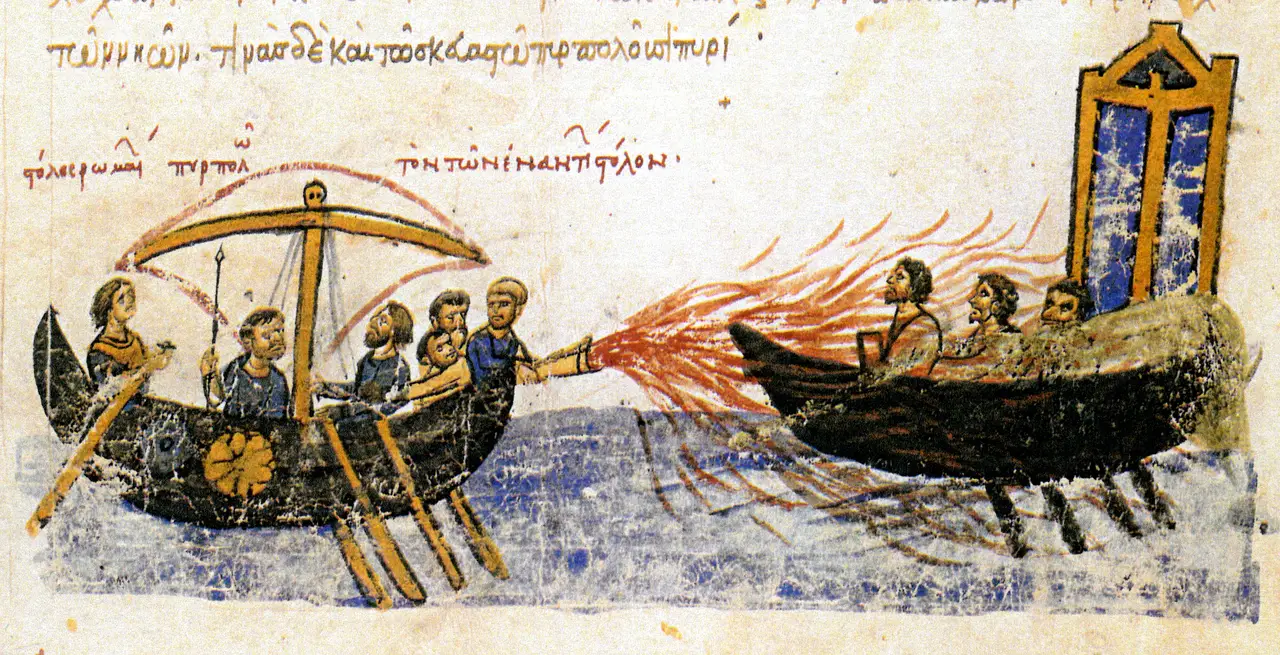 Greek fire pumped through a bronze siphon from a Byzantine ship against an enemy crew, in the twelfth-century Madrid Skylitzes. Public domain, via Wikimedia Commons.
Whether thick-walled pots like this were ever incendiary grenades is a century-old dispute; a 2016 themed issue of the Journal of Islamic Archaeology was given over to it. The candidates for what they held include incendiary mixtures, mercury (traces were found in a vessel from Sidon), perfume, medicine and oils, and beer or wine: Ghouchani and Adle, reading the inscriptions on some examples as drinking poetry, suggested the pointed base was set in snow to chill the drink. The sceptics have the better of it. Henri Seyrig and Richard Ettinghausen argued the grenade idea down long ago, and the case against is concrete: the walls are too thick to shatter usefully, the decoration too careful for a thing meant to be thrown away, the find-spots overwhelmingly domestic, in houses and baths and markets, while medieval writers describe real grenades as glass or copper. The explosive-and-wick picture is the romantic minority reading. Most of these pots come from the Islamic world; the Greek term mesaion kakabion comes from a 2019 essay by the military historian Raffaele D'Amato that accompanies these lots; and without residue analysis of this particular pot, what it held is simply unknown. The mystery is the thing worth £98.
7. Money you could wear (£98)
A small group of plain silver wire hoops with hook-and-eye fastenings. The object is modest; the economy behind it is not. Across the Norse and Baltic world, silver worked as money by weight and purity, with coins, ingots, ornaments and scrap all interchangeable. "Hacksilver" was exactly that: jewellery and ingots chopped into bits to make up the weight of a deal. Traders "pecked" silver with a knife to check the fineness and expose any plated forgery. A wearable hoop like this was portable bullion that could be cut up when the moment came.
The scale of the trade is the surprising part. The silver came up the rivers of Russia as Islamic dirhams, paid out for furs and slaves on the Volga route, and well over 170,000 of those coins survive in Scandinavia from the single century around 840 to 940, with far more melted into ingots and ornaments. The hoards are enormous: Cuerdale in Lancashire, buried around 905, held more than 8,600 items and some 40 kilograms of silver; Spillings on Gotland, found in 1999 under an outhouse floor, is the largest in the world at around 67 kilograms, with 14,295 coins. For the Norse this was the Silver Age, when wealth was counted in silver.
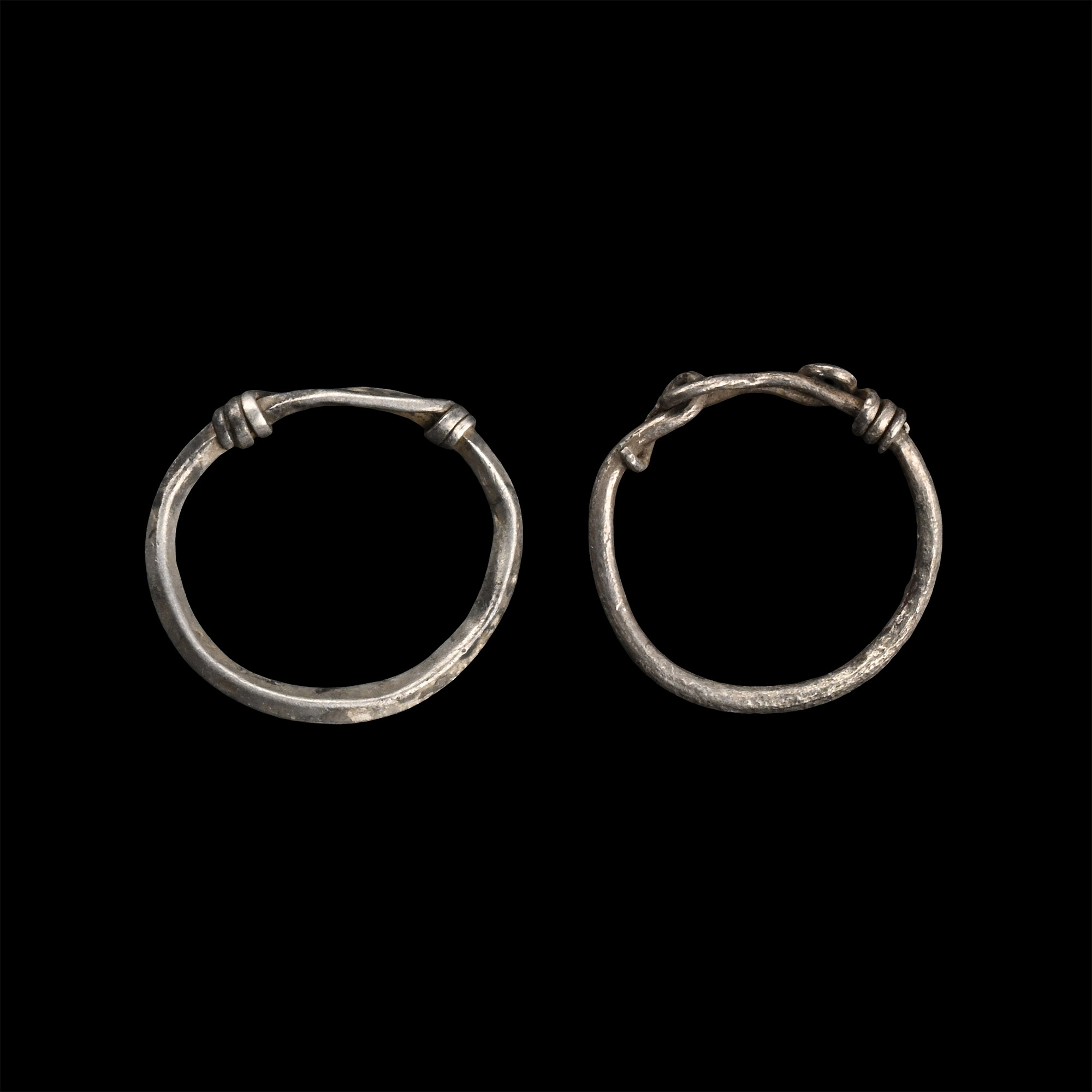
The interesting part is where ear ornaments like these belong. Scandinavian women wore paired shoulder brooches, arm-rings, neck-rings and beads; earrings sat with the Slavic, Baltic and Rus' world to the east, where women wore "temple rings" beside the head, and where such hoops tend to be found whole, as worn jewellery that was never chopped for its silver. The form is hard to pin down on its own: small undecorated wire hoops are nearly impossible to date and barely tied to any one culture, and the same shape appears in Cypro-Archaic, Etruscan, Roman and Byzantine contexts, while the German-market provenance here records no findspot. What gives the piece its weight, in every sense, is the silver-by-weight economy it points to.
8. A nomad's eagle, in bronze (£59)
A small cast-bronze object: a curved hook of round section ending in a pierced cube, read as a stylised eagle's talon. Whatever its name, it most likely fastened a garment or belt, or hung from a harness. It comes from the world of the Scythians, the Iranian-speaking horse peoples of the Eurasian steppe north of the Black Sea between roughly the ninth and third centuries BC: mounted archers with no cities, known to us from Herodotus and from the gold-rich frozen burial mounds of the Altai.
Their art is the reason to care about a £59 hook. The so-called Animal Style is dominated by vividly abstracted animals, predators and birds of prey above all, eagles and griffins and big cats and stags, set on horse-gear, weapons and ornaments. The raptor was there from the start, often boiled down to a shorthand of beak and one large round eye, and the claw on its own is a documented motif: Scythian sword-pommels were made "in the form of claws of a bird of prey with an eye at the base," which makes the talon reading defensible even if it cannot be proved. This was portable art, worn and carried; it spread across the whole steppe, from the Black Sea to the Ordos region of China, and it brushed against Greek and Celtic work along the way. The frozen tombs at Pazyryk preserved its organic side, including animal-style tattoos on a mummified body, the same motifs worn on skin that were cast in bronze.
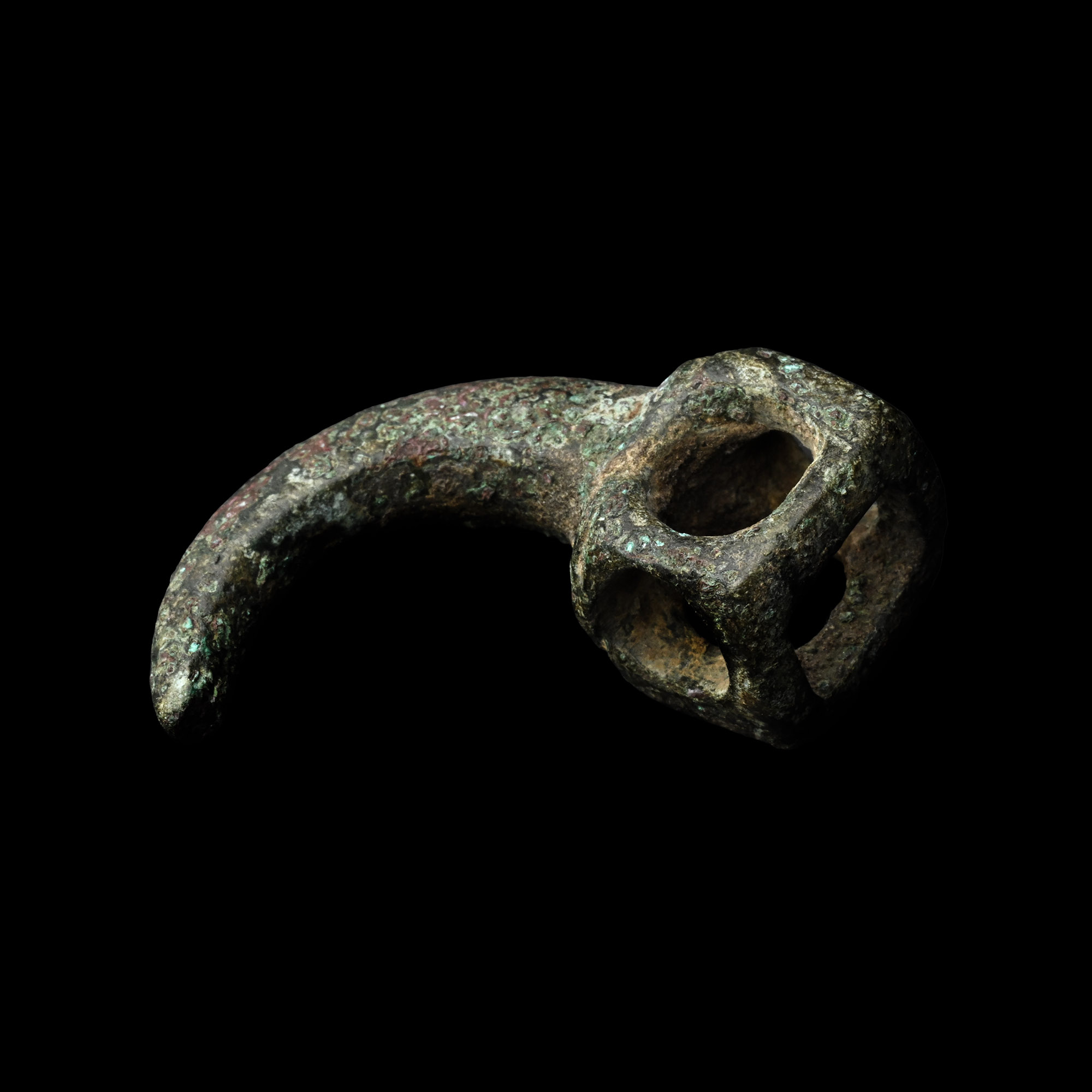
"Scythian" covers a wide world here. Small abstract steppe bronzes are very hard to date or place, and they shade into Sarmatian, Saka, Thraco-Cimmerian, Koban and Luristan material; the type is widely faked and mostly without findspot. Taken for what it is, it remains a real scrap of one of the great nomad art traditions, for the price of a couple of pints.
9. Gold for the price of a takeaway (£85)
A tiny sheet-gold disc with a granulated rim, a ribbed suspension loop and a single applied granule at the base: two ancient goldsmithing techniques in miniature. Its £39 companion in the same sale is the simplest ornament imaginable, one gold wire with its ends coiled round the body and no solder at all.
The headline is granulation, the technique that was genuinely lost. It fixes minute gold spheres to a surface with almost no visible solder, so the grains seem to sit on the metal and cast their own small shadows; Etruscan masters managed more than seventy granules to the centimetre, each under 0.15 mm. The trick is a copper-salt soldering: powdered copper mineral, often malachite (the Greek for it, chrysocolla, means "gold glue"), was mixed with organic glue, painted on, and heated. The glue burns to carbon, the carbon reduces the copper to metal at around 850 degrees, well below gold's melting point of 1,063, and the copper diffuses to weld each grain to its base with no seam. The method was lost after the early medieval period and only worked out again in the 1930s, when Harold Littledale reconstructed the copper-salt reaction. The Etruscans perfected granulation without inventing it; its roots are in third-millennium BC Mesopotamia and Anatolia, with classic examples from the Royal Cemetery of Ur around 2500 BC and from Troy, so the technique was already some seventeen centuries old when Etruria took it up.
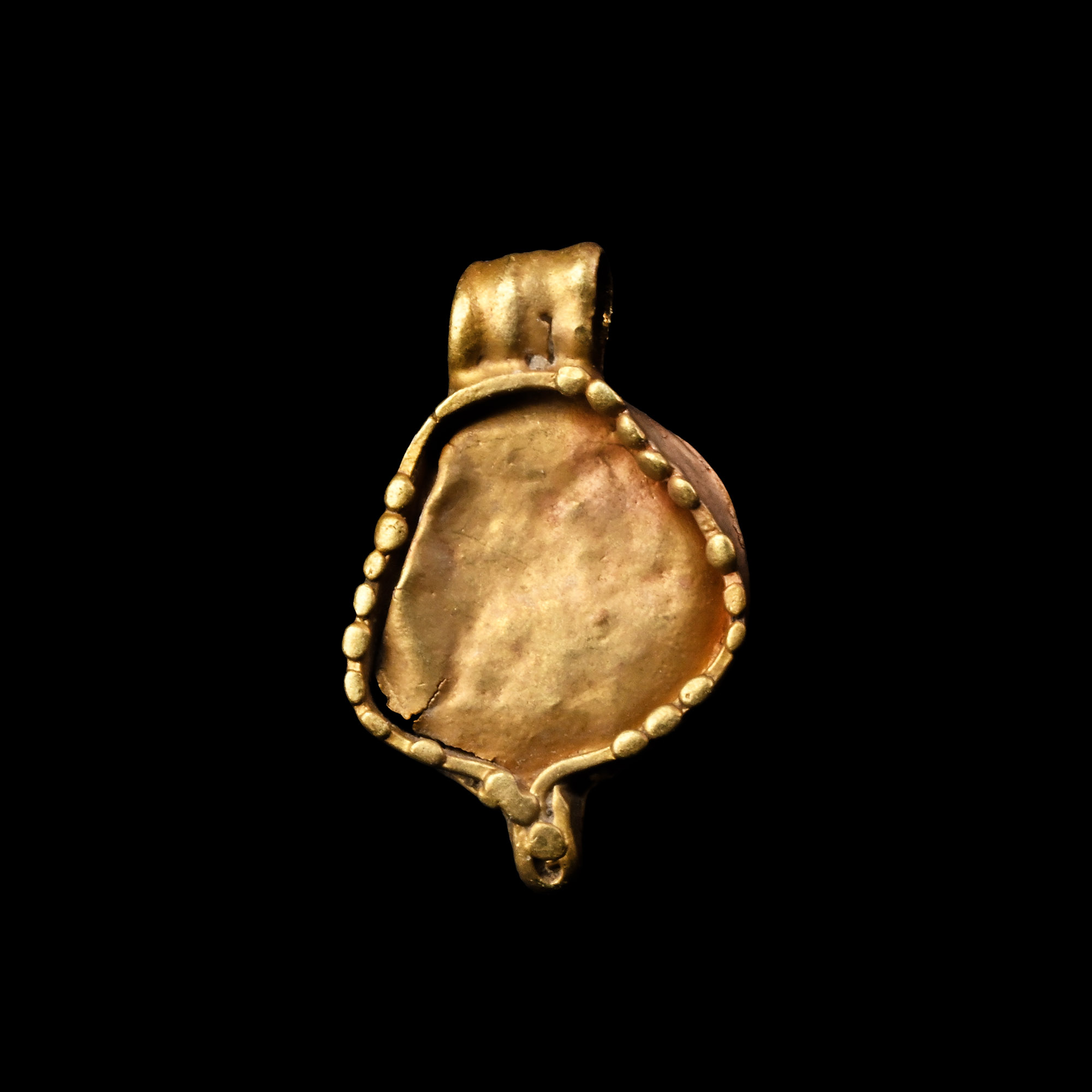
The "ancient gold for the price of a takeaway" line is literally true: these two pendants weigh 0.10 and 0.15 grams, so the £85 and the £39 are paid almost entirely for age and handwork. They reach us bright because gold does not corrode, the reason tiny gold ornaments survive while the iron and bronze of the same graves rot away. The dating is necessarily wide, a thousand years across the Levant, Anatolia, Iran and Mesopotamia, which a tiny unprovenanced disc cannot narrow; the name "sun-disc" is a modern convenience, since a plain granulated disc carries no solar imagery of its own. Granulated gold has been reproduced since the Castellani revival of the nineteenth century, so the usual care over simple unprovenanced gold applies, though at these weights and prices the stakes are small.
10. A desert bowl as thin as porcelain (£39)
The Nabataeans were an Arab people who, from the fourth and second centuries BC, settled the deserts of modern Jordan and the Negev, made their capital at Petra, and grew rich on the caravan trade in frankincense, myrrh and spices. They were famous water engineers, threading cisterns and dams and channels through the rock, and Rome annexed their kingdom in AD 106 as the Province of Arabia. The surprising thing about so tough a desert people is that they threw pottery as fine as anyone in the ancient world.
Nabataean fine ware is called the hallmark, even the fingerprint, of their sites, and its walls are eggshell-thin, roughly one to four millimetres and sometimes under one. Nelson Glueck called it "almost unbelievably thin"; G. L. Harding judged it "even more remarkable than porcelain... for it is all thrown on the wheel and turned." It was made from well-cleaned local Petra clay, thrown on a fast wheel, turned down thin while leather-hard, and fired to a near-metallic hardness at the az-Zurraba workshop, which neutron-activation analysis has confirmed as the source. Stephan Schmid's sequence from Petra dates the classic bowls to the late first century AD, the tradition's best years.
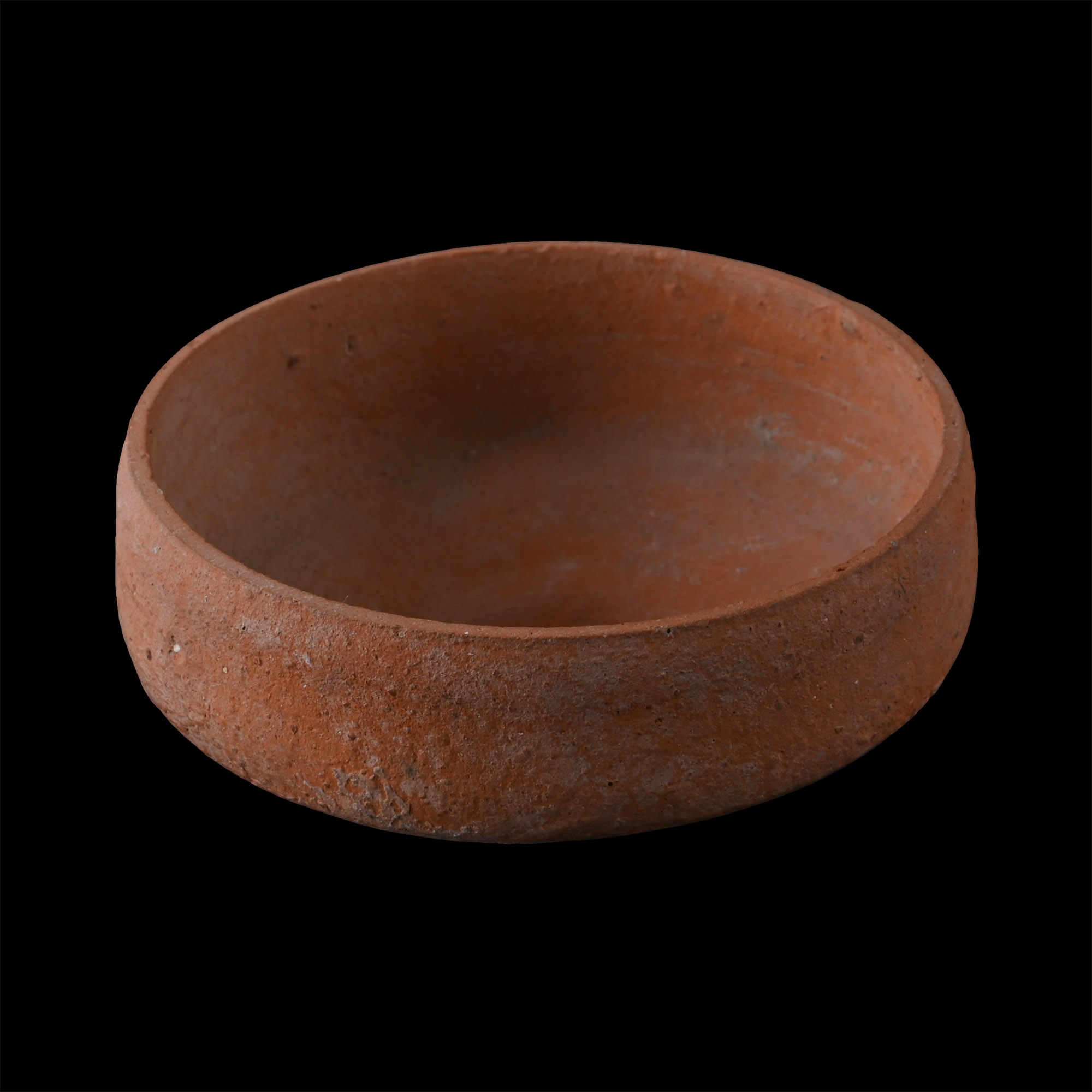
The painted bowls are the eggshell stars of the class, with their fine red palmettes and dot-clusters. This is a plain red dish, one of the everyday Nabataean fine wares, and its walls run thin all the same. A small, plain, unprovenanced dish is harder to pin to Petra, and to date, than a painted one from a known layer. None of that touches what it is: a real two-thousand-year-old fine-ware bowl from the world of Petra, 69 mm across and weighing 38 grams, for £39, the whole argument of this article in a single object.
A few more under £100
Three others belong in any honest version of this list, and one ringer. The ringer is a Campo del Cielo meteorite, a 22 mm, 6.68-gram fragment of iron drilled and hung on a cord (£98). The metal crystallised about 4.5 billion years ago and fell on the Chaco of Argentina some four thousand years back, where the indigenous peoples named the place Field of the Sky; it is the same class of metal as the blade of Tutankhamun's meteoritic-iron dagger, which is to say the metal of pharaohs for under £100. But the mounting is modern and these fragments are sold by the thousand worldwide, so it belongs here as the odd one out, a curio more than an antiquity (it was also the single most-watched lot in the sale).
Of the genuine antiquities, a Romano-Egyptian oil lamp moulded with a frog (£59) carries more than it looks: the frog stood for rebirth, emblem of the frog-goddess Heqet and of the Nile flood's return, a sign so durable that Christian Egypt kept it, with one late lamp inscribed in Greek "I am the resurrection." That is "I am the resurrection" for £59. There is the £39 gold-wire pendant from entry nine, the cheapest gold in the sale. And there is a 16 mm alabaster head with two ring-and-dot eyes on a stem (£98), echoing the eye idols Max Mallowan dug up by the thousand at the Eye Temple of Tell Brak around 3500 BC and read as "abstract symbols of some divinity," though the Brak type is a flat plaque and this little in-the-round head is a looser cousin of it.
What survives, and what it costs
Survival is not even-handed, and the prices follow it. Stone keeps almost forever, which is why the oldest object on this list is also one of the cheapest. Gold does not corrode, so a tenth of a gram of it reaches us bright while the iron of the same century has rusted to nothing. Fired clay outlasts almost everything organic, which is why a plain Petra dish still rings when you tap it though the oil it held is two thousand years gone. The one thing here that did not survive at all is the recipe for Greek fire, kept as a state secret and never written down. What lands on the under-£100 shelf is the durable and the common: knapped flint, fired pottery, incorruptible gold, silver weighed out by the gram. It is also the easiest place to begin a collection, and TimeLine's sales carry pieces like these in every auction.
The flint that opened this list was struck, used and dropped by someone who was not quite us, on a riverbank now under the North Sea. It waited there through an ice age and the rise and fall of everything that came after, and this March it sold for less than the dinner you might have had instead.
TimeLine Auctions, 6th August 2026