Home > Stories by TimeLine Auctions
Stories by TimeLine Auctions
The £100 Vase, the £1,000 Vase, and the £10,000 Vase
Over the past year four Greek oil flasks of the same shape passed through our rooms. The plainest sold for £98. The next, with a single painted figure, made £975. A third, given to a named Athenian painter, reached £9,100. The last, carrying a battle across its belly, took £29,900. Each is a lekythos, the standard Greek bottle for perfumed and household oil, its narrow neck built to let the oil out in a thin stream and its thick lip to catch the drips (Clark, Elston and Hart, Understanding Greek Vases). Same object, same purpose, a rise of more than three hundredfold from the first to the last. Almost all of that gap is a question of what is painted on the clay, and by whom.
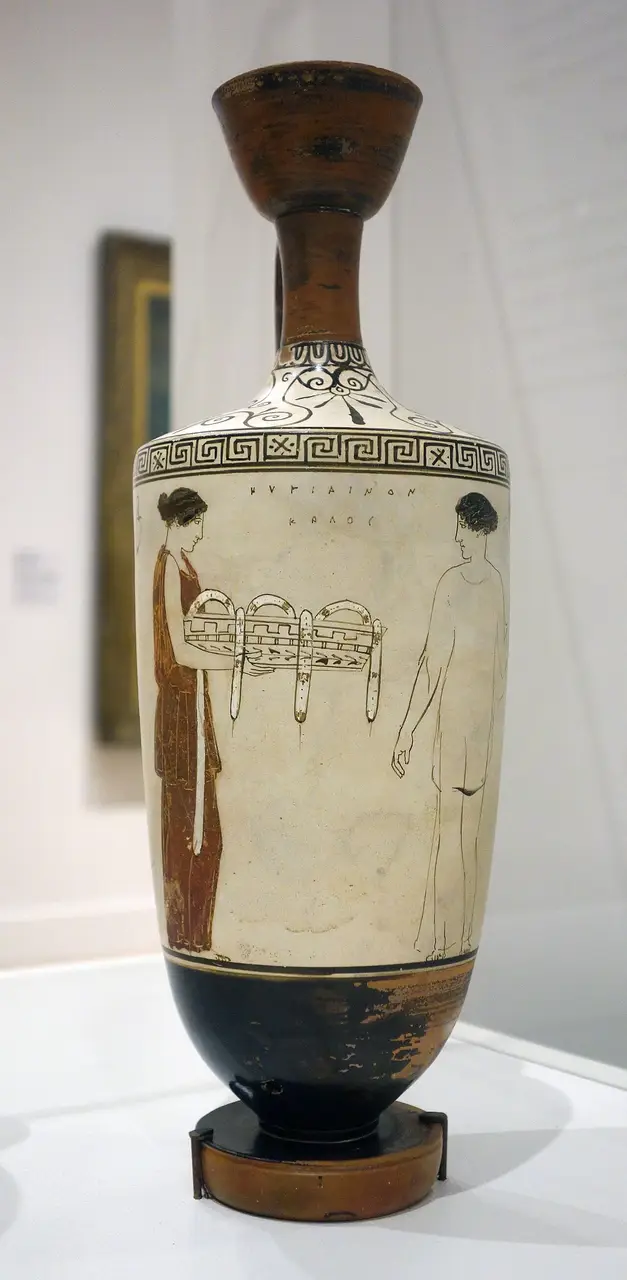 An Attic white-ground lekythos attributed to the Achilles Painter, about 450 BC, its funerary scene drawn in outline on a white slip. Worcester Art Museum (1900.65). Photo: Mark Landon, CC BY 4.0, via Wikimedia Commons.
The shape was made in enormous numbers: in Athens the lekythos was the commonest grave gift from about 560 BC to the end of the fifth century, left at the tomb and buried with the dead, so they survive in quantity (Oakley, Picturing Death in Classical Athens). Most were never meant to be studied closely. A large share of all Greek pottery was plain black-glazed or undecorated utility ware, turned out cheaply by the same workshops that produced the fine pieces (Sparkes and Talcott, Athenian Agora XII).
£98: a plain oil bottle
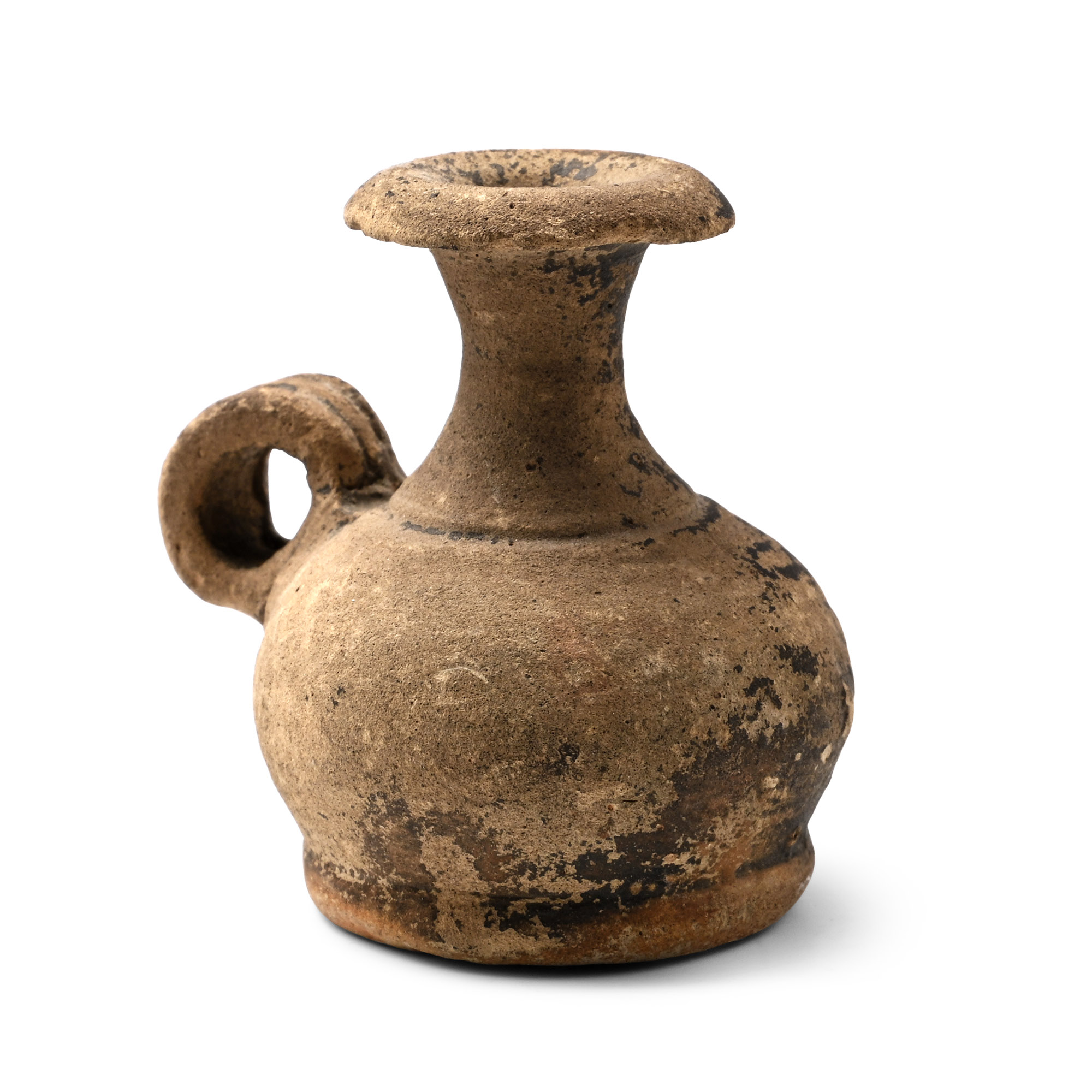
This one carries no decoration at all: a bulbous body, a ribbed strap handle, a low foot, and a weathered grey-brown surface with a few traces of the black gloss it once had. It stands 51 millimetres tall, a small "secondary" lekythos of the fourth or third century BC. Nothing about it points to a workshop or a hand, and it sold, with no reserve, for £98. That is close to the floor for a complete, genuine Greek vessel with a collection history, in this case a Scottish gentleman's collection formed from the early 2000s. At that level the buyer is paying for age and authenticity, not for anything on the surface.
£975: one figure
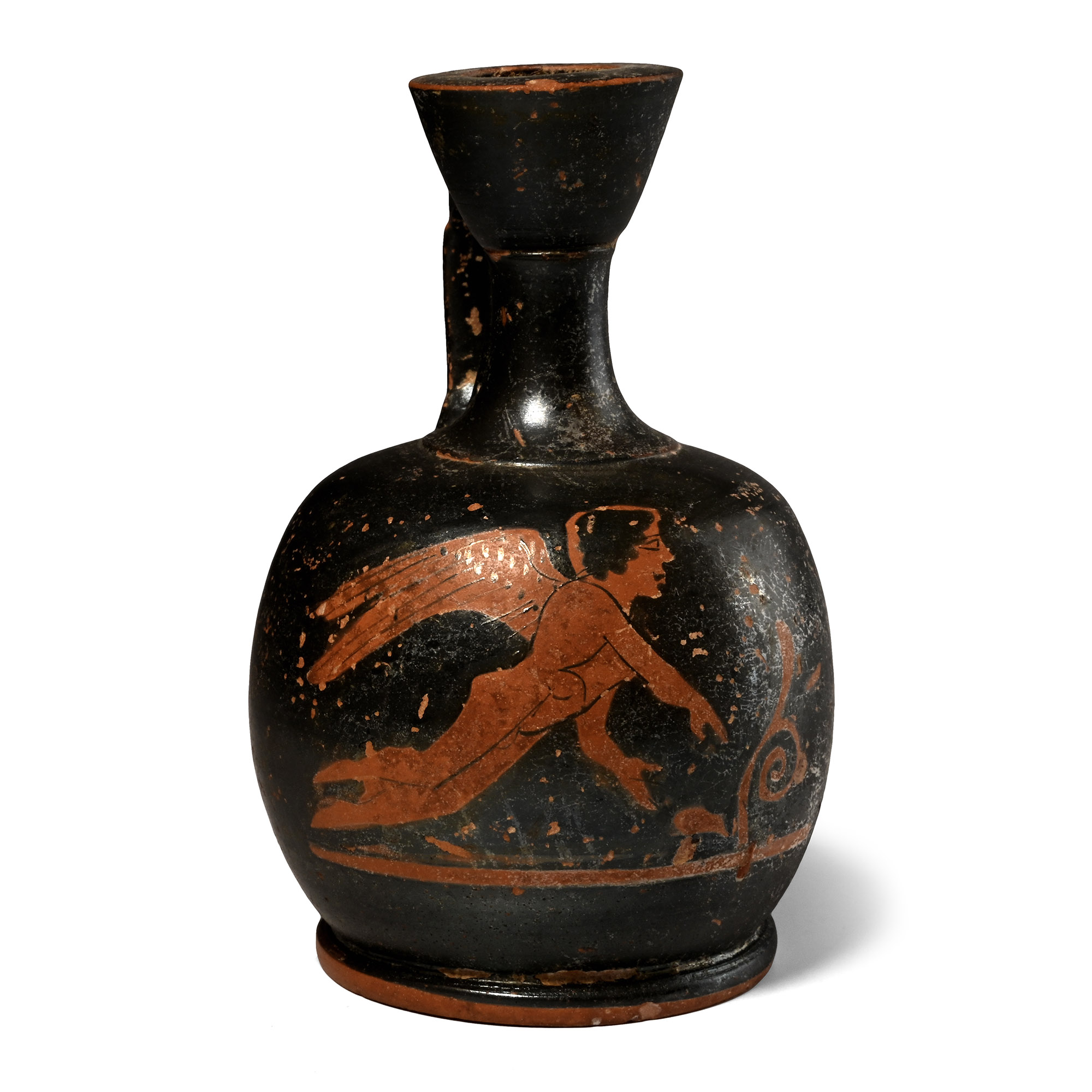
The second bottle is glossy black all over, with one figure left in the orange of the bare clay: a winged Eros in flight above the groundline, a frond beside him. This is red-figure, the technique invented in Athens around 525 BC that reversed the older method, blacking in the background and reserving the figures in the clay colour, their interior detail drawn with a brush rather than cut with a graver (Boardman, The History of Greek Vases). One brushed figure on an otherwise plain body is the first real step up in price, moving the pot from tableware to picture even when the picture is a single stock Eros with no story attached. It too sold with no reserve, for £975.
£9,100: a name
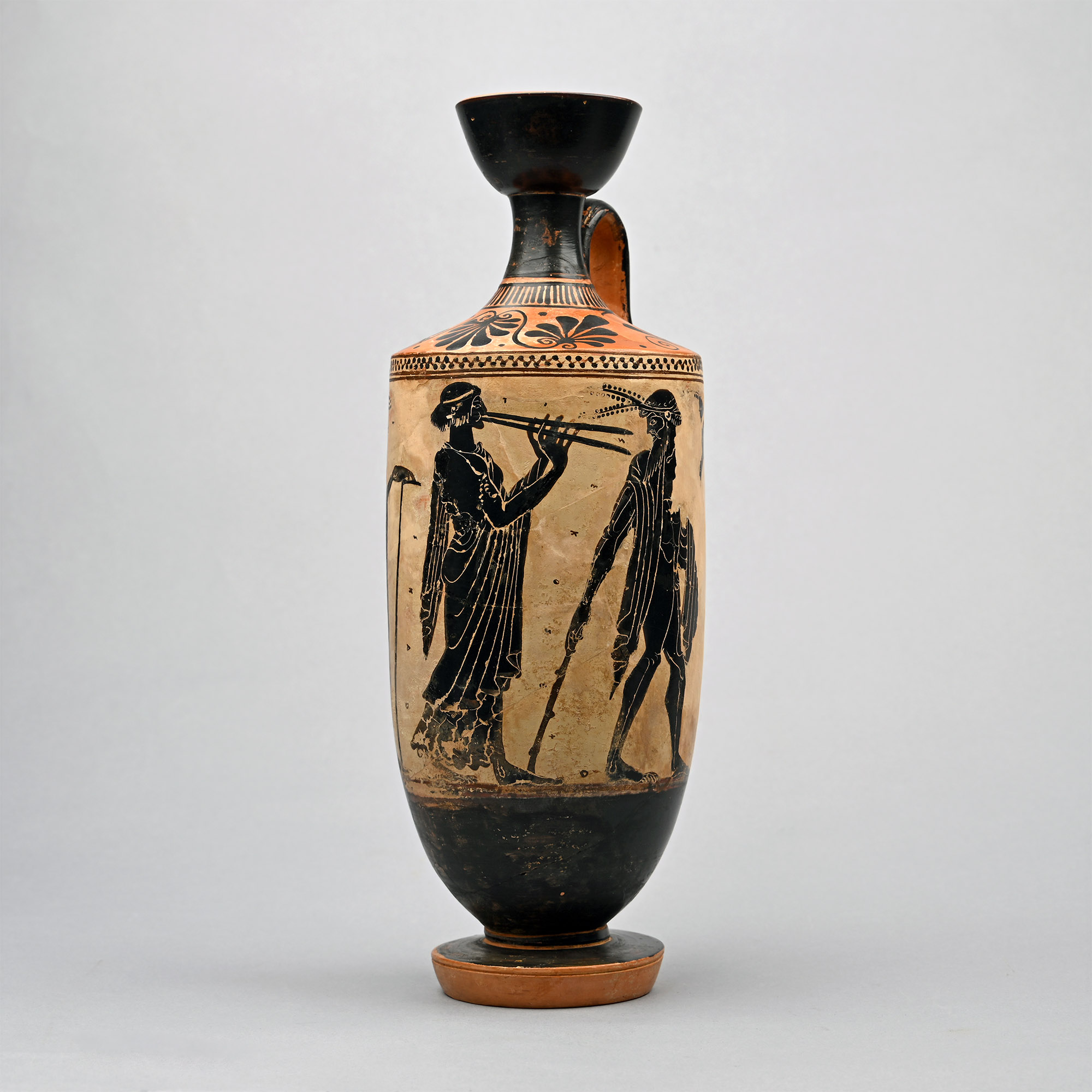
The third is taller, and finished differently: its body is coated in a white slip, the figures painted in black on that pale ground, a draped man playing the double pipes, other robed figures in procession, a shoulder of palmettes and scrolls, a banded neck. White-ground was the surface Athenian potters kept for their better funerary lekythoi in the fifth century, and it is fragile, its added colours easily lost (Oakley). The catalogue reads the figures as a Dionysiac procession with satyrs; what is plain on the vase is a well-drawn line of robed men and a piper. The decisive words are the last ones: "attributed to the Athena Painter."
The Athena Painter is not a recorded ancient name. It is the label scholars use for an anonymous hand working in the first half of the fifth century who specialised in lekythoi and painted in black-figure, much of it on the white ground (Oakley; Haspels, Attic Black-figured Lekythoi, 1936, the book that first sorted these workshops). Naming him is the business of connoisseurship. Following the connoisseur Giovanni Morelli's method of the 1870s and 1880s, Sir John Beazley learned to tell one unsigned painter from another by the way each drew ears, eyes and folds of drapery, and on that basis assigned tens of thousands of Attic vases to some nine hundred such "hands" (Whitley, "Beazley as theorist"; Boardman). Fewer than one vase in a hundred is signed, so an attribution is usually the closest thing to an author a Greek pot will ever have.
The attribution is what the extra money buys. As Martin Robertson put it in the 1985 Wolfson College lectures on Beazley, "if a vase can secure an attribution to the Nikoxenos Painter it will probably fetch more money than a better piece for which one cannot find a name. That is a matter for the art market" (Beazley and Oxford, ed. Kurtz, 1985). This lekythos sold for £9,100.
£29,900: a battle
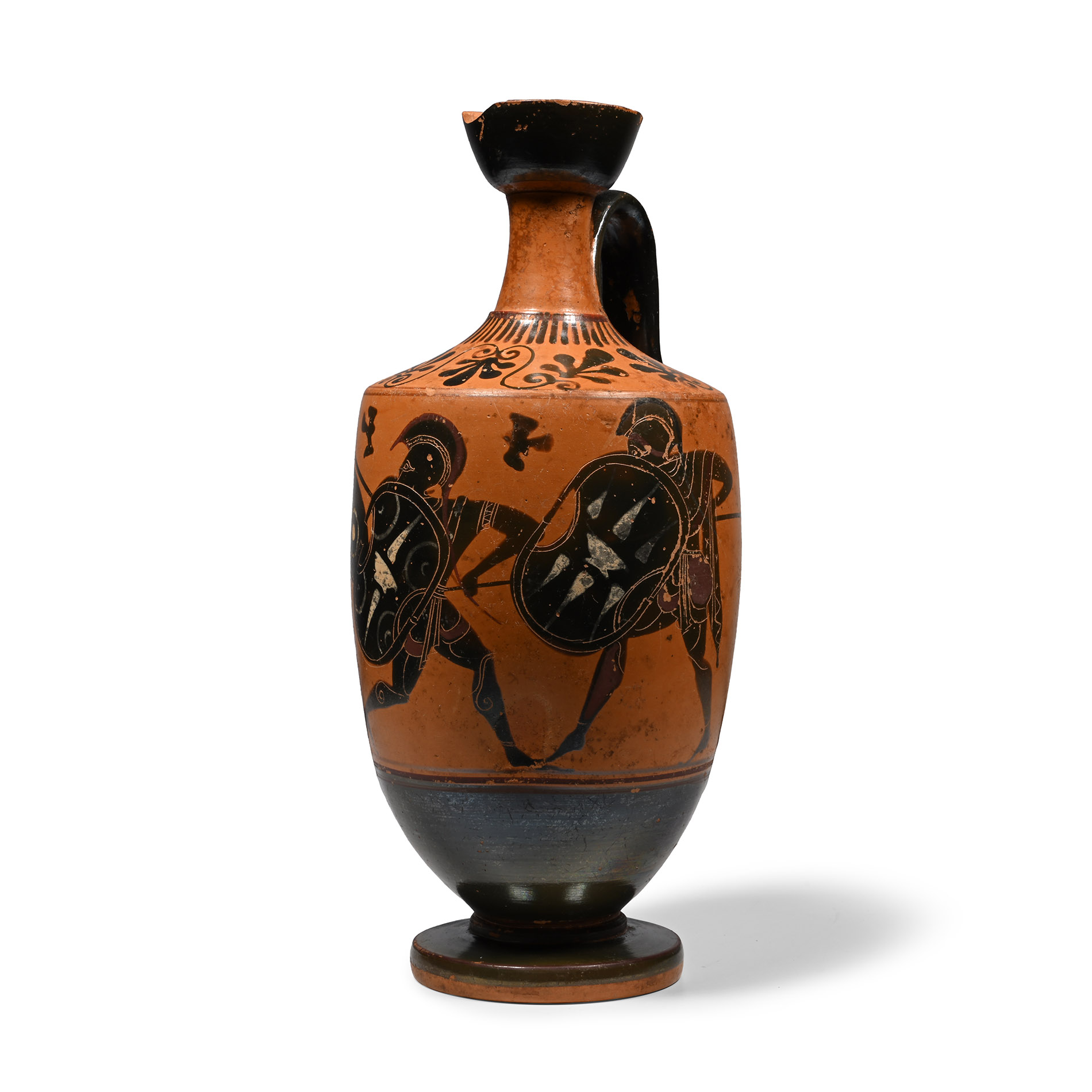
The dearest of the four returns to standard black-figure, silhouette figures on the orange clay with their detail incised, and covers the whole body with a scene. Three hoplites fight across it: the left-hand warrior in a tall-crested Corinthian helmet, cuirass and greaves, driving his spear over a round shield towards a second man who twists away behind a large Boeotian shield, while a third presses in from the right, birds in the field above. The shields carry devices, concentric circles and bundles of what the catalogue reads as lightning, though such blazons are usually the painter's own preference rather than heraldry (Boardman).
Combat scenes reliably raise the price of a Greek vase: heroic single duels were popular on Attic pottery at the end of the sixth and start of the fifth century, when a fight between champions carried Homeric and aristocratic overtones that a massed phalanx did not, and the expensive panoply advertised a wealth only the top of society could afford (Alexandridou, The Early Black-Figured Pottery of Attika in Context). Without an inscription the scene stays generic heroic rather than a named myth, but a crowded, well-drawn fight running the length of the body is a different object from a single Eros. The catalogue supports it with the standard literature, Haspels and Beazley's ABV and Boardman, and it sold for £29,900.
What the extra money buys
The plain bottle is the shape alone; the Eros adds a figure and the technique to draw it; the Athena Painter adds a name, and with it a place in the framework that organises the whole subject; the battle adds a full narrative and the size to carry it. Size counts for its own sake too: before Christie's April 2017 New York sale the head of its antiquities department, Laetitia Delaloye, said that "as a rule, larger pieces in good condition will sell for the highest prices". Plotted against size, that sale's three largest vessels took its three highest prices. Condition and collection history matter too, and both tend to improve as you climb.
The ladder is a modern one, though, and whether Athenians themselves paid much more for a figured pot than a plain one is an open argument. Boardman reads the price graffiti scratched under vase feet as a clear hierarchy, plain wares at a fraction of an obol, elaborate multi-figure vases many times dearer; Gill and Vickers read the same marks as showing decoration made little difference, the pottery cheap either way beside vessels of silver and gold (Gill, "Pots and Trade", JHS 1991). What is not in dispute is that the market of the last two centuries pays for pictures and for names. Four oil flasks of one shape left our rooms priced from £98 to £29,900.
TimeLine Auctions, 20th August 2026