Home > Stories by TimeLine Auctions
Stories by TimeLine Auctions
The Barbarian on the Flask: How the Scythian Archer Changed Sides on Greek Vases
Two men are fighting on the side of a perfume bottle. One strides in behind a round shield close on a metre across, crested helmet pulled low, spear raised overhand for the downward thrust that Attic painters reserved for the kill. The other has gone down on one knee, torso twisted back to face what is coming. He wears a tall soft cap that curls backwards at the tip and a skin-tight suit incised with zigzags from shoulder to ankle; at his hip hangs the case that carries his bow and arrows together, and the short recurved bow still in his hand has done him no good at all. A Greek is killing an archer dressed as a Scythian.
The bottle is an Attic black-figure alabastron of about 500 to 480 BC, lot 48 in our sale of 8 September, and near its base is pasted an octagonal paper label, bordered in blue, inked "№ 147" in a nineteenth-century hand. The fight on the clay looks at first like news: Athens against the Persian invader, painted in the decades of Marathon and Salamis. It can be read that way. It can also be read as the last flicker of an older convention, in which this same costumed archer had been, for two generations, the Greek hero's most trusted companion. The flask was painted in the years when one meaning was dying and the other taking hold, and nobody can say for certain which side of the line it falls on.
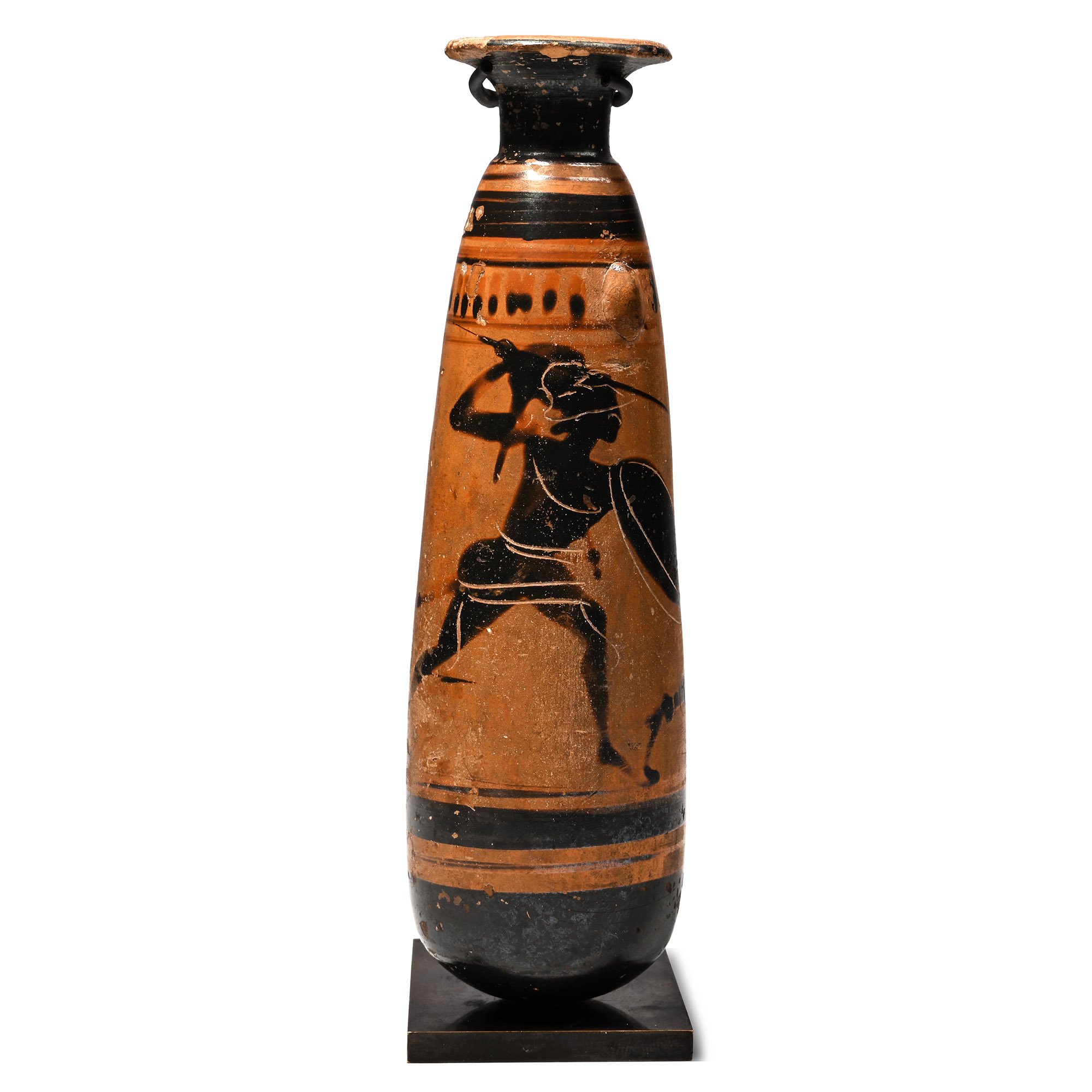
A bottle made to hang
Alabastron means, near enough, "the alabaster thing". The shape came out of Egypt, where flasks of banded calcite held scented oil; Corinthian potters copied it in clay in the seventh century BC, and Athenian workshops took it up around 560. The design is all function: a narrow body that sits in the palm, a flat disc mouth for dabbing oil onto the skin, and a rounded base, so the vessel cannot stand. Owners threaded cords through the small lugs at the shoulder and hung their alabastra on the wall, or slotted them into stands. The bronze mount under this one, which brings it to sixteen centimetres, is modern, and a kindness.
It was, by Athenian lights, a woman's vase. Men carried their oil to the gymnasium in the round aryballos; the alabastron belongs, in painted scenes, to the dressing table, the bridal bath and the grave, and most surviving examples come from tombs, left as offerings.
A killing is a strange thing to put on a scent bottle. Yet exotic archers were nearly a speciality of the shape. In the years around 490, Athenian workshops turned out alabastra painted with trousered Amazons and with black African archers standing between palm trees, the group John Beazley catalogued as the "Negro alabastra"; they have been read as Trojan exotica, Memnon's men and the warrior-women of epic, and also as something closer to branding, foreign glamour on the outside to advertise the foreign scent within. By this date black-figure was old technology, superseded on the prestige market by red-figure a generation earlier and surviving mainly on small oil flasks like this one. The alabastra of these years cluster in the output of two workshops, around the painters scholars call the Diosphos Painter and the Emporion Painter. Ours is unsigned and unattributed, but that is its company.
The hero's archer
The man in the pointed cap has a long pedigree. He makes his entrance around 570 BC on the François Vase, the great mixing-bowl now in Florence, where three archers in his costume carry the names Toxamis, Kimmerios and Euthymachos. Toxamis sounds convincingly foreign until you look at it: a Greek coinage from toxon, "bow", a bow-name for a bow-man, about as Scythian as a stage Frenchman called Monsieur Baguette.
For half a century he multiplied. François Lissarrague catalogued roughly seven hundred archer-vases from archaic Athens, and on some 620 of them the archer wears Scythian dress. Askold Ivantchik, whose 2006 study is now the standard treatment of the figure, counted the closely datable examples decade by decade: two around 570, a handful through the 550s and 540s, twenty-eight around 530, and then the flood, 264 around 520 and 186 around 510.
In almost none of them is he an enemy. He stands at the hoplite's shoulder in scenes of arming and departure; he attends the sacrifices read before battle; he fights in the press of heroic battles on both sides, including among the Greeks defending the body of Achilles. When a painter wanted to stress that a hero was, at that moment, an archer, he reached for the same wardrobe: Paris wears it, name inscribed, on a pair of vases by the Priam Painter, and the Brygos Painter three times put Herakles in the full body-suit, under the lion-skin. Neither Paris nor Herakles had anything to do with Scythia. The costume was a job description, the archer's equivalent of the hoplite's crested helmet, and the names painters wrote beside such figures agree: on an amphora in Munich, a hoplite called Thorykion, roughly "Mr Corselet", is armed by attendants in archer's dress named Euthybolos and Chalkaspis, "Straight-shooter" and "Copper-shield". Names like that are captions, the way a cartoonist labels a drawing.
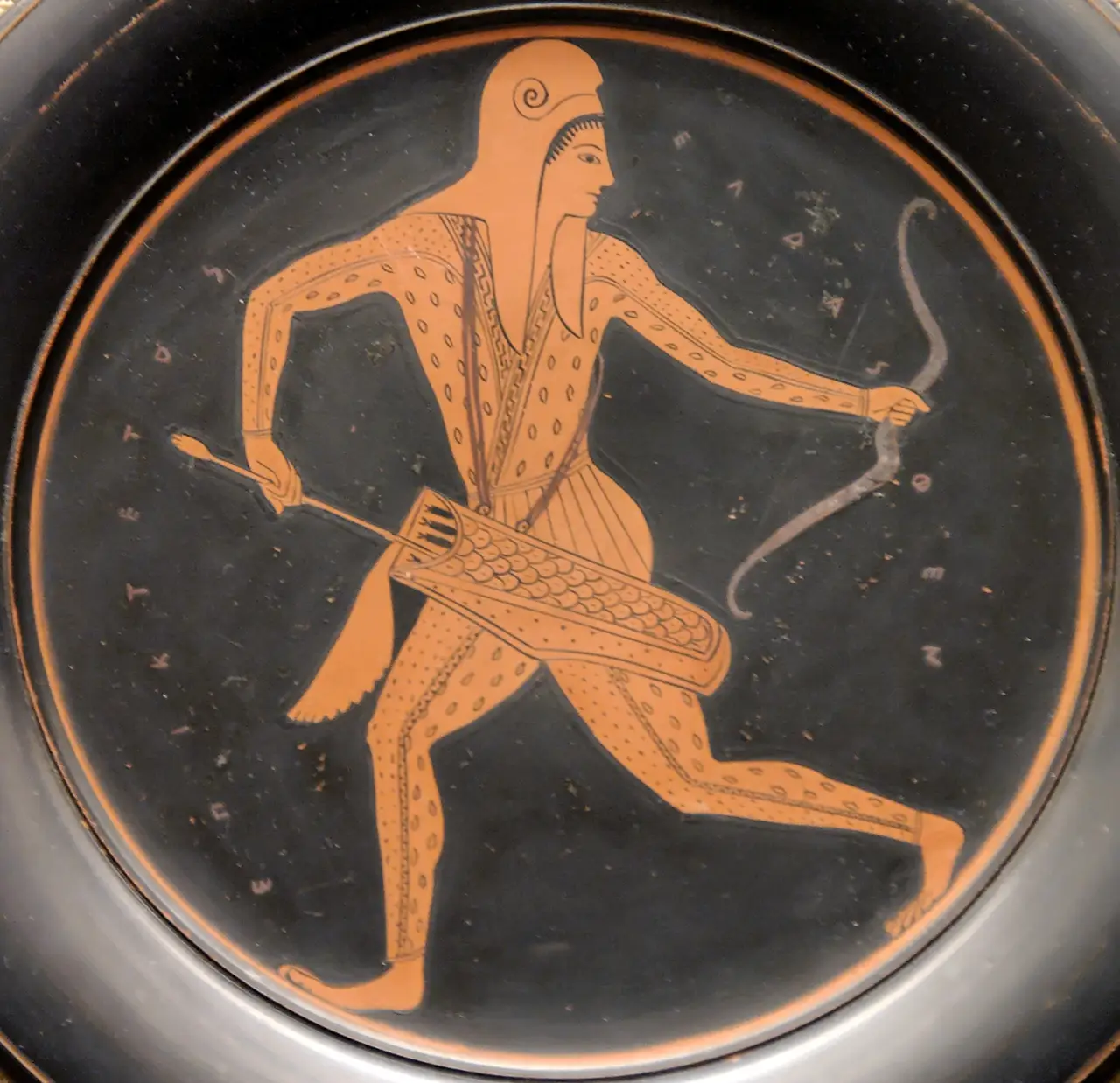 A single archer in the full costume, bow and arrow in hand, on a plate signed by the painter Epiktetos, about 520 to 510 BC. British Museum. Public domain, via Wikimedia Commons.
For a long time scholars took the vases as documentary and went looking for the real Scythians of sixth-century Athens. In 1963 M. F. Vos made the painted archers a corps of mercenaries hired by the tyrant Peisistratos, and the theory settled into the handbooks. The difficulty was always the evidence: no ancient text places Scythians in archaic Athens, and Herodotus records that at Marathon the Athenian army had no archers at all, of any nationality. The case for the corps rested on the vases themselves, an argument eating its own tail. Most specialists now read the figure the way Ivantchik does, as an epic squire in an archer's uniform, though the debate has not quite closed; Balbina Bäbler still argues for real Scythians behind the pictures. On the majority view, the pointed cap says "archer" the way the round shield says "hoplite", and says nothing about where its wearer was born.
The wardrobe was real
None of this means the painters invented the clothes. Pointed hood, sleeved coat and trousers were the riding dress of the Iranian-speaking peoples of the steppe and, nearer to hand, of the archers of the Median and then the Persian army: everything, garment for garment, that a Greek hoplite's kit was not. The Persians themselves sorted the steppe peoples by their hats. Their royal inscriptions name the Sakā tigraxaudā, the "pointed-hat Sakā", and when Darius captured the Sakā chief Skunkha he had him carved onto the rock relief at Behistun, tall hat and all. Herodotus, reviewing Xerxes' army, describes the caps of the Sakā as "erect and stiff and tapering to a point", and adds that Sakā is simply the Persian name for all the Scythian peoples.
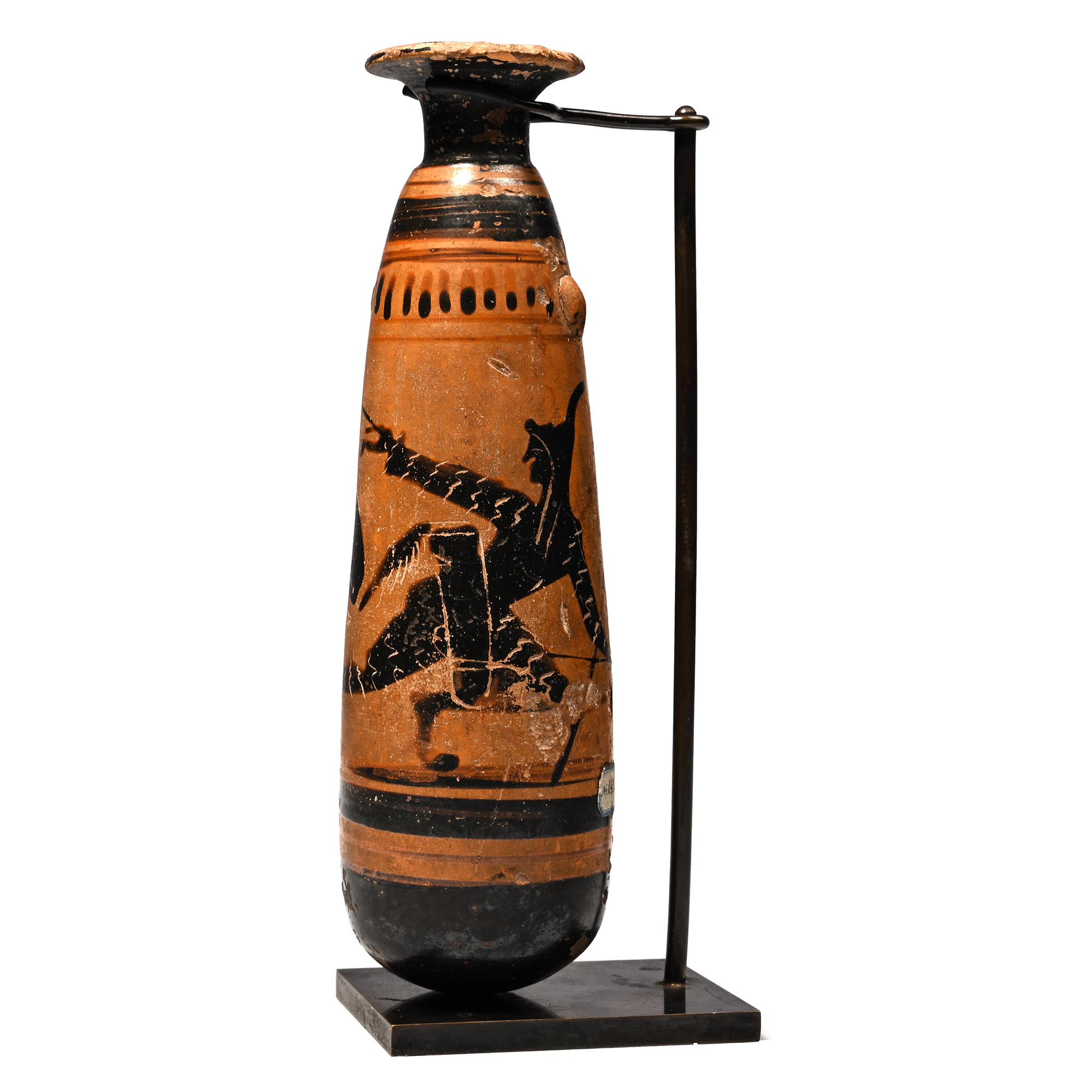 The archer on lot 48: the backward-curling cap, the zigzag suit, and the gorytos at the hip
The kit on the flask is real piece by piece. The case at the fallen archer's hip is a gorytos, the steppe's combined bowcase and quiver, worn on the left hip where every other archery tradition of the ancient world hung its quiver on the right; the silver-gilt gorytos from the Solokha burial mound held 180 arrows. The bow is the short composite of the mounted archer: surviving examples from Scythian tombs run to about seventy-five centimetres of laminated wood, with a double curve one Greek poet compared to the letter sigma. Even the clothes survive. From the frozen tombs at Pazyryk in the Altai mountains, excavators lifted caftans, felt stockings and pointed felt caps that had lain in the ice for well over two thousand years.
The painters, though, assembled the real pieces into a costume. On the vases the coat and trousers merge into a single skin-tight garment, covered in zigzags and lozenges, that Ivantchik calls a "tricot" and that, as he notes, "it is difficult to imagine ever actually existed". The suit on our flask is exactly that: a wardrobe-department Scythian, legible at arm's length on a pot made to hang from a cord. For steppe dress observed from life you go to the goldwork Greek craftsmen made for Scythian patrons around the Black Sea; on the drinking-vessel from the Kul-Oba mound near Kerch, men in real caftans and worked trousers string bows and pull teeth, every seam in place.
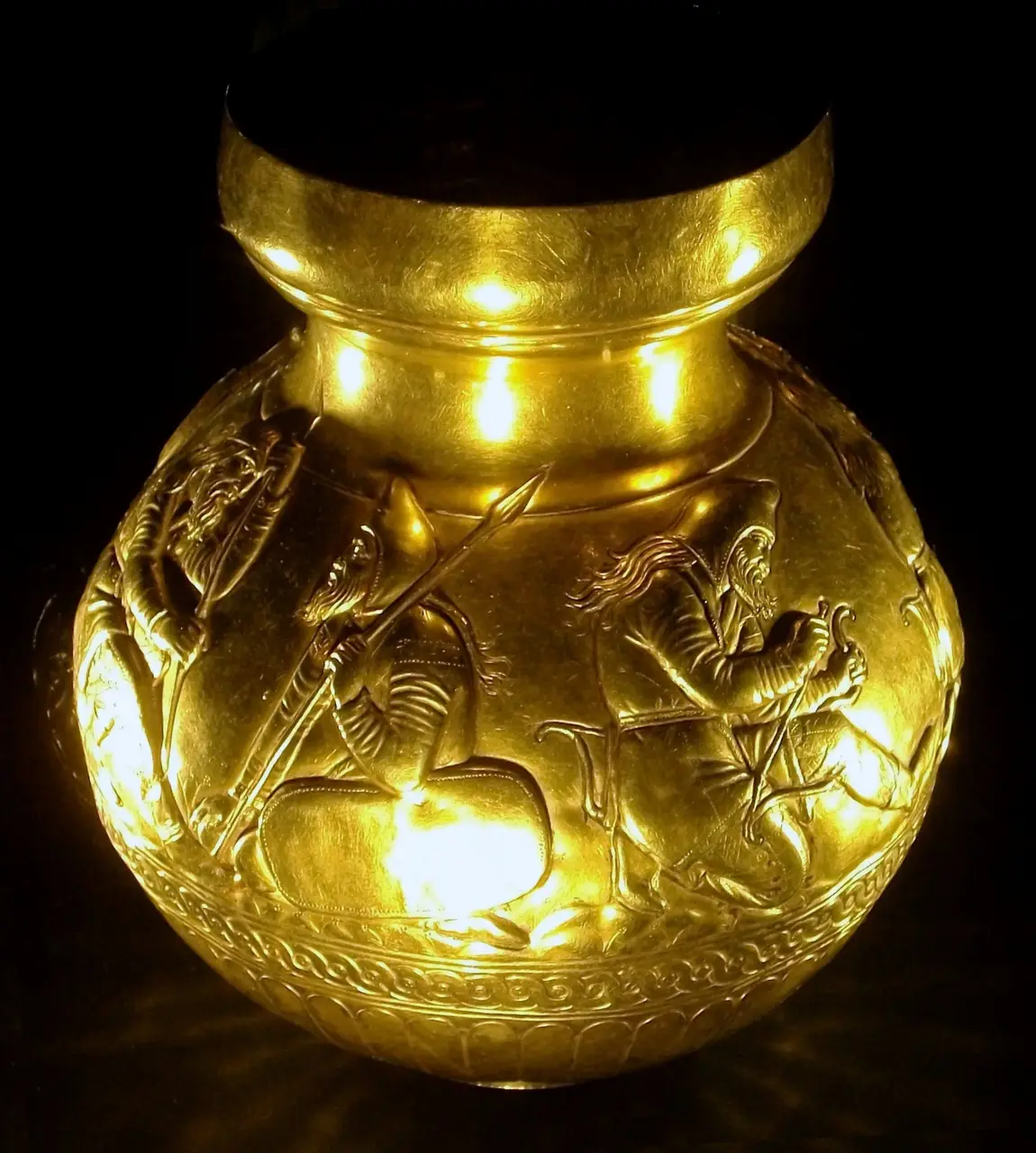 The electrum vessel from the Kul-Oba mound near Kerch, worked by a Greek craftsman for a Scythian owner in the fourth century BC. Hermitage Museum, St Petersburg. Photo: Joanbanjo, CC BY-SA 3.0, via Wikimedia Commons.
Marathon changes the picture
In 490 BC the costume came ashore at Marathon on real shoulders. Herodotus puts "the Persians themselves and the Sakā" at the centre of the invaders' line, and the centre is where the invasion nearly worked: they broke the Athenians facing them and pursued them inland, and the day was retrieved by the Greek wings closing from either side. The men who broke the Athenian centre were pointed-cap steppe archers in Persian service. Athens now knew the wardrobe personally, and knew it as an enemy's.
The painted companion did not survive the acquaintance. Ivantchik's decade-counts fall off a cliff: seventy-five vases around 500, twenty-five around 490, ten around 480, one around 470, then none. In arming scenes the archer's old place at the hoplite's side passes to naked Greek youths. There is even a dated document of the change of heart: an ostracon of 485 BC, a potsherd cast to vote a man into exile, on which the voter scratched a little archer in full Scythian costume and labelled him "Kallias son of Kratios, the Mede". A generation earlier the costume had meant the hero's trusted second; now it was shorthand for Persian sympathies, scratched beside an Athenian's name as an insult.
After the wars, painters completed the reversal. On a cup in Edinburgh painted around 480 by the Triptolemos Painter, a Greek hoplite bears down on an oriental archer in the full old kit; "the Persian has Scythian dress, bow, and bowcase," John Boardman observes, because to an Attic painter that was simply what an eastern archer wore. Cruder is a wine-jug in Hamburg of the 460s, on which a naked Greek advances, member in hand, on a stooping easterner in a spotted body-suit, with an inscription naming the Athenian victory at the Eurymedon river; its exact reading is still argued over, though most take it as a crow over the beaten enemy. The same suit that had dressed the faithful companion now dressed the barbarian going down before a Greek spear.
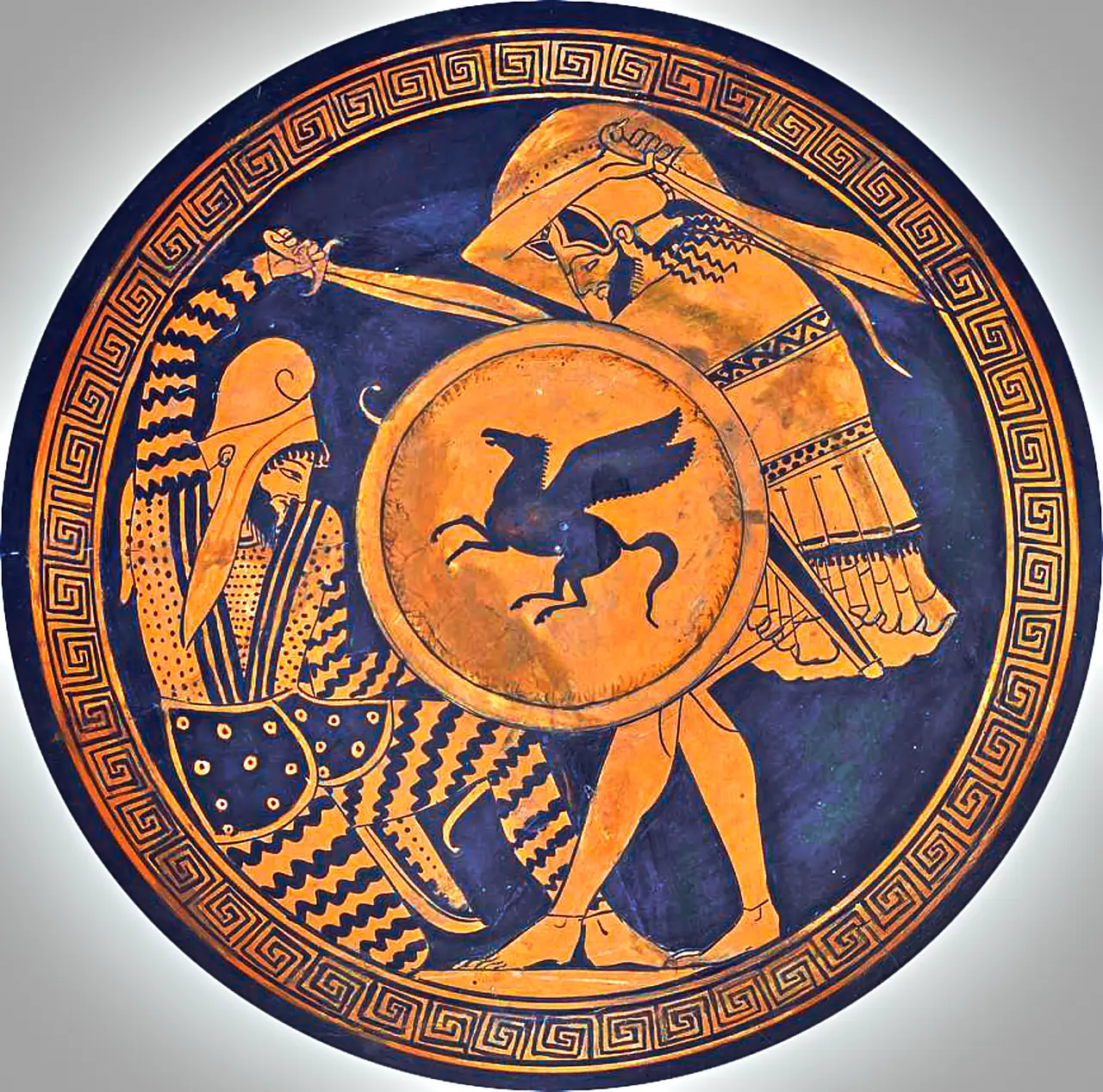 The interior of the Triptolemos Painter's cup: a Greek hoplite bearing down on a Persian archer in eastern dress, the shield with its winged-horse device set between them, about 480 BC. National Museum of Scotland, Edinburgh. Public domain, via Wikimedia Commons.
So which archer is falling on our flask? Painted on the early side of its date range, he is among the last of the old guard: a heroic duel in the epic manner, spearman against bowman, the kind of single combat painters had staged for a century without meaning any particular war by it. Painted on the late side, he is an early Persian, collapsing under an Athenian spear with Marathon in every line. The scholarship counsels against forcing the choice; Susanne Muth has argued that no Attic vase depicts a specific historical engagement, and the one-against-one duel was a heroic format long before it was propaganda. What the flask certainly carries is the idea that made both readings possible. Greeks told the story of the Persian Wars as spear against bow, the armoured man who closes against the man who kills from a distance, and when Aeschylus staged those wars in his Persians a decade or so later, bow against spear is the question the play keeps asking. The flask has it in two figures, one striding, one falling.
Athens supplied a coda. In the decades after Salamis the city bought, as public slaves, a corps of real Scythian archers, three hundred in the usual count, to keep order in the agora and the Assembly, whip in hand; Aristophanes put one on stage, mangling his Greek for laughs. Real Scythians reached the streets of Athens at almost exactly the moment the painted ones vanished from its pots, and Ivantchik has wondered whether the daily sight of the slave policeman helped finish the heroic figure off. Whatever the truth of that, the corps arrived a full generation too late to be what the vases painted.
Number 147
Louis-Gabriel Bellon, born in Lille in 1819, made his money in the cloth trade, painted in the circle of Corot, and from the 1870s filled his house in Rouen with some two thousand antiquities: Greek vases, bronzes, ancient glass, and the Tanagra terracottas that were his particular passion. He showed a case of them at the Paris Exposition Universelle of 1878, and Ernest Babelon published two of his terracottas in the Gazette archéologique of 1883 as "two of the pearls of M. Bellon's collection".
Bellon died in 1899, and the collection passed to his son Paul, who built a private museum for it at Saint-Nicolas-lez-Arras: a gallery nearly thirteen metres long, with more than five hundred vases on show. Saint-Nicolas sits on the northern edge of Arras, and in October 1914 the German bombardment of the Arras front reached it. Over that winter the museum was destroyed, and with it thousands of objects and most of the collection's records. What survived stayed with the family, largely out of sight, for nearly a century.
The survivors resurfaced on 4 April 2009, at an auction in Vannes, in Brittany: 373 lots. French law gives the state a right of pre-emption, the power to step into the winning bid as the hammer falls, and that day the Louvre used it twelve times, seven of them for Greek vases; the Petit Palais took three more. Our alabastron passed into a European private collection that year, and it did not travel alone: lot 65 of the September sale, a terracotta Eros, carries the same provenance. The two have kept each other's company since.
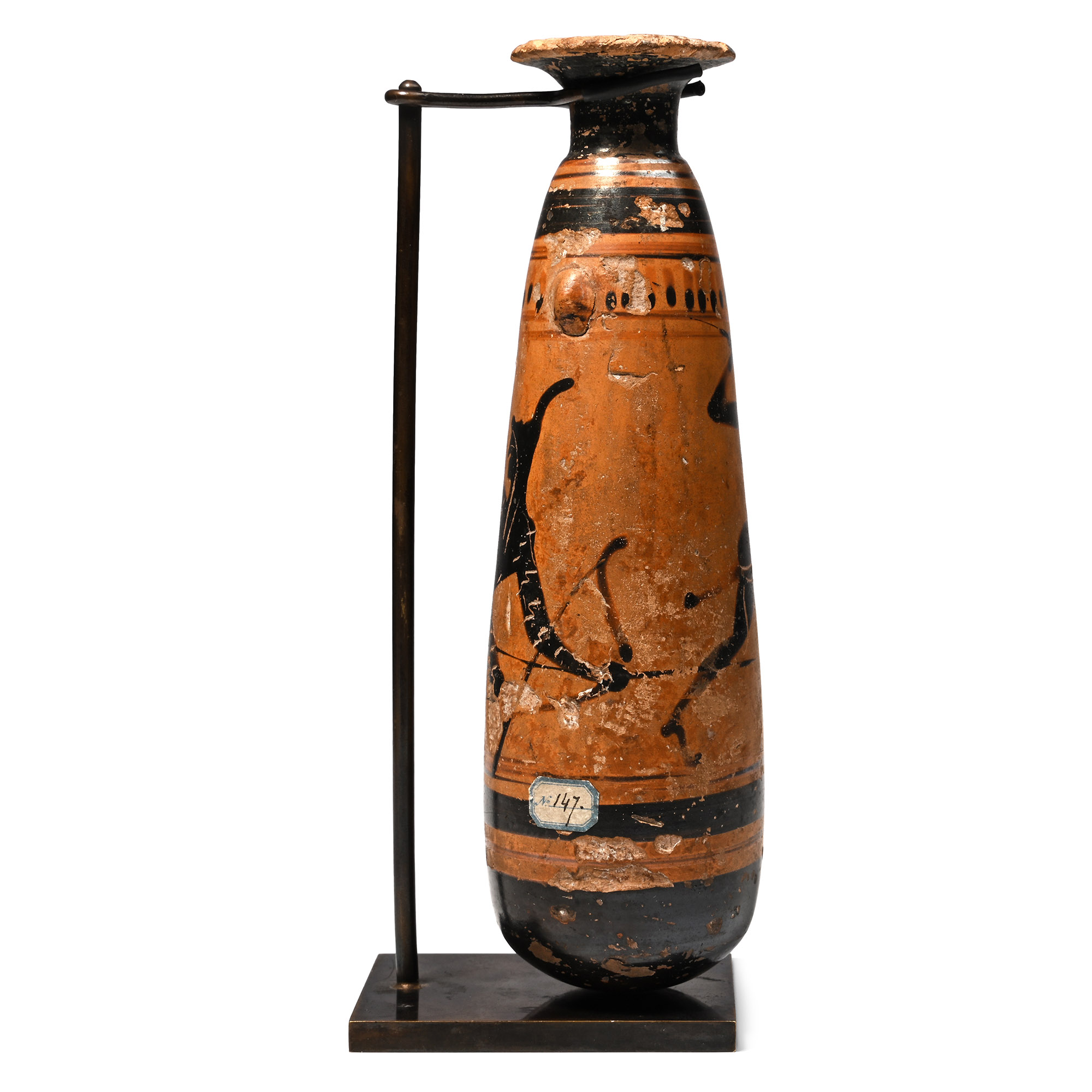 The nineteenth-century collector's label on the reverse of the flask
The catalogue compresses all of this into a single provenance line. The flask keeps a better record of it: the octagonal label near its base, numbered 147 in ink, in the style recorded on other objects from the collection. Whether the hand was the father's or the son's, nobody can now say; the papers that could settle it went with the museum.
A perfume flask painted in Athens while a war was remaking the meaning of its own decoration; hung on a wall or laid in a grave; intact through twenty-four centuries, and then through the shelling that wrecked the collection it belonged to. The old label says № 147. On 8 September it answers to lot 48.
TimeLine Auctions, 25th August 2026